• 검색 결과가 없습니다.

Ocular Myasthenia Gravis in Monozygotic Twins with Mirror-image Myopic Anisometropia

N/A
N/A
Protected

Academic year: 2022

Share "Ocular Myasthenia Gravis in Monozygotic Twins with Mirror-image Myopic Anisometropia"

Copied!
2
0
0

로드 중.... (전체 텍스트 보기)

전체 글

(1)

392

Korean J Ophthalmol Vol.30, No.5, 2016

Ocular Myasthenia Gravis in Monozygotic Twins with Mirror- image Myopic Anisometropia

Dear Editor,

Mirror-image twinning with inverse laterality happens in 10% to 15% of monozygotic twins and can be useful in es- tablishing that twinning events have occurred after the cells of the embryonic plate began to lateralize, but before for- mation of the primitive streak [1]. Previous reports on ocu- lar mirror image included cases with myopic anisometropia, infantile esotropia, infantile nystagmus, optic glioma, optic nerve dysplasia, and retinoblastoma [2,3]. Herein we report a case of monozygotic twins with mirror-image myopic anisometropia who developed ocular myasthenia gravis (MG) and had remnant motility defects in mirror-image eyes. To the best of our knowledge, this is the first report of

ocular MG in mirror-image twins.

A pair of 26-year-old female twins presented with mir- ror-image asymmetry of monocular low vision and motility deficits. One (twin 1) had myopic anisometropia, a myopic disc, and an adduction deficit in the left eye, while the other (twin 2) exhibited the same conditions in the right eye.

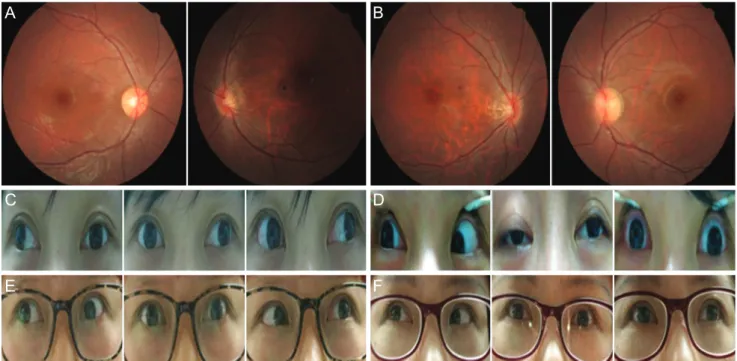
Anisometropia of -0.75 Dsph -1.00 Dcyl axis 90 (20 / 20) in the right eye and of -6.50 Dsph -1.50 Dcyl axis 90 (counting fingers) in the left eye, whereas the same mea- sures for twin 2 were -8.00 Dsph -1.50 Dcyl axis 180 (counting fingers) in the right eye and -5.00 Dsph -1.50 Dcyl axis 180 (20 / 25) in the left eye. On fundus examina- tion, a myopic tilted disc with parapapillary atrophy and tigroid fundus with reduction of the foveal reflex were ob- served in the left eye of twin 1 (Fig. 1A) and in the right eye of twin 2 (Fig. 1B).

These twins had a history of ocular motility disturbanc- es and a positive acetylcholine receptor antibody titer, which led to a presumptive diagnosis of ocular MG. They had previously had an eye examination at 19 years of age.

On this initial examination, twin 1 exhibited left exotropia

Korean J Ophthalmol 2016;30(5):392-393 http://dx.doi.org/10.3341/kjo.2016.30.5.392

Fig. 1. Fundus photographs showing the mirror-image myopic tilted disc, tigroid fundus, and reduction of foveal reflex in the left eye of twin 1 (A) and in the right eye of twin 2 (B), which is consistent with mirror-image amblyopia due to myopic anisometropia. Gaze pho- tographs showing varied duction deficits at 19 years of age (C,D) and residual duction deficits 7 years later (E,F). (C) Twin 1 exhibited 55 prism diopters of left exotropia, and limited adduction in the left (-4) and right eye (-2). (D) Twin 2 exhibited ptosis of both eyes, limited adduction in the right eye (-4) and abduction in the left eye (-2). (E) Twin 1 is orthotropic in the primary position after muscle surgery;

however, she still has an adduction deficit (-2) in the left eye. (F) Twin 2 exhibits 25 prism diopters of right exotropia, and markedly limit- ed adduction (-4) in the right eye.

A

C

E

B

D

F

(2)

393 of 55 prism diopters and limited adduction in both eyes,

which was more marked in the left eye (Fig. 1C). She stat- ed that this problem was first noted at 4 years of age, but she did not complain of diplopia. Twin 2 exhibited fluctu- ating ptosis and various motility deficits, which had been more prominent in the right eye 1 year prior (Fig. 1D). The results of anti-acetylcholine receptor binding antibody test were weakly positive (>0.200 nmol/L; 0.282 nmol/L for twin 1 and 0.227 nmol/L for twin 2). Twin 2 was adminis- tered a combination of pyridostigmine and methylprednis- olone, which was decreased gradually over a 2-year period.

This medication led to complete normalization of acetyl- choline receptor antibody titer, resolution of ptosis, and stabilization of motility disturbances. The patients had no speech or swallowing problems or limb girdle weakness during 2 years of follow-up.

At the recent examination (7 years after initial visit), twin 1 was orthotropic with a -2 limitation of adduction in the left eye (Fig. 1E). She underwent muscle surgery for left exotropia at other clinics 2 years ago. Twin 2 had right exotropia of 25 prism diopters and a -4 deficit of adduction in the right eye (Fig. 1F). With the exception of ocular ab- normalities, they were generally healthy and on no other medications.

Our patients showed a prominent remnant inability to adduct each eye with mirror-image myopic anisometropia.

MG is a heterogeneous and complex disorder, but there is strong evidence that an individual’s genetic make-up is an important predisposing factor for its development [4]. In addition, there are a number of case reports describing the concordance of generalized MG in monozygotic twins in terms of neurology and/or immunology. Furthermore, Punga et al. [5] reported a case of monozygotic twins with neuromuscular transmission defects at opposite sides of

the motor end plates: MG and Lambert-Eaton myasthenic syndrome. Therefore, a possible explanation for mirror-im- age twinning of ocular MG is that anatomic similarities within the neuromuscular junction of extraocular muscles lead to a similar predisposition to MG. The addition of our report to the literature implicates a strong underlying ge- netic susceptibility in the pathogenesis of MG.

Seung Ah Chung, Seran Jang

Department of Ophthalmology, Ajou University School of Medicine, Suwon, Korea

E-mail (Seung Ah Chung): [email protected]

Conflict of Interest

No potential conflict of interest relevant to this article was reported.

References

1. Hall JG. Twinning. Lancet 2003;362:735-43.

2. Okamoto F, Nonoyama T, Hommura S. Mirror image myo- pic anisometropia in two pairs of monozygotic twins. Oph- thalmologica 2001;215:435-8.

3. Kim WK, Chung SA, Lee JB. Two cases of mirror-image eye anomalies in monozygotic twins. Korean J Ophthalmol 2010;24:314-7.

4. Vincent A, Palace J, Hilton-Jones D. Myasthenia gravis.

Lancet 2001;357:2122-8.

5. Punga AR, Nygren I, Askmark H, Stalberg EV. Monozy-

gous twins with neuromuscular transmission defects at op-

posite sides of the motor endplate. Acta Neurol Scand

2009;119:207-11.

수치

Fig. 1. Fundus photographs showing the mirror-image myopic tilted disc, tigroid fundus, and reduction of foveal reflex in the left eye of  twin 1 (A) and in the right eye of twin 2 (B), which is consistent with mirror-image amblyopia due to myopic anisomet

참조

관련 문서

Phase profile of conventional DOE Obtained diffraction image. Optical vortices appear in the diffraction image generated by

Taubin, “The QBIC Project: Querying Image by Content using Color, Texture and Shape,” Proceedings of SPIE Storage and Retrieval for Image and Video Databases, pp.. Pala,

To develop a prolonged ocular drug delivery system with less frequency dosing, nanoparticles covalently bonded with levofloxacin in contact lenses will be a

load and differential output have a superior p p high frequency response over differential amplifiers with current mirror load and. amplifiers with current mirror load

* Symmetry operation symmetry element reflection mirror plane rotation rotation axis inversion inversion center..

Photonic crystals containing rugate structure result in a mirror with high reflectivity in a specific narrow spectral region and are prepared by applying

Postoperative Postoperative Postoperative Postoperative Magnetic Magnetic Magnetic Magnetic resonance resonance resonance image resonance image image image shows

With uses of a techniques named mola that pursues modern and Korean image by overlapping of cloth with various colors, and a technique named slash that