89 http://dx.doi.org/10.9719/EEG.2016.49.2.89
표준물질을 이용한 몰리브덴 동위원소 분석
조윤수1·길영우1*·류종식2·설정환1·Nguyen The Cong1·정우철1·박상희2
1전남대학교 에너지자원공학과, 2한국기초과학지원연구원 지구환경연구부
Molybdenum Isotope Analysis of Standard Reference Materials
Yunsoo Jo1, Youngwoo Kil1*, Jongsik Ryu2, Junghwan Seol1, The Cong Nguyen1, Woochul Jung1 and Sanghee Park2
1Department of Energy and Resources Engineering, Chonnam National University, Gwangju 500-757, Korea
2Division of Earth and Environmental Sciences, Korea Basic Science Institute, Ochang 363-883, Korea (Received: 2 April 2016 / Revised: 11 April 2016 / Accepted: 12 April 2016)
Mo isotope, one of highly redox-sensitive isotopes, has been shown to be useful tracers of geochemical pro- cesses. Many studies for Mo isotope have documented with the help of recently developed analysis tools, but it has not yet been documented in the Korea. In this study, we introduce two-stage column separation method of Mo using column tube (BioRad PolyPrepR column, 10 ml) and anion exchange resin (BioRad Resin AGR 1-X8, 200−
400 mesh). Mo isotope ratios in the solid SRMs (BHVO-2, SDO-1, PACS-2) and liquid SRM (IAPSO) were mea- sured on MC-ICP-MS (Multi-collector Inductively Coupled Plasma Mass Spectrometer) and then compared with reference Mo isotope ratios. Mo isotope ratios in our study overlap with reference Mo isotope ratios within analyti- cal error.
Key words :Mo isotope, SRM, MC-ICP-MS, anion exchange resin, column tube
산화·환원 환경에 민감하게 분별되는 몰리브덴(Mo) 안정동위원소는 지구화학적 과정을 유추할 수 있는 지시자로 사용될 수 있다. 최근 분석기기의 발달로 Mo 동위원소를 활용한 지질물질 연구가 많이 보고되고 있지만, 국내에서는 Mo 동위원소에 관한 연구가 없었다. 이번 연구에서는 컬럼관(BioRad PolyPrepR column, 10 ml)과 음이온 교환수지 (BioRad Resin AGR 1-X8, 200−400 mesh)를 이용한 두 번에 걸친 컬럼 작업을 통해 Mo을 분리 및 회수하였다.
이 분리법을 이용하여 고체(BHVO-2, SDO-1, PACS-2) 및 액체(IAPSO) 표준시료의 Mo 동위원소 분석을 다검출기 유도결합 플라즈마 질량분석기(Multi-collector Inductively Coupled Plasma Mass Spectrometer; MC-ICP-MS)로 측정한 결과, 측정된 표준물질의 Mo 동위원소 분석값은 참값과 오차 범위 내에서 잘 일치하였다.
주요어 : 몰리브덴 동위원소, 표준물질, 다검출기 유도결합 플라즈마 질량분석기, 음이온 교환수지, 컬럼관
1. 서 론
지질물질을 대상으로 수소(H), 탄소(C), 질소(N), 산 소(O), 황(S)과 같은 안정동위원소에 관한 연구는 오래
전부터 수행되어져 왔으나, 최근 분석기기 발달로 인 하여 리튬(Li), 철(Fe), 마그네슘(Mg), 니켈(Ni), 아연 (Zn), 몰리브덴(Mo)과 같은 비전통 안정동위원소(non- traditional stable isotope)에 대한 연구가 활발하게 진
This is an Open Access article distributed under the terms of the Creative Commons Attribution Non-Commercial License (http://creativecommons.org/licenses/by-nc/3.0) which permits unrestricted non-commercial use, distribution, and reproduction in any medium, provided original work is properly cited.
*Corresponding author: [email protected]
행되고 있다. 그러나 국내에서는 Li, Mg 이외에 비전 통 안정동위원소에 관한 연구가 수행되지 않았다(Kil et al., 2009; Ryu et al., 2011; Choi et al., 2012;
Lee et al., 2014; Ryu et al., 2014; Cheong and Ryu, 2014).
Mo은 92Mo, 94Mo, 95Mo, 96Mo, 97Mo, 98Mo,
100Mo의 7개 동위원소를 가지고 있으며, 이 동위원소 들은 자연 상태에서 9.2~24.1%의 존재비를 가진다 (Laeter et al., 2003). 기존 연구에 의하면 화강암이나 현무암 같은 화성암의 δ98/95Mo과 δ97/95Mo은 0‰에 가까운 값을 가지며, 마그마에서 일어나는 지질학적 과 정 속에서 Mo 동위원소 분별이 없다고 하였다(Anbar, 2004; Malinovsky et al., 2005; Yang et al., 2015).
그러나 최근 분석기기의 발달로 해수나 열수에서의 Mo 동위원소의 거동에 대한 연구가 다수 수행되었고 (Hannah et al., 2007; Mathur et al., 2010; Greber et al., 2011; Nakagawa et al., 2012), 산화·환원상 태에 민감한 Mo 동위원소의 특징을 이용하여 고기 해 양퇴적 환경을 추적하는 유추자로서 Mo 동위원소가 이용되기도 하였다(Barling et al., 2001; Siebert et al., 2003; Barling and Anbar, 2004; Malinovsky et al., 2005; Pearce et al., 2008).
최근 다검출기 유도결합 플라즈마 질량분석기(MC- ICP-MS)의 발달은 Mo 동위원소의 정밀한 측정을 가 능하게 했다(Wieser et al., 2007; Wen et al., 2010;
Greber et al., 2012; Nakagawa et al., 2012). MC- ICP-MS는 용액상태로 동위원소 분석이 가능하여 동위 원소를 빠르고 정확하게 분석할 수 있는 장점이 있으나, 분석 시 아르곤가스나 용액시료에 의해 발생하는 간섭 (interference)이 있다는 것이 큰 단점이다(Malinovsky et al., 2005). 따라서 정확한 Mo 동위원소 값을 측정 하기 위해서는 이온교환 크로마토그래피 분리법(ion exchange chromatography; IEC)을 이용하여 시료 내 에서 Mo를 완벽하게 분리할 필요가 있다. 이온교환 크 로마토그래피를 이용하여 Mo를 분리하는 연구는 다양 하게 수행되었으나(Barling et al., 2001; Malinovsky et al., 2005; Pearce et al., 2009; Wen et al., 2010), 두 번에 걸친 컬럼 작업을 통해 완벽하게 간섭 원소로 부터 Mo를 분리하는 연구는 미비하다(Nagai and Yokoyama, 2014).
본 연구에서는 컬럼관(BioRad PolyPrepR column, 10 ml)과 음이온 교환수지(BioRad Resin AGR 1-X8, 200−400 mesh)를 사용한 두 번에 걸친 컬럼 작업을 통해 Mo를 분리 및 회수 하고, MC-ICP-MS를 이용
한 Mo 동위원소 분석 조건을 알아보았다. 또한 이 분 석방법을 이용하여 고체 및 액체 표준물질 내의 Mo 동위원소 값을 정확히 측정하였다. 이 연구 결과를 통 해 국내에서도 Mo 동위원소를 이용한 지질과정 연구 가 가능할 것으로 보인다.
2. 실험 절차
실험 방법은 크게 Mo를 분리 및 회수하기 위한 컬 럼작업(chromatography)과 다검출기 유도결합플라즈마 질량분석기(MC-ICP-MS)를 이용한 표준시료 분석 조 건으로 나누어 설명된다. Mo 동위원소(δ98/95Mo)는 표 준물질(JMC-Mo; Johnson Matthey Specure, lot. # 34-479397C)에 대한 상대적인 값을 δ98/95Mo (‰) = [(98Mo/95Mo)sample/(98Mo/95Mo)standard − 1] × 1000 에 적용하여 계산되었다.
2.1. Mo 원소분리 및 회수
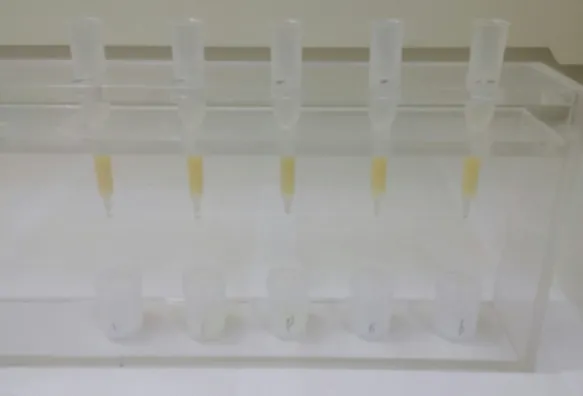
실험 전 안전 및 오염에 주의가 필요하였고, 모든 전처리 작업은 후드 안에서 이루어졌다. 실험에는 ppt 단위로 불순물이 들어 있는 초고순도 시약(Optima, Fisher Scientific)과 3차 증류수(DIW, 18.2 MΩ)가 사 용 되었고, 컬럼관을 고정하기 위해 선반(rack)을 제작 하였다(Fig. 1). Mo 원소분리 및 회수 실험은 대부분 원소들이 30 ppm 단위로 들어 있는 NIST 612 표준 물질을 이용하여 아래와 같이 두 번에 걸친 컬럼 작업 을 통해 수행되었다. 컬럼 작업을 수행하기 전 NIST 612 30 mg을 정량하여 혼합산(HF : HNO3 : HClO4
Fig. 1. Photograph of ion exchange chromatography column using column tube (BioRad PolyPrepR column, 10 ml) and anion exchange resin (BioRad Resin AGR 1-X8, 200− 400 mesh) to separate Mo from SRMs (standard reference materials).
= 4 : 4 : 1) 5 ml와 함께 60 ml 테플론 용기 (Savillex, USA)에 넣고, 완전히 용해되도록 열판(hot plate)에서 170oC로 24시간동안 가열하였다(Cho and Choi, 2009). 시료가 완벽하게 용해되면 140oC에서 건 조시켰다.
이번 연구에서 사용되는 이온교환 크로마토그래피 방법은 Nagai and Yokoyama. (2014)의 방법을 참조 하였으나, 음이온 교환수지의 양과 음이온 교환수지의 컬럼 구간을 달리하여, 컬럼 시간을 줄였고 Mo 분리 구간도 달리하였다.
2.1.1. 1차 컬럼
1차 컬럼을 하기에 앞서 증류수를 이용하여 컬럼관 에 음이온 교환수지를 1 ml 넣은 다음 아크릴 선반에 거치하였다(Fig. 1). 1차 컬럼 순서는 표 1과 같다.
6M HCl 5 ml를 컬럼관에 통과시켜 음이온 교환수지 내에 존재하는 이온들을 제거한 후, 음이온 교환수지 의 매질을 바꾸어주기 위하여 6M HNO3 + 3M HF 5 ml, 0.4M HCl + 0.5M HF 2 ml을 차례로 컬럼관 에 통과시켜 주었다. 각 단계 사이에는 증류수 5 ml를 통과 시켜 세척하였다(Table 1).
표 1에서와 같이 건조된 시료(NIST 612)를 0.4M
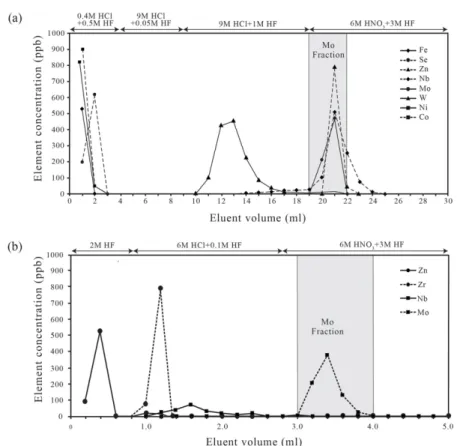
HCl + 0.5M HF 1 ml로 용해시켜 컬럼관을 통과 시킨 후, 순차적으로 0.4M HCl + 0.5M HF, 9M HCl + 0.05M HF, 9M HCl + 1M HF, 6M HNO3 + 3M HF를 컬럼관에 통과 시켰다. 통과 시킨 용액은 Mo 분리곡선(eltution curve)을 만들기 위해 1 ml 씩 테플론 용기에 받아, 유도결합 플라즈마 질량분석기 (ICP-MS)를 이용하여 용액 내 원소 농도를 분석을 하 였다. 분석 값을 이용하여 그림 2a와 같이 1차 컬럼 분리곡선을 작성하였다. 1차 컬럼 결과 19~22 ml 구 간사이에서 Mo가 분리되었다(Fig. 2a). 그러나 Mo뿐만 아니라 Nb, Zn, Zr이 같이 분리되어, 이들로부터 Mo 을 분리하기 위한 2차 컬럼 작업이 필요하였다. NIST 612 표준물질의 Mo 농도는 37.4 ppm인데, 1차 컬럼 후 회수된 Mo 농도가 36.1 ppm이다. 일반적인 ICP- MS 분석에러(10~15%)를 고려할 때 1차 컬럼 작업 후 Mo이 100% 회수 되었다는 것을 알 수 있었다.
2.1.2. 2차 컬럼
Mo이 100% 회수된 1차 컬럼 19~22 ml 구간의 용액을 열판위에서 건조하여 2차 컬럼에 사용하였다.
2차 컬럼에 앞서 증류수를 이용하여 컬럼관에 음이온 교환수지를 0.3 ml를 넣은 다음 아크릴 선반에 거치하 였다.
1차 컬럼에서와 같이 6M HCl 2 ml를 컬럼관에 통 과시켜 음이온 교환수지 내에 존재하는 이온들을 제거 한 후, 6M HNO3 + 3M HF 2 ml, 2M HF 1 ml 넣어 수지의 매질을 바꿔주었다. 각 단계 사이에는 증 류수를 통과시켜 세척하였다(Table 1).
이 후 1차 컬럼 시료를 2M HF 0.2 ml로 용해하 여 컬럼관에 통과시킨 후 순차적으로 2M HF, 6M HCl + 0.1M HF, 6M HNO3 + 3M HF를 컬럼관에 통 과 시켰다(Table 1). 통과 시킨 용액은 Mo 분리곡선을 만들기 위해 0.2 ml 씩 테플론 용기에 받아, ICP-MS 를 이용하여 용액 내 원소 농도를 분석을 하였다.
분석 값을 이용하여 그림 2b와 같이 2차 컬럼 분리 곡선을 작성하였다. 2차 컬럼 결과 3~4 ml 구간사이 에서 Mo이 분리되었다(Fig. 2b). 2차 컬럼 작업 결과 Nb, Zn, Zr 원소는 Mo에서 완전하게 분리되었다. 2차 컬럼 후 회수된 Mo 농도는 36.0 ppm로서 1차 컬럼 후 회수된 Mo(36.1 ppm)가 2차 컬럼 후 100% 회수 되었다.
2.2. 실험기기
본 연구에 사용된 MC-ICP-MS는 한국기초과학지원 Table 1. Simplified ion exchange chromatography process
for separating Mo
Purpose Reagent Volume
(ml) 1st column
resin cleaning
6M HCl 5
DIW 5
6M HNO3 + 3M HF 5 DIW 5 0.4M HCl + 0.5M HF 2 load sample 0.4M HCl + 0.5M HF 1 remove major element 0.4M HCl + 0.5M HF 3 9M HCl + 0.05M HF 5 9M HCl + 1M HF 10 Mo fraction 6M HNO3 + 3M HF 5 2nd column
resin cleaning
6M HCl 2
DIW 2
6M HNO3 + 3M HF 2 DIW 1
2M HF 1
load sample 2M HF 0.4
remove Zn 2M HF 0.4
remove Nb, Zr 6M HCl + 0.1M HF 2 Mo fraction 6M HNO3 + 3M HF 1.2
연구원에 설치된 독일 Thermo Scientific 사의 Jet Interface로 업그레이드된 Neptune 모델이다. 이 기기 는 고온의 플라즈마에서 이온화된 원소가 에너지 필터 (ESA)와 전자기석을 통과하면서 질량/전하 비율에 의 해 분리된 이온들을 9개의 파라데이 검출기로 동시에 검출할 수 있는 질량분석기로 분해능이 뛰어나 최근
동위원소 분석에 많이 이용되는 기기이다.
Mo 동위원소는 정적모드(static mode)를 이용하여
90Zr, 91Zr, 94Mo, 95Mo, 96Mo, 97Mo, 98Mo, 99Ru,
100Mo를 동시에 분석하였고 이때 분석 조건은 표 2와 같 다. MC-ICP-MS로 Mo 표준물질인 JMC-Mo (δ98/95Mo
= 0 ± 0.08‰)를 분석한 결과 δ98/95Mo값은 0.02 ± 0.12‰ (2σ, n=15)이었으며 기존 보고된 값과 오차범 위에서 일치하였다(Greber et al., 2012) (Table 3). 시 료 분석 시 JMC-Mo 표준물질을 이용한 외부 보정법 (external bracket method)을 사용하여 시료에 대한 분석 값을 보정하였다.
3. Mo 동위원소 분석 및 토의
정확하게 Mo 동위원소 분석이 가능한지를 알아보기 위해 국제적으로 공인된 표준물질을 다양하게 선정하 였다. Mo 동위원소 분석에 사용된 표준물질은 지질 표 준물질인 BHVO-2(basalt std.; Mo = 3.5 µg/g), SDO-1 (shale std.; Mo = 134µg/g), PACS-2(marine sediment std.; Mo = 5.43µg/g)와 해수 표준물질 IAPSO(seawater Fig. 2. Elution curve (NIST 612) of (a) the first column and (b) the second column.
Table 2. MC-ICP-MS instrument setting
RF forward power 1200 W
RF reflected power < 2 W
Cooling gas 15 L/min
Auxiliary gas 0.75 - 0.80 L/min Sample gas 0.985 - 0.990 L/min
Extraction -2 kV
Focus -0.654 kV
Acceleration voltage 10 kV Interface cones Nickel X-type Spray chamber Quartz dual cyclonic
Nebulizer ESI PFA MicroFlow Sample uptake rate 100 µL/min Instrumental resolution ca. 400 Mass analyzer pressure 2.9 × 10⁻⁹ mbar
std.; Mo = 0.01µg/g)이다(GEOREM; http://georem.
mpch-mainz.gwdg.de). 고체 표준물질 시료는 테플론 용기와 혼합산(HF : HNO3 : HClO4 = 4 : 4 : 1) 을 이용하여 용해하였다. 해수 표준물질 IAPSO는 Mo 농도가 낮아 10배 농축하여 실험에 사용하였다.
1차와 2차 컬럼 작업 전에 증류수를 이용하여 컬럼 관에 음이온 교환수지를 각각 1 ml, 0.3 ml 채워 선 반에 거치하였다. 이 후 위에서 언급한 방법으로 1차 와 2차 컬럼 수지를 세척하고, 매질을 바꾸어 주었다 (Table 1). 컬럼 작업은 1차 컬럼 19~22 ml 구간과 2차 컬럼 3~4 ml 구간의 용액을 이용하여 표 1의 절 차에 따라 수행하였다. 컬럼 작업 후 음이온 교환수지 를 재활용하기 위해 6M HCl을 가득 부어 버린 후 증류수를 가득 부어 버리는 작업을 2회 반복하고, 증 류수 3 ml을 컬럼관에 채우고 밀봉하였다.
ICP-MS을 이용한 표준시료들의 Mo 회수율은 표 3 에서와 같이 85~99%이다. 일반적인 ICP-MS 분석오 차(10~15%)를 고려할 때 컬럼 작업을 통해 Mo는 대 부분 회수되었다고 할 수 있다.
MC-ICP-MS로 측정된 표준물질들의 Mo 동위원소 값은 표 3과 같다. 측정된 Mo 동위원소 값들을 기존 논문들에 소개되어 확인된 Mo 동위원소 값들과 비교
하여 보았다(Table 3)(Pearce et al., 2009; Poulson Brucker et al., 2009; Duan et al., 2010; Wen et al., 2010; Kendall et al., 2011; Greber et al., 2012; Goldberg et al., 2013; Hin et al., 2013).
δ98/95Mo을 구하기 위해 사용되는 대표적인 표준물질
은 JMC-Mo와 NIST 3134이다. 기존 연구자들에 의 하면 두 표준물질 간 δ98/95Mo 값이 0.26‰ 정도 차 이를 보이기도하나(Greber et al., 2012; Hin et al., 2013), 0.04‰ 정도로 유사하기도 하다(Wen et al.
2010)(Table 3). 또한 표 3에서 Poulson Brucker et al. (2009)은 JMC-Mo와 Claritas-Mo의 δ98/95Mo 값이 0.02~0.04‰ 정도의 차이를 보이며 유사하다고 언급하 였다(Table 3). 이는 현재로서는 표준물질로 사용되어 져 왔던 JMC-Mo, NIST 3134, Claritas-Mo의 정확
한 δ98/95Mo 값을 확인할 수는 없다는 것이다.
JMC-Mo, NIST 3134, Claritas-Mo의 δ98/95Mo 값이 유사하다고 가정한다면, 이번 연구에서 분석된 암석 및 퇴적물 표준물질 중 BHVO-2, SDO-1, PACS-2의 δ98/95Mo값은 각각 –0.32 ± 0.24‰, 0.66 ± 0.11‰, 0.91 ± 0.16‰로 기존 논문에서 보고된 δ98/95Mo값과 오차범위 내에 일치한다(Table 3). 해수 표준물질 IAPSO의 δ98/95Mo값은 1.88 ± 0.08‰로 기존 논문에 Table 3. Comparison δ98/95Mo of SRMs (standard reference materials) with reference values. δ98/95Mo values were calculated by δ98/95Mo (‰) = [(98Mo/95Mo)sample/(98Mo/95Mo)standard − 1] × 1000, where (98Mo/95Mo)standard was 98Mo/95Mo of JMC-Mo standard
Sample
Mo recovery rate (%)
δ98/95Mo (‰) This study
2SD n
d98/95Mo (‰) reference
2SD Reference
solution References
Mo
standard JMC-Mo 0.02 0.12 15
-0.05 0.13 NIST 3134 Wen et al. (2010) -0.04 0.13 NIST 3134 Wen et al. (2010)
0.00 0.08 JMC-Mo Greber et al. (2012) -0.26 0.03 NIST 3134 Hin et al. (2013)
Rock and Sediment
BHVO-2 89 -0.32 0.24 20 -0.07 0.13 NIST 3134 Hin et al. (2013) -0.06 0.05 NIST 3134 Hin et al. (2013)
SDO-1 95 0.66 0.11 20
1.16 0.16 JMC-Mo Duan et al. (2010) 1.16 0.16 JMC-Mo Kendall et al. (2011) 1.20 0.30 Claritas-Mo Poulson Brucker et al. (2009) 1.14 0.30 Claritas-Mo Poulson Brucker et al. (2009) 0.82 0.11 NIST 3134 Goldberg et al. (2013) 0.78 0.10 NIST 3134 Goldberg et al. (2013) 0.80 0.16 NIST 3134 Goldberg et al. (2013) PACS-2 85 0.91 0.16 20 1.30 0.30 Claritas-Mo Poulson Brucker et al. (2009)
Sea
water IAPSO 91 1.88 0.08 20
2.11 0.05 NIST 3134 Greber et al. (2012) 2.13 0.09 NIST 3134 Greber et al. (2012) 2.07 0.09 NIST 3134 Greber et al. (2012) 2.10 0.09 NIST 3134 Greber et al. (2012)
보고된 δ98/95Mo값과 약간의 차이를 보이나 유사하다 (Table 3). 결과적으로 이번 실험에서 얻은 Mo 동위원 소 값은 오차범위 내에서 대부분 일치하는 좋은 결과 를 보여준다.
4. 결 론
본 연구에서는 컬럼관(BioRad PolyPrepR column, 10 ml)과 음이온 교환수지(BioRad Resin AGR 1-X8, 200−400 mesh)를 이용하여 두 번에 걸친 컬럼 작업 을 통해 NIST 612에서 Mo 원소를 분리 및 회수 하 였다. 또한 MC-ICP-MS을 이용하여 고체 및 액체 표 준물질(BHVO-2, SDO-1, PACS-2, IAPSO)들의 Mo 동위원소를 MC-ICP-MS을 활용하여 측정한 결과, 기 존 논문에 보고된 값들과 오차 범위 내에서 잘 일치함 을 알았다. 본 실험으로 얻어진 Mo 동위원소 분석법 을 지질 시료에 적용하면 국내에서도 Mo 동위원소를 활용한 연구가 가능할 것으로 보인다.
사 사
이 논문에 세심한 심사를 해주신 심사위원께 진심으 로 감사드립니다. 이 연구는 한국연구재단의 ‘금속 비 전통 안정동위원소 분석기술 개발 및 지질학적 응용 연구’ 과제(NRF-2014R1A1A4A01004570)의 일환으로 수행되었습니다.
References
Anbar, A.D. (2004) Molybdenum Stable Isotope: Obser- vation, Interpretations and Directions. In: Johnson C.M., Beard B. and Albarède F. (eds), Geochemistry of non-traditional stable isotopes. Reviews in Min- eralogy and Geochemistry, 55, p.429-454.
Barling, J., Arnold, G.L. and Andar, A.D. (2001) Natural mass-dependent variations in the isotopic composi- tion of molybdenum. Earth and Planetary Science Letters, v.193, p.447-457.
Barling, J. and Anbar, A.D. (2004) Molybdenum isotope fractionation during adsorption by manganese oxides.
Earth and Planetary Science Letters, v.217, p.315- 329.
Cheong, C.S. and Ryu, J.S. (2014) Use of Magnesium Sta- ble Isotope Signature for the Petrogenetic Interpre- tation of Granitic Rocks. The Journal of The Petrological Society of Korea, v.23, p.221-227.
Cho, N.C. and Choi, S.Y. (2009) A Provenance Study and Chemical Compositions of the Obsidian from Jang- hung-ri Paleolithic Site, Cheolwon. Korean Associa-
tion Of University Museums, v.12, p.67-82.
Choi, M.S., Lee, S.W., Ryu, J.S., Lee, K.S. and Shin, H.S.
(2012) Magnesium isotope analysis using MC-ICP- MS. Journal of the Geological Society of Korea, v.4, p.357-363.
Duan, Y., Anbar, A.D., Arnold, G.L., Lyons, T.W., Gordon, G.W. and Kendall, B. (2010) Molybdenum isotope evi- dence for mild environmental oxygenation before the Great Oxidation Event. Geochimica et Cosmochimica Acta, v.74, p.6655-6668.
Goldberg, T., Gordon, G., Izon, G., Archer, C., Pearce, C.R., McManus, J., Anbar, A.D. and Rehkämper, M.
(2013) Resolution of inter-laboratory discrepancies in Mo isotope data: an intercalibration. Journal of Ana- lytical Atomic Spectrometry, v.28, p.724-735.
Greber, N.D., Hofmann, B.A., Voegelin, A.R., Villa, I.M.
and Nägler, T.F. (2011) Mo isotope composition in Mo- rich high- and low-T hydrothermal systems from the Swiss Alps. Geochimica et Cosmochimica Acta, v.75, p.6600-6609.
Greber, N.D., Siebert, C., Nägler, T.F. and Pettke, T.
(2012) δ98/95Mo values and Molybdenum Concentra- tion Data for NIST SRM 610, 612 and 3134: Towards a Common Protocol for Reporting Mo data. Geo- standards and Geoanalytical Research, v.36, p.291- 300.
Hannah, J.L., Stein, H.J., Wieser, M.E., de Laeter, J.R.
and Varner, M.D. (2007) Molybdenum isotope vari- ations in molybdenite: Vapor transport and Rayleigh fractionation of Mo. Geology, v.35, p.703-706.
Hin, R.C., Burkhardt, C., Schmidt, M.W., Bourdon, B. and Kleine, T. (2013) Experimental evidence for Mo iso- tope fractionation between metal and silicate liquids.
Earth and Planetary Science Letters, v.379, p.38-48.
Kendall, B., Gordon, G.W., Poulton, S.W. and Anbar, A.D.
(2011) Molybdenum isotope constraints on the extent of late Paleoproterozoic ocean euxinia. Earth and Planetary Science Letters, v.307, p.450-460.
Kil, Y.W., Ryu, J.S., Shin, H.S. and Shin, H.J. (2009) Lith- ium isotope analysis of rock seawater reference mate- rials. Journal of the Geological Society of Korea, v.2, p.107-113.
Laeter, J.R.D., Böhlke, J.K., Bièvre, P.D., Hidaka, H., Peiser, H.S., Rosman, K.J.R. and Taylor, P.D.P. (2003) Atomic weights of the elements: review 2000. Pure and Applied Chemistry, v.75, p.683-800.
Lee, S.W., Ryu, J.S. and Lee, K.S. (2014) Magnesium iso- tope geochemistry in the Han River, South Korea.
Chemical Geology, v.364, p.9-19.
Malinovsky, D., Rodushkin, I., Baxter, D.C., Ingri, J. and Öhlander, B. (2005) Molybdenum isotope ratio mea- surements on geological samples by MC-ICPMS.
International Journal of Mass Spectrometry, v.245, p.94-107.
Mathur, R., Brantley, S., Anbar, A.D., Munizaga, F., Mak- saev, V., Newberry, R., Vervoort, J. and Hart, G. (2010) Variation of Mo isotopes from molybdenite in high- temperature hydrothermal ore deposits. Mineralium Deposita, v.45, p.43-50.
Nagai, Y. and Yokoyama, T. (2014) Chemical Separation of Mo and W from Terrestrial and Extraterrestrial Sam-
ples via Anion Exchange Chromatography. Analytical Chemistry, v.86, p.4856-4863.
Nakagawa, Y., Takano, S., Firdaus, M.L., Norisuye, K., Hirata, T., Vance, D. and Sohrin, Y. (2012) The molyb- denum isotopic composition of the modern ocean.
Geochemical Journal, v.46, p.131-141.
Pearce, C.R., Cohen, A.S., Coe, A.L. and Burton, K.W.
(2008) Molybdenum isotope evidence for global ocean anoxia coupled with perturbations to the carbon cycle during the Early Jurassic. Geology, v.36, p.231-234.
Pearce, C.R., Cohen, A.S. and Parkinson, I.J. (2009) Quantitative Separation of Molybdenum and Rhenium from Geological Materials for Isotopic Determination by MC-ICP-MS. Geostandards and Geoanalytical Research, v.33, p.219-229.
Poulson Brucker, R.L., McManus, J., Severmann, S. and Berelson, W.M. (2009) Molybdenum behavior during early diagenesis: Insights from Mo isotopes. Geochem- istry, Geophysics, Geosystems, v.10, Q06010.
Ryu, J.S., Jacobson, A.D., Holmden, C., Lundstrom, C.
and Zhang, Z. (2011) The major ion, δ44/40Ca, δ44/42Ca, and δ26/24Mg geochemistry of granite weathering at pH = 1 and T = 25°C: power-law processes and the relative reactivity of minerals. Geochimica et Cos- mochimica Acta, v.75, p.6004-6026.
Ryu, J.S., Vigier, N., Lee, S.W., Lee, K.S. and Chadwick, O.A. (2014) Variation of lithium isotope geochemistry during basalt weathering and secondary mineral transformations in Hawaii. Geochimica et Cosmo- chimica Acta, v.145, p.103-115.
Siebert, C., Nägler, T.F., von Blanckenburg, F. and Kram- ers, J.D. (2003) Molybdenum isotope records as a potential new proxy for paleoceanography. Earth and Planetary Science Letters, v.211, p.159-171.
Wen, H., Carignan, J., Cloquet, C., Zhu, X. and Zhang, Y.
(2010) Isotopic delta values of molybdenum standard reference and prepared solutions measured by MC- ICP-MS: Proposition for delta zero and secondary ref- erences. Journal of Analytical Atomic Spectrometry, v.25, p.716-721.
Wieser, M.E., Laeter, J.R.D. and Varner, M.D. (2007) Iso- tope fractionation studies of molybdenum. Interna- tional Journal of Mass Spectrometry, v.265, p.40-48.
Yang, J., Siebert, C., Barling, J., Savage, P., Liang, Y.H.
and Halliday, A.N. (2015) Absence of molybdenum isotope fractionation during magmatic differentiation at Hekla volcano, Iceland. Geochimica et Cosmo- chimica Acta, v.162, p.126-136.