ABSTRACT
Purpose: The aim of the present study was to retrospectively investigate the influence of potential risk indicators on the development of peri-implant disease.
Methods: Overall, 103 patients referred for implant treatment from 2000 to 2012 were randomly enrolled. The study sample consisted of 421 conventional-length (>6 mm) non- turned titanium implants that were evaluated clinically and radiographically according to pre- established clinical and patient-related parameters by a single investigator. A non-parametric Mann-Whitney U test or Kruskal-Wallis rank test and a logistic regression model were used for the statistical analysis of the recorded data at the implant level.
Results: The diagnosis of peri-implant mucositis and peri-implantitis was made for 173 (41.1%) and 19 (4.5%) implants, respectively. Age (≥65 years), patient adherence
(professional hygiene recalls <2/year) and the presence of plaque were associated with higher peri-implant probing-depth values and bleeding-on-probing scores. The logistic regression analysis indicated that age (P=0.001), patient adherence (P=0.03), the absence of keratinized tissue (P=0.03), implants placed in pristine bone (P=0.04), and the presence of peri-implant soft-tissue recession (P=0.000) were strongly associated with the event of peri-implantitis.
Conclusions: Within the limitations of this study, patients aged ≥65 years and non-adherent subjects were more prone to develop peri-implant disease. Therefore, early diagnosis and a systematic maintenance-care program are essential for maintaining peri-implant tissue health, especially in older patients.
Keywords: Dental implants; Implant-supported dental prosthesis; Periodontal diseases;
Peri-implantitis; Retrospective study; Risk factors
INTRODUCTION
Peri-implant mucositis and peri-implantitis can be categorized as biological complications in implant rehabilitation. Peri-implant mucositis has been defined as a reversible inflammatory reaction of peri-implant soft tissues with no radiographic evidence of bone loss [1]. From a clinical perspective, signs that determine the presence of peri-implant mucositis include erythema and swelling, usually associated with probing depths ≥4 mm [2,3]; however, the essential parameter for diagnosis is bleeding on gentle probing (<0.25 N) [4]. In contrast, peri-implantitis has been identified as a progressive and irreversible infectious pathological
Research Article
Received: Apr 25, 2016 Accepted: Jul 6, 2016
*Correspondence to Pier Paolo Poli
Implant Center for Edentulism and Jawbone Atrophies, Maxillofacial Surgery and Odontostomatology Unit, Fondazione IRCCS Cà Granda, Ospedale Maggiore Policlinico, Via della Commenda 10, Milan 20122, Italy.
E-mail: [email protected] Tel: +39-02-55032621 Fax: +39-02-55032513
Copyright © 2016 Korean Academy of Periodontology
This is an Open Access article distributed under the terms of the Creative Commons Attribution Non-Commercial License (http://
creativecommons.org/licenses/by-nc/3.0/).
ORCID Pier Paolo Poli
http://orcid.org/0000-0003-3739-1490 Mario Beretta
http://orcid.org/0000-0002-2223-2553 Giovanni Battista Grossi
http://orcid.org/0000-0003-3367-0679 Carlo Maiorana
http://orcid.org/0000-0001-8748-9483 Conflict of Interest
No potential conflict of interest relevant to this article was reported.
Pier Paolo Poli,* Mario Beretta, Giovanni Battista Grossi, Carlo Maiorana
Implant Center for Edentulism and Jawbone Atrophies, Maxillofacial Surgery and Odontostomatology Unit, IRCCS Cà Granda Foundation Maggiore Policlinico Hospital, University of Milan, Milan, Italy
Risk indicators related to peri-
implant disease: an observational
retrospective cohort study
condition associated with changes in the level of crestal bone, the presence of bleeding on probing (BOP), and/or suppuration with or without concomitant deepening of the peri- implant pockets around an osseointegrated implant in function [4,5]. Although these are typical signs, sometimes they are not clearly recognizable. Furthermore, the predictive value of BOP, increased peri-implant probing depth (PPD), or peri-implant bone loss (PBL) as individual features remains insufficiently well established [6]. Despite this, the presence of BOP, PPD, and PBL have been associated with peri-implant lesions when evaluated in the context of specific patient- and site-dependent variables, including age, gender, smoking, adherence to oral hygiene procedures, gingival biotype, the presence of plaque, keratinized tissue and soft tissue recessions, and the type of bone graft and membrane during the implant placement [7-9]. Etiologically, other factors and conditions may contribute to the development of peri-implant disease, including alcohol consumption, a history of periodontitis, residual cement, bacterial micro-leakage at the implant abutment interface, implant surface characteristics, the type of the prosthetic supra-structure, osteoporosis, and diabetes [10,11]. A risk factor has been described as “an environmental, behavioral, or biological factor that, if present, directly increases the probability of a disease (or adverse event) occurring and, if absent or removed, reduces that probability. Risk factors are part of the causal chain, or expose the host to the causal chain,” [12] whereas a risk indicator may be defined as a “probable risk factor that has not been confirmed by carefully conducted longitudinal studies” [12]. Because there is increasing evidence to suggest that peri-implant mucositis is the precursor of peri-implantitis, early detection of risk factors plays a key role in preventing further progression of the disease. Despite the fact that prospective studies are essential to assess true risk factors, retrospective and cross-sectional studies may be suitable to identify risk indicators for the disease [13]. However, it is difficult to compare the analyses of such risk indicators due to heterogeneity between studies in terms of the peri- implant disease diagnostic criteria, the definitions of implant success, and the reference points for measuring the marginal PBL [5,7]. Consequently, the influence of potential clinical predictors on the diagnosis and prognosis of peri-implant disease might be inadequately reported. Therefore, the purpose of the present retrospective study was to evaluate how the presence of different independent implant- and patient-related risk indicators might influence the odds of developing a peri-implant disease in a randomized cohort of patients.
MATERIALS AND METHODS
Study design and participants
The study reports on patients treated in a university setting with conventional-length (>6 mm), non-turned, 2- and 3-piece titanium implants during a period ranging from 2000 to 2012. A random sample was enrolled of partially and fully edentulous patients with at least one implant-supported restoration in occlusal loading during the appointment for evaluation. The patients were consecutively included, and the data were collected from July 2014 to July 2015 during regular implant maintenance visits. Implant surgical operations and prosthetic restorations were all performed in the same department (Implant Center for Edentulism and Jawbone Atrophies, Maxillofacial Surgery and Odontostomatology Unit, Fondazione IRCCS Cà Granda, Ospedale Maggiore Policlinico, Milan, Italy). To exclude possible operator-dependent bias, clinical measurements were taken by a single blinded investigator. Each patient was given a detailed description of the procedure, and informed consent was obtained prior to participation in the study. The present cross-sectional study was carried out in accordance with the Declaration of Helsinki of ethical human research
practices. No ethics committee approval was sought due to the retrospective nature of the present study, and such oversight was not required by national law or by ordinance of the local inspection authority.
Exclusion criteria
In accordance with Konstantinidis et al. [9] and Schwarz et al. [8], for patient selection, the following exclusion criteria were defined: (1) any uncontrolled systemic diseases that could influence the implant therapy outcome (e.g., diabetes [HbA1c >7], osteoporosis); (2) any intake of medications that may have an effect on bone turnover and mucosal healing (i.e., steroids, antiresorptive therapy); (3) any antibiotic treatment for a medical or dental reason within the 2 months prior to the examination; (4) any restorations that did not allow for the calculation of PPD; (5) inability or refusal to sign the informed consent form; (6) fewer than 12 months of follow-up post loading; (7) pregnancy or breastfeeding in women; and (8) the absence of baseline radiographs taken at the time of placement of the suprastructure.
Anamnestic data and implant site characteristics
The following study variables were assessed: (1) patient age at the time of final examination;
(2) gender; (3) smoking habits; and (4) patient adherence (PA) (i.e., whether a patient came to professional hygiene recall appointments at least every 6 months or at intervals >6 months since placement of the suprastructure).
The following implant site characteristics were considered: (1) the bone graft (i.e., whether the implant was placed in regenerated bone or in pristine bone) and (2) the presence or absence of a membrane covering the graft during the regenerative procedure.
Clinical measurements
The following clinical parameters were assessed at each implant site using a periodontal probe (Williams 14W Probe, Hu-Friedy Mfg. Co., Chicago, IL, USA): (1) the gingival biotype (direct visual assessment, i.e., visibility of the periodontal probe); (2) the presence (≥1 mm) or absence of keratinized tissue (KT) measured as the distance between the peri-implant mucosal margin and the muco-gingival junction at the buccal marginal portion of the implant mucosa; (3) PPD (measured from the mucosal margin to the probeable pocket);
(4) BOP; (5) plaque index (PI); and (6) peri-implant recession (REC, defined as the distance between the implant shoulder and mucosal margin). The measurements of PI, BOP, and PPD were performed at six aspects per implant: mesio-buccal, mid-buccal, disto-buccal, and respective lingual/palatal sites. The presence of KT was visually assessed at the mid-facial and mid-oral surfaces. When clinical signs (i.e., BOP with or without suppuration) suggested the presence of peri-implantitis, non-standardized periapical radiographs were taken at the time of the clinical examination with the long cone paralleling technique and film holders (Rinn XCP, Dentsply Corporate, York, PA, USA) and compared with a baseline radiograph taken at the time of prosthesis installation for bone level confirmation [2]. Particularly, the radiographs were scanned to obtain standardized digital images with a resolution of 1,200 dpi. These images were imported and analyzed using specialized computer software (ImageJ v 1.49, Research Services Branch, National Institute of Health, Bethesda, MD, USA). The calibration of the pixel/mm ratio was performed using the length of the implant as a fixed reference point to compensate for potential radiographic distortion. For the assessment of bone loss, the radiographic distance between the implant shoulder level and the most coronal bone-to-implant contact level was measured mesially and distally, parallel with the long axis of the implant. The same blinded examiner performed all radiographic measurements.
Case definition
Implants were considered healthy in case of no BOP or bleeding only at one surface, assuming one point of bleeding as a consequence of trauma from probing, with no suppuration. The presence of peri-implant mucositis was defined by an osseointegrated implant presenting BOP from more than one surface area of the implant [14]. The presence of peri-implantitis was defined as an osseointegrated implant presenting ≥2 mm peri- implant marginal bone loss concomitant with BOP and/or pus on probing from at least one surface area of the implant, associated with PPD ≥4 mm at the time of examination [5]. The measurement of BOP and the presence of suppuration were assessed within 60 seconds of measurements of PPD.
Statistical analysis
Data were collected using Excel (Microsoft, Redmond, WA, USA). Statistical analysis was performed using SPSS version 22.0 (IBM Corp., Armonk, NY, USA).
The statistical evaluation included the Kolmogorov-Smirnov test to evaluate the normality of the distributions. Since the data were not normally distributed, non-parametric tests were used for all comparisons, including the Mann-Whitney U test, the Kruskal-Wallis rank test, or the Pearson χ2 test, as appropriate. To measure the association between the predictor and outcome variable while controlling for confounders, a logistic regression model was used. The data were allowed to enter the model using backward selection with the significance level to remove set at 0.1. Recorded data are presented as mean values, median (interquartile range;
IQR) values, or frequencies (%). P-values <0.05 were considered to be statistically significant.
RESULTS
Overall, 62 (60.2%) female patients and 41 (39.8%) male patients aged 26 to 87 years (mean, 60±8.6 years) were randomly enrolled. A total of 421 dental implants were inserted, 244 (58%) into female patients and 116 (42%) into male patients. According to the given definition, out of the 421 implants, 173 (41.1%) presented BOP on more than one surface area of the implant and were therefore considered affected by a peri-implant mucositis. From a deeper analysis by means of periapical X-rays, 19 (4.5%) presented peri-implant marginal bone loss, and therefore the diagnosis of peri-implantitis was made.
The descriptive statistics for the sample are summarized in Table 1. When considering the PPD, the median value (IQR) was 2.6 mm (1.2 mm). Statistically significant differences in probing depths were observed when the measurements were correlated with specific independent variables: age, gender, PA, membrane, bone graft, and REC. Clinically, 248 (58.9%) implants did not present BOP, whereas 173 (41.1%) showed BOP. Differences in BOP were statistically significant when the following independent variables were considered: age, PA, gingival biotype, PI, and REC.
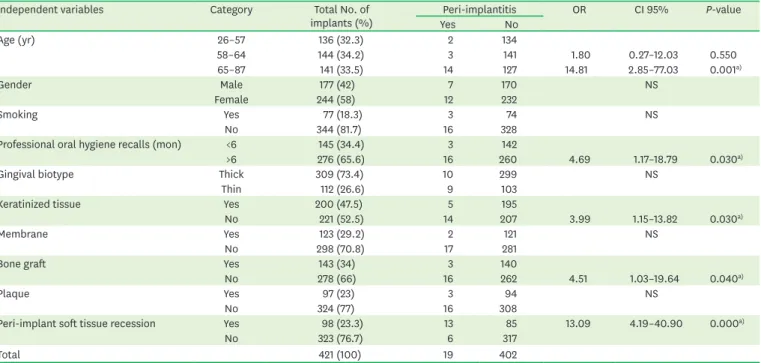
The logistic regression analysis revealed risk factors for peri-implantitis (Table 2). Overall, 5 out of 10 independent variables were significant indicators for peri-implantitis: age (P=0.001), PA (P=0.03), KT (P=0.03), bone graft (P=0.04), and REC (P=0.000). Odds ratio (OR) estimates and 95% confidence intervals (CIs) were retrieved from the intercept of each factor.
Table 1. The association between the independent variables versus peri-implant probing depth and bleeding on probing Independent variables Category Total No. of
implants (%) Clinical measurements
PPD (mm) BOP
Mean Median (IQR) P-value Yes, No. (%) No, No. (%) P-value
Age (yr) 26–57 136 (32.3) 2.49 2.5 (1.0) 0.036a) 46 (33.8) 90 (66.2) 0.025
58–64 144 (34.2) 2.55 2.6 (1.2) 57 (39.6) 87 (60.4)
65–87 141 (33.5) 2.78 2.6 (0.9) 70 (49.6) 71 (50.4)
Gender Male 177 (42) 2.50 2.5 (1.0) 0.012 72 (40.7) 105 (59.3) 0.880
Female 244 (58) 2.69 2.6 (1.1) 101 (41.4) 143 (58.6)
Smoking Yes 77 (18.3) 2.53 2.6 (1.2) 0.570 32 (41.6) 45 (58.4) 0.930
No 344 (81.7) 2.63 2.6 (1.2) 141 (41.0) 203 (59.0)
Professional oral hygiene recalls
(mon) <6 145 (34.4) 2.46 2.5 (1.1) 0.020 50 (34.5) 95 (65.5) 0.046
>6 276 (65.6) 2.69 2.6 (1.0) 123 (44.6) 153 (55.4)
Gingival biotype Thick 309 (73.4) 2.59 2.6 (1.0) 0.490 119 (38.5) 190 (61.5) 0.070
Thin 112 (26.6) 2.67 2.6 (1.2) 54 (48.2) 58 (51.8)
Keratinized tissue Yes 200 (47.5) 2.57 2.5 (1.0) 0.190 74 (37.0) 126 (63.0) 0.100
No 221 (52.5) 2.65 2.6 (1.0) 99 (44.8) 122 (55.2)
Membrane Yes 123 (29.2) 2.48 2.5 (1.4) 0.080 51 (41.5) 72 (58.5) 0.920
No 298 (70.8) 2.66 2.6 (1.0) 122 (40.9) 176 (59.1)
Bone graft Yes 143 (34) 2.46 2.5 (1.4) 0.013 62 (43.4) 81 (56.6) 0.500
No 278 (66) 2.69 2.6 (1.0) 111 (39.9) 167 (60.1)
Plaque Yes 97 (23) 2.78 2.6 (1.0) 0.005 54 (55.7) 43 (44.3) 0.001
No 324 (77) 2.56 2.5 (1.0) 119 (36.7) 205 (63.3)
Peri-implant soft tissue recession Yes 98 (23.3) 2.70 2.6 (1.1) 0.160 53 (54.1) 45 (45.9) 0.003
No 323 (76.7) 2.58 2.5 (1.0) 120 (37.2) 203 (62.8)
Total 421 (100) 2.61 2.6 (1.2) 173 (41.1) 248 (58.9)
Data are presented as mean, median and interquartile range, or frequencies (%).
PPD, peri-implant probing depth; BOP, bleeding on probing; IQR, interquartile range.
a)Post hoc analysis revealed a statistically significant difference between the older patients (the 65–87 age group) and the other groups (P<0.05).
Table 2. The risk indicators for peri-implantitis according to the logistic regression analysis
Independent variables Category Total No. of
implants (%) Peri-implantitis OR CI 95% P-value
Yes No
Age (yr) 26–57 136 (32.3) 2 134
58–64 144 (34.2) 3 141 1.80 0.27–12.03 0.550
65–87 141 (33.5) 14 127 14.81 2.85–77.03 0.001a)
Gender Male 177 (42) 7 170 NS
Female 244 (58) 12 232
Smoking Yes 77 (18.3) 3 74 NS
No 344 (81.7) 16 328
Professional oral hygiene recalls (mon) <6 145 (34.4) 3 142
>6 276 (65.6) 16 260 4.69 1.17–18.79 0.030a)
Gingival biotype Thick 309 (73.4) 10 299 NS
Thin 112 (26.6) 9 103
Keratinized tissue Yes 200 (47.5) 5 195
No 221 (52.5) 14 207 3.99 1.15–13.82 0.030a)
Membrane Yes 123 (29.2) 2 121 NS
No 298 (70.8) 17 281
Bone graft Yes 143 (34) 3 140
No 278 (66) 16 262 4.51 1.03–19.64 0.040a)
Plaque Yes 97 (23) 3 94 NS
No 324 (77) 16 308
Peri-implant soft tissue recession Yes 98 (23.3) 13 85 13.09 4.19–40.90 0.000a)
No 323 (76.7) 6 317
Total 421 (100) 19 402
OR, 95% CI, and P-values are reported.
OR, odds ratio; CI, confidence interval; NS, not significant, the independent variable was not a statistically significant predictor of peri-implantitis.
a)Statistically significant difference between the analyzed variables.
DISCUSSION
The present retrospective study was designed to assess the influence of potential risk factors on the development of peri-implant disease at the implant level. Because multivariate analyses correcting for confounding factors may be indicated in cases of retrospective studies assessing peri-implantitis predictors, a logistic regression model was used. Mean prevalences of peri-implant mucositis and peri-implantitis at 43% and 22%, respectively, have been recently reported [15]. In the present study, prevalences of 41.1% and 4.5% were observed for the peri-implant mucositis and peri-implantitis group, respectively. These results favorably compare with those reported in a recent meta-analysis, in which the frequency of peri-implant mucositis and peri-implantitis were 30.7% and 9.6%, respectively [16]. In the present study, the lower peri-implantitis rate was probably related to the selection of a convenience sample subjected to the same surgical and prosthetic protocol, which may have decreased the prevalence of the event. Moreover, the heterogeneity among studies resulting from differences in case definition and study design may have led to an overestimation of the frequency of the disease.
Because many systemic diseases are chronic and more common in older individuals, and can directly or indirectly compromise implant health, age may be considered a risk indicator. As a confirmation of this hypothesis, the present study indicated that patient age ≥65 years and a low level of patient adherence (>6 months per recall appointment) were strongly associated with peri-implant mucositis (P=0.025 and P=0.046, respectively) and peri-implantitis (OR=14.81; P=0.001 and OR=4.69; P=0.03, respectively). This was also emphasized by the significantly higher PPD values measured in the two groups (2.78 mm; P=0.036 and 2.69 mm; P=0.020, respectively). A similar trend was observed by Ferreira et al. [14] considering a study group of 212 partially edentulous subjects rehabilitated with osseointegrated implants.
The authors found slightly higher prevalences of peri-mucositis and peri-implantitis for older individuals (>45 years old) (58.57% vs. 67.60% and 7.14% vs. 9.85%, respectively) and for patients who underwent episodic maintenance visits (>6 months) (61.70% vs. 66.95%
and 8.51% vs. 9.32%, respectively). Peri-mucositis showed a correlation with the age of the patients that was also validated by the univariate analysis performed by Roos-Jansaker et al., who found that age (≥60 years old) was a significant risk factor for the development of the disease (P=0.02). This finding is in agreement with a study regarding prevalence and risk variables for peri-implant disease in a comparable cohort sample, which concluded that subjects older than 65 years were more prone to develop peri-implantitis [17]. This may be explained by several factors, namely difficulties in maintaining proper oral hygiene due to impaired vision, lack of dexterity, brain diseases (e.g., Parkinson disease or dementia), and osteoarthritis; increased occurrence of cancer that requires radiotherapy treatment, therefore enhancing the risk of peri-implantitis; lower immunity, compromised healing capacity, and lack of motivation in oral hygiene measures that may arise as a consequence of tooth loss [18,19]. Age was also identified as a contributory factor for the development of peri- implantitis when associated with a history of periodontitis and cardiovascular disease [20].
Even the immobility of older patients preventing them from reaching the dental clinic may postpone recall hygiene visits, jeopardizing the efficacy of the implant maintenance program and thus increasing the risk of peri-implant disease. On the other hand, a recent long- term retrospective study evaluating implants placed in subjects older than 65 years found a failure rate of 4.61% at the implant level and 0.02% at the patient level [21]. Thus, it may be suggested that the patient’s age might not represent a factor of major prognostic significance in implant treatment, if meticulous oral hygiene procedures and recall visits are respected.
Indeed, inadequate plaque control due to poor accessibility for oral hygiene at implant sites has been associated with peri-implantitis [22].
In the present study, the role of plaque accumulation in terms of increased risk of peri- implant disease led to contradictory results. Despite the failure to demonstrate a clear association between the presence of plaque and peri-implantitis in terms of increased risk of susceptibility, statistically significant differences in terms of a higher percentage of PPD (P=0.005) and BOP (P=0.001) were found. This was probably related to the great heterogeneity within the group with no plaque (n=324) versus the group showing plaque (n=97), which in turn led to misleading results. On the other hand, several studies have pointed out a positive correlation between high plaque scores and increased risk of
presenting peri-implant disease [17,22]. The primary role of plaque in disease occurrence was also stressed by Ferreira et al. [14], who found a dose-dependent association between higher plaque scores and worse conditions in peri-implants. The OR for plaque score in cases of peri-implantitis (OR=14.3, 95% CI, 9.1–28.7) was much higher when compared with the same level of plaque score in peri-implant mucositis (OR=2.9, 95% CI, 2.0–4.1). In the present study, this was corroborated by the higher likelihood of developing peri-implantitis for patients who underwent professional oral hygiene recall less than twice a year with respect to patients who adhered to the implant maintenance schedule.
Furthermore, the patient's adherence has a consequent effect on the marginal bone levels.
Indeed, a lower mean level of bone loss was observed in the adherent group compared with the non-responding group [23]. Hence, the role of supportive maintenance care could be considered a key factor in reducing the risk of implant complications. Accordingly, the absence of preventive maintenance has been associated with significantly worse peri- implant conditions, in terms of PI, BOP, percentage of sites with PD ≥5 mm, number of implants with peri-implantitis, and PBL [24]. Accordingly, data reported in the present study confirmed the fact that the worst PPD and BOP scores were significantly associated with non-adherent patients.
The correlation between peri-implantitis and the presence or absence of KT deserves some discussion. Indeed, the data show a higher incidence of peri-implantitis in patients who did not present KT compared with patients presenting with at least 1 mm of KT (OR=3.99;
P=0.03). There has been controversy in the discussion of the impact of KT around dental implants. Soft tissue defects or poor-quality soft tissue at the area of implantation has been considered to be a risk factor for the development of peri-implantitis [25]. This is probably related to the association of a lack of adequate KT around endosseous dental implants with more plaque accumulation, tissue inflammation, mucosal recession, and attachment loss.
Conversely, similar studies were not able to find a clear association between the absence of keratinized peri-implant mucosa and peri-implant disease [7,8,26]. The results obtained in the present study corroborated those reported in a recent systematic review, emphasizing the importance of an adequate zone of KT surrounding implants so that better peri-implant tissue health may be achieved [27]. Interestingly, on the other hand, the presence or absence of KT did not influence the likelihood of developing peri-implant mucositis. Thus, one may speculate that implants might be maintained in a healthy condition even in cases of an inadequate width of KT; however, the absence of KT associated with poor oral hygiene is a relevant risk factor for the development of peri-implant disease. This is particularly true when patients without keratinized mucosa are categorized as thin-biotype subjects [28]. Our statistical analyses indicated that a thin biotype was associated with higher percentages of
BOP as compared with thick-biotype patients (38.5% vs. 48.2%, respectively). This result can be attributed to thinner tissues being more friable, less vascularized, and accompanied with thinner underlying bone. Furthermore, a thin periodontal biotype is associated with a more shallow biologic width compared with a thick biotype. As a consequence, a thin biotype is more susceptible to biologic width invasion, resulting in marginal tissue recession and alveolar bone loss [29]. This is particularly true in cases of dental implants, due to the fundamental differences that exist between the peri-implant mucosa and its counterpart in natural teeth. Thus, similar to gingival tissue, thin peri-implant soft tissue is more susceptible to soft tissue recession compared with thick peri-implant soft tissue. Therefore, a thin-tissue biotype associated with missing KT is associated with an increased risk of unfavorable treatment outcomes following surgical interventions [30].
This may explain the strong relation between peri-implant soft tissue recession and the occurrence of peri-implantitis. The logistic regression model showed a statistically significant connection between the presence of REC and peri-implant disease (OR=13.09; P=0.00).
This might be attributed to the different behavior of the two different biotypes in response to mechanical and/or surgical trauma. Indeed, a thick biotype reacts with the formation of periodontal pockets and intrabony defects, whereas a thin biotype responds with gingival recessions [31]. These results corroborated those of a previous study that reported increased soft and hard tissue resorption to re-establish a healthy peri-implant mucosal dimension, especially in a thin biotype [32]. This explanation favorably compares with a recent
observation that the distance between the implant platform level and bone level was greater in individuals with peri-implantitis, indicating that soft tissue recession as a consequence of bone loss negatively influences peri-implant tissue health [20]. A peri-implant soft tissue recession as a consequence of bone loss induced by a peri-implantitis lesion might expose the coronal portion of the implant. Moreover, due to a greater tendency for rougher surfaces to accumulate and retain more plaque, biofilm formation is facilitated [33]. Thus, the relevant correlation between REC and peri-implantitis can also be explained by the fact that, for implants with a coronal roughened surface, such as those evaluated in the present study, a bacterial biofilm forms upon exposure to the oral environment as a consequence of soft tissue recession. Because these microorganisms may persist and proliferate, they are a leading contributor to peri-implantitis, which can lead to the loss of implant integration [34].
Although rough-surface implants are technically more susceptible to bacterial colonization, this has been demonstrated mostly in animal or in vitro studies [35,36]. Evidence for the influence of the implant surface characteristics as a risk indicator for peri-implantitis still needs further investigation [37].
The role of the recipient bone (native bone vs. grafted bone) in developing peri-implant disease is still debated. From the data obtained in the present analysis, implants placed in pristine bone had significantly higher PPD (P=0.013) and were more susceptible to develop peri-implantitis (OR=4.51; P=0.04) as compared with implants inserted in regenerated bone.
Accordingly, a similar study found that implants in augmented sites have a lower risk of developing peri-implant mucositis when compared with implants placed in non-augmented sites. Regenerating the missing bone provides better hard tissue architecture, allowing for ideal implant placement. As a consequence, the better adaptation of the hard and soft tissue around the implant shoulder might explain a better control against bacterial colonization and greater resistance to bacteria, thus decreasing the probability of developing peri-implantitis [9]. Other studies failed to demonstrate a similar association between augmentation
procedures and implant failures [38,39]. In contrast, from a different cross-sectional study, the events of peri-implant mucositis and peri-implantitis appeared to be correlated with augmentation procedures. In particular, implants with a fixed prosthesis placed in the upper jaw along with bone augmentation procedures appeared to be more susceptible to peri-implant diseases [8]. Notably, in our department, augmentation procedures are carried out only in non-smoking, healthy patients; this may have had an effect on the outcomes of implant therapy.
Within the limitations of the study, subjects aged 65 years or older and non-adherent subjects were more prone to developing peri-implant mucositis and peri-implantitis to a degree that was statistically significant. At the implant level, the absence of keratinized gingiva, implants placed in pristine bone, and peri-implant soft tissue recessions were statistically correlated with peri-implant disease. Therefore, early diagnosis of peri-implant mucositis associated with the identification of specific risk indicators may prevent subsequent advanced tissue breakdown.
REFERENCES
1. Albrektsson T, Isidor F. Consensus report of session IV. In: Lang NP, Karring T, editors. Proceedings of the First European Workshop on Periodontology. London: Quintessence; 1994. p. 365-9.
2. Lindhe J, Meyle J. Group D of European Workshop on Periodontology. Peri-implant diseases: Consensus Report of the Sixth European Workshop on Periodontology. J Clin Periodontol 2008;35 Suppl:282-5.
PUBMED | CROSSREF
3. Peri-implant mucositis and peri-implantitis: a current understanding of their diagnoses and clinical implications. J Periodontol 2013;84:436-43.
PUBMED | CROSSREF
4. Lang NP, Berglundh T. Working Group 4 of Seventh European Workshop on Periodontology. Periimplant diseases: where are we now?--Consensus of the Seventh European Workshop on Periodontology. J Clin Periodontol 2011;38 Suppl 11:178-81.
PUBMED | CROSSREF
5. Sanz M, Chapple IL. Working Group 4 of the VIII European Workshop on Periodontology. Clinical research on peri-implant diseases: consensus report of Working Group 4. J Clin Periodontol 2012;39 Suppl 12:202-6.
PUBMED | CROSSREF
6. Mombelli A, Müller N, Cionca N. The epidemiology of peri-implantitis. Clin Oral Implants Res 2012;23 Suppl 6:67-76.
PUBMED | CROSSREF
7. Heitz-Mayfield LJ. Peri-implant diseases: diagnosis and risk indicators. J Clin Periodontol 2008;35 Suppl:292-304.
PUBMED | CROSSREF
8. Schwarz F, Becker K, Sahm N, Horstkemper T, Rousi K, Becker J. The prevalence of peri-implant diseases for two-piece implants with an internal tube-in-tube connection: a cross-sectional analysis of 512 implants. Clin Oral Implants Res. Forthcoming 2015.
PUBMED | CROSSREF
9. Konstantinidis IK, Kotsakis GA, Gerdes S, Walter MH. Cross-sectional study on the prevalence and risk indicators of peri-implant diseases. Eur J Oral Implantology 2015;8:75-88.
PUBMED
10. Turri A, Rossetti PH, Canullo L, Grusovin MG, Dahlin C. Prevalence of peri-implantitis in medically compromised patients and smokers: a systematic review. Int J Oral Maxillofac Implants 2016;31:111-8.
PUBMED | CROSSREF
11. Dalago HR, Schuldt Filho G, Rodrigues MA, Renvert S, Bianchini MA. Risk indicators for Peri-implantitis.
A cross-sectional study with 916 implants. Clin Oral Implants Res. Forthcoming 2016.
PUBMED | CROSSREF
12. Consensus report. Periodontal diseases: epidemiology and diagnosis. Ann Periodontol 1996;1:216-22.
PUBMED | CROSSREF
13. Koldsland OC, Scheie AA, Aass AM. The association between selected risk indicators and severity of peri- implantitis using mixed model analyses. J Clin Periodontol 2011;38:285-92.
PUBMED | CROSSREF
14. Ferreira SD, Silva GL, Cortelli JR, Costa JE, Costa FO. Prevalence and risk variables for peri-implant disease in Brazilian subjects. J Clin Periodontol 2006;33:929-35.
PUBMED | CROSSREF
15. Derks J, Tomasi C. Peri-implant health and disease. A systematic review of current epidemiology. J Clin Periodontol 2015;42 Suppl 16:S158-71.
PUBMED | CROSSREF
16. Atieh MA, Alsabeeha NH, Faggion CM Jr, Duncan WJ. The frequency of peri-implant diseases: a systematic review and meta-analysis. J Periodontol 2013;84:1586-98.
PUBMED
17. Marrone A, Lasserre J, Bercy P, Brecx MC. Prevalence and risk factors for peri-implant disease in Belgian adults. Clin Oral Implants Res 2013;24:934-40.
PUBMED | CROSSREF
18. Trullenque-Eriksson A, Guisado Moya B. Retrospective long-term evaluation of dental implants in totally and partially edentulous patients: part II: periimplant disease. Implant Dent 2015;24:217-21.
PUBMED
19. Muller F. Too old for implants? Risks and benefits in elderly patients. Forum Implantol 2009;5:107-11.
20. Renvert S, Aghazadeh A, Hallström H, Persson GR. Factors related to peri-implantitis - a retrospective study. Clin Oral Implants Res 2014;25:522-9.
PUBMED | CROSSREF
21. Park JC, Baek WS, Choi SH, Cho KS, Jung UW. Long-term outcomes of dental implants placed in elderly patients: a retrospective clinical and radiographic analysis. Clin Oral Implants Res. Forthcoming 2016.
PUBMED | CROSSREF
22. Serino G, Ström C. Peri-implantitis in partially edentulous patients: association with inadequate plaque control. Clin Oral Implants Res 2009;20:169-74.
PUBMED | CROSSREF
23. Vervaeke S, Collaert B, Cosyn J, Deschepper E, De Bruyn H. A multifactorial analysis to identify predictors of implant failure and peri-implant bone loss. Clin Implant Dent Relat Res 2015;17 Suppl 1:e298-307.
PUBMED | CROSSREF
24. Costa FO, Takenaka-Martinez S, Cota LO, Ferreira SD, Silva GL, Costa JE. Peri-implant disease in subjects with and without preventive maintenance: a 5-year follow-up. J Clin Periodontol 2012;39:173-81.
PUBMED | CROSSREF
25. Smeets R, Henningsen A, Jung O, Heiland M, Hammächer C, Stein JM. Definition, etiology, prevention and treatment of peri-implantitis--a review. Head Face Med 2014;10:34.
PUBMED | CROSSREF
26. Saaby M, Karring E, Schou S, Isidor F. Factors influencing severity of peri-implantitis. Clin Oral Implants Res 2016;27:7-12.
PUBMED | CROSSREF
27. Brito C, Tenenbaum HC, Wong BK, Schmitt C, Nogueira-Filho G. Is keratinized mucosa indispensable to maintain peri-implant health? A systematic review of the literature. J Biomed Mater Res B Appl Biomater 2014;102:643-50.
PUBMED | CROSSREF
28. Chen ST, Darby IB, Reynolds EC, Clement JG. Immediate implant placement postextraction without flap elevation. J Periodontol 2009;80:163-72.
PUBMED | CROSSREF
29. Maynard JG Jr, Wilson RD. Physiologic dimensions of the periodontium significant to the restorative dentist. J Periodontol 1979;50:170-4.
PUBMED | CROSSREF
30. Thoma DS, Mühlemann S, Jung RE. Critical soft-tissue dimensions with dental implants and treatment concepts. Periodontol 2000 2014;66:106-18.
PUBMED | CROSSREF
31. Kan JY, Rungcharassaeng K, Umezu K, Kois JC. Dimensions of peri-implant mucosa: an evaluation of maxillary anterior single implants in humans. J Periodontol 2003;74:557-62.
PUBMED | CROSSREF
32. Linkevicius T, Apse P, Grybauskas S, Puisys A. The influence of soft tissue thickness on crestal bone changes around implants: a 1-year prospective controlled clinical trial. Int J Oral Maxillofac Implants 2009;24:712-9.
PUBMED
33. Teughels W, Van Assche N, Sliepen I, Quirynen M. Effect of material characteristics and/or surface topography on biofilm development. Clin Oral Implants Res 2006;17 Suppl 2:68-81.
PUBMED | CROSSREF
34. Zetterqvist L, Feldman S, Rotter B, Vincenzi G, Wennström JL, Chierico A, et al. A prospective, multicenter, randomized-controlled 5-year study of hybrid and fully etched implants for the incidence of peri-implantitis. J Periodontol 2010;81:493-501.
PUBMED | CROSSREF
35. Schmidlin PR, Müller P, Attin T, Wieland M, Hofer D, Guggenheim B. Polyspecies biofilm formation on implant surfaces with different surface characteristics. J Appl Oral Sci 2013;21:48-55.
PUBMED | CROSSREF
36. Albouy JP, Abrahamsson I, Berglundh T. Spontaneous progression of experimental peri-implantitis at implants with different surface characteristics: an experimental study in dogs. J Clin Periodontol 2012;39:182-7.
PUBMED | CROSSREF
37. Renvert S, Polyzois I, Claffey N. How do implant surface characteristics influence peri-implant disease? J Clin Periodontol 2011;38 Suppl 11:214-22.
PUBMED | CROSSREF
38. Karbach J, Callaway A, Kwon YD, d’Hoedt B, Al-Nawas B. Comparison of five parameters as risk factors for peri-mucositis. Int J Oral Maxillofac Implants 2009;24:491-6.
PUBMED
39. Busenlechner D, Fürhauser R, Haas R, Watzek G, Mailath G, Pommer B. Long-term implant success at the Academy for Oral Implantology: 8-year follow-up and risk factor analysis. J Periodontal Implant Sci 2014;44:102-8.
PUBMED | CROSSREF