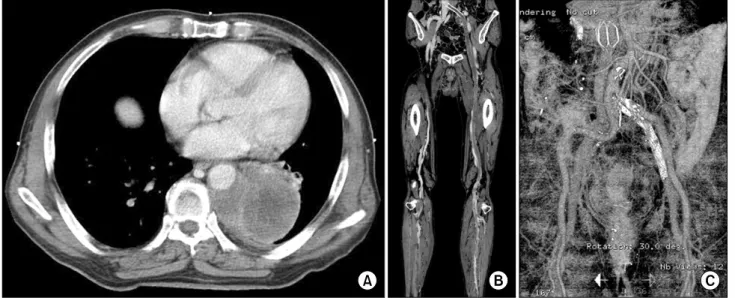
Fig. 1. Chest CT shows a 7.8 cm heterogeneously-enhancing mass in the medial aspect of the left lower lobe (A). Lower extremity CT angiogram reveals deep vein thrombosis involving the left lower extremity from the infrapopliteal veins to the common iliac vein (CIV), with a collapsed junction between the CIV and inferior vena cava (IVC) (B, C). IVC filter and vascular stent insertion on the left CIV was performed successfully.
J Lung Cancer 2008;7(1):36
36
May-Thurner Syndrome in Lung Cancer
May-Thurner syndrome is deep vein thrombosis (DVT) of the iliofemoral vein due to compression of the left common iliac vein (CIV) by the overlying right common iliac artery (CIA). In contrast to the right CIV, which ascends almost vertically to the inferior vena cava (IVC), the left CIV follows a more transverse course.
Along this course, it underlies the right CIA, which may compress it against the lumbar spine. A 69-year-old man with squamous cell lung cancer presented with acute onset painful left leg swelling. He had been undergoing chemotherapy with gemcitabine and cisplatin as a 2nd line treatment after concurrent chemoradiation. Physical examination revealed left leg edema with tenderness and warmth. The D-dimer level was elevated and a lower extremity computed tomographic angiogram (CTA) showed a DVT involving the left infrapopliteal vein to the common iliac vein with collapsed junction between the CIV and IVC.
Systemic anticoagulation with low molecular weight heparin (LMWH) and an IVC filter insertion was performed to prevent further thrombosis, such as a PTE. After IVC filter placement, mechanical thrombectomy was performed on the left femoral vein and left CIV. A vascular stent was then deployed in the left CIV. Left leg swelling seemed to be improved after heparinization, but he had a 2nd episode one week later. Therefore, he underwent a 2nd mechanical thrombectomy and stent deployment of the left external iliac vein. His leg swelling was gradually relieved. He has received LMWH for 3 months, and has received 2 cycles of pemetrexed followed by erlotinib. (J Lung Cancer 2008;7(1):36)
Key Words: May-Thurner syndrome, Deep vein thrombosis, Lung cancer
Su-Young Chi, M.D.
In-Jae Oh, M.D.
Kyu-Sik Kim, M.D. and Young-Chul Kim, M.D.
Department of Internal Medicine, Chon- nam National University Hwasun Hos- pital, Hwasun, Korea
Received: June 9, 2008 Accepted: June 13, 2008
Address for correspondence In-Jae Oh, M.D.
Department of Internal Medicine, Chon- nam National University Hwasun Hos- pital, 160, Ilsim-ri, Hwasun 519-809, Korea
Tel: 82-61-379-7617 Fax: 82-61-379-7619 E-mail: [email protected]