REVIEW ARTICLE
헬리코박터 제균 치료의 미래
이주엽
1, 김나영
1,2분당서울대학교병원 내과1, 서울대학교 의과대학 내과학교실 간연구소2
Future Trends of Helicobacter pylori Eradication Therapy in Korea
Ju Yup Lee1 and Nayoung Kim1,2
Department of Internal Medicine, Seoul National University Bundang Hospital, Seongnam1, Department of Internal Medicine and Liver Research Institute, Seoul National University College of Medicine, Seoul2, Korea
The prevalence of Helicobacter pylori infection in Korea shows a decreasing trend and has changed to that of developed country, especially for those below 30 years old. However, the primary antibiotic resistance rates are higher than those of developed countries. The reason for the decrease in the efficacy of standard triple therapy is mainly due to the increase in the resistance against clarithromycin. Sequential therapy seems to be more effective than the standard triple therapy, but the intention-to-treat eradication rate of sequential therapy in Korea, which is mostly under 80.0%, is still not satisfactory.
Therefore, a promising regimen is needed. Recently, the Japanese health insurance system admitted ‘H. pylori-infected gastritis’
as an indication of eradication. Furthermore, the Kyoto Consensus Meeting on H. pylori Gastritis held from January 30th to February 1st, 2014, proposed that ‘all H. pylori positive patients should be offered to receive H. pylori eradication’. This suggests that the concept of eradication has been changed from ‘treatment’ to ‘prevention’. Various individualized tailored therapy based on the polymorphism, age and other demographic factors and antibiotic resistance has been attempted to maximize H. pylori eradication therapy. The aim of this article is to review the current epidemiology, H. pylori resistance state, treatment guideline, and to assess the possible future strategy and treatment for H. pylori infection in Korea. (Korean J Gastroenterol 2014;63:158-170)
Key Words: Helicobacter pylori; Guidelines; Treatment; Prevention
CC This is an open access article distributed under the terms of the Creative Commons Attribution Non-Commercial License (http://creativecommons.org/licenses/
by-nc/3.0) which permits unrestricted non-commercial use, distribution, and reproduction in any medium, provided the original work is properly cited.
교신저자: 김나영, 463-707, 성남시 분당구 구미로 173번길 82, 분당서울대학교병원 내과
Correspondence to: Nayoung Kim, Department of Internal Medicine, Seoul National University Bundang Hospital, 82 Gumi-ro, 173beon-gil, Bundang-gu, Seongnam 463-707, Korea. Tel: +82-31-787-7008, Fax: +82-31-787-4051, E-mail: [email protected]
Financial support: This work was supported by a grant from the National Research Foundation of Korea funded by the Korean Government (2012R1A1B5002680).
Conflict of interest: None.
서 론
Helicobacter pylori는 그람 음성 막대균으로 사람의 위점 막에 장기간 기생하면서 만성위염, 소화성궤양, 위 변연부 B 세포 림프종, 그리고 위암을 일으킨다.1,2 1982년 배양에 성공 하면서 위점막에 서식하는 세균으로 인정받은 후, 여러 후속 연구들을 통하여 역학적 특성과 병태생리, 그리고 진단과 치 료방법 등에 괄목할 만한 진전이 이루어졌다. H. pylori 감염 의 치료는 소화성궤양의 재발을 억제하고, 위 변연부 B세포 림프종의 관해를 유도하며, 조기위암의 내시경 치료 후 재발
률을 낮출 수 있는 것으로 알려져 있으며,3,4 국내에서는 프로 톤펌프 억제제(proton-pump inhibitor, PPI)를 포함한 표준 삼제요법을 1차 치료로 사용하여 왔으나5 점점 증가하고 있는 항생제 내성으로 인해 그 효과가 감소하고 있다.6 2014년 1월 30일부터 2월 1일에 열린 Kyoto Consensus Meeting에서는 H. pylori 제균 치료가 위암 예방 효과가 있으며, 모든 H. py- lori 감염 환자에서 제균 치료를 권유하는 방안을 담고 있다.
이는 기존의 치료적 개념에서 예방적 개념의 제균 치료로 변 화를 뜻하며, 젊은 층을 중심으로 점차 H. pylori 감염률이 떨어지고 있는 우리나라에서도 이러한 추세에 발맞추어 제균
Fig. 1. Comparison of prevalence rate of Helicobacter pylori infection among China, Korea, and Japan. (A) Prevalence (using urea breath test or serum IgG antibody) by age in 2004-2005 in Jiangsu, China and in 2003 in Beijing, China.14,15 (B) Seroprevalence in asymptomatic subjects without a history of H. pylori eradication in 1998, 2005, and 2011 in Korea.16-18 (C) Prevalence (using urine antibody or serum IgG antibody) of H. pylori in 1992, 2002-2006, and 2007-2011 in Japan.19-21 Reused from the article of Shiota, et al. (Expert Rev Gastroenterol Hepatol 2013;7:35-40)21 with original copyright holder’s permission.
치료의 적응증을 넓히기 위해서는 기존의 제균요법에 대한 재 검토 및 새로운 제균 치료에 대한 논의가 필요하다고 본다.
이에 본 고에서는 H. pylori의 역학, 내성 증가 현황에 대해서 알아보고 최근 가이드라인의 변화 및 최근 대안으로 제시되고 있는 다양한 치료법을 정리함으로써 앞으로의 바람직한 방향 에 대해 논의해보고자 한다.
본 론
1. 역학
전 세계적으로 H. pylori 감염률은 성인 인구에서 50% 이 상이며, 감염빈도는 선진국일수록 낮고 개발도상국이나 저개 발국에서 높고, 성별, 연령, 지역적 분포, 종족 간에도 차이를 보인다.7 미국이나 유럽과 같은 선진국에서의 H. pylori 유병 률은 3-5세에 10-15%였다가 연령이 높아지면서 증가하지만, 인도나 사우디아라비아와 같은 개발도상국이나 저개발국의 경우에는 10세 이전에 40-60%의 높은 유병률을 나타내며,8,9 이는 성장기의 사회경제 여건의 중요성을 뒷받침해주고 있다.
같은 지역에서도 인종 간의 차이를 보여 라틴 아메리카계 미 국인의 경우 유병률이 80% 정도로 높고, 무증상 아프리카계 미국인의 경우 백인과 비교했을 때 연령별 H. pylori 감염률 의 증가는 비슷하나 유병률 자체는 훨씬 높다. 또한 흑인계 및 히스패닉(Hispanic)계 미국인들의 경우 H. pylori 유병률 이 사회경제적 요소를 보정한 후에도 백인들보다 2배가 높은
데,10,11 이러한 높은 유병률은 성장기의 열악한 사회경제적 여
건에 기인하는 것으로 밝혀져12,13 가족 수, 감염된 가족 구성 원 유무, 개인 위생 상태 및 사회경제적 인자가 H. pylori 유병 률 결정에 중요한 요소로 생각되고 있다.
중국과 우리나라, 그리고 일본의 H. pylori 유병률을 비교 해 보면, 중국의 장쑤성 일대 농촌지역의 경우 전 연령에서 감염률이 55% 이상으로 나타났으며,14 수도 베이징 일대의 감 염률은 이보다 낮기는 하지만 역시 전 연령에서 비슷한 감염 률을 보여,15 아동기에 H. pylori 감염률이 높은 전형적인 개 발도상국의 유형을 보이고 있다(Fig. 1A). 우리나라에서는 1998년 대한 H. pylori 연구회에서 총 5,732명의 제균력이 없 는 무증상 인구를 대상으로 전국적인 역학조사를 시행한 결 과, 16세 이상 성인에서의 혈청 유병률은 66.9%였고, 영유아 포함 15세 이하에서는 평균 17.2%로 나타났다.16 전국 건강검 진자 15,916명을 대상으로 한 2005년 연구에서는 16세 이상 제균력이 없는 무증상 성인에서의 혈청 유병률은 59.6%로 1998년에 비하여 감소하였으며,17 역시 같은 조건의 2011년 16세 이상 10,796명의 무증상의 건강검진 수진자 혈청 유병 률은 54.4%로 1998년 및 2005년과 비교하여 볼 때 유의하게 감소하는 추세였다.18 또한, 나이에 따른 유병률 조사에서도 모든 연령에서 감소하는 추세를 보였으며, 특히 40세 미만의 연령에서 감염률이 큰 폭으로 감소한 바 있다(Fig. 1B).18 일본 의 경우 우리나라보다 일찍 선진국형으로 바뀌었는데, 2007 년에서 2011년의 조사에서는 유아기의 H. pylori 감염률은 낮 고 이후 점점 증가하여 60대 이후로는 50% 중반에 이르는 그래프를 보이고 있으며, 이전 조사에 비해서 감염률은 점점 감소하고 있는 추세이다(Fig. 1C).19-21 이상에서 살펴본 바와 같이 전반적인 사회경제적 요인과 위생상태의 개선에 따라 우 리나라도 개발도상국의 감염 형태에서 선진국형으로 이행하 는 단계임을 알 수 있으며, cohort 효과로 인해 향후 40대 이후에서도 H. pylori 유병률은 점점 감소하는 양상을 보일 것으로 기대된다.
Table 1. Antibiotics Resistance Rates (%) for Helicobacter pylori Infection around the World
Antibiotics USA (1998-2002)29 Europe (2008-2009)30
Japan (2004-2005)28 China (2010-2012)41 Northern Central/Western Southern
Amoxicillin 0.9 <0.7 <0.7 <0.7 0.08 0.1
Clarithromycin 12.9 7.7 18.7 21.5 27.7 21.5
Metronidazole 25.1 28.6 43.8 29.7 2.1 94.5
Tetracycline - <0.9 <0.9 <0.9 - -
Ciprofloxacin - - - 13.7
Levofloxacin - 7.7 18.6 13.1 15.034 20.6
Table 2. Antibiotic Resistance Rates for Helicobacter pylori in Korea
Antibiotics
Seoul Gyeonggi Gyeonggi Gangwon Busan
198742 (n=34)
199442 (n=36)
199444 (n=63)
199544 (n=130)
199644 (n=129)
199744 (n=69)
1998- 199944 (n=65)
200342 (n=65)
2003- 20056 (n=69)
2006- 20086 (n=202)
2009- 20136 (n=204)
200845 (n=40)
200845 (n=40)
200845 (n=19)
Amoxicillin 0 5.6 0 0 0 0 0 18.5 7.2 7.4 17.2 12.5 10.0 9.1
Clarithromycin 0 2.8 4.8 4.6 3.9 11.6 7.7 13.8 23.2 27.2 37.3 32.5 12.5 26.3
Metronidazole 52.9 61.1 33.3 38.5 42.6 40.6 47.7 66.2 34.8 23.8 35.8 25.0 10.0 19.2
Tetracycline 5.9 0 3.0 6.9 4.7 2.9 7.7 12.3 8.7 11.9 10.8 12.5 7.5 15.2
Ciprofloxacin 0 13.9 - - - 33.8 17.4 29.7 38.2 40.0 22.5 30.0
Levofloxacin 0 0 - - - 21.5 5.8 23.3 37.7 22.5 22.5 23.2
Moxifloxacin 0 0 - - - 21.5 5.8 23.3 37.3 22.5 22.5 23.2
Resistant breakpoints of minimum inhibitory concentration (MIC) were defined as 0.5 mg/mL for amoxicillin, 1.0 mg/mL for clarithromycin, 8.0 mg/mL for metronidazole, 4.0 mg/mL for tetracycline, 1.0 mg/mL for ciprofloxacin, levofloxacin and moxifloxacin.
Values represent percent numbers (patients infected with resistant H. pylori/total subjects).
2. H. pylori 치료의 내성 증가 현황
H. pylori 치료에 있어서 가장 중요한 항생제는 clari- thromycin, metronidazole, amoxicillin이며 이 항생제들에 대한 내성 증가가 제균 치료 실패의 중요한 원인으로 작용하 고 있다.22-26 현재까지 가장 널리 사용되어 온 PPI에 amox- icillin과 clarithromycin을 병합한 표준 삼제요법의 제균율은 전 세계적으로 감소하고 있는 추세이며,22-26 clarithromycin 내성이 제균 실패의 주요 원인이다. 지역적인 차이는 있으나 이미 미국과 유럽, 아시아의 선진국에서 20% 이상의 높은 clarithromycin 내성률을 보이는 지역이 많지만, 유럽에서도 중부 유럽, 서유럽, 남유럽에서는 clarithromycin 내성이 20%를 넘고 있으나 북유럽은 10% 미만으로 그 내성이 낮았 다(Table 1).27 일본의 다기관 조사에서도 2002년의 clari- thromycin 내성률은 18.9%인데 반해 2006년의 clari- thromycin 내성률은 27.2%로 급격히 증가함을 보고하였다.28 미국과 유럽의 metronidazole 내성률은 20-40% 정도이고29,30 일본의 metronidazole 내성률은 2.1-24.0%이지만,28 아시아 의 일부 지역과 아프리카, 그리고 남아메리카 지역에서는 metronidazole 내성률이 80%가 넘는 지역도 있다.31-33 또한 quinolone 내성도 유럽과 아시아의 선진국에서 점차 증가하
는 것으로 보고되고 있으며,30,34 amoxicillin 내성률은 유럽에 서는 2% 미만으로 보고되고 있으나30,35,36 아프리카와 아시아, 그리고 라틴아메리카 지역에서는 6-59%로 보고되고 있다.37,38 Tetracycline의 내성률은 대부분의 나라에서 5% 미만으로 보 고되고 있으나(Table 1), 일부 아시아와 라틴아메리카에서는 9-27%까지 보고되고 있다.30,39-41 이러한 차이는 항생제 사용 패턴에 따른 지역적 차이겠지만 경우에 따라서는 agar dilu- tion법 내지 E-test와 같은 항생제 내성검사 방법의 차이에 기인했을 가능성을 배제할 수 없다.
2000년 이후 세계적 항생제 내성률 보고 및 한국에서 보고 된 H. pylori 일차 항생제 내성률을 살펴보면, clarithromycin 내성률 20% 이상, metronidazole 내성률 40% 이상, 그리고 quinolone 내성률 10% 이상으로 한국은 항생제 내성의 문제 가 심각한 국가 중 하나이다.39 국내 clarithromycin 내성률을 자세히 살펴보면(Table 2), 1987년 한양대학교병원과 서울대 학교병원에서 분리한 균주에서 0%와 1994년 2.8%로 낮았으 나 2003년에는 13.8%로 급격히 증가하였다.42 2003년 개원한 분당서울대병원에서 분리된 균주의 내성률은 2003년부터 2005년까지 23.2%, 2006년부터 2008년까지 27.2%, 2009년 에서 2013년까지 37.3%로 급격한 상승을 보이고 있다.6,43 Metronidazole 내성률은 한양대학교병원과 서울대학교병원
Table 3. Treatment Indication and Recommended First-line Regimen against Helicobacter pylori Infection by Japanese, Korean, and European Guideline
Japan (2009 revised edition)47 Korea (2013 revised edition)48 Europe (Maastricht IV, 2012)49 Indication H. pylori infection (Recommendation grade A) Evidence level A
1) Peptic ulcer disease (1A) 2) MALToma (1A)
3) Following EMR for EGC (1A) 4) Idiopathic thromcobytopenic purpura
(1A)
5) Functional dyspepsia (2A) Evidence level B
1) First-relatives of gastric cancer (2B) Evidence level C
1) Atrophic gastritis/intestinal metaplasia (2C)
2) Long-term use of low dose aspirin (2C)
Gastroduodenal diseases
Evidence level I Peptic ulcer disease
1) Peptic ulcer disease MALToma
2) Atrophic gastritis Following EMR for EGC
3) Idiopathic thromcobytopenic purpura Gastritis with preneoplastic conditions
4) Functional dyspepsia Functional dyspepsia
Evidence level II
1) Following EMR for EGC 2) Gastric hyperplastic polyps 3) Reflux esophagitis Evidence level III
1) Iron-deficiency anemia 2) Chronic urticaria 3) MALToma
Prior to NSAIDs therapy/additional to PPI therapy
In ‘Aspirin’ users with history of peptic ulcer
In patients on long term PPI Extragastric diseases
Idiopathic thrombocytopenic purpura Iron deficiency anemia
Vitamin B12 deficiency First-line
regimen
PPI (standard dose b.i.d.) Clarithromycin (200-400 mg b.i.d) Amoxicillin (750 mg b.i.d.)
PPI (standard dose b.i.d.) Clarithromycin (500 mg b.i.d) Amoxicillin (1,000 mg b.i.d.)
Prevalence of Clari-R <20%: PPI-Clari- amoxicillin/metronidazole
Prevalence of Clari-R >20%: bismuth quadruple therapy or sequential/
concomitant therapy
Duration 7 days 7-14 days 7 or 10-14 days
EMR, endoscopic mucosal resection; EGC, early gastric cancer; MALToma, mucosal associated lymphoid tissue lymphoma; PPI, proton pump inhibitor; Clari-R, clarithromycin resistance; b.i.d., bis in die (twice a day).
In Japan guideline47: Recommendation grade A, strongly recommended based on strong evidence; Evidence level I, systemic review/
meta-analysis; level II, at least one randomized controlled clinical trial; level III, non-randomizedcontrolled clinical studies.
In Korea guideline48: Evidence level A, high-quality evidence; level B, moderate-quality evidence; level C, low-quality evidence; strength of recommendation 1, strong; strength of recommendation 2, weak.
에서 분리한 균주에서 1987년 52.9%, 1994년 61.1%, 2003년 66.2%로 매우 높았으며,42 삼성서울병원에서 분리한 균주에 서의 내성률도 1994년 33.3%에서 1999년 47.7%로 꾸준히 증가하는 양상을 보였다.44 분당서울대학교병원의 metroni- dazole 내성률은 2003-2005년에 34.8%로 비교적 낮은 편이 고 2006-2008년에 23.8%로 더 감소하는 추세를 보이다가 2009-2013년까지는 35.8%로 다시 증가하는 양상을 보였다.43 Quinolone 계열 항생제(ciprofloxacin, levofloxacin, moxi- floxacin)의 내성률은 서울대학교병원 분리 균주에서 1987년 0%, 1994년 13.9%, 2003년 33.8%로 급격히 증가하였으며,42 이러한 급격한 증가 추세는 분당서울대학교병원 분리 균주에 서도 마찬가지로 확인할 수 있었다.43 2008년 시행한 경기, 강원, 부산 지역의 항생제 내성률 비교분석을 보면 clari- thromycin 내성률은 경기에서 32.5%, 부산에서 26.3%로 높 았으나 강원지역에서는 12.5%로 낮았으며, metronidazole 내성률 역시 강원지역에서는 10.0%로 낮았다. 하지만, qui- nolone 계열 항생제의 내성률은 세 지역 모두에서 20% 이상 으로 높게 측정되었다.45 두 가지 이상의 약제에 내성을 보이 는 다약제 내성 균주는 1987년 24%, 1994년 33%, 2003년 47.7%로 시간이 지남에 따라 증가하고 있다.42,46 이상에서 살
펴본 바와 같이 국내에서 항생제 내성 H. pylori 균주는 지속 적으로 증가하고 있는 추세이며, 다약제 내성 균주도 증가하 고 있는 추세이다. 한 기관에서 agar dilution법으로 진행된 경기, 강원, 부산 지역의 항생제 내성률의 차이는 아마도 지역 차이라기보다는 항생제 사용 패턴의 차이와 각 병원의 중증도 차이의 반영일 수 있겠으나 제균 치료의 지침을 지역적으로 달리 적용할 필요를 시사하는 결과라 하겠다.
3. 최근 가이드라인의 변화
세계 각 국가, 지역마다 H. pylori의 적절한 치료를 위해 지역적 특성을 고려한 진단 및 치료 지침을 제정하고 있다 (Table 3).47-52 본 고에서는 최근 H. pylori 치료전략에 있어서 큰 변화를 가져온 유럽 가이드라인49 및 제균 치료 대상의 변 화를 가져온 일본 가이드라인,47 그리고 가장 최근인 2014년 1월 30일에서 2월 1일 사이에 열린 Kyoto Global Consensus Meeting에 대해 살펴보고자 한다.
1) Maastricht IV Consensus Report (2012년)
2012년에 발표된 Maastricht IV Consensus Report에서 는 치료전략에 있어서 clarithromycin 내성을 고려한 것이 특 징이다. Clarithromycin 내성률 20%를 기준으로 내성이 낮은
지역과 높은 지역으로 구분하였는데, 내성이 낮은 지역에서는 clarithromycin을 포함한 삼제요법이 경험적 1차 치료로 권 장되고 bismuth 사제요법이 대안이 될 수 있으며, 치료에 실 패한 경우 bismuth 사제요법이나 levofloxacin을 포함한 삼 제요법을 2차 치료로 권장하고 있다. 반면, 내성이 높은 지역 에서는 bismuth 사제요법을 경험적 1차 치료로 권장하고 있 으며, 순차치료(sequential therapy) 혹은 동시치료(concom- itant therapy)를 1차 치료로 권장하고 있다. 순차치료 혹은 연속치료는 비록 clarithromycin을 포함하고 있으나 기존 발 표들에 의하면 치료 성공률이 약 75-95% 정도 되므로 clari- thromycin 내성을 어느 정도 극복할 수 있는 것으로 평가하 고 있다. Clarithromycin 내성이 높은 지역에서 순차치료로 의 1차 치료에 실패하게 되면 levofloxacin을 포함한 삼제요 법이 2차 치료로 권장되고 있다. Clarithromycin 내성에 관계 없이 2차 치료에 실패하게 되면, 배양 및 항생제 감수성 검사 를 시행한 후 3차 치료를 진행하기를 권장하고 있다. 즉, 항생 제 내성률에 따라 치료 전략을 달리해야 함을 강조하고 있는 것이다.
2) 제균 치료 대상의 최근 변화 - 일본(2013년 2월) 2009년 개정된 일본 H. pylori 치료 가이드라인에서는 H.
pylori 감염이 있을 경우 이와 연관된 질병이 없더라도 제균 치료를 할 것을 강력히 권고하였다(Recommendation grade A).47 일본의 약 절반 정도의 인구가 H. pylori에 감염되어 있 으며, H. pylori에 감염된 인구는 비록 위축성 위염, 소화성궤 양, 위암, 위 변연부 B세포 림프종 등의 질병이 없더라도 이러 한 H. pylori와 연관된 질병이 발생될 위험이 높기 때문에 이 를 예방하기 위해서, 또는 H. pylori 균의 전파를 막기 위한 예방적 차원에서 제균 치료를 시행하자는 개념인데, 제균에 성공하게 되면 위염의 조직학적 소견의 호전은 물론 소화성궤 양과 위암의 발생을 막을 수 있다는 연구에 기초한 것이었
다.53-55 이러한 일본 가이드라인 변화에도 불구하고 H. pylori
감염의 제균 치료에 대해서 최근까지 보험적용을 하지 않던 일본 정부가 2013년 2월부터 기존의 적응증이었던 (1) 소화성 궤양, (2) 위 변연부 B세포 림프종, (3) 조기위암의 내시경적 절제 후, (4) 특발성 혈소판 감소성 자반증의 네 가지 질환 적응증에 이어 내시경으로 진단된 (5) H. pylori 감염성 위염 (H. pylori infected gastritis)이면 모두 제균 치료를 보험 적 용되게 함으로써 세계적인 관심을 모으고 있다. 일본의 체계 적 문헌 고찰에서는 H. pylori 제균 치료는 위암의 유병률을 약 1/3 가량 감소시키는 것으로 보고한 바 있으며,56 제균 치 료 후 10년 동안 전향적으로 경과관찰을 한 연구들에서는 성 공적 제균 치료는 조직학적 염증이나 위축을 유의하게 호전시 키는 것으로 보고하고 있다.57,58 하지만 위험요소에 무관하게 H. pylori에 감염된 모든 사람을 대상으로 한 제균 치료(mass
eradication)가 위암을 예방할 수 있는가를 입증하려면 잘 고 안된 연구가 필요한데,59,60 이는 많은 수의 참가자를 대상으로 오랜 기간 동안 관찰이 필요하기 때문에 결코 쉽지 않다. 이러 한 어려움에도 불구하고 최근 위암의 유병률이 높은 아시아에 서 H. pylori 제균 치료의 위암 예방효과에 대한 대규모 연구 들이 시행되어 긍정적 결과를 제시하고 있다. 즉, 대만에서 2004년에서 2008년 사이 30세 이상 H. pylori에 감염된 5,000 명의 참가자를 대상으로 제균 치료를 시행하였고, 제균 치료 를 시행하지 않은 1995년에서 2003년 사이의 결과와 비교하 여 제균 치료의 위암 예방효과에 대해 발표함으로써 세계적 주목을 받은 바 있다.61 즉, 제균 치료 후 H. pylori의 감염률은 78.7%, 위축성 위염은 77.2%에서 감소하였으며, 위암 발생률 은 25% 감소한 결과를 보였다.61 중국에서 시행된 또 다른 연구에서는 H. pylori 혈청검사 양성인 2,258명을 제균 치료 군과 위약군으로 나누어서 15년 관찰한 결과 제균 치료를 시 행한 군에서 위약군보다 위암의 발생률이 39% 감소된 결과를 보였다.62 제균 시기가 중요한데, Asaka 등63,64은 40세 이전에 는 위축성 위염의 유병률이 낮기 때문에 H. pylori 제균 치료 를 시행할 경우 거의 100%에 가까운 위암 예방효과를 가져올 수 있는 반면, 50세 이상에서는 위축성 위염의 빈도가 높기 때문에 제균 치료를 시행하더라도 나이가 들수록 위암 발생 가능성이 높아지므로 제균 치료를 시행한 후에도 위축성 위염 의 유무와 그 정도에 따라 정기적인 내시경 검사를 시행해야 한다고 보고하였다. Wu 등65은 대만에서 약 80,000명의 소화 성궤양 환자를 제균 치료하고 10년 동안 관찰하였는데, H.
pylori 진단 즉시 제균 치료를 시행한 군은 H. pylori 진단 1년 후에 제균 치료를 시행한 군에 비해 위암의 발생률이 유의하 게 낮음을 보고하였다.
일본 H. pylori 가이드라인 및 최근 보험적용 내용의 변화 는 비록 예방적 제균 치료에 따르는 문제점을 감수하고서라도 연간 위암 사망인구가 50,000명에 달하는 일본에서 H. pylori 에 감염된 위를 가역적인 단계에서 조기에 구제하여 궁극적으 로 위암이 없는 일본을 후세들에게 물려주고자 하는 강한 의 지가 담겨져 있는 바,64,66 일본과 함께 위암 유병률이 높은 우 리나라에서도 이를 주목할 필요가 있겠다.
3) The Kyoto Global Consensus Meeting on H. pylori Gastritis (2014년 1월 30일-2월 1일)
2014년 1월 30일부터 2월 1일까지 Graham, Kuipers, Malfertheiner 등 전세계에서 22명, 그리고 일본에서 24명의 저명한 학자들이 Kyoto에 모여 H. pylori gastritis에 대한 Global Consensus Meeting을 가졌다. 총 4개의 세션(위염 의 분류, H. pylori와 연관된 소화불량, 위염의 진단, 위염의 치료)으로 나누어 23개(CQ1-23)의 질문에 대한 statement를 제정하였는데, 주요 내용들은 다음과 같이 요약할 수 있겠다.
Table 4. Current Recommended Regimens against Helicobacter pylori Infection
Treatment Regimen
First-line therapy
Standard triple therapy PPI (standard dose, b.i.d.), clarithromycin (500 mg, b.i.d.), amoxicillin (1 g, b.i.d.) for 7-14 days Bismuth quadruple therapy PPI (standard dose, b.i.d.), bismuth (standard dose, q.i.d.), tetracycline (500 mg, q.i.d.), metronidazole
(250 mg, q.i.d.) for 10-14 days
PPI (standard dose, b.i.d.), bismuth (standard dose, q.i.d.), tetracycline (500 mg, q.i.d.), amoxicillin (1,000 mg, t.i.d.) for 14 days
Sequential therapy Day 1-5: PPI (standard dose, b.i.d.), amoxicillin (1 g, b.i.d.)
Day 6-10: PPI (standard dose, b.i.d.), clarithromycin (500 mg, b.i.d.), metronidazole (500 mg, b.i.d.) Concomitant therapy PPI (standard dose, b.i.d.), clarithromycin (500 mg, b.i.d.), amoxicillin (1 g, b.i.d.), metronidazole (500
mg, b.i.d.) for 7-10 days
Hybrid therapy Day 1-7: PPI (standard dose, b.i.d.), amoxicillin (1 g, b.i.d)
Day 8-14: PPI (standard dose, b.i.d.), amoxicillin (1 g, b.i.d.), clarithromycin (500 mg, b.i.d.), metronidazole (500 mg, b.i.d.)
Second-line therapy
Bismuth quadruple therapy PPI (standard dose, b.i.d.), bismuth (standard dose, q.i.d.), tetracycline (500 mg, q.i.d.), metronidazole (500 mg, q.i.d.) for 10-14 days
Levofloxacin triple therapy PPI (standard dose, b.i.d.), levofloxacin (500 mg, q.d.), amoxicillin (1 g, b.i.d.) for 10 days Moxifloxacin triple therapy PPI (standard dose, b.i.d.), moxifloxacin (400 mg, q.d.), amoxicillin (1 g, b.i.d.) for 10 days Third-line therapy
Culture-guided therapy 10-day quadruple therapy: PPI (standard dose, b.i.d.), bismuth (standard dose, q.i.d.), two antibiotics selected by antimicrobial sensitivity tests
Levofloxacin quadruple therapy PPI (standard dose, b.i.d.), bismuth (standard dose, q.i.d.), levofloxacin (500 mg, q.d.), amoxicillin (500 mg, q.i.d.) for 10 days
Rifabutin-based triple therapy PPI (standard dose, b.i.d.), rifabutin (150 mg, b.i.d.), amoxicillin (1 g, b.i.d.) for 14 days
PPI, proton pump inhibitor; b.i.d., bis in die (twice a day); q.i.d., quater in die (4 times a day); t.i.d., ter in die (3 times a day); q.d., quaque die (once a day).
첫째, 위염의 분류에 있어서 주된 내용은 H. pylori 위염을
‘감염성 질환’으로 정의한 것이다. 비록 환자의 증상이 없고, 소화성궤양이나 위암 등에 관련된 질환이 없더라도 H. pylori 위염 자체를 감염성 질환으로 보아야 하며, 질병 분류에 있어 서도 H. pylori를 하나의 원인 인자로 간주해야 한다는 것이 다. 여기에 더하여 위염의 위치에 따라, 그리고 위염의 조직학 적 소견에 따라 세분화하는 것이 필요하다고 주장하고 있다.
둘째, H. pylori와 연관된 소화불량증에서 H. pylori 위염이 소화불량을 일으키는 하나의 원인인 것으로 규정하고 있다.
이에 더 나가 소화불량 증상 호전에 있어 제균 치료가 위약 (placebo군) 및 다른 치료보다 효과가 좋으므로 H. pylori 감 염 양성인 소화불량증의 경우 제균 치료를 1차 치료로 추천하 고 있다. 셋째, 위염의 진단에 있어서 Update Sydney System은 위염의 조직학적 진단에는 적합하지만 위축을 평 가하기 위해서는 개선이 필요하며, OLGA (operative link on gastritis assessment)와 OLGIM (operative link on gastric intestinal metaplasia assessment)은 위암의 위험도 예측에 유용하다고 하고 있다. 또한, 위축성 위염과 장상피화생의 진 단은 narrow band imaging-확대내시경 등의 신기술로 그 진단율을 높일 수 있으며, 혈청학적 표지자인 pepsinogen I, II 그리고 anti-H. pylori antibody는 위암의 고위험군을 선정 하는 데 유용하다고 하고 있다. 그리고 위축성 위염과 장상피
화생이 발생하기 이전의 나이에서 H. pylori 위염에 대한 스 크리닝을 시행할 것을 강조하고 있다. 넷째, 위염의 치료에서 가장 핵심적인 내용은 모든 H. pylori 양성 환자는 제균 치료 를 시행하자는 것인데, 의사는 H. pylori 감염이 확인되면 환 자에게 이 사실을 알리고 제균 치료의 필요성을 알려주어야 (offer) 한다는 것이다. 또한 제균 치료는 위암을 예방할 수 있지만, 제균 치료를 시행한다고 해서 위암의 위험요소가 제 거되는 것은 아니므로 50세 이상, 위축성 위염의 정도가 심하 거나 장상피화생 등의 위암 발생의 위험 요소가 있을 경우 정기적인 위내시경 검사를 추천하고 있다.
‘Time for a Change’를 모토로 내건 Kyoto Global Con- sensus Meeting은 진단 및 치료에 있어서 많은 급진적 변화 를 제시하고 있으며, 특히 소화불량증 환자에서 제균 치료의 필요성을 강조한다거나, 위암의 예방을 위해 모든 H. pylori 감염환자를 제균 치료의 대상으로 하고 있다는 점에서 우리나 라에서 이에 대한 더 많은 연구가 필요함을 느끼게 해준다.
4. 1차 치료의 대안은 무엇인가?
1) 표준 삼제요법의 실패
적합한 H. pylori 제균 치료법으로는 per protocol analy- sis (PP 분석)에서 90% 이상, intention-to-treat analysis (ITT 분석)에서 80% 이상 치료 성공률이 있어야 하며 부작용이 5%
Table 5. Summary of Meta-analysis Investigating the Efficacy of Sequential therapy Compared with Standard Triple Therapy
First author
Study years
RCT (n)
Patient (n) Region
Overall eradication
rate (ITT, %) Relative risk (95% CI)
SQT STT vs. STT vs. 7-day STT vs. 10-day STT vs. 14-day STT Jafri71 -2007 10 2,747 Italy 93.4 76.9 1.71 (1.64-1.77) 1.26 (1.20-1.33) 1.35 (1.24-1.53) - Gatta72 -2008 13 3,006 Italy 91.0 75.7 2.99 (2.47-3.62) 3.21 (2.61-3.97) 2.93 (1.95-4.39) -
Tong73 -2008 11 2,883 Italy 93.3 76.9 - 1.23 (1.19-1.27) 1.16 (1.10-1.23) -
Gatta80 2003-2013 46 5,666 Global 84.3 76.0 - 1.21 (1.17-1.25) 1.11 (1.04-1.19) 1.00 (0.94-1.06) Yoon82 2008-2013 17 3,419 Asia 81.8 74.3 1.10 (1.04-1.16) 1.15 (1.09-1.22) 1.05 (0.93-1.20) 1.06 (1.01-1.11)
Kim81 2008-2012 6 1,759 Korea 79.4 68.2 1.76 (1.40-2.21) - - -
RCT, randomized controlled trial; ITT, intention-to-treat; SQT, sequential therapy; STT, standard triple therapy.
이하, 가급적 1주일간의 치료 기간이 바람직하다고 권유되어
왔다.2,67,68 이에 맞추어 현재까지 가장 널리 사용된 H. pylori
제균 요법은 PPI에 2개의 항생제(amoxicillin, clarithromycin) 를 추가하는 표준 삼제요법이었다. 이 요법의 제균율은 초창 기에는 효과적인 것으로 인정받았지만 항생제 내성률의 증가 와 함께 그 제균율이 감소하여 메타분석을 포함한 국내외의 보고를 종합해보면 18% 정도만이 ITT 분석에서 제균율 85%
를 넘을 뿐, ∼60%에서는 ITT 분석에서 제균율이 80%에 미 치지 못한다고 한다.69 이미 서구에서는 표준 삼제요법을
‘legacy therapy’로 간주하고 있으며, 유럽 가이드라인에서도 clarithromycin 내성이 20% 미만일 때만 1차 치료로 권장하 고 있다. 표준 삼제요법의 실패의 대안으로 PPI와 세 가지의 항생제를 사용하는 다양한 형태의 치료가 시행되고 있는데, 대표적으로 순차치료, 동시치료, 변형 순차치료를 들 수 있겠 다(Table 4).
2) 순차치료, 동시치료는 적절한 대안이 될 수 있을까?
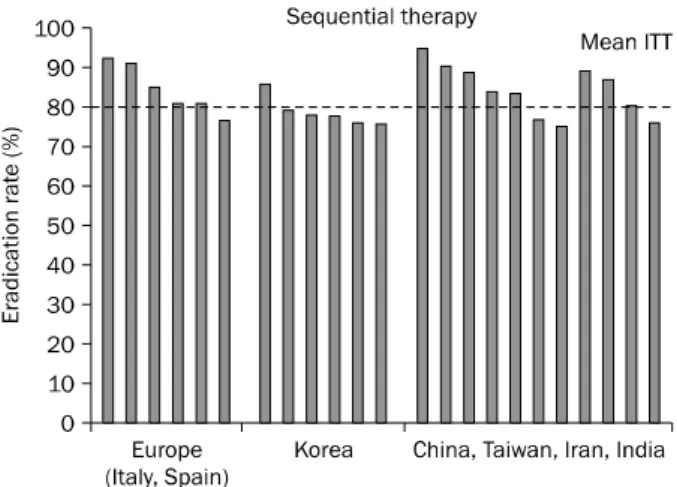
순차치료(sequential therapy)는 5일간 PPI와 amoxicillin 을 투약하고, 이후 나머지 5일간 clarithromycin과 metroni- dazole 혹은 tinidazole을 투약하는 것이다. 2000년 Zullo 등70 이 처음 소개하면서 그 제균율이 ITT 분석에서 98% (95% CI, 94.3-100)에 이른다고 보고하였다. 순차치료의 이론적 근거는 첫 5일간 amoxicillin을 투여하면 H. pylori 균주의 세포벽이 손상되어 clarithromycin과 같은 항생제가 균주 안으로 침투 하기 쉬워지고, 세포벽이 손상된 H. pylori 균주는 clari- thromycin을 밖으로 내보내는 채널이 형성되지 않아 clari- thromycin에 대한 내성이 발생하더라도 항생제의 효과가 그 대로 유지되어 제균 효과를 높인다는 것이다. 이탈리아에서 시행된 2008년 이전의 무작위 대조 연구를 기반으로 한 3개 의 메타분석 결과에 의하면 ITT 분석에서 순차치료의 제균율 은 91.0-93.5%로 표준 삼제요법의 75.7-79.2%에 비해서 유의 하게 높았다(Table 5).71-73 2008년 이후에 유럽(이탈리아, 스 페인)에서 시행된 무작위배정 연구에서 순차치료의 제균율은 ITT 분석에서 대부분 80%를 넘고 있으며, 비록 초창기보다
제균율이 조금 감소한 면은 있으나 여전히 표준 삼제요법에 비해 우월한 제균율을 보이고 있다.74-80 여섯 개의 무작위배정 전향적 연구를 기반으로 국내에서 진행한 메타분석 결과에 의 하면 순차치료의 제균율은 ITT 분석에서 79.4%, PP 분석에 서 86.4%였으며, ITT 분석에서 상대 위험도(relative risk)는 1.761로 순차치료가 표준 삼제요법보다 우수함을 입증하였다 (Table 5).81 하지만, 비록 표준 삼제요법에 비해서 우월한 제 균율을 보였지만 한국에서의 순차치료의 제균율은 기대만큼 높지 않았으며(ITT, 79.4%; 95% CI, 76.3-82.2) (Fig. 2),81 한국 을 포함한 아시아 지역에서도 마찬가지 결과를 보였는데,82 초 창기의 이탈리아의 결과와 비교해 보면 약 10% 정도 낮은 수치이다. 이는 한국을 포함한 아시아 지역의 H. pylori 항생 제 내성의 지역적 특성으로 설명할 수 있겠다. 이탈리아 지역 의 clarithromycin과 metronidazole의 동시 내성은 3.5-4.3%
에 불과한 반면,83,84 한국은 9.6%,85 중국은 20.5%,41 이란은 44.7%,86 인도는 47.0%87로 상대적으로 높은 비율을 보이고 있는 것이 특징이다. 각각의 항생제 내성의 유병률과 각 항생 제의 제균 성공률을 이용하여 전체 투약요법의 예측된 제균율 을 계산할 수 있는데, 이 계산에 따르면 clarithromycin 내성 이 있으며 10일 순차치료의 PP 제균율은 80%, metronida- zole 내성이 있으며 10일 순차치료의 PP 제균율은 75%로 예 상된다고 한다.88 Clarithromycin과 metronidazole의 동시내 성이 있을 경우는 치료 실패의 가능성이 더 높아지는데, 동시 내성이 5%를 초과할 경우 14일 순차치료의 PP 제균율은 90% 미만으로 감소한다고 한다.88
동시치료(concomitant)는 bismuth 비포함 사제요법(non- bismuth quadruple therapy)이라고도 불리는데, PPI와 amoxicillin, clarithromycin, metronidazole을 동시에 투약 하는 것이다. 2000년 초반까지의 연구를 기반으로 두 개의 메타분석의 ITT 분석에서 제균율은 90% 정도로 표준 삼제요 법에 비해 우수한 결과를 보였으며,89,90 최근에 시행된 2011 년까지의 15개의 연구 1,723명의 환자를 대상으로 한 메타분 석에서도 제균율은 ITT 분석에서 90%로 표준 삼제요법보다
Fig. 2. The mean intention-to-treat (ITT) eradication rate for sequential therapy reported after 2008 in Europe (Italy,74-79 Spain78,79), Korea,82 and Asia (China, Taiwan, India, and Iran).82
높은 결과를 보였다.91 최근 시행된 국내의 한 연구에서는 동 시치료의 제균율은 ITT 분석에서 80.7%로 표준 삼제요법 제 균율 72.6%에 비해 높았으나 통계적 차이는 없었고, 경미한 부작용은 동시요법(35.6%)에서 표준 삼제요법(25.2%)보다 더 많은 경향을 보였다.92 순차치료와 동등한 치료효과를 보이고
있으나77,79 부작용은 좀 더 빈번하다는 보고가 있다.77 하지만,
metronidazole 내성이 있을 경우 동시치료의 효과에 대해서 는 아직까지 데이터가 부족한 실정이며, clarithromycin과 metronidazole의 동시 내성이 15%를 초과할 경우 PP 제균율 은 90% 미만으로 감소하게 된다.88 변형 순차치료(hybrid therapy)는 PPI와 amoxicillin을 14일간 투여하고 후반 7일 에 clarithromycin과 metronidazole을 추가하는 방법으로 순 차치료와 동시치료를 병합해 놓은 방법이다.93,94 비록 복용방 법이 복잡하기는 하지만 14일 동시요법과 비교하여서 효과가 동등하다는 보고가 있으나,95 아직까지 관련 보고가 적어서 추 가적인 연구가 필요한 실정이다. 순차, 동시치료와 마찬가지 로 clarithromycin과 metronidazole 동시 내성이 9%를 초과 할 경우 제균율은 90% 미만으로 감소한다.88
전술한 바와 같이 우리나라의 clarithromycin과 metroni- dazole의 내성은 30%를 넘고 동시 내성도 10% 정도이므로 순차치료와 동시치료의 예상 제균 성공률은 기대에 미치지 못 할 것으로 생각되며, 이미 시행된 순차치료에 대한 메타분석 에서도 6개 중 5개 연구에서 ITT 제균율이 80% 미만이었다 (Fig. 2). 무엇보다도 항생제 내성을 극복하는 것이 가장 큰 문제로 생각된다. 항생제의 측면에서만 본다면 용량을 늘리거 나 기간을 연장하거나 아니면 내성이 없는 약제를 첨가하여 사용하는 방법이 원칙인데, 이를 고려한 새로운 제균 요법의 수립이 가장 필요한 상황이다.
5. 맞춤형 치료(tailored therapy)로 가는 길
H. pylori 제균 치료 효과를 극대화하기 위해 개인의 유전 적 다형성, 항생제 내성, 연령 등 다양한 인구학적 요소들을 고려한 개별화 맞춤형 치료의 시대가 도래하고 있다. 항생제 감수성 검사가 가능하다면 이 결과에 맞추어 적절한 항생제를 병합 처방하는 것이 기본 개념인데, 실제 임상에서 항생제 감 수성 검사를 시행하기 어려운 경우가 많으므로 최근에는 이를 손쉽게 알 수 있는 다양한 상품 개발에 노력을 기울이고 있다.
이 밖에도 흡연은 제균의 효과를 감소시킬 수 있음을,96 그리 고 동반된 만성질환(당뇨,97 고혈압,98 만성신부전99 등) 또한 제균율에 영향을 줄 수 있음을 고려해야 하겠다. 고령환자의 경우 제균 치료 시 부작용의 발생빈도가 높으며 일부에서는 연령이 증가할수록 제균율이 감소한다는 보고도 있다.25 하지 만 이러한 인구학적 요소들에 대한 확실한 증거는 부족한 실 정이어서 추가적인 연구가 필요하겠다.
1) CYP2C19 유전자 다형성
적절한 위산 억제와 H. pylori 균주 내성 여부가 제균 성공 에 중요한 요인이 되기 때문에 PPI를 기본으로 하는 표준 삼 제요법에서 CYP2C19 유전자형은 제균 성공을 판가름하는 중요한 인자가 될 수 있다. PPI는 간에 존재하는 cytochrome p450 system 중 주로 CYP2C19에 의해 대사되는 것으로 알 려져 있다. CYP2C19은 유전자형의 다형성에 따라 신속대사 자(extensive metabolizer), 중간대사자(intermediate me- tabolizer), 그리고 대사저하자(poor metabolizer)로 분류할 수 있다. 대사저하자의 경우 PPI의 대사가 매우 천천히 일어 나기 때문에 신속대사자에 비해 생체이용률이 20배 가량 높 은 것으로 알려져 있다.100 CYP2C19의 유전자형은 동서양에 서 확연한 차이를 보이는데, 대사저하자는 코카시안이나 아프 리카 아메리칸에서는 3-4%에 불과한 반면 한국인, 중국인에 서는 14%를, 일본인에서는 22.3%를 차지한다.100,101 CYP2C19 유전자형에 대한 이전 3개의 메타분석에 따르면 omeprazole 은 CYP2C19 유전자형에 영향을 받는 반면, rabeprazole은 영향을 받지 않았다.102-104 최근에 무작위배정 연구들을 기반 으로 한 메타분석에서는 대사저하자가 신속대사자에 비해 제 균율이 높았고 omeprazole과 lansoprazole을 투여하였을 경 우 제균율은 CYP2C19 유전자형의 영향을 받았으나 rabe- prazole과 esomeprazole은 CYP2C19 유전자형에 영향을 받 지 않는 것으로 보고되었다.105 국내에서는 lansoprazole과 rebeprazole을 이용한 삼제요법의 제균율은 CYP2C19 유전 자형에 영향을 받지 않았으나,106 다른 연구에서는 pan- toprazole과 esomeprazole 포함 삼제요법에서 대사저하자의 제균율이 신속대사자보다 의미 있게 높았다.6,107 그러나 아직 까지 국내에서 CYP2C19의 유전자형을 임상에서 검사하기는
쉽지 않다. 이러한 이유로 Second Asia-Pacific Consensus Guideline에서는 PPI의 종류와 용량을 조절하는 것이 더 실 질적인 접근 방법이라고 제시하고 있다.51
2) PCR을 이용한 clarithromycin 내성 돌연변이 검사 여러 연구를 통하여 clarithromycin 감수성 H. pylori 감염 환자의 경우 clarithromycin 포함 삼제요법의 성공률이 90-95%를 상회한다는 사실이 알려져 있다.108-110 따라서 우리 나라와 같이 clarithromycin 내성률이 높은 지역의 경우 치료 전 내성 검사를 통한 제균 치료 처방이 가장 효과적인 방법이 라 하겠다. 하지만 기존의 내성검사 방법인 H. pylori 배양 및 최소억제농도(minimum inhibitory concentration) 검사 는 다른 세균에 비해 매우 까다롭고 시간이 수 주에 이를 정도 로 오래 걸리며 표준화 또한 되어있지 않아, 시행을 하기 위해 서는 많은 노력과 비용이 소요되므로 실제 임상에서 거의 시 행되지 못하고 있는 실정이다. 최근 기존의 방법을 대체할 수 있는 신속 내성검사에 대한 연구가 지속적으로 이루어지고 있 는데, 그 중 하나로 dual priming oligonucleotide (DPO)- based multiplex PCR검사를 도입하여 개발된 Seeplex ClaR- H. pylori PCR kit (Seegene Inc., Seoul, Korea)가 있다.111 이 방법은 clarithromycin 23S rRNA 점 돌연변이 중 내성 여부와 관련성이 많이 알려진 A2142G, A2143G 돌연변이 여 부를 중합효소연쇄반응(PCR)을 이용해서 측정하는 것인 데,112 최근 상품화되어 사용되고 있다. 이 검사는 위 점막 조 직만으로도 비교적 간단히 검사가 가능하고 검사 소요시간은 수 시간에 불과하다는 장점이 있으며, 민감도와 특이도는 80-85% 정도이다.110 비용은 신속요소분해검사(rapid urease test)와 비슷하고 신기술로 보험적용을 고려하고 있어, 향후 일 차의료기관에서도 수탁검사를 이용하면 사용할 수 있을 것으로 생각된다.113
DPO-based multiplex PCR 방법을 통해 23S rRNA의 점 돌연변이를 판별하여 치료한 군과 경험적 치료로 PPI, amox- icillin, clarithromycin을 사용한 군, 그리고 PPI, amox- icillin, metronidazole을 사용한 군의 총 3군으로 나누어서 맞춤형 치료의 효과를 분석한 국내 연구에서는 맞춤형 치료의 제균율이 91.2%로 다른 두 군의 75.9%, 79.1%보다 유의하게 높은 결과를 보였다.114 일본의 한 연구에서도 제균 치료 전 대상 환자들의 CYP2C19 유전자형과 H. pylori 23S rRNA genotype 분석을 통하여 clarithromycin 내성 여부를 조사하 고 이에 맞추어 PPI 용량 및 투여 간격과 clarithromycin 사 용 여부를 결정하는 맞춤형 치료를 시행하였고, 95% 이상의 제균 성공으로 표준 삼제요법에 비해 우수한 성적을 보여준 바 있다.115
앞으로 이러한 신기술을 이용한 맞춤형 치료는 제균 치료 효과 극대화에 많은 도움을 줄 것으로 생각되며, 맞춤형 치료
가 표준 1차 제균 치료로 인정받기 위해서는 제균율 및 비용 효과의 우수성에 대한 더 많은 연구가 뒷받침되어야 할 것이다.
결 론
H. pylori에 감염된 모든 환자를 제균 치료 대상으로 하겠 다는 최근의 변화들은 아직까지 H. pylori 감염률이 50% 이상 으로 높고 위암의 유병률이 높은 우리나라에서 매우 주목해야 할 사항이다. Clarithromycin 내성이 높은 한국에서 표준 삼 제요법을 1차 치료로 사용하는 것에 대해서는 재고가 필요하 며, 순차치료는 표준 삼제요법보다는 효과가 우월하지만 이 또한 만족할 만한 효과를 보이지 않고 있어서 새로운 제균 요법의 수립이 절실한 상황이다. 이러한 요법이 수립되기 전 에는 23S rRNA의 점 돌연변이를 판별하여 제균 치료요법을 선택하는 방안으로 제균 치료효과를 극대화시키는 것이 필요 할 것으로 보인다. 향후 효과적 치료법의 수립을 위해서는 전 국적인 H. pylori 내성 조사 및 여러 가지 새로운 제균 요법에 대한 많은 연구들이 필요하겠다.
REFERENCES
1. McColl KE. Clinical practice. Helicobacter pylori infection. N Engl J Med 2010;362:1597-1604.
2. NIH Consensus Conference. H. pylori in peptic ulcer disease.
NIH Consensus development panel on Helicobacter pylori in peptic ulcer disease. JAMA 1994;272:65-69.
3. Graham DY, Lew GM, Klein PD, et al. Effect of treatment of Helicobacter pylori infection on the long-term recurrence of gastric or duodenal ulcer. A randomized, controlled study. Ann Intern Med 1992;116:705-708.
4. Bayerdörffer E, Neubauer A, Rudolph B, et al. Regression of pri- mary gastric lymphoma of mucosa-associated lymphoid tissue type after cure of Helicobacter pylori infection. MALT Lymphoma Study Group. Lancet 1995;345:1591-1594.
5. Kim N, Kim JJ, Choe YH, Kim HS, Kim JI, Chung IS; Korean College of Helicobacter and Upper Gastrointestinal Research;
Korean Association of Gastroenterology. Diagnosis and treat- ment guidelines for Helicobacter pylori infection in Korea.
Korean J Gastroenterol 2009;54:269-278.
6. Lee JY, Kim N, Kim MS, et al. Factors affecting first-line triple therapy of Helicobacter pylori including CYP2C19 genotype and antibiotic resistance. Dig Dis Sci 2014. doi: 10.1007/
s10620-014-3093-7. 1-9.
7. World Gastroenterology Organisation global guideline: Helico- bacter pylori in developing countries. J Dig Dis 2011;12:319- 326.
8. Klein PD, Graham DY, Gaillour A, Opekun AR, Smith EO. Water source as risk factor for Helicobacter pylori infection in Peruvian children. Gastrointestinal Physiology Working Group.
Lancet 1991;337:1503-1506.
9. al-Moagel MA, Evans DG, Abdulghani ME, et al. Prevalence of Helicobacter (formerly Campylobacter) pylori infection in Saudia Arabia, and comparison of those with and without up- per gastrointestinal symptoms. Am J Gastroenterol 1990;85:
944-948.
10. Malaty HM, Evans DG, Evans DJ Jr, Graham DY. Helicobacter py- lori in Hispanics: comparison with blacks and whites of similar age and socioeconomic class. Gastroenterology 1992;103:
813-816.
11. Graham DY, Malaty HM, Evans DG, Evans DJ Jr, Klein PD, Adam E. Epidemiology of Helicobacter pylori in an asymptomatic pop- ulation in the United States. Effect of age, race, and socio- economic status. Gastroenterology 1991;100:1495-1501.
12. Malaty HM, Graham DY. Importance of childhood socio- economic status on the current prevalence of Helicobacter py- lori infection. Gut 1994;35:742-745.
13. Bures J, Kopácová M, Koupil I, et al; European Society for Primary Care Gastroenterology. Epidemiology of Helicobacter pylori infection in the Czech Republic. Helicobacter 2006;11:
56-65.
14. Shi R, Xu S, Zhang H, et al. Prevalence and risk factors for Helicobacter pylori infection in Chinese populations. Helico- bacter 2008;13:157-165.
15. Cheng H, Hu F, Zhang L, et al. Prevalence of Helicobacter pylori infection and identification of risk factors in rural and urban Beijing, China. Helicobacter 2009;14:128-133.
16. Kim JH, Kim HY, Kim NY, et al; Korea H. pylori Study Group, South Korea. Seroepidemiological study of Helicobacter pylori infection in asymptomatic people in South Korea. J Gastroenterol Hepatol 2001;16:969-975.
17. Yim JY, Kim N, Choi SH, et al. Seroprevalence of Helicobacter pylori in South Korea. Helicobacter 2007;12:333-340.
18. Lim SH, Kwon JW, Kim N, et al. Prevalence and risk factors of Helicobacter pylori infection in Korea: nationwide multicenter study over 13 years. BMC Gastroenterol 2013;13:104.
19. Asaka M, Kimura T, Kudo M, et al. Relationship of Helicobacter pylori to serum pepsinogens in an asymptomatic Japanese population. Gastroenterology 1992;102:760-766.
20. Shiota S, Murakami K, Fujioka T, Yamaoka Y. Population-based strategies for Helicobacter pylori-associated disease manage- ment: a Japanese perspective. Expert Rev Gastroenterol Hepatol 2010;4:149-156.
21. Shiota S, Murakawi K, Suzuki R, Fujioka T, Yamaoka Y.
Helicobacter pylori infection in Japan. Expert Rev Gastroenterol Hepatol 2013;7:35-40.
22. Nishizawa T, Suzuki H, Suzuki M, Takahashi M, Hibi T. Proton pump inhibitor-amoxicillin-clarithromycin versus proton pump inhibitor-amoxicillin-metronidazole as first-line Helicobacter pylori eradication therapy. J Clin Biochem Nutr 2012;51:114- 116.
23. Oh HS, Lee DH, Seo JY, et al. Ten-day sequential therapy is more effective than proton pump inhibitor-based therapy in Korea:
a prospective, randomized study. J Gastroenterol Hepatol 2012;27:504-509.
24. Basu PP, Rayapudi K, Pacana T, Shah NJ, Krishnaswamy N, Flynn M. A randomized study comparing levofloxacin, omepra-
zole, nitazoxanide, and doxycycline versus triple therapy for the eradication of Helicobacter pylori. Am J Gastroenterol 2011;
106:1970-1975.
25. Perri F, Villani MR, Festa V, Quitadamo M, Andriulli A. Predictors of failure of Helicobacter pylori eradication with the standard 'Maastricht triple therapy'. Aliment Pharmacol Ther 2001;15:
1023-1029.
26. Bigard MA, Delchier JC, Riachi G, Thibault P, Barthelemy P.
One-week triple therapy using omeprazole, amoxycillin and clarithromycin for the eradication of Helicobacter pylori in pa- tients with non-ulcer dyspepsia: influence of dosage of ome- prazole and clarithromycin. Aliment Pharmacol Ther 1998;12:
383-388.
27. De Francesco V, Giorgio F, Hassan C, et al. Worldwide H. pylori antibiotic resistance: a systematic review. J Gastrointestin Liver Dis 2010;19:409-414.
28. Kobayashi I, Murakami K, Kato M, et al. Changing antimicrobial susceptibility epidemiology of Helicobacter pylori strains in Japan between 2002 and 2005. J Clin Microbiol 2007;45:
4006-4010.
29. Duck WM, Sobel J, Pruckler JM, et al. Antimicrobial resistance incidence and risk factors among Helicobacter pylori-infected persons, United States. Emerg Infect Dis 2004;10:1088-1094.
30. Megraud F, Coenen S, Versporten A, et al; Study Group participants. Helicobacter pylori resistance to antibiotics in Europe and its relationship to antibiotic consumption. Gut 2013;62:34-42.
31. Rafeey M, Ghotaslou R, Nikvash S, Hafez AA. Primary resist- ance in Helicobacter pylori isolated in children from Iran. J Infect Chemother 2007;13:291-295.
32. Datta S, Chattopadhyay S, Patra R, et al. Most Helicobacter py- lori strains of Kolkata in India are resistant to metronidazole but susceptible to other drugs commonly used for eradication and ulcer therapy. Aliment Pharmacol Ther 2005;22:51-57.
33. Sherif M, Mohran Z, Fathy H, Rockabrand DM, Rozmajzl PJ, Frenck RW. Universal high-level primary metronidazole resist- ance in Helicobacter pylori isolated from children in Egypt. J Clin Microbiol 2004;42:4832-4834.
34. Miyachi H, Miki I, Aoyama N, et al. Primary levofloxacin resist- ance and gyrA/B mutations among Helicobacter pylori in Japan. Helicobacter 2006;11:243-249.
35. Toracchio S, Marzio L. Primary and secondary antibiotic resist- ance of Helicobacter pylori strains isolated in central Italy dur- ing the years 1998-2002. Dig Liver Dis 2003;35:541-545.
36. Boyanova L. Prevalence of multidrug-resistant Helicobacter pylori in Bulgaria. J Med Microbiol 2009;58:930-935.
37. Asrat D, Kassa E, Mengistu Y, Nilsson I, Wadström T.
Antimicrobial susceptibility pattern of Helicobacter pylori strains isolated from adult dyspeptic patients in Tikur Anbassa University Hospital, Addis Ababa, Ethiopia. Ethiop Med J 2004;42:79-85.
38. Nahar S, Mukhopadhyay AK, Khan R, et al. Antimicrobial sus- ceptibility of Helicobacter pylori strains isolated in Bangladesh.
J Clin Microbiol 2004;42:4856-4858.
39. Boyanova L, Mitov I. Geographic map and evolution of primary Helicobacter pylori resistance to antibacterial agents. Expert
Rev Anti Infect Ther 2010;8:59-70.
40. Vakil N, Vaira D. Treatment for H. pylori infection: new chal- lenges with antimicrobial resistance. J Clin Gastroenterol 2013;47:383-388.
41. Su P, Li Y, Li H, et al. Antibiotic resistance of Helicobacter pylori isolated in the Southeast Coastal Region of China. Helicobacter 2013;18:274-279.
42. Kim JM, Kim JS, Jung HC, Kim N, Kim YJ, Song IS. Distribution of antibiotic MICs for Helicobacter pylori strains over a 16-year period in patients from Seoul, South Korea. Antimicrob Agents Chemother 2004;48:4843-4847.
43. Lee JW, Kim N, Kim JM, et al. Prevalence of primary and secon- dary antimicrobial resistance of Helicobacter pylori in Korea from 2003 through 2012. Helicobacter 2013;18:206-214.
44. Kim JJ, Reddy R, Lee M, et al. Analysis of metronidazole, clari- thromycin and tetracycline resistance of Helicobacter pylori isolates from Korea. J Antimicrob Chemother 2001;47:459- 461.
45. Kim JY, Kim NY, Kim SJ, et al. Regional difference of antibiotic resistance of Helicobacter pylori strains in Korea. Korean J Gastroenterol 2011;57:221-229.
46. Kim JM. Antibiotic resistance of Helicobacter pylori isolated from Korean patients. Korean J Gastroenterol 2006;47:337- 349.
47. Asaka M, Kato M, Takahashi S, et al; Japanese Society for Helicobacter Research. Guidelines for the management of Helicobacter pylori infection in Japan: 2009 revised edition.
Helicobacter 2010;15:1-20.
48. Kim SG, Jung HK, Lee HL, et al; Korean College of Helicobacter and Upper Gastrointestinal Research. Guidelines for the diag- nosis and treatment of Helicobacter pylori infection in Korea, 2013 revised edition. Korean J Gastroenterol 2013;62:3-26.
49. Malfertheiner P, Megraud F, O'Morain CA, et al; European Helicobacter Study Group. Management of Helicobacter pylori infection--the Maastricht IV/ Florence Consensus Report. Gut 2012;61:646-664.
50. Chey WD, Wong BC; Practice Parameters Committee of the American College of Gastroenterology. American College of Gastroenterology guideline on the management of Helicobacter pylori infection. Am J Gastroenterol 2007;102:1808-1825.
51. Fock KM, Katelaris P, Sugano K, et al; Second Asia-Pacific Conference. Second Asia-Pacific Consensus Guidelines for Helicobacter pylori infection. J Gastroenterol Hepatol 2009;
24:1587-1600.
52. Chinese Society of Gastroenterology, Chinese Study Group on Helicobacter pylori, Liu WZ, et al. Fourth Chinese National Consensus Report on the management of Helicobacter pylori infection. J Dig Dis 2013;14:211-221.
53. Fukase K, Kato M, Kikuchi S, et al; Japan Gast Study Group.
Effect of eradication of Helicobacter pylori on incidence of metachronous gastric carcinoma after endoscopic resection of early gastric cancer: an open-label, randomised controlled trial. Lancet 2008;372:392-397.
54. Gisbert JP, Khorrami S, Carballo F, Calvet X, Gené E, Dominguez-Muñoz JE. H. pylori eradication therapy vs. anti- secretory non-eradication therapy (with or without long-term
maintenance antisecretory therapy) for the prevention of re- current bleeding from peptic ulcer. Cochrane Database Syst Rev 2004;(2):CD004062.
55. Wong BC, Lam SK, Wong WM, et al; China Gastric Cancer Study Group. Helicobacter pylori eradication to prevent gastric can- cer in a high-risk region of China: a randomized controlled trial.
JAMA 2004;291:187-194.
56. Ito M, Takata S, Tatsugami M, et al. Clinical prevention of gastric cancer by Helicobacter pylori eradication therapy: a system- atic review. J Gastroenterol 2009;44:365-371.
57. Kodama M, Murakami K, Okimoto T, et al. Helicobacter pylori eradication improves gastric atrophy and intestinal metaplasia in long-term observation. Digestion 2012;85:126-130.
58. Kodama M, Murakami K, Okimoto T, et al. Ten-year prospective follow-up of histological changes at five points on the gastric mucosa as recommended by the updated Sydney system after Helicobacter pylori eradication. J Gastroenterol 2012;47:394- 403.
59. de Martel C, Ferlay J, Franceschi S, et al. Global burden of can- cers attributable to infections in 2008: a review and synthetic analysis. Lancet Oncol 2012;13:607-615.
60. Choi IJ. Current evidence of effects of Helicobacter pylori erad- ication on prevention of gastric cancer. Korean J Intern Med 2013;28:525-537.
61. Lee YC, Chen TH, Chiu HM, et al. The benefit of mass erad- ication of Helicobacter pylori infection: a community-based study of gastric cancer prevention. Gut 2013;62:676-682.
62. Ma JL, Zhang L, Brown LM, et al. Fifteen-year effects of Helicobacter pylori, garlic, and vitamin treatments on gastric cancer incidence and mortality. J Natl Cancer Inst 2012;
104:488-492.
63. Asaka M, Kato M, Graham DY. Strategy for eliminating gastric cancer in Japan. Helicobacter 2010;15:486-490.
64. Asaka M. A new approach for elimination of gastric cancer deaths in Japan. Int J Cancer 2013;132:1272-1276.
65. Wu CY, Kuo KN, Wu MS, Chen YJ, Wang CB, Lin JT. Early Helicobacter pylori eradication decreases risk of gastric can- cer in patients with peptic ulcer disease. Gastroenterology 2009;137:1641-1648.e1-2.
66. Asaka M, Kato M, Graham DY. Prevention of gastric cancer by Helicobacter pylori eradication. Intern Med 2010;49:633-636.
67. Lam SK, Talley NJ. Report of the 1997 Asia Pacific Consensus Conference on the management of Helicobacter pylori infection. J Gastroenterol Hepatol 1998;13:1-12.
68. European Helicobacter pylori Study Group. Current European concepts in the management of Helicobacter pylori infection.
The Maastricht Consensus Report. Gut 1997;41:8-13.
69. Graham DY, Fischbach L. Helicobacter pylori treatment in the era of increasing antibiotic resistance. Gut 2010;59:1143- 1153.
70. Zullo A, Rinaldi V, Winn S, et al. A new highly effective short-term therapy schedule for Helicobacter pylori eradication. Aliment Pharmacol Ther 2000;14:715-718.
71. Jafri NS, Hornung CA, Howden CW. Meta-analysis: sequential therapy appears superior to standard therapy for Helicobacter pylori infection in patients naive to treatment. Ann Intern Med
2008;148:923-931.
72. Gatta L, Vakil N, Leandro G, Di Mario F, Vaira D. Sequential ther- apy or triple therapy for Helicobacter pylori infection: system- atic review and meta-analysis of randomized controlled trials in adults and children. Am J Gastroenterol 2009;104:3069- 3079.
73. Tong JL, Ran ZH, Shen J, Xiao SD. Sequential therapy vs. stand- ard triple therapies for Helicobacter pylori infection: a meta-analysis. J Clin Pharm Ther 2009;34:41-53.
74. Urgesi R, Pelecca G, Cianci R, et al. Helicobacter pylori in- fection: is sequential therapy superior to standard triple ther- apy? A single-centre Italian study in treatment-naive and non-treatment-naive patients. Can J Gastroenterol 2011;25:
315-318.
75. Paoluzi OA, Visconti E, Andrei F, et al. Ten and eight-day sequen- tial therapy in comparison to standard triple therapy for erad- icating Helicobacter pylori infection: a randomized controlled study on efficacy and tolerability. J Clin Gastroenterol 2010;44:
261-266.
76. Romano M, Cuomo A, Gravina AG, et al. Empirical levo- floxacin-containing versus clarithromycin-containing sequen- tial therapy for Helicobacter pylori eradication: a randomised trial. Gut 2010;59:1465-1470.
77. Zullo A, Scaccianoce G, De Francesco V, et al. Concomitant, se- quential, and hybrid therapy for H. pylori eradication: a pilot study. Clin Res Hepatol Gastroenterol 2013;37:647-650.
78. Molina-Infante J, Perez-Gallardo B, Fernandez-Bermejo M, et al. Clinical trial: clarithromycin vs. levofloxacin in first-line triple and sequential regimens for Helicobacter pylori eradication.
Aliment Pharmacol Ther 2010;31:1077-1084.
79. McNicholl AG, Marin AC, Molina-Infante J, et al; Participant Centres. Randomised clinical trial comparing sequential and concomitant therapies for Helicobacter pylori eradication in routine clinical practice. Gut 2014;63:244-249.
80. Gatta L, Vakil N, Vaira D, Scarpignato C. Global eradication rates for Helicobacter pylori infection: systematic review and meta-analysis of sequential therapy. BMJ 2013;347:f4587.
81. Kim JS, Kim BW, Ham JH, et al. Sequential therapy for Helicobacter pylori infection in Korea: systematic review and meta-analysis. Gut Liver 2013;7:546-551.
82. Yoon H, Lee DH, Kim N, et al. Meta-analysis: is sequential ther- apy superior to standard triple therapy for Helicobacter pylori infection in Asian adults? J Gastroenterol Hepatol 2013;28:
1801-1809.
83. Vaira D, Zullo A, Vakil N, et al. Sequential therapy versus stand- ard triple-drug therapy for Helicobacter pylori eradication: a randomized trial. Ann Intern Med 2007;146:556-563.
84. Zullo A, Perna F, Hassan C, et al. Primary antibiotic resistance in Helicobacter pylori strains isolated in northern and central Italy. Aliment Pharmacol Ther 2007;25:1429-1434.
85. Chung JW, Jung YK, Kim YJ, et al. Ten-day sequential versus tri- ple therapy for Helicobacter pylori eradication: a prospective, open-label, randomized trial. J Gastroenterol Hepatol 2012;
27:1675-1680.
86. Abadi AT, Taghvaei T, Mobarez AM, Carpenter BM, Merrell DS.
Frequency of antibiotic resistance in Helicobacter pylori
strains isolated from the northern population of Iran. J Microbiol 2011;49:987-993.
87. Thyagarajan SP, Ray P, Das BK, et al. Geographical difference in antimicrobial resistance pattern of Helicobacter pylori clin- ical isolates from Indian patients: multicentric study. J Gastroenterol Hepatol 2003;18:1373-1378.
88. Graham DY, Lee YC, Wu MS. Rational Helicobacter pylori ther- apy: evidence-based medicine rather than medicine-based evidence. Clin Gastroenterol Hepatol 2014;12:177-186.e3.
89. Essa AS, Kramer JR, Graham DY, Treiber G. Meta-analysis:
four-drug, three-antibiotic, non-bismuth-containing "concomitant therapy" versus triple therapy for Helicobacter pylori eradication.
Helicobacter 2009;14:109-118.
90. Fischbach LA, van Zanten S, Dickason J. Meta-analysis: the ef- ficacy, adverse events, and adherence related to first-line an- ti-Helicobacter pylori quadruple therapies. Aliment Pharmacol Ther 2004;20:1071-1082.
91. Gisbert JP, Calvet X. Review article: non-bismuth quadruple (concomitant) therapy for eradication of Helicobater pylori.
Aliment Pharmacol Ther 2011;34:604-617.
92. Kim SY, Lee SW, Hyun JJ, et al. Comparative study of Helicobacter pylori eradication rates with 5-day quadruple
"concomitant" therapy and 7-day standard triple therapy. J Clin Gastroenterol 2013;47:21-24.
93. Hsu PI, Wu DC, Wu JY, Graham DY. Modified sequential Helicobacter pylori therapy: proton pump inhibitor and amox- icillin for 14 days with clarithromycin and metronidazole added as a quadruple (hybrid) therapy for the final 7 days.
Helicobacter 2011;16:139-145.
94. Sardarian H, Fakheri H, Hosseini V, et al. Comparison of hybrid and sequential therapies for Helicobacter pylori eradication in Iran: a prospective randomized trial. Helicobacter 2013;18:
129-134.
95. Molina-Infante J, Romano M, Fernandez-Bermejo M, et al.
Optimized nonbismuth quadruple therapies cure most pa- tients with Helicobacter pylori infection in populations with high rates of antibiotic resistance. Gastroenterology 2013;
145:121-128.e1.
96. Suzuki T, Matsuo K, Ito H, et al. Smoking increases the treat- ment failure for Helicobacter pylori eradication. Am J Med 2006;119:217-224.
97. Sargýn M, Uygur-Bayramicli O, Sargýn H, Orbay E, Yavuzer D, Yayla A. Type 2 diabetes mellitus affects eradication rate of Helicobacter pylori. World J Gastroenterol 2003;9:1126-1128.
98. Osawa H, Kawakami M, Fujii M, et al. Helicobacter pylori in- fection and coronary heart disease in Japanese patients.
Cardiology 2001;95:14-19.
99. Aydemir S, Boyacioglu S, Gur G, et al. Helicobacter pylori in- fection in hemodialysis patients: susceptibility to amoxicillin and clarithromycin. World J Gastroenterol 2005;11:842-845.
100. Dickson EJ, Stuart RC. Genetics of response to proton pump in- hibitor therapy: clinical implications. Am J Pharmacogenomics 2003;3:303-315.
101. Chong E, Ensom MH. Pharmacogenetics of the proton pump in- hibitors: a systematic review. Pharmacotherapy 2003;23:460- 471.