This is an Open Access article distributed under the terms of the Creative Commons Attribution Non-Commercial License (http://creativecommons.org/licenses/by-nc/3.0/) which permits unrestricted non-commercial use, distribution, and reproduction in any medium, provided the original work is properly cited.
© 2015 The Korean Society of Clinical Nutrition http://dx.doi.org/10.7762/cnr.2015.4.3.153 pISSN 2287-3732 ∙ eISSN 2287-3740
*Corresponding author Soon-Kyung Kim
Address Department of Food Science & Nutrition, Soonchunhyang University, 22 Soonchunhyang-ro, Sinchang-myeon, Asan 336-745, Korea
Tel +82-41-530-1261 Fax +82-41-530-1264 E-mail [email protected]
Received June 20, 2015 Revised July 10, 2015 Accepted July 23, 2015
Introduction
Cancer negatively affects the quality of life (QoL) ow- ing to the disease itself but also adverse effects of cancer therapy and the possibility of relapse. The best treatment for gastric cancer is determined by the survival rate and the QoL in patient after the treatment. Therefore, many studies have continued to evaluate the QoL in cancer patients [1]. Gastric cancer is the second most common cancer in Korea and the first among Koream men [2]. From an early stage of cancer development, gastric cancer patients experience malnutrition and weight loss mainly due to loss of appetite and decrease in bowel function. In addition, there are considerable changes in the physical symptoms and emotional status depending on the timing and the method of the treatment. Since these
Comparison of Quality of Life and Nutritional Status in Gastric Cancer Patients Undergoing Gastrectomies
Hee-Sook Lim
1,2, Gyu-Seok Cho
3, Yoon-Hyung Park
2, Soon-Kyung Kim
4*
1Department of Clinical Nutrition, Soonchunhyang University Bucheon Hospital, Bucheon 420-767, Korea
2Department of Preventive Medicine, Soonchunhyang University College of Medicine, Cheonan 330-930, Korea
3Department of Surgery, Soonchunhyang University Bucheon Hospital, Bucheon 420-767, Korea
4Department of Food Science & Nutrition, Soonchunhyang University, Asan 336-745, Korea
The aim of this study was to compare the quality of life (QoL) depending on the postoperative survival period or nutritional status in gastric cancer patients. Surviving gastric cancer patients (n = 222) after the gastrectomy were included in the study at Soonchunhyang University Bucheon Hospital from April 2010 to August 2012. The Korean versions of the European Organi- zation for Research and Treatment of Cancer (EORTC) Quality of Life Questionnaire Core 30 (QLQ-C30) and a gastric cancer- specific module, the EORTC QLQ-STO22, were used to assess the QoL. The postoperative survival period of the patients fell into two groups; the less-than-1-year group or the more-than-1-year group, and the nutritional status of the patients fell into three groups by a score of patient generated-subjective global assessment (SGA)-A, B, and C. As a result, the rate of malnutri- tion was 34.5% in the less-than-1-year group and 19.8% in the more-than-1-year group, respectively. Score for the fatigue (p = 0.006), loss of appetite (p = 0.002), reflux (p = 0.027) and body image (p = 0.004) in which the QoL was significantly lower in the less-than-1-year group than in the more-than-1-year group. The score of QoL according to the nutritional status of all subjects, overall health status (p = 0.043), physical functioning (p = 0.016), fatigue (p = 0.006), pain (p = 0.028), loss of appetite (p = 0.017), reflux (p = 0.003), eating restriction (p = 0.002), anxiety (p = 0.010), and body image (p = 0.001) was sig- nificantly lower in the SGA-C group than in other SGA groups. These results suggest that the nutritional status of the gastrec- tomy patients with stomach cancer may impact on their QoL. It is necessary to to develop nutritional intervention to improve QoL in gastric cancer patients with postoperative malnutrition.
Key Words: Stomach neoplasms, Gastrectomy, Nutritional status, Quality of life
conditions greatly affects the QoL, the demands on short- and long- term QoL assessment is getting increased [3]. In fact, studies on the QoL of Korean gastric patients have been conducted according to the type of reconstruction surgery, resection extent, and the status of long-term survival [4-6].
These studies have demonstrated that enhanced level of QoL with increasing survival rate of cancer patients was closely re- lated with the treatment methods or conditions. Cancer recur- rence is different for each type of cancer. Usually recurrence of gastric cancer is confirmed one year after surgery. On the other hand, the malnutrition rate in patients after gastrectomy is still high and several problems co-exist, including dumping syndrome, anemia, and nutrient malabsorption.
Therefore, it is very important to devlop a method to iden- tify the malnutrition early and to improve nutritional status because it is directly linked to patient symptoms and the QoL [7]. However, studies that simultaneously assess the nutritional status and QoL are limited in Korea. Therefore, we conducted this study to help improve the QoL of gastric cancer patients by investigating the malnutrition rate of gastric cancer pa- tients through the evaluation of nutritional status and the QoL, and to determine whether the QoL is different in gastric cancer patients depending on the postoperative survival pe- riod or nutritional status.
Materials and Methods
The subjects were 222 gastric cancer survivors who under- went gastrectomy at the Surgery Department of Soonchun- hyang University Hospital, and had no evidence of relapse and no disease in other organs. The goal of the study was thor- oughly explained to the patients, who then signed the consent form. The results were obtained through one-on-one inter- views. Clinicopathological factors including disease stage, sur- gical methods, extent of resection, and chemotherapy status were investigated by using the medical records, and the nutri- tional status was evaluated by the score of patient generated- subjective global assessment (PG-SGA), which the attending dietitian of the gastric cancer surgical team commonly uses for cancer patients. Using the evaluation score, the nutritional status was divided into three stages (SGA-A: well nourished, SGA-B: moderate malnutrition, SGA-C: severe malnutrition).
Korean versions of the European Organization for Research and Treatment of Cancer Core Questionnaire (EORTC) QLQ- C30 and the EORTC QLQ-STO22, corresponding to the gastric cancer module, were used to evaluate the QoL. The score was
calculated by investigating 15 scales from the EORTC QLQ-C30 and 9 scales from the EORTC QLQ-STO22. In the EORTC QLQ- C30, the QoL is higher when the general health and functional scale score is higher, and the QOL is lower when the symptom scale score is higher. In the EORTC QLQ-STO22, the QoL is low- er when the score of each category is higher. In this study, the postoperative survival period was divided into two groups (the less-than-1-year group and the more-than-1-year group) and the nutritional status into three groups (SGA-A, B, and C), and each indicator was analyzed comparatively. Statistical analysis for all data collected from the investigation were performed by using the SPSS program (ver. 18.0, SPSS Inc., Chicago, IL, USA). The Soonchunhyang University Medical School IRB ap- proved the study protocol. The general information of the patients was presented as means and standard deviation, and the postoperative malnutrition rate was analyzed by using the chi-square test. Analysis of covariance (ANCOVA), adjusted for gender and follow up duration, was conducted for comparison of QoL between groups according to postoperative elapsed time period. Among the groups divided by the nutritional status, the differences of QoL were also tested by ANCOVA adjusted for extent of gastric resection which showed the significant differences. Then, post hoc comparison was per- formed among groups of different nutritional status. For all analyses, p < 0.05 was considered statistically significant.
Results
Clinical characteristics
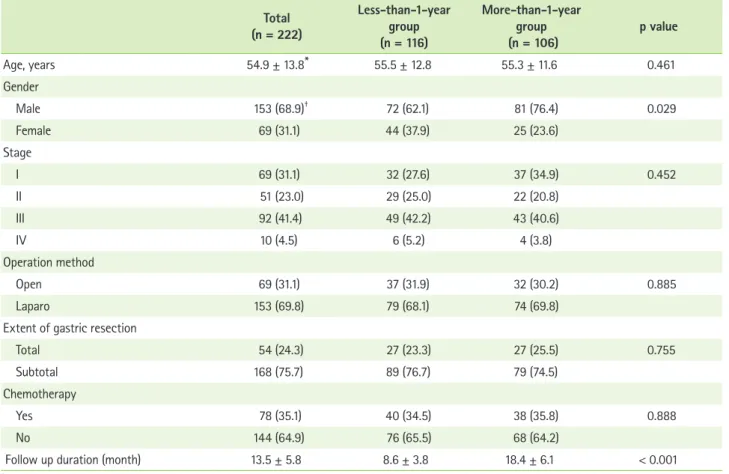
A total of 222 patients participated in the study; the mean age was 54.9, with 68.9% men and 31.1% women. A group of the less-than-1-year of post-operation, with a mean survival duration of 8.6 month, had 116 (52.3%) patients, and a group of the more-than-1-year of post-operation, with a mean survival duration of 18.4 months, had 106 (47.7%) patients.
When the final disease stage was classified according to the 6th Union for International Cancer Control (UICC), 120 (54.1%) patients had stage I and II while 102 (45.9%) patients had stage III and IV, showing no significant difference between the two groups. In terms of the surgical methods, 153 (68.9%) underwent laparoscopic surgery and 69 (31.1%) underwent laparotomy. Considering the resection extent, 168 (75.7%) received subtotal gastrectomy and 54 (24.3%) received total gastrectomy; adjuvant chemotherapy was administered to 78 patients (35.1%), and there was no significant difference in the distribution between the two groups (Table 1).
Malnutrition rate
When indicators of nutritional status were compared be- tween two groups of postoperative survival period, there was no difference in the serum albumin and hemoglobin levels, since these indicators were within the normal range in patient of both groups. The serum albumin level was significantly different after the surgery between two groups. The mean weight loss was 5.1% in the less-than-1-year group and 3.3%
in the more-than-1-year group, and the difference was sig- nificant (p < 0.001). The pre-operative malnutrition rate for all subjects was 4.5%. After surgery, the rate of moderate mal- nutrition and the rate of severe malnutrition was 25.9% and 8.6% in the less-than-1-year group and 17.0% and 2.8% in the more-than-1-year group, respectively; thus, the malnutri- tion rate was significantly higher in the less-than-1-year group (p < 0.05) (Table 2).
QoL according to the period of postoperative survival The overall health status considering the EORTC QLQ-C30 was lower in the less-than-1-year group, but the difference
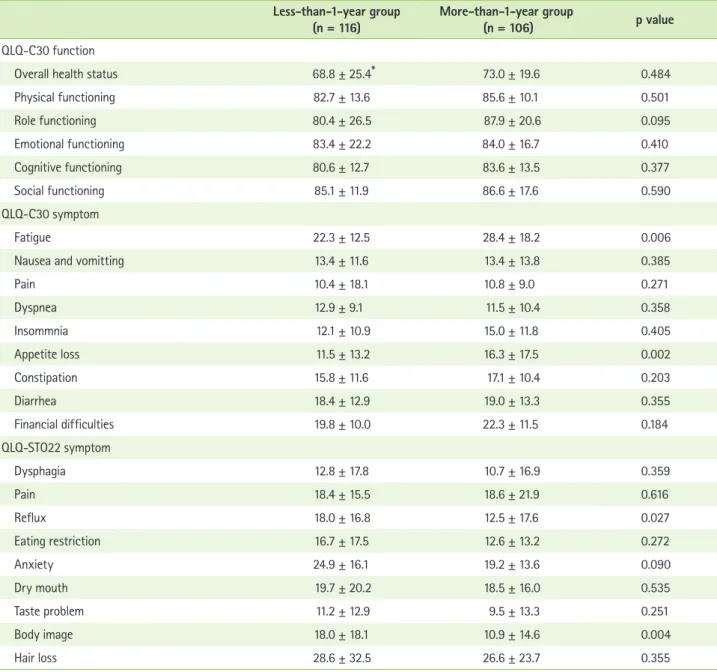
between two groups was not significant. When the 15 func- tional scales were compared, although the QoL considering the physical, emotional, congnitive and social function cat- egories was lower in the less-than-1-year group than in the more-than-10year group, the difference between two groups was not significant. In the 9 categories pertaining to symptom scales, the QoL considering fatigue, pain, sleep disorder, loss of appetite, diarrhea and finalcial difficulties was lower in the less-than-1-year group but the mean scores for nausea and vomiting were the same. On the other hand, the QoL consider- ing the dyspnea was higher in the less-than-1-year group than in the more-than-10year group. Among those symptoms, the symptoms that reached statistical significance were fatigue (p < 0.01) and loss of appetite (p < 0.01), in which the QoL was significantly lower in the less-than-1-year group. The QoL considering all the 9 categories of the QLQ-STO22 was lower in the less-than-1-year group, but the result was significant for only two categories of reflux (p < 0.05) and body image (p < 0.01) (Table 3).
Table 1. Clinicopathologic data according to the period of postoperative survival Total
(n = 222)
Less-than-1-year group (n = 116)
More-than-1-year group
(n = 106) p value
Age, years 54.9 ± 13.8* 55.5 ± 12.8 55.3 ± 11.6 0.461
Gender
Male 153 (68.9)† 72 (62.1) 81 (76.4) 0.029
Female 69 (31.1) 44 (37.9) 25 (23.6)
Stage
I 69 (31.1) 32 (27.6) 37 (34.9) 0.452
II 51 (23.0) 29 (25.0) 22 (20.8)
III 92 (41.4) 49 (42.2) 43 (40.6)
IV 10 (4.5) 6 (5.2) 4 (3.8)
Operation method
Open 69 (31.1) 37 (31.9) 32 (30.2) 0.885
Laparo 153 (69.8) 79 (68.1) 74 (69.8)
Extent of gastric resection
Total 54 (24.3) 27 (23.3) 27 (25.5) 0.755
Subtotal 168 (75.7) 89 (76.7) 79 (74.5)
Chemotherapy
Yes 78 (35.1) 40 (34.5) 38 (35.8) 0.888
No 144 (64.9) 76 (65.5) 68 (64.2)
Follow up duration (month) 13.5 ± 5.8 8.6 ± 3.8 18.4 ± 6.1 < 0.001
*Mean ± standard deviation; †Number (%).
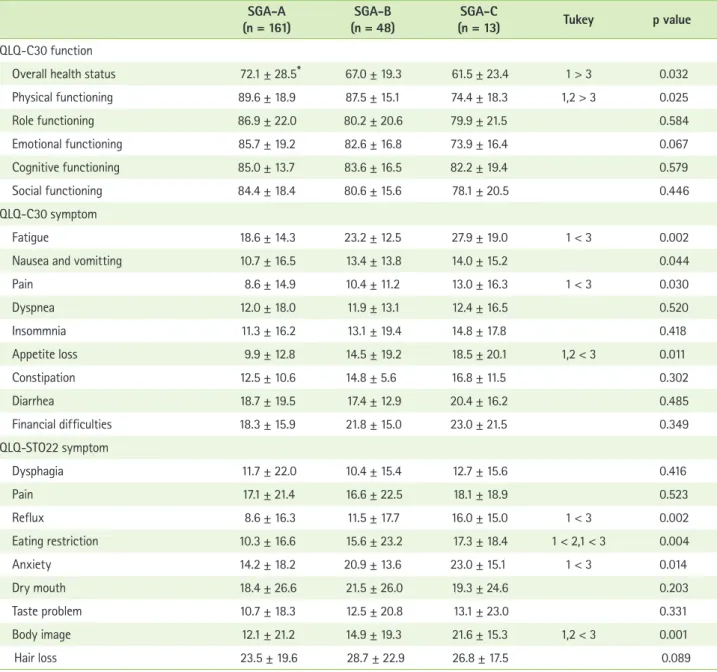
QoL according to the postoperative nutritional status When we compared the QoL according to the nutritional status of all subjects, the overall health status was the highest for the well-nourished group (SGA-A) (p < 0.05). In terms of the functional scales, the QoL of the SGA-A and SGA-B groups was higher than that of the SGA-C group in the physical funtioning (p < 0.05). Regarding the symptom scales, the QoL was significantly lower in the SGA-C group than in the SGA- A group for considering the categories of fatigue (p < 0.01) and pain (p < 0.05), and the QoL was significantly lower in the SGA-C group than in the other two groups for considering the category of loss of appetite (p < 0.05). Considering most categories of the QLQ-STO22, SGA-C group has significantly lower QoL for reflux (p < 0.01), eating restriction (p < 0.01), anxiety (p < 0.05), and body image (p < 0.01) (Table 4).
Discussion
The results from QoL studies in gastric cancer patients are diverse [4,8,9]. In studies of the QoL according to resection extent, patients who underwent partial resection showed a significant difference in the overall health status at 3 months after the surgery compared to the patients who underwent total resection [4]. In addition, the QoL was reported to be lower in patients whose diagnosed disease stage was higher and who underwent total resection [8], and the QoL was
higher in patients who underwent laparoscopic surgery than in patients who underwent laparotomy [9]. In this study, when the QoL categories were evaluated according to the postop- erative survival period, a significant difference was observed only in symptoms of fatigue, loss of appetite, reflux, and body image. This is somewhat different from the results reported by Park et al. [10], that the QoL score of both groups was lower than the mean score for overall health status and that signifi- cant differences were shown regarding the physical function, dyspnea, constipation, diarrhea, financial difficulties, loss of appetite, and body image between two groups.
The malnutrition rate of the subjects in our study was 34.5% in the less-than-1-year group but this number was decreased to 19.8% in the more-than-1-year group. This was slightly higher than the rate reported by Ryu & Kim [11] and similar to the result of Wu et al. [12]. As the postoperative nu- tritional status of patients are getting worse and manifested with weight loss and hypoalbuminemia even at 6 months after the surgery, continuous nutritional management is recom- mended [13]. From up to date studies which explored the rela- tionship between the nutritional status and QoL are very rare.
In a study by Seo et al. [14], there was no association between the QoL and nutritional indicators such as the total serum pro- tein and albumin levels, prognostic nutrition index (PNI), and a body weight. Regarding nutrient intake, the group with a lower QoL had significantly less intake of nutrients such as proteins, Table 2. Comparison of nutritional status according to the period of postoperative survival
Total
(n = 222) Less-than-1-year group
(n = 116) More-than-1-year group
(n = 106) p value
Albumin, g/dL Preoperative 4.3 ± 0.4* 4.3 ± 0.4 4.3 ± 0.4 0.932
Current 4.2 ± 0.5 4.1 ± 0.5 4.3 ± 0.5 0.009
Hemoglobin, g/dL Preoperative 13.1 ± 2.1 13.2 ± 2.1 13.0 ± 2.2 0.818
Current 13.3 ± 2.3 13.1 ± 2.7 13.5 ± 1.8 0.118
Weight loss change, % 4.4 ± 2.9 5.1 ± 3.4 3.3 ± 2.4 < 0.001
BMI gap, kg/m2 1.0 ± 0.9 1.2 ± 0.9 0.8 ± 0.6 < 0.001
Preoperative SGA grade A 212 (95.5)† 112 (96.6) 100 (94.3) 0.438
B 10 (4.5) 4 (3.4) 6 (5.7)
C 0 (0.0) 0 (0.0) 0 (0.0)
Current SGA grade A 161 (72.5) 76 (65.5) 85 (80.2) 0.033
B 48 (21.6) 30 (25.9) 18 (17.0)
C 13 (5.9) 10 (8.6) 3 (2.8)
BMI: body mass index, SGA: subjective global assessment.
*Mean ± standard deviation; †Number (%).
iron, and zinc, and such a problem was more severe in women than in men; thus, a balanced nutrient intake is emphasized to improve the post-operative QoL [15]. In our study, the QoL was significantly lower in the SGA-C group than in the SGA-A group considering the overall health status including function- al scales (physical functioning), and symptom scales (fatigue, pain, and loss of appetite) of the EORTC QLQ-C30, and the QoL in the SGA-C group was lower for considering reflux, eating restriction, anxiety, and body image scales of the QLQ-STO22.
This is consistent with the results from other study for the nunutritional evaluation by using the nutritional risk screen- ing (NRS) 2002, in which the QoL of the high-risk group with NRS ≥ 3 was significantly lower than that of other groups [16].
The association between the nutritional status and the QoL of cancer patients was well described in a study by Marín Caro et al. [17]. Therefore, as QoL markedly decreases when the nutri- tional status deteriorates, great efforts to prevent malnutrition to enhance early recovery from post-surgery need to be made.
Table 3. Comparison of quality of life according to the period of postoperative survival Less-than-1-year group
(n = 116) More-than-1-year group
(n = 106) p value
QLQ-C30 function
Overall health status 68.8 ± 25.4* 73.0 ± 19.6 0.484
Physical functioning 82.7 ± 13.6 85.6 ± 10.1 0.501
Role functioning 80.4 ± 26.5 87.9 ± 20.6 0.095
Emotional functioning 83.4 ± 22.2 84.0 ± 16.7 0.410
Cognitive functioning 80.6 ± 12.7 83.6 ± 13.5 0.377
Social functioning 85.1 ± 11.9 86.6 ± 17.6 0.590
QLQ-C30 symptom
Fatigue 22.3 ± 12.5 28.4 ± 18.2 0.006
Nausea and vomitting 13.4 ± 11.6 13.4 ± 13.8 0.385
Pain 10.4 ± 18.1 10.8 ± 9.0 0.271
Dyspnea 12.9 ± 9.1 11.5 ± 10.4 0.358
Insommnia 12.1 ± 10.9 15.0 ± 11.8 0.405
Appetite loss 11.5 ± 13.2 16.3 ± 17.5 0.002
Constipation 15.8 ± 11.6 17.1 ± 10.4 0.203
Diarrhea 18.4 ± 12.9 19.0 ± 13.3 0.355
Financial difficulties 19.8 ± 10.0 22.3 ± 11.5 0.184
QLQ-STO22 symptom
Dysphagia 12.8 ± 17.8 10.7 ± 16.9 0.359
Pain 18.4 ± 15.5 18.6 ± 21.9 0.616
Reflux 18.0 ± 16.8 12.5 ± 17.6 0.027
Eating restriction 16.7 ± 17.5 12.6 ± 13.2 0.272
Anxiety 24.9 ± 16.1 19.2 ± 13.6 0.090
Dry mouth 19.7 ± 20.2 18.5 ± 16.0 0.535
Taste problem 11.2 ± 12.9 9.5 ± 13.3 0.251
Body image 18.0 ± 18.1 10.9 ± 14.6 0.004
Hair loss 28.6 ± 32.5 26.6 ± 23.7 0.355
p values were calculated by ANCOVA adjusted for gender and follow up duration.
QLQ: quality of life questionnaire.
*Mean ± standard deviation.
This study has some limitations. Different recovery pat- terns among patients owing to variations in the elapsed time from the surgery could result in differences in QoL, but our classification might have been somewhat broad owing to a criterion value of 1 year. Unfortunately, QoL comparison or adjusting the results with the surgical method or range could not be performed. Though many studies has been performed to associate the surgical method and QoL, this study is still
meaningful because the study involved nutritional evalua- tion methods commonly used by dietitians. The results of this study implicate the relationship between nutritional status and QoL. Therefore, these two indicators could be included in the management protocol of postoperative gastric cancer and also be utilized in the care system of long-term survivals from gastric cancer.
Table 4. Comparison of quality of life according to nutritional status SGA-A
(n = 161) SGA-B
(n = 48) SGA-C
(n = 13) Tukey p value
QLQ-C30 function
Overall health status 72.1 ± 28.5* 67.0 ± 19.3 61.5 ± 23.4 1 > 3 0.032
Physical functioning 89.6 ± 18.9 87.5 ± 15.1 74.4 ± 18.3 1,2 > 3 0.025
Role functioning 86.9 ± 22.0 80.2 ± 20.6 79.9 ± 21.5 0.584
Emotional functioning 85.7 ± 19.2 82.6 ± 16.8 73.9 ± 16.4 0.067
Cognitive functioning 85.0 ± 13.7 83.6 ± 16.5 82.2 ± 19.4 0.579
Social functioning 84.4 ± 18.4 80.6 ± 15.6 78.1 ± 20.5 0.446
QLQ-C30 symptom
Fatigue 18.6 ± 14.3 23.2 ± 12.5 27.9 ± 19.0 1 < 3 0.002
Nausea and vomitting 10.7 ± 16.5 13.4 ± 13.8 14.0 ± 15.2 0.044
Pain 8.6 ± 14.9 10.4 ± 11.2 13.0 ± 16.3 1 < 3 0.030
Dyspnea 12.0 ± 18.0 11.9 ± 13.1 12.4 ± 16.5 0.520
Insommnia 11.3 ± 16.2 13.1 ± 19.4 14.8 ± 17.8 0.418
Appetite loss 9.9 ± 12.8 14.5 ± 19.2 18.5 ± 20.1 1,2 < 3 0.011
Constipation 12.5 ± 10.6 14.8 ± 5.6 16.8 ± 11.5 0.302
Diarrhea 18.7 ± 19.5 17.4 ± 12.9 20.4 ± 16.2 0.485
Financial difficulties 18.3 ± 15.9 21.8 ± 15.0 23.0 ± 21.5 0.349
QLQ-STO22 symptom
Dysphagia 11.7 ± 22.0 10.4 ± 15.4 12.7 ± 15.6 0.416
Pain 17.1 ± 21.4 16.6 ± 22.5 18.1 ± 18.9 0.523
Reflux 8.6 ± 16.3 11.5 ± 17.7 16.0 ± 15.0 1 < 3 0.002
Eating restriction 10.3 ± 16.6 15.6 ± 23.2 17.3 ± 18.4 1 < 2,1 < 3 0.004
Anxiety 14.2 ± 18.2 20.9 ± 13.6 23.0 ± 15.1 1 < 3 0.014
Dry mouth 18.4 ± 26.6 21.5 ± 26.0 19.3 ± 24.6 0.203
Taste problem 10.7 ± 18.3 12.5 ± 20.8 13.1 ± 23.0 0.331
Body image 12.1 ± 21.2 14.9 ± 19.3 21.6 ± 15.3 1,2 < 3 0.001
Hair loss 23.5 ± 19.6 28.7 ± 22.9 26.8 ± 17.5 0.089
p values were calculated by ANCOVA adjusted for extent of gastric resection.
QLQ: quality of life questionnaire.
*Mean ± standard deviation.
Conclusion
Our results indicate that the QoL of gastric cancer patients is getting lower with lesser elapsed time of post-gastrectomy and with a worsening of nutritional status. To improve the QoL when treating cancer, active nutritional management must be performed and continuous studies that integrate the effect of the long-term outcome and diet quality on the QoL are re- quired.
Conflict of Interest
We declare that we have no conflict of interest.
Acknowledgement
This work was supported by the Soonchunhyang University Research Fund.
References
1. Ferrell BR, Wisdom C, Wenzl C. Quality of life as an outcome variable in the management of cancer pain. Cancer 1989;63:2321-7.
2. Jung KW, Won YJ, Kong HJ, Oh CM, Cho H, Lee DH, Lee KH. Cancer sta- tistics in Korea: incidence, mortality, survival, and prevalence in 2012.
Cancer Res Treat 2015;47:127-41.
3. Yasuda K, Shiraishi N, Etoh T, Shiromizu A, Inomata M, Kitano S. Long- term quality of life after laparoscopy-assisted distal gastrectomy for gastric cancer. Surg Endosc 2007;21:2150-3.
4. Park S, Chung HY, Lee SS, Kwon O, Yu W. Serial comparisons of qual- ity of life after distal subtotal or total gastrectomy: what are the rational approaches for quality of life management? J Gastric Cancer 2014;14:32-8.
5. Kim AR, Cho J, Hsu YJ, Choi MG, Noh JH, Sohn TS, Bae JM, Yun YH, Kim
S. Changes of quality of life in gastric cancer patients after curative re- section: a longitudinal cohort study in Korea. Ann Surg 2012;256:1008- 13.
6. Lee JH, Kim YW, Ryu KW, Lee JR, Kim CG, Choi IJ, Kook MC, Nam BH, Bae JM. A phase-II clinical trial of laparoscopy-assisted distal gastrec- tomy with D2 lymph node dissection for gastric cancer patients. Ann Surg Oncol 2007;14:3148-53.
7. Horváth OP, Kalmár K, Cseke L, Pótó L, Zámbó K. Nutritional and life- quality consequences of aboral pouch construction after total gastrec- tomy: a randomized, controlled study. Eur J Surg Oncol 2001;27:558- 63.
8. Rausei S, Mangano A, Galli F, Rovera F, Boni L, Dionigi G, Dionigi R.
Quality of life after gastrectomy for cancer evaluated via the EORTC QLQ-C30 and QLQ-STO22 questionnaires: surgical considerations from the analysis of 103 patients. Int J Surg 2013;11 Suppl 1:S104-9.
9. Kim YW, Baik YH, Yun YH, Nam BH, Kim DH, Choi IJ, Bae JM. Improved quality of life outcomes after laparoscopy-assisted distal gastrectomy for early gastric cancer: results of a prospective randomized clinical trial. Ann Surg 2008;248:721-7.
10. Park JY, Eom BW, Jo MJ, Yoon HM, Ryu KW, Kim YW, Nam BH, Lee JH.
Health-related quality of life after robot-assisted distal gastrectomy in early gastric cancer. World J Surg 2014;38:1112-20.
11. Ryu SW, Kim IH. Comparison of different nutritional assessments in detecting malnutrition among gastric cancer patients. World J Gastro- enterol 2010;16:3310-7.
12. Wu GH, Liu ZH, Wu ZH, Wu ZG. Perioperative artificial nutrition in malnourished gastrointestinal cancer patients. World J Gastroenterol 2006;12:2441-4.
13. Sungurtekin H, Sungurtekin U, Balci C, Zencir M, Erdem E. The influence of nutritional status on complications after major intraabdominal sur- gery. J Am Coll Nutr 2004;23:227-32.
14. Seo KS, Lee JM, Kim WY. Comparison of reconstructive techniques after total gastrectomy as determined by patient quality of life and nutritional status. J Korean Gastric Cancer Assoc 2007;7:219-27.
15. Tian J, Chen JS. Nutritional status and quality of life of the gastric cancer patients in Changle County of China. World J Gastroenterol 2005;11:1582-6.
16. Gavazzi C, Colatruglio S, Sironi A, Mazzaferro V, Miceli R. Importance of early nutritional screening in patients with gastric cancer. Br J Nutr 2011;106:1773-8.
17. Marín Caro MM, Laviano A, Pichard C. Impact of nutrition on quality of life during cancer. Curr Opin Clin Nutr Metab Care 2007;10:480-7.