Effect of Renin-Angiotensin System Blockade on Mortality in Korean Hypertensive Patients with Proteinuria
Hyung Jung Oh1*, Clara Tammy Kim2*, and Dong-Ryeol Ryu3,4
1Ewha Institute of Convergence Medicine, Ewha Womans University Mokdong Hospital, Seoul,
2Institute of Life and Death Studies, Hallym University, Chuncheon,
3School of Medicine and 4Tissue Injury Defense Research Center, Ewha Womans University, Seoul, Korea
Received: June 7, 2019 Revised: October 10, 2019 Accepted: October 28, 2019
Corresponding Author: Dong-Ryeol Ryu, MD, PhD Department of Internal Medicine, School of Medicine, Ewha Womans University, 25, Magokdong-ro 2-gil, Gangseo-gu, Seoul 07804, Korea
Tel: +82-2-2650-2507 Fax: +82-2-2650-2501 E-mail: [email protected]
*HJ Oh and CT Kim equally contributed to this study.
Background: Although renin-angiotensin system (RAS) blockade is recom- mended for hypertensive patients with proteinuria, the effect of RAS block- ade on Korean hypertensive patients has not been investigated.
Methods: Among individuals who underwent a National Health Examination between 2002 and 2003 in Korea, hypertensive patients with proteinuria (defined as a dipstick test result ≥2+) were enrolled in this study. We in- vestigated the outcomes of two groups stratified by RAS blockade pre- scription (with RAS blockade vs. without RAS blockade). Moreover, Cox pro- portional hazard regression and Kaplan-Meier analyses were performed to examine the effects of RAS blockade on mortality and end-stage renal disease (ESRD).
Results: A total of 8,460 patients were enrolled in this study, of whom 6,236 (73.7%) were prescribed with RAS blockade. The mean follow-up pe- riod was 129 months. A total of 1,003 (11.9%) patients died, of whom 273 (3.2%) died of cardiovascular (CV) events. The Kaplan-Meier curves for all- cause or CV mortality showed that the survival probability was significantly higher in the RAS blockade group than in the non-RAS blockade group.
Multivariate Cox analysis also revealed RAS blockade significantly reduced the all-cause and CV mortality rates by 39.1% and 33.7%, respectively, compared with non-RAS blockade, even after adjusting for age, sex, and comorbid diseases; however, ESRD was not affected.
Conclusion: In this study, we found that RAS blockade was significantly associated with a reduction in mortality but not in the incidence of ESRD.
However, 26.3% of the enrolled patients did not use RAS blockade. Phy- sicians need to consider the usefulness of RAS blockade in hypertensive patients with proteinuria.
Key Words: Hypertension, Proteinuria, Renin-angiotensin system blockade, All-cause mortality, Cardiovascular mortality, End-stage renal disease
This is an Open Access article distributed under the terms of the Creative Commons Attribution Non-Commercial License (https://creativecommons.org/licenses/by-nc/4.0/) which permits unrestricted non-commercial use, distribution, and reproduction in any medium, provided the original work is properly cited.
Introduction
Proteinuria is a risk factor for cardiovascular (CV) and all-cause mortality in patients with diabetes mellitus (DM) and hypertension1). In addition, microalbuminuria (often
defined as 30 mg/g≤albumin-creatinine ratio<300 mg/g) also predicts mortality independent of the presence of DM and hypertension2). Randomized trials on protei- nuria-lowering treatment have emphasized the impor- tance of intervention in slowing the progression of chro-
nic kidney disease (CKD) and reducing the development of CV events3-6). However, as patients with proteinuria are typically asymptomatic, screening tests are needed to detect proteinuria7). Dipstick urinalysis is widely used as an initial screening tool for the evaluation of proteinuria owing to its low cost, wide availability, and ability to pro- vide rapid point-of-care information to clinicians and pa- tients8,9). These attributes suggest that a simple dipstick test for proteinuria is an ideal population-level screening tool for identifying individuals at a high risk of all-cause and/or CV mortality10).
Hypertension can be both a cause and a complication of CKD11) and has been identified as a key modifiable risk factor in patients with decreased renal function12). Pro- teinuria develops easily in damaged kidneys13-15). More- over, uncontrolled blood pressure (BP) leading to rapid renal dysfunction can cause increased proteinuria16,17). In- creased proteinuria accelerates the decline of kidney func- tion and the development of CV events15,18-20). Therefore, several clinical trials have highlighted the importance of strict BP control in slowing the progression of kidney disease and reducing the risk of CV disease8,21,22). How- ever, physicians must be aware of the presence of protei- nuria as well as the current BP status when caring for hypertensive patients. In addition, they should carefully consider which antihypertensive agents to prescribe for decreasing BP and proteinuria, as the ideal treatment will produce better renal and CV outcomes.
Antihypertensive agents that interfere with the renin- angiotensin system (RAS), including angiotensin-convert- ing enzyme inhibitors (ACEis) and angiotensin receptor blockers (ARBs), have been consistently shown to reduce proteinuria and the rate of renal function deterioration in patients with diabetic and non-diabetic kidney disease, independent of BP. Therefore, RAS blockade is recom- mended for its renoprotective benefits in hypertensive pa- tients with proteinuria, in addition to its BP-lowering ef- fect23-27). However, the frequency with which RAS block- ade is prescribed in hypertensive patients with proteinuria in Korea has not been reported. In addition, to our know- ledge, there have been no studies on the benefit of RAS blockade in patients with hypertension and proteinuria in comparison with the non-use of RAS blockade. We
investigated the clinical utility of RAS blockade by divid- ing the study population into two groups based on the use or non-use of RAS blockade treatment.
Materials and Methods
1. Source of dataThe National Health Insurance Service (NHIS) operates the National Health Insurance Sharing Service to provide sufficient support to policy and academic research. The National Health Information database contains records of 1.5 trillion cases and includes data on insurance eligi- bility, insurance contribution, health examination results, details of medical treatment, long-term care insurance for the elderly, and medical care institutions, as well as a registry of cancers and rare diseases.
We obtained data of the NHIS-Health Screening (NHIS-HEALS) cohort from the NHIS database. The NHIS-HEALS cohort database is a 12-year cohort dataset that includes socioeconomic variables (residence, year and month of death, cause of death, income level), details of medical treatment, and health examination results of ap- proximately 500,000 individuals from 2002 to 2013. The dataset was constructed by randomly selecting 10% of the Korean population who underwent a health examina- tion between 2002 and 2003. This dataset allows long- time observations for investigating causal relationships.
The study was approved by the NHIS review commit- tee and the institutional review board (IRB) of Ewha Womans University Mokdong Hospital (approval no.
NHIS-2016-2-066, IRB file: EUMC 2016-03-048).
2. Subjects
For the purposes of the current study, the subjects were restricted to hypertensive patients (defined by the pres- ence of one diagnostic code of hypertension: International Classification of Diseases, 10th revision [ICD10] code I10- I15) with proteinuria (defined as dipstick test result ≥2+).
We determined an index date for each patient, defined as the earliest date at which an individual was identified to have hypertension and had a qualifying proteinuria
Fig. 1. Diagram of patient selection. Ten percent of the Korean population who underwent a health examination between 2002 and 2003 were randomly extracted, and the subjects were res- tricted to those with hypertension and proteinuria. We excluded events with repetitive identification and divided the patients into two groups according to whether or not they were treated with RAS blockade, defined as having at least two prescriptions for RAS blockade medication during the follow-up period. RAS, renin- angiotensin system.
test. All cases were classified between January 1, 2002 and December 31, 2013 in Korea.
The following baseline covariates and comorbidities were considered: age, sex, health insurance type (National Health Insurance System and Medical Aid), disability type (none, light, and severe), history of acute myocardial in- farction, congestive heart failure, peripheral vascular dis- ease, cerebral vascular accident, dementia, chronic pulmo- nary disease, connective tissue disorder, peptic ulcer, liver dis- ease, DM, CKD (defined by the presence of one diag- nostic code of CKD: ICD10 code N18), cancer, and para- plegia. Systolic BP (SBP) and diastolic BP (DBP) were also considered. Patients with SBP <140 mmHg and DBP <90 mmHg at the time of BP measurement were considered to have well-controlled hypertension, whereas patients with SBP ≥140 mmHg or DBP ≥90 mmHg at the time of BP measurement were defined as having poorly con- trolled hypertension.
The process of patient enrollment is shown in the sche- matic flow diagram in Figure 1. The main study outcome was overall survival, which was further divided into all- cause and/or CV mortality (defined by the presence of one diagnostic code of CV mortality: ICD10 code I00-I78) in the absence of ESRD (defined by the presence of one diagnostic code of ESRD: ICD10 code N18.6 or the pres- ence of one therapeutic code of dialysis: O701-O708).
Patients were excluded if they had undergone dialysis be- fore the index date. RAS blockade was defined as having at least two prescriptions for an ACEi or ARB medication during the study period.
3. Statistical analysis
In the overall study population, continuous variables and categorical variables were compared between patients with RAS blockade and those without RAS blockade using t-tests and chi-square tests, respectively. Cox proportional hazard regression and Kaplan-Meier analyses were per- formed to examine the effects of RAS blockade on the de- velopment of all-cause mortality, CV mortality, and ESRD.
The analyses were performed in a backward stepwise man- ner. Moreover, we conducted an additional analysis to confirm the multicollinearity between the variables in the final models with three different outcomes. The values
of the variation inflation factors (VIFs) were further con- firmed. VIF measures the magnitude of the spread of the estimated accounting coefficients when the predictors are correlated. As the spread increases, the regression model becomes unreliable. Empirically, multicollinearity can pre- sent potential problems when VIFs are >4. The largest VIF in our model was 1.108, which shows some multi- collinearity but was not large enough to be a cause of concern. All reported p-values were two-tailed, and p<0.05 was considered significant. All statistical analyses were conducted using SAS (version 9.3; SAS Institute Inc., Cary, NC, USA) and R version 3.01 for Windows (http://cran.r-project.org/).
Results
1. Baseline characteristicsA total of 6,236 of 8,460 (73.7%) patients were pre-
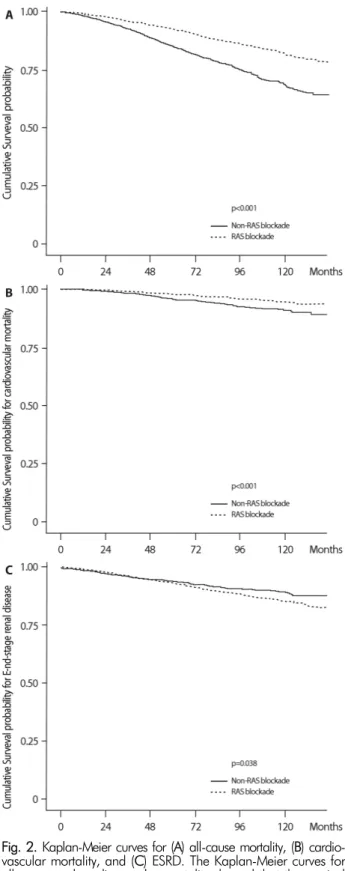
Fig. 2. Kaplan-Meier curves for (A) all-cause mortality, (B) cardio- vascular mortality, and (C) ESRD. The Kaplan-Meier curves for all-cause and cardiovascular mortality showed that the survival probability in the RAS blockade group was significantly higher than that in the non-RAS blockade group. Conversely, the occu- rrence of ESRD was significantly increased in the RAS blockade group compared with the non-RAS blockade group. ESRD, end- stage renal disease; RAS, renin-angiotensin system.
scribed with RAS blockade. The overall mean age was 56.2 years, and 5,263 (62.2%) of the patients were men.
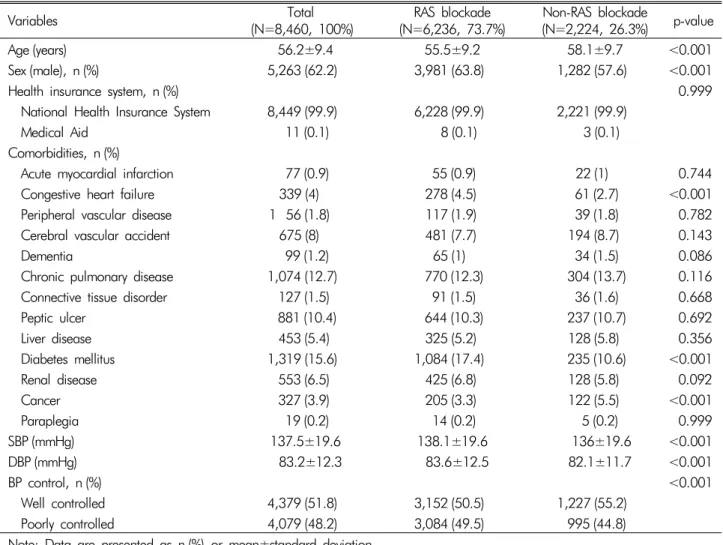
The mean age in the RAS blockade group was significan- tly lower than that in the non-RAS blockade group. There were significantly more men in the RAS blockade group than in the non-RAS blockade group. With respect to comorbidities, the RAS blockade group had a significantly higher incidence of congestive heart failure and DM but a lower incidence of cancer than the non-RAS blockade group. SBP and DBP were significantly increased in the RAS blockade group compared with the non-RAS bloc- kade group. Moreover, the ratio of patients with poorly controlled hypertension to those with well-controlled hy- pertension was higher in the RAS blockade group than in the non-RAS blockade group (3,084/3,152 [97.8%] vs.
995/1,227 [81.1%]) (Table 1).
2. Cox proportional hazard analysis for all-cause and/or CV mortality or ESRD
The mean follow-up duration was 129 months. A total of 1,003 patients (11.9%) died during the study period, of whom 273 (3.2%) died of CV events.
The incidence rate ratio, which was calculated as the incidence rate of RAS blockade divided by the incidence rate of non-RAS blockade, was 0.526 (95% confidence interval [CI] 0.463-0.598, p<0.001) for all-cause mortal- ity and 0.587 (95% CI 0.458-0.752, p<0.001) for CV mortality, whereas the incidence rate ratio for ESRD was 1.213 (95% CI 1.012-1.454, p<0.05), which means that the use of RAS blockade may have a protective effect against the risk of all-cause and CV mortality but a detri- mental effect on the incident risk of ESRD compared with the non-use of RAS blockade (Supplementary Table 1).
The Kaplan-Meier curves for all-cause and/or CV mor- tality showed that the survival probability in the RAS blockade group was significantly higher than that in the non-RAS blockade group (Fig. 2A and B).
Cox proportional regression analysis showed that all- cause mortality was decreased by 48.5% in the RAS bloc- kade group compared with the non-RAS blockade group (hazard ratio [HR] 0.515, 95% CI 0.454-0.585, p<0.001).
Moreover, RAS blockade significantly reduced the all-
Table 1. Baseline characteristics
Variables Total
(N=8,460, 100%) RAS blockade
(N=6,236, 73.7%) Non-RAS blockade
(N=2,224, 26.3%) p-value
Age (years) 56.2±9.4 55.5±9.2 58.1±9.7 <0.001
Sex (male), n (%) 5,263 (62.2) 3,981 (63.8) 1,282 (57.6) <0.001
Health insurance system, n (%) 0.999
National Health Insurance System 8,449 (99.9) 6,228 (99.9) 2,221 (99.9)
Medical Aid 11 (0.1) 8 (0.1) 3 (0.1)
Comorbidities, n (%)
Acute myocardial infarction 77 (0.9) 55 (0.9) 22 (1) 0.744
Congestive heart failure 339 (4) 278 (4.5) 61 (2.7) <0.001
Peripheral vascular disease 1 56 (1.8) 117 (1.9) 39 (1.8) 0.782
Cerebral vascular accident 675 (8) 481 (7.7) 194 (8.7) 0.143
Dementia 99 (1.2) 65 (1) 34 (1.5) 0.086
Chronic pulmonary disease 1,074 (12.7) 770 (12.3) 304 (13.7) 0.116
Connective tissue disorder 127 (1.5) 91 (1.5) 36 (1.6) 0.668
Peptic ulcer 881 (10.4) 644 (10.3) 237 (10.7) 0.692
Liver disease 453 (5.4) 325 (5.2) 128 (5.8) 0.356
Diabetes mellitus 1,319 (15.6) 1,084 (17.4) 235 (10.6) <0.001
Renal disease 553 (6.5) 425 (6.8) 128 (5.8) 0.092
Cancer 327 (3.9) 205 (3.3) 122 (5.5) <0.001
Paraplegia 19 (0.2) 14 (0.2) 5 (0.2) 0.999
SBP (mmHg) 137.5±19.6 138.1±19.6 136±19.6 <0.001
DBP (mmHg) 83.2±12.3 83.6±12.5 82.1±11.7 <0.001
BP control, n (%) <0.001
Well controlled 4,379 (51.8) 3,152 (50.5) 1,227 (55.2)
Poorly controlled 4,079 (48.2) 3,084 (49.5) 995 (44.8)
Note: Data are presented as n (%) or mean±standard deviation.
RAS, renin-angiotensin system; SBP, systolic blood pressure; DBP, diastolic blood pressure.
#Well-controlled patients: SBP <140 mmHg and DBP <90 mmHg at the time of blood pressure measurement (among hypertensive patients).
##Poorly controlled patients: SBP ≥140 mmHg or DBP ≥90 mmHg at the time of blood pressure measurement (among hypertensive patients).
cause mortality rate by 39.1%(HR 0.609, 95% CI 0.534- 0.693, p<0.001), even after adjusting for age, sex, health insurance system, comorbid diseases, and BP management (Table 2). CV mortality was also significantly decreased by 33.7% in the RAS blockade group compared with the non- RAS blockade group after adjusting for the same variables (HR 0.663, 95% CI 0.515-0.854, p=0.002) (Table 3).
In contrast, 682 patients (8.1%) progressed to ESRD during the follow-up period. Unlike all-cause and/or CV mortality, RAS blockade was not significantly associated with a decrease in the incidence of ESRD compared with non-RAS blockade after adjusting for the same variables.
Only Kaplan-Meier analysis showed that ESRD was sig- nificantly increased in the RAS blockade group compared with the non-RAS blockade group (Fig. 2C).
Discussion
In this study, 73.7% of patients with hypertension and proteinuria were treated with RAS blockade, whereas 26.3% were not. In addition, RAS blockade was signifi- cantly related to reducing the all-cause and/or CV mortality by 39.1% and 33.7%, respectively. However, RAS block- ade was not more effective in reducing the development
Table 2. Cox proportional hazard analysis for all-cause mortality among patients diagnosed with hypertension and proteinuria
Univariate Multivariate
HR 95% CI p-value HR 95% CI p-value
Prescribed with RAS blockade (vs. no RAS blockade) 0.515 (0.454-0.585) <0.001 0.609 (0.534-0.693) <0.001 Age (per 1 year) 1.088 (1.080-1.095) <0.001 1.083 (1.075-1.091) <0.001 Sex (female vs. male) 0.695 (0.608-0.794) <0.001 0.567 (0.494-0.650) <0.001 Health insurance system
(Medical Aid vs. National Health Insurance System) 2.468 (0.795-7.667) 0.118 2.154 (0.689-6.733) 0.187 Acute myocardial infarction 2.675 (1.699-4.212) <0.001 2.158 (1.366-3.409) 0.001 Congestive heart failure 2.279 (1.818-2.856) <0.001 1.969 (1.567-2.473) <0.001 Peripheral vascular disease 2.336 (1.613-3.382) <0.001 1.241 (0.852-1.810) 0.261 Cerebral vascular accident 1.960 (1.625-2.365) <0.001 1.336 (1.103-1.617) 0.003
Dementia 3.872 (2.508-5.976) <0.001 2.195 (1.413-3.410) <0.001
Chronic pulmonary disease 1.453 (1.224-1.726) <0.001 1.123 (0.943-1.336) 0.193 Connective tissue disorder 1.103 (0.683-1.782) 0.687 1.016 (0.628-1.644) 0.950
Peptic ulcer 0.944 (0.765-1.165) 0.593 0.872 (0.706-1.078) 0.205
Liver disease 1.170 (0.897-1.525) 0.246 1.341 (1.025-1.755) 0.033
Diabetes mellitus 1.589 (1.361-1.856) <0.001 1.478 (1.264-1.729) <0.001
Renal disease 2.181 (1.795-2.651) <0.001 2.342 (1.921-2.855) <0.001
Cancer 4.039 (3.264-4.998) <0.001 2.749 (2.211-3.417) <0.001
BP management (well controlled vs. poorly controlled) 0.896 (0.790-1.016) 0.087 0.895 (0.789-1.016) 0.088 HR, hazard ratio; CI, confidence interval; RAS, renin-angiotensin system; BP, blood pressure.
Adjusted for age, sex, health insurance system, comorbid diseases, and BP management.
#Well-controlled patients: SBP <140 mmHg and DBP <90 mmHg at the time of blood pressure measurement (among hypertensive patients).
##Poorly controlled patients: SBP ≥140 mmHg or DBP ≥90 mmHg at the time of blood pressure measurement (among hypertensive patients).
of ESRD than non-RAS blockade (Table 4).
Proteinuria in a person with high BP is indicative of de- clining kidney function and accelerates the development of CV events15-20). Therefore, emphasis should be placed on reducing proteinuria and strictly controlling BP for better renal and CV outcomes8,21,22). To date, RAS block- ade is known to have an effect of decreasing proteinuria and lowering the rate of renal function aggravation in pa- tients with diabetic and non-diabetic kidney disease, in- dependent of BP control. Therefore, in hypertensive pa- tients with proteinuria, RAS blockade is recommended for its renoprotective benefits in addition to its effects on BP23-27). Moreover, RAS blockade is well known to reduce CV and all-cause mortality and morbidity by preventing or reversing endothelial dysfunction and atherosclero- sis28-33). Thereby, RAS blockade reduces the risk of CV events and has been shown to be beneficial in patients at all stages of hypertension and in those with a risk of pro-
gression to atherosclerosis, target organ damage, and ultima- tely myocardial infarction, heart failure, stroke, or death.
Although we could not investigate the change of BP, atherosclerosis, and other conditions, we surmise that the benefit of RAS blockade in terms of preventing mortality may be explained by the above findings.
Consistent with previous studies23-27), the incidence of all-cause and/or CV mortality in our study was significan- tly lower in the RAS blockade group than in the non-RAS blockade group. However, unlike previous renal function trials15,18,20,34-37), RAS blockade was not superior in terms of reducing the incidence of ESRD compared with non- RAS blockade. Concerning the renoprotective effect of RAS blockade, there are several papers showing different results. According to Rahman et al.38), there is no differ- ence between lisinopril and chlorthalidone with respect to reducing the incidence of ESRD in hypertensive pati- ents. Moreover, Lewis et al.39) showed that in patients with
Table 3. Cox proportional hazard analysis for cardiovascular mortality among patients diagnosed with hypertension and proteinuria
Univariate Multivariate
HR 95% CI p-value HR 95% CI p-value
Prescribed RAS blockade (vs. no RAS blockade) 0.575 (0.449-0.737) <0.001 0.663 (0.515-0.854) 0.002 Age (per 1-year) 1.086 (1.072-1.101) <0.001 1.080 (1.065-1.095) <0.001 Sex (female vs. male) 0.749 (0.581-0.965) 0.025 0.575 (0.444-0.745) <0.001 Health insurance system
(Medical Aid vs. National Health Insurance System) 0.000 - 0.969 0.000 - 0.964 Acute myocardial infarction 2.586 (1.067-6.264) 0.035 1.933 (0.791-4.722) 0.148 Congestive heart failure 3.171 (2.170-4.634) <0.001 2.794 (1.904-4.099) <0.001 Peripheral vascular disease 2.707 (1.390-5.268) 0.003 1.538 (0.78-3.033) 0.214 Cerebral vascular accident 2.578 (1.861-3.572) <0.001 1.796 (1.286-2.508) 0.001
Dementia 6.274 (3.215-12.24) <0.001 3.127 (1.579-6.194) 0.001
Chronic pulmonary disease 1.419 (1.018-1.979) 0.039 1.100 (0.786-1.541) 0.579 Connective tissue disorder 1.447 (0.644-3.249) 0.371 1.232 (0.545-2.783) 0.616
Peptic ulcer 0.899 (0.596-1.357) 0.612 0.860 (0.570-1.300) 0.475
Liver disease 0.577 (0.285-1.165) 0.125 0.702 (0.346-1.424) 0.326
Diabetes mellitus 1.243 (0.901-1.715) 0.185 1.196 (0.865-1.654) 0.278
Renal disease 2.017 (1.373-2.965) <0.001 2.245 (1.522-3.312) <0.001
Cancer 1.335 (0.686-2.595) 0.395 0.929 (0.474-1.821) 0.830
BP management (well-controlled vs. poorly controlled) 0.808 (0.634-1.031) 0.087 0.824 (0.645-1.053) 0.122 HR, hazard ratio; CI, confidence interval; RAS, renin-angiotensin system; BP, blood pressure.
Adjusted for age, sex, health insurance system, comorbid diseases, and BP management.
#Well-controlled patients: SBP <140 mmHg and DBP <90 mmHg at the time of blood pressure measurement (among hypertensive patients).
##Poorly controlled patients: SBP ≥140 mmHg or DBP ≥90 mmHg at the time of blood pressure measurement (among hypertensive patients).
serum creatinine (sCr) level <1.0 mg/dL, captopril was as- sociated with only a 4% reduction in the risk of doubling of sCr level compared with that in the placebo group, whereas patients with baseline sCr >2.0 mg/dL derived the greatest benefit from captopril, with a 74% reduction in the same endpoint. These findings suggested that the stage of kidney disease might be important in determining who would obtain benefit from RAS blockade. A meta-analysis by Jafar et al.40) also supported the observation that RAS blockade provides better renoprotection in individuals with heavier proteinuria. Owing to the design of the present study, we were unable to determine the baseline proteinu- ria or sCr level, which made it difficult to determine the specific degree of proteinuria and the severity of renal dysfunction. As a result, we could not delineate the effect of RAS blockade on the progression of ESRD in this study.
However, only 6.5% of the patients enrolled in our study had a history of CKD (Table 1), which could be inter-
preted to mean that most patients had normal renal func- tion at the start of the study. A longer follow-up duration is needed to reveal the effect of RAS blockade on the incidence of ESRD.
Although our findings were not consistent with previ- ous results showing that the use of RAS blockade provides protection against adverse renal outcomes15,20,34,36,39,41,42), there are some other studies that failed to show the be- neficial effects of RAS blockade on renal outcomes. In a prospective diabetes study on patients with hyperten- sion and type 2 DM in the United Kingdom, the incidence of renal failure was not different between the captopril and atenolol groups43). Moreover, Suissa et al.44) reported that ACEi use did not seem to decrease the long-term risk of ESRD in patients with diabetes. In addition, com- bination treatments with ACEis and ARBs worsened the renal outcomes45). Moreover, a recent study by Oh et al.46) showed that habitual use of RAS blockade in predialysis
Table 4. Cox proportional hazard analysis for ESRD among patients diagnosed with hypertension and proteinuria
Univariate Multivariate
HR 95% CI p-value HR 95% CI p-value
Prescribed with RAS blockade
(vs. without RAS blockade) 1.211 (1.010-1.452) 0.038 1.009 (0.838-1.215) 0.923
Age (per 1 year) 1.001 (0.993-1.009) 0.747 1.001 (0.993-1.009) 0.876
Sex (female vs. male) 0.700 (0.595-0.824) <0.001 0.789 (0.669-0.931) 0.005 Health insurance
(Medical Aid vs. National Health Insurance System) 0.000 - 0.948 0.000 - 0.946 Acute myocardial infarction 2.488 (1.406-4.404) 0.002 2.082 (1.170-3.705) 0.013 Congestive heart failure 1.693 (1.248-2.298) 0.001 1.633 (1.199-2.225) 0.002 Peripheral vascular disease 1.366 (0.789-2.366) 0.265 1.029 (0.592-1.791) 0.919 Cerebral vascular accident 1.226 (0.942-1.595) 0.129 1.211 (0.926-1.583) 0.162
Dementia 0.199 (0.028-1.417) 0.107 0.201 (0.028-1.432) 0.109
Chronic pulmonary disease 1.078 (0.859-1.353) 0.519 1.011 (0.803-1.274) 0.923 Connective tissue disorder 0.941 (0.504-1.756) 0.848 0.812 (0.433-1.523) 0.517
Peptic ulcer 1.018 (0.795-1.303) 0.890 0.987 (0.770-1.265) 0.917
Liver disease 0.745 (0.507-1.095) 0.134 0.708 (0.481-1.043) 0.081
Diabetes mellitus 1.634 (1.361-1.962) <0.001 1.728 (1.437-2.079) <0.001
Renal disease 10.58 (8.941-12.53) <0.001 10.432 (8.787-12.39) <0.001
Cancer 1.488 (1.032-2.146) 0.033 1.387 (0.957-2.009) 0.084
BP management
(well-controlled vs. poorly controlled) 0.876 (0.752-1.020) 0.088 0.837 (0.718-0.977) 0.024 HR, hazard ratio; CI, confidence interval; RAS, renin-angiotensin system; BP, blood pressure.
Adjusted for age, sex, health insurance system, comorbid diseases, and BP management.
#Well-controlled patients: SBP <140 mmHg and DBP <90 mmHg at the time of blood pressure measurement (among hypertensive patients).
##Poorly controlled patients: SBP ≥140 mmHg or DBP ≥90 mmHg at the time of blood pressure measurement (among hypertensive patients).
patients with advanced CKD may have a detrimental ef- fect on renal outcomes without improving all-cause mor- tality. We could not investigate how many patients had advanced CKD and how many patients had received com- bination treatment (ACEi and ARB), which is one of the limitations of the current study. Thus, our results on the renoprotective effects of RAS blockade should be carefully interpreted. In contrast, considering the above-mentioned previous studies, evidence supporting the renoprotective effects of RAS blockade might also need to be carefully reconsidered.
Furthermore, we also conducted the same analysis after stratifying patients into four groups according to RAS blockade treatment: ACEi or ARB users, ARB only users, ACEi only users, and non-users of RAS blockade. As seen in Supplementary Table 2, all-cause mortality and CV
mortality were significantly reduced when the patients used ARB only or either ACEi or ARB compared with non-use of RAS blockade. However, we did not observe a protective effect against all-cause mortality and CV mor- tality in ACEi only users. Moreover, RAS blockade had no benefit with respect to the incidence of ESRD.
We investigated the number of annual prescriptions of RAS blockers (Supplementary Fig. 1). Although the num- ber of prescriptions of ACEi only was decreased during the follow-up period, the number of prescriptions of ARB only was remarkably increased from 2007. The promi- nent increase in the prescription of ARBs cannot be pre- cisely explained; however, the preference of physicians might have led to the above results. Considering such a skewed prescription between ACEis and ARBs, we sur- mise that these data are limited in indicating the protec-
tive effect of each of ACEis and ARBs on the clinical out- comes. The purpose of this study was to provide a com- prehensive review of the effects of ACEis and ARBs in Korea. To identify factors associated with the effective- ness of commonly used antihypertensive drugs, further precise studies including patient-matching analysis and considering additional hypertensive drug use, frequency of drug use, and other factors will be needed in the future.
This study has several limitations. First, this was a ret- rospective cohort study. Thus, it was difficult to deter- mine the effects of baseline variables on the final clinical outcomes. Second, we could not identify the exact causal effect of RAS blockade on the clinical benefit in patients because we did not investigate serial proteinuria levels during RAS blockade treatment. Third, we were unable to determine why some patients were not treated with RAS blockade because of the observational nature of the study.
Fourth, as we could not measure sCr levels, we were un- able to determine the detailed renal status at baseline.
Despite these limitations, this large cohort study describes the frequency and effects of RAS blockade prescription in Korean hypertensive patients with proteinuria.
Conclusion
We found that RAS blockade was significantly asso- ciated with reducing mortality but not the incidence of ESRD. However, 26.3% of the enrolled patients did not use RAS blockade. Physicians need to consider the useful- ness of RAS blockade in hypertensive patients with pro- teinuria.
Conflict of interest
The author declares no relevant financial interests.
Supplementary Material
Supplementary Tables and Figure can be found via https://doi.org/10.5049/Ebp.2019.17.2.25.
References
1. Dinneen SF, Gerstein HC: The association of microalbu-
minuria and mortality in non-insulin-dependent diabetes mellitus. A systematic overview of the literature. Archives of Internal Medicine 157(13):1413-1418, 1997 2. Hillege HL, Fidler V, Diercks GF, et al.: Urinary albumin
excretion predicts cardiovascular and noncardiovascular mortality in general population. Circulation 106(14):
1777-1782, 2002
3. Jafar TH, Stark PC, Schmid CH, et al.: Proteinuria as a modifiable risk factor for the progression of non-dia- betic renal disease. Kidney International 60(3):1131- 1140, 2001
4. Mann JF, Gerstein HC, Yi QL, et al.: Development of renal disease in people at high cardiovascular risk: results of the HOPE randomized study. Journal of the American Society of Nephrology: JASN 14(3):641-647, 2003 5. Atkins RC, Briganti EM, Lewis JB, et al.: Proteinuria re-
duction and progression to renal failure in patients with type 2 diabetes mellitus and overt nephropathy. American Journal of Kidney Diseases: the Official Journal of the National Kidney Foundation 45(2):281-287, 2005 6. Asselbergs FW, Diercks GF, Hillege HL, et al.: Effects
of fosinopril and pravastatin on cardiovascular events in subjects with microalbuminuria. Circulation 110(18):
2809-2816, 2004
7. White SL, Yu R, Craig JC, Polkinghorne KR, Atkins RC, Chadban SJ: Diagnostic accuracy of urine dipsticks for detection of albuminuria in the general community.
American Journal of Kidney Diseases: the Official Journal of the National Kidney Foundation 58(1):19-28, 2011 8. K/DOQI clinical practice guidelines for chronic kidney
disease: evaluation, classification, and stratification. Ame- rican Journal of Kidney Diseases: the Official Journal of the National Kidney Foundation 39(2 Suppl 1):S1-S266, 2002
9. Lamb EJ, MacKenzie F, Stevens PE: How should protei- nuria be detected and measured? Annals of Clinical Bio- chemistry 46(Pt 3):205-217, 2009
10. Pesola GR, Argos M, Chen Y, et al.: Dipstick proteinuria as a predictor of all-cause and cardiovascular disease mor- tality in Bangladesh: a prospective cohort study. Preven- tive Medicine 78:72-77, 2015
11. Rao MV, Qiu Y, Wang C, Bakris G: Hypertension and CKD: Kidney Early Evaluation Program(KEEP) and Natio- nal Health and Nutrition Examination Survey (NHANES), 1999-2004. American Journal of Kidney Diseases: the Official Journal of the National Kidney Foundation 51(4 Suppl 2):S30-S37, 2008
12. Coresh J, Wei GL, McQuillan G, et al.: Prevalence of high blood pressure and elevated serum creatinine level in the United States: findings from the third National Health and Nutrition Examination Survey (1988-1994). Archives of Internal Medicine 161(9):1207-1216, 2001
13. Breyer JA, Bain RP, Evans JK, et al.: Predictors of the progression of renal insufficiency in patients with insulin- dependent diabetes and overt diabetic nephropathy. The Collaborative Study Group. Kidney International 50(5):
1651-1658, 1996
14. Peterson JC, Adler S, Burkart JM, et al.: Blood pressure control, proteinuria, and the progression of renal disease.
The Modification of Diet in Renal Disease Study. Annals of Internal Medicine 123(10):754-762, 1995
15. Randomised placebo-controlled trial of effect of ramipril on decline in glomerular filtration rate and risk of termi- nal renal failure in proteinuric, non-diabetic nephropathy.
The GISEN Group (Gruppo Italiano di Studi Epidemiolo- gici in Nefrologia). Lancet (London, England) 349(9069):
1857-1863, 1997
16. Botdorf J, Chaudhary K, Whaley-Connell A: Hyperten- sion in cardiovascular and kidney disease. Cardiorenal Medicine 1(3):183-192, 2011
17. Segura J, Ruilope LM: Hypertension in moderate-to- severe nondiabetic CKD patients. Advances in Chronic Kidney Disease 18(1):23-27, 2011
18. de Zeeuw D, Remuzzi G, Parving HH, et al.: Proteinuria, a target for renoprotection in patients with type 2 dia- betic nephropathy: lessons from RENAAL. Kidney Inter- national 65(6):2309-2320, 2004
19. Irie F, Iso H, Sairenchi T, et al.: The relationships of pro- teinuria, serum creatinine, glomerular filtration rate with cardiovascular disease mortality in Japanese general population. Kidney International 69(7):1264-1271, 2006 20. Lewis EJ, Hunsicker LG, Clarke WR, et al.: Renopro-
tective effect of the angiotensin-receptor antagonist ir- besartan in patients with nephropathy due to type 2 dia- betes. The New England Journal of Medicine 345(12):
851-860, 2001
21. Chobanian AV, Bakris GL, Black HR, et al.: The seventh report of the joint national committee on prevention, detection, evaluation, and treatment of high blood pre- ssure: the JNC 7 Report. JAMA 289(19):2560-2572, 2003 22. Introduction: the American Diabetes Association’s (ADA)
evidence-based practice guidelines, standards, and related recommendations and documents for diabetes care. Dia- betes Care 35(Suppl 1):S1-S2, 2012
23. Sarafidis PA, Khosla N, Bakris GL: Antihypertensive the- rapy in the presence of proteinuria. American Journal of Kidney Diseases: the Official Journal of the National Kidney Foundation 49(1):12-26, 2007
24. Yoshioka T, Rennke HG, Salant DJ, Deen WM, Ichikawa I: Role of abnormally high transmural pressure in the permselectivity defect of glomerular capillary wall: a study in early passive Heymann nephritis. Circulation Research 61(4):531-538, 1987
25. Kunz R, Friedrich C, Wolbers M, Mann JF: Meta-analy- sis: effect of monotherapy and combination therapy with inhibitors of the renin angiotensin system on proteinuria in renal disease. Annals of Internal Medicine 148(1):30- 48, 2008
26. Gansevoort RT, Sluiter WJ, Hemmelder MH, de Zeeuw D, de Jong PE: Antiproteinuric effect of blood-pressure- lowering agents: a meta-analysis of comparative trials.
Nephrology, dialysis, transplantation: official publication of the European Dialysis and Transplant Association - European Renal Association 10(11):1963-1974, 1995 27. Li PK, Leung CB, Chow KM, et al.: Hong Kong study
using valsartan in IgA nephropathy (HKVIN): a double- blind, randomized, placebo-controlled study. American Journal of Kidney Diseases: the Official Journal of the National Kidney Foundation 47(5):751-760, 2006 28. Nickenig G, Harrison DG: The AT(1)-type angiotensin
receptor in oxidative stress and atherogenesis: part I: oxi- dative stress and atherogenesis. Circulation 105(3):393- 396, 2002
29. Perticone F, Ceravolo R, Pujia A, et al.: Prognostic sig- nificance of endothelial dysfunction in hypertensive pati- ents. Circulation 104(2):191-196, 2001
30. Quyyumi AA: Endothelial function in health and disease:
new insights into the genesis of cardiovascular disease.
The American Journal of Medicine 105(1a):32s-39s, 1998 31. Schmieder RE: Endothelial dysfunction: how can one
intervene at the beginning of the cardiovascular con- tinuum? Journal of Hypertension Supplement: Official Journal of the International Society of Hypertension 24(2):S31-S35, 2006
32. Wassmann S, Nickenig G: Pathophysiological regulation of the AT1-receptor and implications for vascular dis- ease. Journal of Hypertension Supplement: Official Jour- nal of the International Society of Hypertension 24(1):
S15-S21, 2006.
33. Weber M: The telmisartan programme of research tO show Telmisartan End-organ proteCTION (PROTECTION)
programme. Journal of Hypertension Supplement: Official Journal of the International Society of Hypertension 21(6):S37-S46, 2003
34. Brenner BM, Cooper ME, de Zeeuw D, et al.: Effects of losartan on renal and cardiovascular outcomes in patients with type 2 diabetes and nephropathy. The New England Journal of Medicine 345(12):861-869, 2001
35. Hou FF, Zhang X, Zhang GH, et al.: Efficacy and safety of benazepril for advanced chronic renal insufficiency.
The New England Journal of Medicine 354(2):131-140, 2006
36. Maschio G, Alberti D, Janin G, et al.: Effect of the an- giotensin-converting-enzyme inhibitor benazepril on the progression of chronic renal insufficiency. The Angioten sin-Converting-Enzyme Inhibition in Progressive Renal In- sufficiency Study Group. The New England Journal of Medicine 334(15):939-945, 1996
37. Lee JH, Kwon YE, Park JT, et al.: The effect of renin- angiotensin system blockade on renal protection in ch- ronic kidney disease patients with hyperkalemia. Journal of the Renin-angiotensin-aldosterone System: JRAAS 15(4):491-497, 2014
38. Rahman M, Pressel S, Davis BR, et al.: Renal outcomes in high-risk hypertensive patients treated with an angio- tensin-converting enzyme inhibitor or a calcium channel blocker vs a diuretic: a report from the antihypertensive and lipid-lowering treatment to prevent heart attack trial (ALLHAT). Archives of Internal Medicine 165(8):936- 946, 2005
39. Lewis EJ, Hunsicker LG, Bain RP, Rohde RD: The effect of angiotensin-converting-enzyme inhibition on diabetic nephropathy. The Collaborative Study Group. The New England Journal of Medicine 329(20):1456-1462, 1993 40. Jafar TH, Schmid CH, Landa M, et al.: Angiotensin-con- verting enzyme inhibitors and progression of nondiabetic
renal disease. A meta-analysis of patient-level data. Annals of Internal Medicine 135(2):73-87, 2001
41. Ruggenenti P, Perna A, Gherardi G, et al.: Renopro- tective properties of ACE-inhibition in non-diabetic nephropathies with non-nephrotic proteinuria. Lancet.
354(9176):359-364, 1999. Epub 1999/08/07. doi:
10.1016/S0140-6736(98)10363-X PMID: 10437863.
42. Giatras I, Lau J, Levey AS: Effect of angiotensin-conver- ting enzyme inhibitors on the progression of nondiabetic renal disease: a meta-analysis of randomized trials. Angio- tensin-Converting-Enzyme Inhibition and Progressive Renal Disease Study Group. Annals of Internal Medicine 127(5):337-345, 1997. Epub 1997/09/01. PMID: 9273824 43. UK Prospective Diabetes Study Group: Efficacy of ateno- lol and captopril in reducing risk of macrovascular and microvascular complications in type 2 diabetes: UKPDS 39. UK Prospective Diabetes Study Group. BMJ 317(7160):
713-720, 1998. Epub 1998/09/11. PubMed Central PMCID: PMC28660. PMID:9732338
44. Suissa S, Hutchinson T, Brophy JM, et al.: ACE-inhibitor use and the long-term risk of renal failure in diabetes.
Kidney International 69(5):913-919, 2006. Epub 2006/03/07.
doi: 10.1038/sj.ki.5000159 PMID:16518351
45. Mann JF, Schmieder RE, McQueen M, et al.: Renal out- comes with telmisartan, ramipril, or both, in people at high vascular risk (the ONTARGET study): a multi- centre, randomised, double-blind, controlled trial. Lancet 372(9638):547-553, 2008. Epub 2008/08/19. doi:
10.1016/S0140-6736(08)61236-2 PMID: 18707986 46. Oh YJ, Kim SM, Shin BC, et al.: The impact of re-
nin-angiotensin system blockade on renal outcomes and mortality in pre-dialysis patients with advanced chro- nic kidney disease. PLoS One 12(1):e0170874, 2017.
doi:10.1371/journal.pone.0170874