187 Korean Chem. Eng. Res., 52(2), 187-190 (2014)
http://dx.doi.org/10.9713/kcer.2014.52.2.187 PISSN 0304-128X, EISSN 2233-9558
Simple synthesis of Biphosphonates with Excellent Flameproofing Properties
Yang Cao, Weiwei Zhang, Xufeng Yang, Jinfei Yang and Huizhen Zhi† School of Chemistry and Materials Science, Nanjing Normal University, Nanjing, 210046, China (Received 10 November 2013; Received in revised form 7 February 2014; accepted 12 February 2014)
Abstract − Four excellent halogen-free biphosphonate flame retardants (EBDMP, EBDEP, MBDMP, MBDEP) were synthesized through polycondensation and Arbuzov rearrangement reactions without using any solvents. The products were characterized by ESI-MS, FT-IR and 1H NMR. The application of EBDEP in polyurethane soft foam was studied and the results illustrated its excellent flame-proofing properties
Key words: Flame Retardants, Biphosphonates, Synthesize, Polycondensation
1. Introduction
Phosphonates [1-3] have been hot research targets owing to their obvious advantages, such as good thermal stability and chemical sta- bility, excellent waterproofing and solvent resistance. And phospho- nates [4-6] were proposed to have potential for ame retardancy to polymers due to their thermal stability. Such as, diethyl ethyl phos- phonate (DEEP) and dimethyl methylphosphonate (DMMP) can be used as good flame retardants for polyurethane. Unfortunately, sin- gle phosphonates show a degree of incompatibility with polymers, which causes many diculties for applications. Research shows that biphosphonates [7-9] enhance compatibility with polymers. However, some methylene biphosphonates [10] have been studied following low yield, releasing dangerous gases or use of expensive catalyst, etc.
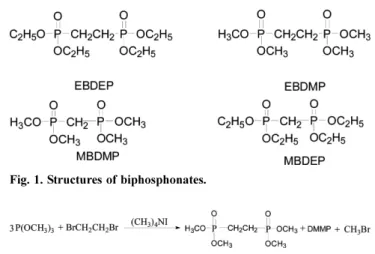
So, (CH3)4NI was used to catalyze four biphosphonates (Fig. 1) as additive-type flame retardants. Their structures were characterized by ESI-MS, 1H NMR, FT-IR. According to the thermogravimetric analy- sis (TGA) of these biphosphonates and single phosphonates (DEEP Supported by the Jiangsu Natural Science Foundation of China (BK2011369) and Priority Academic Program Development of Jiangsu Higher Education Institutions and DMMP), results showed that biphosphonates had better thermal stability and higher char residue, two important measures of low flammability materials. These flame retardants were synthesized through polycondensation and Arbuzov rearrangement reactions [11](Scheme 1).
2. Experimental
2-1. Materials
All raw materials (AR) used in synthesis, including trimethyl phos- phite, (CH3)4NI, BrCH2CH2Br triethyl phosphite, and BrCH2Br were received from Chemical Company, China.
2-2. Physico-chemical characterization
1H NMR spectra were recorded with a Varian XL-400 spectrom- eter (chemical shifts are downeld from TMS), using hot deuterated CDCl3 as solvent. The thermogravimetric analyses (TGA) were performed using a Perkin Elmer TGA 7 apparatus in N2 (gas ow:
40 mL/min) at 10oC/min heating rate, from 20oC to 600oC. IR spectra were recorded in KBr disks on a Bomem MB154S FT-IR spectrometer.
Mass spectra were taken on an Agilent LC-MS 1100 series instru- ment in the electrospray ionization (positive ESI) mode.
2-2-1. Synthesis of EBDMP
18.8 g BrCH2CH2Br and 37.2 g trimethyl phosphite were charged into a four-necked ask with a catalyst of (CH3)4NI (0.25 g), then the mixture was magnetically stirred in an oil bath at 150oC for 4 h. CH3Br (12.1 g) and DMMP (125.5g) were collected at different tempera- ture under reduced pressure. The resulting product was evaporated from 106oC to 108oC under vacuum (0.8 KPa) to give as a color- less liquid product in 90.9% yield. 1HNMR(CDCl3, 400 MHz), δ:
1.38(s, 4H, J =15.0 Hz), 3.64(s,12H); ESI-MS, m/z: 92.99, 110.99, 126.99, 136.99, 214.97, 246.93; FT-IR (KBr, cm-1): 3491, 2954, 2852, 1467, 1187~1261, 1049, 962, 734.
†To whom correspondence should be addressed.
E-mail: [email protected]
This is an Open-Access article distributed under the terms of the Creative Com- mons Attribution Non-Commercial License (http://creativecommons.org/licenses/by- nc/3.0) which permits unrestricted non-commercial use, distribution, and reproduc- tion in any medium, provided the original work is properly cited.
Fig. 1. Structures of biphosphonates.
Scheme 1. Synthesis of EBDMP.
188 Yang Cao, Weiwei Zhang, Xufeng Yang, Jinfei Yang and Huizhen Zhi
Korean Chem. Eng. Res., Vol. 52, No. 2, April, 2014 2-2-2. Synthesis of EBDEP
A mixture of BrCH2CH2Br (18.8 g), triethyl phosphite (49.8 g) and (CH3)4NI (0.35 g) was stirred at 160oC for 6 h, CH3CH2Br (19.8 g) and DEEP (18.5 g) were collected, respectively, under reduced pressure.
The resulting product was distilled from 117oC to 119oC under vacuum (0.8 KPa) to give a colorless liquid product in 70.2% yield.
1HNMR (CDCl3, 400 MHz), δ: 1.32(s, 12H, J = 6.9 Hz), 1.72(s, 4H, J = 18.1 Hz), 4.12(s, s, 8H, J = 7.2 Hz)); ESI-MS, m/z: 88.16, 154.89, 172.85, 190.92, 200.91, 18.90, 246.88, 275.10, 284.94, 303.21; FT- IR (KBr, cm-1): 3524, 2979, 2909, 1447, 1168~1272 , 1040, 971, 796.
2-2-3. Synthesis of MBDMP
An oven-dried four-necked round-bottomed ask was charged with BrCH2Br (17.4 g), trimethyl phosphite (37.2 g) and (CH3)4NI (0.25 g). The mixture was stirred at 115oC for 6 h with reflux. Then the unreacted trimethyl phosphite was removed under reduced pressure. MBDMP was given as a slightly yellow liquid product in 36.5% yield without any dealing with. 1HNMR(CDCl3, 400 MHz) , δ:
1.32(s, 12H, J = 6.9 Hz), 1.72(s, 4H, J = 18.1 Hz), 4.12(s, s, 8H, J
=7.2 Hz)); ESI-MS, m/z: 110.73, 140.91, 170.67, 200.96, 218.34, 232.87. FT-IR (KBr, cm-1): 3472, 2956, 2860, 1458, 1177~1238, 1046, 914.
2-2-4. Synthesis of MBDEP
A mixture of BrCH2Br (17.4 g), triethyl phosphite (49.8 g) and (CH3)4NI (0.35 g) was stirred between 135~165oC for 14 h, The unreacted triethyl phosphite was removed under reduced pressure.
MBDEP was dried under vacuum to give as a colorless liquid prod- uct in 30.3% yield. 1HNMR (CDCl3, 400 MHz), δ: 1.28(s, 12H, J
= 6.9 Hz), 1.67(s, 2H, J = 17.9 Hz), 4.10(s, s, 8H, J = 6.9 Hz)); ESI-MS, m/z: 90.07, 174.80, 212.71, 292.64, 274.91, 259.90, 310.58; FT-IR (KBr, cm-1): 3538, 2983, 2896, 1375, 1159~1253, 1038, 954.
3. Results and Discussion
Four reactions were all catalyzed by small amount of (CH3)4NI and refluxed for some time. The products were hygroscopic color- less viscous clear liquid and stable in air. Some of their properties were investigated and the results are shown in Table 1. Byproducts CH3CH2Br, CH3Br, DMMP and DEEP were recovered under vac- uum. It was found that only 30.3% and 36.5% yield of methylene bis(diethyl Phosphonate) (MBDEP) and methylene bis(dimethyl phosphnate) (MBDMP) were obtained through the reaction of BrCH2Br with triethyl phosphite and trimethyl phosphate, respectively. However, 70.2% and 90.9% yield of 1,2-ethylene bis(diethyl phosphonate) (EBDEP) and 1,2-ethylene bis(dimethyl phosphonate) (EBDMP) were
obtained with the BrCH2CH2Br in place of BrCH2Br. The reason may be larger space steric hindrance of BrCH2Br than BrCH2CH2Br. In comparison, 1,2-ethylene bis(dimethyl phosphonate) (EBDMP) could be obtained with the best result.
It can be seen from the FT-IR statum of EBDMP, EBDEP, MBDMP and MBDEP that they all exhibit three characteristic peaks; for instance, at near 1200 cm-1, which are due to P=O double ring.
Additional band at near 1040 cm-1 is due to P-O-C groups. Moreo- ver, important peaks between 1375 and 1467 cm-1 assigned to the P-C linkage are observed [12-16]. Moreover, they all have methyl bands.
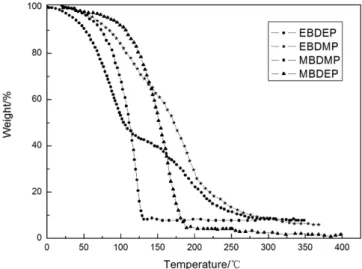
The TGA traces of them provide information about their ther- mal stability [17-22] and char residue [23-26]. Fig. 2 shows TGA curves of specimens that were evaluated in nitrogen atmosphere.
Clearly, the TGA results show differences among the products with different groups. It is well known that DMMP and DEEP undergo sharp degradation at low temperature; at the same time, the char residue is only 0.09% at 92oC and 0.56% at 130oC, respectively.
Whereas, EBDMP exhibits a greatly different degradation behav- ior corresponding to very low mass loss rates (15.9% at 92oC) and 6.2% char residue at 350oC. Similarly, EBDEP exhibits relatively at group and weight loss is 57.6% at 150oC. Considering the char residue at 350oC, however, the EBDEP yielded as high as 8.0%
char residues, revealing a higher thermal stability at high tempera- ture. The samples of MBDEP and MBDMP revealed slightly lower char residues of 1.6% and 1.0%, respectively. It can be seen that biphosphonates possess more excellent thermal stability and higher char residue than DMMP because two P-C covalent linkages are more stable than single P-C covalent linkage. At the same time, EBDEP is superior to EBDMP due to the strength of P-C covalent linkage.
The results reveal that the groups introduced in the backbone can inuence the thermal stability of the biphosphonates [27,28]. It seems that the contained P-C linkage in the backbone is more ther-
Table 1. Performance of polyphosphorates
Performance EBDMP EBDEP MBDMP MBDEP
Color(Pt-Co) P content / % Acid value/mgKOH·g
100 25.17
<0.3
100 20.45
<0.3
100 26.33
<0.3
100 21.09
<0.3 Fig. 2. TGA for EBDMP EBDEP MBDMP and MBDEP.
Simple synthesis of Biphosphonates with Excellent Flameproofing Properties 189
Korean Chem. Eng. Res., Vol. 52, No. 2, April, 2014 mally stable in the high temperature region than that containing P-O-C
linkage only. The rst decomposition is explained by the break of P-O- C [29] bonds of methyl phosphonic chain; then with the increase of temperature, there is a loss of P-C band. Because the char yield in nitrogen has been correlated to the ame retardancy, these biphos- phonates are expected to possess high ame-retardant properties.
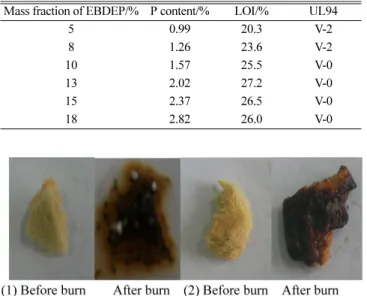
The high char yield can decrease the production of combustible gases, limit the exothermicity of the pyrolysis reactions, and inhibit the thermal conductivity of the burning materials. The application of EBDEP in polyurethane soft foam was studied and the results illustrated its excellent flame-proofing properties (Table 2). It is obvious that the LOI increased gradually with the increasing weight of EBDEP in polyurethane soft foam And polyurethane soft foam containing 10% EBDEP reached the requirement of re-retar- dancy (UL 94: V-0; LOI: 25.5). The soft foam gave off black dense smoke during combustion; however, no obvious phenomena of burning were observed after dealing with EBDEP (Fig. 3).
4. Conclusions
Four biphosphonates have been synthesized through polycon- densation and Arbuzov rearrangement reactions. The biphosphonates have several advantages: (1) they are high molecular polymer, halogen-free, and show superior thermal stability and high char residue in the presence of P-C covalent linkage. (2) They can be green synthesized without dangerous chemical products. (3) Com- pared to the commercial ame retardant compound used for poly- urethane, i.e., DMMP and DEEP, the adducts of biphosphonates, and especially of EBDEP, show a better behavior in flame retar- dant. Finally, the molecular weights of the synthesized adducts are higher than that of DMMP and DEEP, which will avoid migration of the FRs towards the surface of the polyurethane.
Acknowledgment
A project funded by the Priority Academic Program Develop- ment of Jiangsu Higher Education Institutions and Jiangsu Natural Science Foundation of China (BK2011369).
References
1. Lassiaz, S., Galarneau, A., Trens, P., Labarre, D., Mutin, H. and Brunel, D., “Organo-Lined Alumina Surface from Covalent Attachment of Alkylphosphonate Chains in Aqueous Solution,”
New J. Chem., 34, 1424 (2010).
2. Vasiljevi´c, J., Hadži´c, S., Jerman I., erne L., Tomši , B., Medved, J., Godec, M., Orel, B. and Simon i , B., “Study of Flame-retardant Finishing of Cellulose Fibres: Organic-inorganic Hybrid Versus Conventional Organophosphonate,” Polym. Degrad.
Stabi., 2013, doi/10.1016/.
3. Lin, H.-J., Liu, S.-R., Han, L.-J., Wang, X.-M., Bian, Y.-J., Dong, L.-S., “Effect of a Phosphorus-containing Oligomer on Flame-retardant, Rheological and Mechanical Properties of Poly (lactic acid),” Polym. Degrad. Stabi., 98(7), 1389-1396(2013).
4. Köhler, J., Keul, H. and Möller, M., “Post-polymerization Func- tionalization of Linear Polyglycidol with Diethyl Vinylphospho- nate,” Chem. Commun., 47, 8148-8150(2011).
5. Evano, G., Tadiparthi, K. and Couty, F., “Copper-mediated Cross- coupling of 1,1-dibromo-1-alkenes with Dialkyl Phosphites: a Con- venient Synthesis of 1-alkenylphosphonates,” Chem. Commun., 47(1), 179-181(2011).
6. Murugavel, R. and Singh, M. P., “One, two, and Three Methylene Phosphonic Acid Groups (-CH2PO3H2) on a Mesitylene Ring:
Synthesis, Characterization and Aspects of Supramolecular Aggre- gation,” New J. Chem., 34(9), 1846-1854(2010).
7. Bourbigot, S. and Duquesne, S., “Fire Retardant Polymers:
Recent Developments and Opportunities,” J. Mater. Chem., 17, 2283-2300(2007).
8. Bourbigot, S. and Fontaine, G., “Flame Retardancy of Polylac- tide: An Overview,” Polym. Chem., 1, 1413-1422(2010).
9. Lim, H. and Chang, J. Y., “Thermally Stable and Flame Retardant Low Dielectric Polymers Based on Cyclotriphosphazenes,” J.
Mater. Chem., 20, 749-754(2010).
10. Wu, M. S., Chen, R. Y. and Huang, Y., “Progress in Synthesis of Bisphosphonic(ate) Analogues,” Chin. J Org. Chem., 24(5), 485- 497(2004).
11. Jansa, P., Holý, A., Dra inský, M., Baszczyòski, O., esnek, M.
and Janeba, Z., “Efficient and ‘green’ Microwave-assisted Synthe- sis of Haloalkylphosphonates via the Michaelis-Arbuzov Reac- tion,” Green Chem., 13, 882-888(2011).
12. Masuda, K., Sakiyama, N., Tanaka, R., Noguchi, K. and Tanaka, K., “Rhodium-Catalyzed Enantioselective Cyclizations of γ-Alkyny- laldehydes with Acyl Phosphonates: Ligand- and Substituent-Con- trolled C-P or C-H Bond Cleavage,” J. Am. Chem. Soc., 133(18), 6918-6921(2011).
13. Zhuang, R. Q., Xu, J. and Cai, Z. S., “Copper-Catalyzed CP Bond Construction via Direct Coupling of Phenylboronic Acids with H-Phosphonate Diesters,” Org. Lett., 13(8), 2110-2113(2011).
14. Ashkenazi, N., Segall, Y. and Chen, R., “The Mechanism of Nucleo-
Cˇ cˇ
cˇcˇ
cˇ Cˇ
Table 2. Influence of EBDEP to polyurethane soft foam Mass fraction of EBDEP/% P content/% LOI/% UL94
5 0.99 20.3 V-2
8 1.26 23.6 V-2
10 1.57 25.5 V-0
13 2.02 27.2 V-0
15 2.37 26.5 V-0
18 2.82 26.0 V-0
Fig. 3. Char images of (1) soft foam (no EBDEP) and (2) soft foam dealing with EBDEP.
190 Yang Cao, Weiwei Zhang, Xufeng Yang, Jinfei Yang and Huizhen Zhi
Korean Chem. Eng. Res., Vol. 52, No. 2, April, 2014
philic Displacements at Phosphorus in Chloro-Substituted Meth- ylphosphonate Esters: PO vs PC Bond Cleavage: A DFT Study,”
J. Org. Chem., 75(6), 1917-1926(2010).
15. Rueping, M., Zhu, S. Q. and Koenigs, R. M., “Photoredox Cat- alyzed C-P Bond Forming Reactions-visible Light Mediated Oxidative Phosphonylations of Amines,” Chem. Commun., 47(30), 8679-8681(2011).
16. Negrell-Guirao, C., Boutevin, B., David, G., Fruchier, A., Sonnier, R. and Lopez-Cuesta, J., “Synthesis of Polyphosphorinanes Part II. Preparation, Characterization and Thermal Properties of Novel Flame Retardants,” Polym. Chem., 2, 236-243(2011).
17. Song, P. A., Xu, L. H., Guo, Z. H., Zhang, Y. and Fang, Z. P.,
“Flame-retardant-wrapped Carbon Nanotubes for Simultaneously Improving the Flame Retardancy and Mechanical Properties of Polypropylene,” J. Mater. Chem., 18, 5083-5091(2008).
18. Song, P. A., Liu, H., Shen, Y., Du, B. X., Fang, Z. P. and Wu, Y.,
“Fabrication of Dendrimer-like Fullerene (C60)-decorated Oligo- meric Intumescent Flame Retardant for Reducing the Thermal Oxidation and Flammability of Polypropylene Nanocomposites,”
J. Mater. Chem., 19, 1305-1313(2009).
19. Zhuo, D. X., Gu, A. J., Liang G. Z., Hu, J. T., Yuan, L. and Chen, X.
X., “Flame Retardancy Materials Based on a Novel Fully End- capped Hyperbranched Polysiloxane and Bismaleimide/diallyl- bisphenol A Resin with Simultaneously Improved Integrated Performance,” J. Mater. Chem., 21, 6584-6594(2011).
20. Brebu, M. and Sakata, Y., “Novel Debromination Method for Flame-retardant High Impact Polystyrene (HIPS-Br) by Ammo- nia Treatment,” Green Chem., 8, 984-987(2006).
21. Bhaskar, T., Hosokawa, A., Muto, A., Tsukahara, Y., Yamauchi, T. and Wada, Y. J., “Enhanced Debromination of Brominated
Flame Retardant Plastics Under Microwave Irradiation,” Green Chem., 10, 739-742(2008).
22. Mosurkal, R., Kirby, R. and Muller, W. S., “Simple Green Syn- thesis of Polyborosiloxanes as Environmentally-safe, Non-halo- genated Flame Retardant Polymers,” Green Chem.,13, 659-665 (2011).
23. Song, P. A., Zhao, L. P., Cao, Z. H. and Fang, Z. P., “Polypropy- lene Nanocomposites Based on C60-decorated Carbon Nanotubes:
Thermal Properties, Flammability, and Mechanical Properties,”
J. Mater. Chem., 21, 7782-7788(2011).
24. Wilkie, C. A., Chigwada, G. and Gilman, Sr. J. W., “High-through- put Techniques for the Evaluation of Fire Retardancy,” J. Mater.
Chem., 16, 2023-2030(2006).
25. Shi, Y. M. and Li, L. J., “Chemically Modified Graphene: Flame Retardant or Fuel for Combustion?,” J. Mater. Chem., 21, 3277- 3279(2011).
26. Ranganathan, T., Cossette, P. and Emrick, T., “Halogen-free, Low Flammability Polyurethanes Derived from Deoxybenzoin-based Monomers,” J. Mater. Chem., 20, 3681-3687(2010).
27. Urbanczyk, L., Bourbigot, S., Calberg, C., Detrembleur, C., Jérôme, C., Boschini F. and Alexandre, M., “Preparation of Fire- resistant Poly(styrene-co-acrylonitrile) Foams Using Supercritical CO2 Technology,” J. Mater. Chem., 20, 1567-1576(2010).
28. Tai, Q. L., Hu, Y., Yuen, R. K. K., Song, L. and Lu, H. D., “Syn- thesis, Structure-property Relationships of Polyphosphoramides with High Char Residues,” J. Mater. Chem., 21, 6621-6627(2011).
29. Liu, Y. L., Hsiue, G. H., Chiu, Y. S., Jeng, R. J. and Perng, L. H.,
“Phosphorus-containing Epoxy for Flame Retardant. I. Synthe- sis, Thermal, and Flame-retardant Properties,” J. Appl. Polym.
Sci., 61, 613-621(1996).