ABSTRACT
The human respiratory tract hosts both pathogenic and commensal bacteria. The
development of well-conserved 16S rRNA sequencing and culture-independent techniques has enabled many achievements in the study of the human microbiome. Microbial composition of the respiratory tract in early childhood has been shown to correlate to respiratory health in later stages of life. This review highlights current understandings of respiratory microbiota development in healthy children, examples of microbial interactions, impacts on the host immune system, and the relationship between respiratory tract
microbiome and respiratory health.
Keywords: Microbiota; Microbiome; Children; Respiratory infections
서론
사람의 몸 안에 존재하는 세균들은 사람의 세포 숫자보다 약
10배 가량 많으며
,대부분 소화 기관에 서식하는 것으로 알려져 있다
.1)지금까지 많은 미생물 의학 연구들은 사람에게 질병
을 일으키는 미생물
,이른바 병원체를 주제로 이루어져 온 반면 상재균
(resident flora)의 규
모
,역할
,상호작용 등은 충분히 알려지지 않았다
.그런데
1977년 원핵 세포의 계통 발생학적
구성에 대한 연구를 시작으로 미생물군 복합체 안에서 비교적 잘 보존되는 부위인
16S리보
솜
RNA를 분석함으로써 배양이 불가능하거나 어려운 경우에도 미생물군의 계통 발생학적
관련성이 알려지게 되었고
,2-6) 2001년 사람 유전체 서열
(human genome sequence)이 발표되
어
7)사람이 보유한 미생물 군집의 구조와 기능에 관한 세부적인 연구를 가속화시키는 계기 가 되었다
.미생물총
(微生物叢, microbiota)은 사람의 몸 안에 존재하는 공생균
(commensal or symbioticbacteria)
과 병원균
(pathogenic bacteria)의 생태학적 집단으로 정의하며 그들이 사람의 몸 어
디에 특별히 위치하는지
(niche differentiation)에 관한 개념이다
(who’s there
).8,9)미생물군 유전
Review Article
Received: Jul 14, 2019 Revised: Dec 9, 2019 Accepted: Dec 9, 2019 Correspondence to Dong Hyun Kim
Department of Pediatrics, Inha University School of Medicine, 27 Inhang-ro, Jung-gu, Incheon 22332, the Republic of Korea.
E-mail: [email protected]
Copyright © 2019 The Korean Society of Pediatric Infectious Diseases
This is an Open Access article distributed under the terms of the Creative Commons Attribution Non-Commercial License (https://
creativecommons.org/licenses/by-nc/4.0/) which permits unrestricted non-commercial use, distribution, and reproduction in any medium, provided the original work is properly cited.
ORCID iDs Dong Hyun Kim
https://orcid.org/0000-0001-9883-0229 Conflict of Interest
No potential conflict of interest relevant to this article was reported.
Respiratory Microbiome in Children
Dong Hyun Kim
Department of Pediatrics, Inha University School of Medicine, Incheon, the Republic of Korea
소아의 호흡기 미생물군 유전체
김동현
인하대학교 의과대학 소아과학교실
체
(微生物群 遺傳體, microbiome)는 미생물총과 미생물총의 유전자 및 작용
(what they can do
)뿐만 아니라 바이러스
,진균 등과의 상호작용까지 포함한다
.10)많은 연구에서 미생물들이 주로 집락하는 사람 몸 안의 주요한 장소는 구강
,장내
,질
,피부의 네 곳으로 알려져 있고
,11)주로 장내 미생물군을 중심으로 유전적 다양성 및 상호작용 연구가
진행되어 왔다
.12)소아를 대상으로 한 연구들도
2007년 영아의 장내 미생물총 발달에 관한 연
구를 시작으로 지난
10여년간 군유전체학
(metagenomics)의 발전에 힘입어 차세대 염기서열
분석
(next-generation sequencing)을 활용한 장내 미생물총과 이들의 대사 물질이 면역에 미
치는 영향 등이 밝혀지고 있다
.13)최근 소화기 외의 다른 신체 부위 미생물군 유전체 연구도 활발하게 진행되고 있는데
,특히 호흡기 미생물군 유전체 연구는 낮은 미생물 밀도로 인한 연구의 어려움이 있음에도 불구하 고 장내
,구강
,질
,피부 다음으로 많은 수를 차지하고 있으며 호흡기 건강과 효과적인 중재의 가능성을 제시하고 있다
.14)이에
,소아 호흡기 미생물군 유전체에 대한 지금까지의 보고와 연구결과들을 정리함으로 써 호흡기 건강을 위한 올바른 정보를 제공하고 연구의 방향을 설정하는 데에 도움을 주고 자 한다
.본론
1.
호흡기미생물총의발달16S
리보솜
RNA의 계통학적 분석을 통한 연구 결과들을 보면 사람은 무균 상태로 출생한
다는 가설이 오랫동안 지지를 받았으나 최근 자궁 내 태아가 이미 미생물을 획득한다는 보
고
15,16)가 있었고 그렇지 않다는 논란도 있지만
17),자궁 내에서 경태반 항체와 미생물 분자가
출생 후 선천 면역 발달에 영향을 준다는 사실은 잘 알려져 있다
.18,19)출생 직후 미생물에 노출되기 때문에 첫
1시간 내 건강한 신생아의 상부 호흡기에서도 다양 한 미생물군이 존재하는데 대개 모체로부터 기원한 비특이적인 양상을 보인다
.20)출생 후 첫 주 동안 Staphylococcus
spp.가 우세하다가 점차 Corynebacterium
spp.,Dolosigranulum
spp.가 풍 부해지고
,생후
4–6개월경 Moraxella
spp.가 우세한 순으로 위치 분화
(niche differentiation)가 일어나는데
,21)이 변화는 안정적인 미생물 생태계 뿐만 아니라 호흡기 건강과도 관련이 있
다
.22,23)하부 호흡기는 출생 후
1일 내 Streptococcus viridans 가 우세하다가 생후 첫 주까지 빠르게
성장하는 Staphylococcus aureus로 대체되고
,생후
2주부터 S. aureus는 감소하면서 생후
2개월까 지 Moraxella catarrhalis
,Corynebacterium
spp.,Dolosigranulum
spp.가 급격하게 증가하여 우세한 자 리를 차지하고 이 시기와 겹쳐 생후
6개월경 Streptococcus pneumoniae
,Haemophilus influenzae의 집 락이 시작된다
.24)2.
호흡기미생물총발달과성숙에영향을주는주요인자들출산 방법과 수유 형태는 출생 후 신생아 미생물총의 초기 성숙에 큰 영향을 준다
.20-22,25)질식
분만으로 출생한 신생아의 호흡기에서는 질내 환경과 유사한 Lactobacillus
spp.,Prevotella
spp.,혹은 Sneathia
spp.가 관찰되는 반면 제왕절개로 출생한 신생아의 호흡기는 피부 상재균과 유사한 Staphylococcus
spp.,Corynebacterium
spp.,그리고 Propionibacterium
spp.가 우세하고
,이후
S. aureus로부터 Moraxella
spp.,Corynebacterium
spp.,Dolosigranulum
spp.의 우세 형태로 전환되는 시기도 질식 분만 출생아에 비하여 느린 것으로 나타났다
.21)수유 방법이 장내 미생물총 구 성에 영향을 준다고 알려져 있는 것처럼
25)호흡기 미생물총의 발달도 수유 방법에 따라 차이 가 있었다
.22)생후
6주 모유 수유아의 상부 호흡기에서 분유 수유아보다 Corynebacterium
spp.,Dolosigranulum
spp.가 더 풍부하였고 Staphylococcus
spp.는 감소되어 있었는데
,이는 이후의 가 벼운 호흡기 감염의 이환률과 영아기 천명의 발생률이 낮은 것과 연관이 있었다
.22)항생제도 건강한 소아의 상부 호흡기 미생물총에 영향을 주는데 항생제 노출 후 유익한 상재균으로 여 겨지는 Corynebacterium
spp.와 Dolosigranulum
spp.의 유의한 감소가 관찰되며
23,26,27)노출이 반복 될수록 호흡기 감염의 가능성이 증가할 수도 있다는 연구 결과가 있었다
.28)그리고 계절적 영 향
,백신 접종
,형제의 유무
,보육 시설 이용
,간접 흡연
,선행 감염의 요인들도 소아의 미생물
총 구성에 영향을 주는 것으로 알려져 있다
.29-33)유전적 소인은 건강한 소아의 상부 호흡기 미
생물총의 전체적인 구성에 큰 영향을 주진 않으나 비강내 미생물총의 군집도와 관련성은 있 는 것으로 생각되고
34),특히 객담 미생물총의 구성은 유전적 소인과 환경적 요인의 영향이 동 일한 기여를 하고 있는 것으로 나타났다
.35)장내 미생물총은 생후 첫
3년 동안 성인과 유사한 형태로 성숙되는 것으로 알려져 있는데 반하여
,36)호흡기 미생물총이 안정화되는 기간은 아 직 분명하지 않은데 생후 첫 주에 이미 미생물총의 위치 분화
(niche differentiation)가 시작됨 에도 불구하고 생후
1년까지도 미생물총의 변화가 관찰되기 때문이다
.22,31,37)호흡기 미생물 총이 안정된 후에는 항생제 치료 유무가 생애 전체에 걸친 미생물총의 평형에 영향을 주는 주요 인자이며
,38)직접 흡연은 상부 호흡기 미생물총에 영향을 주지만
,35,39)하부 호흡기 미생
물총 구성과의 관련성은 분명하지 않다
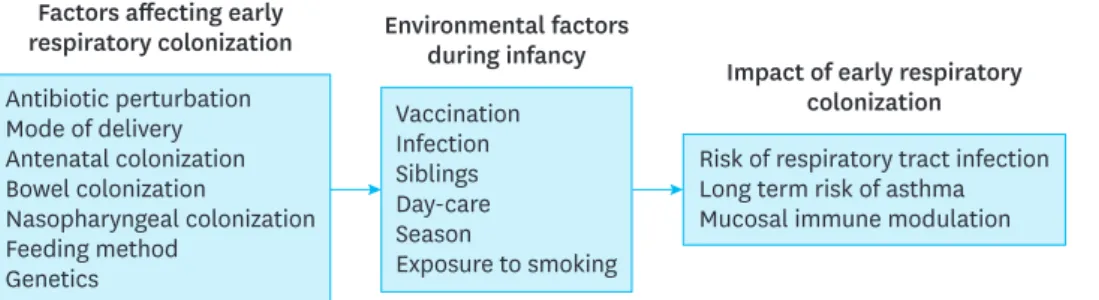
(Fig. 1).40)3.
건강한호흡기미생물총의구성상부 호흡기에 존재하는 미생물들이 점막 확산
(mucosal dispersion)과 미세 흡인
(micro-aspi-ration)
의 과정을 통하여 폐로 들어가 하부 호흡기 미생물총을 구성하기에 성인의 경우 구인
두
(oropharynx)의 미생물총이 하부 호흡기 미생물총의 원천일 것으로 생각되나
,소아의 경우
상부 호흡기의 해부학 구조가 성인과 차이가 있고 비강 분비물이 빈번하여 미생물의 확산을
촉진하기 때문에 구인두와 함께 비인두
(nasopharynx)의 미생물총도 하부 호흡기 미생물총
형성에 중요한 역할을 하는 것으로 알려져 있다
.41)한편 위식도 역류에 의한 장내 미생물총의 호흡기 미생물총으로의 이동은 현재까지 무시할 만한 수준으로 여겨진다
.42)Antibiotic perturbation Mode of delivery Antenatal colonization Bowel colonization
Nasopharyngeal colonization Feeding method
Genetics
Factors affecting early respiratory colonization
Vaccination Infection Siblings Day-care Season
Exposure to smoking Environmental factors
during infancy
Risk of respiratory tract infection Long term risk of asthma Mucosal immune modulation
Impact of early respiratory colonization
Fig. 1. Host and environmental factors that influence the respiratory microbiota.
출생 후 Moraxella
spp.에 이어 Corynebacterium
spp.와 Dolosigranulum
spp.가 빠르게 나타나고 우 세해지는
,소위 안정된 미생물총 구성인 경우 생후
6개월 이후 급성 중이염의 위험을 낮추는 것으로 알려져 있다
.27)반면 생후
5–7주경 Moraxella
spp.와 함께 Streptococcus
spp.,Haemophilus
spp.가 우세해지는 구성이 나타나면 생후
1세까지 급성 상기도 감염의 빈도가 증가하였다
.23)그리고 생후
4주 이내 S. pneumoniae
,H. influenzae
,M. catarrhalis의 집락이 조기에 이루어지면 하 부 호흡기 감염의 위험이 증가하고 이후 연령에서의 반복적 천명의 발생과 천식 발작 증가에 영향을 주는 것으로 나타나
43)신생아기 미생물총의 집락 구성이 환경 자극에 대한 체내 면역 반응에 장기적 영향을 주는 것으로 생각된다
.44)기관을 삽관한 조산아의 하부 호흡기 미생물총은 병원균인 Staphylococcus
spp.,Ureaplasma
spp.혹은 Acinetobacter
spp.등이 우세한 것으로 나타나는데 미생물총의 발달에 있어 다양성이 결
여된 특징을 보인다
.45-47)그러나 건강한 소아에서 하부 호흡기의 미생물총 구성은 다양성
이 특징으로 대개 상부 호흡기에서도 관찰되는 Moraxella
spp.,Haemophilus
spp.,Staphylococcus
spp.,Streptococcus
spp.등이 독특한 생태 집단을 이루고 있으며
,Corynebacterium
spp.와 Dolosig- ranulum
spp.은 관찰되지 않아 상부 호흡기 미생물총과 구별된다
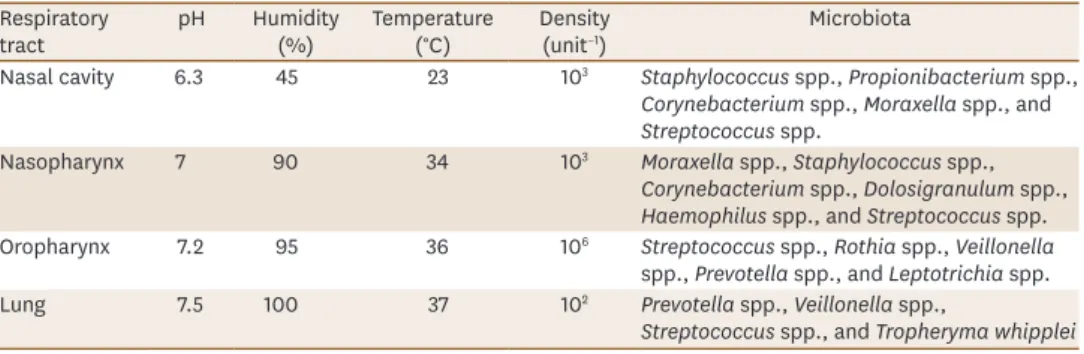
(Table 1). 42-44)4.
소아호흡기미생물총의구성체간상호관계미생물총을 구성하는 세균들 간의 상호작용은 생태학적으로 긍정적인 상호작용
(positive in-teraction)
과 부정적인 상호작용
(negative interaction)으로 나뉘는데
,호흡기 미생물총을 구성
하는 세균 간에도 이러한 모습들을 관찰할 수 있다
.전자
(前者)의 경우 두 균이 모두 이득이
나타나는 상리공생
(相利共生, mutualism),한 세균은 이득이 있으나 다른 세균은 영향을 받
지 않는 편리공생
(片利共生, commensalism)으로 나뉘고
,후자
(後者)의 경우 한 세균만 손해
를 보고 다른 세균은 영향을 받지 않는 편해공생
(片害共生, amensalism),한 세균이 손해를 보
고 다른 세균이 이득을 보는 기생
(寄生, predatism and parasitism),두 세균 모두 손해를 보는
경쟁
(競爭, competition)이 있다
.48)호흡기 미생물총 간의 상리공생은 Veillonella
spp.가
strep-tococcal biofilm
형성을 촉진시키는 예에서 볼 수 있고
49),상재균과 병원성 Streptococcus 계통군
사이
,50)비인두 생태에서의 M. catarrhalis와 S. pneumoniae 사이
51)에서 볼 수 있다
.이와 같은 관계 는 종
(種)특이적
(species-specific)이고 때로는 주
(株)특이적
(strain-specific)이기도 한데 기전 은 명확하게 알려져 있지 않으며
,예를 들어 Corynebacterium accolens와 S. aureus는 상리공생 관계 이지만
,Corynebacterium pseudodiphtheriticum 과 S. aureus 의 관계는 서로 다른 결과를 보고한 연구 들이 있다
52).부정적인 상호 관계는 S. aureus와 S. pneumoniae 사이에서 볼 수 있으며
,아직 기전
에 대한 연구가 진행 중이지만
,S. pneumoniae 의 과산화수소 생성이 S. aureus 에 치명적인 박테
Table 1. Niche-specific selective growth of the respiratory microbiota42-44) Respiratory
tract pH Humidity
(%) Temperature
(°C) Density
(unit−1) Microbiota
Nasal cavity 6.3 45 23 103 Staphylococcus spp., Propionibacterium spp., Corynebacterium spp., Moraxella spp., and Streptococcus spp.
Nasopharynx 7 90 34 103 Moraxella spp., Staphylococcus spp.,
Corynebacterium spp., Dolosigranulum spp., Haemophilus spp., and Streptococcus spp.
Oropharynx 7.2 95 36 106 Streptococcus spp., Rothia spp., Veillonella spp., Prevotella spp., and Leptotrichia spp.
Lung 7.5 100 37 102 Prevotella spp., Veillonella spp.,
Streptococcus spp., and Tropheryma whipplei
리오파지를 유도하기 때문은 아닐까 생각되고 있다
.30)생애 초반부터 대부분 영아의 호흡기
에 존재하는 S. aureus 는 간혹 질병을 일으킬 때도 있으나 오히려 항균물질을 분비함으로써 숙
주의 면역에 기여하는 것처럼 보이는데 Corynebacterium striatum에 의하여 S. aureus의 공생적 성 향이 증가되고 병독력이 감소하는 것이 실험적으로 관찰되기도 하였다
.53)같은 종 내에서는 Neisseria lactamica가 기존에 형성된 Neisseria meningitidis의 집락을 감소시켜 새로운 N. meningitidis 의 획득을 방해하는 것이 관찰되었으나 아직 기전은 밝혀지지 않았다
.54)또한 Staphylococcus
spp.
내에서도 S. epidermidis가 분비하는 세린 단백질 분해효소
(Esp),S. lugdunensis가 분비하는
lugdunin
이 S. aureus 의 집락과 과성장을 방해하는 것으로 알려져 있다
.55,56)미생물 간 간접적인 경로를 통하여 영향을 주는 경우들도 있는데
,C. accolens 가 소아의 코와
피부에 존재하는 중성지방
(triacylglycerol)을 유리지방산
(free fatty acid)으로 전환함으로써
S. pneumoniae 의 성장을 제한할 수 있고
,57)Corynebacterium
spp.와 Dolosigranulum
spp.가 공존하면 서 Dolosigranulum
spp.가 주변 환경을 산성화시킴으로써 Corynebacterium
spp.의 성장을 도울 수 있다고 발표되었다
.58)호흡기에 존재하는 미생물총은 다양한 기전을 통하여 바이러스 감염을 촉진시킬 수 있다
.영아의 호흡기에 집락된 H. influenzae가 세포간 부착분자
(intercellular adhesion molecule-1,ICAM-1)
의 상승 조절을 일으켜 리노바이러스
(human rhinovirus)와 호흡기 세포융합 바이러
스
(respiratory syncytial virus, RSV)등의 수용체 결합을 증가시키고 염증 전 반응
(proinflam-matory response)
을 증폭할 수 있음이 알려졌다
.59)또한
RSV에 이환된 영아를 대상으로 한 전
향적인 연구에서 S. pneumoniae와 H. influenzae의 비인두 집락은
RSV에 의하여 유도되는 숙주의
면역 반응을 증폭시켜
RSV감염의 중증도를 높이고 반복적인 천명과 폐기능의 감소를 유발
할 수 있음이 발표되었다
.60,61)반대로 항생제 사용으로 인한 인두 상재균의 파괴는
RSV감염 후 기관지 과민성을 증가시킬 수 있는 것으로 보고되었다
.62)호흡기 미생물총은 진균 감염에도 영향을 줄 수 있다
.동물 부비동염 모델에서 S. aureus
,Strep- tococcus
spp.,Pseudomonas aeruginosa에 의하여 호흡기 상피세포가 손상되면 진균
biofilm이 형 성되기 쉽고
,63)특히 P. aeruginosa 는 대사물질을 분비하여 먼 거리에서도 Aspergillus fumigatus 의 성장을 자극할 수 있었다
.64)5.
호흡기미생물총과숙주의면역간상호작용호흡기 미생물총의 생태학적 모형은 호흡기에서 미생물의 유입과 제거가 균형을 이루는 것 에 의하여 건강한 미생물총이 구성되고 유지되는 것이며
(The adapted island model
),미생물총이 어떻게 호흡기 건강을 도모하고 유지하는 데에 도움이 되는지 명확하게 밝혀져 있지 않으나 아마도 숙주
–미생물 간 상호작용을 통하여 점막 면역의 항상성과 면역 관용에 기여하기 때 문일 것으로 보고 있다
.65)실험적으로 사람의 상기도 상피세포에서
Toll-like receptors (TLRs), nucleotide-binding oligomerization domain-like receptor (NOD)-1, NOD-2가 활성화되면
β-de-fensin
과 같은 항균 펩타이드가 분비되어
Th17세포를 자극함으로써 상기도의 미생물총 구성
에 영향을 주고
,66)동물 실험에서 비강내 S. aureus를 접종한 후 나타나는
TLR-2에 의하여 유도
된 항염증 반응으로
influenza virus에 의한 폐손상이 감소하거나
,67)마찬가지로 동물 실험에
서 비강내 Lactobacillus plantarum을 접종한 후
TLR-2와
NOD-2에 의한 면역 제어
(immunomodu-lation)
로 치명적인
pneumovirus감염을 조절한 연구가 발표된 바 있다
.68)현재까지는 건강한 호흡기 미생물총의 구성을 위하여 소아뿐만 아니라 성인에게도 직접 호 흡기에 미생물을 접종하거나 중재하는 연구는 이루어지지 못하고 있는 실정이나
,열처리된
Lactobacillus casei를 면역증강제
(adjuvant)로 사용한 비강내 백신이 동물 실험에서 면역원성과
안전성이 확인된 바 있다
.69)6.
소아호흡기미생물총연구의어려움지금까지 미생물총 연구가 활발히 이루어지고 있는 구강
,장내
,질
,피부와 달리 호흡기는 미
생물의 밀도가 매우 낮아서 건강한 소아에서 기관지
-폐포 세척액을 얻는다 하여도
1 mL당
100–1,000
세포 수 미만이기 때문에
whole-genome sequencing이 어렵거나 낮은
DNA함량으
로 인하여 분류와 해석이 불가능할 수도 있다
.21)그리고 무엇보다 소아의 하기도 검체를 채취 하기가 다른 연령에 비하여 용이하지 않으며 상기도 미생물과의 교차 오염의 확률이 높아 호 흡기계 미생물총의 해부학적 위치에 따른 분포를 구별하기가 어렵다
.그렇기 때문에 오염된 염기서열을 인지하고 제외하기 위하여 검체를 채취하는 단계부터 주의하고 실험의 각 단계 에서 적절한 음성 대조군을 신중하게 사용하며 표준화된 절차를 준수할 필요가 있다
.결론
출생 후 시작되는 호흡기 미생물총의 발달은 출산 방법
,수유 형태
,항생제
,형제 유무
,보육 시설 이용 유무
,계절적 요인
,백신
,간접 흡연
,선행 감염
,유전적 소인 등의 영향을 받으며
,이 후 생애의 호흡기 건강과 밀접한 연관이 있었다
.또한 호흡기 미생물총 내의 세균 간
,세균
-바 이러스 간
,세균
-진균 간 상호관계가 있으며
,이는 호흡기 감염의 경과와 예후에 영향을 주고 있었다
.건강한 호흡기 미생물총의 발달은 숙주 점막 면역의 항상성 유지와 면역 관용에 기 여하는 것으로 생각되나 아직 분명하게 밝혀지지 않았다
.현재까지 많은 연구가 진행되고 있 는 장내 미생물총의 발달을 통하여 면역 제어의 과정을 거쳐 호흡기 건강에 도움을 줄 수 있
다는
“gut-lung axis”모형이 잘 알려져 있는데 반하여
(Fig. 2),70)소아 호흡기에서 건강한 미생
물총 발달을 위한 직접적인 중재는 아직 동물 실험 단계에 있다
.향후 소아의 상부 호흡기
,하
부 호흡기 미생물총에 대하여 더 많은 연구가 필요할 것으로 생각하며
,사람 미생물군 유전
체에 대한 의학적 중재가 호흡기 감염의 진단 접근
,치료 계획
,경과 예측에 있어 지금보다 나
은 가능성을 제공할 것으로 기대한다
.REFERENCES
1. Savage DC. Microbial ecology of the gastrointestinal tract. Annu Rev Microbiol 1977;31:107-33.
PUBMED | CROSSREF
2. Woese CR, Fox GE. Phylogenetic structure of the prokaryotic domain: the primary kingdoms. Proc Natl Acad Sci U S A 1977;74:5088-90.
PUBMED | CROSSREF
3. Stahl DA, Lane DJ, Olsen GJ, Pace NR. Analysis of hydrothermal vent-associated symbionts by ribosomal RNA sequences. Science 1984;224:409-11.
PUBMED | CROSSREF
4. Woese CR, Olsen GJ. Archaebacterial phylogeny: perspectives on the urkingdoms. Syst Appl Microbiol 1986;7:161-77.
PUBMED | CROSSREF
5. Giovannoni SJ, Britschgi TB, Moyer CL, Field KG. Genetic diversity in Sargasso Sea bacterioplankton.
Nature 1990;345:60-3.
PUBMED | CROSSREF
6. Schmidt TM, DeLong EF, Pace NR. Analysis of a marine picoplankton community by 16S rRNA gene cloning and sequencing. J Bacteriol 1991;173:4371-8.
PUBMED | CROSSREF
7. Lander ES, Linton LM, Birren B, Nusbaum C, Zody MC, Baldwin J, et al. Initial sequencing and analysis of the human genome. Nature 2001;409:860-921.
PUBMED | CROSSREF
8. NIH HMP Working Group, Peterson J, Garges S, Giovanni M, McInnes P, Wang L, et al. The NIH Human Microbiome Project. Genome Res 2009;19:2317-23.
PUBMED | CROSSREF
9. Rogers GB, Shaw D, Marsh RL, Carroll MP, Serisier DJ, Bruce KD. Respiratory microbiota: addressing clinical questions, informing clinical practice. Thorax 2015;70:74-81.
PUBMED | CROSSREF
Bacteria
Environmental products Bacterial fragments SCFAs
Signals via nervous system
Oropharynx Blood Nerve
Fig. 2. Gut-lung communication. The oropharynx, bloodstream, and nerve may serve as routes of immunologic communication between the gut and the lung.
Abbreviations: SCFAs, short-chain fatty acids.
10. Huang YJ, Charlson ES, Collman RG, Colombini-Hatch S, Martinez FD, Senior RM. The role of the lung microbiome in health and disease. A National Heart, Lung, and Blood Institute workshop report. Am J Respir Crit Care Med 2013;187:1382-7.
PUBMED | CROSSREF
11. Relman DA, Falkow S. The meaning and impact of the human genome sequence for microbiology. Trends Microbiol 2001;9:206-8.
PUBMED | CROSSREF
12. Eckburg PB, Bik EM, Bernstein CN, Purdom E, Dethlefsen L, Sargent M, et al. Diversity of the human intestinal microbial flora. Science 2005;308:1635-8.
PUBMED | CROSSREF
13. Palmer C, Bik EM, DiGiulio DB, Relman DA, Brown PO. Development of the human infant intestinal microbiota. PLoS Biol 2007;5:e177.
PUBMED | CROSSREF
14. Lloyd-Price J, Abu-Ali G, Huttenhower C. The healthy human microbiome. Genome Med 2016;8:51.
PUBMED | CROSSREF
15. Aagaard K, Ma J, Antony KM, Ganu R, Petrosino J, Versalovic J. The placenta harbors a unique microbiome. Sci Transl Med 2014;6:237ra65.
PUBMED | CROSSREF
16. Collado MC, Rautava S, Aakko J, Isolauri E, Salminen S. Human gut colonisation may be initiated in utero by distinct microbial communities in the placenta and amniotic fluid. Sci Rep 2016;6:23129.
PUBMED | CROSSREF
17. Lauder AP, Roche AM, Sherrill-Mix S, Bailey A, Laughlin AL, Bittinger K, et al. Comparison of placenta samples with contamination controls does not provide evidence for a distinct placenta microbiota.
Microbiome 2016;4:29.
PUBMED | CROSSREF
18. Gomez de Agüero M, Ganal-Vonarburg SC, Fuhrer T, Rupp S, Uchimura Y, Li H, et al. The maternal microbiota drives early postnatal innate immune development. Science 2016;351:1296-302.
PUBMED | CROSSREF
19. Koch MA, Reiner GL, Lugo KA, Kreuk LS, Stanbery AG, Ansaldo E, et al. Maternal IgG and IgA antibodies dampen mucosal T helper cell responses in early life. Cell 2016;165:827-41.
PUBMED | CROSSREF
20. Dominguez-Bello MG, Costello EK, Contreras M, Magris M, Hidalgo G, Fierer N, et al. Delivery mode shapes the acquisition and structure of the initial microbiota across multiple body habitats in newborns.
Proc Natl Acad Sci U S A 2010;107:11971-5.
PUBMED | CROSSREF
21. Bosch AATM, Levin E, van Houten MA, Hasrat R, Kalkman G, Biesbroek G, et al. Development of upper respiratory tract microbiota in infancy is affected by mode of delivery. EBioMedicine 2016;9:336-45.
PUBMED | CROSSREF
22. Biesbroek G, Tsivtsivadze E, Sanders EA, Montijn R, Veenhoven RH, Keijser BJ, et al. Early respiratory microbiota composition determines bacterial succession patterns and respiratory health in children. Am J Respir Crit Care Med 2014;190:1283-92.
PUBMED | CROSSREF
23. Teo SM, Mok D, Pham K, Kusel M, Serralha M, Troy N, et al. The infant nasopharyngeal microbiome impacts severity of lower respiratory infection and risk of asthma development. Cell Host Microbe 2015;17:704-15.
PUBMED | CROSSREF
24. Johnson CL, Versalovic J. The human microbiome and its potential importance to pediatrics. Pediatrics 2012;129:950-60.
PUBMED | CROSSREF
25. Penders J, Thijs C, Vink C, Stelma FF, Snijders B, Kummeling I, et al. Factors influencing the composition of the intestinal microbiota in early infancy. Pediatrics 2006;118:511-21.
PUBMED | CROSSREF
26. Prevaes SM, de Winter-de Groot KM, Janssens HM, de Steenhuijsen Piters WA, Tramper-Stranders GA, Wyllie AL, et al. Development of the nasopharyngeal microbiota in infants with cystic fibrosis. Am J Respir Crit Care Med 2016;193:504-15.
PUBMED | CROSSREF
27. Pettigrew MM, Laufer AS, Gent JF, Kong Y, Fennie KP, Metlay JP. Upper respiratory tract microbial communities, acute otitis media pathogens, and antibiotic use in healthy and sick children. Appl Environ Microbiol 2012;78:6262-70.
PUBMED | CROSSREF
28. Leibovitz E, Greenberg D, Piglansky L, Raiz S, Porat N, Press J, et al. Recurrent acute otitis media occurring within one month from completion of antibiotic therapy: relationship to the original pathogen.
Pediatr Infect Dis J 2003;22:209-16.
PUBMED | CROSSREF
29. Bogaert D, Keijser B, Huse S, Rossen J, Veenhoven R, van Gils E, et al. Variability and diversity of nasopharyngeal microbiota in children: a metagenomic analysis. PLoS One 2011;6:e17035.
PUBMED | CROSSREF
30. Bogaert D, van Belkum A, Sluijter M, Luijendijk A, de Groot R, Rümke HC, et al. Colonisation by Streptococcus pneumoniae and Staphylococcus aureus in healthy children. Lancet 2004;363:1871-2.
PUBMED | CROSSREF
31. Mika M, Mack I, Korten I, Qi W, Aebi S, Frey U, et al. Dynamics of the nasal microbiota in infancy: a prospective cohort study. J Allergy Clin Immunol 2015;135:905-12.e11.
PUBMED | CROSSREF
32. Spijkerman J, Prevaes SM, van Gils EJ, Veenhoven RH, Bruin JP, Bogaert D, et al. Long-term effects of pneumococcal conjugate vaccine on nasopharyngeal carriage of S. pneumoniae, S. aureus, H. influenzae and M. catarrhalis. PLoS One 2012;7:e39730.
PUBMED | CROSSREF
33. Greenberg D, Givon-Lavi N, Broides A, Blancovich I, Peled N, Dagan R. The contribution of smoking and exposure to tobacco smoke to Streptococcus pneumoniae and Haemophilus influenzae carriage in children and their mothers. Clin Infect Dis 2006;42:897-903.
PUBMED | CROSSREF
34. Liu CM, Price LB, Hungate BA, Abraham AG, Larsen LA, Christensen K, et al. Staphylococcus aureus and the ecology of the nasal microbiome. Sci Adv 2015;1:e1400216.
PUBMED | CROSSREF
35. Lim MY, Yoon HS, Rho M, Sung J, Song YM, Lee K, et al. Analysis of the association between host genetics, smoking, and sputum microbiota in healthy humans. Sci Rep 2016;6:23745.
PUBMED | CROSSREF
36. Yatsunenko T, Rey FE, Manary MJ, Trehan I, Dominguez-Bello MG, Contreras M, et al. Human gut microbiome viewed across age and geography. Nature 2012;486:222-7.
PUBMED | CROSSREF
37. Stearns JC, Davidson CJ, McKeon S, Whelan FJ, Fontes ME, Schryvers AB, et al. Culture and molecular- based profiles show shifts in bacterial communities of the upper respiratory tract that occur with age.
ISME J 2015;9:1246-59.
PUBMED | CROSSREF
38. Jakobsson HE, Jernberg C, Andersson AF, Sjölund-Karlsson M, Jansson JK, Engstrand L. Short-term antibiotic treatment has differing long-term impacts on the human throat and gut microbiome. PLoS One 2010;5:e9836.
PUBMED | CROSSREF
39. Charlson ES, Chen J, Custers-Allen R, Bittinger K, Li H, Sinha R, et al. Disordered microbial communities in the upper respiratory tract of cigarette smokers. PLoS One 2010;5:e15216.
PUBMED | CROSSREF
40. Morris A, Beck JM, Schloss PD, Campbell TB, Crothers K, Curtis JL, et al. Comparison of the respiratory microbiome in healthy nonsmokers and smokers. Am J Respir Crit Care Med 2013;187:1067-75.
PUBMED | CROSSREF
41. Marsh RL, Kaestli M, Chang AB, Binks MJ, Pope CE, Hoffman LR, et al. The microbiota in
bronchoalveolar lavage from young children with chronic lung disease includes taxa present in both the oropharynx and nasopharynx. Microbiome 2016;4:37.
PUBMED | CROSSREF
42. Bassis CM, Erb-Downward JR, Dickson RP, Freeman CM, Schmidt TM, Young VB, et al. Analysis of the upper respiratory tract microbiotas as the source of the lung and gastric microbiotas in healthy individuals. MBio 2015;6:e00037-15.
PUBMED | CROSSREF
43. Vissing NH, Chawes BL, Bisgaard H. Increased risk of pneumonia and bronchiolitis after bacterial colonization of the airways as neonates. Am J Respir Crit Care Med 2013;188:1246-52.
PUBMED | CROSSREF
44. Bisgaard H, Hermansen MN, Buchvald F, Loland L, Halkjaer LB, Bønnelykke K, et al. Childhood asthma after bacterial colonization of the airway in neonates. N Engl J Med 2007;357:1487-95.
PUBMED | CROSSREF
45. Lohmann P, Luna RA, Hollister EB, Devaraj S, Mistretta TA, Welty SE, et al. The airway microbiome of intubated premature infants: characteristics and changes that predict the development of bronchopulmonary dysplasia. Pediatr Res 2014;76:294-301.
PUBMED | CROSSREF
46. Payne MS, Goss KC, Connett GJ, Kollamparambil T, Legg JP, Thwaites R, et al. Molecular microbiological characterization of preterm neonates at risk of bronchopulmonary dysplasia. Pediatr Res 2010;67:412-8.
PUBMED | CROSSREF
47. Mourani PM, Harris JK, Sontag MK, Robertson CE, Abman SH. Molecular identification of bacteria in tracheal aspirate fluid from mechanically ventilated preterm infants. PLoS One 2011;6:e25959.
PUBMED | CROSSREF
48. Huitzil S, Sandoval-Motta S, Frank A, Aldana M. Modeling the role of the microbiome in evolution. Front Physiol 2018;9:1836.
PUBMED | CROSSREF
49. Mashima I, Nakazawa F. The influence of oral Veillonella species on biofilms formed by Streptococcus species. Anaerobe 2014;28:54-61.
PUBMED | CROSSREF
50. Cook LC, LaSarre B, Federle MJ. Interspecies communication among commensal and pathogenic streptococci. MBio 2013;4:e00382-13.
PUBMED | CROSSREF
51. Armbruster CE, Hong W, Pang B, Weimer KE, Juneau RA, Turner J, et al. Indirect pathogenicity of Haemophilus influenzae and Moraxella catarrhalis in polymicrobial otitis media occurs via interspecies quorum signaling. MBio 2010;1:e00102-10.
PUBMED | CROSSREF
52. Yan M, Pamp SJ, Fukuyama J, Hwang PH, Cho DY, Holmes S, et al. Nasal microenvironments and interspecific interactions influence nasal microbiota complexity and S. aureus carriage. Cell Host Microbe 2013;14:631-40.
PUBMED | CROSSREF
53. Ramsey MM, Freire MO, Gabrilska RA, Rumbaugh KP, Lemon KP. Staphylococcus aureus shifts toward commensalism in response to Corynebacterium species. Front Microbiol 2016;7:1230.
PUBMED | CROSSREF
54. Deasy AM, Guccione E, Dale AP, Andrews N, Evans CM, Bennett JS, et al. Nasal inoculation of the commensal Neisseria lactamica inhibits carriage of Neisseria meningitidis by young adults: a controlled human infection study. Clin Infect Dis 2015;60:1512-20.
PUBMED | CROSSREF
55. Iwase T, Uehara Y, Shinji H, Tajima A, Seo H, Takada K, et al. Staphylococcus epidermidis Esp inhibits Staphylococcus aureus biofilm formation and nasal colonization. Nature 2010;465:346-9.
PUBMED | CROSSREF
56. Zipperer A, Konnerth MC, Laux C, Berscheid A, Janek D, Weidenmaier C, et al. Human commensals producing a novel antibiotic impair pathogen colonization. Nature 2016;535:511-6.
PUBMED | CROSSREF
57. Bomar L, Brugger SD, Yost BH, Davies SS, Lemon KP. Corynebacterium accolens releases antipneumococcal free fatty acids from human nostril and skin surface triacylglycerols. MBio 2016;7:e01725-15.
PUBMED | CROSSREF
58. van den Broek MF, De Boeck I, Kiekens F, Boudewyns A, Vanderveken OM, Lebeer S. Translating recent microbiome insights in otitis media into probiotic strategies. Clin Microbiol Rev 2019;32:e00010-18.
PUBMED | CROSSREF
59. Sajjan US, Jia Y, Newcomb DC, Bentley JK, Lukacs NW, LiPuma JJ, et al. H. influenzae potentiates airway epithelial cell responses to rhinovirus by increasing ICAM-1 and TLR3 expression. FASEB J 2006;20:2121-3.
PUBMED | CROSSREF
60. Blanken MO, Rovers MM, Molenaar JM, Winkler-Seinstra PL, Meijer A, Kimpen JL, et al. Respiratory syncytial virus and recurrent wheeze in healthy preterm infants. N Engl J Med 2013;368:1791-9.
PUBMED | CROSSREF
61. Zomer-Kooijker K, van der Ent CK, Ermers MJ, Uiterwaal CS, Rovers MM, Bont LJ, et al. Increased risk of wheeze and decreased lung function after respiratory syncytial virus infection. PLoS One 2014;9:e87162.
PUBMED | CROSSREF
62. Ni K, Li S, Xia Q, Zang N, Deng Y, Xie X, et al. Pharyngeal microflora disruption by antibiotics promotes airway hyperresponsiveness after respiratory syncytial virus infection. PLoS One 2012;7:e41104.
PUBMED | CROSSREF
63. Boase S, Jervis-Bardy J, Cleland E, Pant H, Tan L, Wormald PJ. Bacterial-induced epithelial damage promotes fungal biofilm formation in a sheep model of sinusitis. Int Forum Allergy Rhinol 2013;3:341-8.
PUBMED | CROSSREF
64. Briard B, Heddergott C, Latgé JP. Volatile compounds emitted by Pseudomonas aeruginosa stimulate growth of the fungal pathogen Aspergillus fumigatus. MBio 2016;7:e00219-16.
PUBMED | CROSSREF
65. Dickson RP, Erb-Downward JR, Freeman CM, McCloskey L, Beck JM, Huffnagle GB, et al. Spatial variation in the healthy human lung microbiome and the adapted island model of lung biogeography. Ann Am Thorac Soc 2015;12:821-30.
PUBMED | CROSSREF
66. Uehara A, Fujimoto Y, Fukase K, Takada H. Various human epithelial cells express functional Toll-like receptors, NOD1 and NOD2 to produce anti-microbial peptides, but not proinflammatory cytokines. Mol Immunol 2007;44:3100-11.
PUBMED | CROSSREF
67. Wang J, Li F, Sun R, Gao X, Wei H, Li LJ, et al. Bacterial colonization dampens influenza-mediated acute lung injury via induction of M2 alveolar macrophages. Nat Commun 2013;4:2106.
PUBMED | CROSSREF
68. Rice TA, Brenner TA, Percopo CM, Ma M, Keicher JD, Domachowske JB, et al. Signaling via pattern recognition receptors NOD2 and TLR2 contributes to immunomodulatory control of lethal pneumovirus infection. Antiviral Res 2016;132:131-40.
PUBMED | CROSSREF
69. Almada G, Haro C, Vintiñi E, Medina M. Safety of a nasal vaccine against Streptococcus pneumoniae using heat-killed Lactobacillus casei as adjuvant. Immunobiology 2015;220:109-16.
PUBMED | CROSSREF
70. Ranucci G, Buccigrossi V, de Freitas MB, Guarino A, Giannattasio A. Early-life intestine microbiota and lung health in children. J Immunol Res 2017;2017:8450496.
PUBMED | CROSSREF
요약