- 593 -
Screening of DPPH radical scavenging and antimicrobial activity of extracts from local some native plants
Hyun-Soo Kim1, Joung-Jwa Ahn1, Tae-Ho Choi2, Tae-Young Hwang1*
1
Department of Food Science and Industry, Jungwon University, Goesan 367-805, Korea
2SNT, Seongnam 463-070, Korea
국내 자생 식물추출물의 DPPH radical 소거활성 및 항균성 스크리닝
김현수1․안정좌1․최태호2․황태영1*
1중원대학교 한방식품바이오학과, 2㈜에스앤텍
Abstract
This study was conducted to determine the antioxidant potentials of some available plants to source alternate antioxidants and antibiotics. The antioxidant activity was evaluated by determining the antioxidant activity reducing powers and 2,2-diphenyl-1-picrylhydrazyl (DPPH) scavenging activities of extracts from some local edible native plants.
The DPPH radical scavenging activity of the extracts was found to have been 0.41-94.84%. The Elsholtziasplendens NAKAI extract (85ºC, ethanol, accelerated solvent extraction) showed the highest level of antioxidant activity. Eight samples of plant extracts were evaluated for their antimicrobial activities against three microflora (Bacillus subtilis, Escherichia coli, and Candida albicans) using disc diffusion assay. Two samples (Geranium krameri FR. Et SAV.
and Cleyera japonica Thunb.) had much more intensive antimicrobial activities than the control. However, their DPPH free radical scavenging activity levels were only 14.50 and 13.85, respectively. It is suggested that they could be used as natural preservatives against bacterial contamination in cosmetics and foods, in place of the common synthetic preservatives currently used.
Key words:antioxidant, antimicrobial, natural preservative, plant extract, DPPH radical scavenging
서 론
1)
삶의 질적 향상을 추구하는 현대의 소비자는 합성보다는 천연물질을, 의약이 아닌 식품을 통한 건강기능 향상을 도 모하려는 경향이 있다. 최근 관심이 집중되어 있는 항산화 제에 있어서도 예외는 아니다. 항산화제는 산화로 인한 식 품의 변질 및 품질 열화를 방지하고 인체에서의 노화 지연, 성인병 예방 등의 기능을 가진 생리활성물질의 하나로 알려져 있다. 기존 합성 항산화제로 butylated hydroxy anisole(BHA), butylated hydroxy toluene(BHT) 및 천연 항산 화제로 토코페롤이 사용되고 있었으나, 전자의 경우 합성 화합물이 가질 수 있는 독성 문제, 후자의 경우 높은 가격과
*Corresponding author. E-mail:[email protected] Phone:82-43-830-8617, Fax:82-43-830-8679
합성 대비 상대적으로 낮은 항산화 효과가 문제가 되어 새로운 항산화제에 대한 탐색과 개발이 요구되는 실정이다 (1,2). 식품의 저장 중 보존성을 확보하기 위한 보존료의 경우에도 합성보존료를 기피하는 현상이 강하게 일어나고 있어 천연 보존료의 개발이 절실히 필요하다. 이에 따라 천연물에 존재하는 항산화 및 항균성을 연구하여 이들로부 터 천연 항산화제 및 항균제로 활용하고자 하는 시도가 지속적으로 수행되어 왔다(3-7). 국내 자생 약초, 약용식물 등을 대상으로 이러한 항산화 및 항균성 연구를 지속적으로 실시해 왔으나 식품으로 사용 가능한 소재 중심의 스크리닝 연구는 아직까지 보고된 바 없다(8-10).
따라서 본 연구에서는 국내 자생식물 추출물 중 식품으 로 사용이 가능한 식물 원료를 중심으로 이들의 항산화 효과를 탐색하여 천연 보존료로의 가능성이 있는 소재를 확보하기 위한 기초자료로 활용하고자 한다.
재료 및 방법
실험재료
항산화 및 항균성 실험은 국립원예특작과학원 인삼특작 부 추출물은행(PJ007437)에서 분양받은 국내 자생식물추 출물 총 458점 중 식품 원료로 사용이 가능한 135종을 대상 으로 실시하였다. 즉, 채취된 식물시료를 각 부위별로 정선, 세척, 동결건조 및 분쇄하여 메탄올, 에탄올 및 물 추출물로 조제한 후 동결건조한 시료를 DMSO용액에 일정농도로 녹여 사용하였으며 실험에 사용된 식물추출물의 추출 조건 은 다음의 Table 1과 같다.
Table 1. The conditions of extraction from the plant parts Abbreviation Extract condition
Solvent temperature(℃) ASE1)
25M 100% methanol 25 -
50MA 100% methanol 50 ASE
50EA 100% ethanol 50 ASE
74M 100% methanol 74 -
85M 100% methanol 85 -
85EA 100% ethanol 85 ASE
1)Sample was extracted with accelerated solvent extractor; ASE300, DIONEX, USA
항산화력 측정
DPPH Radical 소거능 실험은 DPPH(1,1-diphenyl-2- picryl hydrazyl, Sigma Chemical Co., St. Louis, MO, USA)에 의한 전자공여능(electron donating ability, EDA)을 측정하 였다(11). 즉, 0.2 mM의 DPPH용액 0.8 mL에 식물추출물 시료액 0.2 mL를 첨가하여 혼합한 다음 실온에서 30분간 반응시킨 후 517 nm에서 흡광도를 측정하였다. 항산화력은 [1-(시료첨가구의 흡광도/무첨가구의 흡광도)]×100의 계산 식에 의해 전자공여능(%)을 구하였으며, 대조구는 시료 대 신 메탄올을 첨가하였고, positive control로 L-ascorbic acid 를 사용하였다.
항균활성 측정
항산화력 측정 결과 10%대의 항산화효과를 보이는 식물 추출물 중 대표적인 분과의 식물 8종을 선정하여 이들을 대상으로 agar disc diffusion방법(12)으로 항균효과를 측정 하였다. 즉, 시료액을 0.22 μm membrane filter로 여과, 제균 하고 멸균된 paper disc에 흡수시킨 후 시험용 평판배지 표면에 놓아 각 균주(Bacillus subtilis, Escherichia coli, Candida albicans)의 배양조건에 따라 24∼48시간 동안 배 양한 다음 paper disc 주위의 clear zone 및 inhibition zone의 크기(mm)로 항균성을 조사하였다. 대조구로 10% DMSO 액을 사용하였다.
결과 및 고찰
식물추출물의 항산화 활성
항산화활성 측정방법 중 DPPH 라디칼을 이용한 소거활 성 측정은 짙은 자색을 띄는 비교적 안정한 라디컬인 DPPH 를 소거시키는 항산화물질의 활성을 측정하여 상대적 혹은 절대적인 DPPH 농도 감소정도를 나타내거나 대조구의 DPPH 농도를 50% 감소시키는데 필요한 실험물의 농도로 표현하는 것이다(11). 실험 대상 물질의 부분적 이온화 및 pH에 따른 영향을 받을 수 있기 때문에 이에 대한 신뢰성에 의문을 제기하는 경우도 있으나 상대적으로 실험이 용이하 게 때문에 널리 사용되고 있다(13). 즉, 본 연구에서와 같이 다수의 식물추출물로부터 항산화 활성을 초기 스크리닝 할 때는 영향요소를 배제하고 일정 농도의 식물추출물이 가지는 항산화 활성을 비교하기 용이하다.
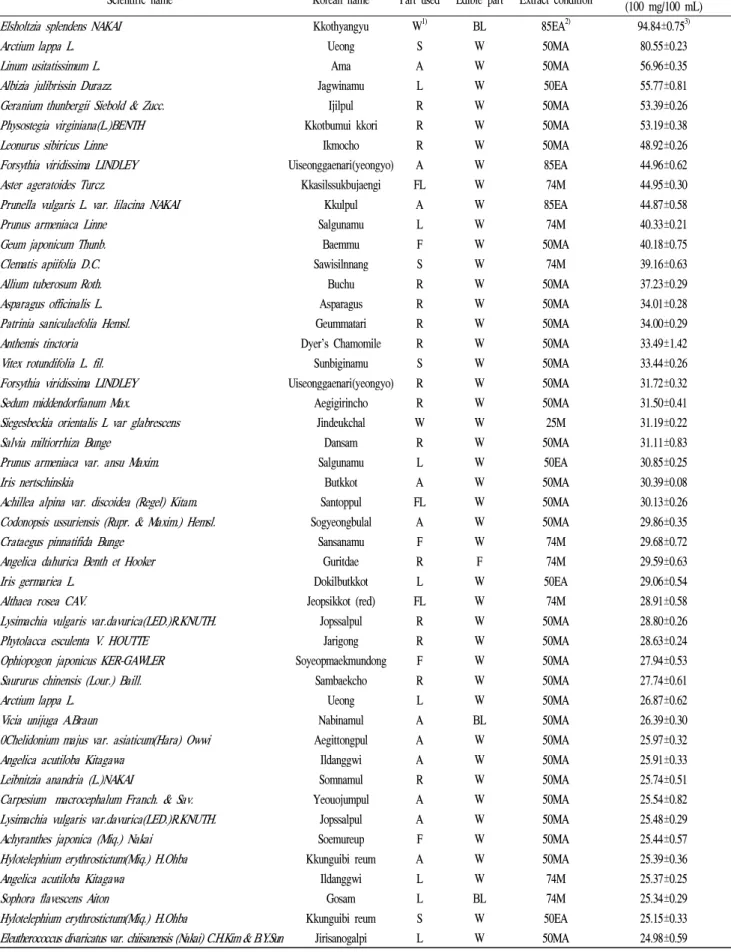
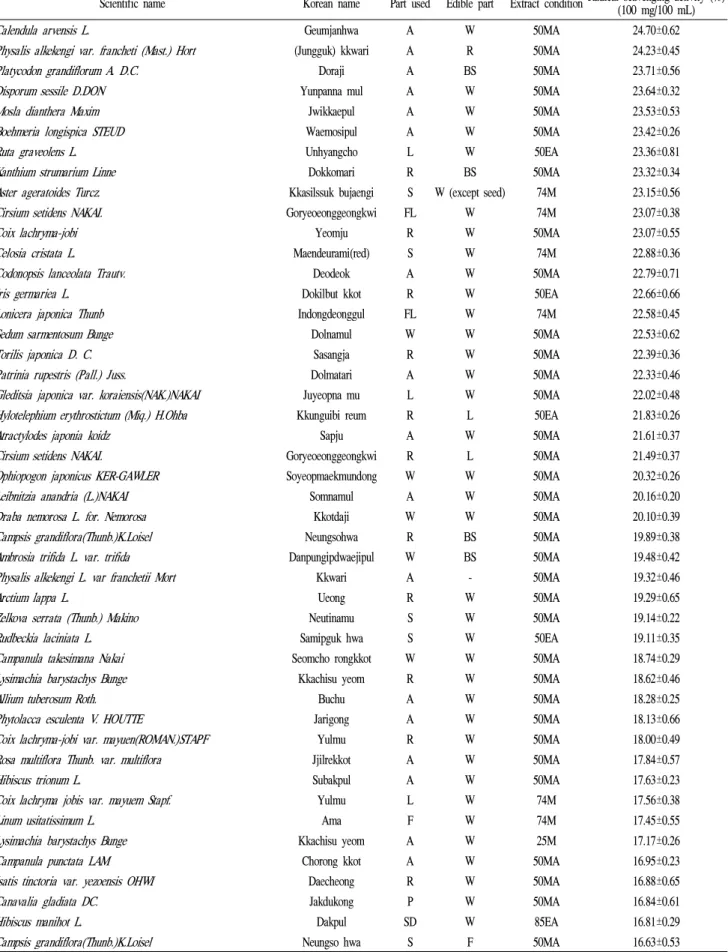
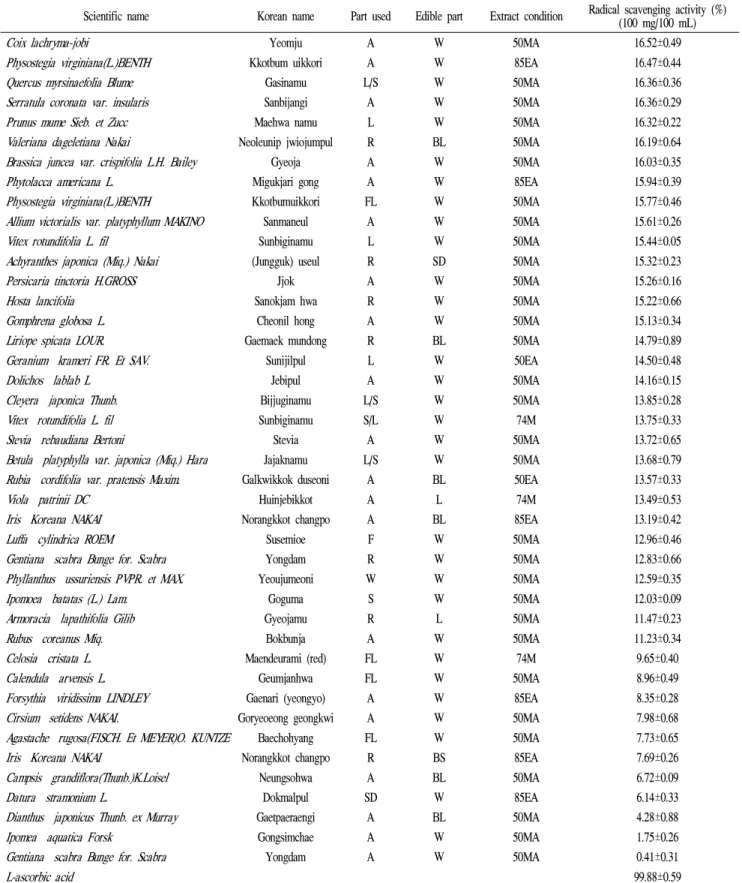
국내 자생 식물 중 식품원료로 사용이 가능한 135종의 식물추출물을 대상으로 DPPH radical 소거활성을 측정한 결과는 다음의 Table 2와 같다. 추출물에 따라 0.41~94.84%
의 DPPH radical 소거활성을 나타내고 있었으며 꽃향유, 우엉(줄기)이 각각 94.84%, 80.55%로 높은 활성을 나타내 고 있었다. 아마, 자귀나무, 이질풀, 꽃범의꼬리는 50%대의 활성을, 익모초, 의성개나리(연교) 지상부, 까실쑥부쟁이, 꿀풀, 살구나무, 뱀무의 경우 40%, 사위질빵, 부추, 아스파 라거스, 금마타리, 다이어스카모마일, 순비기나무, 의성개 나리(연교) 뿌리, 애기기린초, 진측찰, 단삼, 살구나무, 붓꽃, 산톱풀은 30%대의 활성을 순서대로 나타내고 있었다. 가장 높은 항산화 활성을 나타낸 꽃향유는 실제 에탄올 추출물에 서 항산화효과가 가장 큰 것으로 보고되고 있다(14).
우엉은 이 등(10)의 연구에서도 85.6%의 소거활성을 나 타내는 것으로 보고되고 있어 본 연구의 결과와 유사한 수준으로 향후 활용가능성이 높은 항산화 소재로 판단된 다. 한편 우엉은 잎의 경우 26.87%, 뿌리 19.29%의 활성을 나타내 동일 식물이라도 추출부위에 따라 활성의 차이가 있을 것으로 보인다. 반면 율무의 경우는 뿌리(18.00%), 잎(17.56%)로 유사하게 나타났다.
식물추출물의 항균 활성
일반적으로 항산화 활성과 항균 활성을 함께 검토할 경 우 높은 항산화 활성을 나타내는 식물에 대해 항균효과를 추가로 검토하는 경우가 많다. 한편 본 연구에서는 20%
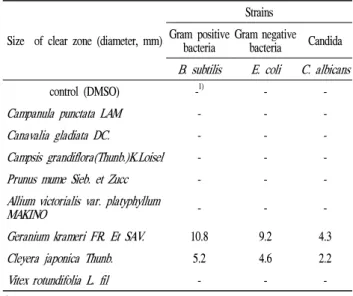
미만의 항산화활성을 나타내는 식물 중 분과별로 대표적 식물을 선정하여 총 8종의 추출물에 대한 항균활성을 조사 하였다. 그 결과는 다음의 Table 3과 같다. 항균활성이 높게
나타난 선이질풀과 비쭈기나무는 각각 그람양성균인 B.
subtilis, 그람음성균인E. coli및Candida속인C. albicans에 대해 2.2~10.8 mm 수준의 항균활성을 나타내었다. 특히 선이질풀의 항균활성은 비쭈기나무의 약 2배에 해당하는
Table 2. Scavenging effect of plant extracts on DPPH
Scientific name Korean name Part used Edible part Extract condition Radical scavenging activity (%)(100 mg/100 mL) Elsholtzia splendens NAKAI Kkothyangyu W1) BL 85EA2) 94.84±0.753)
Arctium lappa L. Ueong S W 50MA 80.55±0.23
Linum usitatissimum L. Ama A W 50MA 56.96±0.35
Albizia julibrissin Durazz. Jagwinamu L W 50EA 55.77±0.81
Geranium thunbergii Siebold & Zucc. Ijilpul R W 50MA 53.39±0.26 Physostegia virginiana(L.)BENTH Kkotbumui kkori R W 50MA 53.19±0.38
Leonurus sibiricus Linne Ikmocho R W 50MA 48.92±0.26
Forsythia viridissima LINDLEY Uiseonggaenari(yeongyo) A W 85EA 44.96±0.62 Aster ageratoides Turcz. Kkasilssukbujaengi FL W 74M 44.95±0.30 Prunella vulgaris L. var. lilacina NAKAI Kkulpul A W 85EA 44.87±0.58
Prunus armeniaca Linne Salgunamu L W 74M 40.33±0.21
Geum japonicum Thunb. Baemmu F W 50MA 40.18±0.75
Clematis apiifolia D.C. Sawisilnnang S W 74M 39.16±0.63
Allium tuberosum Roth. Buchu R W 50MA 37.23±0.29
Asparagus officinalis L. Asparagus R W 50MA 34.01±0.28
Patrinia saniculaefolia Hemsl. Geummatari R W 50MA 34.00±0.29
Anthemis tinctoria Dyer's Chamomile R W 50MA 33.49±1.42
Vitex rotundifolia L. fil. Sunbiginamu S W 50MA 33.44±0.26
Forsythia viridissima LINDLEY Uiseonggaenari(yeongyo) R W 50MA 31.72±0.32
Sedum middendorfianum Max. Aegigirincho R W 50MA 31.50±0.41
Siegesbeckia orientalis L var glabrescens Jindeukchal W W 25M 31.19±0.22
Salvia miltiorrhiza Bunge Dansam R W 50MA 31.11±0.83
Prunus armeniaca var. ansu Maxim. Salgunamu L W 50EA 30.85±0.25
Iris nertschinskia Butkkot A W 50MA 30.39±0.08
Achillea alpina var. discoidea (Regel) Kitam. Santoppul FL W 50MA 30.13±0.26 Codonopsis ussuriensis (Rupr. & Maxim.) Hemsl. Sogyeongbulal A W 50MA 29.86±0.35
Crataegus pinnatifida Bunge Sansanamu F W 74M 29.68±0.72
Angelica dahurica Benth et Hooker Guritdae R F 74M 29.59±0.63
Iris germariea L. Dokilbutkkot L W 50EA 29.06±0.54
Althaea rosea CAV. Jeopsikkot (red) FL W 74M 28.91±0.58
Lysimachia vulgaris var.davurica(LED.)R.KNUTH. Jopssalpul R W 50MA 28.80±0.26
Phytolacca esculenta V. HOUTTE Jarigong R W 50MA 28.63±0.24
Ophiopogon japonicus KER-GAWLER Soyeopmaekmundong F W 50MA 27.94±0.53 Saururus chinensis (Lour.) Baill. Sambaekcho R W 50MA 27.74±0.61
Arctium lappa L. Ueong L W 50MA 26.87±0.62
Vicia unijuga A.Braun Nabinamul A BL 50MA 26.39±0.30
0Chelidonium majus var. asiaticum(Hara) Owwi Aegittongpul A W 50MA 25.97±0.32
Angelica acutiloba Kitagawa Ildanggwi A W 50MA 25.91±0.33
Leibnitzia anandria (L.)NAKAI Somnamul R W 50MA 25.74±0.51
Carpesium macrocephalum Franch. & Sav. Yeouojumpul A W 50MA 25.54±0.82 Lysimachia vulgaris var.davurica(LED.)R.KNUTH. Jopssalpul A W 50MA 25.48±0.29 Achyranthes japonica (Miq.) Nakai Soemureup F W 50MA 25.44±0.57 Hylotelephium erythrostictum(Miq.) H.Ohba Kkunguibi reum A W 50MA 25.39±0.36
Angelica acutiloba Kitagawa Ildanggwi L W 74M 25.37±0.25
Sophora flavescens Aiton Gosam L BL 74M 25.34±0.29
Hylotelephium erythrostictum(Miq.) H.Ohba Kkunguibi reum S W 50EA 25.15±0.33 Eleutherococcus divaricatus var. chiisanensis (Nakai) C.H.Kim & B.Y.Sun Jirisanogalpi L W 50MA 24.98±0.59
Table 2. Continued
Scientific name Korean name Part used Edible part Extract condition Radical scavenging activity (%)(100 mg/100 mL)
Calendula arvensis L. Geumjanhwa A W 50MA 24.70±0.62
Physalis alkekengi var. francheti (Mast.) Hort (Jungguk) kkwari A R 50MA 24.23±0.45
Platycodon grandiflorum A. D.C. Doraji A BS 50MA 23.71±0.56
Disporum sessile D.DON Yunpanna mul A W 50MA 23.64±0.32
Mosla dianthera Maxim Jwikkaepul A W 50MA 23.53±0.53
Boehmeria longispica STEUD Waemosipul A W 50MA 23.42±0.26
Ruta graveolens L. Unhyangcho L W 50EA 23.36±0.81
Xanthium strumarium Linne Dokkomari R BS 50MA 23.32±0.34
Aster ageratoides Turcz. Kkasilssuk bujaengi S W (except seed) 74M 23.15±0.56 Cirsium setidens NAKAI. Goryeoeonggeongkwi FL W 74M 23.07±0.38
Coix lachryma-jobi Yeomju R W 50MA 23.07±0.55
Celosia cristata L. Maendeurami(red) S W 74M 22.88±0.36
Codonopsis lanceolata Trautv. Deodeok A W 50MA 22.79±0.71
Iris germariea L. Dokilbut kkot R W 50EA 22.66±0.66
Lonicera japonica Thunb Indongdeonggul FL W 74M 22.58±0.45
Sedum sarmentosum Bunge Dolnamul W W 50MA 22.53±0.62
Torilis japonica D. C. Sasangja R W 50MA 22.39±0.36
Patrinia rupestris (Pall.) Juss. Dolmatari A W 50MA 22.33±0.46 Gleditsia japonica var. koraiensis(NAK.)NAKAI Juyeopna mu L W 50MA 22.02±0.48 Hylotelephium erythrostictum (Miq.) H.Ohba Kkunguibi reum R L 50EA 21.83±0.26
Atractylodes japonia koidz Sapju A W 50MA 21.61±0.37
Cirsium setidens NAKAI. Goryeoeonggeongkwi R L 50MA 21.49±0.37 Ophiopogon japonicus KER-GAWLER Soyeopmaekmundong W W 50MA 20.32±0.26
Leibnitzia anandria (L.)NAKAI Somnamul A W 50MA 20.16±0.20
Draba nemorosa L. for. Nemorosa Kkotdaji W W 50MA 20.10±0.39
Campsis grandiflora(Thunb.)K.Loisel Neungsohwa R BS 50MA 19.89±0.38 Ambrosia trifida L. var. trifida Danpungipdwaejipul W BS 50MA 19.48±0.42 Physalis alkekengi L. var franchetii Mort Kkwari A - 50MA 19.32±0.46
Arctium lappa L. Ueong R W 50MA 19.29±0.65
Zelkova serrata (Thunb.) Makino Neutinamu S W 50MA 19.14±0.22
Rudbeckia laciniata L. Samipguk hwa S W 50EA 19.11±0.35
Campanula takesimana Nakai Seomcho rongkkot W W 50MA 18.74±0.29 Lysimachia barystachys Bunge Kkachisu yeom R W 50MA 18.62±0.46
Allium tuberosum Roth. Buchu A W 50MA 18.28±0.25
Phytolacca esculenta V. HOUTTE Jarigong A W 50MA 18.13±0.66
Coix lachryma-jobi var. mayuen(ROMAN.)STAPF Yulmu R W 50MA 18.00±0.49 Rosa multiflora Thunb. var. multiflora Jjilrekkot A W 50MA 17.84±0.57
Hibiscus trionum L. Subakpul A W 50MA 17.63±0.23
Coix lachryma jobis var. mayuem Stapf. Yulmu L W 74M 17.56±0.38
Linum usitatissimum L. Ama F W 74M 17.45±0.55
Lysimachia barystachys Bunge Kkachisu yeom A W 25M 17.17±0.26
Campanula punctata LAM Chorong kkot A W 50MA 16.95±0.23
Isatis tinctoria var. yezoensis OHWI Daecheong R W 50MA 16.88±0.65
Canavalia gladiata DC. Jakdukong P W 50MA 16.84±0.61
Hibiscus manihot L. Dakpul SD W 85EA 16.81±0.29
Campsis grandiflora(Thunb.)K.Loisel Neungso hwa S F 50MA 16.63±0.53
Table 2. Continued
Scientific name Korean name Part used Edible part Extract condition Radical scavenging activity (%) (100 mg/100 mL)
Coix lachryma-jobi Yeomju A W 50MA 16.52±0.49
Physostegia virginiana(L.)BENTH Kkotbum uikkori A W 85EA 16.47±0.44
Quercus myrsinaefolia Blume Gasinamu L/S W 50MA 16.36±0.36
Serratula coronata var. insularis Sanbijangi A W 50MA 16.36±0.29
Prunus mume Sieb. et Zucc Maehwa namu L W 50MA 16.32±0.22
Valeriana dageletiana Nakai Neoleunip jwiojumpul R BL 50MA 16.19±0.64 Brassica juncea var. crispifolia L.H. Bailey Gyeoja A W 50MA 16.03±0.35
Phytolacca americana L. Migukjari gong A W 85EA 15.94±0.39
Physostegia virginiana(L.)BENTH Kkotbumuikkori FL W 50MA 15.77±0.46 Allium victorialis var. platyphyllum MAKINO Sanmaneul A W 50MA 15.61±0.26
Vitex rotundifolia L. fil Sunbiginamu L W 50MA 15.44±0.05
Achyranthes japonica (Miq.) Nakai (Jungguk) useul R SD 50MA 15.32±0.23
Persicaria tinctoria H.GROSS Jjok A W 50MA 15.26±0.16
Hosta lancifolia Sanokjam hwa R W 50MA 15.22±0.66
Gomphrena globosa L. Cheonil hong A W 50MA 15.13±0.34
Liriope spicata LOUR. Gaemaek mundong R BL 50MA 14.79±0.89
Geranium krameri FR. Et SAV. Sunijilpul L W 50EA 14.50±0.48
Dolichos lablab L Jebipul A W 50MA 14.16±0.15
Cleyera japonica Thunb. Bijjuginamu L/S W 50MA 13.85±0.28
Vitex rotundifolia L. fil Sunbiginamu S/L W 74M 13.75±0.33
Stevia rebaudiana Bertoni Stevia A W 50MA 13.72±0.65
Betula platyphylla var. japonica (Miq.) Hara Jajaknamu L/S W 50MA 13.68±0.79 Rubia cordifolia var. pratensis Maxim. Galkwikkok duseoni A BL 50EA 13.57±0.33
Viola patrinii DC Huinjebikkot A L 74M 13.49±0.53
Iris Koreana NAKAI Norangkkot changpo A BL 85EA 13.19±0.42
Luffa cylindrica ROEM Susemioe F W 50MA 12.96±0.46
Gentiana scabra Bunge for. Scabra Yongdam R W 50MA 12.83±0.66 Phyllanthus ussuriensis PVPR. et MAX. Yeoujumeoni W W 50MA 12.59±0.35
Ipomoea batatas (L.) Lam. Goguma S W 50MA 12.03±0.09
Armoracia lapathifolia Gilib Gyeojamu R L 50MA 11.47±0.23
Rubus coreanus Miq. Bokbunja A W 50MA 11.23±0.34
Celosia cristata L. Maendeurami (red) FL W 74M 9.65±0.40
Calendula arvensis L. Geumjanhwa FL W 50MA 8.96±0.49
Forsythia viridissima LINDLEY Gaenari (yeongyo) A W 85EA 8.35±0.28 Cirsium setidens NAKAI. Goryeoeong geongkwi A W 50MA 7.98±0.68 Agastache rugosa(FISCH. Et MEYER)O. KUNTZE Baechohyang FL W 50MA 7.73±0.65
Iris Koreana NAKAI Norangkkot changpo R BS 85EA 7.69±0.26
Campsis grandiflora(Thunb.)K.Loisel Neungsohwa A BL 50MA 6.72±0.09
Datura stramonium L. Dokmalpul SD W 85EA 6.14±0.33
Dianthus japonicus Thunb. ex Murray Gaetpaeraengi A BL 50MA 4.28±0.88
Ipomea aquatica Forsk Gongsimchae A W 50MA 1.75±0.26
Gentiana scabra Bunge for. Scabra Yongdam A W 50MA 0.41±0.31
L-ascorbic acid 99.88±0.59
1)A=aboveground part, B=barks, BL=baby leaves, BR=baby sprout, F=fruit, FL=flower, L=leaves, P=pea pod, R=root, RD=rind, S=stem, SD=seed, SP=stem sprout, W=whole
2)25M=sample was extracted in 100% methanol at 25℃, 50MA=sample was extracted in refluxing apparatus with 100% methanol at 50℃ (accelerated solvent extractor; ASE300, DIONEX, USA), 50EA=sample was extracted in refluxing apparatus with 100% ethanol at 50℃ (accelerated solvent extractor; ASE300, DIONEX, USA), 74M=sample was extracted in 100% methanol at 74℃, 85M=extract in 100% methanol at 85℃, 85EA=extract in 100% ethanol at 85℃ (accelerated solvent extractor; ASE300, DIONEX, USA). The solvents in the samples was evaporated in vacuum condition. All of the extracts were stored in -27℃before using.
3)Mean±SD
높은 결과였다. 특히 선이질풀은 쥐손이풀과(geranium)의 다년생 식물로 항균작용이 있어 이질, 지사에 효과가 있는 약초로 알려져 있으나 선이질풀 자체에 대한 보고보다는 쥐손이풀에 대한 각종 생리활성에 대한 보고가 주를 이루고 있다(15). 추출용매에 따라 쥐손이풀(Gerinium sibiricum L) 은 25 mg/100 mL 농도에서 76.55±0.11%의 DPPH radical 소거능을 나타내었는데 이러한 생리활성은 주로 폴리페놀, 플라보노이드로 인해 기인하는 것으로 보고되고 있다(16).
비쭈기나무는 차나무과 식물로 충치예방, 입 냄새 제거, 혈압상승억제, 혈중콜레스테롤 상승억제 등의 효과가 있으 며, 차나무 속인 동백나무에 대한 항미생물 및 항산화효과 등이 보고되어 있으며 비쭈기나무의 잎은 24.5, 줄기는 30.9%의 DPPH radical 소거능을 나타내고 있었다(17,18).
이러한 결과는 선이질풀 및 비쭈기나무에 대해서도 다수의 항산화 및 항균성 물질이 존재함을 시사하는 것으로 다양한 추출법을 적용하여 기능성을 확인하고 이들 항산화성 물질 에 대한 추가 연구가 진행되어야 할 것으로 사료된다.
Table 3. Antimicrobial activities of plant extract Size of clear zone (diameter, mm)
Strains Gram positive
bacteria Gram negative bacteria Candida B. subtilis E. coli C. albicans
control (DMSO) -1) - -
Campanula punctata LAM - - -
Canavalia gladiata DC. - - -
Campsis grandiflora(Thunb.)K.Loisel - - - Prunus mume Sieb. et Zucc - - - Allium victorialis var. platyphyllum
MAKINO - - -
Geranium krameri FR. Et SAV. 10.8 9.2 4.3 Cleyera japonica Thunb. 5.2 4.6 2.2 Vitex rotundifolia L. fil - - -
1)No inhibition
요 약
항산화 및 항균활성을 가진 천연물을 활용해 합성보존료 를 대체하고자 하는 연구가 활발한 가운데 국내 자생 식물 중 135종을 대상으로 DPPH radical 소거활성을 측정하였다.
이중 항산화 활성이 10%대로 낮게 나타난 식물 8종에 대해 항균효과를 조사하였다. 식물 추출물의 DPPH radical 소거 활성은 0.41~94.84%로 다양하였으며, 가장 효과가 좋은 식물은 꽃향유와 우엉으로 각각 94.84, 80.55%를 나타내었 다. 우엉은 잎의 경우 26.87, 뿌리 19.29%의 활성을 나타내 동일 식물이라도 추출부위에 따라 활성의 차이가 있을 것으
로 보인다. 선이질풀과 비쭈기나무는 각각 그람양성균인 B. subtilis, 그람음성균인E. coli및Candida속인C. albicans 에 대해 2.2~10.8 mm 수준의 항균활성을 나타내었다. 각 식물에 대한 다양한 추출법을 적용하여 기능성을 확인하고 이들 항산화성 물질에 대한 추가 연구가 진행되어야 할 것으로 사료된다.
감사의 글
본 연구는 2013년도 산업통상자원부에서 시행한 지역특 화산업육성(R&D) 기술개발사업“의 지원(R-0002327)에 의 해 수행되었으며, 국립원예특작과학원 인삼특작부추출물 은행(과제번호 PJ007437)으로부터 제공받은 추출물을 재 료로 사용하였음으로, 이에 감사드립니다.
References
1. Gupta VK, Sharma SK (2006) Plants as natural antioxidants. Nat Prod Radiance, 5, 326-334 2. MS Brewer (2011) Natural antioxidants: sources,
compounds, mechanisms of action, and potential applications. Compr Rev Food Sci Food Safety, 10, 221-247
3. Sa YJ, Kim JS, Kim MO, Jeing HJ, Yu CY, Park DS, Kim MJ (2010) Comparative study of electron donating ability, reducing power, antimicrobial activity and inhibition of α-glucosidase bySorghum bicolor extracts.
Korean J Food Sci Technol, 42, 598-604
4. Ifesan BOT, Fashakin JF, Ebosele F, Oyerinde AS (2013) Antioxidant and antimicrobial properties of selected plant leaves. Eur J Med Plants, 3, 465-473
5. Nik AK, Guzej B, Kolar MH, Abramovic H, Moz SS (2009) In vitro antimicrobial and antioxidant activity of commercial rosemary extract formulations. J Food Prot, 72, 174-1752
6. Fattouch S, Caboni P, Coroneo V, Tuberoso C, Angioni A, Dessi S, Marzouki N, Cabras P (2008) Comparative analysis of polyphenolic profiles and antioxidant and antimicrobial activities of tunisian pome fruit pulp and peel aqueous acetone extracts. J Agric Food Chem, 56, 1084-1090
7. Singh G, Maurya S, deLampasona MP, Catalan CAN (2007) A comparison of chemical, antioxidant and antimicrobial studies of cinnamon leaf and bark volatile oils, oleoresins and their constituents. Food Chem
Toxicol, 45, 1650-1661
8. Moon YG, Heo MS (2007) Screening of antioxidative and antibacterial activity from methanol extracts of Indigenous plants, Jeju-island. Korean J Biotechnol Bioeng, 22, 78-83
9. Kim EJ, Choi JY, Yu MR, Kim MY, Lee SH, Lee BH (2012) Total polyphenols, total flavonoid contents, and antioxidant activity of Korean natural and medicinal plants. Korean J Food Sci Technol, 44, 337-342 10. Lee YM, Kim DI, Lee SH, Cho SM, Chun HK, Park
HJ, Lee YS (2005) Investigation of DPPH radical scavenging and prolyl endopeptidase inhibitory activities of plant extracts. Korean J Community Living Sci, 16, 95-102
11. Sharma OP, Bhat TK (2009) DPPH antioxidant assay revisited. Food Chem, 113, 1201-1205
12. RS Farag (1989) Antimicrobial activity of some Egyptian spice essential oils. J Food Prot, 52, 665-670 13. Musialik M, Litwinienko G (2005) Scavenging of DPPH
radicals by vitamin E is accelerated by its partial
ionization: the role of sequential proton loss electron transfer. Org Lett, 7, 4951-4954
14. Lee JA, Jeong DS (2011) Screening of the antioxidant and anti-elastase activities for the extracts of Jeju endemic plants. Res Sci Educ, 13, 249-269
15. Woo WS, Lee EB, Han BH (1979) Biological evaluation of Korean medical plants (III). Arch Pharm Res, 2, 127-188
16. Lee BH (2014) Composition for preventing hair loss or promoting hair growth comprising extract of Geranium sibiricum L.. Korea Patent No 10-2014-0031489 17. Lee MW, Oh MH (2014) Novel hydrolysable tannis
isolated from the leaves ofCleyera japonica Thunberg and anti-oxidative use thereof. Korea Patent No 10-2014-0008694
18. Oh SJ, Lee JH, Ko KS, Shin DB, Koh SC (2010) Antioxidative activity, including Inhibitory activities of ACE, APN and α-amylase, in Theaceae Plants Native to Jeju island. Korean J Plant Res, 23, 406-414
(접수 2014년 5월 7일 수정 2014년 6월 23일 채택 2014년 6월 24일)