Prevalence of Obesity and Incidence of
Obesity-Related Comorbidities in Koreans Based on National Health Insurance Service Health Checkup Data 2006–2015
Mi Hae Seo
1, Yang-Hyun Kim
2, Kyungdo Han
3, Jin-Hyung Jung
3, Yong-Gyu Park
3, Seong-Su Lee
4, Hyuk-Sang Kwon
5, Won-Young Lee
6,*, Soon Jib Yoo
4,*; on Behalf of the Taskforce Team of the Obesity Fact Sheet of the Korean Society for the Study of Obesity
1
Division of Endocrinology, Department of Internal Medicine, Soonchunhyang University Gumi Hospital, Soonchunhyang University School of Medicine, Gumi;
2
Department of Family Medicine, Korea University College of Medicine, Seoul;
3Department of Biostatistics, The Catholic University of Korea, Seoul;
4Division of Endocrinology and Metabolism, Department of Internal Medicine, Bucheon St. Mary’s Hospital, College of Medicine, The Catholic University of Korea, Bucheon;
5
Division of Endocrinology and Metabolism, Department of Internal Medicine, Yeouido St. Mary’s Hospital, College of Medicine, The Catholic University of Korea, Seoul;
6Division of Endocrinology and Metabolism, Department of Internal Medicine, Kangbuk Samsung Hospital, Sungkyunkwan University School of Medicine, Seoul, Korea
Background: The prevalence of obesity and related comorbidities is increasing worldwide, including in Korea.
The Korean Society for the Study of Obesity released the Obesity Fact Sheet 2017 to address this problem in the Korean population.
Methods: Data from the National Health Insurance Service Health Checkup database from 2006 to 2015 were standardized by age and sex using the 2010 Census. The definition of obesity was a body mass index (BMI) ≥25 kg/m
2, and that of abdominal obesity was a waist circumference ≥90 cm in men and ≥85 cm in women. Multi- variate adjusted Cox regression analysis was conducted, and hazard ratios (HRs) with 95% confidence intervals were calculated for comorbidities.
Results: From 2009 to 2015, the prevalence of obesity increased from 29.7% to 32.4%, and that of abdominal obesity increased from 18.4% to 20.8%. Obesity with abdominal obesity also increased from 15.1% to 17.7%.
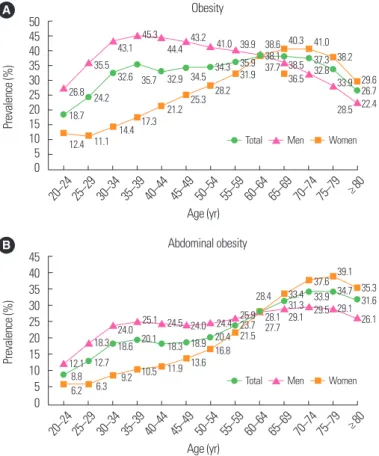
Between 2014 and 2015, the prevalence of obesity increased until 30–40 years of age, but decreased from 40–
50 years of age in men. In women, it increased until the mid-70s, and decreased thereafter. Abdominal obesity increased from 20–30 years of age to 70–80 years of age, but decreased thereafter. The HRs for type 2 diabetes mellitus, hypertension, dyslipidemia, myocardial infarction, and ischemic stroke were elevated in subjects with abdominal obesity, and their incidence increased as the BMI increased, but slowed down at BMI ≥35 kg/m
2. Conclusion: Based on the Obesity Fact Sheet 2017, strategies for reducing the prevalence of obesity and ab- dominal obesity are essential.
Key words: Obesity, Abdominal obesity, Body mass index, Comorbidity, National Health Insurance Service
Received March 7, 2018 Reviewed March 8, 2018 Accepted March 15, 2018
* Corresponding author Won-Young Lee
https://orcid.org/0000-0002-1082-7592 Division of Endocrinology and Metabolism, Department of Internal Medicine, Kangbuk Samsung Hospital, Sungkyunkwan University School of Medicine, 29 Saemunan-ro, Jongno-gu, Seoul 03181, Korea
Tel: +82-2-2001-2579 Fax: +82-2-2001-1588 E-mail: [email protected]
* Co-Corresponding author Soon Jib Yoo
https://orcid.org/0000-0002-9932-4130 Division of Endocrinology and Metabolism, Department of Internal Medicine, Bucheon St. Mary’s Hospital, College of Medicine, The Catholic University of Korea, 327 Sosa-ro, Wonmi-gu, Bucheon 14647, Korea Tel: +82-32-340-7011
Fax: +82-32-340-2669 E-mail: [email protected]
The first two authors contributed equally to this study.
2017-03-16 https://crossmark-cdn.crossref.org/widget/v2.0/logos/CROSSMARK_Color_square.svg
Copyright © 2018 Korean Society for the Study of Obesity
This is an Open Access article distributed under the terms of the Creative Commons Attribution Non-Commercial License (http://creativecommons.org/licenses/by-nc/4.0/) which per-
mits unrestricted non-commercial use, distribution, and reproduction in any medium, provided the original work is properly cited.
Prevalence of Obesity and Incidence of
Obesity-Related Comorbidities in Koreans Based on National Health Insurance Service Health Checkup Data 2006–2015
Mi Hae Seo
1, Yang-Hyun Kim
2, Kyungdo Han
3, Jin-Hyung Jung
3, Yong-Gyu Park
3, Seong-Su Lee
4, Hyuk-Sang Kwon
5, Won-Young Lee
6,*, Soon Jib Yoo
4,*; on Behalf of the Taskforce Team of the Obesity Fact Sheet of the Korean Society for the Study of Obesity
1
Division of Endocrinology, Department of Internal Medicine, Soonchunhyang University Gumi Hospital, Soonchunhyang University School of Medicine, Gumi;
2
Department of Family Medicine, Korea University College of Medicine, Seoul;
3Department of Biostatistics, The Catholic University of Korea, Seoul;
4Division of Endocrinology and Metabolism, Department of Internal Medicine, Bucheon St. Mary’s Hospital, College of Medicine, The Catholic University of Korea, Bucheon;
5