Using Patient-Reported Outcome Measurement Information System Computer Adaptive Testing Domains to Investigate the Impact of Obesity on Physical Function, Pain Interference, and Mental Health in Sports Medicine Patients
Jacob W Blanchett, Noah A Kuhlmann, Mohsin S Fidai, Peter A Borowsky, Stephanie J Muh, Eric C Makhni*
Department of Orthopedic Surgery, Henry Ford Hospital, West Bloomfield, MI, USA
Background: While obesity has become an increasingly prevalent health concern in the United States, little emphasis has been placed on utilizing patient reported outcome measures (PROM) to investigate its impact on life from the patients’ perspective. The purpose of the study was to determine the association between patients’
body mass index (BMI) and three Patient-Reported Outcome Measurement Information System (PROMIS) com- puter adaptive test scores: upper extremity physical function (UE) or lower extremity physical function (PF), pain interference (PI), and depression (D).
Methods: Patients were recruited from two sports medicine orthopedic surgery clinics. PROMIS questionnaires were administered to patients arriving for their first visit. Patients were stratified into BMI groupings according to the National Institute of Health standards. Patients’ BMI, sex, race, ethnicity, and injury were determined retroac- tively. Data were analyzed using a Pearson correlation and a least significant difference post hoc test.
Results: A total of 833 patients completed the set of PROMIS questionnaires that were retrospectively analyzed.
BMI was found to have a correlation with PROMIS-UE (R=–0.111, P<0.05), PROMIS-PF (R=–0.174, P<0.01), PROMIS-PI (R=0.224, P<0.01), and PROMIS-D (R=0.092, P<0.05). Obese patients also portrayed the worst PROMIS-UE, PROMIS-PI, and PROMIS-PF.
Conclusion: We found BMI to correlate with each PROMIS domain: negatively with PROMIS-UE, PROMIS-PF, PROMIS-D, and positively with PROMIS-PI. Additionally, overweight and obese BMI patients portrayed worse physical function and pain interference scores than their healthy group counterparts.
Key words: Body mass index, Patient reported outcome measures, Overweight, Obesity, Quality of life, Pain
Received May 31, 2019 Reviewed August 9, 2019 Accepted October 7, 2019
* Corresponding author Eric C Makhni
https://orcid.org/0000-0003-4408-1175 Department of Orthopedic Surgery, Henry Ford Hospital, 6777 W Maple Rd, West Bloomfield, MI 48322, USA Tel: +1-248-661-6470 Fax: +1-248-661-7155 E-mail: [email protected]
INTRODUCTION
Obesity, defined as a body mass index (BMI) of 30 kg/m
2or higher, is a pressing health care problem around the world. It has been significantly associated with chronic disease in both men and women.
1,2Despite negative implications, obesity has become in-
creasingly prevalent rising from 29.7% in 2009 to 32.4% in 2015.
2Studies have reported that statistics may actually underestimate the impact of obesity on mortality and its associated costs.
1,3Studies have addressed the impact of BMI on postoperative success in or- thopedic surgery by utilizing objective measures, in addition to leg- acy patient reported outcome measures (PROM).
4,5However, the
Copyright © 2019 Korean Society for the Study of Obesity
This is an Open Access article distributed under the terms of the Creative Commons Attribution Non-Commercial License (http://creativecommons.org/licenses/by-nc/4.0/) which permits unrestricted non-commercial use, distribution, and reproduction in any medium, provided the original work is properly cited.
2017-03-16 https://crossmark-cdn.crossref.org/widget/v2.0/logos/CROSSMARK_Color_square.svg
Using Patient-Reported Outcome Measurement Information System Computer Adaptive Testing Domains to Investigate the Impact of Obesity on Physical Function, Pain Interference, and Mental Health in Sports Medicine Patients
Jacob W Blanchett, Noah A Kuhlmann, Mohsin S Fidai, Peter A Borowsky, Stephanie J Muh, Eric C Makhni*
Department of Orthopedic Surgery, Henry Ford Hospital, West Bloomfield, MI, USA
Background: While obesity has become an increasingly prevalent health concern in the United States, little emphasis has been placed on utilizing patient reported outcome measures (PROM) to investigate its impact on life from the patients’ perspective. The purpose of the study was to determine the association between patients’
body mass index (BMI) and three Patient-Reported Outcome Measurement Information System (PROMIS) com- puter adaptive test scores: upper extremity physical function (UE) or lower extremity physical function (PF), pain interference (PI), and depression (D).
Methods: Patients were recruited from two sports medicine orthopedic surgery clinics. PROMIS questionnaires were administered to patients arriving for their first visit. Patients were stratified into BMI groupings according to the National Institute of Health standards. Patients’ BMI, sex, race, ethnicity, and injury were determined retroac- tively. Data were analyzed using a Pearson correlation and a least significant difference post hoc test.
Results: A total of 833 patients completed the set of PROMIS questionnaires that were retrospectively analyzed.
BMI was found to have a correlation with PROMIS-UE (R=–0.111, P<0.05), PROMIS-PF (R=–0.174, P<0.01), PROMIS-PI (R=0.224, P<0.01), and PROMIS-D (R=0.092, P<0.05). Obese patients also portrayed the worst PROMIS-UE, PROMIS-PI, and PROMIS-PF.
Conclusion: We found BMI to correlate with each PROMIS domain: negatively with PROMIS-UE, PROMIS-PF, PROMIS-D, and positively with PROMIS-PI. Additionally, overweight and obese BMI patients portrayed worse physical function and pain interference scores than their healthy group counterparts.
Key words: Body mass index, Patient reported outcome measures, Overweight, Obesity, Quality of life, Pain
Received May 31, 2019 Reviewed August 9, 2019 Accepted October 7, 2019
* Corresponding author Eric C Makhni
https://orcid.org/0000-0003-4408-1175 Department of Orthopedic Surgery, Henry Ford Hospital, 6777 W Maple Rd, West Bloomfield, MI 48322, USA Tel: +1-248-661-6470 Fax: +1-248-661-7155 E-mail: [email protected]
impact of BMI on physical function, pain interference, and depres- sion in patients undergoing surgical or nonsurgical treatments has not been assessed from the patients’ perspective utilizing the new Patient-Reported Outcome Measurement Information System’s (PROMIS’s) computer adaptive testing (CAT) domains.
As healthcare continues to evolve to a more value-based approach, PROM are becoming increasingly important, as they represent clin- ical outcomes from the patient perspective. Many insurance com- panies have already begun replacing fee-for-service models with re- cently-developed, pay-for-performance models.
6These PROM also provide benefits to the patient, as patients are able to quantify progression throughout their treatment.
7The National Institute of Health (NIH) created PROMIS in a concentrated effort to stream- line PROM reporting via a single effective and efficient system.
8,9PROMIS CAT forms are an electronic questionnaire that utilizes an item response theory to determine the most relevant subsequent question to ask—choosing from a large question bank specific to each subdomain. This has made PROMIS more responsive, had fewer ceiling and floor effects, and taken less time compared to leg- acy PROM.
10,11Additionally, several studies have found CAT forms to be well received by patients from a diverse population—even denoting that it can promote elevated self-reflection.
12The purpose of this study is to investigate the association of BMI on numerous health domains, such as physical function, pain inter- ference (the impact of pain on a patient’s quality of life), and men- tal health (depression) as measured by PROMIS CAT domains to enable providers to further incorporate BMI into treatment choices.
We hypothesize that BMI has a negative correlation with physical function scores and a positive correlation with pain interference and depression scores.
METHODS
This study was performed under Institutional Board Approval of Henry Ford Health System (No. 11361), which waived the require- ment for informed consent. All patients presenting to one of two surgeons’ ambulatory sports medicine clinics, as part of routine practice, were asked to complete an electronic questionnaire. The questionnaire consisted of an intake form that presented injury lo- cation options, followed by the corresponding PROMIS CAT
forms: PROMIS-upper extremity physical function (PROMIS- UE) or PROMIS-lower extremity physical function (PROMIS- PF), PROMIS-pain interference (PROMIS-PI), and PROMIS-de- pression (PROMIS-D). If a patient presented for an upper extrem- ity complaint, they were directed to PROMIS-UE, whereas if a lower extremity complaint was selected, they were directed to PROMIS-PF. All patients were then automatically directed to PROMIS-PI and PROMIS-D forms. These questionnaires were administered on iPad tablets (Apple, Cupertino, CA, USA) using a secure, web-based application designed to support data capture for research studies hosted at our institution (REDCap, Nashville, TN, USA).
13The PROMIS CAT questionnaires were automatically scored on a standard system by REDCap; a score of 50 represents the average value of the general population with 10 points equal to one standard deviation change in that measure.
14,15Patients that presented for their first visit between June 30, 2017 and December 29, 2017, and completed the questionnaire, were retrospectively screened for inclusion. We screened a total of 858 patients and excluded a total of 25 patients for one of two reasons;
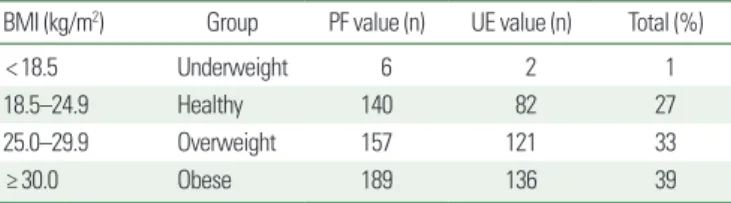
17 because they indicated both an upper extremity and lower ex- tremity injury, and eight because they did not have a BMI indicated in their electronic medical record (EMR). In total, we included 833 of the 858 screened patients in our study. Several patient demograph- ics were retrospectively collected from the EMR: BMI, age, sex, race, employment status, history of smoking and tobacco use, and an estimated median household income (MHI). Patients’ BMI val- ues were categorized as underweight, normal, overweight, and obese, according to accepted values provided by the NIH (Table 1).
16To- bacco use was documented as current, former, never, or unknown.
Employment status was documented as either employed or un- known, with the latter encompassing both unemployed and un- known in the EMR. To determine the estimated MHI, we utilized patients’ zip codes and the United States Census Bureau 2010 data
Table 1. BMI categorization (n= 833)
BMI (kg/m2) Group PF value (n) UE value (n) Total (%)
< 18.5 Underweight 6 2 1
18.5–24.9 Healthy 140 82 27
25.0–29.9 Overweight 157 121 33
≥ 30.0 Obese 189 136 39
BMI, body mass index; PF, physical function; UE, upper extremity.
through an online platform, American Fact Finder.
17Statistical analysis
Summary statistics were calculated for the demographic data.
Pearson correlations were calculated between BMI, and PROMIS- UE, PROMIS-PF, PROMIS-PI, and PROMIS-D. Additionally, each NIH-dictated BMI category was compared to one another through their respective PROMIS domain mean scores utilizing a least significant difference post hoc test. For each test, a P-value of
< 0.05 denoted statistical significance. All statistical analyses were conducted by a trained psychometrician.
RESULTS
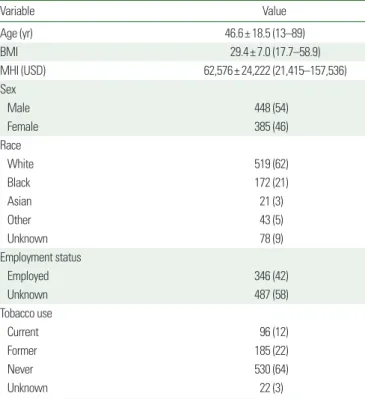
A total of 833 unique patients completed the PROMIS CAT forms and met inclusion criteria for the study. The demographics of the patient cohort are described in Table 2. The average age of patients surveyed was 46.6 years (range, 13–89 years; standard de- viation [SD], 18.5 years) with a male predominance (54%). The average BMI was 29.4 kg/m
2with a range of 17.7–58.9 kg/m
2(SD,
7.0 kg/m
2). Seventy-two percent of patients, according to their in- dicated BMI, were classified as either overweight or obese (Table 1).
Sixty-two percent (n= 519) of patients identified as White and twenty-one percent (n=172) as Black. Forty-two percent (n=346) of patients had documented employment in the EMR, and the pre- ponderance of patients had no history of tobacco use (64%). There were 341 patients that presented with an upper extremity injury (the upper-extremity cohort) and 492 patients that presented with a lower extremity injury (the lower-extremity cohort) (Table 3).
The most common upper and lower extremity diagnoses were ro- tator cuff tear and osteoarthritis, respectively.
We found BMI to correlate with each PROMIS domain: PRO- MIS-UE, PROMIS-PF, PROMIS-PI, and PROMIS-D. These es- tablished correlations indicate that for each point of increased BMI, the corresponding domain will change by the correlation coefficient.
In upper extremity patients, BMI was found to have a correlation with PROMIS-UE (R= –0.111, P<0.05). In lower extremity pa- tients, BMI was found to have a correlation with PROMIS-PF (R=
–0.174, P<0.01), PROMIS-PI (R=0.224, P<0.01), and PROM- IS-D (R= 0.092, P<0.05). There were no statistically significant
Table 2. Patient demographic characteristics (n= 833)
Variable Value
Age (yr) 46.6± 18.5 (13–89)
BMI 29.4± 7.0 (17.7–58.9)
MHI (USD) 62,576± 24,222 (21,415–157,536)
Sex
Male 448 (54)
Female 385 (46)
Race
White 519 (62)
Black 172 (21)
Asian 21 (3)
Other 43 (5)
Unknown 78 (9)
Employment status
Employed 346 (42)
Unknown 487 (58)
Tobacco use
Current 96 (12)
Former 185 (22)
Never 530 (64)
Unknown 22 (3)
Values are presented as mean± standard deviation (range) or number (%).
BMI, body mass index; MHI, median household income; USD, United States dollar.
Table 3. Diagnoses (n= 833)
Variable No. (%)
Upper extremity cohort (n= 341) Shoulder
Rotator cuff 121 (15)
Instability/labrum 26 (3)
Nerve impingement 22 (3)
Osteoarthriti 21 (3)
Other 99 (12)
Elbow
Lateral epicondylitis 37 (4)
Distal biceps 8 (1)
Other 7 (1)
Lower extremity cohort (n= 492) Knee
Osteoarthritis 111 (13)
Anterior cruciate ligament 66 (8)
Meniscus 49 (6)
Osteoarthritis 34 (4)
Other 120 (14)
Hip
Femoroacetabular impingement 37 (4)
Osteoarthritis 29 (3)
Other 46 (6)
correlations found between BMI and PROMIS-PI or PROMIS-D in patients with an upper extremity injury (Table 4).
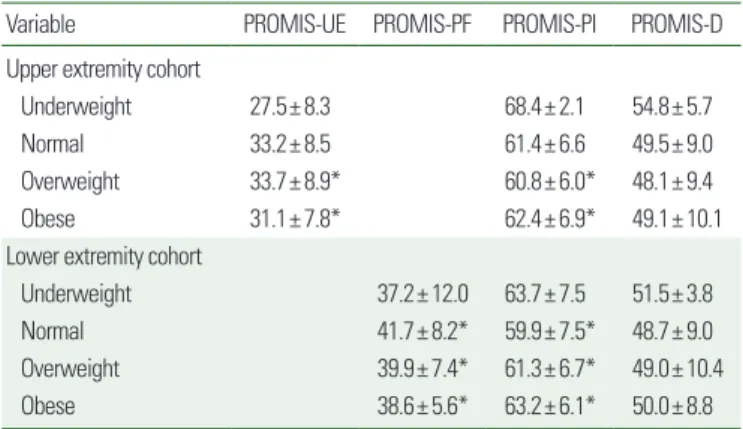
Both upper-extremity and lower-extremity patient cohorts ex- hibited statistically significant differences between BMI categoriza- tions. For patients with upper extremity diagnoses, significant dif- ferences were found between overweight patients and obese pa- tients when evaluating both PROMIS-UE and PROMIS-PI (33.7 vs. 31.1, 60.8 vs. 62.4; P<0.05). No statistical significance was found between any BMI categories with regard to PROMIS-D in upper or lower extremity patients. In lower extremity patients, there were statistically significant differences between healthy patients and both overweight and obese patients when assessing PROMIS-PF (41.7 vs. 39.9, 41.7 vs. 38.6; P<0.05). Lower extremity healthy patients also exhibited lower PI scores compared to obese patients (59.9 vs.
63.2; P<0.05). Additionally, with regard to PI scores, overweight patients exhibited lower scores compared to their obese counter- parts (61.3 vs. 63.2; P<0.05) (Table 5).
DISCUSSION
This study, conducted in the ambulatory shoulder and sports medicine clinic, set out to determine the association between BMI and several PROMIS CAT domains: PROMIS-UE, PROMIS-PF, PROMIS-PI, and PROMIS-D. In upper extremity patients, we found a negative correlation between BMI and physical function and significantly better scores in the overweight group when com- pared to the obese group in regard to physical function and pain in- terference. In lower extremity patients, we found correlations be- tween BMI and physical function, pain interference, and depres- sion. Additionally, we found the healthy group to have significantly better physical function and pain interference scores when com- pared to the obese group.
Elevated BMI was associated with a decrease in physical function for lower extremity patients. Our study found a statistically signifi- cant difference between healthy patients and both overweight and obese patients when assessing PROMIS-PF (41.7 vs. 39.9, 41.7 vs.
38.6; P<0.05). These associations provide physicians with insight toward the impact of BMI on physical functioning. It is believed that an elevated BMI, particularly when reaching obese parameters, is accompanied with an increased amount of adipose tissue that compresses load-bearing joints. This compression results in inflam- mation and ultimately in the loss of muscle mass, and deterioration of the joint structures; collectively, over a period of time, these im- plications develop into a diminished level of physical functioning.
18Our study demonstrates similar findings to previously conducted studies.
19,20Although previous studies have attempted to quantify the association between BMI and physical function, there are con- tradictory findings in the literature.
21-24Many of the previous stud- ies used legacy PROM which have been shown to have limita- tions.
19,21,23,24Our study utilized PROMIS CAT which has been shown to more precise than legacy PROM and have less floor and ceiling effects.
10,25,26Additionally, previous studies focused solely on postoperative physical function. The incorporation of all ambula- tory patients in this study, regardless of treatment modality, allows for greater generalizability of the study findings.
Elevated BMI demonstrated an association with pain interference in our patient population. Specifically, in lower extremity patients,
Table 4. Correlations between BMI and PROMIS domainsVariable PROMIS-UE PROMIS-PF PROMIS-PI PROMIS-D
Upper extremity cohort BMI –0.111* 0.063 0.012
Lower extremity cohort BMI –0.174† 0.224† 0.092*
Pearson correlation (R-value).
Denotes a statistically significant finding, *P< 0.05; †P< 0.01.
BMI, body mass index; PROMIS, Patient-Reported Outcomes Measurement Informa- tion System; UE, upper extremity physical function; PF, lower extremity physical func- tion; PI, pain interference; D, depression.
Table 5. Impact of BMI categorization on PROMIS domain means
Variable PROMIS-UE PROMIS-PF PROMIS-PI PROMIS-D
Upper extremity cohort
Underweight 27.5± 8.3 68.4± 2.1 54.8± 5.7
Normal 33.2± 8.5 61.4± 6.6 49.5± 9.0
Overweight 33.7± 8.9* 60.8± 6.0* 48.1± 9.4
Obese 31.1± 7.8* 62.4± 6.9* 49.1± 10.1
Lower extremity cohort
Underweight 37.2± 12.0 63.7± 7.5 51.5± 3.8
Normal 41.7± 8.2* 59.9± 7.5* 48.7± 9.0
Overweight 39.9± 7.4* 61.3± 6.7* 49.0± 10.4
Obese 38.6± 5.6* 63.2± 6.1* 50.0± 8.8
Values are presented as mean± standard deviation. Least significant difference post hoc test.
*Denotes a statistically significant finding (P< 0.05).
BMI, body mass index; PROMIS, Patient-Reported Outcomes Measurement Informa- tion System; UE, upper extremity physical function; PF, lower extremity physical func- tion; PI, pain interference; D, depression.