INTRODUCTION
Zika virus (ZIKV), a member of the Flaviviridae family, was first isolated in 1947 from the serum of a febrile rhesus monkey in Uganda [1]. ZIKV is mostly transmitted to humans via mosquitoes, mainly Aedes aegypti and less commonly by A. albopictus. In 2007, a ZIKV outbreak in humans occurred on the island of Yap, Micronesia, and spread throughout Oceania until late 2013 [2]. In May 2015, ZIKV infection was confirmed in Brazil and continued to spread to the continent of South America [3]. The World Health Organization (WHO) classified ZIKV as a public health emergency of international concern, and recent data reported ZIKV transmis- sion in about 75 countries [4]. Traveling has contributed to the ex- pansion of ZIKV to non-endemic countries. For example, the first ZIKV infection case in Korea in 2016 was reported in a traveler
소변 검체를 이용한 careGENE TM 지카바이러스 RT-PCR 키트의 성능평가
Performance Evaluation of the CareGENE
TMZika Virus Reverse Transcription-PCR Kit for Urine Specimen
김건우·박금보래·곽승연·장웅식·남정훈·임채승
Gun Woo Kim, M.D., Borae G. Park, M.D., Seung Yeon Kwak, Ph.D., Woong Sik Jang, Ph.D., Jeounghun Nam, Ph.D., Chae Seung Lim, M.D.
고려대학교 구로병원 진단검사의학과
Department of Laboratory Medicine, Korea University Guro Hospital, Seoul, Korea Vol. 11, No. 4: 267-274, October 2021
https://doi.org/10.47429/lmo.2021.11.4.267 임상미생물학
Corresponding author: Chae Seung Lim, M.D., Ph.D.
https://orcid.org/0000-0002-7765-0840
Department of Laboratory Medicine, Korea University Guro Hospital, 148 Gurodong-ro, Guro-gu, Seoul 08308, Korea
Tel: +82-2-2626-3245, Fax: +82-2-2626-1465, E-mail: [email protected] Co-corresponding author: Borae G. Park, M.D., Ph.D.
https://orcid.org/0000-0001-9710-9253
Department of Laboratory Medicine, Korea University Guro Hospital, 148 Gurodong-ro, Guro-gu, Seoul 08308, Korea
Tel: +82-2-2626-3244, Fax: +82-2-2626-1465, E-mail: [email protected] Received: December 30, 2020
Revision received: February 9, 2021 Accepted: February 16, 2021
This article is available from https://www.labmedonline.org 2021, Laboratory Medicine Online
This is an Open Access article distributed under the terms of the Creative Commons Attribution Non-Commercial License (https://creativecommons.org/licenses/by-nc/4.0/) which permits unrestricted non-commercial use, distribution, and reproduction in any medium, provided the original work is properly cited.
Background: Zika virus (ZIKV) is a major health concern worldwide, highlighting the importance of accurate and reliable viral detection to con- trol transmission. The careGENE
TMZIKV Reverse Transcription-Polymerase Chain Reaction (RT-PCR) Kit (Wells Bio, INC, Korea) was developed to detect Zika infection. We compared the clinical sensitivity and specificity of this kit with those of the Aptima Zika Virus Assay (Hologic, Inc., USA) and the World Health Organization (WHO)-recommended conventional PCR method.
Methods: A total of 168 urine samples (143 clinical samples and 25 RNA-spiked samples [RNA-positive lyophilized plasma spiked in urine]) were tested in this study.
Results: In comparison with the WHO-recommended conventional PCR method, the careGENE
TMZIKV RT-PCR Kit detected ZIKV RNA with a sen- sitivity of 100% (95% confidence interval [ CI], 73.5–99.9) and specificity of 100% (95% CI, 88.9–97.8). Similar results were obtained with the Aptima Zika Virus Assay, as evident from a sensitivity of 100% (95% CI, 73.5–99.9) and specificity of 100% (95% CI, 88.9–97.8). The limit of de- tection at a 95% detection probability was 1 U/mL in the urine.
Conclusions: Positive identification of Zika infection was selective and specific using the target Zika viral sequence. The overall performance of the careGENE
TMZIKV RT-PCR Kit was satisfactory.
Key Words: Zika virus, Reverse transcription-PCR, Sensitivity, Specificity
2017-03-16 https://crossmark-cdn.crossref.org/widget/v2.0/logos/CROSSMARK_Color_square.svg
who had returned from Brazil [5]. Since then, ZIKV infections have been reported in Korea in travelers from south-eastern Asia and South Africa [6].
ZIKV can be transmitted not only through vector-borne routes but also through non-vector-borne routes such as sexual inter- course, transplacental transmission, blood product transfusion, and body fluids. More than 70% of ZIKV-infected patients are as- ymptomatic [7]. Even in symptomatic patients, the clinical condi- tions such as maculopapular rash, mild fever, arthralgia, conjunc- tivitis, myalgia, and headache are similar to the symptoms of den- gue virus or other mosquito-borne flavivirus-related infections, and can be confused with other causes of febrile illness [8]. The most significant consideration in ZIKV-infected patients is the causal relationship between ZIKV infection in pregnant women and the development of birth defects [9]. Therefore, prevention of ZIKV infection in pregnant women is imperative.
ZIKV infection can be diagnosed through the detection of ZIKV- specific immunoglobulin M (IgM) antibodies and from the pres- ence of ZIKV RNA or antigens. According to the WHO guidance, IgM antibody positivity alone cannot be deemed sufficient for the
diagnosis of ZIKV infections [10]. Instead, ZIKV infection is charac- terized with the presence of ZIKV RNA or antigens in the serum or other samples, IgM antibodies against ZIKV, or anti-Zika antibod- ies in the plaque reduction neutralization test. As plaque reduction neutralization test is labor-intensive [10], the diagnosis of ZIKV in- fection mainly relies on the detection of ZIKV RNA. ZIKV RNA de- tection using reverse transcription-PCR (RT-PCR) is useful during the acute phase, which encompasses the first 7 days from symp- tom onset. RT-PCR-mediated detection of ZIKV using urine, se- rum, and saliva samples proved urine samples to be the most reli- able and sensitive for identification of acute ZIKV infection [11, 12].
Here, we evaluated the analytical performance of a newly devel- oped real-time RT-PCR kit (careGENE
TMZika virus RT-PCR Kit;
Wells Bio. Inc., Seoul, Korea) to detect ZIKV RNA in urine samples.
MATERIALS AND METHODS
1. Sample collection
1) Clinical samples
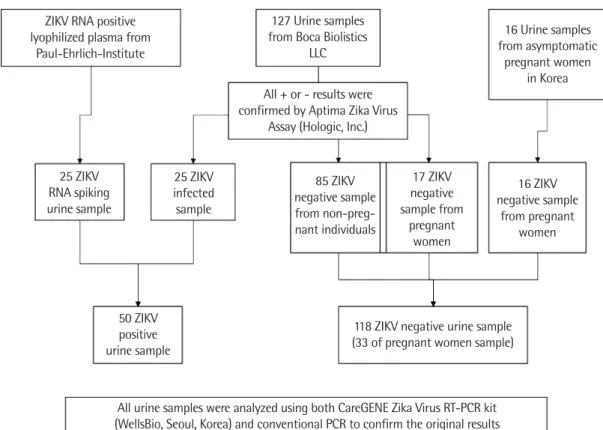
A total of 168 urine specimens were analyzed in this study (Fig.
Fig. 1. Information on the 168 urine specimens analyzed in this study.
Abbreviations: ZIKV, zika virus; RT-PCR, reverse transcription-PCR.
ZIKV RNA positive lyophilized plasma from
Paul-Ehrlich-Institute
127 Urine samples from Boca Biolistics
LLC
16 Urine samples from asymptomatic
pregnant women in Korea All + or - results were
confirmed by Aptima Zika Virus Assay (Hologic, Inc.)
25 ZIKV RNA spiking urine sample
25 ZIKV infected sample
85 ZIKV negative sample from non-preg- nant individuals
17 ZIKV negative sample from
pregnant women
16 ZIKV negative sample
from pregnant women
50 ZIKV positive urine sample
118 ZIKV negative urine sample (33 of pregnant women sample)
All urine samples were analyzed using both CareGENE Zika Virus RT-PCR kit (WellsBio, Seoul, Korea) and conventional PCR to confirm the original results
1). In total, 127 clinical specimens of symptomatic patients were provided by Boca Biolistics (Pompano Beach, FL, USA); these specimens were collected from patients with ZIKV-like symp- toms. Clinical information on the samples from Boca Biolistics LLC is given in Table 1. In addition, 25 ZIKV-positive samples were sourced from the dilution of ZIKV RNA-containing lyophi- lized plasma, which is the candidate WHO international standard for ZIKV RNA nucleic acid amplification technique-based assays.
In addition, 16 negative samples from asymptomatic pregnant Ko- rean women were obtained. The clinical sample collection proto- cols were approved by the Bioethics Committee of the Hospital de la plaza de la Salud (BB-ID-061; Santo Domingo, Dominican Republic) and the Institutional Review Board of Korea University Guro Hospital (MD16075; Seoul, Korea).
2) ZIKV-positive specimens
Twenty-five natural positive urine specimens were provided by Boca Biolistics, and were confirmed positive for ZIKV RNA using the Aptima Zika Virus Assay (Hologic, Inc., San Diego, CA, USA).
Twenty-five positive specimens were prepared by spiking the neg- ative urine samples with ZIKV RNA. Positive RNA was the candi- date for the WHO international standard (PEI code 11468/16; Paul- Ehrlich-Institute, Langen, Germany) and included 0.5 mL of lyoph- ilized plasma and the non-infectious Asian strain of ZIKV RNA containing 50,000,000 U/mL. This WHO standard ZIKV was di-
luted by negative urine specimens obtained from Boca Biolistics that were confirmed as ZIKV negative using the Aptima Zika Vi- rus Assay. The spiked samples were prepared at concentrations of 1, 2, 3, and 4 U/mL of ZIKV RNA.
3) Negative specimens
A total of 118 negative urine specimens were included in this study, of which 102 were provided by Boca Biolistics; 85 negative urine specimens were obtained from non-pregnant individuals, and 17, from pregnant women. All specimens were confirmed as ZIKV negative using the Aptima Zika Virus Assay. In addition, 16 negative urine specimens were collected from asymptomatic preg- nant women who visited Korea University Guro Hospital.
2. Analytical methods
1) RNA sample preparation
The QIAamp Viral RNA Mini Kit (Qiagen, Hilden, Germany) was used for RNA extraction. Urine (140 μL) sample was added to a 1.5-mL microcentrifuge tube containing 560 μL of AVL buffer with carrier RNA. The mixture was incubated at room tempera- ture (20-22°C) for 10 minutes. Ethanol (560 μL) was added to the mixture and mixed by pulse-vortexing for 15 seconds. After mix- ing, the tube was briefly centrifuged to collect droplets from the inside of the lid and sides to the bottom. The resulting solution (630 μL) was carefully applied to the QIAamp Mini column equipped with a 2-mL collection tube without a wetting rim. The cap of the column was closed and the column was centrifuged at 6,000
×gfor 1 minute. To wash the column, the cap was opened and 500 μ L of AW1 buffer was added. The column was centrifuged at 6,000
×g for 1 minute. The column was washed again with 500 μL of
AW2 buffer, and the RNA was eluted with 60 μL of nuclease-free water.
2) Real-time PCR
Real-time PCR was performed to amplify NS5B and envelope genes of ZIKV using careGENE
TMZIKV RT-PCR Kit (Wells Bio.
Inc.) on an Applied Biosystems 7500 Real-Time PCR system (Life Technologies, Carlsbad, CA, USA). The assay was performed in a 15 μL reaction mixture containing 5 μL of 4
×1 Step RT-PCR Mix, 5 μL of Zika primer/probe mix, and 5 μL of nuclease-free water. The mixture components were prepared on ice, and 5 μL of extracted RNA was well mixed with 15 μL of mixture components. The opti-
Table 1. Clinical information on the clinical samples from naturallyZIKV-infected or uninfected patients with ZIKV symptoms provided by Boca Biolistics LLC (N=127)
Symptom onset date
N of patients with ZIKV infection confirmed by
ZIKV PCR
N of non-infectious patients*
N of non-pregnant subjects (N of pregnant subjects)*
1 1
2 1 14 (1)
3 3 26 (3)
4 8 22 (2)
5 7 22 (2)
6 4 5 (1)
7 1 2 (1)
8 3 (2)
9 1
≥10 1† 6‡ (5)
Total 25 102 (17)
*Non-pregnant and pregnant individuals were included. No. of samples for preg- nant individuals were indicated in parentheses; †10 days after onset of symptom;
‡The symptom onset days of each patients were 10, 13, 54, 65, 57, and 70.
Abbreviation: ZIKV, Zika virus.
mized thermal cycling conditions were as follows: reverse tran- scription at 50°C for 15 minutes, initial denaturation at 95°C for 20 seconds, and 40 cycles of PCR amplification at 95°C for 15 sec and 58°C for 60 seconds. Probes for ZIKV-specific sequences were la- beled with the fluorophores FAM and CY5/Alexa647 for dual de- tection. The probe for the internal control (IC)-specific sequence was labeled with the fluorophore VIC or HEX. The careGENE
TMZIKV RT-PCR Kit includes an endogenous IC, which can be used to control the sample preparation procedure (nucleic acid extrac- tion) and/or as an RT-PCR inhibition control (Table 2). The real-time
PCR results were defined based on the following criteria: the sam- ple was positive if the Ct value was
<36 with acceptable results or considered negative if the Ct value was
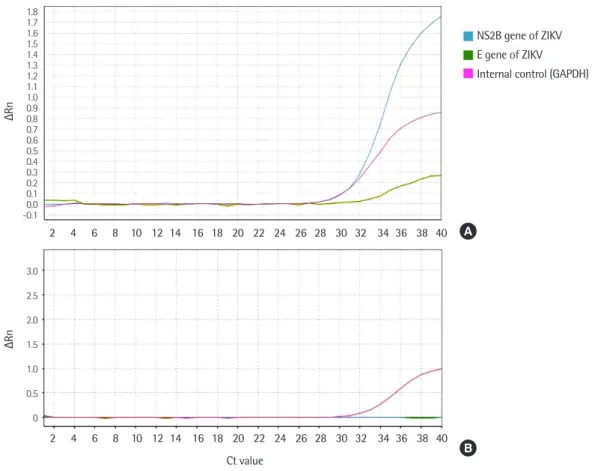
≥36 (Table 3). Representa- tive results of positive and negative samples were shown on Fig. 2.
3) Sensitivity and specificity of the real-time PCR assay To test sensitivity, the WHO standard ZIKV was diluted with negative urine specimens to target concentrations of 1, 2, 3, and 4
Table 2. Target gene and reporter dye composition of the careGENETM ZIKV RT-PCR Kit
Detection target Target gene Reporter
Zika virus RNA target 1 NS2B FAM
Zika virus RNA target 2 E CY5/Alexa647
Endogenous internal control (enIC) GAPDH VIC/HEX
Abbreviations: ZIKV, Zika virus; RT-PCR, reverse transcription-PCR; GAPDH, glycer- aldehyde 3-phosphate dehydrogenase.
Table 3. Acceptance criteria for positive results from the careGENETM ZIKV RT-PCR Kit
Ct Zika-FAM Zika-Cy5/Alexa647 enIC Result
<36 + + + Positive
+ - + Weak positive
- + + Weak positive
~36 +/- - + Negative
- +/- + Negative
>36 - - + Negative
- - - - Invalid
Abbreviations: ZIKV, Zika virus; RT-PCR, reverse transcription-PCR.
Fig. 2. (A) Representative results of ZIKV-positive sample, both the target gene for ZIKV (blue, green) and the internal control gene (pink) were am- plified. (B) Representative results of ZIKV-negative sample, only the internal control gene (pink) was amplified.
Abbreviations: ZIKV, zika virus; GAPDH, glyceraldehyde 3-phosphate dehydrogenase.
1.81.7 1.61.5 1.41.3 1.21.1 1.00.9 0.80.7 0.60.5 0.40.3 0.20.1 -0.10.0
3.0 2.5 2.0 1.5 1.0 0.5 0
∆Rn∆Rn
Ct value
2 4 6 8 10 12 14 16 18 20 22 24 26 28 30 32 34 36 38 40
2 4 6 8 10 12 14 16 18 20 22 24 26 28 30 32 34 36 38 40 A
B
NS2B gene of ZIKV E gene of ZIKV Internal control (GAPDH)
U/mL of ZIKV RNA; 1 U/mL of ZIKV RNA-containing urine was tested 10 times. To evaluate the specificity in pregnant women, 17 ZIKV-negative urine specimens, which were confirmed as ZIKV- negative using the Aptima Zika Virus Assay, were collected from symptomatic pregnant women and 16 samples were confirmed as ZIKV-negative from non-symptomatic pregnant women using conventional PCR. Additionally, 85 negative urine samples from non-pregnant symptomatic individuals confirmed as ZIKV nega- tive using the Aptima Zika Virus Assay were analyzed.
4) Conventional PCR for confirmation of the results
To confirm all positive and negative results, conventional PCR was performed. Amplification was carried out using the ZIKV primer pairs targeting NS4A (Table 4). PCR was carried out using an initial activation step at 94°C for 3 minutes, followed by 30 cy- cles of 94°C for 30 seconds, 58°C for 30 seconds, and 72°C for 30 seconds, with a final extension step for 7 minutes at 72°C. Con- ventional PCR products were detected by agarose gel electropho- resis, and positivity of amplification products was confirmed fol- lowing comparison with positive control bands.
3. Statistical analysis
Comparisons of the methods were made using the chi-square
agreement analysis and the kappa value. All statistical analyses were performed using MedCalc Statistical Software version 18.5 (MedCalc Software bvba, Ostend, Belgium; http://www.medcalc.
org; 2018).
RESULTS
1. Sensitivity and specificity of careGENETM Zika virus RT-PCR kit
Twenty-five naturally positive specimens that were previously confirmed to be positive using the Aptima Zika Virus Assay and 25 positive RNA-spiked specimens from the Paul-Ehrlich-Institute were tested positive for ZIKV using the careGENE
TMZIKV RT- PCR Kit and the conventional PCR method (Table 5). For the clini- cal sensitivity evaluation, 25 ZIKV-infected clinical urine specimens tested positive with 100% sensitivity. These clinical specimens were obtained between 2 and 10 days after the onset of symptoms; 24 of 25 specimens were obtained within 7 days of symptom onset (Table 1). Lyophilized ZIKV RNA-containing samples were diluted with negative urine samples to concentrations of 1, 2, 3, and 4 U/
mL of ZIKV RNA. The detection limit of the assay was 1 U/mL for ZIKV RNA; 13 repeat measurements of 1 U/mL of ZIKV RNA-con- taining samples tested positive. Ct values of RNA-spiked samples were detected by real-time PCR and found to be between 28 and 32 for NS2B gene and between 32 and 36 for E gene.
For the specificity evaluation, 85 negative specimens from non- pregnant individuals and 33 negative specimens from pregnant women were tested using the careGENE
TMZIKV RT-PCR Kit and the conventional PCR method, and all samples were deemed neg-
Table 4. Forward and reverse primer sets for the conventional PCRamplification of ZIKV
Primer Sequence MW TM (°C) Size (bp)
Forward GCAGAGCAATGGATGGGA 5,941.46 58 97
Reverse CTGAGGGCATGTGCAAACC 5,779.46 58.5
Abbreviations: ZIKV, Zika virus; MW, molecular weight; TM, melting temperature.
Table 5. Clinical evaluation results of the careGENETM ZIKV RT-PCR Kit
Specimen category ZIKV positive ZIKV negative
Aptima careGENE PCR Aptima careGENE PCR
Positive urine specimen (N=50)
Natural ZIKV-infected clinical sample 25/25 25/25 25/25 0/25 0/25 0/25
Contrived ZIKV RNA spiking of negative urine 25/25 25/25 0/25 0/25
1 U/mL 13/13 13/13 0/13 0/13
2 U/mL 4/4 4/4 0/4 0/4
3 U/mL 4/4 4/4 0/4 0/4
4 U/mL 4/4 4/4 0/4 0/4
Negative urine specimen (N=118)
Expected ZIKV-negative samples from non-pregnant patients 0/85 0/85 0/85 85/85 85/85 85/85
Expected ZIKV-negative samples from pregnant women 0/17 0/33 0/33 17/17 33/33 33/33
Abbreviations: ZIKV, Zika virus; RT-PCR, reverse-transcription polymerase chain reaction.
ative. Of these samples, 102 also tested negative using the Aptima Zika Virus Assay. In particular, 16 urine specimens from asymp- tomatic pregnant women were included and tested negative, indi- cating 100% specificity.
2. Percent agreement between assays
An agreement evaluation was performed between the Aptima Zika Virus Assay and careGENE
TMZIKV RT-PCR Kit (N
=127) and between the conventional PCR method and careGENE
TMZika Vi- rus RT-PCR Kit (N
=168). The positive and negative percent agree- ment values between the careGENE
TMKit and Aptima assay were both 100%. The kappa value was 1.00 and the chi-squared value was 126.0 (Table 6). Further, the positive and negative percent agreement values between the careGENE
TMKit and conventional PCR were both 100%. The kappa value was 1.00 and the chi-squared value was 167.0. The diagnostic sensitivity and specificity were both 100%.
DISCUSSION
The clinical signs and symptoms of ZIKV infection are similar to those of dengue virus or other mosquito-borne flavivirus-re- lated infections. The most common signs and symptoms include maculopapular rash, mild fever, arthralgia, conjunctivitis, myalgia, and headache [8]. However, more than 70% of infections are as- ymptomatic [7]. The most significant clinical condition is neonatal infection. ZIKV-associated congenital defects owing to vertical vi- ral transmission from the mother to the fetus are clinically signifi- cant and have been well documented [9]. Aside from mosquito bites, ZIKV can be transmitted through sexual contact. Further, ZIKV infection via transfusion of infected blood products remains a significant concern. About 1.1% and 2.8% of asymptomatic blood
donors were tested positive for ZIKV during their respective out- breaks [11, 13]. Moreover, immunocompromised patients can be infected by transfusion from an asymptomatic ZIKV-infected blood donor [7]. ZIKV infection through blood transfusion to immuno- compromised patients such as transplant recipients has been re- cently reported [7, 8]. Therefore, ZIKV screening of asymptomatic individuals such as pregnant women, travelers, and blood donors should be emphasized. For the ZIKV screening test, a sensitive detection method is warranted.
There is no gold standard for the diagnosis of ZIKV infection, but detection of ZIKV-specific IgM antibodies and presence of ZIKV RNA are the commonly employed methods. For the diagno- sis of ZIKV infection, antibody detection methods such as enzyme- linked immunosorbent assays have shown relatively lower sensi- tivity and specificity than ZIKV RNA detection methods such as real-time PCR [14]. Therefore, ZIKV infection is easily confirmed by real-time PCR detection of ZIKV RNA.
The ZIKV genome is composed of three structural units, in- cluding the capsid, membrane precursor/membrane, and enve- lope proteins, and seven non-structural proteins. There are vari- ous molecular assays to detect ZIKV, but only a few were devel- oped to detect two gene targets [15]. The careGENE
TMZIKV RT- PCR Kit was developed based on real-time RT-PCR technology exploiting an RT reaction to convert RNA into complementary DNA, followed by PCR to amplify the specific target sequences (E and NS5B genes) and target-specific probes for detection of the amplified DNA. ZIKV genetic variations have been reported as two lineages (African and Asian) and three genotypes (West Afri- can, East African, and Asian). Up to 10 nucleotide mismatches have been identified between a previously published assay and Asian lineage consensus sequences [16]. Therefore, a ZIKV RNA detection test designed to detect a single RNA target may produce false-negative results, whereas multiple target ZIKV RNA detec- tion can reduce false-negative results. The careGENE
TMZIKV RT- PCR Kit using dual detection of the E and NS5B genes of ZIKV with FAM and CY5/Alexa647 probes could increase the sensitivity and specificity of ZIKV detection.
In this study, 1 U/mL of ZIKV RNA was successfully detected using the careGENE
TMZIKV RT-PCR Kit. The analytical specificity of the careGENE
TMkit was 100% as compared with a previously approved kit. The sensitivity results showed maximum sensitivity as compared with the previously reported limit of detection con-
Table 6. Contingency table for the new test method (careGENE) andcomparative methods (Aptima assay and conventional PCR) Aptima Conventional PCR Positive Negative Positive Negative careGENE
Positive 25 0 50 0
Negative 0 102 0 118
Chi-squared* 126.0 167.0
Contingency coefficient* 0.706 0.706 Kappa value agreement* 1.0 1.0
*P value<0.0001.
centration. Thus, the careGENE
TMZIKV RT-PCR Kit may be useful for the screening of ZIKV RNA and diagnosis of ZIKV infection.
ZIKV RNA can be detected at higher levels and for a longer time after the onset of infection in the urine than in the serum [11, 12, 17]. ZIKV RNA can be detected in the urine from 2 to more than 20 days following symptom onset. However, RT-PCR for both se- rum and urine samples is recommended for diagnostic molecular testing within 7 days from symptom onset [18]. ZIKV RNA is de- tectable in the urine from the first day of symptom onset to day 20 [11]. ZIKV RNA was less detectable in the serum than in the urine from the first week after symptom onset. Therefore, urine sam- ples are preferred over serum samples, especially within 1 week of symptom onset. In our study, 24 of 25 clinical ZIKV specimens were obtained from patients within 7 days of symptom onset (Ta- ble 1). Our results show that the appropriate sensitivity of urine RT-PCR testing was within 7 days. The detection limit and repeat- ability of the assay were 1 IU/mL and 100%, respectively, for the urine specimens.
In this study, a single-blind, single-center clinical test was per- formed to evaluate the ability of the careGENE
TMZIKV RT-PCR Kit to qualitatively detect ZIKV RNA from human urine specimens and its clinical sensitivity and specificity were assessed. In addi- tion, the performance of the kit was compared to that of the WHO- recommended conventional PCR method. The careGENE
TMZIKV RT-PCR Kit was used to detect Zika infection from 168 human urine samples (50 positive and 118 negative). Positive identifica- tion of Zika infection was selective and specific for the target Zika viral sequence. Overall, the performance of the careGENE
TMZIKV RT-PCR Kit was satisfactory. Both the sensitivity and specificity were 100%.
The careGENE
TMZIKV RT-PCR Kit is a sensitive assay to detect ZIKV RNA in urine specimens. The detection limit of the assay was 1 U/mL in the urine, which is deemed satisfactory for a diag- nostic test.
요 약
배경: 지카바이러스는 모기 매개 감염원이며 국제 공중보건 위기 관리 대상으로, 바이러스의 확산을 방지하기 위해서는 지카바이 러스를 정확하게 검출하는 것이 중요하다. 이에 본 연구에서는 지 카바이러스를 검출하기 위해 고안된 역전사 중합효소 연쇄반응 키 트인 CareGENE
TMZika virus RT-PCR kit (Wells Bio, Inc., Korea)의
민감도와 특이도를 Aptima Zika Virus Assay (Hologic, Inc., USA) 와 WHO 추천 검사인 PCR 검사로 비교 평가하고자 하였다.
재료 및 방법: 본 연구는 143개의 임상검체와 25개의 RNA 혼합 소 변 검체를 포함하여 총 168개의 검체가 사용되었다.
결과: 본 연구에서 careGENE
TM지카바이러스 RT-PCR 키트의 분 석민감도, 특이도는 WHO 추천 검사법과 비교했을 때, 각각 100%
(95% CI (신뢰구간, confidence interval), 73.5–99.9)와 100% (95%
CI, 88.9–97.8)였고, Aptima Zika Virus Assay와 비교했을 때도 각 각 100% (95% CI, 73.5–99.9)와 100% (95% CI, 88.9–97.8)였다. 소변 내 바이러스 검출한계는 1 unit/mL이었다.
결론: 본 연구에서 careGENE
TM지카바이러스 RT-PCR 키트의 분 석민감도와 특이도는 모두 100%로 소변 검체에서 지카바이러스 검출에 사용하는데 문제가 없을 것으로 평가하였다.
Conflicts of Interest
None declared.
Acknowledgements
This study was supported by a government-wide R&D fund proj- ect for infectious disease research (HG18C0012), National Research Foundation of Korea (NRF-2016R1A5A1010148) and a grant of the Korea Health Technology R&D Project through the Korea Health Industry Development Institute (KHIDI), funded by the Ministry of Health & Welfare, Republic of Korea (grant number: HR20C0021).
REFERENCES
1. Dick GW, Kitchen SF, Haddow AJ. Zika virus. I. Isolations and sero- logical specificity. Trans R Soc Trop Med Hyg 1952;46:509-20.
2. Waggoner JJ and Pinsky BA. Zika virus: diagnostics for an emerging pandemic threat. J Clin Microbiol 2016;54:860-7.
3. Campos GS, Bandeira AC, Sardi SI. Zika virus outbreak, Bahia, Brazil.
Emerg Infect Dis 2015;21:1885-6.
4. Jimenez A, Shaz BH, Kessler D, Bloch EM. How do we manage blood donors and recipients after a positive Zika screening result? Transfu- sion 2017;57:2077-83.
5. Jang HC, Park WB, Kim UJ, Chun JY, Choi SJ, Choe PG, et al. First im- ported case of Zika virus infection into Korea. J Korean Med Sci 2016;
31:1173-7.
6. Yoon D, Shin SH, Jang HC, Kim ES, Song EH, Moon SM, et al. Epide-
miology and clinical characteristics of Zika virus infections imported into Korea from March to October 2016. J Korean Med Sci 2017;32:1440-4.
7. Barjas-Castro ML, Angerami RN, Cunha MS, Suzuki A, Nogueira JS, Rocco IM, et al. Probable transfusion-transmitted Zika virus in Brazil.
Transfusion 2016;56:1684-8.
8. Darrigo LG Jr., de Sant’Anna Carvalho AM, Machado CM. Chikungu- nya, Dengue, and Zika in immunocompromised hosts. Curr Infect Dis Rep 2018;20:5.
9. Rasmussen SA, Jamieson DJ, Honein MA, Petersen LR. Zika virus and birth defects--reviewing the evidence for causality. N Engl J Med 2016;
374:1981-7.
10. World Health Organization. Zika virus disease: interim case defini- tions. http://www.who.int/iris/handle/10665/204381 (Updated on Feb 2016).
11. Bingham AM, Cone M, Mock V, Heberlein-Larson L, Stanek D, Black- more C, et al. Comparison of test results for Zika virus RNA in urine, serum, and saliva specimens from persons with travel-associated Zika virus disease - Florida, 2016. MMWR Morb Mortal Wkly Rep 2016;65:
475-8.
12. Lamb LE, Bartolone SN, Kutluay SB, Robledo D, Porras A, Plata M, et al. Advantage of urine based molecular diagnosis of Zika virus. Int
Urol Nephrol 2016;48:1961-6.
13. Musso D, Nhan T, Robin E, Roche C, Bierlaire D, Zisou K, et al. Poten- tial for Zika virus transmission through blood transfusion demonstrated during an outbreak in French Polynesia, November 2013 to February 2014. Euro Surveill 2014;19:20761.
14. Balmaseda A, Zambrana JV, Collado D, García N, Saborío S, Elizondo D, et al. Comparison of four serological methods and two reverse tran- scription-PCR assays for diagnosis and surveillance of Zika virus infec- tion. J Clin Microbiol 2018;56:e01785-17.
15. Theel ES and Hata DJ. Diagnostic testing for Zika virus: a postoutbreak update. J Clin Microbiol 2018;56:e01972-17.
16. Corman VM, Rasche A, Baronti C, Aldabbagh S, Cadar D, Reusken CB, et al. Assay optimization for molecular detection of Zika virus. Bull World Health Organ 2016;94:880-92.
17. Rossini G, Gaibani P, Vocale C, Cagarelli R, Landini MP. Comparison of Zika virus (ZIKV) RNA detection in plasma, whole blood and urine - Case series of travel-associated ZIKV infection imported to Italy, 2016.
J Infect 2017;75:242-5.
18. Centers for Disease Control and Prevention. Interim guidance for Zika virus testing of urine-United States, 2016. http://dx.doi.org/10.15585/
mmwr.mm6518e1 (Updated on May 2016).