• 검색 결과가 없습니다.

Removal of Bone Cement through Right Anterolateral ThoracotomyJin Woo Chung, M.D., Je Kyoun Shin, M.D., Hyun Keun Chee, M.D., Jun Seok Kim, M.D., Dong Chan Kim, M.D., Jae Bum Park, M.D.

N/A
N/A
Protected

Academic year: 2021

Share "Removal of Bone Cement through Right Anterolateral ThoracotomyJin Woo Chung, M.D., Je Kyoun Shin, M.D., Hyun Keun Chee, M.D., Jun Seok Kim, M.D., Dong Chan Kim, M.D., Jae Bum Park, M.D."

Copied!
3
0
0

로드 중.... (전체 텍스트 보기)

전체 글

(1)

Korean J Thorac Cardiovasc Surg 2012;45:202-204 □ Case Report □ http://dx.doi.org/10.5090/kjtcs.2012.45.3.202 ISSN: 2233-601X (Print) ISSN: 2093-6516 (Online)

− 202 −

Department of Thoracic and Cardiovascular Surgery, Konkuk University Medical Center, Konkuk University School of Medicine Received: October 4, 2011, Revised: December 9, 2011, Accepted: December 12, 2011

Corresponding author: Je Kyoun Shin, Department of Thoracic and Cardiovascular Surgery, Konkuk University Medical Center, Konkuk University School of Medicine, 120-1 Neungdong-ro, Gwangjin-gu, Seoul 143-729, Korea

(Tel) 82-2-2030-5042 (Fax) 82-2-2030-5009 (E-mail) [email protected]

C

The Korean Society for Thoracic and Cardiovascular Surgery. 2012. All right reserved.

CC
This is an open access article distributed under the terms of the Creative Commons Attribution Non-Commercial License (http://creative- commons.org/licenses/by-nc/3.0) which permits unrestricted non-commercial use, distribution, and reproduction in any medium, provided the original work is properly cited.

Removal of Bone Cement through Right Anterolateral Thoracotomy

Jin Woo Chung, M.D., Je Kyoun Shin, M.D., Hyun Keun Chee, M.D., Jun Seok Kim, M.D., Dong Chan Kim, M.D., Jae Bum Park, M.D.

A 55-year-old woman who had a history of percutaneous vertebroplasty was referred to our institution with sudden onset of chest pain. Computed tomography (CT) scan demonstrated a long, linear, highly-attenuated segment in the right side of the heart and fragmented pieces in the right pulmonary artery. The CT scan and echocardiogram re- vealed no pericardial effusion or hemopericardium. Based on these findings, we performed surgery through right an- terolateral thoracotomy without cardiac arrest. As a result, we safely removed the foreign body. This approach may be a feasible and effective procedure for selected cases.

Key words: 1. Foreign bodies 2. Thoracotomy 3. Bone cements

CASE REPORT

A 55-year-old woman was referred to our institution with sudden onset of chest pain. She had a history of percuta- neous vertebroplasty at the 12th thoracic vertebra for osteo- porotic fracture 3 weeks before she was referred to the institution. Administering sublingual nitroglycerin partially re- lieved the chest pain. An electrocardiogram (ECG) did not show ST-segment elevation; sinus rhythm, creatine kinase, and troponin-I were all within their respective normal limits.

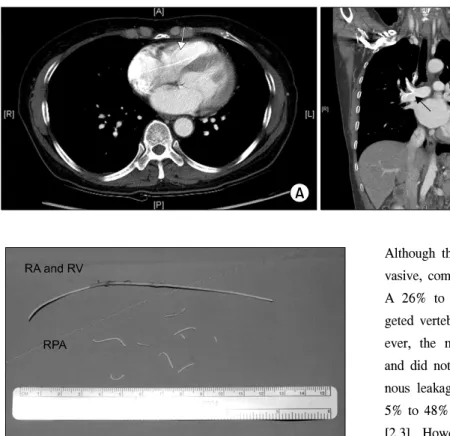
The patient underwent a coronary computed tomography (CT) scan and transthoracic echocardiogram (TTE) under suspicion of stable angina. The CT scan demonstrated a long, linear, highly-attenuated segment (10.5 cm in length) in the right atrium and ventricle, as well as fragmented pieces in the right pulmonary artery and its branches, causing a pulmo- nary embolism (Fig. 1). TTE also revealed a piece of long,

linear, echogenic material (10 cm in length) in the right at-

rium and ventricle. The patient was transferred to our depart-

ment for emergency surgery with a diagnosis of pulmonary

embolism and foreign body in the right side of the heart due

to an injection of polymethylmethacrylate (PMMA, bone ce-

ment) via an injured azygos vein after percutaneous

vertebroplasty. After the right anterolateral thoracotomy

through the 4th intercostal space, a cardiopulmonary bypass

was performed using the femoral artery, femoral vein, and su-

perior vena cava. Immediately after incising the right atrium,

a long, needle-shaped segment was located and removed un-

der the beating heart. There were no other PMMA segments

or fragmented pieces in the right atrium or ventricle. After

the right atrial incision was closed, the right pulmonary artery

was longitudinally incised and we removed as many frag-

mented pieces as possible (Fig. 2). The cardiopulmonary by-

pass was weaned without difficulty. The operating time was

(2)

Removal of Bone Cement

− 203 −

Fig. 1. A preoperative computed to- mography scan. (A) A long, linear body is in the right side of the heart (arrow). (B) Fragmented pieces are present in the right pulmonary artery (arrow).

Fig. 2. Polymethylmethacrylate segments from the right atrium (RA), right ventricle (RV), and right pulmonary artery (RPA). The longer segment is present in the RA and RV, while the shorter segments are present in the RPA.

140 minutes and cardiopulmonary bypass time was 43 minutes. A post-operative TTE did not reveal residual foreign bodies in the right atrium or ventricle, and the patient did not have pulmonary hypertension. The patient recovered unevent- fully and was discharged on the 10th postoperative day. The follow-up CT scan demonstrated no linear, highly-attenuated segments in the intracardiac or right pulmonary arteries; how- ever, residual fragmented pieces that were observed pre- operatively on CT were observed in the anterior segmental artery and middle lobar artery. Six months later, the patient is doing well.

DISCUSSION

Percutaneous vertebroplasty is a widely performed and a minimally invasive surgical technique used to enhance me- chanical strength by injecting PMMA into the vertebral body.

Although this procedure is effective, easy, and minimally in- vasive, complications, such as leakage of PMMA, may occur.

A 26% to 65% incidence of PMMA leakage from the tar- geted vertebral body has been reported in the literature; how- ever, the majority of leakage incidents were asymptomatic and did not require surgical treatment [1-3]. Perivertebral ve- nous leakage has also been reported at an incidence rate of 5% to 48% in the literature, and is also usually asymptomatic [2,3]. However, some serious complications have been re- ported, such as massive pulmonary embolism and cardiac per- foration necessitating surgical treatment [4-7].

We report a case of pulmonary embolectomy and removal of a free-floating PMMA segment in the right side of the heart via a right anterolateral thoracotomy without cardiac ar- rest after percutaneous vertebroplasty. Many surgical proce- dures to repair a perforated right ventricle, tricuspid regur- gitation, incision of the main pulmonary artery, and pulmo- nary embolism have been performed via median sternotomy with cardiac arrest [4-7]. However, in this case, pulmonary embolism was limited to the right pulmonary artery and the PMMA segment was located in the right heart. Therefore, a right-side approach was a possible alternative. We also want- ed to avoid performing a median sternotomy, if possible, due to osteoporosis. Fortunately, CT and TTE revealed no peri- cardial effusion or hemopericardium. Lim et al. [4] presumed that a PMMA segment in the right ventricle could not move into the pulmonary artery because of its long and stiff nature.

We thought that we could remove the foreign body in the

right side of the heart in a single attempt because it was long

enough. Based on these findings, we performed a right ante-

rolateral thoracotomy without cardiac arrest. We safely re-

(3)

Jin Woo Chung, et al

− 204 − moved the PMMA segment from the right atrium and ven- tricle, and successfully completed a pulmonary embolectomy.

This approach may be a feasible and effective procedure for selected cases.

REFERENCES

1. Al-Assir I, Perez-Higueras A, Florensa J, Munoz A, Cuesta E. Percutaneous vertebroplasty: a special syringe for cement injection. AJNR Am J Neuroradiol 2000;21:159-61.

2. Cotten A, Dewatre F, Cortet B, et al. Percutaneous verte- broplasty for osteolytic metastases and myeloma: effects of the percentage of lesion filling and the leakage of methyl methacrylate at clinical follow-up. Radiology 1996;200:525- 30.

3. Perez-Higueras A, Alvarez L, Rossi RE, Quinones D,

Al-Assir I. Percutaneous vertebroplasty: long-term clinical and radiological outcome. Neuroradiology 2002;44:950-4.

4. Lim SH, Kim H, Kim HK, Baek MJ. Multiple cardiac per- forations and pulmonary embolism caused by cement leak- age after percutaneous vertebroplasty. Eur J Cardiothorac Surg 2008;33:510-2.

5. Son KH, Chung JH, Sun K, Son HS. Cardiac perforation and tricuspid regurgitation as a complication of percuta- neous vertebroplasty. Eur J Cardiothorac Surg 2008;33:508- 9.

6. Tozzi P, Abdelmoumene Y, Corno AF, Gersbach PA, Hoo- gewoud HM, von Segesser LK. Management of pulmonary embolism during acrylic vertebroplasty. Ann Thorac Surg 2002;74:1706-8.

7. Dash A, Brinster DR. Open heart surgery for removal of polymethylmethacrylate after percutaneous vertebroplasty.

Ann Thorac Surg 2011;91:276-8.

수치

Fig. 2. Polymethylmethacrylate segments from the right atrium  (RA), right ventricle (RV), and right pulmonary artery (RPA)

참조

관련 문서

• 파이썬은 연산자와 동일한 결과를 산출하는 함수로서 특수 메소드의 정의를 허용한다.이 메소드들은 파이썬이 인식할 수 있도록 특별한

#define 에서 인자 사용 예제 compoundassign.c... 관계와

▪ 실세계의 객체에서 불필요한 부분을 제거하여 필요한 부분만을 간결하고 이해하기 쉬운 클래스 로 만드는 작업. ▪

Likewise, the ripple effect of M&A on the value of the acquiring company -- which could not be determined using existing M&A theoretical

The close substitutes are R&D efforts, technologies, and goods that significantly constrain the exercise of market power with respect to the relevant

One might try to solve the problem by copying the first d elements of x to a temporary array, moving the remaining n − d elements left d places, and then copying the first d

(바) “액체 밀봉드럼 (Liquid seal drum)”이라 함은 플레어스택의 화염이 플레어시 스템으로 거꾸로 전파되는 것을 방지하거나 또는 플레어헤더에

[r]