■
Hyun-Joo Kim, RN, PhD
■
Department of Physical Therapy, College of Health and Biosciences, Chungju National University
Purpose: The aim of this study was to investigate the relationship between social support and quality of life (QOL) in elderly people and to examine potential cross‐cultural differences.
Methods: The author surveyed 82 elderly people, over the age of 65, residing in a nursing home in a Korean rural area and 73 Korean immigrants living in Houston Texas USA who were also elderly. The degree of social support was measured with 20 questions that were answered using a 5 grade scale. The quality of life was measured in 5 fields (mobility, self‐care, usual activities, pain/discomfort, and anxiety/depression, each scored using a 3 grade scale) with EUROQOL EQ‐5D.
Results: The mean score of social support was 65.43 for domestic Korean elderly people (range: 26 to 98); it was 73.43 for elderly Korean Americans (range: 26 to 100). The score was lower for domestic Koreans despite the traditional environment (p<0.05). Regarding QOL, 61% of domestic Korean elderly people complained of pain/discomfort and 47.5% appeared to have anxiety/depression, 30.5% complained of limitations in mobility, 20.7% reported limitations in usual activities, and 14.6% had limitations in basic self‐care activity such as washing or dressing. A similar proportion of Korean American elderly had limitations in usual activities (19.2%) and self care activity (9.5%). But significantly fewer complained of anxiety/depression (16.5%, p<0.01) or pain/discomfort (38.3%, p<0.01). The major differences in psychological domains of QOL may be related to the degree of social support and the difference in the socio‐cultural environment.
Conclusion: Social support is a major determinant of QOL, especially for psychological domains, and these relationships are under the influence of the socio‐cultural environment.
Keywords: Elderly Koreans, Social support, Quality of life Received: October 15, 2010
Revised: December 2, 2010 Accepted: December 8, 2010
Corresponding author: Hyun-Joo Kim, [email protected]
Korean American Elderly People
The Journal Korean Society of Physical Therapy
I. Introduction
Due to recent advances in medical science and standard of living, average life span has increased. According to the National Statistics Office (NSO), one out of ten people in the current population is over the age of 65, which is to say that 10.3% of the whole population is elderly. Also, the NSO predicts that Korea will become an aged society by 2018.
1An increasing proportion of elderly people inevitably causes problems for the aged people, and they are often social problems.
Problems of the aged include health problems, economic insecurity caused by retirement, loneliness due to the change in one’s position in society and at home, a sense of alienation, and
fear of death. Those problems should be dealt with from
psychological, physical, and economic perspectives.
2Physically
the elderly are required to pay more attention to their health
than people at other ages because the elderly have to be more
concerned about senile disease and daily health.
3It is known that
the possibility of experiencing cardiac disease, high blood
pressure, diabetes, osteoporosis, falls, stroke, depression, colon
cancer, and early death can be increased by diminishing physical
activity in the elderly years.
4One of the important factors that
affect the health of the elderly is social support. Social support is
a widely used term that means aid from families, friends, and
neighbors. Social support can relieve or reduce stress that would
otherwise cause health problems.
5A senior citizen with strong
social support and social relationships has many opportunities to get different kinds of information and has a high morale and confidence. On the contrary, poor social support is related to a negative influence on general health status and quality of life.
6,7Social support is a significant factor in one’s life, especially in the lives of the elderly who have physical, psychological, and social problems.
8In terms of social support, the elderly have specific needs that are different from other age groups.
9According to the World Health Organization (WHO),
10QOL is the personal perception of one’s status in relation to one’s goal, expectation, standard, and interest in the context of one's culture and value system. Major determinants of quality of life in elderly people are physical functioning, level of independence, and emotional status.
11,12Social support is emotional and instrumental support from family, friends, or society and it is an important factor that determines health and QOL in the elderly. Kaplan
13reported that people without close social groups such as family and friends have a higher chance of getting disease than people with close social groups. QOL is closely related to one’s socio-cultural environment and its role is growing with modernization of society, the prevalence of nuclear families, and changes in the pattern of life.
14,15Since 1970, when the Korean government launched an emigration policy, the number of Korean people living in other countries has increased, and the first generation of Korean immigrants have become elderly. There has been no study that has tried to demonstrate cross-cultural differences in social support and QOL among Korean elderly. Therefore, the author investigated social support and QOL of domestic Korean elderly and of Korean American elderly.
II. Methods
1. Subjects
The author surveyed 73 Korean American elderly in day care centers in Houston Texas USA from April 2006 to June 2006 and 82 domestic Korean elderly people in day care centers in Cheongweon-gun Chungbuk Korea from January 2008 to July 2008.
2. Research tools
The questionnaire was composed of 9 queries on demographic
characteristics, 20 queries on social support, and EUROQOL EQ-5D for assessment of quality of life. The degree of social support was evaluated with a 5 grade scale for each of the 20 questions so the total score could range from 20 to 100.
EUROQOL EQ-5D has 5 domains: mobility, self care, usual activities, pain/discomfort, and anxiety/depression. Each of these domains was measured with a 3 grade scale.
3. Data collection
The author got permission from the institutes on voluntary service and surveys. At first the author became familiar with the elderly people in the institutes by talking with them and providing some services for them. Then the author surveyed them with their consent.
4. Research design
This was a cross-sectional study on social support and quality of life of 82 domestic Korean and 73 Korean American elderly.
5. Statistical analysis
The data were analyzed with SPSS/Window (version 12.0) to describe social support and quality of life. Demographic data were analyzed with a t-test or a test. Between group comparisons of social support were done with a t-test. Quality of life was analyzed with a test. The correlation between social support and quality of life was analyzed with a Pearson correlation coefficient.
III. Results
1. Demographic characteristics
The mean age of domestic Koreans was 73.67; for Korean Americans it was 70.15. Among 82 domestic Koreans, 67 were female; among 73 Korean Americans, 42 were female. There was no significant difference between the two groups regarding the proportion having a spouse. Domestic Koreans (mean, 3.04) had significantly more offspring than Korean Americans (mean, 2.38) (p<0.01). Significantly more Korean Americans practiced their religion (p<0.01)(Table 1).
2. Social support
The social support score for domestic Koreans was between 26
Domestic Korean (N=82) Korean American (N=73) Z value
Age (M±SD) 73.67±6.52 70.15±5.24 3.72**
Offspring (M±SD) 3.04±1.56 2.38±1.18 2.98**
value
Sex Man 15 31
10.81**
Woman 67 42
Spouse Have spouse 27 34
No spouse 55 39 3.01
Religion Have religion 64 68
6.97**
No religion 18 5
*p<0.05, **p<0.01
Table 1. Demographic characteristics of domestic Korean and Korean American elderly people
Min Max Mean S.D. Z value Domestic Korean
(N=82) 26 98 65.43 19.70
2.43*
Korean American
(N=73) 26 100 73.43 21.03
*p<0.05
Table 2. Degree of social support in domestic Korean and Korean American elderly people
and 98 (mean 65.43); for Korean Americans it was between 26 and 100 (mean 73.43), which was higher than the score for domestic Koreans (p<0.05)(Table 2).
3. Quality of life
Among domestic Korean people, 61% complained of pain and/or discomfort, 47.5% of anxiety/ depression and they were prevalent problem not specific for some people. Additionally, 30.5% appeared to have problems with mobility, 20.7% with usual activities, and 14.6% with self care. On the contrary, a significantly smaller proportion of Korean American elderly complained of pain/discomfort (38.3%, p<0.01) or anxiety/
depression (16.5%, p<0.01). A similar proportion of people had limitations in usual activities (19.2%), self care (9.5%), and mobility (21.9%) (Table 3).
4. Correlation between social support and quality of life
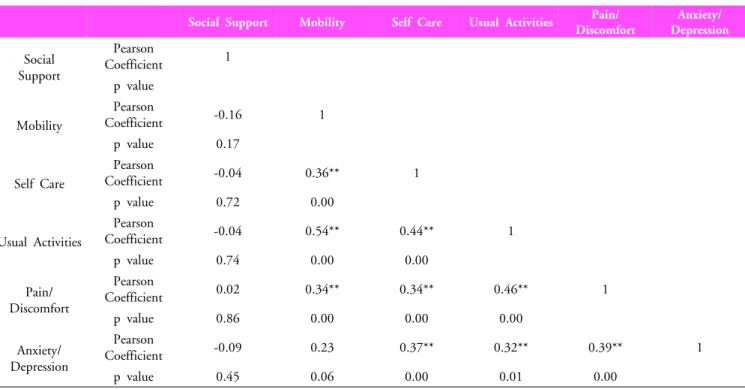
For domestic Koreans there was no significant correlation between the degree of social support and each component of the EURO QOL except for a strong association between social support and mobility (p=0.10). There was a strong correlation
between each component of the EURO QOL (Table 4). Our analysis also failed to disclose any significant correlation between the degree of social support and each component of the EURO QOL in Korean Americans. Similar to domestic Korean elderly people, Korean Americans showed a correlation between social support and mobility (p=0.16). Similarly, there was strong correlation between each component of the EURO QOL (Table 5).
IV. Discussion
Since birth, one is in mutual relationships with other people and
groups. In other words, as one grows up, one takes on a role in
one’s family, neighbor, and society. And one plays a in keeping
these social relationships.
8Lin
16defines social support as one
that is available to a person through social bonds with other
individuals, groups, and communities. Also, Lin includes family
members, relatives, colleagues, and communities as part of social
support. Most Korean elderly people in day care centers are
alone because of bereavement. Even though they have sons and
daughters, their social support ranges from 26 to 98 with an
average of 65.4. That is to say, social support for Korean elderly
people is insufficient. It is expected that the size of the elderly
population and the proportion of nuclear families will continue
increasing; therefore, under these conditions, a community
policy or a national level policy is needed to improve the
situation. After surveying Korean elderly with Euro QOL, it was
shown that 61% of the participants had pain or discomfort and
47.5% felt anxiety or depression. Therefore, it seems that pain or
depression is a general problem of Korean elderly people. Other
Social Support Mobility Self Care Usual Activities Pain/
Discom-fort
Anxiety/
Depress-ion Social
Support
Pearson
Coefficient 1
p value Mobility
Pearson
Coefficient 0.19 1
p value 0.10
Self Care
Pearson
Coefficient 0.07 0.33** 1
p value 0.54 0.00
Usual Activities
Pearson
Coefficient -0.15 0.39** 0.50** 1
p value 0.19 0.00 0.00
Pain/ Discomfort
Pearson
Coefficient -0.09 0.40** 0.02 0.25* 1
p value 0.44 0.00 0.87 0.03
Anxiety/
Depression
Pearson
Coefficient -0.11 0.31** 0.24* 0.37** 0.36** 1
p value 0.34 0.01 0.03 0.00 0.00
*p<0.05, **p<0.01
Table 4. Correlation between the degree of social support and QOL in domestic Korean elderly Components of
QOL Degrees Numbers (%)
value
‡Korean American
Mobility
No problems in walking about 55(68.3) 56(76.7)
1.56
Some problems in walking about 25(30.5) 15(20.5)
Confined to bed 0 1(1.4)
Self Care
No problems with self-care 70(85.4) 62(84.9)
0.68 Some problems in washing or dressing 11(13.4) 5(6.8)
Unable to wash or dress 1(1.2) 2(2.7)
Usual Activities
No problems in usual activities 62(75.6) 58(79.5)
0.09
Some problems in usual activities 17(20.7) 13(17.8)
Unable to perform usual activities 0 1(1.4)
Pain/
Discomfort
No pain or discomfort 31(37.8) 44(60.3)
7.95**
Moderate pain or discomfort 46(56.1) 25(34.2)
Extreme pain or discomfort 4(4.9) 3(4.1)
Anxiety/
Depression
No anxiety or depression 40(48.8) 59(80.8)
17.56**
Moderate anxiety or depression 37(45.1) 11(15.1)
Extreme anxiety or depression 2(2.4) 1(1.4)
*p<0.05, **p<0.01
‡