ISSN 2234-3806 • eISSN 2234-3814
http://dx.doi.org/10.3343/alm.2014.34.2.145 www.annlabmed.org 145
Ann Lab Med 2014;34:145-147
http://dx.doi.org/10.3343/alm.2014.34.2.145
Brief Communications
Clinical Microbiology
Prevalence of Human Astrovirus in Patients with Acute Gastroenteritis
Heejin Ham, M.S.1, Seah Oh, M.S.1, Jungim Jang, Ph.D.1, Sukju Jo, M.S.1, Sungmin Choi, M.S.1, and Sonil Pak, Ph.D.2
Department of Microbiology1, Seoul Metropolitan Government Research Institute of Public Health and Environment, Gwacheon; College of Veterinary Medicine2, Kangwon National University, Chuncheon, Korea
The prevalence of human astroviruses was tested in patients with acute gastroenteritis by using conventional duplex reverse transcription (RT)-PCR and electrophoresis. Diarrheal fecal samples were collected from 9,597 patients at local hospitals in Seoul. The preva- lence of astroviruses was 1.0% (94/9,597 patients; mostly infants), and that of sapovi- ruses was 0.1% (14/9,597 patients). Age- and gender- wise analyses were carried out on 29 astrovirus-positive patients having complete information on file regarding their age, gender, and other particulars. The results were higher in patients of ages 0 to 14 yr, and 69.0% of the astrovirus-positive patients were females, of which 69.2% were infants (0 to 12 months), and 61.5% were 1-4 yr old. Notably, in the case of 5 to 78-yr-old acute gas- troenteritis patients, 100% were females.
Key Words: Astrovirus, Prevalence, Acute gastroenteritis, Infants
Received: September 30, 2013 Revision received: October 17, 2013 Accepted: December 31, 2013 Corresponding author: Heejin Ham Department of Microbiology, Seoul Metropolitan Government Research Institute of Public Health and Environment, 30 Janggunmaeul 3-gil, Gwacheon 427-070, Korea
Tel: +82-2-570-3426 Fax: +82-2-570-3275 E-mail: [email protected]
© The Korean Society for Laboratory Medicine This is an Open Access article distributed under the terms of the Creative Commons Attribution Non-Commercial License (http://creativecom- mons.org/licenses/by-nc/3.0) which permits unrestricted non-commercial use, distribution, and reproduction in any medium, provided the original work is properly cited.
Monitoring of diarrheal patients in Korea has revealed that the incidence of bacterial infections is declining, whereas viral infec- tions are on the rise. Gastroenteritis caused by astroviruses is becoming common, and being contagious, can be easily trans- mitted; however, it is clinically less severe than rotavirus and norovirus infections [1-5]. In developed countries, the preva- lence of astrovirus in diarrheal children was 4-8% [6, 7]. In Eng- land, 75% of children aged 5 to 11 yr did not develop any diar- rheal symptoms. In addition, 75% of adults aged 17 to 30 yr were positive for astrovirus antibodies as measured by immuno- fluorescence testing, indicating that they had been exposed to the virus during childhood [7]. These results indicated that as- troviruses are important causative agents of acute gastroenteritis [4, 7]. Astroviruses induce acute gastroenteritis in newborns, as well as severe and chronic diarrhea in immunocompromised patients [8]. Even though the most common causative agents are noroviruses and rotaviruses, astroviruses are also capable of
causing gastroenteritis [1, 5, 9]. In the present study, we investi- gated the prevalence of uncommon human astrovirus in patients with acute gastroenteritis.
A total of 9,597 diarrheal fecal samples from patients suffer- ing from acute gastroenteritis were collected from six local hos- pitals in Seoul (SW hospital, SG hospital, AM center, NP hospi- tal, EJ hospital, and NM center) from 2008 to 2012. These samples were tested for the presence of astrovirus and sapovi- rus. One gram of feces was mixed with 9 mL of autoclaved 0.1 M phosphate buffered saline (PBS; pH 7.4, Sigma, St. Louis, MO, USA) and centrifuged at 1,660 g for 30 min at 4°C. The supernatant was used for the next step of fragmentation at 4°C.
At the AM center, 0.5 to 1 mL rectal swab suspensions were collected instead of feces, and mixed with PBS for further pro- cessing. Most of the samples, from either direct rectal swabs or diarrheal feces of patients, were collected from six hospitals and transferred within 24 hr to Seoul Metropolitan Research Institute
Ham H, et al.
Astrovirus prevalence in gastroenteritis patients
146 www.annlabmed.org http://dx.doi.org/10.3343/alm.2014.34.2.145 of Public Health and Environment, where they were stored at
-70°C until further analysis.
For the detection of astroviruses, one-step duplex RT-PCR followed by electrophoresis was carried out. RNA was extracted by using a viral RNA mini kit (QIAgen, Hilden, Germany) [10].
One-step duplex RT-PCR was performed by using the Hotstart RT/PCR premix Astro/Sapo kit (K-2055-C, Bioneer, Daejeon, Korea) and the Mon269/Mon270 primer pair that hybridized within the open reading frame (ORF) 2 region (5’-CAACTCAG- GAAACAGGGTGT-3’, and 5’-TCAGATGCATTGTCATTGGT-3’, re- spectively) [2, 6]. Positive results were indicated by the pres- ence of a 449 bp band for astrovirus and a 720 bp band for sapovirus [2, 6].
Our analysis showed that, in diarrheal feces collected from 2008 to 2012 at local hospitals in Seoul, astroviruses were de- tected in 1.0% (94/9,597) and sapoviruses in 0.1% (14/9,597) of samples (Table 1).
In 2011, results from the Korea Center for Disease Control (KCDC) showed that out of 26,673 diarrheal fecal samples, 83 (0.3%), tested positive for human astrovirus, and 7 (0.0%) for sapovirus [11]. In 2002, Kang et al. [12] reported the presence of human astrovirus, by RT-PCR of the ORF-1a region, in 1.5%
of samples (15/1,153 patients) collected from five tertiary hospi- tals, four secondary hospitals, and one primary hospital. How- ever, other studies have shown higher positive rates for human astroviruses; 58% (7/12 patients) in a tertiary hospital (Seoul Na- tional University hospital) in 2004 [10], 4.0% (33/812 patients) in a postpartum care center in 2006 [4], and 29.5% (18/61 pa- tients) in a tertiary hospital (Ewha Womans University hospital) in 1999 [7]. Although our results were similar to those obtained from the Korean CDC and Kang et al. [12], the numbers were lower than those reported by Lee et al. [10], Jung et al. [4], and Park et al. [7], possibly due to low sample numbers.
The detection rates of astrovirus were then analyzed year-wise, which showed a decreasing trend of 1.2% in 2008, 1.7% in
2009, 0.7% in 2010, 0.4% in 2011, and 0.7% in 2012; the ex- ception being the year 2009 where it showed an increase (1.7%). In earlier years, the astrovirus-positive rates showed an initial increase of 1.5% (15/1,153 patients) in 2002 [12], 3.8%
in 2004 [6], and human astrovirus positive rate 4.0% (33/812 patients) in 2006 in a tertiary hospital (Sangge Bak hospital) [3].
Subsequently, the rates showed a decrease of 4.0% (73/1,836 patients) in 2004, 3.5% (47/1,338 patients) in 2005, 1.6%
(36/2,213 patients) in 2006, 0.6% (8/1,401 patients) in 2007 [10], and 0.3% (83/26,673 patients) in 2011 [11]. From the above observations, it can be concluded that the prevalence of astroviruses in patients with gastroenteritis is declining every year.
In subsequent studies, the prevalence of astrovirus-positive samples was analyzed on a monthly basis over a five-year pe- riod. The numbers of astrovirus-positive samples from January to December were equalized (11, 9, 13, 9, 5, 7, 3, 6, 8, 8, 12, and 3 over the 12-month period) and showed no significant dif- ference between all the five years tested (Fig. 1). However, an interesting trend reported in another study stated that the detec- tion of astroviruses was higher in May, June, July, and August than in December, January, and February [6].
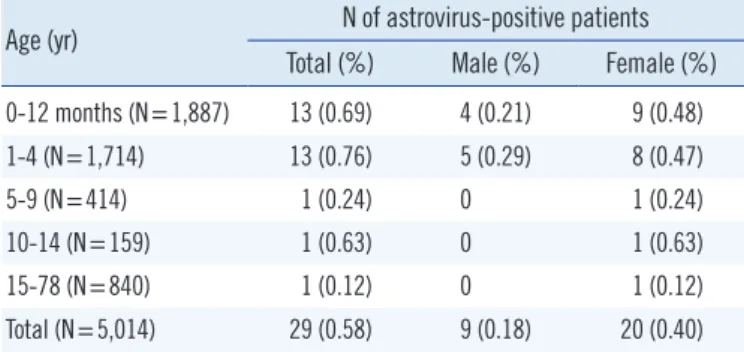
Next, age- and gender-wise analyses were carried out on 29 astrovirus-positive patients having complete information on their age, gender, and other particulars. As expected, astroviruses were commonly detected in infants, especially in newborns. Out of 29 (0.58%) astrovirus-positive patients, 0.69% (13/1,887 pa- tients) were 0 to 12-month-old infants, 0.76% (13/1,714 pa- tients) were 1 to 4 yr old, 0.24% (1/414 patients) were 5 to 9 yr old, 0.63% (1/159 patients) were 10 to 14 yr old, and 0.12%
(1/840 patients) were 15 to 78 yr old. The detection of astrovi- ruses was higher in patients aged 0 to 14 yr, and subsequently
Table 1. Prevalence of astrovirus and sapovirus in 9,597 patients with acute gastroenteritis, from 2008 to 2012 in Seoul
Year N of tested patients
N of virus-positive patients (%) Astrovirus Sapovirus
2008 2,667 31 (1.2) 1 (0.04)
2009 1,916 33 (1.7) 4 (0.2)
2010 2,253 16 (0.7) 8 (0.4)
2011 1,789 7 (0.4) 0 (0.0)
2012 972 7 (0.7) 1 (0.1)
Total 9,597 94 (1.0) 14 (0.1)
Fig. 1. Monthly distribution of astroviruses from 9,597 patients with acute gastroenteritis from 2008 to 2012 in Seoul by periodic surveil- lance.
Months
Detective numbers
8 7 6 5 4 3 2 1 0
Jan. Feb. Mar. Apr. May Jun. Jul. Aug. Sep. Oct. Nov. Dec.
2008 2009 2010 2011 2012
Ham H, et al.
Astrovirus prevalence in gastroenteritis patients
http://dx.doi.org/10.3343/alm.2014.34.2.145 www.annlabmed.org 147
decreased in older individuals (Table 2). Jung et al. [3] reported 82.0% (27/33 patients) of positive rate in children below 12 months old, of which newborns constituted 39.4% (13/33 pa- tients), at the Sangge Bak tertiary hospital; whereas Lee et al. [6]
reported astrovirus-positive rates of 8.4% (48/572 patients) in children below 12 months old. Our results were comparable to those from the above two studies as well as to results from a ter- tiary hospital (Seoul National University hospital) where the av- erage age of astrovirus-positive children was 20.6±15.4 months [9]. From the above analyses, it can be concluded that astrovi- ruses are important pathogens associated with acute gastroen- teritis in infants, especially below 2 yr [3-5]. All feces and rectal swabs were obtained from outpatients at six hospitals, of which one was a primary hospital (AM center), three were secondary hospitals (SW hospital, NP hospital, and NM center), and two were tertiary hospitals (SG and EJ hospitals).
Finally, gender-based analyses were carried out on 20 female and 9 male patients. The results showed that 69.0% of the as- trovirus-positive patients were females, of which 69.2% were in- fants (0 to 12 months), and 61.5% were 1-4 yr old. Notably, 5 to 78-yr-old patients with acute gastroenteritis were all females.
In conclusion, astroviruses were prevalent in the patients with gastroenteritis, and showed a higher occurrence in young chil- dren and female patients compared to the general population.
Authors’ Disclosures of Potential Conflicts of Interest
No potential conflicts of interest relevant to this article were re-
ported.
Acknowledgment
This study was supported by the EnterNet-Korea Project of the Korean CDC. We are grateful for this support.
REFERENCES
1. Lee JI. Molecular characterization of enteric viruses isolated from acute gastroenteritis patients. Ph.D. Thesis. Chung Buk University, 2008.
2. Park SH, Kim EJ, Oh SA, Kim CK, Choi SS, Cho SJ, et al. Viral agents associated with acute gastroenteritis in Seoul, Korea. Clin Lab 2011;57:
59-65.
3. Chung JY, Huh K, Kim SW, Shin BM, Han TH, Lee JI, et al. Molecular epidemiology of human astrovirus infection in hospitalized children with acute gastroenteritis. Korean J Pediatr Gastroenterol Nutr 2006;9:139- 46.
4. Yi J, Lee JK, Chung EH, Cho DH, Kim EC. An outbreak of astrovirus in- fection of newborns with hemorrhagic diarrhea in a neonatal unit. Kore- an J Clin Microbiol 2004;7:55-8.
5. Chung JY. Acute viral gastroenteritis: recent trends and updates. Korean J Pediatr Gastroenterol Nutr 2007;10(S1):S53-7.
6. Lee JI, Hwang YO, Kim SJ, Song MO, Kim JS, Seo BT, et al. Detection of astroviruses from diarrhea patients by RT-PCR and EIA. Report of SIHE 2004;40:290-300. http://health.seoul.go.kr/healthlab/1623?sc=bd_
title&pageno=1&bc_no=108&sv=astrovirus (Updated on Feb 2013).
7. Park HK, Woo SY, Seoh JY, Chong YH, Seo JW. Detection of astrovirus infections from hospitalized young children feces by reverse transcrip- tion-polymerase chain reaction. J Korean Soc Microbiol 1999;34:453-9.
8. Unicomb LE, Banu NN, Azim T, Islam A, Bardhan PK, Faruque AS, et al. Astrovirus infection in association with acute, persistent and nosoco- mial diarrhea in Bangladesh. Pediatr Infect Dis J 1998;17:611-4.
9. Yang HR, Jee YM, Ko JS, Seo JK. Detection and genotyping of viruses detected in children with benign afebrile seizures associated with acute gastroenteritis. Korean J Pediatr Gastroenterol Nutr 2009;12:183-93.
10. Lee JI, Park SH, Kim MS, Oh YH, Yu IS, Choi BH, et al. Surveillance of acute gastroenteritis in Seoul, Korea, during May 2004 and June 2007.
J Bacteriol Virol 2009;39:363-71.
11. Korea Centers for Disease Control and Prevention. Enternet Korea, Yearly Report 2012;43-49. http://www.cdc.go.kr/CDC/notice/CdcKrInfo0301.
jsp?menuIds=HOME001-MNU0004-MNU0036-MNU0037&cid=21904 (Updated on Nov 2013).
12. Kang YH, Park YJ, Ahn JB, Yeun JD, Jee YM. Identification of human astrovirus infections from stool samples with diarrhea in Korea. Arch Vi- rol 2002;147:1821-7.
13. Park KS, Baek KA, Kim DU, Kwon KS, Bing SH, Park JS, et al. Evalua- tion of a new immunochromatographyic assay kit for the rapid detection of norovirus in fecal specimens. Ann Lab Med 2012;32:79-81.
14. Kim JS, Lim CS, Kim YK, Lee NL, Lee CK. Human bocavirus in patients with respiratory tract infection. Korean J Lab Med 2011;31;179-84.
Table 2. Age distribution of 29 astrovirus-positive patients from a total of 5,014 acute gastroenteritis cases reported in Seoul from 2010 to 2012
Age (yr) N of astrovirus-positive patients Total (%) Male (%) Female (%) 0-12 months (N=1,887) 13 (0.69) 4 (0.21) 9 (0.48)
1-4 (N=1,714) 13 (0.76) 5 (0.29) 8 (0.47)
5-9 (N=414) 1 (0.24) 0 1 (0.24)
10-14 (N=159) 1 (0.63) 0 1 (0.63)
15-78 (N=840) 1 (0.12) 0 1 (0.12)
Total (N=5,014) 29 (0.58) 9 (0.18) 20 (0.40)