Minimally invasive surgery for choledochal cysts:
Laparoscopic versus robotic approaches
Jong Hwi Yoon1, Ho Kyoung Hwang1,2, Woo Jung Lee1,2, and Chang Moo Kang1,2
1Division of HBP Surgery, Department of Surgery, Yonsei University College of Medicine,
2Pancreatobiliary Cancer Center, Yonsei Cancer Center, Severance Hospital, Seoul, Korea
Backgrounds/Aims: Minimally invasive surgery is a widely accepted approach in hepatobiliary surgery and choledochal cyst excision has also been performed by minimally invasive methods, including laparoscopic and robotic approaches.
However, only a few studies have compared laparoscopic and robotic surgery. Therefore, we performed a comparative study between two groups, including cost aspects. Methods: We retrospectively analyzed minimally invasive chol- edochal cyst excision at Severance Hospital in Seoul, South Korea from January 2005 to December 2018. A total of 39 patients that underwent minimally invasive choledochal cyst excision were identified. The 23 patients (58.9%) and 16 patients (41.1%) were enrolled in laparoscopic and robotic approach, respectively. We compared the patient’s characteristics, and perioperative outcomes between laparoscopic and robotic surgery groups. Results: A comparative analysis between the two groups showed no differences in preoperative clinical characteristics. There were no sig- nificant differences in operative time, estimated blood loss, and postoperative complications, including biliary complication. The preoperative ASA score (p=0.021) and hospital stays (p=0.011) were the only clinical variables that differed between the two groups. All of the variables included in the cost analysis showed statistically significant differ- ences (total hospital charge: p=0.035, patient’s bill: p≤0.001, operation: p=0.002, anesthesia: p=0.001, postoperative management: p=0.001). Conclusions: The overall clinical outcomes between the laparoscopic and robotic approach to choledochal cyst were comparable. The surgical approach should be balanced based on the surgeons’ skill, patients’
general condition, disease extent, and economic status. (Ann Hepatobiliary Pancreat Surg 2021;25:71-77) Key Words: Choledochal cyst; Laparoscopy; Robotic surgical procedure
Received: October 5, 2020; Revised: November 6, 2020; Accepted: November 6, 2020 Corresponding author: Chang Moo Kang
Department of Surgery, Yonsei University College of Medicine, Ludlow Faculty Research Building #203, 250 Seongsan-ro, Seodaemun-gu, Seoul 03722, Korea
Tel: +82-2-2228-2100, Fax: +82-2-2228-2135, E-mail: [email protected]
Copyright Ⓒ 2021 by The Korean Association of Hepato-Biliary-Pancreatic Surgery
This is an Open Access article distributed under the terms of the Creative Commons Attribution Non-Commercial License (http://creativecommons.org/
licenses/by-nc/4.0) which permits unrestricted non-commercial use, distribution, and reproduction in any medium, provided the original work is properly cited.
Annals of Hepato-Biliary-Pancreatic Surgery ∙ pISSN: 2508-5778ㆍeISSN: 2508-5859
INTRODUCTION
Choledochal cysts are a rare cystic disease in the biliary tract. Most cases develop in children under 10 years of age and there is a higher incidence in the Asian pop- ulation than in other ethnicities.1 In the past, only enteric drainage was performed for choledochal cysts, leading to recurrent cholangitis due to biliary stasis. The malignant potential of choledochal cysts, such as cholangiocarcinoma and gallbladder cancer which have been reported in 5%
to 10% of patients with choledochal cysts,2 is concerning.
Therefore, surgical resection of the cyst and cholecystectomy with appropriate reconstruction for biliary drainage using a bilo-enteric anastomosis is typically performed today.3-5
Minimally invasive surgery is more widely accepted in
hepatobiliary surgery. Choledochal cyst excision has also been performed by minimally invasive methods, including laparoscopic and robotic approaches.6-10 Furthermore, sev- eral studies have compared clinicopathologic outcomes between laparoscopic and robotic surgeries and have shown the superiority and feasibility of robotic surgery.11,12 However, the number of reported studies on minimally invasive chole- dochal cyst excisions is not sufficient, especially in regard to cost efficiency.
Therefore, we investigated a total of 39 cases of mini- mally invasive choledochal cyst excision and compared short-term outcomes between laparoscopic and robotic ap- proaches, including cost aspects.
Fig. 1. Minimally invasive ap- proach to treat choledochal cyst.
Laparoscopic isolation (A), and resection of choledochal cyst (B).
Note subsequent laparoscopic choledochojejunostomy (C) and robotic reconstruction (D). B, bile duct; CC, choledochal cyst;
D, duodenum; J, jejunum.
MATERIALS AND METHODS
Data collection
The medical records of the patients who underwent sur- gery for choledochal cysts in the Severance Hospital in Seoul, South Korea from January 2005 to December 2018 were retrospectively reviewed. Patients who needed com- bined hepatectomy were excluded. Perioperative clinical parameters such as age, sex, body mass index (BMI), chief complaint, presence of anomalous pancreaticobiliary ductal union (APBDU), Todani classification, American Society of Anesthesiologist (ASA) score, preoperative car- cinoembryonic antigen (CEA), Carbohydrate antigen (CA) 19-9, total bilirubin, operation time, estimated blood loss, retrieved lymph nodes, medical cost, hospital stays, types of complication, postoperative intervention and period of surgery were collected. Biliary stricture was defined as follow-up abdomino-pelvic computed tomography (APCT) findings which showed intrahepatic duct dilatation and a need for interventional radiological management, such as percutaneous transhepatic biliary drainage. Biliary leakage was also diagnosed with APCT scans and some cases needed percutaneous drainage. Laboratory tests were also used to diagnose biliary complications.
Preoperative magnetic resonance cholangiopancreatog-
raphy and APCT were performed on all included cases to evaluate the clinical stage and type of choledochal cyst.
Patients were followed-up on an outpatient basis. APCT and laboratory tests, including for tumor markers were performed within 6 months after surgery to evaluate early and delayed postoperative complications.
Surgical technique
Brief minimally invasive surgical procedures are showed in Fig. 1. Using a robotic surgical system is preferred for an accurate and gentle anastomosis, because it allows for stable handling and suturing. However, the surgical instru- ments for excision in robotic surgical systems are limited.
Based on the assessment that laparoscopic resection is more appropriate, robotic cases were performed by a hy- brid procedure, with the exception of the first few cases.
Selection of the surgical approach was determined based on the surgeon’s preference and the patient’s financial status. A case of robot-assisted excision of choledochal cysts, hepaticojejunostomy, and extracorporeal Roux-en-y anastomosis was reported previously and the detailed sur- gical technique was described in that report.9
Cost analysis
The total hospital charges were classified into four cate-
Table 1. Incidence of surgery over time according to surgical approach
2005-2008 2009-2013 2014-2018 p
Laparoscopic (n=23) 1 (11.1%) 4 (40.0%) 18 (90.0%) <0.001
Robotic (n=16) 8 (88.9%) 6 (60.0%) 2 (10.0%)
Table 2. Preoperative clinical characteristics Laparoscopic
(n=23)
Robotic
(n=16) p
Sex 0.674
Male 3 (13.0%) 3 (18.7%)
Female 20 (87.0%) 13 (81.3%) Age (years) 34.3±11.2 37.0±10.7 0.462 BMI (kg/m2) 23.0±3.0 21.4±2.4 0.098
Chief complaint 0.987
No 13 (56.5%) 9 (56.3%)
Pain 10 (43.5%) 7 (43.7%)
Past medical history 0.100
None 22 (95.7%) 13 (81.3%) Diabetes 0 (0.0%) 2 (12.5%) Hepatitis 0 (0.0%) 1 (6.3%) Multiple combined 1 (4.3%) 0 (0.0%)
ASA score 0.021
1 15 (65.2 %) 16 (100.0%)
2 6 (26.1%) 0 (0.0%)
3 2 (8.7%) 0 (0.0%)
Todani classification 0.398
I 22 (95.7%) 16 (100.0%)
II 1 (4.3%) 0 (0.0%)
Diameter of bile duct (mm)
9.8±1.9 11.5±4.3 0.099 Preoperative CEA
level (ng/ml)
1.3±1.7 1.4±1.1 0.363 Preoperative CA19-9
(U/ml)
11.2±13.3 13.4±12.0 0.358 Preoperative total
bilirubin (mg/dl)
0.6±0.3 0.7±0.4 0.366 gories: total hospital charge, patient’s bill, operative charge,
anesthesia charge, and charges from postoperative man- agement. Considering that the reimbursement of hospital charges is about 80% by the National Health Insurance Corporation (NHIC), the actual patient’s bill was classi- fied separately, and was defined by the sum of 20% of the insured charge and 100% the of non-insured charge.
The operative charge included the surgery fee and cost of instruments and supplies for the surgery. The anes- thesia charge included a fee for anesthesia, medications for induction and maintenance of anesthesia. In some cas- es, intravenous patient-controlled analgesia was applied and charged as a non-insured anesthesia charge. Charges for postoperative management included any medications for postoperative care, imaging studies for follow-up and surveillance of postoperative complications and laboratory tests. All costs were converted to US dollars based on the exchange rate of May 2019 ($1=₩1,197).
Statistical analysis
Continuous variables were analyzed with a student t-test or Mann-Whitney U test in the case of non-normal dis- tribution. Categorical variables were analyzed by chi-square test or Fisher’s exact test. Operation time was also analyzed and compared by simple linear regression analysis. The data were analyzed by SPSS (Version 21, IBM, USA).
RESULTS
Chronological changes in the surgical approach to choledochal cysts
A total of 39 patients that underwent minimally in- vasive choledochal cyst excision were identified. The lap- aroscopic approach was performed in 23 patients (58.9%), and the robotic approach was performed in 16 patients (41.1%). In the early period of applying the minimally in- vasive approach to choledochal cysts, robotic surgery was performed more frequently than laparoscopic surgery.
Over time, with the experiences of laparoscopic surgery
increasing, the incidence of laparoscopic surgery increased beyond robotic surgery (Table 1).
Preoperative clinical characteristics
The general characteristics of patients are presented in Table 2. There were no significant differences in sex, age, chief complaint, and past medical history. The preopera- tive BMI was also similar between the two groups (23.0±
3.0 vs. 21.4±2.4, p=0.098).
The preoperative clinical variables are shown in Table 2. There were no significant general clinical differences between the two groups. According to Todani classifica- tion, Type I was most common in both groups and only
Table 4. Comparison of biliary complications Minimally
invasive approach
Laparoscopic (n=23)
Robotic
(n=16) p
Bile leakage 0.101
No 21 (91.3%) 11 (68.8%)
Yes 2 (8.7%) 5 (31.3%)
Biliary stricture 0.631
No 21 (91.3%) 13 (81.3%)
Yes 2 (8.7%) 3 (18.8%)
Table 3. Intraoperative and postoperative outcomes Laparoscopic
(n=23)
Robotic
(n=16) p
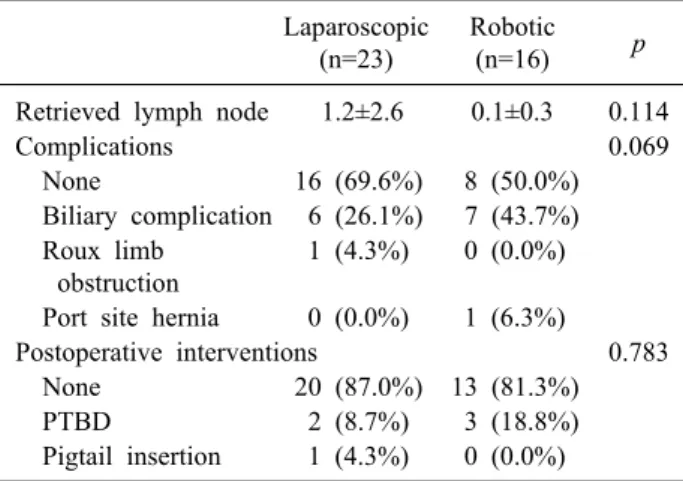
Retrieved lymph node 1.2±2.6 0.1±0.3 0.114 Complications 0.069 None 16 (69.6%) 8 (50.0%) Biliary complication 6 (26.1%) 7 (43.7%) Roux limb
obstruction
1 (4.3%) 0 (0.0%) Port site hernia 0 (0.0%) 1 (6.3%)
Postoperative interventions 0.783 None 20 (87.0%) 13 (81.3%)
PTBD 2 (8.7%) 3 (18.8%)
Pigtail insertion 1 (4.3%) 0 (0.0%)
Table 5. Comparison of hospital charges (US$) Laparoscopic
(n=23)
Robotic
(n=16) p
Total hospital charge 6,568±1,047 7,331±720 0.035 Patient’s bill 2,626±632 6,578±1,081 <0.001 Operation 4810±954 5,781±845 0.002 Anesthesia 612±138 788±154 0.001 Postoperative
management
1,098±260 716±264 0.001 Fig. 2. Time-dependent biliary stricture-free probability.
1 case belonging to the robotic group was classified as type II. Diameter of bile duct measured at upper resection margin was similar between two groups (mm, 9.8±1.9 vs.
11.5±4.3, p=0.099). The mean preoperative CEA (ng/ml, 1.3±1.7 vs. 1.4±1.1, p=0.363), CA 19-9 (U/ml, 11.2±13.3 vs. 13.4±12.0, p=0.358) and total bilirubin (mg/dl, 0.6±0.3 vs. 0.7±0.4, p=0.366) were also similar between the two groups. The ASA score was the only variable that showed a statistically significant difference in the preoperative findings (p=0.021).
Intraoperative and postoperative outcome Several intraoperative findings are presented in Table 3. No significant difference in the average operation time was observed between the two groups (333.6±60.9 vs.
362.9±86.6, p=0.221). The mean estimated blood loss (ml) was higher in the robotic surgery group but not sig- nificantly different compared to the laparoscopic group (128.3±159.1 vs. 186.9±214.7, p=0.746). The number of retrieved lymph nodes is minimal in both groups (1.2±2.6 vs. 0.1±0.3, p=0.114). Some perioperative findings show- ing postoperative outcomes are presented in Table 3.
Hospital stays (days) were significantly longer in the ro- botic surgery group than in the laparoscopic surgery group (11.4±6.3 vs. 14.7±5.6, p=0.011). The incidence of post- operative complications was higher in the robotic surgery group. Table 4 shows biliary complication between two groups. Biliary leakage was observed more frequently in the robotic surgery group than in the laparoscopic surgery group, but the finding was not statistically significant (8.7% vs. 31.3%, p=0.101). Biliary stricture was also more common in the robotic surgery group (8.7% vs. 18.8%, p=0.631). Biliary stricture free probability is showed in Fig. 2 and there is no statistical difference.
Cost analysis
The total hospital charge was higher in the robotic group ($6,568±1,047 vs. $7,331±720, p=0.035) (Table 5).
The difference in the actual patient’s bill was also remark- ably higher in the robotic group ($2,626±632 vs. $6,578±
1,081, p<0.001). The anesthesia charge was higher too in the robotic group ($612±138 vs. $788±154, p=0.001).
But the charge from postoperative management was high- er in the laparoscopic group compared with the robotic
group ($1,098±260 vs. $716±264, p=0.001).
DISCUSSION
As minimally invasive techniques became popular in oncologic surgery, the cases of minimally invasive chol- edochal cyst excision increased since the approach was first reported in 1995 by Farello et al.13 Our institution has been performing minimally invasive choledochal cyst excision since 2005 and a total of 39 cases which con- sisted of 23 laparoscopic cases and 16 robotic cases, have been performed up until December 2018.
There was no significant difference in the patient’s characteristics. Perioperative outcomes were also similar, except for hospital stays which was longer in the robotic group (11.4±6.3 vs. 14.7±5.6, p=0.011). Most patients with robotic surgery had private insurance, which led to a de- lay in discharge from the hospital, and this factor seems to be associated with longer hospital stays. In addition, a higher rate of complications in the robotic surgery group required additional time in postoperative management.
However, when referring to other studies, variables like postoperative complications and data for comparing func- tional recovery rather than length of hospital stay can be more appropriate to evaluate efficacy of minimally in- vasive surgery.14-16
As mentioned before, the rate of biliary complications for containing bile leakage and biliary stricture were high- er in the robotic surgery group. This result showed contra- dictory view from other papers dealing with minimally in- vasive choledochal cyst excision.11,12 But there was possi- bility of bias in different biliary stricture rate between two groups. It might be associated with surgeon’s learning curve and observation period. Considering that some time (median 131 month) is needed for development of biliary stricture, the minimally invasive surgery for choledochal cyst excision was almost done with robotic approach in early period of time. Therefore, higher prevalence of bili- ary stricture in robotic surgery group was also explained by other factors as mentioned above. Further follow up study is mandatory.
The total hospital charge was higher in the robotic group compared to the laparoscopic group, especially re- gard to operation charge. Because the cost for robotic sur- gery is not included in the insurance charge, the cost for
robotic surgery is not reimbursed by the NHIS in South Korea, therefore, the patient’s burden for the hospital charge was significantly higher in the robotic group. So, the presence of private insurance affected the patient’s choice of surgical methods, laparoscopic or robotic. Even though longer hospital stays were observed in the robotic surgery group, the cost from postoperative management was higher in the laparoscopic surgery group. This is like- ly attributable to the increase in the amount of routinely used drugs, combined with the increase in the rate of lapa- roscopic surgery over time.
Robotic surgery was introduced in the late 1990s and was initially confined to several medical areas, including urology and gynecology. As refinement of the technology, such as better image quality, and reduced charges for sur- gery, robotic surgery has expanded into general surgery fields such as hepatobiliary, colorectal, endocrine surgery and even breast surgery.17-20 Robotic surgery has been de- veloped to overcome disadvantages and limitations of lap- aroscopic surgery such as limited degree of motion, com- prised dexterity, the fulcrum effect and two-dimensional visualization. Despite the advantages of robotic surgery, compared with laparoscopic surgery, there are several dis- advantages associated with robotic surgery. The high cost of the operation and set up is a major factor that prevent surgeons from choosing robotic surgery.21,22 In terms of oncologic safety, there is limited supporting clinical evi- dence, therefore factors such as a shortage of long-term clinical outcomes is a concern for robotic surgery. The da VinciⓇ Surgical System which is the most widely used robot surgical system in our institution is comprised of three components: The Surgeon’s console, Patient’s cart, and the Vision cart. Not only does it require a specific amount of space, but the system also requires skilled extra staff to assist with docking the system to the patient.
Therefore, an additional charge and time were needed to satisfy all these factors.
At our institution, minimally invasive choledochal cyst excision was initially performed with the robotic approach.
Based on those experiences, laparoscopic surgical skills were improved and other hepatobiliary surgeries such as hepatectomy and pancreatectomy have been performed more recently with the laparoscopy. As a result, in consid- eration of the general conditions and economic status of patients, performance of laparoscopic choledochal cyst ex-
cision also increased, rather than unconditionally adopting robotic surgery.
Our study has several limitations. The first is that some surgical procedures in the same group were not performed in the same way. For example, among 23 cases of laparo- scopic surgery, 16 cases were performed for the Roux-en-y hepaticojejunostomy by the intracorporeal method but in the remaining 7 cases, they were performed extracorporeally.
The robotic surgery group also did not have the same Roux-en-y hepaticojejunostomy method (3 intracorporeally vs. 13 extracorporeally). This is associated with the se- lection of the surgical approach (hybrid or total robotic approach).
The second limitation is that this study was designed retrospectively; thus, several medical records, such as de- tailed postoperative complications related to this study could not be verified. The third is that there was a short- age of cases because of the single institution in the study.
Choledochal cysts are more commonly diagnosed in chil- dren and more of the surgeries were actually performed in children.1 However, the youngest person in this study was 15 years old and most people were over 20 years old.
In conclusion, the overall statistical outcomes between laparoscopic and robotic choledochal cyst excision ap- proaches were comparable, and the selection of surgical method should be decided in consideration of variety fac- tors including const aspect.
CONFLICT OF INTEREST
The authors have no potential conflicts of interest to disclose.
ORCID
Jong Hwi Yoon: https://orcid.org/0000-0002-2917-2274 Ho Kyoung Hwang: https://orcid.org/0000-0003-4064-7776 Woo Jung Lee: https://orcid.org/0000-0001-9273-261X Chang Moo Kang: https://orcid.org/0000-0002-5382-4658
AUTHOR CONTRIBUTIONS
Conceptualization: JHY, HKH, WJL, CMK. Data cura- tion: HKH, WJL, CMK. Formal analysis: JHY, CMK.
Methodology: JHY, HKH, WJL, CMK. Project admin-
istration: JHY, HKH, WJL, CMK. Writing - original draft:
JHY. Writing - review & editing: JHY, HKH, WJL, CMK.
REFERENCES
1. Soares KC, Kim Y, Spolverato G, Maithel S, Bauer TW, Marques H, et al. Presentation and clinical outcomes of chol- edochal cysts in children and adults: a multi-institutional analysis.
JAMA Surg 2015;150:577-584.
2. Jan YY, Chen HM, Chen MF. Malignancy in choledochal cysts.
Hepatogastroenterology 2002;49:100-103.
3. Lipsett PA, Pitt HA. Surgical treatment of choledochal cysts. J Hepatobiliary Pancreat Surg 2003;10:352-359.
4. Todani T, Watanabe Y, Narusue M, Tabuchi K, Okajima K.
Congenital bile duct cysts: classification, operative procedures, and review of thirty-seven cases including cancer arising from choledochal cyst. Am J Surg 1977;134:263-269.
5. Moreno González E, García García I, Hidalgo Pascual M, Calleja Kempin J, García Blanch G, Gómez Gutiérrez M, et al. Choledo- chal cyst resection and reconstruction by biliary-jejuno-duodenal diversion. World J Surg 1989;13:232-237; discussion 237.
6. Tanaka M, Shimizu S, Mizumoto K, Yokohata K, Chijiiwa K, Yamaguchi K, et al. Laparoscopically assisted resection of chol- edochal cyst and Roux-en-Y reconstruction. Surg Endosc 2001;15:
545-552.
7. Li L, Feng W, Jing-Bo F, Qi-Zhi Y, Gang L, Liu-Ming H, et al. Laparoscopic-assisted total cyst excision of choledochal cyst and Roux-en-Y hepatoenterostomy. J Pediatr Surg 2004;39:1663- 1666.
8. Ure BM, Schier F, Schmidt AI, Nustede R, Petersen C, Jesch NK. Laparoscopic resection of congenital choledochal cyst, chol- edochojejunostomy, and extraabdominal Roux-en-Y anastomosis.
Surg Endosc 2005;19:1055-1057.
9. Kang CM, Chi HS, Kim JY, Choi GH, Kim KS, Choi JS, et al. A case of robot-assisted excision of choledochal cyst, hep- aticojejunostomy, and extracorporeal Roux-en-y anastomosis us- ing the da Vinci surgical system. Surg Laparosc Endosc Percutan Tech 2007;17:538-541.
10. Woo R, Le D, Albanese CT, Kim SS. Robot-assisted laparo- scopic resection of a type I choledochal cyst in a child. J Laparo- endosc Adv Surg Tech A 2006;16:179-183.
11. Lee H, Kwon W, Han Y, Kim JR, Kim SW, Jang JY.
Comparison of surgical outcomes of intracorporeal hepaticojeju- nostomy in the excision of choledochal cysts using laparoscopic versus robot techniques. Ann Surg Treat Res 2018;94:190-195.
12. Han JH, Lee JH, Hwang DW, Song KB, Shin SH, Kwon JW, et al. Robot resection of a choledochal cyst with Roux-en-y hep- aticojejunostomy in adults: initial experiences with 22 cases and a comparison with laparoscopic approaches. Ann Hepatobiliary Pancreat Surg 2018;22:359-366.
13. Farello GA, Cerofolini A, Rebonato M, Bergamaschi G, Ferrari C, Chiappetta A. Congenital choledochal cyst: video-guided lap- aroscopic treatment. Surg Laparosc Endosc 1995;5:354-358.
14. Porpiglia F, Morra I, Lucci Chiarissi M, Manfredi M, Mele F, Grande S, et al. Randomised controlled trial comparing laparo- scopic and robot-assisted radical prostatectomy. Eur Urol 2013;63:
606-614.
15. Lee SY, Park YM, Byeon HK, Choi EC, Kim SH. Comparison of oncologic and functional outcomes after transoral robotic lat- eral oropharyngectomy versus conventional surgery for T1 to T3 tonsillar cancer. Head Neck 2014;36:1138-1145.
16. Kim JH, Park YH, Kim YJ, Kang SH, Byun SS, Kwak C, et
al. Perioperative and long-term renal functional outcomes of ro- botic versus laparoscopic partial nephrectomy: a multicenter matched-pair comparison. World J Urol 2015;33:1579-1584.
17. Kang SW, Jeong JJ, Yun JS, Sung TY, Lee SC, Lee YS, et al.
Robot-assisted endoscopic surgery for thyroid cancer: experience with the first 100 patients. Surg Endosc 2009;23:2399-2406.
18. Lee KE, Rao J, Youn YK. Endoscopic thyroidectomy with the da Vinci robot system using the bilateral axillary breast approach (BABA) technique: our initial experience. Surg Laparosc Endosc Percutan Tech 2009;19:e71-e75.
19. Spinoglio G, Summa M, Priora F, Quarati R, Testa S. Robotic
colorectal surgery: first 50 cases experience. Dis Colon Rectum 2008;51:1627-1632.
20. Toesca A, Peradze N, Galimberti V, Manconi A, Intra M, Gentilini O, et al. Robotic nipple-sparing mastectomy and imme- diate breast reconstruction with implant: first report of surgical technique. Ann Surg 2017;266:e28-e30.
21. Lanfranco AR, Castellanos AE, Desai JP, Meyers WC. Robotic surgery: a current perspective. Ann Surg 2004;239:14-21.
22. Jung M, Morel P, Buehler L, Buchs NC, Hagen ME. Robotic general surgery: current practice, evidence, and perspective.
Langenbecks Arch Surg 2015;400:283-292.