ISSN 2234-3806 • eISSN 2234-3814
https://doi.org/10.3343/alm.2021.41.5.489 www.annlabmed.org 489
Ann Lab Med 2021;41:489-492
https://doi.org/10.3343/alm.2021.41.5.489
Brief Communication
Clinical Microbiology
Genetic Characterization of Clostridium botulinum
Isolated from the First Case of Infant Botulism in Korea
Jun Ho Jeon , Ph.D.1*, Chi-Hwan Choi , Ph.D.2*, Jeong Hyun Kim , M.D.3, Junghee Hyun , M.S.4, Eun-Sun Choi , Ph.D.1, Sang-Yoon Choi , Ph.D.1, Yong-Woo Shin , Ph.D.1, Seong Wook Pyo , M.S.1, Dae-Won Kim , Ph.D.2, Byung Hak Kang , Ph.D.1, Young Joon Park , M.D.5, and Gi-eun Rhie , Ph.D.1
1Division of High-risk Pathogens, 2Division of Zoonotic and Vector Borne Disease Research, 3Division of Zoonotic and Vector Borne Disease Control, 4Division of Emerging Infectious Disease Response, 5Director for Epidemiological Investigation Analysis, Korea Disease Control and Prevention Agency, Cheongju, Korea
Botulism is a neuroparalytic disease caused by a neurotoxin produced by Clostridium bot- ulinum. This study aimed to genetically characterize C. botulinum strain isolated from the first case of infant botulism in Korea reported on June 17, 2019. We isolated C. botulinum strain CB-27 from a stool sample of the patient and analyzed the toxin types and toxin gene cluster compositions of the strain using a mouse bioassay, real-time PCR, and ge- nome sequencing. Toxin gene cluster analysis showed that strain CB-27 possesses a C.
botulinum neurotoxin type A harboring an unexpressed B gene. Although the nucleotide and amino acid sequences of toxin genes as well as the toxin gene cluster arrangements in strain CB-27 were identical to those of the known strain CDC_69094, the total nucleo- tide sequences of the toxin gene clusters of CB-27 differed from those of CDC_69094 by 0.47%, indicating genetic diversity of toxin gene clusters of CB-27 among other previously reported C. botulinum strains. To our knowledge, this is the first description of a C. botuli- num strain with two separate toxin gene clusters in Korea.
Key Words: Clostridium botulinum, Toxin type, Toxin gene cluster, Genetic diversity, Neu- rotoxin
Received: July 14, 2020
Revision received: October 14, 2020 Accepted: March 20, 2021
Corresponding author: Gi-eun Rhie, Ph.D.
Division of High‐risk Pathogens, Korea Disease Control and Prevention Agency, 187 Osongsaengmyeong 2-ro, Cheongju 28159, Korea
Tel: +82-43-719-8270 Fax: +82-43-719-8309 E-mail: [email protected]
* These authors contributed equally to this study.
© Korean Society for Laboratory Medicine This is an Open Access article distributed under the terms of the Creative Commons Attribution Non-Commercial License (https://creativecom- mons.org/licenses/by-nc/4.0) which permits unrestricted non-commercial use, distribution, and reproduction in any medium, provided the original work is properly cited.
Botulism is a neuroparalytic disease caused by the seven im- munologically distinct toxins (A to G) produced by Clostridium botulinum, a gram-positive, anaerobic, spore-forming bacterium [1, 2]. Botulinum toxin types A, B, E, and F cause botulism in humans [2]. There are three main forms of botulism: foodborne botulism, infant botulism, and wound botulism [3]. From 2002 to June 16 2019, eight cases of human botulism have been re- ported in Korea, and all were presumed to be foodborne botu- lism [4–6]. In the USA, more than 1,500 cases of infant botu- lism have been confirmed between 1976 and 2007 [7]. By contrast, in Korea, the first documented case of infant botulism
was reported in 2019, after botulism was designated as a notifi- able infectious disease in 2002 [8]. In addition, no C. botulinum strains with two toxin gene clusters have been reported in Ko- rea. This study aimed to characterize the C. botulinum strain CB-27 isolated from a stool sample from the first case of infant botulism in Korea. We found that the strain possessed two dif- ferent toxin gene clusters, showing genetic diversity compared with other previously reported C. botulinum strains.
On June 7, 2019, a 4-month-old Korean baby with suspected infant botulism was admitted to Ajou University Hospital, Suwon, Korea, and on June 13, clinical samples, including serum and
1 / 1 CROSSMARK_logo_3_Test
2017-03-16 https://crossmark-cdn.crossref.org/widget/v2.0/logos/CROSSMARK_Color_square.svg
Jeon JH, et al.
Clostridium botulinum from infant botulism
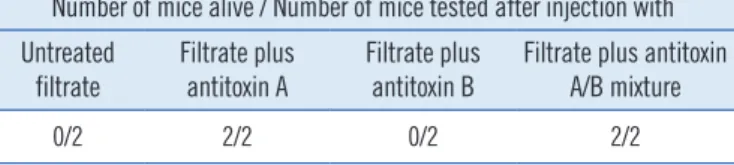
490 www.annlabmed.org https://doi.org/10.3343/alm.2021.41.5.489 Table 1. Mouse bioassay to identify C. botulinum neurotoxin type produced by CB-27 strain
Number of mice alive / Number of mice tested after injection with Untreated
filtrate Filtrate plus
antitoxin A Filtrate plus
antitoxin B Filtrate plus antitoxin A/B mixture
0/2 2/2 0/2 2/2
Fig. 1. Comparison of botulinum neurotoxin (boNT)/A and boNT/B nucleotide sequences. (A) The boNT/A sequences of strain CB-27 were compared with those of previously reported strains. (B) The boNT/B sequences of strain CB-27 were compared with those of previously re- ported strains. Nucleotide and amino acid identities of toxin genes between each strain and CB-27 are indicated on the right. The numbers on the tree indicate bootstrap values for branch points; only values >70 are shown. GenBank accession numbers are as follows:
CDC_69094 (CP013246), ATCC 3,502 (AM412317), H04402 065 (EU679004), 2,008-148 (JQ954969), CDC41370 (FJ981696, FJ981697), Chemnitz (KM233166), Kyoto-F (X73423), Loch Maree (CP000963), 657 (CP001081), Okra (CP000940), Osaka05 (AB302852), 111 (AB084152), CDC 795 (EF028400), Maehongson 2010 (JQ964806), Bac-04-07755 (JQ354985), Eklund 17B (EF051570), and CB-27(MT199282).
stool samples, were submitted to the Korea Centers for Disease Control and Prevention (KCDC) to identify C. botulinum and its toxins [8]. We conducted a mouse bioassay to identify botulinum toxins in the stool and serum samples [9]. Based on neutraliza- tion of sample toxicity by monovalent antitoxin A (National Insti- tute for Biological Standards and Control, Potters Bar, UK), only the stool sample was positive for botulinum neurotoxin (boNT) A.
A small amount of the stool sample was inoculated into cooked-meat medium (Difco, Franklin Lakes, USA) and cul- tured under anaerobic conditions at 37°C for three days. The culture was mixed 1:1 with 100% ethanol and incubated at 37°C for 1 hour. Serial culture dilutions were plated on egg yolk agar under anaerobic conditions to isolate C. botulinum. Five li- pase-positive colonies were isolated, and DNA was extracted from each strain using a genomic DNA isolation kit (Intron Bio- technology, Seongnam, Korea). We analyzed botulinum toxin
genes by real-time PCR using previously reported primers [10, 11]. As all strains were positive for both boNT/A and boNT/B genes, we selected the first isolated strain, named “CB-27,” and cultured it in trypticase peptone glucose yeast extract medium (KisanBio, Seoul, Korea) at 37°C for 24 hours. This study was exempted from the approval by the Institutional Review Board of the KCDC because clinical bacterial strains were used.
The culture filtrate of strain CB-27 was diluted 1:10,000 in
A
B
Jeon JH, et al.
Clostridium botulinum from infant botulism
https://doi.org/10.3343/alm.2021.41.5.489 www.annlabmed.org 491
phosphate-buffered saline containing 0.2% gelatin and then analyzed using a mouse bioassay. The mice were injected with 0.05 international units of botulinum antitoxins A and B (Na- tional Institute for Biological Standards and Control, Potters Bar, UK). Botulinum antitoxin A and a mixture of antitoxins A and B showed neutralizing ability against the CB-27 culture filtrate (Ta- ble 1) in accordance with the mouse bioassay results obtained using stool samples.
To confirm the discrepancy between the mouse bioassay and real-time PCR analysis results, genomic DNA was extracted from the CB-27 strain and subjected to whole genome sequenc- ing using a PacBio RS II (Pacific Biosciences, Menlo Park, CA, USA; https://www.pacb.com) and an Ion S5 (Thermo Fisher Scientific, Waltham, MA USA; https://www.thermofisher.com) sequencer. The toxin gene cluster sequences of CB-27 were as- sembled de novo using the Hierarchical Genome Assembly Process version 3 (Pacific Biosciences). High-quality Ion S5 reads were used to correct potential sequencing errors in the PacBio long reads in Proovread version 2.14 (https://github.
com/BioInf-Wuerzburg/proovread) [12]. The cluster sequence of CB-27 (67,538 bp) has been deposited at GenBank under accession number MT199282. Genes were annotated using rapid prokaryotic genome annotation (Prokka version 1.14.5, https://github.com/tseemann/prokka) [13]. Gene annotation
showed that the cluster sequence of CB-27 harbored a boNT/A gene and a silent boNT/B gene (boNT/A(B)).
To phylogenetically characterize the toxin gene clusters of CB- 27, we downloaded sequence data of 240 strains representing different toxin types and subtypes from Pathosystems Resource Integration Center (PATRIC) (https://www.patricbrc.org) [14].
All-against-all pairwise sequence comparisons were conducted using Basic Local Alignment Search Tool (https://blast.ncbi.nlm.
nih.gov/) to determine the closest relatives of CB-27. Multiple sequence alignments were conducted using MAFFT version 7.453 (https://mafft.cbrc.jp/alignment/software/), with a maxi- mum of 1,000 iterations. We constructed maximum-likelihood phylogenetic trees using RAxML-NG version 0.9.0 (https://
github.com/amkozlov/raxml-ng) with TVM+F+G4, the best nu- cleotide substitution model recommended by ModelFinder [15, 16]. The boNT/A nucleotide sequence of CB-27 was identical or highly similar to the sequences of previously reported subtype A1 strains, including CDC_69094 (100%) and ATCC 3502 (99.95%) (Fig. 1A). The boNT/B sequence of CB-27 showed 100% identity with that of CDC_69094 (Fig. 1B), which con- tains a nucleotide substitution that can lead to premature termi- nation of boNT/B at amino acid position 128 [17].
We examined genomic arrangements of the toxin gene clus- ters of CB-27 using the multiple genome alignment tool MAUVE
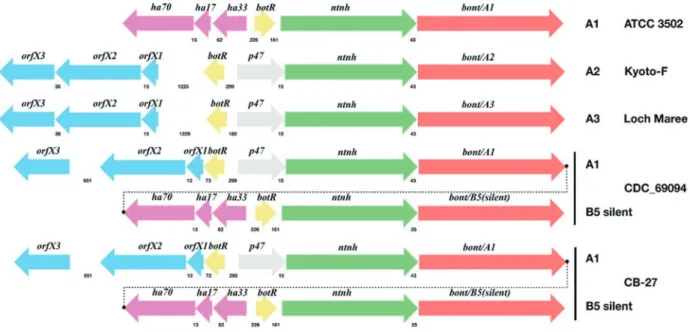
Fig. 2. The toxin gene cluster structures of CB-27 and other representative strains (subtypes A1, A2, A3, and A(B)). Gene locations and di- rections are indicated by arrows, with gene names presented above the arrows. The numbers between genes below the arrows indicate in- tergenic spacing. GenBank accession numbers are as follows: ATCC 3502 (AM412317), Kyoto-F (CP001581), Loch Maree (CP000963), CDC_69094 (CP013246), and CB-27(MT199282).
Jeon JH, et al.
Clostridium botulinum from infant botulism
492 www.annlabmed.org https://doi.org/10.3343/alm.2021.41.5.489 version 2.4.0 (http://darlinglab.org/mauve/mauve.html) [18].
Fig. 2 shows a schematic diagram of the toxin A and B gene cluster structures of CB-27 and other representative strains (subtypes A1, A2, A3, and A(B)). The toxin gene cluster struc- tures of CB-27 were identical to those of CDC_69094. Both CB- 27 and CDC_69094 possess not only ha70, ha17, ha33, botR, ntnh, and boNT/A1 in the HA gene cluster but also orfX3, orfX2, orfX1, botR, p47, ntnh, and boNT/B5 (silent) in the OrfX gene cluster. However, the toxin gene cluster of CB-27 showed 99.53%
nucleotide sequence identity with that of CDC_69094, showing genetic diversity between the toxin gene clusters.
In conclusion, we characterized the toxin gene clusters of C.
botulinum strain CB-27 isolated from the first case of infant bot- ulism in Korea in 2019. The CB-27 genome possesses boNT/A1 and unexpressed boNT/B5. Although the nucleotide sequences of the toxin gene cluster of CB-27 showed a 0.47% difference from that of CDC_69094, the sequence of the complete genome of CB-27 strain may show a larger difference. Further analysis us- ing whole genome sequencing of CB-27 will be needed to confirm this notion.
AUTHOR CONTRIBUTIONS
Conceptualization: Rhie G. Data curation: Jeon JH, Choi CH, Kim JH, Hyun J, Choi ES, Choi SY, Shin YW, Pyo SW, Kim DW, Kang BH, Park YJ. Writing-review and editing: Rhie G, Jeon JH.
Final approval of the manuscript: all authors.
CONFLICTS OF INTEREST
The authors have declared no conflicts of interest.
RESEARCH FUNDING
This work was supported by the KDCA (4840-302-210-13).
ORCID
Jun Ho Jeon https://orcid.org/0000-0003-2612-1081 Chi-Hwan Choi https://orcid.org/0000-0002-8560-5230 Jeong Hyun Kim https://orcid.org/0000-0003-3918-2676 Junghee Hyun https://orcid.org/0000-0002-9499-4143 Eun-Sun Choi https://orcid.org/0000-0002-5432-1059 Sang-Yoon Choi https://orcid.org/0000-0001-5108-4345 Yong-Woo Shin https://orcid.org/0000-0002-0239-7502 Seong Wook Pyo https://orcid.org/0000-0001-8775-3571
Dae-Won Kim https://orcid.org/0000-0003-0917-1511 Byung Hak Kang https://orcid.org/0000-0003-1952-0965 Young Joon Park https://orcid.org/0000-0001-9697-4173 Gi-eun Rhie https://orcid.org/0000-0002-4212-5501
REFERENCES
1. Arnon SS, Schechter R, Inglesby TV, Henderson DA, Bartlett JG, Ascher MS, et al. Botulinum toxin as a biological weapon: medical and public health management. JAMA 2001;285:1059-70.
2. Hill KK, Smith TJ, Helma CH, Ticknor LO, Foley BT, Svensson RT, et al.
Genetic diversity among botulinum neurotoxin-producing clostridial strains. J Bacteriol 2007;189:818-32.
3. Sharma SK, Ferreira JL, Eblen BS, Whiting RC. Detection of type A, B, E, and F Clostridium botulinum neurotoxins in foods by using an amplified enzyme-linked immunosorbent assay with digoxigenin-labeled antibod- ies. Appl Environ Microbiol 2006;72:1231-8.
4. Chung GT, Kang DH, Yoo CK, Choi JH, Seong WK. The first outbreak of botulism in Korea. Korean J Clin Microbiol 2003;6:160-3.
5. Yi HA, Lim JG, Lee JB, Her JH, Kim HA, Shin YE, et al. A familial out- break of food-borne botulism. J Korean Neurol Assoc 2004;22:670-2.
6. Infectious Disease Portal. http://www.kdca.go.kr/npt/biz/npp/ist/bass/
bassDissStatsMain.do (Updated on Mar 11, 2021).
7. Brook I. Infant botulism. J Perinatol 2007;27:175-80.
8. Jang HG, Jang J, Jung HJ, Jung DE. The first reported case of infant botulism in Korea: treatable infantile neuromuscular disease. J Korean Med Sci 2020;35:e93.
9. Thirunavukkarasu N, Johnson E, Pillai S, Hodge D, Stanker L, Wentz T, et al. Botulinum neurotoxin detection methods for public health re- sponse and surveillance. Front Bioeng Biotechnol 2018;6:80.
10. Hill BJ, Skerry JC, Smith TJ, Arnon SS, Douek DC. Universal and spe- cific quantitative detection of botulinum neurotoxin genes. BMC Micro- biol 2010;10:267.
11. Fach P, Micheau P, Mazuet C, Perelle S, Popoff M. Development of re- al-time PCR tests for detecting botulinum neurotoxins A, B, E, F pro- ducing Clostridium botulinum, Clostridium baratii and Clostridium bu- tyricum. J Appl Microbiol 2009;107:465-73.
12. Hackl T, Hedrich R, Schultz J, Förster F. proovread: large-scale high- accuracy PacBio correction through iterative short read consensus.
Bioinformatics 2014;30:3004-11.
13. Seemann T. Prokka: rapid prokaryotic genome annotation. Bioinformat- ics 2014;30:2068-9.
14. Wattam AR, Davis JJ, Assaf R, Boisvert S, Brettin T, Bun C, et al. Im- provements to PATRIC, the all-bacterial Bioinformatics Database and Analysis Resource Center. Nucleic Acids Res 2017;45:D535-42.
15. Kozlov AM, Darriba D, Flouri T, Morel B, Stamatakis A. RAxML-NG: a fast, scalable and user-friendly tool for maximum likelihood phylogenet- ic inference. Bioinformatics 2019;35:4453-5.
16. Kalyaanamoorthy S, Minh BQ, Wong TKF, von Haeseler A, Jermiin LS.
ModelFinder: fast model selection for accurate phylogenetic estimates.
Nat Methods 2017;14:587-9.
17. Lúquez C, Raphael BH, Maslanka SE. Neurotoxin gene clusters in Clos- tridium botulinum type Ab strains. Appl Environ Microbiol 2009;75:
6094-101.
18. Darling AC, Mau B, Blattner FR, Perna NT. Mauve: multiple alignment of conserved genomic sequence with rearrangements. Genome Res 2004;14:1394-403.