225 서 론
아로마는 그리스어 “향신료(spice)”에서 파생된 말로 오늘날에는 일반적으로 “향”을 의미한다. 아로마 에센셜 오일은 식물에서 추출한 화학물질과 호르몬 성분으로 인체에 사용 가능한 오일은 약 300여 종 이상이 있으며 그중 약 60여 종의 오일이 이용되고 있다. 이들 오일 중 eucalyptus는 Eucalyptus globulus라는 식물의 잎에서 추출한 오일로서 thuione, carvone, menthrone, atlantone, vetivone, pino cam phone, piperitone, cryptone vervenone, jasmone, fen- chone, pulegone 등의 복합성분으로 이루어져 있으며 항
박테리아, 항바이러스, 해열작용, 항염증작용 등을 나타 내는 것으로 알려져 있는, 케톤 군에 속하는 오일이다.
Geranium은 Pelargonium graveolens라는 식물의 잎에서 추출 한 오일로서 geraniol, a-terpineol, terpineol-4, sabinol, linalol, thuyanol 등의 복합성분으로 이루어져 있으며 항박테리 아, 항바이러스 작용, 상처치유, 염증완화를 나타내는 것 으로 알려져 있는, 알코올 군에 속하는 오일이다.1) 김 등2)은 정향나무나 다수의 식물추출물에 존재하는 기름성분인 eugenol을 이용한 실험에서 아나필락시스 유 발물질이 투여된 쥐에 eugenol을 작용시키면 강력한 항 아나필락시스 효과가 나타남을 관찰함과 동시에 아나필
Correspondence to:Kwang-Hyuk Kim
Department of Microbiology, Kosin Medical College, 34 Amnam-dong, Seo-gu, Busan 602-702, Korea
Tel: +82-51-990-6422, Fax: +82-51-990-3081 E-mail: [email protected]
Eucalyptus와 Geranium이 마우스의 Nitric Oxide 생성에 미치는 효과
1고신대학교 의과대학 미생물학교실, 2부산대학교 식품영양학과
차 봉 규1․박 건 영2․김 광 혁1
Effects of Eucalyptus and Geranium on Production of Nitric Oxide in Mice
Bong-Kyu Cha1, Kun-Young Park2 and Kwang-Hyuk Kim1
1Department of Microbiology, Kosin Medical College, Busan 602-702,
2Department of Food Science and Nutrition, Pusan National University, Busan 609-735, Korea
Aromatherpy is the controlled use of essential oils to promote health and well-being. The most frequent form of using the essential oils is through massage; however, essential oil can be used in a variety of other ways such as inhalation, vaporization, in the bath and through a compress. In this work we have investigated the effect of eucalyptus and geranium on nitric oxide (NO) production in mice to understand the effect of these oils on immune system. Mouse splenocytes were incubated with essential oils and Con A to observe the effects on cell proliferation. The culture supernatants of mouse splenocytes exposed with these oils were harvested to assay NO production. The NO production was inhibited after essential oils exposure. The reduction in NO levels by these agents may be related to down-regulation of inflammation. (Cancer Prev Res 10, 225-231, 2005)
ꠏꠏꠏꠏꠏꠏꠏꠏꠏꠏꠏꠏꠏꠏꠏꠏꠏꠏꠏꠏꠏꠏꠏꠏꠏꠏꠏꠏꠏꠏꠏꠏꠏꠏꠏꠏꠏꠏꠏꠏꠏꠏꠏꠏꠏꠏꠏꠏꠏꠏꠏꠏꠏꠏꠏꠏꠏꠏꠏꠏꠏꠏꠏꠏꠏꠏꠏꠏꠏꠏꠏꠏꠏꠏꠏꠏꠏꠏꠏꠏꠏꠏꠏꠏꠏꠏꠏꠏꠏꠏꠏꠏꠏꠏꠏꠏꠏꠏꠏꠏꠏꠏ Key Words: Eucalyptus, Geraniumm, Immunity, Cell proliferation, Nitric oxide
책임저자:김광혁 ꂕ 602-702, 부산시 서구 암남동 34 고신대학교 의과대학 미생물학교실 Tel: 051-990-6422, Fax: 051-990-3081 E-mail: [email protected]
접수일:2005년 9월 21일, 게재승인일:2005년 11월 29일
락시스 유발물질이 투여된 쥐의 혈청내 히스타민의 상 승 또한 eugenol의 주사에 의해서 현저히 감소함을 관찰 하여 eugenol이 비만세포의 탈과립을 차단함으로써 항아 나필락시스 특성이 나타남을 보고한 바 있다. Visioli 등3) 은 LPS를 미리 노출시킨 마우스 대식세포에 아로마 오일 인 oleuropein을 작용시키면 nitrite 생성이 증가하고 nitric oxide 생성효소의 활성이 상승하는 것을 관찰하여 내독 소가 관여된 생체반응에서 대식세포 매개성 반응이 증 강되어 결과적으로 세포성 혹은 생체방어에 유익할 수 있음을 보고하였다. Fujiwara 등4)은 고압 스트레스로 유 발시킨 마우스의 면역억제현상이 여러 가지 향료에 노 출시켰을 때 회복됨을 관찰하였다. 이러한 결과는 면양 적혈구에 대한 프라크 형성세포를 산출하여 증명한 결 과이며 향료의 종류와 작용시간에 따라 그 효과가 달라 질 수 있음을 보고하였다. Siani 등5)은 남아메리카나 아마 존지역에서 궤양이나 염증에 민간약제로 널리 사용하고 있는 Protium이라는 식물들로부터 에센셜 오일을 추출하 여 항염증활성을 측정하였다. 결과에서는 Protium 속내의 종에 따라 상당한 차이를 보였다. 즉 NO생성 등이 이들 식물의 종에 따라 증가 혹은 감소를 보인 것이다. 따라서 이들은 이러한 에센셜 오일이 병증에 따라 유효한 약제 로서 사용될 가능성을 제의한 바 있다. Shinde 등6)은 Cedrus deodara에서 추출한 기름성분을 인위적으로 유발시 킨 부종을 보이는 쥐에 작용시켰을 때 비만세포의 탈과 립을 억제하고 lipoxygenase의 활성을 억제시킴을 관찰하 였다. 이들은 결론적으로 C. deodara의 오일이 비만세포의 안정화, leukotriene생성의 억제를 통해서 항염증작용이 나타날 수 있음을 보고하였다. 또한 Shinde 등7)은 C.
deodara의 오일을 투여한 쥐의 호중구부착능저해, 3형 혹 은 4형 과민반응의 저해 등을 관찰하여 이들 오일이 체 액성이나 세포성 면역반응에 저해효과를 보일 수 있음 을 보고하였다. Mazor 등8)은 멕시코나 인도의 약용식물 에서 추출한 sesquiterpene 락톤이 사람 호흡기 상피세포 의 인터루킨-8 유전자발현을 억제함을 관찰하여 항염증 작용의 효과를 증명하였다.
Nitric oxide (NO)는 사이토카인이나 미생물의 영향을 받아 대식세포, 호중구, 혈관내피세포, 활막표층세포, 활 막섬유아세포, 연골세포 등에서 생성되는 반응질소중간 체(reactive nitrogen intermediates, RNI)로서 nitric oxide syn- thase (NOS)가 산소와 결합하여 L-알지닌을 산화시켜 NO 가 생성된다.9∼13) 생성된 NO는 생체내에서 혈관이완물 질, 신경전달물질, 면역기능조절물질로서 작용할 뿐만 아니라 패혈증이나 염증반응에 관련하게 된다. 즉, 면역 염증반응을 통한 항미생물작용 혹은 항암작용을 일으키
는 것으로 알려져 있으며 이러한 독작용은 미토콘드리 아 기능 억제, FeS 함유 효소기능 저하, DNA 손상 등의 작용에 의하여 나타나기 때문에 과량의 NO 생성시 정상 조직에 손상을 주게 된다. 내피세포나 혈관 연조직세포 들은 감염과정에서 내독소(endotoxin), tumor necrosis factor-α (TNF-α) 혹은 interferon-γ (IFN-γ) 등에 반응하 여 NO를 생성할 수 있다.14∼22) NO의 방출은 현재 패혈 성환자에서 저혈압과 쇼크의 주요인자로 생각되고 있 다.23,24)
본 연구에서는 eucalyptus와 geranium이 마우스면역에 미치는 효과를 보기 위하여 마우스림프구배양에서 세포 의 증식과 nitric oxide 생성의 변화를 관찰하였다.
재료 및 방법
1. 연구재료
1) 실험동물: 암컷 Balb/C 마우스로서 생후 8주 내외, 체중 25 g 내외의 것을 한국 효창 사이언스(대구, 경북) 로부터 구입하여 실험에 사용하였다.
2) 시약: Eucalytus와 geranium 에센셜 오일은 Razzmatazz Ltd. (England)의 제품으로서 Eucalyptus (Code No. AD01)과 Geranium (Code No. AD08)을 사용하였다.
2. 연구방법
1) 림프구 세포 증식 효과: 마우스 비장세포 분리는 다
음과 같이 시행하였다. 경부를 탈구하여 희생시킨 마우 스로부터 비장을 무균적으로 적출하여 4oC의 Hank’s balanced salt solution (HBSS, Gibco, Grand Island, NY, USA) 으로 2회 세척하였다. 이를 직경 60 mm 조직배양용 접 시(Costar, Cambridge, MA, USA)에 옮기고 다시 신선한 HBSS를 가한 후 핀셋으로 가볍게 문질러 비장세포를 유 리시켰다. 이 세포 부유액을 15 ml 원심관(Falcon, Oxford, USA)에 옮긴 후 2∼3분 동안 실온에 방치한 다음 세포 부유액의 상층액을 새로운 15 ml 원심관에 옮겼다. 이 세포를 200 ×g에서 5∼10분 원침한 후 HBSS로 1회 원침 세척한 다음 증류수와 10배 농축 phosphate buffered saline (PBS)를 이용하여 혼입된 적혈구를 용해시킨 후 HBSS로 2회 원침 세척하여 사용하였다. 림프구에 대한 세포 증 식 효과는 상기와 같이 준비된 비장세포(2×10⁶ cells/ml) 를 96 wells microplate에 100μl씩 분주하고 에센셜 오일은 ml당 10μg, 100μg, 1 mg씩 되게 적하하였다. Concana- valin A (Con A, Sigma, USA)의 농도는 ml당 2μg이 되게 사용하였다. 분주가 완료된 plate는 5% CO2, 37oC 그리고 충분한 습도가 유지되고 있는 배양기에 3일 동안 배양하
였다. 3일 배양 후에 plate의 각 well에 Cell Counting Kit-8 (Dojindo Laboratories, Kumamoto, Japan)액 10μl씩을 적하 하고 4시간 추가 배양하였다. Optical density (OD)는 microplate reader (Model 550 microplate reader, Bio-Rad, Richmond, USA)를 이용하여 450 nm에서 측정하였다.
2) 비장세포배양 상층액 준비: 비장세포배양 상층액 준
비는 미리 준비된 비장세포 부유액을 10%가 되게 소 태 아혈청을 가한 RPMI 1640 (Gibco, Grand Island, NY, USA) 배지(complete 10% FCS RPMI 1640)로 ml당 2×10⁶ 세포가 되도록 조절하여, 24 wells tissue culture plate (Costar, Cambridge, MA, USA)에 1 ml씩 분주한 후 eucalyptue 10μg, 100μg, 1 mg을 각각 작용시키거나 geranium 0.1, 1, 10μg 을 각각 작용시켜 37oC, 5% CO2 배양기에 배양하였다.
배양시간은 상기의 조건에서 2, 4, 24, 48, 72시간으로 하 였다. 각각 일정시간 배양이 끝난 후 전량 배양액을 수거 한 다음 300 ×g에서 10분간, 10,000 ×g에서 30분간 원 침 시킨 후 그 상층액을 수거하여 배양 상층액에서 nit- rite ion을 정량하였다.
3) Nitrite ion 정량분석: Nitric oxide (NO) 측정은 nitrite ion 측정법인 Ding 등25)의 microplate 검사법에 준하여 시 행하였다. Kit 시약은 Griess reagent system (Promega, Madi- son, USA)을 구입하여 사용하였다. 간략하면 상기 2) 항 의 배양상층액 각각에서 0.1 ml씩의 시료를 96 wells microplate (Costar, Cambridge, USA)로 옮긴 다음 Griess 시 약 [1% sulfanilamide/0.1% naphthylethylene diamine dihy- drochloride/2.5% phosphoric acid] 0.1 ml씩을 작용시킨 후 실온에서 10분 동안 방치하였다. Optical density는 micro- plate reader (Model 550 microplate reader, Bio-Rad, Richmond,
USA)를 이용하여 540 nm에서 측정하였다. 표준곡선은 nitrite standard (Promega, USA)로 작성하였다.
3. 통계학적 분석
실험성적은 평균 또는 평균±표준편차로 나타냈으며 각 군 간의 통계학적 검정에는 Student’s t-test를 사용하 고 p값이 0.05 미만일 때 의의 있는 차로 간주하였다.
결 과
1. 림프구 세포 증식 효과
정상마우스의 비장세포에 eucalyptus나 geranium을 노 출시킨 후 나타나는 림프구 증식은 PBS 노출군인 대조 군에 비하여 감소하였다. 세포자극물인 Con A에 노출시 키고 eucalyptus를 첨가하면 Con A 단독 자극 때보다 eucalyptus 100μg에서 유의한 림프구의 증식이 나타났으 나 Con A와 geranium 첨가에서는 Con A 단독 노출 때보 다 감소하였다(Table 1, 2).
2. 마우스 비장세포에서의 nitric oxide 생성 NO의 생성양상은 비장세포에 eucalyptus 10μg를 작용시 켰을 때 48시간 째를 제외한 모든 시간대에서 대조군과 비교하여 유의한 감소효과를 나타냈다(P<0.01)(Fig. 1).
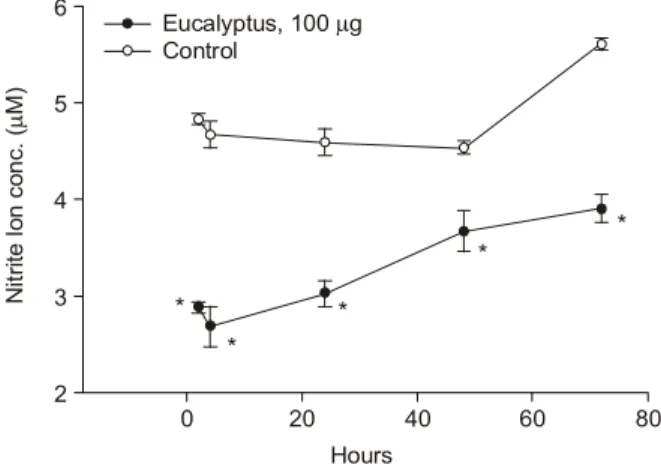
비장세포에 eucalyptus 100μg, 1 mg을 작용시켰을 때에도 각 시간대마다 대조군에 비하여 감소를 보였다(P
<0.01)(Fig. 2, 3). 비장세포에 geranium 0.1, 1, 10μg을 작용 시켰을 경우 또한 모든 시간대에서 대조군보다 낮게 나타
Table 1. Effect of eucalyptus on the Con A-induced prolifera- tion of mouse splenocytes
ꠏꠏꠏꠏꠏꠏꠏꠏꠏꠏꠏꠏꠏꠏꠏꠏꠏꠏꠏꠏꠏꠏꠏꠏꠏꠏꠏꠏꠏꠏꠏꠏꠏꠏꠏꠏꠏꠏꠏꠏꠏꠏꠏꠏꠏꠏꠏꠏꠏꠏꠏꠏꠏꠏꠏ Optical density Agents
(450 nm)×1,000 ꠏꠏꠏꠏꠏꠏꠏꠏꠏꠏꠏꠏꠏꠏꠏꠏꠏꠏꠏꠏꠏꠏꠏꠏꠏꠏꠏꠏꠏꠏꠏꠏꠏꠏꠏꠏꠏꠏꠏꠏꠏꠏꠏꠏꠏꠏꠏꠏꠏꠏꠏꠏꠏꠏꠏ
Eucalyptus, 1 mg 261.17±8.01
Eucalyptus, 100μg 240.83±12.07
Eucalyptus, 10μg 250.00±16.91
Con A, 2μg+eucalyptus, 1 mg 252.67±11.89 Con A, 2μg+eucalyptus, 100μg 395.17±12.86*
Con A, 2μg+eucalyptus, 10μg 321.67±10.82
Con A, 2μg 334.33±14.45
Control 270.83±6.11
ꠏꠏꠏꠏꠏꠏꠏꠏꠏꠏꠏꠏꠏꠏꠏꠏꠏꠏꠏꠏꠏꠏꠏꠏꠏꠏꠏꠏꠏꠏꠏꠏꠏꠏꠏꠏꠏꠏꠏꠏꠏꠏꠏꠏꠏꠏꠏꠏꠏꠏꠏꠏꠏꠏꠏ Mouse splenocytes were exposed with Concanavalin A (Con A), Con A+eucalyptus, and PBS (control) each for 72 hr. Prolifera- tion was determined as described in materials and methods.
Data are mean±SD. *p<0.01 compared to Con A group.
Table 2. Effect of geranium on the Con A-induced proliferation of mouse splenocytes
ꠏꠏꠏꠏꠏꠏꠏꠏꠏꠏꠏꠏꠏꠏꠏꠏꠏꠏꠏꠏꠏꠏꠏꠏꠏꠏꠏꠏꠏꠏꠏꠏꠏꠏꠏꠏꠏꠏꠏꠏꠏꠏꠏꠏꠏꠏꠏꠏꠏꠏꠏꠏꠏꠏꠏ Optical density
Agents (450 nm)×1,000
ꠏꠏꠏꠏꠏꠏꠏꠏꠏꠏꠏꠏꠏꠏꠏꠏꠏꠏꠏꠏꠏꠏꠏꠏꠏꠏꠏꠏꠏꠏꠏꠏꠏꠏꠏꠏꠏꠏꠏꠏꠏꠏꠏꠏꠏꠏꠏꠏꠏꠏꠏꠏꠏꠏꠏ
Geranium, 1 mg 258.83±10.98
Geranium, 100μg 259.33±12.24
Geranium, 10μg 266.33±6.92
Con A, 2μg+geranium, 1 mg 240.05±4.93 Con A, 2μg+geranium, 100μg 250.83±6.49 Con A, 2μg+geranium, 10μg 302.40±7.40
Con A, 2μg 334.33±14.45
Control 270.83±6.11
ꠏꠏꠏꠏꠏꠏꠏꠏꠏꠏꠏꠏꠏꠏꠏꠏꠏꠏꠏꠏꠏꠏꠏꠏꠏꠏꠏꠏꠏꠏꠏꠏꠏꠏꠏꠏꠏꠏꠏꠏꠏꠏꠏꠏꠏꠏꠏꠏꠏꠏꠏꠏꠏꠏꠏ Mouse splenocytes were exposed with Concanavalin A (Con A), Con A+geranium, and PBS (control) each for 72 hr. Prolifera- tion was determined as described in materials and methods.
Data are mean±SD.
났으며 유의한 감소효과를 보였다(P<0.01)(Fig. 4, 5, 6).
고 찰
아로마테라피란 건강과 삶의 만족을 증진시키기 위하 여 에센셜 오일을 적합하게 사용하는 것을 말한다. 에센 셜 오일의 가장 빈번한 이용은 마사지나 목욕시 피부를 통한 흡수방법이 있지만 그 외에도 후각, 호흡, 입을 통 한 섭취방법 등이 적용되고 있다. 아로마 에센셜 오일이 란 식물에서 추출한 화학물질과 호르몬 성분의 천연 식
물향으로 부작용이 거의 없고 정신적 안정, 피부미용, 공 기정화 등에 탁월한 효능이 있으며 향기요법은 향의 독 특한 성분을 이용한 자연치료의 개념으로 이용되고 있 다. 에센셜 오일은 각종 식물의 꽃, 잎, 열매, 줄기, 뿌리 등에 따라 추출방법이 다양하며 추출 부위에 따라 인체 에서의 치료 효능도 다르기 때문에 효능별 오일의 종류 또한 여러 가지이다. 일부 에센셜 오일이 면역계의 유지, 억제, 자극을 위한 조절자로서 작용하고 있으며 류마티 스 관절염,26,27) 혈관질환,28∼30) 종양,31∼33) 스트레스,34) 염
증,35,36) 통증,37,38) 정신장애,39) 감염질환40)과 같은 여러 질
Fig. 2. NO release in cultures of mouse splenocytes exposed to Eucalyptus, 100μg. Supernatants were collected after 2, 4, 24, 48 and 72 hrs.
Data are mean±SD.
*Significantly different from the corresponding control value (p<
0.01).
0 20 40 60 80
Nitrite lon conc. (M)µ
Hours 2
3 4 5
6 Eucalyptus, 100 gµ
*
*
*
* Control
*
Fig. 1. NO release in cultures of mouse splenocytes exposed to Eucalyptus, 10μg. Supernatants were collected after 2, 4, 24, 48 and 72 hrs. Data are mean±SD.
*Significantly different from the corresponding control value (p<
0.01).
0 20 40 60 80
Nitrite lon conc. (M)µ
Hours 2
3 4 5
6 Eucalyptus, 10 gµ
*
*
*
* Control
Fig. 3. NO release in cultures of mouse splenocytes exposed to Eucalyptus, 1 mg. Supernatants were collected after 2, 4, 24, 48 and 72 hrs. Data are mean±SD.
*Significantly different from the corresponding control value (p<
0.01).
0 20 40 60 80
Nitrite lon conc. (M)µ
Hours 2
3 4 5
6 Eucalyptus, 1 mg
* * * *
Control
*
Fig. 4. NO release in cultures of mouse splenocytes exposed to Geranium, 0.1μg. Supernatants were collected after 2, 4, 24, 48 and 72 hrs.
Data are mean±SD.
*Significantly different from the corresponding control value (p<
0.01).
0 20 40 60 80
Nitrite lon conc. (M)µ
Hours 2
3 4 5
6 Geranium, 0.1 gµ
* *
*
* Control
*
환들의 상태를 호전시키는 데에 어떻게 작용하는 것인 가에 대한 연구들이 보고되고 있다.41) Shibata 등42)은 고 압에 의한 스트레스를 나타낸 마우스에 향료를 노출시 켰을 때 면양적혈구에 대한 항면양적혈구 프라크형성세 포수의 정상회복과 흉선퇴화현상이 정상화되는 것을 관 찰함으로써 스트레스에 의해서 유도된 면역억제가 향료 에 의해서 회복됨을 보고하였다. Komori 등43)은 감귤류 향료를 우울성환자에 적용하면 항우울성 약제의 필요량 이 감소되었고 이 향료의 치료효과는 신경내분비 호르 몬과 면역능의 정상화차원에서 항우울제보다 더 효과적 임을 관찰하였다. Al-Zuhair 등44)은 carrageenan에 의해서 부종을 보인 쥐에 cardamomum종자유를 투여하였을 때 현저한 항염증작용이 나타남을 관찰하였다.
본 실험에서는 먼저 아로마 에센셜 오일인 eucalyptus 나 geranium이 림프구 세포증식에 미치는 효과를 보았 다. eucalyptus의 경우 마우스 비장세포에 eucalyptus만을 작용시켰을 때 세포 증식을 약간 저해하는 효과를 발휘 했으며 Con A와 함께 작용시키면 Con A 단독처리에 의 한 세포증식 때보다 eucalyptus 적정농도(100μg)에서 세 포증식이 증가하는 것을 알 수 있다. 이는 eucalyptus가 면역세포증식에 있어서 마이토젠인 Con A에 협동적일 수 있음을 보인 결과로 보인다. 그러나 geranium의 경우 에는 eucalyptus와는 다르게 Con A에 대하여 협력작용을 보이지 않고 저해적으로 작용하고 있음을 볼 수 있다.
즉 오일의 종류에 따라 면역세포증식효과는 각각 다를 수 있음을 의미한다 하겠다(Table 1, 2).
마우스 비장세포에 eucalyptus를 작용시켜 배양한 후 수 거된 배양상층액 내의 NO 함량을 nitrite ion 농도로 측정 하였을 때 대조군이나 오일 노출군에서 모두 배양시간 이 경과됨에 따라 증가하는 양상을 보였으며 대조군에 비하여 오일 노출군에서 NO 생성이 저해됨을 볼 수 있 다. 이러한 차이는 배양 후반부(48, 72시간)에서 더 뚜렷 이 나타나고 있다(Fig. 1, 2, 3). 이러한 결과는 eucalyptus에 의해서 염증관련물질인 NO의 생성이 감소됨으로써 이 러한 오일이 항염증작용을 보일 가능성이 높다. 이러한 경향은 geranium을 노출시켰을 때도 유사하게 나타나 모 든 노출량과 배양시간대에서 유의한 감소효과를 보였다 (Fig. 4, 5, 6). 따라서 이런 종류의 에센셜 오일은 염증관 리에서 상당한 효과를 보일 것으로 생각된다.
결 론
마우스의 비장세포에 아로마 에센셜 오일인 eucalyptus 나 geranium을 노출시켰을 때 이들 오일에 노출된 비장 세포의 증식과 비장세포로부터 생성되는 nitric oxide 생 성을 정량하여 에센셜 오일의 노출에 따른 마우스의 면 역반응을 이해하고자 하였다.
마우스 비장세포 증식은 eucalyptus나 geranium에 의해 서 미소한 감소를 나타냈으나 eucalyptus의 경우 일정농 도에서 Con A와 혼합 노출시켰을 때 Con A 단독노출군 에 비하여 유의한 증가를 보임으로써 오일의 종류에 따 라 림프구증식에는 차이를 나타냈다. 이들 에센셜 오일 Fig. 5. NO release in cultures of mouse splenocytes exposed
to Geranium, 1μg. Supernatants were collected after 2, 4, 24, 48 and 72 hrs.
Data are mean±SD.
*Significantly different from the corresponding control value (p<
0.01).
0 20 40 60 80
Nitrite lon conc. (M)µ
Hours 2
3 4 5
6 Geranium, 1 gµ
*
* *
* Control
*
Fig. 6. NO release in cultures of mouse splenocytes exposed to Geranium, 10μg. Supernatants were collected after 2, 4, 24, 48 and 72 hrs.
Data are mean±SD.
*Significantly different from the corresponding control value (p<
0.01).
0 20 40 60 80
Nitrite lon conc. (M)µ
Hours 2
3 4 5
6 Geranium, 10 gµ
*
*
* *
Control
*
의 노출에 의하여 nitric oxide 생성은 감소하였으며 이와 같은 nitric oxide 생성억제는 그만큼 염증반응을 완화시 킬 것으로 보인다.
감사의 글
본 논문은 고신대학교 의과대학 연구비로 일부 지원 받았습니다.
참 고 문 헌
1) 오홍근. 아로마테라피 핸드북. 서울, 양문, pp 15-184, 2002.
2) Kim HM, Lee EH, Kim CY, Chung JG, Kim SH, Lim JP, Shin TY. Antianaphylactic properties of eugenol. Pharmaco Res 36, 475-480, 1997.
3) Visioli F, Bellosta S, Galli C. Oleuropein, the bitter principle of olives, enhances nitric oxide production by mouse macro- phages. Life Sciences 62, 541-546, 1998.
4) Fujiwara R, Komori T, Noda Y, Kuraoka T, Shibata H, Shizuya K, Miyahara S, Ohmori M, Nomura J, Yokoyama MM. Effects of a long-term inhalation of fragrances on the stress-indued immunosuppression in mice. Neuroimmunomodula- tion 5, 318-322, 1998.
5) Siani AC, Ramos MFS, Menezes-de-Lima O, Ribeiro-dos-Santos R, Fernadez-Ferreira E, Soares ROA, Rosas EC, Susunaga GS, Guimaraes AC, Zoghbi MGB, henriques MGMO. Evaluation of anti-inflammatory-related activity of essential oils from the leaves and resin of species of Protium. J Ethnopharmacol 66, 57-69, 1999.
6) Shinde UA, Kulkarni KR, Phadke AS, Nair AM, Mungantiwar AA, Dikshit VJ, Saraf MN. Mast cell stabilizing and lipoxy- genase inhibitory activity of Cedrus deodara (Roxb.) Loud. wood oil. Ind J Exp Biol 37, 258-261, 1999.
7) Shinde UA, Phadke AS, Nair AM, Mungantiwar AA, Dikshit VJ, Saraf MN. Preliminary studies on the immunomodulatory activity of Cedrus deodara wood oil. Fitoterapia 70, 333-339, 1999.
8) Mazor RL, Menendez IY, Ryan MA, Fiedler MA, Wong HR.
Sequiterpene lactones are potent inhibitors of interleukin 8 gene expression in cultured human respiratory epithelium.
Cytokine 12, 239-245, 2000.
9) Curran RD, Billiar TR, Stuehr DJ, Hofmann K, Simmons RL.
Hepatocytes produce nitrogen oxides from L-arginine in response to inflammatory products from Kupffer cells. J Exp Med 170, 1769-1774, 1989.
10) Hibbs JB, Vavrin Z, Taintor RR. L-arginine is required for expression of the activated macrophage effector mechanism causing selective metabolic inhibition in target cells. J Immunol 138, 550-565, 1987.
11) Stuehr DJ, Marletta MA. Mammalian nitrate biosynthesis:
mouse macrophages produce nitrite and nitrate in response to
Escherichia coli lipopolysaccharide. Proc Natl Acad Sci USA 82, 7738-7742, 1985.
12) Iyengar R, Stuehr DJ, Marletta MA. Macrophage synthesis of nitrite, nitrate, and N-nitrosamines: precursors and role of the respiratory burst. Proc Natl Acad Sci USA 84, 6369-6373, 1987.
13) Kwan NS, Nathan CF, Stuehr DJ. Reduced biopterin as a cofactor in the generation of nitrogen oxides by murine macro- phages. L Biol Chem 264, 20496-20501, 1989.
14) Cui S, Reichner JS, Mateo RB, Albina JE. Activated murine macrophages induce apoptosis in tumor cells through nitric oxide-dependent or -independent mechanisms. Cancer Res 54, 2462-2467, 1994.
15) Zhang X, Alley EW, Russell SW, Morrison DC. Necessity and sufficiency of beta interferon for nitric oxide production in mouse peritoneal macrophages. Infect Immun 62, 33-40, 1994.
16) Vazquez-Torres A, Jones-Carson J, Balish E. Nitric oxide production does not directly increase macrophage candidacidal activity. Infect Immun 63, 1142-1144, 1995.
17) Morin AM, Stanboli A. Nitric oxide synthase localization in cultured cerebrovascular endothelium during mitosis. Exp Cell Res 211, 183-188, 1994.
18) Lane TE, Wu-Hsieh BA, Howard DH. Antihistoplasma effect of activated mouse splenic macrophages involves production of reactive nitrogen intermediates. Infect Immun 62, 1940-1945, 1944.
19) Konur A, Krause SW, Rehli M, Kreutz M, Andreesen R.
Human monocytes induce a carcinoma cell line to secrete high amounts of nitric oxide. J Immunol 157, 2109-2115, 1996.
20) Adams LB, Franzblau SG, Vavrin Z, Hibbs JB, Krahenbuhl JL. L-arginine-dependent macrophage effector functions inhibit metabolic activity of Mycobacterium leprae. J Immunol 147, 1642-1646, 1991.
21) Adams LB, Hibbs JB, Taintor RR, Krahenbuhl JL. Microbio- static effects of murine-activated macrophages for Toxoplasma gondii: role for synthesis of inorganic nitrogen oxides from L-arginine. J Immunol 144, 2725-2729, 1990.
22) Bredt DS, Snyder SH. A novel neuronal messenger. Neuron 8, 3-11, 1992.
23) Bredt DS, Snyder SH. Isolation of nitric oxide synthetase, a calmodulin-requiring enzyme. Proc Natl Acad Sci USA 87, 682-685, 1990.
24) Palmer RMJ, Ferrige AG, Moncada S. Nitric oxide release ac- counts for the biological activity of endotherium-derived relax- ing factor. Nature 327, 524-526, 1987.
25) Ding AH, Nathan CF, Stuehr J. Release of reactive nitrogen intermediates and reactive oxygen intermediates from mouse peritoneal macrophages: comparison of activating cytokines and evidence for independent production. J Immunol 141, 2407-2412, 1988.
26) Sharma JN, Ishak FI, Yusof APM, Srivastava KC. Effects of eugenol and ginger oil on adjuvant arthritis and the kallikreins in rat. Asia Pacific J Pharmacol 12, 9-14, 1997.
27) Osborn CE, Barlas P, Baxter GD, Barlow JH. Aromatherapy:
a survey of current practice in the management of rheumatic disease symptoms. Complement Therapies Med 9, 62-67, 2001.
28) Visioli F, Galli C. Oleuropein protects low density lipoprotein from oxidation. Life Sciences 55, 1965-1971, 1994.
29) Visioli F, Bellomo G, Montedoro G, Galli C. Low density lipoprotein oxidation is inhibited in vitro by olive oil cons- tituents. Atherosclerosis 117, 25-32, 1995.
30) Ghanta VK, Hiramoto RN, Solvason B, Spector NH. Influence of conditioned natural immunity on tumor growth. Ann New York Aca Sciences 496, 637-646, 1987.
31) Solvason HB, Ghanta VK, Hiramoto RN. Conditioned aug- mentation of natural killer cell activity. Independence from nociceptive effects and dependence on interferon-beta. J Immu- nol 140, 661-665, 1988.
32) Evans B. An audit into the effects of aromatherapy massage and the cancer patient in palliative and terminal care. Comple- ment Therapies Med 3, 239-241, 1995.
33) Kite SM, Maher EJ, Anderson K, Young T, Young J, Wood J, Howells N, Bradburn J. Development of an aromatherapy service at a cancer center. Palliative Medicine 12, 171-180, 1998.
34) Yamada K, Miura T, Mimaki Y, Sashida Y. Effect of inhala- tion of chamomile oil vapor on plasma ACTH level in ovariectomized-rat under restriction stress. Biol Pharma Bulletin 19, 1244-1246, 1996.
35) Lyss G, Schmidt TJ, Merfort I, Pahl HL. Helenalin, an anti- inflammatory sesquiterpene lactone from Arnica, selectively
inhibits transcription factor NF-kappa B. Biol Chemistry 378, 951-961, 1997.
36) Bensouilah J. Psoriasis and aromatherapy. Int J Aromatherapy 13, 2-8, 2003.
37) Hiramoto RN, Ghanta VK, Rogers CF, Hiramoto NS. Con- ditioning the elevation of body temperature, a host defensive reflex response. Life Sciences 49, 93-99, 1991.
38) Howarth AL. Will aromatherapy be a useful treatment stra- tegy for people with multiple sclerosis who experience pain?
Complement Therapies in Nursing & Midwifery 8, 138-141, 2002.
39) Fujiwara R, Komori T, Yokoyama M. Psychoneuroimmunolo- gical benefits of aromatherapy. Int J Aromatherapy 12, 77-82, 2002.
40) Yu J, Lei J, Cai X, Zou G. Chemical composition and anti- microbial activity of the essential oil of Scutellaria barbata.
Phytochemistry 65, 881-884, 2004.
41) Alexander M. Aromatherapy and immunity: How the use of essential oils aids immune potentiality. Int J Aromatherapy 12, 49-56, 2002.
42) Shibata H, Fujiwara R, Iwamoto M, Matsuoka H, Yokoyama MM. Immunological and behavioral effects of fragrance in mice. Int J Neurosci 57, 151-159, 1991.
43) Komori T, Fujiwara R, Tanida M, Nomura J, Yokoyama MM.
Effects of citrus fragrance on immune function and depressive states. Neuroimmunomodulation 2, 174-180, 1995.
44) Al-Zuhair H, El-Sayeh B, Ameen HA, Al-Shoora H. Pharma- cological studies of cardamom oil in animals. Pharmacol Res 34, 79-82, 1996.