야생 효모 종류에 따른 알코올 발효 특성
백성열1,2, 이유정1, 김명동3, 이재형4, 문지영1, 여수환1*
1농촌진흥청국립농업과학원농식품자원부발효식품과
2경북대학교농업생명과학대학식품공학과
3강원대학교식품생명공학과
4강원도농업기술원농식품연구소
Received: July 15, 2015 / Revised: August 5, 2015 / Accepted: August 5, 2015
서 론
발효는오래전부터자연발생적으로미생물에의해생겨난 현상으로미생물이밝혀지기전부터이를이용해왔다. 과학 이발달하면서미생물의존재와그기능이밝혀지게되었고, 사람들은미생물을이용하여다양한발효식품을만들어왔다
[20]. 최근대부분의발효는자연계에서분리된미생물을배
양하여종균(starter) 형태로개발된균을사용하고있다. 이
러한목적으로다양한종류의효모가분리·동정되었으며그 중일부는빵과술을만드는 Saccharomyces cerevisiae로알
려져있다[15]. 우리나라의경우도전통주를빚기전에주모
를제조한다. 주모란밑술또는술밑으로효모를순수하게 배양해놓은일종의스타터이다. 주모로사용하는대표적인 미생물은 S. cerevisiae이며, 효모중에서알코올생산에관 여하는미생물이다[9, 10]. 우리고유의전통주인탁주는자 연상태의곰팡이, 효모및세균에의해발효된누룩을이용 하여전분질원료를병행복발효방식으로알코올발효한 것이다. 병행복발효주는전분질을미생물이생성한효소로 당화시켜효모에의해알코올발효한것으로탁주, 약주및 청주등이있다. 효모에의한발효는탁주의맛을좌우하는 Characterization of Ethanol Fermentation with Wild Type Yeast Strains
Seong Yeol Baek1,2, You Jung Lee1, Myoung-Dong Kim3, Jae-Hyoung Yi4, Ji-Young Mun1, and Soo-Hwan Yeo1*
1Fermented Food Division, Department of Agro-food Resource, NAAS, RDA, Jeollabuk-do 565-851, Republic of Korea
2Department of Food Science and Technology, Kyungpook National University, Daegu 702-701, Republic of Korea
3Department of Food Science and Biotechnology, Kangwon National University, Chuncheon 200-701, Republic of Korea
4Agro-food Research Institute, Gangwondo Agricultural Research and Extension Services, Chuncheon 200-822, Republic of Korea
The objective of this study was to improve the quality of Korean rice wine with wild type yeast strains isolated from various traditional Korean fermented foods. Herein the fermentation and sensory characterization of wild yeast, for the purposes of brewing Korean rice wine, was investigated. 12 yeast strains were examined for their ethanol and glucose tolerance. In addition, the pH, soluble solids, acidity, amino acidity, ethanol content, organic acids, and volatile compounds were also studied for the alcoholic beverages made with the wild yeasts. Almost all Saccharomyces genera yeasts were showed to have a tolerance at 10% ethanol, but non-Saccharomyces genera yeasts displayed a low tolerance. The alcoholic bever- ages fermented by non-Saccharomyces yeasts demonstrated higher levels of soluble solids, titratable acidity, amino acids, and lower ethanol content, when compared with the alcoholic beverages fermented by Saccharomyces genera yeasts.
The organic acid content, such as malic acid, acetic acid, and succinic acid, was seen to also be higher. The electronic nose was analyzed, and discriminant function analysis (DFA) was used for discriminating wild yeast strains. The DFA plots indicated a significant separation of Saccharomyces genera and non-Saccharomyces yeast strains. For volatile com- pounds, ethyl acetate from non-Saccharomyces yeasts, and ethanol from Saccharomyces genera yeast, a high area ratio was observed.
Keywords: Korean rice wine, fermentation, volatile compound, non-Saccharomyces, electronic nose
*Corresponding author
Tel: +82-63-238-3610, Fax: +82-63-238-3843 E-mail: [email protected]
© 2015, The Korean Society for Microbiology and Biotechnology
여러요인중하나이며효모의종류에의해고유의향미를 생성한다고알려져있다[8].
수입주류와경쟁력을갖춘우리술을개발하기위해서는 주류제조의원천기반기술인우수한토착발효미생물의확 보가필수적이다. 예로부터우리나라는발효공학적으로가 장특징적인누룩을이용한양조기술이발전되었지만, 일제 강점기를거쳐주류제조법의현대화과정에서주미생물원 인누룩의가치가제대로평가받지못하면서전통양조기 술이위축되었다[11]. 그러나최근전통주에대한소비자의 관심증대와소비가늘어남에따라전통주의품질향상을위 해, 전국의전통누룩으로부터분리한야생효모의향미증가 와양조특성에관한연구가수행되고있다.
유럽의와인산업계에서는 Saccharomyces 속효모가아 닌야생 효모에대한관심과연구가 증가하고있다. 특히, non-Saccharomyces 효모는포도밭에서분리되는야생효모 로다양한효소를생산함으로써와인의향미에중요한역할 을한다고보고되었다[2]. 와인제조사및미생물학자들은 non-Saccharomyces 효모가와인의관능적특성에관여하고 있음을인지하고, 산업적응용에대해관심을가지고있다. 그리고 non-Saccharomyces 효모의일부종과 S. cerevisiae 와의혼합발효를통해와인의풍미와품질을향상시킨연 구 결과도 보고되었다[3]. 발효능이 낮은 레몬형 효모인 Hanseniaspora uvarum과 이의 무성세대인 Kloeckera
apiculata는포도과피표면에가장많이존재하는미생물로
써와인의알코올발효초기에우점종으로작용하는야생효 모로보고되었다[5]. 이러한효모들은와인의휘발성향기성
분생성에중요한역할을하는것으로알려져있다[3]. 전통
주에관한 non-Saccharomyces 효모연구는 Kim 등[12]에
의해 Pichia anomala를이용한막걸리의품질향상연구가 수행되었다.
우리술의주질개선연구중야생효모에관한연구로는 Kim 등[11]의청주제조, Lee 등[16]의탁주향기성분, Kim 등 [13]의포도주제조, Lee 등[17]의오미자발효주의제조등으 로대부분 S. cerevisiae에관한연구이며, non-Saccharomyces 효모에관한연구는 Kim 등[12]의 P. anomala 효모에관한 막걸리연구가처음보고되었다.
본연구는전보[1]에서선발된야생효모 12 균주에대한 알코올과당내성을조사하였으며, 낱알누룩의당화액을야 생효모로알코올발효시켜이들의양조적성을분석하여우 리술의품질향상과다양성확보를위한야생효모의활용 가능성을검토하였다.
재료 및 방법
효모 균주
본실험에사용한효모는전보[1]에서선발한효모 12균주 를사용하였다(Table 1). 비교균주로시판효모인 Fermivin (Saccharomyces cerevisiae, Oenobrands, France), Frootzen (Pichia kluyvery, Chr. Hansen, Denmark)을사용하였다. 실험효모는 YPD 액체배지에배양후, 글리세롤을 20% 함 유하도록첨가하여초저온냉동고(-80oC)에보관하여실험에 사용하였다.
당화액 및 알코올 발효액 제조
본연구에서는효모에의한알코올발효특성을조사하기 위해, Kim 등[11]의방법을응용하여낱알누룩을이용한당 Table 1. List of isolated wild type yeasts from different kind of fermented foods and commercial yeasts.
Species Strain Source
Wickerhamomyces anomalus N43-8 Nuruk, Jeonju-si, Jeollabuk-do
Wickerhamomyces anomalus SM2-7 Yakju (Sinju), Bucheon-si, Gyeonggi-do
Wickerhamomyces anomalus Y685 Meju, Jeongseon-gun, Gangwon-do
Pichia kudriavzevii N77-4 Nuruk, Seoul
Hanseniaspora opuntiae HP1-2 Peach, Suwon-si, Gyeonggi-do
Hanseniaspora uvarum N56-10 Nuruk, Seogwipo-si, Jeju-do
Candida tropicalis Y447 Meju, Gunsan-si, Jeollabuk-do
Saccharomyces cerevisiae BY30-1 Fermented Liquid, Namyangju-si, Gyeonggi-do
Saccharomyces cerevisiae A9-2 Apple wine, Gongju-si, Chungcheongnam-do
Saccharomyces cerevisiae CM4-5 Yakju (Chukbae), Bucheon-si, Gyeonggi-do
Saccharomyces cerevisiae M1-9 Nuruk, Bucheon-si, Gyeonggi-do
Saccharomyces cerevisiae SD1-2 Yakju (Sinju), Bucheon-si, Gyeonggi-do Saccharomyces cerevisiae Fermivin Strain n°8906 Champagne, France
Pichia kluyvery Frootzen Wine, New Zealand
화액을 제조하였다. 당화액 제조는 황국균(Aseprgillus oryzae, Choongmoo Fermentation Co. Ltd., Ulju, Korea) 으로낱알누룩을제조하여, 낱알누룩 250 g을물 2 L에혼 합후, 고두밥 1 kg을넣고 60oC에서 110 rpm으로 24시간 당화하였다. 당화액을원심분리(8,000 rpm, 10 min)하여상 등액만회수하여당도를 16 brix로조정하였다. 또한젖산 (lactic acid)을첨가하여 pH 3.7로조정하고 65oC에서 30분 간저온살균하였다. 발효를위한효모접종은글리세롤보 존된효모를 YPD broth 5 ml에 500 µl 넣어접종후 30oC 에서 48시간배양하였다. 배양한효모를 200 ml YPD broth 에 1 ml씩접종하여 30oC에서 48시간배양한후, 배양액을 1/200 희석하여, 세포계수기(hematocytometer)에 10 µl씩분 주하여세포수를측정하였다. 각효모를당화액에 1×10⁶ cell/ml이되도록접종하고 25oC에서 5일간정치배양한후, 8,000 rpm에서 10분원심분리하여효모를제거하고, 상등액 을분석하였다.
알코올 내성 및 내당성
알코올 내성은 YM (yeast extract 3%, malt extract 3%, peptone 0.5%, glucose 1%) 액체배지에무수에탄올농도를 5, 10, 15% (v/v)가되도록각각첨가하였다. 효모를접종하 고 30oC에서 5일간배양한후 660 nm에서흡광도를측정하 여비교하였다. 내당성은 YM 액체배지에 glucose가 20, 30, 40% (w/v)가되도록첨가한후 30oC에서 2일간배양한 후 660 nm에서흡광도를측정하여비교하였다[10].
이화학적 분석
pH는 시료 10 ml를 취하여 pH meter (FE20, Mettler Toledo, Switzerland)를사용하여측정하였으며, 고형분함 량은 당도계(ATAGO Pocket PAL-1, ATAGO Co., Tokyo, Japan)를사용하여측정하였다. 적정산도는시료 10 ml에 0.5% phenolphthalein 2−3방울을 떨어뜨린 다음, 0.1 N NaOH로 중화 적정하였으며 소비된 용액의 양을 acetic acid (%)로환산하였다. 아미노산도는시료 10 ml를 0.1 N NaOH로중화시킨후, 중성포르말린용액 5 ml를가하여 혼합하고여기에 0.1 N NaOH 용액을적정하여 pH 8.3이될 때까지소요된 0.1 N NaOH의 ml 수로표시하였다[6]. 알코 올함량은시료 100 ml를가열하여증류액을 80 ml까지받 은후, 100 ml까지물로정용한후, 온도계와주정계를사용 하여그표시도를읽어 Gay-Lussac 표로서 15oC로보정하 여나타내었다[19].
유기산 분석
야생효모에의한알코올발효액의유기산은다음과같이 분석하였다. 시료 2 ml을 17,000 rpm에서 15분간원심분리
후, 0.45 µm membrane filter (Millipore Co., Bedford, MA, USA)로여과한다음 Sep-pak C18 cartridge (Waters Oasis, Milfort, MA, USA)로 색소를 제거하고 high performance liquid chromatography (HPLC, Chromaster 5000, Hitachi, Ltd, Tokyo, Japan)로분석하였다. 분석 컬 럼은 ODS-100W (4.6 mm × 250.0 mm)를사용하였다. 이동 상은 3 mM perchloric acid를 사용하였으며, flow rate는 0.6 ml/min, column oven 온도는 63oC로하였다. 컬럼을통 과한분리물은반응용액(0.2 mM bromothymol blue, 15 mM Na2HPO4, 2 mM NaOH)과반응한후, UV 440 nm에서검출 하였다. 이때반응용액의 flow rate는 0.9 ml/min로하였다.
전자코 분석
Metal oxide sensor (MOS)가장착된전자코시스템(FOX- 2000, Alpha MOS, Toulouse, France)을이용하여야생효 모에의한알코올발효액의향기양상을측정하였다. 시료 1 ml를 10 ml 헤드스페이스용기에담아밀봉하고, 실온에 서 24시간 방치 후측정하였다. 시료는 80oC에서 20분간 250 rpm으로교반하고, 주입구온도는 130oC 상태에서주 입하였다. 이때사용한가스는공기이며분당 150 ml의유 속으로흘려분석하였다. 각시료는 3회반복을실시하였다.
통계처리는 Alpha MOS에서제공된소프트웨어를사용하
였으며, 판별함수분석(Discriminant Function Analysis;
DFA)으로각시료간의휘발성분의차이를전체적인패턴으 로나타내었다[14].
휘발성 화합물 분석
야생효모에의한알코올발효액의향기성분은 GC-MS로 분석하였다. 시료를 8,000 rpm에서 10분간원심분리하여 OasisTM HLB Plus LP 추출 카트리지(Waters Co., MA, USA)에시료를흡착시켰다. 펜탄(pentane)과에테르(ether) 를 1:1로혼합한용액 1 ml을카트리지에넣어흡착된성분 을튜브에받은후, Na2SO4를넣어용매성분을제거하여전 용 용기에 담아 분석하였다. 분석은 가스크로마토그래피 GCMS-QP2010 PLUS (Shimadzu Co., Kyoto, Japan) 기 기를 사용하였다. 컬럼은 HP-Innowax fused silica capillary column (60 m × 0.25 mm, 0.25 µm film thickness)을 사 용하였고, 컬럼의온도는 40oC에서 5분, 230oC에서 30분, 주 입구와 검출기의 온도는 250oC로 하였다. flow rate는 1.0 ml/min, 시료의양은 1 µl를주입하였다.
결과 및 고찰
야생 효모의 알코올 내성과 당 내성
야생효모의 알코올내성(alcohol 5, 10, 15% (v/v))과당
내성(glucose 20, 30, 40% (w/v)) 분석결과를 Table 2에나 타내었다. 알코올 10%에서효모 M1-9의흡광도값은 0.77 이며대조군(Fermivin)은 0.52로 M1-9가알코올내성이높 았으며, BY30-1을제외한나머지 S. cerevisiae 효모는대조 군과유사한내성을나타내었다. Non-Saccharomyces 효모 중알코올 10%에서내성을나타내는효모는 N77-4 뿐이었 으며, S. cerevisiae보다전반적으로알코올내성이낮은것 으로나타났다. 그리고알코올 15%에서내성을보인효모는 없었다. 당 40%에서내성은 M1-9가가장높았으며, 대조군 의흡광도값은 0.76이며 M1-9은 0.89로당내성이높았다. 당 40%에서 non-Saccharomyces 효모보다 S. cerevisiae 효
모들이내성이높았으며, HP1-2, Y447을제외한효모들은
glucose 40%에서내성을가지는것으로나타났다. Kim 등 [11]이보고한알코올내성효모와비교해본결과, 본연구 에사용한효모는알코올 15%에서내성이매우낮았으며, 당에대한내성도비슷한것으로나타났다.
알코올 발효액의 이화학적 특성
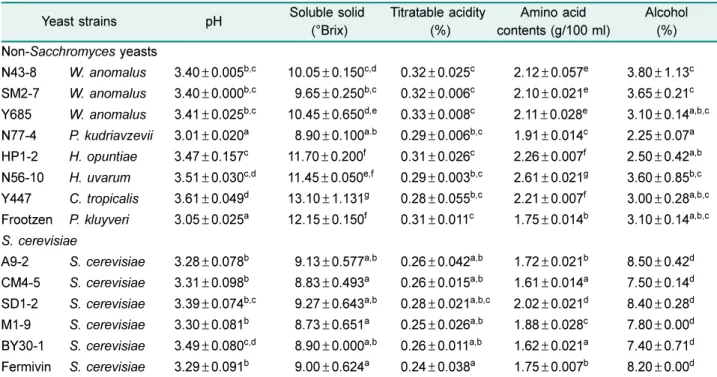
당화액에야생효모를 5일간발효한발효액의 pH, 고형분, 적정산도, 아미노산도및알코올함량을분석한결과는 Table 3과같다. Saccharomyces 속효모의 pH는 3.28−3.49로나타 났으며, A9-2 효모가가장낮았고 BY30-1가가장높게나타 났다. non-Saccharomyces 속효모의 pH는 3.01−3.61로나
타났으며, N77-4가가장낮았으며, Y447 효모가 pH 3.61로 가장높게나타났다.
Saccharomyces 속효모의고형분함량은 8.73−9.27 °Brix 로나타났으며, M1-9가가장낮았고 SD1-2가가장높았다. non-Saccharomyces 속 효모의고형분 함량은 8.90−13.10
°Brix로, N77-4가가장낮았고 Y447가가장높게나타났다. Saccharomyces 속효모의고형분함량은 non-Saccharomyces 속 효모보다낮은함량을나타내었고, 이는 Saccharomyces 속 효모가당을이용하여알코올발효가더진행된것으로보 인다.
Saccharomyces 속효모의적정산도는 0.25−0.28%로나타 났으며, M1-9가 가장 낮았고 SD1-2가 가장 높았다. non- Saccharomyces 속효모는 0.28−0.33%로나타났으며, Y447 가가장낮았고 Y685가가장높았다. Non-Saccharomyces 속효모의적정산도가 Saccharomyces 속효모보다높은경 향을보였다.
Saccharomyces 속효모의아미노산도는 1.61−2.02 g/100 ml로나타났으며, CD4-5가가장낮았고 SD1-2가가장높았 다. non-Saccharomyces 속 효모는 1.91−2.61 g/100 ml로 나타났으며, N77-4가가장낮았고 N56-10가가장높았다.
야생효모의알코올생성능력을비교하기위하여초기당 화액의당도를 16 °Brix로하여발효하였다. 5일발효후의 알코올함량은 A9-2가 8.5%로가장높았으나대조군을포 Table 2. Effect of alcohol and glucose tolerance about different wild yeasts and commercial yeasts.
Yeast strains
Alcohol tolerance (OD600)1 Glucose tolerance (OD600)2
0 5 10 15 1 20 30 40
Non-Sacchromyces yeasts
N43-8 0.92± 0.09d 0.78± 0.05g,h 0.01± 0.01a 0.00± 0.00 0.96 ± 0.05b,c,d,e 1.24± 0.03c 1.07± 0.04d,e 0.56± 0.00d SM2-7 0.89± 0.02d 0.79± 0.01g,h 0.01± 0.01a 0.00± 0.00 0.96 ± 0.02b,c,d,e 1.31± 0.01c,d 1.13± 0.01e 0.57± 0.02d Y685 0.76± 0.01c 0.85± 0.07h,i 0.01± 0.01a 0.00± 0.00 1.02 ± 0.08d,e,f 1.39± 0.02d,e 1.21± 0.02f 0.66± 0.04d,e N77-4 0.56± 0.09b 0.66± 0.05f 0.24± 0.01b 0.00± 0.00 1.04 ± 0.00e,f 1.25± 0.03c 1.01± 0.01d 0.34± 0.01b HP1-2 0.37± 0.00a 0.09± 0.01b 0.00± 0.00a 0.00± 0.00 0.87 ± 0.07a,b 1.04± 0.06a 0.43± 0.08a 0.01± 0.00a N56-10 0.39± 0.01a 0.01± 0.00a 0.00± 0.00a 0.00± 0.00 0.84 ± 0.04a 1.07± 0.02a 0.90± 0.00c 0.44± 0.01c Y447 0.83± 0.01c,d 0.92± 0.06i 0.00± 0.00a 0.00± 0.00 1.08 ± 0.03f 1.07± 0.05a 0.37± 0.07a 0.04± 0.05a Frootzen 0.91± 0.02d 0.72± 0.03f,g 0.01± 0.01a 0.00± 0.00 1.11 ± 0.00f 1.15± 0.01b 0.83± 0.00b,c 0.25± 0.01b S. cerevisiae
A9-2 0.90± 0.02d 0.78± 0.00g,h 0.50± 0.05c 0.00± 0.00 0.92 ± 0.03a,b,c 1.40± 0.00e 1.30± 0.05g,h 0.72± 0.02e,f CM4-5 0.79± 0.01c 0.82± 0.00h 0.57± 0.04c 0.00± 0.00 1.01 ± 0.01c,d,e,f 1.43± 0.02e 1.23± 0.04f,g 0.79± 0.01f,g SD1-2 0.78± 0.00c 0.48± 0.03d 0.50± 0.00c 0.00± 0.00 1.10 ± 0.07f 1.44± 0.08e 1.22± 0.01f,g 0.81± 0.08f,g M1-9 0.86± 0.05c,d 0.57± 0.00e 0.77± 0.00d 0.00± 0.00 1.06 ± 0.01e,f 1.59± 0.05f 1.34± 0.00h 0.89± 0.11g BY30-1 0.91± 0.03d 0.34± 0.01c 0.21± 0.09b 0.00± 0.00 0.93 ± 0.03a,b,c,d 1.39± 0.03d,e 0.79± 0.04b 0.31± 0.07b Fermivin 0.84± 0.02c,d 0.67± 0.06f 0.52± 0.04c 0.00± 0.00 0.92 ± 0.04a,b,c,d 1.42± 0.00e 1.27± 0.01f,g,h 0.76± 0.04e,f
1Yeast strains were cultured at 30oC for 5 days in YM broth containing 0%, 5%, 10% or 15% ethanol.
2Yeast strains were cultured at 30oC for 24 hours in YM broth containing 1%, 20%, 30% or 40% glucose.
Table 3. Chemical content of alcohol fermentation with different wild yeasts and commercial yeasts.
Yeast strains pH Soluble solid
(°Brix)
Titratable acidity (%)
Amino acid contents (g/100 ml)
Alcohol (%) Non-Sacchromyces yeasts
N43-8 W. anomalus 3.40± 0.005b,c 10.05± 0.150c,d 0.32± 0.025c 2.12± 0.057e 3.80± 1.13c SM2-7 W. anomalus 3.40± 0.000b,c 09.65± 0.250b,c 0.32± 0.006c 2.10± 0.021e 3.65± 0.21c Y685 W. anomalus 3.41± 0.025b,c 10.45± 0.650d,e 0.33± 0.008c 2.11± 0.028e 3.10± 0.14a,b,c N77-4 P. kudriavzevii 3.01± 0.020a 08.90± 0.100a.b 0.29± 0.006b,c 1.91± 0.014c 2.25± 0.07a HP1-2 H. opuntiae 3.47± 0.157c 11.70± 0.200f 0.31± 0.026c 2.26± 0.007f 2.50± 0.42a,b N56-10 H. uvarum 3.51± 0.030c,d 11.45± 0.050e,f 0.29± 0.003b,c 2.61± 0.021g 3.60± 0.85b,c Y447 C. tropicalis 3.61± 0.049d 13.10± 1.131g 0.28± 0.055b,c 2.21± 0.007f 3.00± 0.28a,b,c Frootzen P. kluyveri 3.05± 0.025a 12.15± 0.150f 0.31± 0.011c 1.75± 0.014b 3.10± 0.14a,b,c S. cerevisiae
A9-2 S. cerevisiae 3.28± 0.078b 09.13± 0.577a,b 0.26± 0.042a,b 1.72± 0.021b 8.50± 0.42d CM4-5 S. cerevisiae 3.31± 0.098b 08.83± 0.493a 0.26± 0.015a,b 1.61± 0.014a 7.50± 0.14d SD1-2 S. cerevisiae 3.39± 0.074b,c 09.27± 0.643a,b 0.28± 0.021a,b,c 2.02± 0.021d 8.40± 0.28d M1-9 S. cerevisiae 3.30± 0.081b 08.73± 0.651a 0.25± 0.026a,b 1.88± 0.028c 7.80± 0.00d BY30-1 S. cerevisiae 3.49± 0.080c,d 08.90± 0.000a,b 0.26± 0.011a,b 1.62± 0.021a 7.40± 0.71d Fermivin S. cerevisiae 3.29± 0.091b 09.00± 0.624a 0.24± 0.038a 1.75± 0.007b 8.20± 0.00d Data are means± standard deviations of two independent experiments. Values displaying different superscript letter (a,b,c,d,e,f,g) according to the Duncan test (0.05%).
Table 4. Concentrations of organic acid of alcohol fermentation with different wild yeasts and commercial yeasts.
(Unit: g/l) Yeast strains Oxalic acid Malic acid Lactic acid Acetic acid Citric acid Succinic acid Non-Sacchromyces yeasts
N43-8 W. anomalus 0.27± 0.001e,f,g 0.21± 0.033a,b 1.66± 0.031a 1.56± 0.032d 0.10± 0.036a,b 0.20± 0.048b,c SM2-7 W. anomalus 0.29± 0.008f,g 0.26± 0.025b 1.68± 0.033a 1.72± 0.220d 0.12± 0.042a,b 0.22± 0.068b,c Y685 W. anomalus 0.29± 0.001f,g 0.26± 0.090b 1.75± 0.154a,b 1.58± 0.180d 0.15± 0.002b 0.17± 0.067a,b,c N77-4 P. kudriavzevii 0.24± 0.018c,d,e,f 0.60± 0.197c 1.86± 0.162a,b 0.29± 0.018a,b 0.09± 0.048a,b 0.27± 0.071c HP1-2 H. opuntiae 0.28± 0.007f,g 0.29± 0.069b 1.94± 0.164a,b 0.41± 0.071b 0.08± 0.022a 0.18± 0.077b,c N56-10 H. uvarum 0.30± 0.003g 0.32± 0.110b 1.82± 0.079a,b 0.77± 0.275c 0.10± 0.025a,b 0.21± 0.140b,c Y447 C. tropicalis 0.23± 0.027c,d,e 0.24± 0.034a,b 1.94± 0.258a,b 0.30± 0.085a,b 0.08± 0.023a 0.22± 0.038b,c Frootzen P. kluyveri 0.29± 0.004f,g 0.61± 0.175c 1.96± 0.026a,b 0.49± 0.007b 0.10± 0.020a,b 0.14± 0.039a,b,c S. cerevisiae
A9-2 S. cerevisiae 0.16± 0.035a 0.26± 0.033b 1.95± 0.103a,b 0.31± 0.079a,b 0.06± 0.016a 0.10± 0.011a,b CM4-5 S. cerevisiae 0.18± 0.033a,b 0.25± 0.056a,b 1.92± 0.146a,b 0.36± 0.062a,b 0.08± 0.004a 0.12± 0.092a,b,c SD1-2 S. cerevisiae 0.21± 0.020b,c,d 0.28± 0.003b 1.91± 0.082a,b 0.49± 0.071b 0.08± 0.006a 0.22± 0.005b,c M1-9 S. cerevisiae 0.18± 0.030a,b 0.28± 0.047b 1.89± 0.145a,b 0.43± 0.099b 0.06± 0.004a 0.13± 0.060a,b,c BY30-1 S. cerevisiae 0.22± 0.000b,c,d 0.21± 0.019a,b 2.06± 0.298b 0.35± 0.026a,b 0.08± 0.029a 0.13± 0.060a,b Fermivin S. cerevisiae 0.19± 0.020a,b,c 0.19± 0.052a,b 2.00± 0.033a,b 0.25± 0.152a,b 0.08± 0.020a 0.16± 0.017b,c Medium 0.31± 0.040g 0.05± 0.039a 1.89± 0.132a,b 0.09± 0.041a 0.09± 0.021a nda Data are means± standard deviations of two independent experiments. Values displaying different superscript letter (a,b,c,d,e,f,g) according to the Duncan test (0.05%).
nd : Not detected.
함한 S. cerevisiae 6종류는 7.4−8.5%로유의적인차이는없 었다. 대조군을포함한 non-Saccharomyces 속 8종류는최소 2.25%에서 최대 3.8%까지 알코올생성 능력을 보였으며, N43-8, SM2-7이 non-Saccharomyces 속에서가장높은 알 코올함량을나타내었다. 최근, Kim 등[11]이보고한알코올 함량은유사하거나높은편으로나타났다.
야생 효모에 따른 알코올 발효액의 유기산 분석
당화액에효모를 5일간발효한다음유기산함량을분석 한결과는 Table 4와같다. 유기산중사과산(malic acid) 함 량은 Saccharomyces 속효모의경우, 0.21−0.28 g/l로나타 났으며, BY30-1가가장낮았으며 SD1-2과 M1-9가가장높 은함량을나타내었다. non-Saccharomyces 속효모의사과 산함량은 0.21−0.60 g/l로나타났으며, N77-4은 N43-8보다 약 3배가량높았다. P. kudriavzevii N77-4 효모로발효한
당화액의사과산함량이높았으며이는시판효모(Frootzen)
와유사한결과를나타내었다. Kim 등[12]의연구에서도 S.
cerevisiae 보다 P. anomala가생성한사과산이더높았으며, 본 연구의 결과와 유사하였다. 초산(acetic acid) 함량은 Saccharomyces 속효모의경우 0.31−0.49 g/l로나타났으며, A9-2가가장함량이낮았으며 SD1-2가가장높은함량을나 타내었다. Non-Saccharomyces 속효모의초산함량은 0.29− 1.72 g/l로나타났으며, P. kudriavzevii N77-4가가장낮았 으며, W. anomalus SM2-7가가장높았다. 주류제조중품 질에 나쁜 영향을 미치는 초산 함량은 전반적으로 non- Saccharomyces 속효모에서함량이높은것으로보아이들 야생효모는 Saccharomyces 속효모보다초산을더생산하는 것으로추측된다. 하지만 N77-4의초산함량은 Saccharomyces
속 효모와 유사하거나 낮은 결과를 나타내었다. 호박산 (succinic acid) 함량은 Saccharomyces 속효모의경우 0.10− 0.22 g/l로나타났으며, A9-2가가장낮았고 SD1-2가가장높 게나타났다. Non-Saccharomyces 속효모는 0.17−0.27 g/l 로 나타났으며, W. anomalus Y685가 가장 낮았으며, P.
kudriavzevii N77-4가가장높았다. 야생효모에따른유기 산분석결과사과산, 초산, 호박산등이초기당화액에비 해증가하였으며, 그중 P. kudriavzevii N77-4는낮은초산 함량과사과산, 호박산의높은함량을보여유기산에의한 관능적특성이뛰어난것을알수있었다.
야생 효모에 따른 알코올 발효액의 전자코 분석
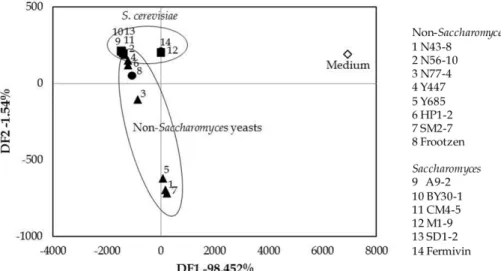
당화액에효모를접종하여 5일간발효한다음, 각효모의 향기패턴을조사하기위해, 전자코를사용하여시료간의판 별함수분석결과를 Fig. 1에나타내었다. Fig. 1에서와같이 당화액과효모에의한알코올발효액을대상으로분석한결 과, 당화액이오른쪽에위치하였고효모 12균주의발효액시 료가 DF1 값의왼쪽에위치하는것으로보아 DF1 값이오 른쪽방향에서왼쪽으로이동할수록휘발성분이감지되는 것으로분석되었다. 그결과, 가로축에해당하는 DF1의 F 값 이 98.45%, 세로축에해당하는 DF2의값이 1.54%로시료간 의차별성이 x축과 y축이 60:1의비율로영향을받아구분 되었다. 당화액시료는 DF1의오른쪽범주에속했으며, 효 모에의한알코올발효액은 DF1의왼쪽범주에속하여발 효에따른뚜렷한차이를보였다. 또한 S. cerevisiae와비교 하였을때 non-Saccharomyces 속의일부효모는 DF2의아 래쪽범주에속하여효모발효에의한향기패턴의차이가 나타났다. Cordero-Bueso 등[4]이보고한포도주발효를위
Fig. 1. Discriminant function analysis (DFA) of the obtained data from electronic nose date for the flavor patterns of alcohol fermentation with different wild yeasts and commercial yeasts. ◇; Medium, ▲; Non-Saccharomyces yeasts, ■; S.
cerevisiae.
한 non-Saccharomyces 연구에의하면효모의종에따라생 산하는주요향기성분의차이를주성분분석(PCA, principal component analysis)으로나타내었으며, S. cerevisiase, P.
kudiavzevii, W. anomalus, C. stellate 등이서로다른군집 을형성하는것으로보고되어본연구의결과와유사하였다. 효모종마다생산하는주요향기성분과기질에따른변화 등추가적인연구가필요한것으로사료된다.
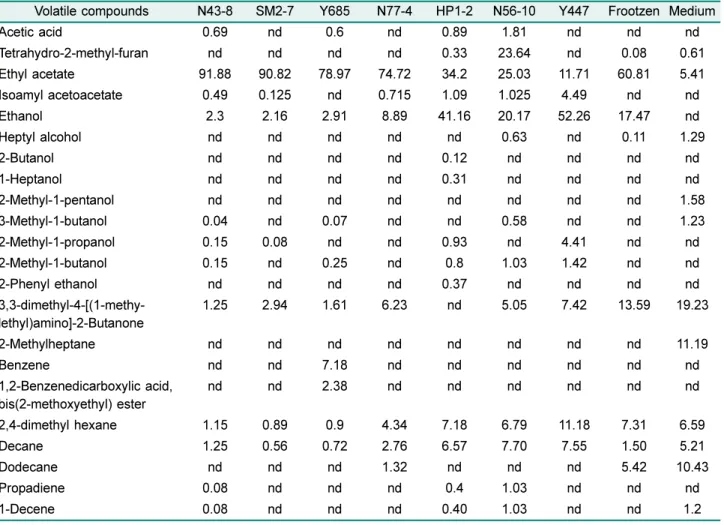
야생 효모에 따른 알코올 발효액의 휘발성 향기성분 당화액에효모종류를달리하여 5일간발효한알코올발 효액의휘발성향기성분을 GC-MS로분석한결과를 Table 5, 6에나타내었다. Non-Saccharomyces 속효모의주요휘 발성 향기성분은 ethyl acetate (11.71−91.88%)와 ethanol (2.16−52.26%)로나타났다. 반면 S. cerevisiase 효모의주요 휘발성향기성분은 ethanol (37.67−62.89%)과 ethyl acetate (1.32−11.97%)로분석되었다. 알코올류에대해시험구별로
살펴보면 S. cerevisiase와 non-Saccharomyces 속효모로크 게구별되었는데, S. cerevisiase는 ethanol 외에도 3-methyl-a- butanol, 2-methyl-1-propanol, 2-methyl-1-butanol 등다양 한종류의알코올들이검출되었다. 반면 non-Saccharomyces 속효모는에탄올및알코올류등의휘발성향기성분들이낮 은비율을나타내었다. 국내생산되는대부분의막걸리향기 성분은원료, 누룩, 주모및담금후술덧에생육하는각종 미생물의발효작용에의해생성되며, 고급알코올류에속하 는향기성분들은 isoamyl alcohol과 2-methyl-1-propanol로 보고되었다[16]. 본연구에서 2-methyl-1-propanol은모든 S.
cerevisiase 시험구에서 검출되었으며(0.68−3.12%), non- Saccharomyces 속효모는 C. tropicalis Y447에서 4.41%로 가장높게나타났다.
Non-Saccharomyces 속알코올발효액의주요휘발성향 기성분은 ethyl acetate로 나타났다. W. anomalus 효모 (N43-8, SM 2-7, Y685)의 ethyl acetate의휘발성향기성분
Table 5. Volatile compound content of alcohol fermentation with different non-Saccharomyces yeasts and commercial yeast.
(Unit : peak area %) Volatile compounds N43-8 SM2-7 Y685 N77-4 HP1-2 N56-10 Y447 Frootzen Medium
Acetic acid 0.69 nd 0.6 nd 0.89 1.81 nd nd nd
Tetrahydro-2-methyl-furan nd nd nd nd 0.33 23.64 nd 0.08 0.61
Ethyl acetate 91.88 90.82 78.97 74.72 34.2 25.03 11.71 60.81 5.41
Isoamyl acetoacetate 0.49 0.125 nd 0.715 1.09 1.025 4.49 nd nd
Ethanol 2.3 2.16 2.91 8.89 41.16 20.17 52.26 17.47 nd
Heptyl alcohol nd nd nd nd nd 0.63 nd 0.11 1.29
2-Butanol nd nd nd nd 0.12 nd nd nd nd
1-Heptanol nd nd nd nd 0.31 nd nd nd nd
2-Methyl-1-pentanol nd nd nd nd nd nd nd nd 1.58
3-Methyl-1-butanol 0.04 nd 0.07 nd nd 0.58 nd nd 1.23
2-Methyl-1-propanol 0.15 0.08 nd nd 0.93 nd 4.41 nd nd
2-Methyl-1-butanol 0.15 nd 0.25 nd 0.8 1.03 1.42 nd nd
2-Phenyl ethanol nd nd nd nd 0.37 nd nd nd nd
3,3-dimethyl-4-[(1-methy- lethyl)amino]-2-Butanone
1.25 2.94 1.61 6.23 nd 5.05 7.42 13.59 19.23
2-Methylheptane nd nd nd nd nd nd nd nd 11.19
Benzene nd nd 7.18 nd nd nd nd nd nd
1,2-Benzenedicarboxylic acid, bis(2-methoxyethyl) ester
nd nd 2.38 nd nd nd nd nd nd
2,4-dimethyl hexane 1.15 0.89 0.9 4.34 7.18 6.79 11.18 7.31 6.59
Decane 1.25 0.56 0.72 2.76 6.57 7.70 7.55 1.50 5.21
Dodecane nd nd nd 1.32 nd nd nd 5.42 10.43
Propadiene 0.08 nd nd nd 0.4 1.03 nd nd nd
1-Decene 0.08 nd nd nd 0.40 1.03 nd nd 1.2
nd : Not detected.
이 높게 나타났으며, 그 중 W. anomalus N43-8 효모가 91.88%로써시판효모인 Frotzen과 Fermivin보다 1.5배에 서 17배이상높게나타났다. 그리고 P. kudriavzevii N77- 4 효모도 74.72%로높게나타났다. 특히, ethyl acetate 화합 물은시럽의향료로사용되며배향, 바나나향, 사과향등의
향을내는에스테르중의하나로알려져있다[21]. 휘발성향
기성분인 ethyl acetate는우리나라전통주, 맥주뿐만아니 라일본증류식소주의대표적인에스테르성분이지만농도 가높으면오히려쓴맛의원인물질로알려져있고[7], 방향 성향기성분으로서알코올류보다향미기여도가높다고보 고되었다[16]. Acetic acid는주류의발효과정중세균과효 모의발효작용으로생성되는산화생성물로서자극취를나 타내는산미성분이며[15], non-Saccharomyces 속효모중 H. uvarum N56-10, H. opuntiae HP1-2, W. anomalus N43-8, Y685에서소량(1.81%, 0.89%, 0.69%, 0.6%) 생성되었다. S.
cerevisiae A9-2와 SD1-2의초산은각각 0.39%, 0.43%로나 타나 non-Saccharomyces 속효모에비해초산함량이낮거
나거의생성되지않았다.
본연구의결과는 Lee 등[18]의누룩종류를달리한탁주 술덧과효모종류를달리한탁주술덧[16]보다향기성분의 종류는적었지만검출된휘발성향기성분중 ethanol, ethyl acetate, 2-methyl-1-propanol, acetic acid 등 5종은 Lee 등 [16, 18]의결과와공통된향기성분을가지고있었다. 그러 나 tetrahydro-2-methyl-furan, isoamyl acetoacetate, decane, dodecane 등 17종은본연구에서만검출된것으로보아효 모종류에따라면적비율이나주성분등에차이가있는것 을알수있었다.
요 약
발효식품에서분리한야생효모 12 균주의주류제조가 능성을조사하기위해, 알코올발효에관여하는특성을분석 하였다. 알코올및당내성을조사한후, 당화액을제조하여 pH, 고형분함량, 적정산도, 아미노산도, 알코올, 유기산및 Table 6. Volatile compound content of alcohol fermentation with different wild-type S. cereviaise yeasts and commercial yeast.
(Unit : peak area %)
Volatile compounds A9-2 CM4-5 SD1-2 M1-9 BY30-1 Fermivin Medium
Acetic acid 0.39 nd 0.43 nd nd nd nd
Tetrahydro-2-methyl-furan 0.24 nd 0.14 nd 0.2 nd 0.61
Ethyl acetate 4.01 8.29 2.49 3.44 5.02 5.35 5.41
Isoamyl acetoacetate 4.00 9.15 1.32 3.80 5.46 11.97 nd
Ethanol 62.89 41.71 51.96 37.67 40.19 37.12 nd
Heptyl alcohol 0.54 nd 0.18 nd 0.47 nd 1.29
2-Butanol nd nd nd nd nd nd nd
1-Heptanol 0.10 nd nd nd nd nd nd
2-Methyl-1-pentanol 0.57 nd nd nd nd nd 1.58
3-Methyl-1-butanol 0.52 0.43 0.17 0.37 nd 0.24 1.23
2-Methyl-1-propanol 2.27 3.12 0.68 2.31 1.22 2.58 nd
2-Methyl-1-butanol 2.12 3.24 0.63 2.57 0.79 3.04 nd
3,3-dimethyl-4-[(1-methy- lethyl)amino]-2-Butanone
nd nd nd nd nd nd nd
2-Methylheptane 7.71 9.16 nd 12.76 13.36 6.39 19.23
Benzene nd nd nd nd nd nd nd
1,2-Benzenedicarboxylic acid, bis(2-methoxyethyl) ester
nd nd nd nd nd nd nd
2,4-dimethyl hexane 3.74 nd nd 3.68 15.69 8.68 11.19
Decane 6.45 11.06 9.26 12.34 13.19 9.32 6.59
Dodecane 1.88 10.77 0.94 11.19 11.84 10.24 5.21
Propadiene nd nd 47.84 3.11 nd nd 10.43
1-Decene 0.48 nd 0.2 0.4 nd 0.53 nd
nd : Not detected.