| Abstract |
1)PURPOSE: This study was implemented to measure the muscle activity of muscles surrounding shoulder during push-up exercise according to the slope angle.
METHODS: This study has research subject consisting of 25 normal male adults without neurologic or musculoskeletal injury in shoulder part. EMG was used as a tool for measuring muscle activity and four muscles including upper trapezius (UT), middle trapezius (MT), Lower Trapezius (LT), and Serratus Anterior (SA) were chosen for measuring the muscle activity of muscles surrounding shoulder. Tilting table slope was set at 0°, 30°, 45°, and 60° and push-up motion was performed three time for each case to use the average value.
The measured value was used after generalization process to create %RVC value where the measured value was standardized by using 0° as a standard.
RESULTS: There was a difference of muscle activity according to the tilting table slope during push-up exercise.
In UT, MT, and SA, there was no significant 0° and 30°, 45°
and 60°. But there was significant 30° and 45°. LT was
†Corresponding Author : [email protected]
This is an Open Access article distributed under the terms of the Creative Commons Attribution Non-Commercial License (http://creativecommons.org/licenses/by-nc/3.0) which permits unrestricted non-commercial use, distribution, and reproduction in any medium, provided the original work is properly cited.
significant difference between 45° and 60° (p<.05).
CONCLUSION: There are cases where push-up exercise should be selectively implemented due to shoulder problems.
According to this results between 0° and 30°, push up will be able to more effectively exercise. Applying proper angle of tilting table for push-up to patients who have difficulties in performing motions along with physical consumption can deliver effective and easy exercise program.
Key Words: Shoulder, EMG, Tilt Angle
Ⅰ. Introduction
Working posture that requires sitting for long time induces repeated use of upper body and a posture where neck protrudes, which causes symptoms that induce neck and shoulder pain such as turtle neck syndrome. These symptoms are caused by imbalance of muscles surrounding neck and shoulder and they result in large inconvenience in daily life (Carter et al., 2001). Modernized lifestyle causes a number of problems. Lack of exercise, generalization of sedentary lifestyle, and increased use of computer and mobile phones induce habits of incorrect posture. This kind of habit consequently causes increase of pain in neck and shoulder part (Mok et al., 2004). To
Research Article Open Access
Activity of Muscles Surrounding Shoulder Joint during Push-Up Exercise according to the Change of Tilting Table Angle
Yong-Ho Cho, PT, PhD⋅Jin-Ho Choi, PT, PhD
†Department of Physical Therapy, Daegu Haany University Received: July 4, 2016 / Revised: July 16, 2016 / Accepted: August 5, 2016
ⓒ 2016 J Korean Soc Phys Med
induce normal daily life by reducing the neck and shoulder pain, alignment and balance in neck and shoulder are important. Balanced development and proper coordination of muscles and tendons in shoulder complex are required for this (Carr and Shepherd, 2010). Shoulder has very wide range of movement and it is a joint that has the most complicated structure in body. The stability of joint itself is very weak and hence a lot of tendons and muscles play an important role in stability. Serratus anterior plays an important role in the stability of shoulder blade and it is important for overall shoulder stability (Watson and Schenkman, 1995). Stabilization of shoulder blade is critical in case of motor defects in shoulder joint and shoulder blade, impingement syndrome, and post-surgical management, for which muscles surrounding shoulder joint and shoulder blade are very important (Hintermeister et al., 1998).
Flexion of shoulder requires an exercise that accompanies internal and external rotation. However, for maximum flexion of shoulder joint, internal rotation of humerus should be followed, instead of external rotation.
This is because internal rotation of humerus according to the action of tension takes place when bending upper arm over horizontal line as tension in tendon around shoulder joint acts (Mackinnon and Winter, 1993). When bending upper arm in external rotation condition on sagittal plane, complete flexion is possible when internal rotation of 45°
on horizontal plane takes place (McGill, 1991). This series of action are implemented by the interaction of tension that acts in shoulder joint tendon, structure of upper arm joint, and inactive tension of muscles in upper arm joint.
However, these are results from the movement of rotation of humerus in shoulder movement. There are scarce data regarding specific measured values that indicate the difference of such movement (Richardson and Jull, 1995).
As such, advancement of society, sedentary lifestyle, and increased time of using computer have caused increase of shoulder diseases. There are a number of methods that
treat the shoulder problems. There are diverse methods that manage shoulder disease, from expensive therapeutic exercise to easily implementable stretching (Jung et al., 2007). Among shoulder exercises that increase shoulder muscle strength, push-up is a representative exercise that people can easily perform at home without any special tool. Push-up is a method that can easily increase shoulder muscle strength without any tool. It is evaluated as a good exercise method for recovery after shoulder injury (Panjabi, 2003). Push up is good relative balance exercise between SA and UT (Ludewing et al., 2004). Problems of stress and posture resulting from work among office workers induce high frequency of musculoskeletal disease occurrence that accompanies pain in neck and shoulder.
This trend is getting stronger following increasing amount of computer works and increasing number of office workers who work in this field. Hence, treatment and management of neck and shoulder disease is very important (Hall et al., 2004). This study measures muscle activity of muscles surrounding shoulder during push-up according to the slope angle. Specifically, this study measures muscle activity of upper trapezius (UT), middle trapezius (MT), lower trapezius (LT), and serratus anterior (SA) for the purpose of providing the most appropriate method during push-up exercise. The study is aimed to provide effective and efficient push-up exercise scheme through selective application of muscle strengthening method in case of weakened shoulder-surrounding muscles or rehabilitation program for shoulder.
Ⅱ. Method
1. Subjects
This study has subject consisting of 25 normal male adults in their twenties without shoulder injury or pain.
Among those without disease or injury in shoulder part,
pain during daily activity, congenital deformity or disease,
surgical damage or neurologic damage and disease were selected. All the subjects voluntarily agreed on participating in the experiment after listening to the explanation of the research purpose and method.
2. Study tool and method
1) Experiment tool
Surface electromyogram MP150 (Biopac system, USA) was used for the measurement of muscular contraction initiation time of shoulder muscles. Distance between active and inactive electrode was set at 20mm and TSD150B (composed of two stainless steels) was used for EMG signal measurement. Surface electromyogram signal was first stored in personal computer using software program Acqknowledge 3.8.2 (Biopac system, USA) and then analyzed. Data were collected where sampling rate was set at 1000Hz to obtain EMG signal. Frequency acquisition domain was set at 30∼500Hz to obtain signal within normal range and 60Hz notch filter was used for noise removal.
2) Study method
Four muscles including UT, MT, LT, and SA were measured for EMG signal in upper body muscles surrounding shoulder. Muscle belly of each muscle that is most prominently contracted in maximal muscular contraction in MMT posture was chosen for the site for attaching the active electrode. For accurate acquisition of EMG signal, skin resistance was reduced by first rubbing the skin of attaching site with thin sandpaper for three to four times to remove contaminants in strata cornea and cleansing with disinfecting alcohol. Moreover, for clear acquisition of the signal, skin tape was used for attaching the electrode to the skin. The reason of using skin tape was to remove mechanical noise caused by movement of research subject during the experiment and skin tape was used for fixating the electrode. Ground electrode was
attached to C7 spinous process, which is a part that is not related to signal acquisition. As for the body slope for push-up, tilting table was used to first make the table horizontal with the ground with an angle 0°. The slope was raised to make the angle 30°, 45°, and 60° for the measurement. Break time of each trial was 1 minute.
Push-up was performed three times in each slope and the average value was used for the measurement signal.
3) Treatment of muscle activity data
As for the data treatment method for the muscle activity data using EMG, test results from different subjects were compared through generalization process. In general, % Maximal Voluntary Contraction (% MVC), % Maximal Vonluntary Isometric Contraction (% MVIC), and % Reference Voluntary Contraction (% RVC) are frequently used for standardization method. This study used %RVC method. In the measurement according to the slope angle, push-up exercise on the ground (0°), which is most generally performed, can be used as a baseline for other slopes of tilting table. In case of 30°, 45°, and 60°, the measured value was converted to %RVC muscle activity measurement by using the measured value at push-up exercise on 0° as a standard.
3. Analysis method
Measured data were analyzed by using SPSS and repeated measurement of ANOVA was used to compare the muscle activity according to the slope angle. A statistical significance level was set at .05.
Ⅲ. Results
The study group’s mean age, height, and weight were
shown to be 23.3±1.4 years, 172.4±3.9cm, and 71.1±8.1kg
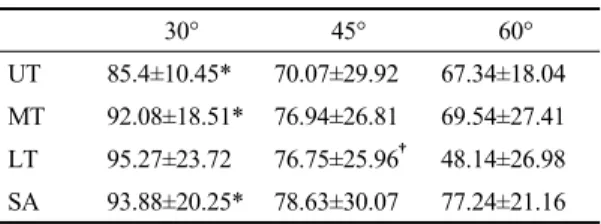
respectively. All muscle activities decrease according to
tilt angle increasing. In UT, MT, and SA, there was
significant difference between 30° and 45° (p<.05), but there was no significant difference between 0° and 30°, 45° and 60 (p>.05). And LT was significant difference between 45° and 60° (p<.05), but there was no significant difference between 0° and 30°, 30° and 45° (p>.05) (Table 1).
30° 45° 60°
UT 85.4±10.45* 70.07±29.92 67.34±18.04 MT 92.08±18.51* 76.94±26.81 69.54±27.41 LT 95.27±23.72 76.75±25.96
†48.14±26.98 SA 93.88±20.25* 78.63±30.07 77.24±21.16 UP : upper trazezius, MT : middle trapezius, LT : lower trapezius, SA : serratus anterior
* significant difference between 30° and 45°
†