RESEARCH ARTICLE
Received: April 8, 2019, Revised: April 25, 2019, Accepted: April 29, 2019 eISSN 2233-7679
†Correspondence to: Young Sun Hwang, https://orcid.org/0000-0001-7012-3434
Department of Dental Hygiene, College of Health Science, Eulji University, 553 Sanseong-daero, Sujeong-gu, Seongnam 13135, Korea Tel: +82-31-740-7493, Fax: +82-31-740-7352, E-mail: [email protected]
Copyright © The Korean Society of Dental Hygiene Science.
Effect of Oral Spray on Dental Plaque Bacteria and Oral Epithelial Cells
Myoung-Hee Kim, Min Kyeng Lee, and Young Sun Hwang
†Department of Dental Hygiene, College of Health Science, Eulji University, Seongnam 13135, Korea
Background: Good oral health is important for systemic body health and quality of life. Spray oral cleansers are increasingly preferred because of
their convenience of carrying and the ease of oral hygiene management. In addition, many kinds of oral cleanser products containing various ingredients with antibacterial, washing, and moisturizing effects are being manufactured. However, concerns about the safety and side effects of oral sprays are increasing, and there is very little information regarding the use and care of oral sprays is available to consumers. This study aimed to investigate the effects of oral spray on oral bacteria and tissue to elucidate the factors that need to be considered when using oral sprays.
Methods: The effects of oral spray on the growth of dental plaque bacteria was assessed using disk diffusion assays. Cytotoxicity and morphological
changes in oral epithelial cells were observed by microscopy. The effects of oral spray on dental plaque growth were also confirmed on specimens from permanent incisors of bovines by Coomassie staining.
Results:
The pH of spray products, such as Perioe Dental Cooling, Cool Sense, and Dentrix, were 3.65, 3.61, and 6.15, respectively. All tested spray products showed strong toxicity to dental plaque bacteria and oral epithelial cells. Compared with those on the control, dental plaque bacteria deposits on the enamel surface increased following the use of oral spray.
Conclusion:
Three types of oral spray, namely Perioe Dental Cooling, Cool Sense, and Dentrix, strongly inhibited the growth of dental plaque bacteria and oral epithelial cells. The oral spray ingredient enhanced dental plaque growth on the enamel surface. Users should be informed of precautions when using oral sprays and the need for oral hygiene after its use.
Key Words: Bacteria, Cytotoxicity, Oral hygiene, Oral sprays, Plague
Introduction
Improvement in living standards has increased interest in overall systemic and oral health. From 2017, health insurance benefits have been expanded; the reduced medical expenses will reduce the burden to patients, which are expected to be more active in health activities to prevent disease along with increased examination and treatment of diseases
1). The demand for oral health and etiquette products such as functional toothpaste, mouthwash, toothbrush, tongue cleaner, and dental floss is growing
2). In 2015, the global oral care market was worth about 45 trillion won and had grown at 5% a year over the past five years. According to the Korea Trade-Investment Promotion
Agency (KOTRA), adult diapers and oral-related items were ranked among the predicted growth items in Japan in 2017
3). The market size growth of the nursing sponge brush to prevent aspiration pneumonia was particularly evident. Among products for oral health and hygiene, the growing interest in oral cleaning is increasing the demand for products with various purposes, including deodorization, oral cleaning, removal of biofilm, and oral moisturizing
2). In the case of spray-type oral cleansers, a variety of products are being released due to their convenience.
However, there is a lack of awareness of problems such as
oral dryness due to alcohol, oral diseases, and dental
discoloration due to chloride compounds such as
cetylpyridinium chloride (CPC). In addition, contamination
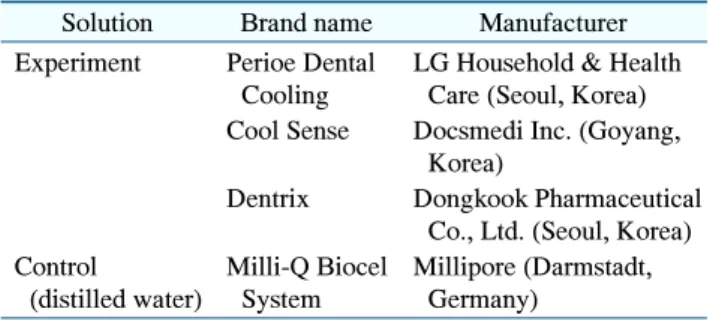
Table 1. Test Solutions
Solution Brand name Manufacturer
Experiment Perioe Dental Cooling
LG Household & Health Care (Seoul, Korea) Cool Sense Docsmedi Inc. (Goyang,
Korea)
Dentrix Dongkook Pharmaceutical Co., Ltd. (Seoul, Korea) Control
(distilled water)
Milli-Q Biocel System
Millipore (Darmstadt, Germany)
of Toothette Oral Care Moisturizer (Advance Oral Moisturizer) was reported in October 2017. Therefore, the sales of products at online shopping malls and purchasing agency sites were suspended to prevent safety accidents
4). Although there are differences in their compositions according to brand, they are widely classified as alcohol- containing and non-alcoholic products as well as products containing propolis, xylitol, menthol, green tea extracts, and licorice extracts for the purpose of deodorization and cleaning. While the range of consumer choices has been expanded with the release of products containing a variety of functional ingredients, the manufacturers have provided use guidelines such as the application ‘several times or three times a day directly into the mouth when necessary and you do not need to wash with water after use.’ Studies are required on the safety of oral sprays and precautions in their use and the information should be provided to consumers. This study observed the effects of oral sprays on the growth of dental plaque bacteria and oral epithelial cells. In addition, the effects of oral sprays on dental plaque growth were also verified to determine the appropriate precautions for the use of these products.
Materials and Methods
1. Materials
A bovine permanent incisor with a healthy enamel surface was removed and stored in saline until use. Three kinds of oral sprays with high purchasing rates (Perioe Dental Cooling, Cool Sense, and Dentrix) were used for the experiments (Table 1). Distilled water was used as a control.
2. Dental plaque bacteria culture and disc diffusion assay
Dental plaques from scaling were placed in sterilized Brain Heart Infusion (BHI) broth (Becton, Dickinson and Co., Baltimore, MD, USA) and cultivated in a 37
oC shaking incubator
5). Dental plaque bacteria were then cultured in a BHI-agar broth (Becton, Dickinson and Co.) at around OD
650=1.5. Oral spray solutions, ampicillin (10
g/disc), and distilled water (10 l each) were added to sterilized Whatman filter discs (Whatman, Maidstone, UK; 8 mm in diameter). After incubating for 16 hours, the clear zone around each filter disc was measured.
3. Oral epithelial cell culture and microscopic analysis Oral epithelial cells were cultured in DMEM/F12 (3:1 ratio; Thermo Fisher Scientific Inc., Waltham, MA, USA) media at 37
oC in a CO
2incubator
6). Oral spray solutions were diluted with the same media for all experiments. The cellular morphology was observed by phase contrast microscopy (CKX41-A32PHP; Olympus, Tokyo, Japan).
4. The pH analysis
The pH of the oral sprays was measured repeatedly using a pH meter (Thermo Scientific Orion 2-Star Plus;
Thermo Fisher Scientific Inc.) to calculate the mean value.
5. Analysis of dental plaque formation
Residual tissue and plaque were removed from the permanent incisor, and specimens measuring 5×5 mm were prepared using a cutting disc
7). The specimens were randomly divided into four groups (n=10 in each group).
The oral spray solutions were sprayed onto the enamel surface of each specimen and then put it into a broth with dental plaque bacteria. After a 12 hours shaking incubation, the specimens were washed three times with a phosphoric acid buffer (pH 7.3) and stained with a Coomassie brilliant blue solution for 10 minutes. Images were obtained (COOLPIX A900; Nikon, Tokyo, Japan) and analyzed using ImageJ (National Institutes of Health, Bethesda, MD, USA).
6. Statistical analysis
The statistical analysis was performed using InStat
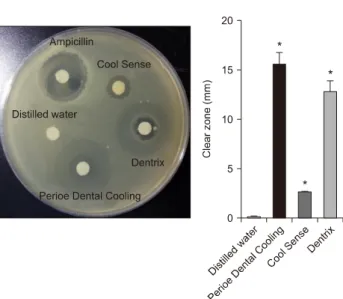
TMFig. 1. Effect of oral sprays on the growth of dental plaque bacteria. Inhibitory effect of oral sprays (10 l of stock sol- ution/disc) on the growth of dental plaque bacteria. Perioe Dental Cooling, Cool Sense, and Dentrix were used as commercial oral spray. Ampicillin (10 g/disc) was used positive control for assay.
Distilled water was used for the control. Relative area of the growth inhibition (clear zone) of dental plaque bacteria was cal- culated with ImageJ (National Institutes of Health). Each values of individual experiments were expressed as a mean±standard error of three independent experiments. *p<0.01 versus distilled water. Refer to Table 1 for the manufacturers’ information.
Fig. 2. Effect of oral sprays on morphology of gingival epithelial cells. The oral spray solution (1/10 dilution in complete media) were treated in gingival epithelial cells for indicated time point (10 minutes and 30 minutes). The oral spray Perioe Dental Cooling, Cool Sense, and Dentrix were tested. Pictures were tak- en using a phase-contrast microscope at 200× magnifications.
Distilled water was used for the control. Refer to Table 1 for the manufacturers’ information.
statistical software (GraphPad Software Inc., San Diego, CA, USA). The statistical significance of the differences between groups was analyzed via repeated measures of one-way analysis of variance and Tukey’s post-hoc analysis. p-values<0.05 were considered significant.
Results
1. Effect of oral sprays on dental plaque bacteria To observe the effect of oral sprays on dental plaque bacteria, bacterial growth was observed by disc diffusion analysis. Ampicillin was used as a positive control. The same volumes of undiluted oral spray solutions were applied. Compared to the distilled water control, Perioe Dental Cooling, Cool Sense, and Dentrix all inhibited dental bacterial growth (Fig. 1). The diameters of the clear zones were 16.8±0.59 mm for Perioe Dental Cooling, 2.7±0.13 mm for Cool Sense, and 12.5±0.33 mm for Dentrix (p<0.01).
2. Effect of oral spray on gingival epithelial cells To observe the effect of oral sprays on gingival epithelial cells, cells were cultured in a medium containing the oral spray solution. Cytotoxicity was observed in mediums containing two- and five-fold diluted oral spray solutions. In the medium containing 10-fold diluted oral spray solutions, morphological changes and loss of cell attachment were observed compared to those in the control (Fig. 2). The cytotoxicity was particularly stronger for Perioe Dental Cooling. The morphological changes were observed about 10 minutes after oral spray addition and the number of floating cells also increased due to decreased cell adhesion.
3. The pH of the oral sprays
The pH of three oral sprays used in this experiment was measured after opening. The pH of Perioe Dental Cooling, Cool Sense, and Dentrix were 3.65, 3.61, and 6.15, respectively. No significant pH changes were observed in measurements performed 1 hour and 24 hours after opening.
4. Effect of oral spray on dental plaque growth
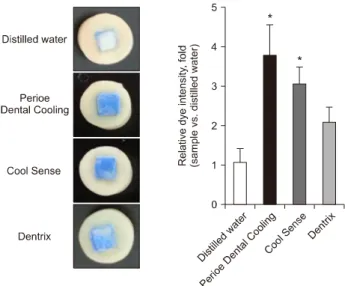
To test the effect of oral sprays on dental plaque growth,
oral spray solutions were sprayed on the enamel surface
five times and then dipped into a broth of dental plaque
bacteria. After 12 hours shaking incubation, the specimens
Fig. 3. Effect of oral sprays on adhesion of dental plaque bac- teria to enamel surface. The bovine enamel specimens were ap- plied with oral spray solution and were cultured in Brain Heart Infusion broth (Becton, Dickinson and Co.) with dental plaque bacteria. The bacteria adhere to specimens were stained with Coomassie brilliant blue G-250 dye. For density quantification, pictures were acquired and captured into ImageJ (National Institutes of Health) and were calculated in pixel intensities. Each values of individual experiments were expressed as a mean±
standard error of three independent experiments. *p<0.01 ver- sus distilled water. Refer to Table 1 for the manufacturers’
information.