• 검색 결과가 없습니다.

Patients’ Perception, Satisfaction and Expectations Towards the Role of Clinical Pharmacists in General Hospitals in China

N/A
N/A
Protected

Academic year: 2021

Share "Patients’ Perception, Satisfaction and Expectations Towards the Role of Clinical Pharmacists in General Hospitals in China"

Copied!
10
0
0

로드 중.... (전체 텍스트 보기)

전체 글

(1)

Abstract : Purpose : Many developed countries have already accepted the indispensable role of clinical pharmacist (CP) in health care system. In past few years, Ministry of Health in China has also worked efficiently to regularize and implement clinical pharmacy services (CPSs). In our study, we opted to access the perception, satisfaction and expectation of patients towards the services provided by CP in hospitals in China.

Method : The study was conducted in 10 general hospitals located in 8 different cities in China.

Questionnaire was composed of four main parts: 1) Demographics of patients, 2) General awareness about CP, 3) Response regarding CP’ s professional capabilities, 4) Satisfaction and expectations regarding different CPSs. The chi-test was performed to examine the statistical significance of asso- ciation between independent variables and dependent variables.

Results : Out of 350 distributed questionnaires, 289 were retrieved giving a response rate of 82%.

Most of the respondents know about clinical pharmacist and 39.79% had experienced CPSs before.

75% believed that clinical pharmacist is a drug expert, whereas mostly all agreed that CP is an important member of health care team and should be encouraged to participate in patient therapy.

More than 75% of respondents perceive that CP can improve quality and safety of treatment. Among those who had previously experienced CPSs, more than 75% showed satisfaction with CP providing individualized patient care, participating in ward rounds, taking medication history, providing drug information and counseling. And approximately 80% of the remaining, who never experienced, expects CP to execute these tasks except for performing physical examination.

Conclusion : Most people in China understand, accept and encourage the role of CP in health care.

As patients who experienced CPSs were less, it triggers the need of hiring more clinical pharmacist

Patients’Perception, Satisfaction and Expectations Towards the Role of Clinical Pharmacists in General Hospitals in China

Madiha, Zhenji Jin

a

, Jia-Qi LI

b

, Changqing Yang

c,�

Hamdard Institute of Pharmaceutical Sciences, Hamdard University, Islamabad Campus, Pakistan Department of Pharmacy, The Affiliated Hospital of Yanbian University, Jilin, China

a

Department of Pharmacy, Nanjing Gulou Hospital, Jiangsu, China

b

School of Basic Medicine and Clinical Pharmacy, China Pharmaceutical University, Jiangsu, China

c

투고일자 2016.8.13; 심사완료일자 2016.9.8; 게재확정일자 2016.9.22

�교신저자 Changqing Yang Tel:(86)-25-86185447 E-mail:[email protected]

Original Article

(2)

and allowing them to perform additional interactive roles, so that effective CPSs can be delivered to masses.

[Key words] Clinical pharmacists, Patients, Perception, Roles, China

INTRODUCTION

American College of Clinical Pharmacy (ACCP) (2008) defined, “Clinical pharmacy as a health science discipline in which pharmacists provide patient care that optimizes medication therapy and promotes health, wellness and disease pre- vention” .

1)

Clinical pharmacy services (CPSs)

have given new dimensions to the health care system by encouraging the appropriate pre- scribing, preventing adverse drug events, reduc- ing medication errors, lowering mortality, and limiting the treatment related costs. In China, health care expenses are high, and it is estimat- ed that 90% of public hospitals’revenue is cur- rently generated directly from patients for med- ications and tests.

2)

Hence to reduce these expenses and load, Government has planned to improve the quality use of medications through clinical pharmacy services.

3)

China’ s Ministry of Public Health has set forward a recommendation in 2002 that “the clinical pharmacist should take part in the diagnosis and treatment of disease, provide pharmaceutical care, and improve the quality of medical care”and so clinical pharmacy departments were established in hospitals.

4)

From 2005 to 2008, the MOH (Ministry of Health P.R. China) conducted a pilot program and introduced clinical pharmacists in 50 hospitals.

At the end of this program, nearly all directors

of surveyed hospitals, doctors, patients and

pharmacy directors supported the role of clinical

pharmacists.

5)

This paved the way of clinical

pharmacists into the hospital wards, and in 2011

the MOH issued a policy that all secondary and

tertiary hospitals should have three and five

full-time clinical pharmacists, respectively.

6)

Despite of all these efforts, in most urban hospi-

tals, clinical pharmacists are usually only

involved in performing auxiliary tasks, provid-

ing adverse drug reaction (ADR) monitoring,

therapeutic drug monitoring, and drug informa-

tion counseling.

7)

A survey carried out in 2013

involving 6272 clinicians across China showed

that many of them use ineffective interventions

in their clinical practice.

8)

This situation particu-

larly emphasize that the strategy for developing

CPSs in China should focus on the role of clinical

pharmacists within the decision support system

for managing therapies, thus encouraging clini-

cal pharmacists to resolve the problem of inef-

fective interventions by clinicians. According to

the current health and population growth situa-

tion of China, it is estimated that till 2015,

annual required number of clinical pharmacy

graduate is 2400 while the actual is 1700/year.

4)

In previous ten years, many researchers in

China have observed the impact of pharmaceu-

tical care provided by clinical pharmacist on the

therapy of particular diseases and if it has

(3)

helped to improve safety, efficacy and cost of treatment.

9)

The purpose of this study is to eval- uate the general perception, satisfaction level and needs of the patients regarding clinical pharmacist and the services they provide in the hospitals.

METHODS Study Sites :

Initially we have contacted 15 hospitals for our survey, where administration of ten hospitals replied and permitted us to approach patients in wards and complete the questionnaire. So the current study was conducted in the inpatient units of 10 general hospitals in 8 cities; one hos- pital in each Beijing, Shanghai, Changzhou, Xuzhou, Wuhu, Changchun, Urumqi and three hospitals in Nanjing. All these hospitals belong to the category of tertiary hospital A, which are comprehensive or general hospitals at the city, provincial, or national level and are advanced with respect to medical technology, health facil- ities, and management level. They are required to have at least five full time clinical pharma- cists working there.

Sample :

A cross-sectional study design was used. Exact number of patients in a particular hospital at a particular time is not always same or easy to access. And knowing the fact that not all the patients would be in a state to participate, we used a convenient sampling technique. From every hospital we estimated to randomly collect the data from at least 35 patients in 3 different wards. A total sample of 350 was calculated from 10 hospitals.

Questionnaire :

In order to develop a suitable questionnaire, we have reviewed different studies.

10)-12)

But as most of them were conducted to seek public percep- tion about the community pharmacists, so a questionnaire was developed according to suit- ability to the current circumstances in the Chinese hospitals. Our aim was to access patients’general response or perception about the capabilities of clinical pharmacist and satisfaction level or expectations regarding their current roles in the hospitals here.

Questionnaire was composed of basically four main parts: (1) Demographics; Patients were asked about gender, age and education level. (2) General awareness about clinical pharmacist;

included three item where patients were needed to respond in “yes”or “no” . (3) Value of clinical pharmacist; Response regarding their profes- sional competence, it had six questions and to indicate the level of agreement, 4-points Likert scale, where 1= strongly disagree, 2 = disagree, 3

= agree, 4 = strongly agree, was used in order to avoid confusion with the neutral responses. (4) Satisfaction and the expectation regarding dif- ferent services provided by clinical pharmacist in the hospital; includes six items, where for those who had experienced any of the mentioned six CPSs were asked to rank them on the scale of three; 1=Satisfactory, 2=Average, 3=Not satis- factory. While the remaining who never experi- enced, were asked if they want clinical pharma- cist to provide them that particular service and their response was measured as “yes”or “no” . Pilot study :

Questionnaire was first developed in English

then translated to Chinese and sent to the hospi-

(4)

tals for the consent and suggestions. A pilot study was also conducted on 20 patients who were later on asked about the legibility, worth and compre- hensiveness of the questions. Both the sugges- tions from the hospitals and response of the patients were used for the validation of the ques- tionnaire. The questions included in the question- naire were selected to assess patients’perception, satisfaction and expectation about clinical phar- macists’role in hospital settings. We knew in advance that not all the patients in the hospitals would be sufficiently educated or would have experienced CPSs, thus they may feel uncomfort- able to be asked questions which are difficult to comprehend or take a lot of time. So we used this format, which may enable the patients to answer with ease while still respecting the intention of the survey.

Accuracy and Reliability :

As questionnaire was first developed in English and then translated into Chinese. To ensure equivalent content of the translated items, back- translation was carried out by an English native speaker with long experience in pharmacy educa- tion in Chinese academia. He was blinded to the study details and the original wording. Back- translation was assessed for discrepancies in con- ceptual content to the original instruments and discussed until reaching satisfaction

Ethical consideration and Data Collection :

Prior to data collection, a review was requested from the institutional review board of the uni- versity with which the authors of this research are affiliated. The research commenced after obtaining the necessary approval. The purpose, nature and prospect of the study were explained

to the patients and the doctor’ s in charge of the particular wards at the time of data collection.

After obtaining their verbal consent, execution of the study took place. Data were collected by our team and recorded over a period of 3 months (Dec 2014 to February 2015). It was collected at the random hours of the day to account varia- tions.

Data analysis :

The questionnaire was coded, checked for accuracy and analyzed using the Statistical Package for Social Sciences (SPSS) version 17.0 for Windows (SPSS Inc., Chicago, Illinois). The chi-test was used to test significance of associ- ation between independent variables (age, gen- der, and education) and dependent variables (perception regarding clinical pharmacist’ s pro- fessional capabilities, satisfaction level and expectations regarding clinical pharmacist’ s role). Statistical significance was accepted at p value of 0.05.

RESULTS

The response rate was almost 82% where 350 patients were approached and 289 of them responded to our questionnaire.

Demographics :

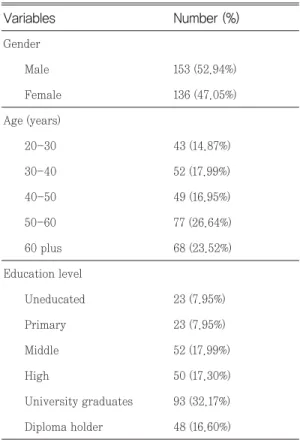
Results show that 52.94% of respondents were male and 47.05% were female. Most of them were from the age group of 50-60 with a per- centage of 26.64%, and 14.87% were between 20 years to 30 years of age. About 66.08% partici- pants have a qualification level of high school or above, whereas only 7.95% were uneducated.

The demographics of the patients who took part

(5)

in this study are shown in Table 1.

General awareness about clinical pharmacist :

The purpose of asking these three simple questions in the start was to roughly estimate patient’ s awareness about clinical pharmacist.

Table 2 indicates that 217 (75.08%) patients out of 289 said that they have heard about the clini- cal pharmacist before. 168 (58.13%) respondents said that they know about the role of clinical pharmacist in health care setting. And 115 (39.79%) responded that they have interacted with the clinical pharmacist in the past.

Value of clinical pharmacists :

About 75% of the participants believed that clinical pharmacist can be a drug expert, 18.68%

strongly agreed while 6.22% showed disagree- ment. When asked if the role of clinical pharma- cist is as important as of doctors and nurses in a health care team, mostly all the respondents (95%) agreed. The objective of asking the patients if clinical pharmacist is capable to pro- vide individual patient care was to take hold of the impression of the clinical pharmacist among the patients, where 24.56% strongly agreed, 69.55% agreed and only 5.88% were not agreed.

With respect to clinical pharmacist’ s ability to improve the efficacy and quality of the treat- ment or the care provided, 72.31% agreed but about 4.84% of respondents disagreed and 1.73%

showed complete disagreement. As shown in table 3, the value was statistically significant with respect to qualification (p=0.013). Similar response was seen when patients were asked if they think that clinical pharmacist can decrease the risks related to their therapy such as ADR, side effects, drug interaction or toxicities. More than half agreed and only 5.20% disagreed.

Again the value was statistically significant only Gender

Male 153 (52.94%)

Female 136 (47.05%)

Age (years)

20-30 43 (14.87%)

30-40 52 (17.99%)

40-50 49 (16.95%)

50-60 77 (26.64%)

60 plus 68 (23.52%)

Education level

Uneducated 23 (7.95%)

Primary 23 (7.95%)

Middle 52 (17.99%)

High 50 (17.30%)

University graduates 93 (32.17%) Diploma holder 48 (16.60%) Number (%) Variables

Table 1. Demographic data

Have you ever heard about clinical pharmacist?

Do you know the about the role of clinical pharmacist in health care setting?

Have you ever experienced any services from clinical pharmacist?

Frequency and percentage of yes Questions

Table 2. General awareness about clinical phar- macists

217 (75.08%)

168 (58.13%)

115 (39.79%)

(6)

Items in questionnaire: 1= Clinical pharmacist is a drug expert. 2= Clinical pharmacist is an important member of health care team. 3= Clinical pharmacist should be encouraged to participate in individual patient therapy. 4= Clinical pharmacist can improve the efficacy and quality of treatment. 5= Clinical pharmacist can reduce the risks (ADR, drug interaction, medication error) related to therapy. 6= Clinical pharmacist led care is a waste of time and money.

Services offered by clinical pharmacist: 1= Clinical Pharmacist led individualized care. 2= Participating in ward round with the doctors and nurses. 3=

Taking patient medication history. 4=Performing physical examination. 5= Providing the information regarding dose, duration and route of administration of drugs). 6= Counseling about ADR, medication error and drug interactions. S=Satisfactory, A=Average, NS=Not satisfactory.

1 2 (0.69%) 16 (5.53%) 217 (75.08%) 54 (18.68%) 0.357 0.157 0.646

2 2 (0.69%) 10 (3.46%) 210 (72.66%) 67 (23.18%) 0.475 0.146 0.391

3 2 (0.69%) 15 (5.19%) 201 (69.55%) 71 (24.56%) 0.894 0.856 0.376

4 5 (1.73%) 14 (4.84%) 209 (72.31%) 61 (21.10%) 0.661 0.423 0.013

5 3 (1.03%) 15 (5.19%) 206 (71.28%) 65 (22.49%) 0.555 0.369 0.015

6 66 (22.83%) 208 (71.97%) 12 (04.15%) 3 (1.03%) 0.235 0.319 0.479

Items in questionnaire

Responses, n (%) P- value

Education Age

Gender Strongly

Disagree Disagree Agree Strongly Agree Table 3. Response regarding professional capabilities of clinical pharmacists

1 115 91 (79.13%) 22 (19.13%) 2 (1.73%) 0.854 0.635 0.311

2 91 69 (75.82%) 20 (21.97%) 2 (2.19%) 0.133 0.068 0.868

3 91 73 (80.21%) 17 (18.68%) 1 (1.09%) 0.383 0.276 0.731

4 35 19 (54.28%) 12 (34.28%) 4 (11.42%) 0.255 0.245 0.883

5 103 85 (82.52%) 18 (17.47%) 0 (0%) 0.588 0.142 0.284

6 93 73 (78.49%) 18 (19.35%) 2 (2.15%) 0.776 0.537 0.646

Level of satisfaction

Total number of respondents=289 P- value

Education Age

Gender Services offered

by clinical pharmacist

Number who had experienced

S n (%)

A n (%)

NS n (%) Table 4. Satisfaction with roles of clinical pharmacist in the hospitals

with respect to qualification (p=0.015). In this era of rapid life rhythm and economical pres- sure, it is important to determine if the patients perceive that the time or cost they spend on clinical pharmacist would worth something.

94.80% of the participants agreed that the clini- cal pharmacist led care is not a waste of time or

money.

Satisfaction and expectation regarding roles of clinical pharmacist in the hospital :

(a) Satisfaction level: Table 4 indicates the

number of patients who had experienced a

(7)

particular CPS, level of satisfaction regard- ing that and if there is any statistical sig- nificance with respect to age, gender and qualification. Most important role a clinical pharmacist is expected to play is improving the quality of treatment by avoiding drug- drug interaction and adverse drug reactions (ADR). Clinical pharmacist can resolve these issues to some extent by taking good patient medication and disease history. For the roles such as providing individual patient oriented therapy, participating in ward rounds, taking medication history and counseling about risks (ADR, medication error or drug interactions), more than 75%

of patients who have experienced them in the past showed satisfaction. In addition to dispensing medications, the pharmacist should impart clear instructions to the patient about the medications forms and administration timings. In the case of clini- cal pharmacist providing information about the dose, route or duration of drug admin-

istration, out of 103 patients 82.5% said they were satisfied. Only 35 participants said that they had experienced clinical pharmacist taking physical examination and only half of them were satisfied.

(b) Expectation regarding above mentioned CPSs: More than 80% of the respondents, who never experienced the mentioned CPSs, said that they want clinical pharmacist to provide them these services; except for the role of performing physical examination, where 64.5% respondents said they need and 35.4% said they do not need. As shown in table 5, none of the values were statisti- cally significant with respect to gender, age or education.

DISCUSSION

Out of 350 questionnaires being handed out, 289 were retrieved showing a good response rate of 82.57%. This is quoted acceptable by researchers for self administered question-

Services offered by clinical pharmacist: 1= Clinical Pharmacist led individualized care. 2= Participating in ward round with the doctors and nurses. 3=

Taking patient medication history. 4=Performing physical examination. 5=Providing the information regarding dose, duration and route of administration of drugs). 6= Counseling about ADR, medication error and drug interactions.

1 174 155 (89.0%) 19 (10.91%) 0.339 0.208 0.446

2 198 175 (88.38%) 23 (11.61%) 0.527 0.543 0.402

3 198 178 (89.89%) 20 (10.10%) 0.621 0.522 0.524

4 254 164 (64.56%) 90 (35.43%) 0.450 0.428 0.457

5 186 168 (90.32%) 18 (9.67%) 0.497 0.753 0.552

6 196 181 (92.34%) 15 (7.65%) 0.592 0.492 0.508

Total number of respondents=289 Expectation towards particular roles P- value

Education Age

Gender Services offered

by clinical pharmacist

No. who had not experienced

Need n (%)

Do not Need

n (%)

Table 5: Expectation regarding roles of clinical pharmacist in the hospital

(8)

naire.

13)

It is encouraging to know that most patients knew about clinical pharmacist.

Although not many of them experienced CPSs but an agreeable number of participants were aware that clinical pharmacist is someone who has more than just dispensing roles and he can guide them regarding therapy. As most of the participants had a qualification level above high school so it can be a reason for their awareness about clinical pharmacist. But as China has a big population and number of clinical pharmacists available in hospitals is not sufficient so most participants have no past experience of CPSs. In 2012, a survey showed that no. of pharmacists available per 10,000 of population in China is 0.27 which is insignificant as compared to the WHO standards which require one pharmacist per 2000 patients.

14)

Now Chinese Government has launched an ambitious and massive program with a goal to improve the affordability and efficacy of health care for all by 2020.

15)

It mainly focuses on public hospitals, which deliver more than 90% of China’ s inpatient and outpatient services. According to the new poli- cies, it is mandatory for tertiary hospitals to integrate clinical pharmacy services in hospitals.

16)

The perception of the patients regarding the professional competence of clinical pharmacist is very well. Most respondents believe that clinical pharmacist is an indispensible member of health care team and their role in individualized patient care should be encouraged. One study conducted in Pakistan and other in Saudi Arabia that focused public perception about community pharmacist’ s abilities and roles in health care also showed a positive response.

10)-11)

But there is also a study where neither doctor nor consumers believed that pharmacists had a major role in pharmaceutical care.

17)

In order to avoid extinc-

tion, the members of effective profession should be perceived as essential or indispensable.

18)

It is observed that the response regarding capabilities of clinical pharmacist actually matches with the satisfaction level among the experienced patients or expectation of those who have never experienced any CPSs. Our results showed that more than 75% of patients who have experienced clinical pharmacist led indi- vidualized patient care, ward visits, taking patient medication history, providing drug information or counseling showed satisfaction.

And more than 80% want clinical pharmacist to provide them the above mentioned services. It is very important for clinical pharmacists to improve the quality of services they provide especially counseling and patient education.

Patients may be less able to judge the technical quality of the care they receive, but they do judge their social interaction with the pharma- cist.

19)

An improved satisfaction level was observed by researchers when there is a higher frequency of counseling and monitoring by clinical pharma- cist.

20)-21)

Patients also showed support for the participation of clinical pharmacist in wards round visits. According to a research, the pres- ence of a pharmacist on a post-take ward round improved the accuracy of drug history docu- mentation, and reduced prescribing costs and potential risk to patients.

22)

It has already been established that patient

education by pharmacist can both improve

patient care and expand their scope of prac-

tice.

23)-24)

But our results showed that most

respondents were not satisfied with pharmacist

performing physical examination. Although

exact reason is unclear but it is a fact that BS

clinical pharmacy curriculum in China, is not

focused on developing these interactive or

(9)

examining skills. It has already been pointed out that to establish an efficient clinical pharmacy set up, it is needed to start from the basic like formulating an effective curriculum and training program for the clinical pharmacy students.

25)

Clinical pharmacy services in China, with its unique healthcare system, appear to positively influence patient care by improving efficacy, safety or quality of treatment and adherence or compliance in the patients. Our study has shown that patients in China appreciate and encourage clinical pharmacy profession. They are well aware of professional capabilities of clinical pharmacist and expect them to play an effective role in patient care. Now clinical pharmacists should prove their worth.

Acknowledgments :

The authors would like to express their appre- ciation for all the research assistants in data collection. Special thanks to Ms. Wei-Hong Ge, Hua Shao, Ya-Min Liu, Jia Cao, Dong-Mei Lv, Dan Su, and Mr. Cheng Ji, Yi-Min Cui, Bin Zhao, Wan-Sheng Chen, Yi-Ming Guo, Jian- Hua Wang.

Disclosure :

The research is a part of the master’ s thesis from Madiha in China Pharmaceutical University, and the authors report no conflicts of interest in this work.

References

1) American College of Clinical Pharmacy (ACCP). The definition of clinical pharmacy.

Pharmacotherapy. 2008;28(6):816-7.

2) Alcorn T., Bao B. China progresses with

health reform but challenges remain.

Lancet. 2011;377(9777):1557-8.

3) Ryan M., Shao H, Yang L., Nie X.Y., Zhai S.D., Shi L.W., Lubawy W.C. Clinical phar- macy education in China. Am J Pharm Educ.

2008;72(6):129.

4) Jiang J.H., Liu Y., Wang Y.J., Liu X., Yang M.S., Zeng Y., Deng P, Li Q.G.. Clinical pharmacy education in China. Am J Pharm Educ. 2011;75(3):57c.

5) Committee for Pharmacy Administration, Chinese Hospital Association. Summary report for clinical pharmacist pilot training project; 2015 January 10. Available from:

http://www.chinadtc.org.cn/a/linchuangyaos hi/guizhangzhidu/2013/0411/267.html (in Chinese)

6) Ministry of Health of the People’ s Republic of China. Policy on pharmacy administration in health care facilities; 2015 January 10.

Available from: http://www.moh. gov.cn/

mohyzs/s3585/201103/51113.shtml (in Chinese)

7) Hu M., Jiang X.H., Wu Y.P., Yang Q., Li X.X. Survey on hospital pharmaceutical care in China and the status quo of clinical phar- macy practice (part 2): survey on status quo of clinical pharmacy practice (in Chinese).

Chin Pharm. 2009;20(13):1030-2.

8) Luo X.M., Tang J.L., Hu Y.H., Li L.M., Wang Y.L., Wang W.Z., Yang L., Ouyang X.H., Duan G.C. How often are ineffective inter- ventions still used in clinical practice? A cross-sectional survey of 6,272 clinicians in China. PLoS One. 2013;8(3):e52159.

9) Penm J., Li Y., Zhai S., Hu Y., Chaar B.,

Moles R. The impact of clinical pharmacy

services in China on the quality use of medi-

cines: a systematic review in context of

China’ s current healthcare reform. Health

(10)

Policy Plan. 2014;29(7):849-72.

10) Jin X., Azhar S., Murtaza G., Xue F., Mumtaz A., Niu H., Taha A., Zhang Y.

Quantitative study evaluating perception of general public towards role of pharmacist in health care system of Pakistan. Acta Pol Pharm. 2014;71(5):869-75.

11) Al-Arifi M.N. Patients’perception, views and satisfaction with pharmacists’role as health care provider in community pharma- cy setting at Riyadh, Saudi Arabia. Saudi Pharm J. 2012;20(4):323-30.

12) Iqbal Z., Jalees A.F., Krishen K.R.

Pharmacist as an indispensable part of health care system: a survey, outcome and reflections. Indian J Pharm Educ Res.

2008;42(1):78-83.

13) Bourque L., Fielder E. How to conduct self- administered and mail surveys. 2nd ed.

Thousand Oaks: Sage Publications Inc.;

2003.

14) Ministry of Health, P.R. China: Chinahealth statistics yearbook 2012. Beijing: China Union Medical College Publishing; 2012.

15) Yip W.C., Hsiao W.C., Chen W., Hu S., Ma J., Maynard A. Early appraisal of China’ s huge and complex health-care reforms. Lancet.

2012;379(9818):833-42.

16) Ministry of Health of the People’ s Republic of China. 2011b: National accreditation cri- teria for tertiary hospitals; 2015 January 15.

Available from: http://www.moh.gov.cn/

yzygj/s3585u/201104/c6fa4cc981d4429ba8ca a7666aa13710.shtml (in Chinese)

17) Law A.V., Ray M.D., Knapp K.K., Balesh J.K.

Unmet needs in the medication use process:

perceptions of physicians, pharmacists, and patients. J Am Pharm Assoc. 2003;43(3):

394-402.

18) Gu N.Y., Gai Y., Hay J.W. The effect of

patient satisfaction with pharmacist con- sultation on medication adherence. An instrumental variable approach. Pharmacy Practice. 2008;6(4):201-210.

19) Ried L.D., Wang F., Young H., Awiphan R.

Patients’satisfaction and their perception of the pharmacist. J Am Pharm Assoc.

1999;39(6):835-842.

20) Schommer J.C. Patients’expectations and knowledge of patient counseling services that are available from pharmacies. Am J Pharm Educ, 1997;61:402-406.

21) Liu M.Y., Jennings J.P., Samuelson W.M., Sullivan C.A., Verltri J.C. Asthma patients’

satisfaction with the frequency and content of pharmacist counseling. J Am Pharm Assoc. 1999;39(4):493-8.

22) Improving medication management for patients: The effect of a pharmacist on post-admission ward rounds. Quality and Safety in Health Care. 2005;14(3):207-211.

23) Adamcik B.A., Stimmel G.L. Use of physical assessment skills by clinical pharmacists in monitoring drug therapy response: atti- tudes and frequency.?Am J Pharm Educ.

1989;53:127?33.

24) Longe R.L., Cavert J.C. Physical assess- ment and the clinical pharmacist. Drug Intell Clin Pharm. 1977;11:200-203.

25) Madiha, Yang C.Q., Sands C.D., Ge W.H.

Evaluating B.S. clinical pharmacy curricu- lum of China Pharmaceutical University (China) by comparing with PharmD cur- riculum of Samford University (USA).

IJPTP. 2014;5(2):944-948.

수치

Table 2 indicates that 217 (75.08%) patients out of 289 said that they have heard about the  clini-cal pharmacist before

참조

관련 문서

1 John Owen, Justification by Faith Alone, in The Works of John Owen, ed. John Bolt, trans. Scott Clark, "Do This and Live: Christ's Active Obedience as the

Method : : : : We evaluate clinical features of 714 Korean vitiligo patients who lived in the Gwangju chonnam province(315 males and 399 females).. Results

Comparison of clinical risk factors and distribution of age, sex of patients aged ≧80 years and <80 years... Comparison of the stroke subtype and thrombolysis of

Purpose: This study was designed to evaluate the clinical characteristics and the treatment of colonoscopic perforation and the availability of

In this study, to investigate how applying a critical pathway to stomach cancer patients affects their recovery and treatment, the clinical effect of the critical

The authors here intended to describe clinical characteristics of gastrointestinal bleeding in scrub typhus, and then to evaluate the clinical significance

The staff of outstanding hospitals (doctors, nurses, administrative personnel) provide proper medical services that meet the

Although visceral fat adiposity has known to be associated with clinical, pathologic, and oncologic outcomes in patients with colorectal cancer (CRC), the