Background and Purpose Information processing speed is one of the most impaired cog- nitive functions in multiple sclerosis (MS). There are two tests widely used for evaluating in- formation processing speed: the Symbol Digit Modalities Test (SDMT) and the Paced Audi- tory Serial Addition Test (PASAT). To analyze the relationship between processing speed and the clinical and social support variables of patients with MS.
Methods A group of 47 patients with relapsing-remitting MS was studied, 31 were women and 16, men. Age: 39.04±13.17, years of schooling: 13.00±3.87, Expanded Disability Status Scale (EDSS): 2.78±1.81, and disease evolution: 8.07±6.26. Instruments of measure; process- ing speed: SDMT, PASAT, clinical variables: EDSS, Fatigue Severity Scale (FSS), Beck’s Depres- sion Inventory II (BDI-II), and social support: Medical Outcomes Study Social Support Sur- vey (MOS).
Results Significant correlations were found between information processing speed and psy- chiatric, motor disability and social support variables. The SDMT correlated significantly and negatively with BDI-II, FSS, EDSS, and MOS (p<0.05), whereas the PASAT correlated negative- ly with FSS and positively with MOS (p<0.05). Information processing speed appeared as the performance predictor of these variables. The SDMT produced significant changes in EDSS (R2= 0.343, p=0.000); FSS (R2=0.109, p=0.031); BDI-II (R2=0.124, p=0.018), and MOS (R2=between 0.212 and 0.379, p<0.05).
Conclusions Information processing speed has influence on the clinical variables and the so- cial support of patients with MS. These aspects are important to bear in mind for therapeutic ap- proach.
Key Words multiple sclerosis, cognition, social support.
The Role of Information Processing Speed in Clinical and Social Support Variables of Patients with Multiple Sclerosis
INTRODUCTION
Cognitive impairments are frequent symptoms of multiple sclerosis (MS). It is estimated that 40–70% of the patients have cognitive deficits,1-3 and information processing speed (IPS) is one of the most affected functions.3 IPS is a primary cognitive function, which is extremely important for the functionality of higher cognitive processes as it influences downward processes such as learning, memory, word retrieval, and executive function.4 Al- though no consensus on the definition of IPS as a neuropsychological construct has been reached, a prominent definition by Shanahan proposed a broad definition of processing speed as an underlying cognitive efficiency at understanding and acting upon external stim- uli, which includes integrating low level perceptual, higher level cognitive, and output speed.
Previous studies have analyzed the impact that processing speed has on emotional and clinical variables, and on different aspects of the MS patients’ quality of life.4-8
There are two tests widely used for evaluating IPS: the Symbol Digit Modalities Test María Bárbara Eizaguirre
Sandra Vanotti Ángeles Merino Cecilia Yastremiz Berenice Silva Ricardo Alonso Orlando Garcea
Multiple Sclerosis Clinic and University of Buenos Aires
Neurology Center, Ramos Mejía Hospital, Buenos Aires, Argentina
pISSN 1738-6586 / eISSN 2005-5013 / J Clin Neurol 2018;14(4):472-477 / https://doi.org/10.3988/jcn.2018.14.4.472
Received December 22, 2017 Revised March 30, 2018 Accepted March 30, 2018 Correspondence María Bárbara Eizaguirre, MS Multiple Sclerosis Clinic and University of Buenos Aires Neurology Center, Ramos Mejía Hospital, Espora 487, La Matanza, Buenos Aires 1704, Argentina Tel +5491138252898 Fax +541146517555
E-mail [email protected]
cc This is an Open Access article distributed under the terms of the Creative Commons Attribution Non-Com- mercial License (https://creativecommons.org/licenses/by-nc/4.0) which permits unrestricted non-commercial use, distribution, and reproduction in any medium, provided the original work is properly cited.
JCN
Open Access ORIGINAL ARTICLEEizaguirre MB et al.
JCN
(SDMT)9,10 and the Paced Auditory Serial Addition Test (PASAT).11-13 In the SDMT an array of symbols that corre- spond to some numbers is presented to the evaluated. Later, the symbols are paired with empty spaces, and the evaluated must indicate the corresponding number as rapidly as possi- ble. In the standard administration, the test has a written re- sponse task, followed by an oral response task, using the same stimuli.9 In the PASAT, according to the instructions, patients are asked to listen to successive numbers presented in a predetermined time interval and orally provide the sums of consecutive numbers as rapidly as possible.11 In MS research and clinical practice, the 3-s (PASAT-3) and 2-s (PASAT-2) versions of the interstimulus interval have been implemented.
Both tests are part of two neuropsychological batteries used for assessing patients diagnosed with MS: the Brief Repeatable Battery of Neuropsychological Tests for Multiple Sclerosis2,14 and the Minimally Assessment of Cognitive Function in Multiple Sclerosis.15 The SDMT is also part of the Brief In- ternational Cognitive Assessment for Multiple Sclerosis.16,17 A recent review describes that most of the studies on IPS of patients with MS are conducted through these two tests.4
Previous studies have analyzed the relationship between IPS and the clinical variables of patients with MS.18-25 Re- garding the relationship between processing speed and the patients’ degree of motor disability, there are authors who claim that increasing motor disability is related to increased IPS slowing.21,23,24 One of these studies23 has even found that of all the cognitive functions evaluated, processing speed was the most strongly associated with motor disability, measured by the Expanded Disability Status Scale (EDSS). However, there are other authors who did not find such relationship.26 With regard to disease evolution, there is a study that shows that the patients who had more years of disease evolution performed worse in IPS tasks,22 contrary to what was found by other authors.24 Regarding fatigue, some studies describe that in patients with MS fatigue is affected by IPS,20,23,25,27
whereas other studies dismiss such relationship.28 Another clinical aspect that has been widely reported in MS, is de- pression, the studies claim that there is a significant relation- ship between the patients’ performance in processing speed tasks and the presence of depressive symptoms.18,23,27,29,30
The symptoms of MS patients produce a negative impact on their psychosocial relationships, for this reason some au- thors have emphasized the role of social support in patient’s life.30-32 Regarding the specific relation between cognitive symptoms and social support, some authors claim that the IPS can affect their ability to face social situations,21,33 but this is an area that has drawn little attention. Glanz et al.21 have analyzed the relationship between IPS and perceived so- cial support, and found significant associations. Social sup-
port is usually described as a system of formal and informal relationships through which people receive material and psy- chological support to cope with their problems.29 The study of this variable has created interest due to the belief that people with better support have better health.
In recent years, there has been increasing interest in the study of IPS of patients with MS. However, the relationship between this cognitive function and the clinical variables of the patients is still under investigation. Also, the network of social support and its relationship with cognitive variables such as IPS is a field scarcely evaluated in this pathology. The aim of the present study is to analyze, in a group of patients with MS, the relationship between IPS and clinical variables such as disability, disease evolution, fatigue and depression, as well as its relationship with the social support perceived by the patients.
METHODS
Participants
A group of 47 patients diagnosed with Relapsing-Remitting Multiple Sclerosis (RRMS) were evaluated—of which 31 were women and 16, men—, who had been treated at the Unit of Demyelinating Diseases of the General Hospital of Acute Diseases J. M. Ramos Mejía, Buenos Aires City. Participants were selected based on an incidental, non-probability sam- pling strategy. The patients who had attended neurological consultation and met inclusion and exclusion criteria were asked to participate in the study. They all signed an informed consent. Both the study and the informed consent were ap- proved by the Ethics Committee of the institution (approval date: November 1, 2017).
As inclusion criteria, the following were established: be- ing more than 18-years-old, having a diagnose of RRMS as per Poser et al.34 and Mcdonald criteria,35 having a minimum of seven years of schooling, and being able to understand and respond to the entire procedure. As exclusion criteria: having psychiatric disorders, severe visual or auditory deficits—or any other physical impairment that would not permit patients to appropriately carry out the test—, a medical history of events that affect cognition or personality, a history of alcoholism or drug abuse, systemic diseases that may produce cognitive im- pairment, or having had relapses or corticoids administration four weeks previous to the study.
Instruments of measure Clinical variables
Motor disability was measured through the EDSS,36 and fa- tigue through the Fatigue Severity Scale (FSS).37 Depression
Information Processing Speed in Multiple Sclerosis
JCN
was measured through Beck’s Depression Inventory II (BDI- II)38 as adapted to Argentina by Brenlla and Rodríguez.39 Measures of IPS
The PASAT 312 and the SDMT9 were administered.
In the PASAT, patients are asked to listen an audio in wich 61 successive numbers were presented at a fixed rate and they should orally provide the sums of consecutive numbers as rapidly as possible. Originally, the time interval between the stimuli was 2.4 s, 2.0 s, 1.6 s, 1.2 s, and 0.8 s.11 However, in MS research and clinical practice, the 3-s (PASAT-3) and 2-s (PASAT-2) versions of the interstimulus interval have been implemented.13 For this research we implemented the 3 seconds version which is internationally used in most MS studies. Higher scores on the PASAT represent better IPS.
In the SDMT, the subject is presented a form headed by a key that pairs single digits (1 to 9) to nine different sym- bols. The rows that are below contain only the symbols. The subject's task is to record both orally and in writing the cor- rect number in the adjacent empty spaces. After completing the first ten items with guidance, the subject is then timed to observe how many responses they can fulfill in 90 sec- onds. In the standard administration of the SDMT, the writ- ten response task is conducted first, followed by an oral re- sponse task using the same stimuli. However, the majority of studies on MS skip the written response administration and only utilize the oral version.15 Thus, the examiner uses a form in which they record the subject’s voiced responses in such a manner that the scoring can be made quickly, with minimal chance for error. In total, the test requires five minutes to complete. Since the subjects participating in this study were MS patients, the oral version of the SDMT was used. Higher scores on the SDMT represent better IPS.
Social support
In order to evaluate this aspect, the Medical Outcomes Study Social Support Survey (MOS) Social Support Survey was used,40 adapted to Argentina by Rodríguez and Enrique.41 It is a brief multidimensional survey that allows to evaluate as- pects both quantitative (social network) and qualitative (di- mensions of social support). It consists of 20 items: the first refers to the size of the social network (number of friends and family members on whom the patient can rely) and the other 19 to the dimensions of social support. These dimen- sions are: emotional/informational support—which repre- sents the information that can be used by the patient to antic- ipate and react to problems, in the form of suggestions and advice—; affective support—real demonstrations of love, af- fection or empathy—; instrumental support—the access to material resources such as economic help, food and clothing—.29
The higher the score in the MOS, the better social support.
Statistical analysis
The data were analyzed through the SPSS statistical package version 21.0 (IBM Corp., Armonk, NY, USA). The degree of significance used was p<0.05. Descriptive statistics for the patients’ demographic and clinical variables were obtained.
Pearson correlation coefficient was implemented in order to study the relationship between IPS, clinical variables and the social support perceived by the patients. A simple linear re- gression analysis was conducted in order to assess the impact of processing speed (independent variable) on each one of the clinical variables (dependent variables). In order to identify to what extent processing speed can predict social support, a stepwise regression was conducted. Scores from EDSS, BDI- II, and FSS were added in each regression analysis (block 1) to control the influence that motor disability, depression and fatigue have in estimating the relationship between process- ing speed (block 2) and each score of social support (depen- dent variable).
RESULTS
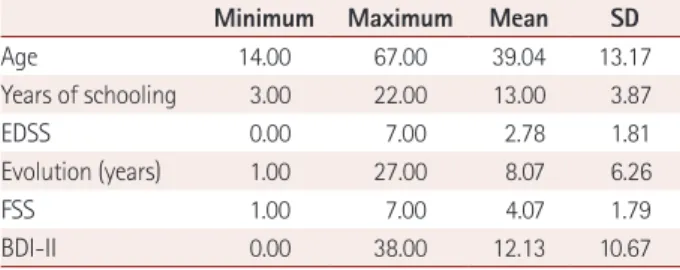
The group of patients was composed of 31 women (66% of the total) and 16 men (34%). The mean for age was 39.04±
13.17 years-old, and for years of schooling, 13.00±3.87. Pa- tients had an EDSS mean of 2.78±1.81, and the mean for years of disease evolution was 8.07±6.26 years. BDI-II mean was 12.13±10.67, and FSS mean was 4.07±1.79, representing mild levels of depression and fatigue as reported by patients.
Results are shown in Table 1.
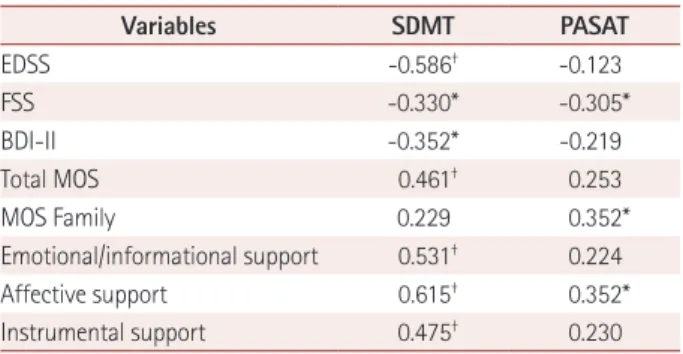
Significant associations were found between IPS and most of the clinical variables, as can be observed in Table 2. The scores that the patients obtained in the SDMT correlated significantly and negatively with measures of motor disabil- ity, fatigue and depression, whereas the scores obtained in the PASAT correlated significantly and negatively with mea- sures of fatigue. No associations were found between IPS and the years of disease evolution.
Table 1. Clinical and demographic data of patients with multiple sclerosis (n=47)
Minimum Maximum Mean SD
Age 14.00 67.00 39.04 13.17
Years of schooling 3.00 22.00 13.00 3.87
EDSS 0.00 7.00 2.78 1.81
Evolution (years) 1.00 27.00 8.07 6.26
FSS 1.00 7.00 4.07 1.79
BDI-II 0.00 38.00 12.13 10.67
BDI-II: Beck’s Depression Inventory II, EDSS: Expanded Disability Status Scale, FSS: Fatigue Severity Scale, SD: standard deviation.
Eizaguirre MB et al.
JCN
Regarding social support, significant and positive associ- ations were found between IPS and the scores obtained by the patients in the social support survey. The SDMT correlated with the total score of the survey, as well as with its three di- mensions—emotional/informational, affective and instru- mental—, while the PASAT correlated significantly with the dimension of emotional support and with the number of fam- ily members whom patients can rely on as their network of support.
In order to analyze the influence of IPS on the clinical variables under evaluation, the scores obtained by the pa- tients in the SDMT and PASAT were added as independent variables in a linear regression model, as performance pre- dictors in EDSS, FSS, and BDI-II. The result was a model that explains to a large extent the variance in the clinical variables.
The regression model implemented with the SDMT ex- plains 34.3% of the variance in EDSS (p=0.000), as well as 10.9% of the variance in FSS (p=0.031), and 12.4% in BDI-II (p=0.018). Processing speed, measured through the SDMT, appeared as the performance predictor of the mentioned vari- ables, demonstrating a significant relationship between pro- cessing speed and EDSS, FSS, and BDI-II. The model imple- mented with the PASAT was not significant (Table 3).
Regarding social support, when the variables of EDSS,
FSS, and BDI-II were controlled, SDMT produced a model that explains 53.7% of the variance of the MOS total score (p=0.032), 54.4% of affective support (p=0.004), and 45.9%
of instrumental support (p=0.010). The PASAT was not a sig- nificant predictor after the clinical variables were controlled (Table 4).
DISCUSSION
Changes in IPS are frequent symptoms of MS that can inter- fere in different aspects of the patients’ life. The study of these variables is relevant for the treatment MS patients. The aim of this study is to describe the relationship between IPS and clinical variables such as motor disability, disease evolu- tion, fatigue and depression, as well as its relationship with the social support perceived by patients with MS.
The results obtained confirm that IPS is a cognitive func- tion that highly predicts clinical aspects and the social sup- port of patients with MS. Patients with a greater degree of motor disability, depression, fatigue, and with a weaker net- work of social support, also had slow processing speed. On the other hand, in this study no associations were found be- tween processing speed and the years of disease evolution.
These findings are consistent with the previously reported by Sundgren et al.,23 who found that IPS was the cognitive function most strongly associated with motor disability. Oth- er authors do not report such association.26 Regarding dis- ease evolution, previous studies coincide with our results in that there is no correlation between processing speed and the years of disease evolution.24,42 However, Dusankova et al.22 found that patients who had more years of disease evolution performed worse in IPS tasks; but in that case, patients had different disease’ subtypes, which might explain those results.
Meanwhile, the results obtained concerning fatigue severity are consistent with previous studies that show that there is a rela- tionship between IPS and fatigue in patients with MS.20,23,25,27
Jougleux-Vie et al.28 dismiss that relationship, but they mea- sured fatigue with a different instrument than ours. In this study, we also found a strong influence of IPS on the patients’
degree of depression, a relationship that has been previously described.18,19,23,27
Table 4. Linear regression analysis predicting social support of pa- tients with multiple sclerosis
Variables Predictor R2 p* β t
Total MOS SDMT 0.537 0.032 0.333 2.25
Affective support SDMT 0.544 0.004 0.464 3.16 Instrumental support SDMT 0.459 0.010 0.438 2.74
*Significant predictors.
MOS: Medical Outcomes Study Social Support Survey, SDMT: Symbol Digit Modalities Test.
Table 2. Correlations between processing speed, clinical variables and social support
Variables SDMT PASAT
EDSS -0.586† -0.123
FSS -0.330* -0.305*
BDI-II -0.352* -0.219
Total MOS 0.461† 0.253
MOS Family 0.229 0.352*
Emotional/informational support 0.531† 0.224
Affective support 0.615† 0.352*
Instrumental support 0.475† 0.230
*Correlation is significant at level 0.05 (bilateral), †Correlation is signifi- cant at level 0.01 (bilateral).
BDI-II: Beck’s Depression Inventory II, EDSS: Expanded Disability Status Scale, FSS: Fatigue Severity Scale, MOS: Medical Outcomes Study So- cial Support Survey, PASAT: Paced Auditory Serial Addition Test, SDMT:
Symbol Digit Modalities Test.
Table 3. Linear regression analysis predicting clinical variables of patients with multiple sclerosis
Variables Predictor R2 p* β t
EDSS SDMT 0.343 0.000 -0.586 -4.21
FSS SDMT 0.109 0.031 -0.330 -2.23
BDI-II SDMT 0.124 0.018 -0.352 -2.46
*Significant predictors.
BDI-II: Beck’s Depression Inventory II, EDSS: Expanded Disability Sta- tus Scale, FSS: Fatigue Severity Scale, SDMT: Symbol Digit Modalities Test.
Information Processing Speed in Multiple Sclerosis
JCN
An interesting finding is the relationship between process- ing speed and the network of social support, both in the quantitative and qualitative aspects. When the influence of speed on social support was analyzed, it was found that pa- tients with slow IPS had weaker social relations in terms of quality. Patients who were experiencing a slowdown receive fewer demonstrations of affection and have less help of ma- terial resources, than those who are not in that stage. There are previous studies that report variations in the social sup- port perceived by patients with MS,21,43 but its relationship with cognition—and specifically, with IPS—has not been studied. Our findings are consistent with those of Glanz et al.,21 who found that there is a strong correlation between the SDMT and one dimension of social support, although they used a different method of measure than ours. Barker-Col- lo33 describes that there is a strong relationship between IPS and the social relations of patients with MS, and although in that case the network of social support was not specifically evaluated, the patients who had a slow IPS ranked lower in the items related to social relations of a quality of life scale.
The reported findings reaffirm the importance of consid- ering the processing speed in the different aspects of MS patients, and specifically consider the variable of social sup- port, which has not been especially highlighted in previous studies about quality of life in MS patients. This last finding is highly relevant because an adequate social support is re- ally necessary in patients suffering from this kind of diseases, and it would be especially affected in patients with slow pro- cessing. Even though there are treatments of cognitive stim- ulation44 and physical activity45 that collaborate with the re- habilitation of different cognitive functions, including the speed of processing, studying in more detail the processing speed could help the development of specific training pro- grams that are really necessary.
It is essential to aim towards the need of taking into con- sideration IPS when treating patients with MS, since it has an important influence on the clinical aspects and the so- cial network of the patients. As it mentioned above, the last point has special importance, given the prominence of so- cial relations in the therapeutic treatment and rehabilitation process of chronic diseases, as well as in the patients’ quality of life.
Conflicts of Interest
The authors have no financial conflicts of interest.
REFERENCES
1. Chiaravalloti ND, Christodoulou C, Demaree HA, DeLuca J. Differ- entiating simple versus complex processing speed: influence on new learning and memory performance. J Clin Exp Neuropsychol 2003;
25:489-501.
2. Cáceres F, Vanotti S, Rao S; RECONEM Workgroup. Epidemiological characteristics of cognitive impairment of multiple sclerosis patients in a Latin American country. J Clin Exp Neuropsychol 2011;33:1094- 1098.
3. Ruano L, Portaccio E, Goretti B, Niccolai C, Severo M, Patti F, et al.
Age and disability drive cognitive impairment in multiple sclerosis across disease subtypes. Mult Scler 2017;23:1258-1267.
4. Costa SL, Genova HM, DeLuca J, Chiaravalloti ND. Information pro- cessing speed in multiple sclerosis: past, present, and future. Mult Scler 2017;23:772-789.
5. Goverover Y, Genova HM, Hillary FG, DeLuca J. The relationship between neuropsychological measures and the Timed Instrumental Activities of Daily Living task in multiple sclerosis. Mult Scler 2007;
13:636-644.
6. Goth-Owens TL, Martinez-Torteya C, Martel MM, Nigg JT. Process- ing speed weakness in children and adolescents with non-hyperactive but inattentive ADHD (ADD). Child Neuropsychol 2010;16:577-591.
7. Shanahan MA, Pennington BF, Yerys BE, Scott A, Boada R, Willcutt EG, et al. Processing speed deficits in attention deficit/hyperactivity disorder and reading disability. J Abnorm Child Psychol 2006;34:585- 602.
8. Forn C, Belenguer A, Parcet-Ibars MA, Avila C. Information-pro- cessing speed is the primary deficit underlying the poor performance of multiple sclerosis patients in the Paced Auditory Serial Addition Test (PASAT). J Clin Exp Neuropsychol 2008;30:789-796.
9. Smith A. Symbol digit modalities test: Manual. Los Angeles: Western Psychological Services;1982.
10. Vanotti S, Cores EV, Eizaguirre B, Angeles M, Rey R, Villa A, et al.
Normatization of the symbol digit modalities test-oral version in a Latin American country. Appl Neuropsychol Adult 2015;22:46-53.
11. Sampson H. Pacing and performance on a serial addition task. Can J Psychol 1956;10:219-225.
12. Gronwall DM. Paced auditory serial-addition task: a measure of re- covery from concussion. Percept Mot Skills 1977;44:367-373.
13. Vanotti S, Eizaguirre MB, Cores EV, Yastremis C, Garcea O, Salgado P, et al. Validation of the PASAT in Argentina. Appl Neuropsychol Adult 2016;23:379-383.
14. Rao SM, The Cognitive Function Study Group of the National Multi- ple Sclerosis Society. A manual for the brief repeatable battery of neu- ropsychological tests in multiple sclerosis. Milwaukee: Medical College of Wisconsin;1990.
15. Benedict RH, Fischer JS, Archibald CJ, Arnett PA, Beatty WW, Bob- holz J, et al. Minimal neuropsychological assessment of MS patients:
a consensus approach. Clin Neuropsychol 2002;16:381-397.
16. Benedict RH, Amato MP, Boringa J, Brochet B, Foley F, Fredrikson S, et al. Brief International Cognitive Assessment for MS (BICAMS):
international standards for validation. BMC Neurol 2012;12:55.
17. Vanotti S, Smerbeck A, Benedict RH, Caceres F. A new assessment tool for patients with multiple sclerosis from Spanish speaking coun- tries: validation of the Brief International Cognitive Assessment for MS (BICAMS) in Argentina. Clin Neuropsychol 2016;30:1023-1031.
18. Landrø NI, Celius EG, Sletvold H. Depressive symptoms account for deficient information processing speed but not for impaired working memory in early phase multiple sclerosis (MS). J Neurol Sci 2004;217:
211-216.
19. Diamond BJ, Johnson SK, Kaufman M, Graves L. Relationships be- tween information processing, depression, fatigue and cognition in multiple sclerosis. Arch Clinical Neuropsychol 2008;23:189-199.
20. Andreasen AK, Spliid PE, Andersen H, Jakobsen J. Fatigue and pro- cessing speed are related in multiple sclerosis. Eur J Neurol 2010;17:
212-218.
21. Glanz BI, Healy BC, Rintell DJ, Jaffin SK, Bakshi R, Weiner HL. The association between cognitive impairment and quality of life in pa- tients with early multiple sclerosis. J Neurol Sci 2010;290:75-79.
22. Dusankova JB, Kalincik T, Havrdova E, Benedict RH. Cross cultural
Eizaguirre MB et al.
JCN
validation of the Minimal Assessment of Cognitive Function in Multi- ple Sclerosis (MACFIMS) and the Brief International Cognitive As- sessment for Multiple Sclerosis (BICAMS). Clin Neuropsychol 2012;
26:1186-1200.
23. Sundgren M, Maurex L, Wahlin Å, Piehl F, Brismar T. Cognitive im- pairment has a strong relation to nonsomatic symptoms of depression in relapsing-remitting multiple sclerosis. Arch Clin Neuropsychol 2013;
28:144-155.
24. Giedraitienė N, Kizlaitienė R, Kaubrys G. The BICAMS battery for assessment of lithuanian-speaking multiple sclerosis patients: rela- tionship with age, education, disease disability, and duration. Med Sci Monit 2015;21:3853-3859.
25. Sandi D, Rudisch T, Füvesi J, Fricska-Nagy Z, Huszka H, Biernacki T, et al. The Hungarian validation of the Brief International Cognitive Assessment for Multiple Sclerosis (BICAMS) battery and the correla- tion of cognitive impairment with fatigue and quality of life. Mult Scler Relat Disord 2015;4:499-504.
26. Amato MP, Portaccio E, Goretti B, Zipoli V, Iudice A, Della Pina D, et al. Relevance of cognitive deterioration in early relapsing-remit- ting MS: a 3 year follow-up study. Mult Scler 2010;16:1474-1482.
27. Niino M, Mifune N, Kohriyama T, Mori M, Ohashi T, Kawachi I, et al.
Apathy/depression, but not subjective fatigue, is related with cognitive dysfunction in patients with multiple sclerosis. BMC Neurol 2014;14:3.
28. Jougleux-Vie C, Duhin E, Deken V, Outteryck O, Vermersch P, Zéphir H. Does fatigue complaint reflect memory impairment in multiple sclerosis? Mult Scler Int 2014;2014:692468.
29. Costa DC, Sá MJ, Calheiros JM. The effect of social support on the quality of life of patients with multiple sclerosis. Arq Neuropsiquiatr 2012;70:108-113.
30. Costa D, Sá MJ, Calheiros JM. [The effect of social support on the symptoms of depression experienced by Portuguese patients with multiple sclerosis]. Rev Neurol 2011;53:457-462.
31. Aghaei N, Karbandi S, Gorji MA, Golkhatmi MB, Alizadeh B. Social support in relation to fatigue symptoms among patients with multi- ple sclerosis. Indian J Palliat Care 2016;22:163-167.
32. Rommer PS, Sühnel A, König N, Zettl UK. Coping with multiple scle- rosis-the role of social support. Acta Neurol Scand 2016;136:11-16.
33. Barker-Collo SL. Quality of life in multiple sclerosis: does informa-
tion-processing speed have an independent effect? Arch Clin Neuro- psychol 2006;21:167-174.
34. Poser CM, Paty DW, Scheinberg L, McDonald WI, Davis FA, Ebers GC, et al. New diagnostic criteria for multiple sclerosis: guidelines for research protocols. Ann Neurol 1983;13:227-231.
35. Polman CH, Reingold SC, Banwell B, Clanet M, Cohen JA, Filippi M, et al. Diagnostic criteria for multiple sclerosis: 2010 revisions to the McDonald criteria. Ann Neurol 2011;69:292-302.
36. Kurtzke JF. Rating neurological impairment in multiple sclerosis: an expanded disability status scale (EDSS). Neurology 1983;33:1444-1452.
37. Paralyzed Veterans of America. Multiple Sclerosis Council for Clinical Practice Guidelines [Internet]. Buenos Aires: Paralyzed Veterans of America; 1998 [cited 2017 Dec 10] Available from: http://www.pva.org/
media/pdf/fatigue1b772.pdf.
38. Beck AT, Steer RA, Brown GK. Manual for the Beck Depression In- ventory-II. San Antonio (TX): Psychological Corporation; 1996.
39. Brenlla ME, Rodríguez CM. [Adaptación argentina del Inventario de Depresión de Beck]. In: Beck AT, Steer RA, Brown GK, editors.
[BDI-II. Inventario de Depresión de Beck]. 2nd ed. Buenos Aires:
Paidós;2006.
40. Sherbourne CD, Stewart AL. The MOS social support survey. Soc Sci Med 1991;32:705-714.
41. Rodríguez S, Enrique HC. [Validación Argentina del cuestionario MOS de apoyo social percibido]. Psicodebate 2007;7:155-168.
42. Roosendaal SD, Bendfeldt K, Vrenken H, Polman CH, Borgwardt S, Radue EW, et al. Grey matter volume in a large cohort of MS patients:
relation to MRI parameters and disability. Mult Scler 2011;17:1098- 1106.
43. Kamenov K, Cabello M, Caballero FF, Cieza A, Sabariego C, Raggi A, et al. Factors related to social support in neurological and mental disorders. PLoS One 2016;11:e0149356.
44. Chiaravalloti ND, Genova HM, DeLuca J. Cognitive rehabilitation in multiple sclerosis: the role of plasticity. Front Neurol 2015;6:67.
45. Sandroff BM, Motl RW, Scudder MR, DeLuca J. Systematic, evidence- based review of exercise, physical activity, and physical fitness effects on cognition in persons with multiple sclerosis. Neuropsychol Rev 2016;26:271-294.