Introduction
Pre-treatment of the tooth surface with antibacteri- al agents is useful for eliminating the harmful effects caused by either the residual bacteria or bacterial microleakage.1Chlorhexidine is one of the most wide- ly used broad spectrum antibacterial or antiseptic agents in dentistry.2 The efficacy of chlorhexidine in caries prevention had been established in clinical trials.3
The latest development in dental adhesion is based on simplification and a reduced application time. The first self-etch adhesives were composed of two solu- tions, an acidic primer and bonding resin. Recently, many clinicians have shifted to one-step self-etch systems (all-in-one adhesives), in which the manu- facturers have attempted to incorporate all the pri- mary components of an adhesive system (etchant, primer, and bonding resin) into a single solution.
Effect of 2% chlorhexidine application on microtensile bond strength of resin composite to dentin using one-step self-etch adhesives
Soon-Ham Jang1, Bock Hur1, Hyeon-Cheol Kim1, Yong-Hun Kwon2, Jeong-Kil Park1*
1Department of Conservative Dentistry, 2Department of Dental Materials, Pusan National University School of Dentistry, Yangsan, Korea
Objectives: This study examined the effect of 2% chlorhexidine on the μTBS of a direct composite restora- tion using one-step self-etch adhesives on human dentin.
Materials and Methods: Twenty-four extracted permanent molars were used. The teeth were assigned ran- domly to six groups (n = 10), according to the adhesive system and application of chlorhexidine. With or without the application of chlorhexidine, each adhesive system was applied to the dentin surface. After the bonding procedure, light-cure composite resin buildups were produced. The restored teeth were stored in distilled water at room temperature for 24 hours, and then cut and glued to the jig of the microtensile test- ing machine. A tensile load was applied until the specimen failed. The failure mode was examined using an operating microscope. The data was analyzed statistically using one-way ANOVA, Student’s t-test (p <
0.05) and Scheffe′’s test.
Results: Regardless of the application of chlorhexidine, the Clearfil S3 Bond showed the highest μTBS, fol- lowed by G-Bond and Xeno V. Adhesive failure was the main failure mode of the dentin bonding agents tested with some samples showing cohesive failure.
Conclusions: The application of 2% chlorhexidine did not affect the μTBS of the resin composite to the dentin using a one-step self-etch adhesive. [J Kor Acad Cons Dent 2010;35(6):486-491.]
Key words:Chlorhexidine, Microtensile bond strength, One-step self-etch adhesive
-Received 21 September 2010; revised 19 October 2010; accepted 20 October 2010- ABSTRACT
1Jang SH, DDS, MS, Graduate Student; Hur B, DDS, PhD, Professor; Kim HC, DDS, PhD, Associate Professor; Park JK, DDS, PhD, Associate Professor, Department of Conservative Dentistry, Pusan National University School of Dentistry
2Kwon YH, PhD, Associate Professor, Department of Dental Materials, Pusan National University School of Dentistry, Yangsan, Korea
*Correspondence to Jeong-Kil Park, DDS, PhD.
Associate Professor, Department of Conservative Dentistry, Pusan National University School of Dentistry, Beomeo-li, Mulgem-up, Yangsan, Korea 626-770
TEL, +82-55-360-5213; FAX, +82-55-360-5214; E-mail, [email protected]
*This work was supported for two years by Pusan National University Research Grant.
One potential problem with the use of chlorhexidine with dentin bonding agents is the possibility of adverse effects on the bond strength of the resin composites. Previous studies4-10 were carried out using etch-and-rinse and self-etch adhesives with conflicting results being reported. However, few stud- ies have examined the effect of chlorhexidine applica- tion on the microtensile bond strength of resin com- posites to dentin using one-step self-etch adhesives.
As the use of one-step self-etch adhesives has become popular at clinical practice recently, a study about the effect of chlorhexidine on resin composite restored with one-step self-etch adhesive is neces- sary.
Therefore, this study examined the effect of chlorhexidine on the microtensile bond strength (μTBS) of direct composite restorations in vitro using a one-step self-etch adhesive on human dentin.
Materials and Methods 1. Tooth preparation
Twenty-four extracted noncarious human perma- nent molars were washed and stored in distilled water. A plastic mold was filled with an autopoly- merizing resin (Tokuso curefast; Tokuyama, Tokyo,
Japan) and the root surface was embedded in acrylic resin, leaving the clinical crown exposed. After removing the plastic mold, the teeth were sectioned horizontally at mid-coronal level using a diamond- saw (Accutom-50; Struers, R∅dovre, Denmark) under continuous water cooling. The flat dentin sur- face was exposed using 600 grit silicon carbide paper under running water.
2. Dentin bonding and resin composite buildups
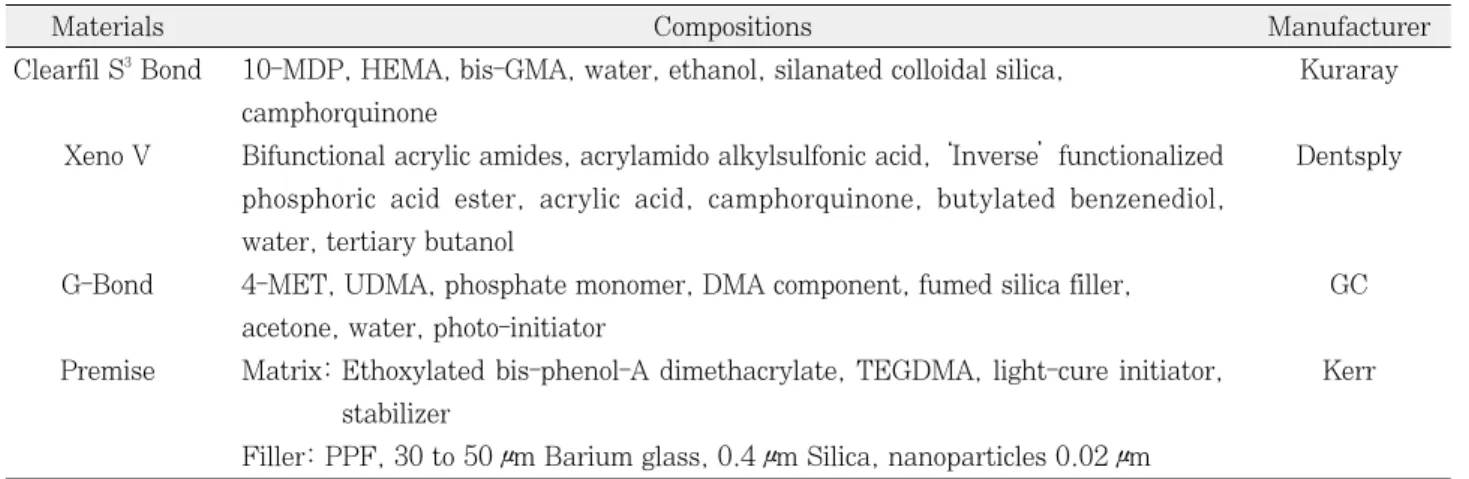
The teeth were then assigned randomly to six groups according to the adhesive system and applica- tion of chlorhexidine. Tables 1 and 2 listed the mate- rials and groups used in this study, respectively. In the chlorhexidine applied groups, 1 mL of a 2%
chlorhexidine solution was applied to the exposed dentin surface for 10 seconds and dried for 10 sec- onds without rinsing. Each adhesive system was applied according to the manufacturer’s instruction.
After the bonding procedure, the light-cure composite resin (Premise; Kerr, Orange, CA, USA) was bonded to the treated dentin surface in 1 mm increments.
Each 1 mm increment was polymerized for 20 sec- onds using a light-emitting diode (LED) visible light- polymerizing unit (Bluephase; Ivoclar Vivadent, Schaan, Liechtenstein), and the height of the total
Table 1.Materials used in this study
*Abbreviations: 10-MDP, 10-methacryloyloxydecyl dihydrogen phosphate; HEMA, 2-hydroxyethyl methacrylate; DMA, dimethacrylate; bis-GMA, bisphenol-A-glycidyl ether dimethacrylate; 4-MET, 4-methacryloxyethyl trimellitic acid;
UDMA, urethane dimethacrylate; TEGDMA, triethylene glycol dimethacrylate; PPF, prepolymerized filler.
Materials Clearfil S3Bond
Xeno V
G-Bond
Premise
Manufacturer Kuraray
Dentsply
GC
Kerr Compositions
10-MDP, HEMA, bis-GMA, water, ethanol, silanated colloidal silica, camphorquinone
Bifunctional acrylic amides, acrylamido alkylsulfonic acid, ‘Inverse’functionalized phosphoric acid ester, acrylic acid, camphorquinone, butylated benzenediol, water, tertiary butanol
4-MET, UDMA, phosphate monomer, DMA component, fumed silica filler, acetone, water, photo-initiator
Matrix: Ethoxylated bis-phenol-A dimethacrylate, TEGDMA, light-cure initiator, stabilizer
Filler: PPF, 30 to 50 μm Barium glass, 0.4 μm Silica, nanoparticles 0.02 μm
resin build up was approximately 5 mm. The restored teeth were then stored in distilled water at room temperature for 24 hours.
3. μTBS testing
The restored teeth were sectioned longitudinally to make approximately 1 ×1 mm thick and 10 mm long specimens using a diamond-saw under copious amounts of water. Each group contained 10 speci- mens. Each specimen was glued to the jig of the microtensile testing machine (BISCO Inc; Bisco, Schaumburg, IL, USA) using cyanoacrylate cement (Zapit; Dental Ventures of America, Corona, CA, USA). A tensile load was applied at a 1.0 mm/min cross-head speed until bonding failure occurred and the maximum load at failure was recorded.
4. Failure mode investigation
The fractured test specimens were examined using an operating microscope (OPMI pico; Carl Zeiss, Obercohen, Germany) under ×25 magnification, and the failure mode was classified as follows: adhesive, if the composite resin cone fractured at the adhesive-
tooth interface; cohesive, if the composite resin cone fractured inside the composite resin or dentin; or mixed, a combination of adhesive and cohesive failure.
5. Statistical analysis
Statistical analysis of the μTBS between chlorhexi- dine application groups and non-application groups were performed using a Student’s t-test. For a com- parison of the dentin adhesives, one-way ANOVA was performed and a Scheffe′’s test was used for a post-hoc multiple comparison. The level of signifi- cance was set to p < 0.05.
Results
Table 3 lists the μTBS of the chlorhexidine applica- tion and non-application groups of each dentin bond- ing agent. In each group, the chlorhexidine non- application group showed a higher μTBS than the application group. However there was no significant difference between application and non-application groups (p > 0.05). In the chlorhexidine application groups, Clearfil S3Bond (group 1) showed the high- est μTBS, followed by a G-Bond (group 5) and Xeno V (group 3). The μTBS values of the three adhesives were significant different (p < 0.05). Similarly, in the chlorhexidine non-application groups, Clearfil S3 Bond (group 2) showed the highest μTBS, followed by G-Bond (group 6) and Xeno V (group 4). The μTBS of the Clearfil S3 Bond was significant higher than that of the G-Bond (p < 0.05). However, there was no significant difference between the G-Bond and Xeno V (p > 0.05).
Table 4 shows the failure mode. Adhesive failure was the main failure mode observed in all groups. All specimens in group 4 showed adhesive failure.
Table 2. Groups used in this study according to the type of adhesive and application of chlorhexidine
Groups Procedure sequence
Group 1 CHX + Clearfil S3Bond (Kuraray, Tokyo, Japan)
Group 2 Clearfil S3Bond
Group 3 CHX + Xeno V (Dentsply, Konstanz, Germany)
Group 4 Xeno V
Group 5 CHX + G-Bond (GC, Tokyo, Japan)
Group 6 G-Bond
Table 3.Mean microtensile bond strength (MPa) and standard deviation (n = 10)
Chlorhexidine Chlorhexidine Student’s t-test
application non-application p-value
Clearfil S3Bond 24.04 ± 2.14A 26.89 ± 1.83a p > 0.05
Xeno V 14.66 ± 1.83B 15.51 ± 2.16b p > 0.05
G-Bond 17.28 ± 1.35C 17.40 ± 1.78b p > 0.05
μTBS with same superscript in the same vertical row were not significantly different (p > 0.05).
Discussion
In many cases, an antiseptic can be useful for elim- inating the effects caused by bacteria and provide a better prognosis for the minimal restorative treat- ment of dental caries. Chlorhexidine is a broad spec- trum antiseptic with pronounced antimicrobial effects,11and has been shown to be effective in reduc- ing cariogenic bacteria.12
In addition to its antibacterial effect, chlorhexidine also functions as a potent matrix metalloproteinase (MMP) inhibitor.13 Despite the remarkable advances that have increased the dentin-resin bond strength, the premature loss of bond strength is a major prob- lems with adhesive restorations. The loss of bond strength was attributed mainly to the degradation of the hybrid layer at the dentin-adhesive interface.
Mild acids can activate MMPs.14,15Both the etch-and- rinse adhesives and self-etching adhesives have mild acidity, and can release and activate endogenous MMPs during dentin bonding.16-18 These activated MMPs can slowly hydrolyze any unprotected collagen fibrils of the dentin hybrid layers, which are believed to be responsible for the thinning and disappearance of collagen fibrils from the incompletely infiltrated hybrid layers in aged, bonded dentin. Auto-degrada- tion of the collagen matrix can be suppressed by syn- thetic protease inhibitors, such as chlorhexidine, indicating that MMP inhibition can be beneficial for preserving hybrid layers.19-21
According to these results, the application of chlorhexidine did not affect the μTBS value signifi- cantly. However, the difference in μTBS between the
bonding agents was significant as follows: Clearfil S3 Bond showed the highest μTBS, followed by G-Bond and Xeno V. Xeno V had the lowest pH (pH < 2), fol- lowed by G-Bond (pH = 2.3), and Clearfil S3 Bond (pH = 2.4). Low-pH self-etch adhesives have rather low bond strengths, particularly to dentin.22This may be why Clearfil S3 Bond showed the highest μTBS, followed by G-Bond and Xeno V.
Previous studies4,5,7,10 reported the association of chlorhexidine application and bond strength to be a contentious issue. There are studies that insist that the application of chlorhexidine affects the bond strength. Gurgan et al reported that the use of 2%
chlorhexidine before or after acid etching may decrease the bond strength by altering the ability of the hydrophilic resin to seal dentin.7 Meiers and Shook indicated that bonding with Tenure (two-step etch-and-rinse adhesive) was unaffected by the application of chlorhexidine, whereas bonding with Syntac (two-step self-etch adhesive) was affected.10
However, Perdigão et al stated that chlorhexidine has strong affinity to the tooth surfaces, which is increased by acid-etching.5 Chlorhexidine also increases the surface free energy of the enamel and can have a similar effect on dentin. These properties might improve the adhesion of primers. However, the loss of calcium from hydroxyapatite and these effects are negated by the presence of chlorhexidine residue.
According to their results, chlorhexidine had no sig- nificant effect on the shear bond strengths of the composite to dentin using the All-Bond 2 adhesive system. Say et al found that chlorhexidine applied before the acid etching of dentin caused changes in the smear layer, but an acid treatment of the surface nullified any effect of chlorhexidine on the smear layer.4 In addition, in the present study, there were no differences between the two groups, regardless of chlorhexidine application.
In this study, adhesive failure was the main failure mode in all groups. Adhesive failure may be due to the lower bond strength or a weak stability of the adhesive layer.
In conclusion, within the limits of this study, the application of 2% chlorhexidine did not affect the μTBS of the resin composite to the dentin using a one-step self-etch adhesive. Because chlorhexidine Table 4. Failure mode (the number of the specimen
of failure)
Groups Adhesive Cohesive Mixed
failure failure failure
Group 1 7 2 1
Group 2 8 1 1
Group 3 8 2 0
Group 4 10 0 0
Group 5 9 1 0
Group 6 8 1 1
has antimicrobial properties and does not significant- ly affect the bond strength to dentin, the use of a chlorhexidine solution with a one-step self-etch adhesive might have the added potential of prevent- ing collagen fibril degradation in the dentin hybrid layers. Further studies will be needed to determine the effects of chlorhexidine on the bond durability.
References
1. Ersin NK, Uzel A, Aykut A, Candan U, Eronat C.
Inhibition of cultivable bacteria by chlorhexidine treat- ment of dentin lesions treated with the ART technique.
Caries Res 2006;40(2):172-177.
2. Mandel ID. Antimicrobial mouthrinses: overview and update. J Am Dent Assoc 1994;125(2):25-105.
3. Baca P, Junco P, Bravo M, Baca AP, Muñoz MJ.
Caries incidence in permanent first molars after dis- continuation of a school-based chlorhexidine-thymol varnish program. Community Dent Oral Epidemiol 2003;31(3):179-183.
4. Say EC, Koray F, Tarim B, Soyman M, Gulmez T. In vitro effect of cavity disinfectants on the bond strength of dentin bonding systems. Quintessence Int 2004;
35(1):56-60.
5. Perdigão J, Denehy GE, Swift EJ Jr. Effects of chlorhexidine on dentin surfaces and shear bond strengths. Am J Dent 1994;7(2):81-84.
6. El-Housseiny AA, Jamjoum H. The effect of caries detector dyes and a cavity cleansing agent on compos- ite resin bonding to enamel and dentin. J Clin Pediatr Dent 2000;25(1):57-63.
7. Gurgan S, Bolay S, Kiremitci A. Effect of disinfectant application methods on the bond strength of composite to dentin. J Oral Rehabil 1999;26(10):836-840.
8. de Castro FL, de Andrade MF, Duarte Junior SL, Vaz LG, Ahid FJ. Effect of 2% chlorhexidine on microten- sile bond strength of composite to dentin. J Adhes Dent 2003;5(2):129-138.
9. Carrilho MR, Carvalho RM, de Goes MF, di Hipolito V, Geraldeli S, Tay FR, Pashley DH, Tjaderhane L.
Chlorhexidine preserves dentin bond in vitro. J Dent Res 2007;86(1):90-94.
10. Meiers JC, Shook LW. Effect of disinfectants on the bond strength of composite to dentin. Am J Dent 1996;9:11-14.
11. Ercan E, Ozekinci T, Atakul F, Gul Kadri.
Antibacterial activity of 2% chlorhexidine gluconate
and 5.25% sodium hypochlorite in infected root canal:
In vivo study. J Endod 2004,30(2):84-87.
12. Attin R, Tuna A, Attin T, Brunner E, Noack MJ.
Efficacy of differently concentrated chlorhexidine var- nishes in decreasing mutans streptococci and lacto- bacilli counts. Arch Oral Biol 2003;48(7):503-509.
13. Gendron R, Grenier D, Sorsa T, Mayrand D. Inhibition of the activities of matrix metalloproteinases 2, 8 and 9 by chlorhexidine. Clin Diagn Lab Immunol 1999;6 (3):437-439.
14. Davis GE. Identification of an abundant latent 94-kDa gelatin-degrading metalloprotease in human saliva which is activated by acid exposure: implications for a role in digestion of collagenous proteins. Arch Biochem Biophys 1991;286(2):551-554.
15. Gunja-Smith Z, Woessner Jr JF. Activation of cartilage stromelysin-1 at acid pH and its relation to enzyme pH optimum and osteoarthritis. Agents Actions 1993;40 (3-4):228-231.
16. Mazzoni A, Pashley DH, Nishitani Y, Breschi L, Mannello F, Tja¨derhane L, Toledano M, Pashley EL, Tay FR. Reactivation of inactivated endogenous prote- olytic activities in phosphoric acid-etched dentine by etch-and-rinse adhesives. Biomaterials 2006;27(25):
4470-4476.
17. Nishitani Y, Yoshiyama M, Wadgaonkar B, Breschi L, Mannello F, Mazzoni A, Carvalho RM, Tja¨derhane L, Tay FR, Pashley DH. Activation of gelatinolytic/col- lagenolytic activity in dentin by self-etching adhesives.
Eur J Oral Sci 2006;114(2):160-166.
18. Tay FR, Pashley DH, Loushine RJ, Weller RN, Monticelli F, Osorio R. Self-etching adhesives increase collagenolytic activity in radicular dentin. J Endod 2006;32(9):862-868.
19. Hashimoto M, Ohno H, Sano H, Kaga M, Oguchi H. In vitro degradation of resin-dentin bonds analyzed by microtensile bond test, scanning and transmission elec- tron microscopy. Biomaterials 2003;24(21):3795-3803.
20. Armstrong SR, Vargas MA, Chung I, Pashley DH, Campbell JA, Laffoon JE, Qian F. Resin-dentin inter- facial ultrastructure and microtensile dentin bond strength after five-year water storage. Oper Dent 2004;29(6):705-712.
21. Pashley DH, Tay FR, Yiu C, Hashimoto M, Breschi L, Carvalho RM, Ito S. Collagen degradation by host- derived enzymes during aging. J Dent Res 2004;83(3):
216-221.
22. De Munck J, Vargas M, Iracki J, Van Landuyt K, Poitevin A, Lambrechts P, Van Meerbeek B. One-day bonding effectiveness of new self-etch adhesives to bur- cut enamel and dentin. Oper Dent 2005;30(1):39-49.
국문초록
2% 클로르헥시딘 적용이 한 단계 자가부식 접착제를 이용한 복합 레진의 상아질에 대한 미세인장 결합강도에 미치는 효과
장순함1∙허 복1∙김현철1∙권용훈2∙박정길1*
부산대학교 치의학전문대학원1치과보존학교실, 2치과재료학교실
연구목적: 이 연구의 목적은 2% 클로르헥시딘 적용이 한 단계 자가부식접착제를 이용한 직접 복합 레진 수복의 미세 인장 강도에 미치는 영향을 평가하는 것이었다.
연구 재료 및 방법: 24개의 발거된 대구치를 사용하여 3종류의 한 단계 자가부식접착제 (Clearfil S3 Bond, Xeno V, G- Bond)를 클로르헥시딘을 적용한 그룹과 적용하지 않은 그룹, 총 6개의 그룹으로 나누었다. 클로르헥시딘을 적용하거나 적용 하지 않고 그 상부에 각각의 접착제를 적용하고 광중합 복합 레진으로 수복하였다. 24시간 동안 실온의 증류수에 보관한 후 각 그룹당 10개의 시편을 준비 하여 모든 시편의 미세인장 결합 강도를 측정하였다.
결과: 2% 클로르헥시딘 적용이 한 단계 자가부식접착제를 이용한 복합레진 수복의 미세인장 결합강도에 영향을 미치지 않 았다. 클로르헥시딘 적용과 상관없이 Clearfil S3 Bond가 가장 높은 미세인장 결합강도 값을 나타내었고 그 다음은 G- Bond, Xeno V 순이었다. 파절 양상은 대부분 접착성 파절을 보였고 일부는 응집성 파절을 보였다.
결론: 2% 클로르헥시딘 적용이 한 단계 자가부식접착제를 이용한 복합레진 수복의 미세인장 결합강도에 영향을 미치지 않 았다.
주요단어: 미세인장강도, 클로르헥시딘, 한 단계 자가부식 접착