INTRODUCTION
The principles that make up esthetics are subtle.1Methodical analysis has revealed that principles can be applied to evalu- ate and alter dental esthetics with predictability.2Each principle can be considered, recognized, assessed and developed indi- vidually in esthetic management.3Among the esthetic principles, the proportion can be predicted with a formula that defines the ratio of the component from one constituent to the next. The golden proportion (1.618 : 1.0) is a mathematically constant ratio that defines the dimensions between larger and a small- er length. This specific relation is unique, perfect, ideal, and desirable. It has been used from studying beauty to design esthet- ic restorations.4,5It is also a valuable tool for the evaluation of symmetry, dominance, and proportion in the diagnosis of tooth arrangement and in the application of esthetic dental treat- ment.6On the contrary, the researchers found that usage of the golden proportion is theoretical and its application is chal- lenging.7-10The studies have shown both the presence and the disapproval of golden proportion. The uncertainty of golden proportion in esthetic analysis and in smile design intended this study to evaluate the existence or presence of golden proportion in Indian population.
MATERIALS AND METHODS
The selected population was approved by a five member pan- el comprising of 2 restorative dentists, two patients and one res- ident for esthetics for standardization. The sample size for this study consisted of 576 volunteers, 305 females and 271 males, ranging in age from 21 to 30 years. A random population of acceptable esthetics was selected. The selection criteria required the subjects to have all of their natural anterior teeth with no history of orthodontic treatment, tooth size alteration, spacing and restorations. The volunteers were of Indian origin, their con- sent and ethical clearances were obtained from the institution ethical committee for the study. The teeth evaluated for max- imum width on the incisal edge. Entire procedure was made simple as the patient restorations were evaluated in normal clin- ical situations rather than in complex environment. The flat end of digital caliper is used to measure the widths of the maxil- lary central, lateral and canine, mandibular central, lateral and canine. The width of maxillary and mandibular anterior teeth arch width was measured using a flexible ruler. The widths of the teeth were measured at the mesio-distal contact points of teeth (Fig. 1). Anterior teeth width was measured from distal contact point of 13 to distal contact point of 23 in maxilla and
http://dx.doi.org/10.4047/jap.2012.4.2.72
Golden proportion assessment between maxillary and mandibular teeth on Indian population
Naveen Gopi Chander1*, MDS, DNB, Vaikunth Vijay Kumar2, MDS, Vedantham Rangarajan3, MDS
1Department of Prosthodontics, SRM Dental College, Ramapuram, Chennai, India, 2Department of Prosthodontics,
Priyadarshini Dental College, Chennai, India, 3Department of Prosthodontics, Sri Venkateshwara Dental College, Chennai, India
PURPOSE. This study evaluated the existence of golden proportion between the widths of the maxillary and mandibular anterior teeth in Indian population. MATERIALS AND METHODS. The clinical tooth width measurements were recorded with the digital vernier calipers on 576 patients of both sexes in the age group of 21 - 30 years. Flexible ruler was used to determine the width of maxillary and mandibular anterior teeth on the patients by the same operator. The data obtained was statistically analyzed using paired student t-test (α=.05). RESULTS. The golden pro- portion was not found between the width of the right central and lateral incisors in 53% of women and 47% of men. The results revealed the golden percentage was rather inconstant in terms of relative tooth width. CONCLUSION. The golden proportion is an inappropriate method to relate the successive widths of the maxillary anterior teeth in Indian population. [J Adv Prosthodont 2012;4:72-5]
72
ORIGINAL ARTICLE J Adv Prosthodont 2012;4:72-5
KEY WORDS: Esthetic ratio; Golden proportion; Golden ratio
Corresponding author: Naveen Gopi Chander Department of Prosthodontics, SRM Dental College, Ramapuram, Chennai, 600089, India
Tel. 91 98407 49441: e-mail, [email protected]
Received October 6, 2011 / Last Revison February 17, 2012 / Accepted February 20, 2012
ⓒ 2012 The Korean Academy of Prosthodontics
This is an Open Access article distributed under the terms of the Creative Commons Attribution Non-Commercial License (http://creativecommons.org/licenses/by- nc/3.0) which permits unrestricted non-commercial use, distribution, and reproduction in any medium, provided the original work is properly cited.
distal contact point of 33 to distal contact point of 43 in mandibular teeth using flexible ruler (Fig. 2). Each mea- surement was made thrice by the same operator and the repetitive value was used for accuracy and calibration of results.
The golden proportion for each subject was assessed by mul- tiplying the width of the larger component by 62% and com- pared the width of the smaller component for proportion to be analyzed. The width of central incisor was multiplied by 62% and compared with the width of the adjacent lateral incisor. Similarly the width of the lateral incisor, canine and the maxillary and mandibular teeth were evaluated for gold- en proportion. The measurements were recorded and statistically analyzed.
RESULTS
Data obtained were entered into Microsoft Excel sheet and analyzed statistically using SPSS statistical package version No. 10. Descriptive statistics were calculated for the fre- quency of participants having various ratios of golden proportions based on sex. Chi square analysis was used to find if there exists any association between sex and various ratios of golden proportions. Alpha error was set at 5%, and P value less than 0.05 was considered statistically significant.
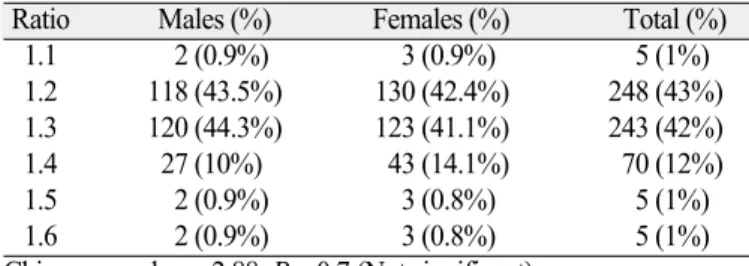
The data revealed no statistical significance in the ratio of gold- en proportions based on gender. The data obtained from this study is summarized in Table 1. The mean ratio existed between maxillary and mandibular teeth ranged from 73% to 84%. The ratio of 1.2 and 1.3 were more common than 1.618 which is observed in 1% of the samples.
DISCUSSION
The golden proportion (1.618 : 1.0) describes the ratio between the dimensions of a larger and a smaller length.
Various researchers have opined for and against the use of this mathematic proportions in dentistry.1-9Levin4observed the gold- en proportion between the width of central incisor, lateral incisor and the canine. George and Bhat11found that the golden pro- portion is reliable predictors for determining the width of the maxillary central incisors in the south Indian population.
Preston12found 17% of his study samples had golden proportion between the width of the maxillary central and lateral incisors.
Lombardi1 recommended a repeated ratio concept in con- trast to golden proportion. Mahshid et al.13reported that the gold- en proportion did not exist between the widths of the maxil- lary anterior teeth and it was substantiated by Ward,14Gillen et al.,15Rosenstiel et al.16The variation of thoughts among researchers17-25and lack of similar study on Indian population aimed this study to evaluate the existence of golden propor- tion between anterior teeth in the Indian population.
73
Golden proportion assessment between maxillary and mandibular teeth on Indian population
J Adv Prosthodont 2012;4:72-5
Chander NG et al.
Fig. 1. Mesio-distal width of maxillary and mandibular central incisor.
x = mesio-distal width of maxillary central incisor y = mesio-distal width of mandibular central incisor
Fig. 2. Mesio-distal width of maxillary and mandibular anterior teeth.
x1 = mesio-distal width of maxillary anterior incisor y1 = mesio-distal width of mandibular anterior incisor
Table 1. Frequency and percentage of ratio in the study sample
Ratio Males (%) Females (%) Total (%)
1.1 2 (0.9%) 3 (0.9%) 5 (1%)
1.2 118 (43.5%) 130 (42.4%) 248 (43%)
1.3 120 (44.3%) 123 (41.1%) 243 (42%)
1.4 27 (10%) 43 (14.1%) 70 (12%)
1.5 2 (0.9%) 3 (0.8%) 5 (1%)
1.6 2 (0.9%) 3 (0.8%) 5 (1%)
Chi square value = 2.88, P = 0.7 (Not significant)
The results of the study indicated that golden proportion did not exist in majority of the Indian population. The ratio of 1.2 and 1.3 were more commonly observed in 43% and 42% of indi- viduals than 1.618. The ratio of 1.5 and 1.6 were found in 5%
and 1% of the study group evaluated. The 1.2 ratio which was commonly observed is substantiated by Rosensteil et al.16 Javaheri and Shahnavaz,26Jahanbin et al.,27Decker,28Sarver and Ackerman,29 Marguardt,30 Howells and Shaw,31 Amoric,32 Phillips et al.,33Wolfart et al.34consider golden proportion to be a superior aspect of esthetics but the proportion is more artis- tic, theoretical and impractical in nature. It is also inappropriate to anticipate for every patient to possess this precise relationship because human are individuals with unique facial and dental features. Being one of the microesthetics factors of esthetics it is not a major consideration whereas the other macroesthetic factors and principles play a significant role in determining esthet- ics.35
The adherence to a particular proportion for all patients universally is impractical.22The results of this study showed varied existence of specific ratio of 1.2 in 43% of study sam- ples and 1.3 and 42% of samples. No major differences in pro- portion existed between the sexes and in the symmetry of max- illary and mandibular teeth. Findings of this study were sub- stantiated by other investigations of de Castro et al.,36Ong et al.,37Wolfart et al.,38Shell and Woods39done on non-Indian pop- ulation. The results of this study have inferred that golden pro- portion is negligible and not seen in majority of Indian pop- ulation.
Unlike other studies8,11 the sample size selected for the study is superior but larger group is required to obtain defin- itive conclusions on Indian population which varies with cultural diversity. Though the width measurements were made to clinical precision there might be a 0.5 mm variation exist in the proximal contact area measurement which can be a binding limitation in this study. From the results obtained and within the limitations of the study the following were appraised.
Ethnic differences should be considered for esthetics and proportion studies especially with Indian population which varies with cultural diversity. The golden proportion was not found between maxillary and mandibular anterior teeth in majority of Indian population and the ratio of 1.2 and 1.3 is more commonly seen in Indian population. There were no major changes seen in the proportions between sexes and symmetry of teeth in Indian population.
CONCLUSION
This study inferred that golden proportion between the widths of maxillary and mandibular teeth was not observed in the majority of Indian population.
REFERENCES
1. Lombardi RE. The principles of visual perception and their clinical application to denture esthetics. J Prosthet Dent 1973;29:
358-82.
2. Ward DH. Proportional smile design using the recurring esthetic dental (red) proportion. Dent Clin North Am 2001;45:143-54.
3. Morley J, Eubank J. Macroesthetic elements of smile design. J Am Dent Assoc 2001;132:39-45.
4. Levin EI. Dental esthetics and the golden proportion. J Prosthet Dent 1978;40:244-52.
5. Snow SR. Esthetic smile analysis of maxillary anterior tooth width:
the golden percentage. J Esthet Dent 1999;11:177-84.
6. Ricketts RM. The biologic significance of the divine proportion and Fibonacci series. Am J Orthod 1982;81:351-70.
7. Mizumoto Y, Deguchi T Sr, Fong KW. Assessment of facial gold- en proportions among young Japanese women. Am J Orthod Dentofacial Orthop 2009;136:168-74.
8. Murthy BV, Ramani N. Evaluation of natural smile: Golden proportion, RED or Golden percentage. J Conserv Dent 2008;11:
16-21.
9. Bukhary SM, Gill DS, Tredwin CJ, Moles DR. The influence of varying maxillary lateral incisor dimensions on perceived smile aesthetics. Br Dent J 2007;203:687-93.
10. Ali Fayyad M, Jamani KD, Agrabawi J. Geometric and math- ematical proportions and their relations to maxillary anterior teeth.
J Contemp Dent Pract 2006;7:62-70.
11. George S, Bhat V. Inner canthal distance and golden proportion as predictors of maxillary central incisor width in south Indian population. Indian J Dent Res 2010;21:491-5.
12. Preston JD. The golden proportion revisited. J Esthet Dent 1993;5:247-51.
13. Mahshid M, Khoshvaghti A, Varshosaz M, Vallaei N. Evaluation of "golden proportion" in individuals with an esthetic smile. J Esthet Restor Dent 2004;16:185-92.
14. Ward DH. Proportional smile design using the recurring esthetic dental (red) proportion. Dent Clin North Am 2001;45:143-54.
15. Gillen RJ, Schwartz RS, Hilton TJ, Evans DB. An analysis of selected normative tooth proportions. Int J Prosthodont 1994;7:
410-7.
16. Rosenstiel SF, Ward DH, Rashid RG. Dentists' preferences of anterior tooth proportion-a web-based study. J Prosthodont 2000;9:123-36.
17. Vegter F, Hage JJ. Clinical anthropometry and canons of the face in historical perspective. Plast Reconstr Surg 2000;106:1090-6.
18. Bell RA. The geometric theory of selection of artificial teeth: is it valid? J Am Dent Assoc 1978;97:637-40.
19. Latta GH Jr, Weaver JR, Conkin JE. The relationship between the width of the mouth, interalar width, bizygomatic width, and interpupillary distance in edentulous patients. J Prosthet Dent 1991;65:250-4.
20. Basting RT, da Trindade Rde C, Flo′rio FM. Comparative study of smile analysis by subjective and computerized meth- ods. Oper Dent 2006;31:652-9.
21. Al Wazzan KA. The relationship between intercanthal dimen- sion and the widths of maxillary anterior teeth. J Prosthet Dent 2001;86:608-12.
22. Ahmad I. Geometric considerations in anterior dental aesthet- ics: restorative principles. Pract Periodontics Aesthet Dent 1998;10:813-22.
23. Koury ME, Epker BN. Maxillofacial esthetics: anthropometrics of the maxillofacial region. J Oral Maxillofac Surg 1992;50:
806-20.
24. Scolozzi P, Momjian A, Courvoisier D. Dentofacial deformities treated according to a dentoskeletal analysis based on the divine proportion: are the resulting faces de facto "divinely" proportioned?
J Craniofac Surg 2011;22:147-50.
74
Golden proportion assessment between maxillary and mandibular teeth on Indian population
J Adv Prosthodont 2012;4:72-5 Chander NG et al.
25. Simon J. Using the golden proportion in aesthetic treatment: a case report. Dent Today 2004;23:82, 84.
26. Javaheri DS, Shahnavaz S. Utilizing the concept of the golden proportion. Dent Today 2002;21:96-101.
27. Jahanbin A, Basafa M, Alizadeh Y. Evaluation of the Divine Proportion in the facial profile of young females. Indian J Dent Res 2008;19:292-6.
28. Decker JD. The divine proportion. Am J Orthod Dentofacial Orthop 2004;126:19A-20A.
29. Sarver DM, Ackerman MB. Dynamic smile visualization and quantification: Part 2. Smile analysis and treatment strategies.
Am J Orthod Dentofacial Orthop 2003;124:116-27.
30. Marquardt SR. Marquardt on the Golden Decagon and human facial beauty. Interview by Dr. Gottlieb. J Clin Orthod 2002;
36:339-47.
31. Howells DJ, Shaw WC. The validity and reliability of ratings of dental and facial attractiveness for epidemiologic use. Am J Orthod 1985;88:402-8.
32. Amoric M. The golden number: applications to cranio-facial eval- uation. Funct Orthod 1995;12:18-21, 24-5.
33. Phillips C, Trentini CJ, Douvartzidis N. The effect of treatment on facial attractiveness. J Oral Maxillofac Surg 1992;50:590-4.
34. Wolfart S, Thormann H, Freitag S, Kern M. Assessment of den- tal appearance following changes in incisor proportions. Eur J Oral Sci 2005;113:159-65.
35. Hasanreisoglu U, Berksun S, Aras K, Arslan I. An analysis of maxillary anterior teeth: facial and dental proportions. J Prosthet Dent 2005;94:530-8.
36. de Castro MV, Santos NC, Ricardo LH. Assessment of the "gold- en proportion" in agreeable smiles. Quintessence Int 2006;37:597- 604.
37. Ong E, Brown RA, Richmond S. Peer assessment of dental at- tractiveness. Am J Orthod Dentofacial Orthop 2006;130:163-9.
38. Wolfart S, Quaas AC, Freitag S, Kropp P, Gerber WD, Kern M.
Subjective and objective perception of upper incisors. J Oral Rehabil 2006;33:489-95.
39. Shell TL, Woods MG. Facial aesthetics and the divine proportion:
a comparison of surgical and non-surgical class II treatment. Aust Orthod J 2004;20:51-63.
75
Golden proportion assessment between maxillary and mandibular teeth on Indian population
J Adv Prosthodont 2012;4:72-5
Chander NG et al.