© 2018 Korean Breast Cancer Society. All rights reserved. http://ejbc.kr | pISSN 1738-6756
INTRODUCTION
Breast-conserving surgery (BCS) is oncologically and surgi- cally safe, with a long-term survival comparable to total mas- tectomy [1,2]. However, the aesthetic outcomes of breast shape and symmetry resulting from BCS are not always opti- mal. In 25%–30% of women, the aesthetic outcome is com- promised after BCS [3]. In addition, BCS is not suitable under certain conditions such as large or multicentric tumors and in cases involving the skin or pectoral muscle. Moreover, with BCS, free margins cannot be obtained in specific oncologic and anatomic conditions such as tumors larger than 5 cm in diameter, high tumor-to-breast ratio, or multicentric tumors
[4]. Previous studies reported that positive margins were found in 10%–40% of the cases, with re-excision rates up to 60% in BCS cases [5,6]. Such high incidences of re-excision result in high morbidity, complications, and healthcare costs [7,8].
A combination of oncoplastic surgery (OPS) and BCS has been developed to overcome the abovementioned shortcom- ings. The primary aim of OPS is to reduce deformity and at- tain acceptable breast appearance. Many oncoplastic breast- conserving techniques have been previously developed. In general, the technical approaches can be categorized into three main types: breast-reduction techniques, volume-re- placement techniques, and en-bloc closure techniques for breast defects [9]. Because OPS involves reshaping of the whole breast, it allows wider excision of the tumor, thus in- creasing the likelihood of performing conservative surgery for patients previously considered unsuitable for BCS, including those with a large tumor, unfavorable tumor-to-breast ratio, central and low-pole tumor location, or multifocal disease [10]. However, outcomes of other oncologic parameters such
Comparison of Oncoplastic Breast-Conserving Surgery and Breast- Conserving Surgery Alone: A Meta-Analysis
Jun-Ying Chen1,2,3,*, Yi-Jie Huang4,*, Liu-Lu Zhang5, Ci-Qiu Yang5, Kun Wang5
1Sun Yat-sen University Cancer Center, Guangzhou; 2State Key Laboratory of Oncology in South China, Guangzhou; 3Collaborative Innovation Center for Cancer Medicine, Guangzhou; Departments of 4General Surgery and 5Breast Cancer, Guangdong General Hospital, Guangdong Academy of Medical Sciences, Guangzhou, China
ORIGINAL ARTICLE
Purpose: The use of oncoplastic reconstruction for breast- conserving surgery (BCS) extends benefits beyond merely minimizing poor cosmetic results. However, the feasibility and oncological safety of oncoplastic surgery (OPS) are controversial.
Methods: This meta-analysis aimed to compare the short-term and long-term oncological outcomes of BCS alone and BCS plus OPS. Relevant studies published before July 2017 in the Embase, the Cochrane Library, PubMed, and Web of Science databases were screened and collected. The meta-analysis was performed using STATA software (Stata Corp.). Results: A total of 3,789 patients from 11 studies were included, with 2,691 patients in the BCS-alone group and 1,098 patients in the BCS plus OPS group. The demographics were similar between both groups, and no significant difference was
observed in pathological T and N stages between the two groups. Re-excision was less common (relative risk [RR], 0.66;
p=0.009) and the positive-margin rate was lower, but not significantly (RR, 0.83; p=0.191), in the BCS plus OPS group than in the BCS-alone group. The local and distal recurrence rates were similar in both groups. Both disease-free survival (hazard ratio [HR], 1.19; 95% confidence interval [CI], 0.96–
1.49; p=0.112) and overall survival (HR, 1.14; 95% CI, 0.76–
1.69; p=0.527) did not differ between the two groups. Conclusion:
A combination of BCS and OPS is preferred over BCS alone for decreasing re-excisions and provides similar long-term survival as BCS alone in patients with breast cancer.
Key Words: Breast neoplasms, Mammaplasty, Mastectomy, Meta-analysis
Correspondence to: Kun Wang
Department of Breast Cancer, Guangdong General Hospital,123 Huifu West Road, Yuexiu District, Guangzhou, Guangdong 510080, China
Tel: +86-020-81884713-80422, Fax: +86-020-83844620 E-mail: [email protected]
*These authors contributed equally to this work.
Received: November 17, 2017 Accepted: July 11, 2018
Cancer
as positive margins and cancer recurrence have not yet been analyzed for OPS.
Therefore, we performed a meta-analysis to compare BCS alone and BCS plus OPS to determine the oncological out- comes of BCS plus OPS. With a large sample size, it is possible to eliminate some of the inherent selection bias associated with these procedures.
METHODS
Literature search
Several databases including PubMed, Web of Science, Embase, and the Cochrane Library were searched by two independent reviewers by using the following terms: (1) oncoplastic OR conserving OR segmental OR segmentectomy OR lumpect- omy OR local excision OR mastectomy AND (2) breast AND (3) neoplasm OR cancer OR tumor OR carcinoma OR malig- nant AND (4) recurrence OR relapse AND (5) survival. Re- views of interest were also retrieved from the reference lists of relevant studies. Only studies published before July 2017 were included in the search.
Inclusion and exclusion criteria
The following studies were selected in the meta-analysis: (1) studies including at least two groups of patients with OPS or BCS; (2) studies comparing short-term outcomes of OPS and BCS including margin status, re-excision, tumor size, and pathological T and N stages; (3) studies comparing long-term outcomes of OPS and BCS including local, regional, and distal relapse, disease-free survival (DFS), and overall survival (OS);
and (4) studies describing the clinicopathological characteris- tics of patients.
The exclusion criteria were as follows: (1) OPS with onco- plastic mastectomy; (2) review, case report, conference ab- stract, and comment articles; (3) experimental studies based on non-human subjects; and (4) duplicate studies or data from the same patient cohort.
Data collection
Data collection from all included studies was performed by two independent investigators. The following general and clinicopathological characteristics were extracted from the eli- gible studies: first author’s names, publication year, country, study period, number of patients, TNM stage, age, gender, di- agnosis (invasive, in situ, and others), tumor characteristics, specimen weight and size, margin status, re-excision rate, length of follow-up, and outcomes (survival and recurrence).
Discrepancies in the data were further discussed, and a con- sensus was reached for all extracted parameters.
Statistical analysis
Pooled analysis was performed using STATA version 12 software (Stata Corp., College Station, USA). The I2 statistic was used to measure the statistical heterogeneity in the meta- analysis of each clinicopathological parameter. The fixed- effects model (the Mantel-Haenszel method) was used if the heterogeneity was accepted, and the random-effects model (the DerSimonian-Laird method) was used if there was con- siderable statistical heterogeneity. The Begg’s and Egger’s tests were performed to calculate the publication bias. Values of p<0.05 were defined as statistically significant in all pooled comparisons.
RESULTS
Demographics
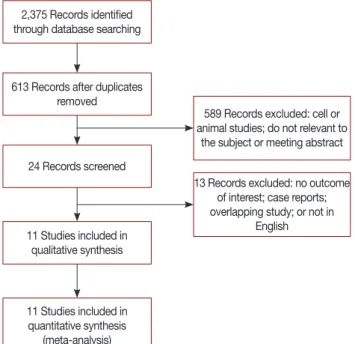
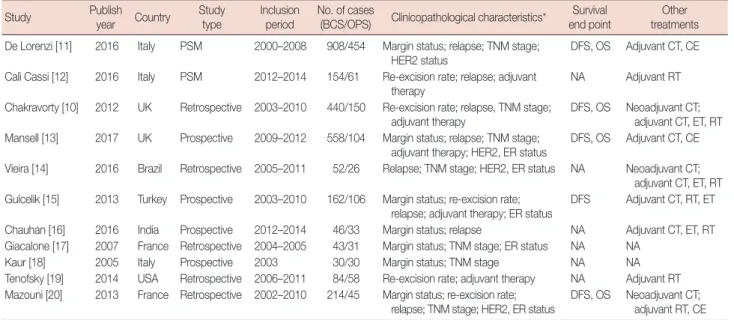
A total of 2,375 studies were initially selected from the liter- ature. Of these, 11 studies [10-20] were finally included in the meta-analysis. The excluded studies were duplicated studies from different websites, studies with overlapping data, case re- ports, conference abstracts, and studies based on experimen- tal or non-human subjects (Figure 1). A total of 3,789 cases (2,691 patients in the BCS group and 1,098 in the BCS plus OPS group) from the 11 studies were included in the meta- analysis (Table 1).
The OPS techniques used in the included studies were glan- dular or pedicle flap transfer, wise-pattern procedure, Grisotti procedure, Benelli procedure, donut mastopexy, reduction
Figure 1. Flow chart of the meta-analysis.
2,375 Records identified through database searching
613 Records after duplicates removed
24 Records screened
589 Records excluded: cell or animal studies; do not relevant to
the subject or meeting abstract
13 Records excluded: no outcome of interest; case reports;
overlapping study; or not in English 11 Studies included in
qualitative synthesis
11 Studies included in quantitative synthesis
(meta-analysis)
Table 1. Main characteristics of studies included in the meta-analysis
Study Publish
year Country Study type
Inclusion period
No. of cases
(BCS/OPS) Clinicopathological characteristics* Survival end point
Other treatments De Lorenzi [11] 2016 Italy PSM 2000–2008 908/454 Margin status; relapse; TNM stage;
HER2 status
DFS, OS Adjuvant CT, CE
Calì Cassi [12] 2016 Italy PSM 2012–2014 154/61 Re-excision rate; relapse; adjuvant therapy
NA Adjuvant RT
Chakravorty [10] 2012 UK Retrospective 2003–2010 440/150 Re-excision rate; relapse, TNM stage;
adjuvant therapy DFS, OS Neoadjuvant CT;
adjuvant CT, ET, RT Mansell [13] 2017 UK Prospective 2009–2012 558/104 Margin status; relapse; TNM stage;
adjuvant therapy; HER2, ER status
DFS, OS Adjuvant CT, CE
Vieira [14] 2016 Brazil Retrospective 2005–2011 52/26 Relapse; TNM stage; HER2, ER status NA Neoadjuvant CT;
adjuvant CT, ET, RT Gulcelik [15] 2013 Turkey Prospective 2003–2010 162/106 Margin status; re-excision rate;
relapse; adjuvant therapy; ER status DFS Adjuvant CT, RT, ET Chauhan [16] 2016 India Prospective 2012–2014 46/33 Margin status; relapse NA Adjuvant CT, ET, RT Giacalone [17] 2007 France Retrospective 2004–2005 43/31 Margin status; TNM stage; ER status NA NA
Kaur [18] 2005 Italy Prospective 2003 30/30 Margin status; TNM stage NA NA
Tenofsky [19] 2014 USA Retrospective 2006–2011 84/58 Re-excision rate; adjuvant therapy NA Adjuvant RT Mazouni [20] 2013 France Retrospective 2002–2010 214/45 Margin status; re-excision rate;
relapse; TNM stage; HER2, ER status
DFS, OS Neoadjuvant CT;
adjuvant RT, CE BCS =breast-conserving surgery; OPS =oncoplastic surgery; PSM =propensity score matching; HER2 =human epidermal growth factor receptor 2;
DFS =disease-free survival; OS =overall survival; CT =chemotherapy; CE =chemotherapy and endocrine therapy; NA =not available; RT =radiotherapy;
ET=endocrine therapy; ER=estrogen receptor.
*Only characteristics associated with prognosis included.
Figure 2. Forest plot of the distribution of pathological stages. The pathological T (A) and N (B) stages in oncoplastic surgery (OPS) and breast-con- serving surgery (BCS) groups. Weights are from random effects analysis.
RR=relative risk; CI=confidence interval.
B A Mansell (2017) [13]
De Lorenzi (2016) [11]
Giacalone (2007) [17]
Kaur (2005) [18]
Mazouni (2013) [20]
Overall (I2=84.3%, p<0.001)
Chakravorty (2012) [10]
Mansell (2017) [13]
De Lorenzi (2016) [11]
Vieira (2016) [14]
Giacalone (2007) [17]
Mazouni (2013) [20]
Overall (I2=20.3%, p=0.280) Study
ID
Study ID
1
1
4.89
0.33
0.55 (0.44–0.68) 25.98 44/51 395/72 1.00 (0.90–1.11) 28.48 251/203 502/406 0.78 (0.49–1.23) 18.78 14/17 25/18 1.04 (0.74–1.47) 22.46 20/6 14/15 1.09 (0.24–4.86) 4.30 2/40 9/197 0.83 (0.59–1.16) 100.00 331/317 945/708
0.96 (0.88–1.06) 25.53 120/30 365/75 0.81 (0.70–0.93) 18.37 65/29 390/65 0.97 (0.87–1.07) 46.91 247/204 512/391 0.90 (0.34–2.41) 0.92 9/43 5/21 1.12 (0.80–1.57) 2.59 17/6 25/13 0.96 (0.71–1.29) 5.69 24/21 119/95 0.94 (0.88–1.00) 100.00 482/333 1,416/660 RR (95% CI) % OPS BCS
Weight pT1/pT2+3 pT1/pT2+3
RR (95% CI) % OPS BCS Weight pN0/pN+ pN0/pN+
mammoplasty following lumpectomy, quadrantectomy, or wide local excision. Young patients with breast cancer tended to choose OPS; the average age of patients in the OPS group was lower in seven studies [10,12,13,16-19], of which three studies [13,18,19] reached statistical significance. All the in- cluded studies compared the oncological outcomes of BCS and BCS plus OPS for breast cancer, and the major histopath- ological type was ductal carcinoma (83.8%–71.6%). There was no significant difference in the in situ (BCS vs. OPS, 5.1%–
18.6% vs. 8.9%–19.4%, respectively) and invasive disease (BCS vs. OPS, 74.4%–85.6% vs. 74.2%–91.3%) diagnoses between the BCS and BCS plus OPS groups. The random-effects mod-
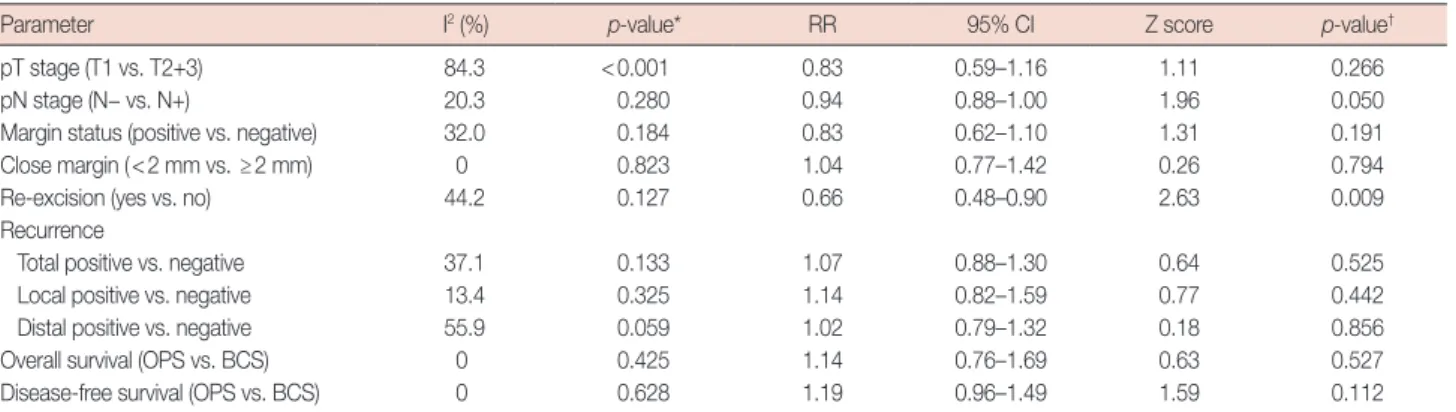
el used to determine the pooled relative risk (RR) of patholog- ical T stages due to statistical heterogeneity (I2=84.3%, p<
0.001) showed no difference in the pathological T stage (T1 vs. T2+T3; RR, 0.83; 95% confidence interval [CI], 0.59–1.16;
p=0.266) (Table 2, Figure 2A); in contrast, the pathological N stage (N0 vs. N1; RR, 0.94; 95% CI, 0.88–1.00; p=0.050) was marginally significant in the BCS-alone and BCS plus OPS groups (Table 2, Figure 2B).
Short-term outcomes
Positive-margin and re-excision rates are the pivotal short- term factors associated with the safety and feasibility of surgical
Figure 3. Forest plot of margin status difference in oncoplastic surgery (OPS) and breast-conserving surgery (BCS) groups.
RR=relative risk; CI=confidence interval.
Margin status Kaur (2005) [18]
Giacalone (2007) [17]
Gulcelik (2013) [15]
Mazouni (2013) [20]
Chauhan (2016) [16]
De Lorenzi (2016) [11]
Mansell (2017) [13]
Subtotal (I2=32.0%, p=0.184)
Close margin (<2 mm) Giacalone (2007) [17]
Gulcelik (2013) [15]
Chauhan (2016) [16]
De Lorenzi (2016) [11]
Subtotal (I2=0.0%, p=0.823) Study
ID
1 139
0.00719
0.38 (0.16–0.94) 14.47 5/25 13/17 0.59 (0.17–2.12) 6.53 3/28 7/36 0.57 (0.28–1.18) 21.13 9/97 24/138 1.11 (0.52–2.37) 11.61 7/38 30/184 0.13 (0.01–2.20) 5.14 0/33 5/41 1.24 (0.63–2.45) 15.59 13/441 21/887 1.10 (0.66–1.84) 25.53 15/89 73/485 0.83 (0.62–1.10) 100.00 52/751 100/1,788
0.79 (0.25–2.47) 8.17 4/27 7/36 0.93 (0.46–1.90) 19.84 11/95 18/114 0.70 (0.19–2.59) 6.98 3/30 6/40 1.14 (0.79–1.66) 65.01 40/414 70/838 1.04 (0.77–1.42) 100.00 58/566 101/1,058 RR (95% CI) % OPS BCS
Weight Yes/no Yes/no
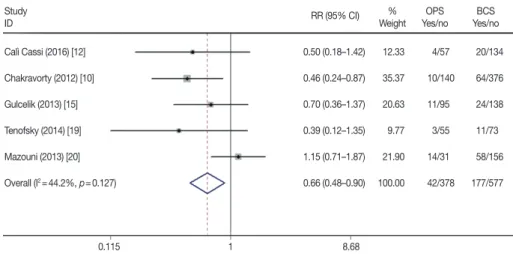
Figure 4. Forest plot of discrepancy of re-excision rate in oncoplastic surgery (OPS) and breast-conserving surgery (BCS) groups.
RR=relative risk; CI=confidence interval.
Calì Cassi (2016) [12]
Chakravorty (2012) [10]
Gulcelik (2013) [15]
Tenofsky (2014) [19]
Mazouni (2013) [20]
Overall (I2=44.2%, p=0.127) Study
ID
1 8.68
0.115
0.50 (0.18–1.42) 12.33 4/57 20/134 0.46 (0.24–0.87) 35.37 10/140 64/376 0.70 (0.36–1.37) 20.63 11/95 24/138 0.39 (0.12–1.35) 9.77 3/55 11/73 1.15 (0.71–1.87) 21.90 14/31 58/156 0.66 (0.48–0.90) 100.00 42/378 177/577 RR (95% CI) % OPS BCS
Weight Yes/no Yes/no
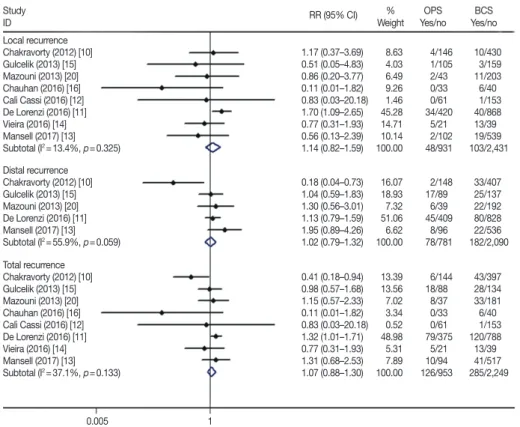
Figure 5. Forest plot of tumor recurrence differences in oncoplastic surgery (OPS) and breast-conserving surgery (BCS) groups.
RR=relative risk; CI=confidence interval.
Local recurrence Chakravorty (2012) [10]
Gulcelik (2013) [15]
Mazouni (2013) [20]
Chauhan (2016) [16]
Calì Cassi (2016) [12]
De Lorenzi (2016) [11]
Vieira (2016) [14]
Mansell (2017) [13]
Subtotal (I2=13.4%, p=0.325)
Total recurrence Chakravorty (2012) [10]
Gulcelik (2013) [15]
Mazouni (2013) [20]
Chauhan (2016) [16]
Calì Cassi (2016) [12]
De Lorenzi (2016) [11]
Vieira (2016) [14]
Mansell (2017) [13]
Subtotal (I2=37.1%, p=0.133) Distal recurrence
Chakravorty (2012) [10]
Gulcelik (2013) [15]
Mazouni (2013) [20]
De Lorenzi (2016) [11]
Mansell (2017) [13]
Subtotal (I2=55.9%, p=0.059) Study
ID
1 0.005
1.17 (0.37–3.69) 8.63 4/146 10/430 0.51 (0.05–4.83) 4.03 1/105 3/159 0.86 (0.20–3.77) 6.49 2/43 11/203 0.11 (0.01–1.82) 9.26 0/33 6/40 0.83 (0.03–20.18) 1.46 0/61 1/153 1.70 (1.09–2.65) 45.28 34/420 40/868 0.77 (0.31–1.93) 14.71 5/21 13/39 0.56 (0.13–2.39) 10.14 2/102 19/539 1.14 (0.82–1.59) 100.00 48/931 103/2,431
0.41 (0.18–0.94) 13.39 6/144 43/397 0.98 (0.57–1.68) 13.56 18/88 28/134 1.15 (0.57–2.33) 7.02 8/37 33/181 0.11 (0.01–1.82) 3.34 0/33 6/40 0.83 (0.03–20.18) 0.52 0/61 1/153 1.32 (1.01–1.71) 48.98 79/375 120/788 0.77 (0.31–1.93) 5.31 5/21 13/39 1.31 (0.68–2.53) 7.89 10/94 41/517 1.07 (0.88–1.30) 100.00 126/953 285/2,249 0.18 (0.04–0.73) 16.07 2/148 33/407 1.04 (0.59–1.83) 18.93 17/89 25/137 1.30 (0.56–3.01) 7.32 6/39 22/192 1.13 (0.79–1.59) 51.06 45/409 80/828 1.95 (0.89–4.26) 6.62 8/96 22/536 1.02 (0.79–1.32) 100.00 78/781 182/2,090 RR (95% CI) % OPS BCS
Weight Yes/no Yes/no
techniques. To evaluate the impact of OPS plus BCS, we ana- lyzed seven of the included studies that reported the margin status during BCS and OPS procedures. In the meta-analysis, neither the positive-margin rate (RR, 0.83; 95% CI, 0.62–1.10;
p=0.191) nor the close-margin rate (RR, 1.04; 95% CI, 0.77–
1.42; p=0.794) showed any difference between the BCS-alone and BCS plus OPS groups (Table 2, Figure 3). In contrast, the re-excision rate was significantly lower in the BCS plus OPS group (RR, 0.66; 95% CI, 0.48–0.90; p=0.009) (Table 2, Figure 4), which indicated a better therapeutic effect of BCS plus
Figure 6. Forest plot of overall survival and disease-free survival difference in oncoplastic surgery (OPS) and breast-conserving surgery (BCS) groups.
HR=hazard ratio; CI=confidence interval; DFS=disease-free survival; OS=overall survival.
DFS
Chakravorty (2012) [10]
Gulcelik (2013) [15]
De Lorenzi (2016) [11]
Mansell (2017) [13]
Subtotal (I2=0.0%, p=0.628)
OS
Chakravorty (2012) [10]
Mazouni (2013) [20]
De Lorenzi (2016) [11]
Mansell (2017) [13]
Subtotal (I2=0.0%, p=0.425) Study
ID
1 25
0.04
0.91 (0.25–3.25) 2.91 150 440 1.34 (0.59–3.07) 7.04 106 162 1.25 (0.98–1.59) 81.78 454 908 0.76 (0.36–1.65) 8.26 104 558 1.19 (0.96–1.49) 100.00 814 2,068
2.39 (0.50–11.45) 6.42 150 440 2.97 (0.35–25.03) 3.45 45 214 0.96 (0.61–1.49) 78.87 454 908 1.81 (0.56–5.95) 11.26 104 558 1.14 (0.76–1.69) 100.00 753 2,120 HR (95% CI) % OPS BCS Weight Case No. Case No.
Table 2. Meta-analysis outcomes of the eligible studies
Parameter I2 (%) p-value* RR 95% CI Z score p-value†
pT stage (T1 vs. T2+3) 84.3 <0.001 0.83 0.59–1.16 1.11 0.266
pN stage (N− vs. N+) 20.3 0.280 0.94 0.88–1.00 1.96 0.050
Margin status (positive vs. negative) 32.0 0.184 0.83 0.62–1.10 1.31 0.191
Close margin (<2 mm vs. ≥2 mm) 0 0.823 1.04 0.77–1.42 0.26 0.794
Re-excision (yes vs. no) 44.2 0.127 0.66 0.48–0.90 2.63 0.009
Recurrence
Total positive vs. negative 37.1 0.133 1.07 0.88–1.30 0.64 0.525
Local positive vs. negative 13.4 0.325 1.14 0.82–1.59 0.77 0.442
Distal positive vs. negative 55.9 0.059 1.02 0.79–1.32 0.18 0.856
Overall survival (OPS vs. BCS) 0 0.425 1.14 0.76–1.69 0.63 0.527
Disease-free survival (OPS vs. BCS) 0 0.628 1.19 0.96–1.49 1.59 0.112
RR=relative risk; CI=confidence interval; OPS=oncoplastic surgery; BCS=breast-conserving surgery.
*p-value for I2; †p-value for RR.
OPS than BCS alone. The Begg’s and Egger’s tests showed no statistically significant publication bias (p>0.05, data not shown).
Long-term outcomes
To assess the long-term differences between BCS alone and BCS plus OPS, the recurrence and survival data were collected from the included studies. Nine studies reported the recur- rence rate following BCS plus OPS and BCS. The pooled data showed that the total relapse rate was similar in the two groups (RR, 1.07; 95% CI, 0.88–1.30; p=0.525). Furthermore, the results were close for both the local (RR, 1.14; 95% CI, 0.82–1.59; p=0.442) and distal recurrence rates (RR, 1.02;
95% CI, 0.79–1.32; p=0.856) (Table 2, Figure 5). The Begg’s and Egger’s tests revealed no statistically significant publica- tion bias (p>0.05, data not shown).
The survival data also revealed non-inferior effects of OPS plus BCS compared with BCS alone. The meta-analysis exam- ined the 10-year OS and DFS with BCS alone and BCS plus OPS, and the results showed that BCS alone and BCS plus OPS had similar long-term effectiveness in terms of the OS (hazard ratio [HR], 1.14; 95% CI, 0.76–1.69; p=0.527) and DFS (HR, 1.19; 95% CI, 0.96–1.49; p=0.112) after the proce- dures (Table 2, Figure 6).
DISCUSSION
The unsatisfactory cosmetic results after BCS has tremen- dously increased the popularity of OPS. OPS can prevent de- formities and unsatisfactory aesthetic effects resulting from BCS [4,9]. Two main factors that impact the aesthetic results are tumor-to-breast volume and tumor location. A volume excision of 10% is usually considered an aesthetically accept- able limit for BCS. Due to the relative tissue paucity, a reduc-
tion of >5% medially can lead to bad aesthetic results, but it is possible to remove up to 15% of the breast volume laterally with a positive outcome. Our meta-analysis showed that OPS allows wide excisions with free margins and can be used for large cancers as an alternative to mastectomy. Additionally, OPS did not affect long-term survival in patients. Owing to these factors, OPS has more advantages over BCS.
In the plastic surgery community, identifying the indica- tions of OPS is important. However, the suitability for imme- diate or delayed OPS has remained a controversy. The Nation- al Comprehensive Cancer Network guidelines for breast can- cer (version 2, 2017) suggest that reconstruction should not interfere with appropriate surgical management of cancer or the scope of appropriate surgical treatment for the disease.
Surgical options for reconstruction include breast implants, autologous tissue transplantation, and a combination of the two methods. According to the reports included in our study, OPS was largely determined by the tumor-to-breast ratio, tu- mor location, and patient anatomy and preferences. Decisions on when and how to perform OPS vary by surgeons; there- fore, the outcome of this meta-analysis could serve as evi- dence for appropriate decision making with regard to OPS in clinical practice.
OPS is suitable for different breast sizes and shapes, not just large breasts. Although it is not easy to use OPS for small breasts or in patients with high tumor-to-breast ratio, person- alized OPS can be designed with the variety of available OPS surgical techniques and timings. Plastic surgery consultations are necessary for patients with small breasts who experience borderline cosmetic results after BCS. It has been reported that volume-replacement techniques such as latissimus dorsi myocutaneous flap transfer have advantages over volume-dis- placement techniques for such patients [21], even when 50%
of the breast volume is resected [22]. In addition, if the cos-
metic result is suboptimal, a second oncoplastic surgery can be performed to compensate for the aesthetic defects.
Although OPS benefits patients by reducing the re-excision rate, our pooled results did not show any advantage of OPS in terms of reducing the positive-margin rate. Re-excision of positive margins after initial lumpectomy for breast cancer is recommended by the guidelines and represents quality care [23]. However, re-excision in breast cancer surgery is impor- tant for reducing positive margins and close margins (<1 mm or <2 mm) [24]. Due to the inconclusive indications for re- excision, a different surgical team may use re-excision for var- ious reasons such as an ink-positive margin, uncertain margin status, fragmented specimen, and evidence of residual disease found by postoperative imaging. Thus, the re-excision rate may be higher than the positive-margin rate. Corresponding- ly, the outcome of our meta-analysis reveals a decreasing trend in the positive-margin rate but a significantly lower re- excision rate with OPS. The reduced re-excision rate in the OPS group did not translate to low recurrence rates or long survival time, which also indicates that re-excision is not a re- markable prognostic factor after breast cancer surgery.
Although the ability to obtain a generous resection by OPS while maintaining the breast shape is an obvious advantage of OPS, its oncological advantages are controversial. Negative surgical margins should be obtained after removing the breast cancer. For tumors with similar sizes, a wide resection is more likely to involve normal adjacent tissue and yield a low posi- tive-margin rate. Sometimes, positive margins merely occur because of the radiated nature of the tumor, which is why re- excisions often do not increase the positive-margin rates;
however, wide resections add to the chances of obtaining free margins.
One limitation of this meta-analysis is that subgroup analy- sis is usually restricted by the results of the included studies.
There are three main approaches of OPS: (1) reconstruction with implants and skin expanders, vascularized tissue flaps, nonvascularized lipoaspirate fat; (2) local tissue rearrange- ment, mastopexy; and (3) reduction mammoplasty [25].
However, we could not perform a meta-analysis analyzing dif- ferent OPS methods because the methods were not compared in all the included studies. The prognostic impacts of those OPS methods seemed similar due to their common charac- teristic of better control of free margins as compared to BCS alone. To the best of our knowledge, no study has thus far re- ported different associations of OPS methods with tumor re- currence or patient survival. Therefore, we believe that the outcome of our meta-analysis is reliable, despite the use of dif- ferent methods in the OPS group.
The similarity distribution of pathological T and N stages in
the BCS-alone and BCS plus OPS groups strengthen the reli- ability of our results. However, the pathological N stage oc- curred notably earlier in the BCS plus OPS group, and the dif- ference was marginally significant. It is possible that patients with early stage breast cancer without suspicious positive axil- lary lymph nodes would tend to choose OPS. The lymph node metastasis status is the most-important prognostic factor in breast cancer [26]. Thus, the earlier nodal stage might explain the trend of better survival in the BCS plus OPS group. In fu- ture prospective clinical trials or real-world studies, the ran- domized control or propensity score-matched strategy will help reduce patient-selection bias.
The expression levels of hormone receptors [27] or cell mi- tosis factors [28] are associated with long-term survival in pa- tients with breast cancer. Although lacking patient data on pathological molecular status such as, estrogen receptor, pro- gesterone receptor, human epidermal growth factor receptor 2, Ki-67 antigen, or proliferating cell nuclear antigen might add biases to the survival outcomes, we believe that patients with various molecular types of cancer were randomly distributed in the BCS alone and BCS plus OPS groups, because the ex- pression of those factors was usually unknown before surgery and was examined from the postoperative specimens. There- fore, we analyzed the molecular expression in the included cases; the outcome demonstrated no difference between the BCS-alone and BCS plus OPS groups (Supplementary Figure 1, available online). Adjuvant radiotherapy, endocrine therapy, and chemotherapy administered on the basis of the molecular types of cancer also influenced the long-term survival out- come [29]. However, the proportion of patients who under- went the adjuvant treatment was similar in both surgery groups (Supplementary Figure 2, available online), thus, the consistency in the molecular status and adjuvant therapy en- hanced the reliability of the outcomes of our meta-analysis.
To our knowledge, our results is the first to provide effective evidence from a meta-analysis comparing BCS alone and BCS plus OPS. Although Losken et al. [30] previously discussed the issue, their study was a pooled retrospective re-analysis of separated OPS or BCS cohort data, rather than a systematic review and meta-analysis. Therefore, the RR and HR differ- ences were calculated using the chi-square test instead of the Mantel-Haenszel method. Moreover, their comparison of sur- vival with different follow-up lengths made it difficult to ob- tain accurate results. In contrast, we performed this meta- analysis with proper methods and chose 5 years after surgery as the cutoff time for survival and relapse calculations.
Owing to the nature of meta-analyses, our study had a sev- eral limitations. First, all related clinicopathological parame- ters such as re-excision rates and positive margins could not
be analyzed in the same patient cohort due to limited original data from the included studies. Second, studies with a large sample size were included from different countries across Europe, America, and Asia, which increased the accuracy of comparisons but introduced heterogeneity. Therefore, some of the pooled comparisons were performed using the ran- dom-effects model, and these results should be interpreted carefully. Nevertheless, the purpose of the meta-analysis was not to confirm the hypotheses, but to provide suggestions and insights for future studies to provide conclusive recommenda- tions on the hypotheses.
In conclusion, OPS could serve as a valuable technique for patients with breast cancer. Our meta-analysis showed that the OPS techniques have benefits extending beyond minimi- zation of poor cosmetic outcomes. Future studies with new cohorts and long follow-ups are necessary to confirm our findings.
CONFLICT OF INTEREST
The authors declare that they have no competing interests.
REFERENCES
1. Fisher B, Anderson S, Bryant J, Margolese RG, Deutsch M, Fisher ER, et al. Twenty-year follow-up of a randomized trial comparing total mas- tectomy, lumpectomy, and lumpectomy plus irradiation for the treat- ment of invasive breast cancer. N Engl J Med 2002;347:1233-41.
2. Veronesi U, Cascinelli N, Mariani L, Greco M, Saccozzi R, Luini A, et al.
Twenty-year follow-up of a randomized study comparing breast-con- serving surgery with radical mastectomy for early breast cancer. N Engl J Med 2002;347:1227-32.
3. Clough KB, Cuminet J, Fitoussi A, Nos C, Mosseri V. Cosmetic sequelae after conservative treatment for breast cancer: classification and results of surgical correction. Ann Plast Surg 1998;41:471-81.
4. Clough KB, Benyahi D, Nos C, Charles C, Sarfati I. Oncoplastic surgery:
pushing the limits of breast-conserving surgery. Breast J 2015;21:140-6.
5. Wanis ML, Wong JA, Rodriguez S, Wong JM, Jabo B, Ashok A, et al.
Rate of re-excision after breast-conserving surgery for invasive lobular carcinoma. Am Surg 2013;79:1119-22.
6. Biglia N, Ponzone R, Bounous VE, Mariani LL, Maggiorotto F, Benevelli C, et al. Role of re-excision for positive and close resection margins in patients treated with breast-conserving surgery. Breast 2014;23:870-5.
7. Jung W, Kang E, Kim SM, Kim D, Hwang Y, Sun Y, et al. Factors associ- ated with re-excision after breast-conserving surgery for early-stage breast cancer. J Breast Cancer 2012;15:412-9.
8. Swanson GP, Rynearson K, Symmonds R. Significance of margins of excision on breast cancer recurrence. Am J Clin Oncol 2002;25:438-41.
9. Macmillan RD, McCulley SJ. Oncoplastic breast surgery: what, when and for whom? Curr Breast Cancer Rep 2016;8:112-7.
10. Chakravorty A, Shrestha AK, Sanmugalingam N, Rapisarda F, Roche N, Querci Della Rovere G, et al. How safe is oncoplastic breast conserva-
tion? Comparative analysis with standard breast conserving surgery.
Eur J Surg Oncol 2012;38:395-8.
11. De Lorenzi F, Hubner G, Rotmensz N, Bagnardi V, Loschi P, Maisonneuve P, et al. Oncological results of oncoplastic breast-conserving surgery:
long term follow-up of a large series at a single institution: a matched- cohort analysis. Eur J Surg Oncol 2016;42:71-7.
12. Calì Cassi L, Vanni G, Petrella G, Orsaria P, Pistolese C, Lo Russo G, et al. Comparative study of oncoplastic versus non-oncoplastic breast conserving surgery in a group of 211 breast cancer patients. Eur Rev Med Pharmacol Sci 2016;20:2950-4.
13. Mansell J, Weiler-Mithoff E, Stallard S, Doughty JC, Mallon E, Romics L.
Oncoplastic breast conservation surgery is oncologically safe when compared to wide local excision and mastectomy. Breast 2017;32:179- 85.
14. Vieira RA, Carrara GF, Scapulatempo Neto C, Morini MA, Brentani MM, Folgueira MA. The role of oncoplastic breast conserving treat- ment for locally advanced breast tumors: a matching case-control study.
Ann Med Surg (Lond) 2016;10:61-8.
15. Gulcelik MA, Dogan L, Yuksel M, Camlibel M, Ozaslan C, Reis E.
Comparison of outcomes of standard and oncoplastic breast-conserv- ing surgery. J Breast Cancer 2013;16:193-7.
16. Chauhan A, Sharma MM. Evaluation of surgical outcomes following oncoplastic breast surgery in early breast cancer and comparison with conventional breast conservation surgery. Med J Armed Forces India 2016;72:12-8.
17. Giacalone PL, Roger P, Dubon O, El Gareh N, Rihaoui S, Taourel P, et al.
Comparative study of the accuracy of breast resection in oncoplastic surgery and quadrantectomy in breast cancer. Ann Surg Oncol 2007;14:605-14.
18. Kaur N, Petit JY, Rietjens M, Maffini F, Luini A, Gatti G, et al. Compara- tive study of surgical margins in oncoplastic surgery and quadrantecto- my in breast cancer. Ann Surg Oncol 2005;12:539-45.
19. Tenofsky PL, Dowell P, Topalovski T, Helmer SD. Surgical, oncologic, and cosmetic differences between oncoplastic and nononcoplastic breast conserving surgery in breast cancer patients. Am J Surg 2014;207:398-402.
20. Mazouni C, Naveau A, Kane A, Dunant A, Garbay JR, Leymarie N, et al. The role of oncoplastic breast surgery in the management of breast cancer treated with primary chemotherapy. Breast 2013;22:1189-93.
21. Yang JD, Lee JW, Cho YK, Kim WW, Hwang SO, Jung JH, et al. Surgical techniques for personalized oncoplastic surgery in breast cancer pa- tients with small- to moderate-sized breasts (part 1): volume displace- ment. J Breast Cancer 2012;15:1-6.
22. Franceschini G, Terribile D, Magno S, Fabbri C, Accetta C, Di Leone A, et al. Update on oncoplastic breast surgery. Eur Rev Med Pharmacol Sci 2012;16:1530-40.
23. Schwartz T, Degnim AC, Landercasper J. Should re-excision lumpectomy rates be a quality measure in breast-conserving surgery? Ann Surg Oncol 2013;20:3180-3.
24. Landercasper J, Whitacre E, Degnim AC, Al-Hamadani M. Reasons for re-excision after lumpectomy for breast cancer: insight from the American Society of Breast Surgeons Mastery (SM) database. Ann Surg Oncol 2014;21:3185-91.
25. Savalia NB, Silverstein MJ. Oncoplastic breast reconstruction: patient selection and surgical techniques. J Surg Oncol 2016;113:875-82.
26. Stankov A, Bargallo-Rocha JE, Silvio AÑ, Ramirez MT, Stankova- Ninova K, Meneses-Garcia A. Prognostic factors and recurrence in breast cancer: experience at the national cancer institute of Mexico.
ISRN Oncol 2012;2012:825258.
27. Dunnwald LK, Rossing MA, Li CI. Hormone receptor status, tumor characteristics, and prognosis: a prospective cohort of breast cancer patients. Breast Cancer Res 2007;9:R6.
28. Dowsett M, Nielsen TO, A’Hern R, Bartlett J, Coombes RC, Cuzick J, et al. Assessment of Ki67 in breast cancer: recommendations from the
International Ki67 in Breast Cancer Working Group. J Natl Cancer Inst 2011;103:1656-64.
29. Berry DA, Cronin KA, Plevritis SK, Fryback DG, Clarke L, Zelen M, et al. Effect of screening and adjuvant therapy on mortality from breast cancer. N Engl J Med 2005;353:1784-92.
30. Losken A, Dugal CS, Styblo TM, Carlson GW. A meta-analysis com- paring breast conservation therapy alone to the oncoplastic technique.
Ann Plast Surg 2014;72:145-9.
Supplementary Figure 1. Forest plot of the molecular expression states in the included cases. Weights are from random effects analysis.
RR=relative risk; CI=confidence interval; HER2=human epidermal growth factor receptor 2; ER=estrogen receptor.
HER2 positive Mazouni (2013) [20]
De Lorenzi (2016) [11]
Vieira (2016) [14]
Mansell (2017) [13]
Subtotal (I2=56.4%, p=0.076)
ER positive Giacalone (2007) [17]
Gulcelik (2013) [15]
Mazouni (2013) [20]
Vieira (2016) [14]
Mansell (2017) [13]
Subtotal (I2=90.1%, p<0.001) Study
ID
1 0.06
0.26 (0.07–1.05) 12.30 1.23 (0.77–1.99) 35.09 2.00 (0.90–4.43) 24.33 1.49 (0.76–2.91) 28.29 1.21 (0.69–2.13) 100.00
0.74 (0.51–1.06) 17.80 1.47 (1.21–1.79) 21.48 1.36 (1.11–1.67) 21.29 0.82 (0.55–1.24) 16.80 0.80 (0.71–0.90) 22.64 1.01 (0.74–1.38) 100.00 RR (95% CI) %
Weight
Supplementary Figure 2. Forest plot of the adjuvant treatments received in the included cases. Weights are from random effects analysis.
RR=relative risk; CI=confidence interval.
Adjuvant radiotherapy Chakravorty (2012) [10]
Tenofsky (2014) [19]
Calì Cassi (2016) [12]
Mansell (2017) [13]
Subtotal (I2=79.8%, p=0.002)
Adjuvant chemotherapy Chakravorty (2012) [10]
Gulcelik (2013) [15]
De Lorenzi (2016) [11]
Mansell (2017) [13]
Subtotal (I2=93.4%, p<0.001)
Adjuvant hormone therapy Chakravorty (2012) [10]
Gulcelik (2013) [15]
De Lorenzi (2016) [11]
Mansell (2017) [13]
Subtotal (I2=83.7%, p<0.001) Study
ID
1 3.29
0.97 (0.92–1.03) 31.84 1.34 (1.15–1.57) 17.61 0.97 (0.82–1.16) 15.80 1.01 (0.97–1.04) 34.75 1.04 (0.95–1.14) 100.00
1.07 (0.83–1.38) 25.06 1.64 (1.25–2.13) 24.92 0.85 (0.65–1.13) 24.76 2.58 (2.04–3.28) 26.26 1.41 (0.85–2.32) 100.00
0.97 (0.87–1.07) 27.09 1.49 (1.23–1.80) 20.89 1.03 (0.93–1.14) 26.96 0.93 (0.82–1.06) 25.07 1.07 (0.92–1.15) 100.00 RR (95% CI) %
Weight