Risk Factors of Postoperative Pancreatic Fistula in Curative Gastric Cancer Surgery
Hyeong Won Yu, Do Hyun Jung, Sang-Yong Son, Chang Min Lee, Ju Hee Lee, Sang-Hoon Ahn, Do Joong Park, and Hyung-Ho Kim
Department of Surgery, Seoul National University Bundang Hospital, Seoul National University College of Medicine, Seongnam, Korea
Purpose: Postoperative pancreatic fistula is a dreadful complication after gastric cancer surgery. The purpose of this study is to evaluate the actual incidence and risk factors of postoperative pancreatic fistula after curative gastrectomy for gastric cancer.
Materials and Methods: A total of 900 patients who underwent gastrectomy for gastric cancer (laparoscopic gastrectomy, 594 patients;
open gastrectomy 306 patients) were enrolled between January 2009 and December 2010. Clinical outcomes, including postoperative pancreatic fistula grade based on the International Study Group on Pancreatic Fistula, were investigated.
Results: Overall, the postoperative pancreatic fistula rate was 3.3% (30/900) (1.5% in laparoscopic gastrectomy versus 6.9% in open gastrectomy, P<0.001). Patients who underwent D2 lymphadenectomy, total gastrectomy, splenectomy or distal pancreatectomy showed higher postoperative pancreatic fistula rates (4.7%, 13.8%, 13.6%, or 57.1%, respectively, P<0.001). Patients with postoper- ative pancreatic fistula had higher morbidity (46.7% versus 13.1%, P<0.001), delayed gas out (4.9 days versus 3.8 days, P<0.001), belated diet start (5.8 days versus 3.5 days, P<0.001) and longer postoperative hospital stay (13.7 days versus 6.8 days, P<0.001).
On the multivariate analysis, total gastrectomy (odds ratio 9.751, 95% confidence interval: 3.348 to 28.397, P<0.001), distal pan- createctomy (odds ratio 7.637, 95% confidence interval: 1.668 to 34.961, P=0.009) and open gastrectomy (odds ratio 2.934, 95%
confidence interval: 1.100 to 7.826, P=0.032) were the independent risk factors of postoperative pancreatic fistula.
Conclusions: Laparoscopic gastrectomy had an advantage over open gastrectomy in terms of the lower postoperative pancreatic fistula rate. Total gastrectomy and combined resection, such as distal pancreatectomy, should be performed carefully to minimize postoperative pancreatic fistula in gastric cancer surgery.
Key Words: Stomach cancer; Gastrectomy; Pancreatic fistula; Risk factors
Correspondence to: Do Joong Park
Department of Surgery, Seoul National University Bundang Hospital, Seoul National University College of Medicine, 82 Gumi-ro 173beon-gil, Bundang-gu, Seongnam 463-707, Korea
Tel: +82-31-787-7097, Fax: +82-31-787-4078 E-mail: [email protected]
Received July 21, 2013 Revised September 15, 2013 Accepted September 16, 2013
Copyrights © 2013 by The Korean Gastric Cancer Association www.jgc-online.org
This is an open-access article distributed under the terms of the Creative Commons Attribution Non-Commercial License (http://creativecommons.org/
licenses/by-nc/3.0) which permits unrestricted noncommercial use, distribution, and reproduction in any medium, provided the original work is properly cited.
Introduction
Gastric cancer is one of the leading causes of cancer death worldwide, especially in Eastern Asia.1 Despite the recent advances in chemotherapy and radiotherapy, surgical resection is still impor-
tant for the treatment of gastric cancer.2 Subtotal or total gastrec- tomy with radical lymph node dissection has been considered as standard surgical treatment for gastric cancer.2,3 Radical lymphad- enectomy is performed for gastric cancer in many Asian countries and in some specialized centers in the Western countries.4 Recently, laparoscopic gastrectomy has been popular in early gastric cancer treatment and its indication is being tried to be extended to ad- vanced gastric cancer.5,6
Radical gastric surgery with lymphadenectomy can guarantee a better survival in gastric cancer. However it may also cause compli- cations.7 Postoperative pancreatic fistula (POPF) is a serious com- plication after radical gastrectomy with lymphadenectomy. Howev- er, there are few reports about POPF after curative gastrectomy for
gastric cancer, especially about comparison between laparoscopic and open gastrectomy.8-10 The purpose of this study is to evaluate the actual incidence and risk factors of POPF in both laparoscopic and open gastrectomy for gastric cancer during short concentrated two years in the experienced high volume center.
Materials and Methods
Nine hundred patients who underwent curative radical gastrec- tomy with lymph node dissection for gastric cancer between Janu- ary 2009 and December 2010 were included in this retrospective study (laparoscopic gastrectomy in 594 patients, open gastrectomy in 306 patients). This retrospective study was approved by Seoul National University Bundang Hospital Institutional Review Board (B-1309-218-104). Preoperative staging was evaluated by using a gastric endoscopic ultrasonography and an abdomino-pelvic com- puted tomography (CT) scan. Open or laparoscopic gastrectomy was performed by experienced surgeons using standardized proce- dures.11
For each patient, preoperative, operative, and postoperative characteristics were evaluated. Postoperative complications were defined according to previous report.12 The POPF is defined by the International Study Group on Pancreatic Fistula.13 POPF is diagnosed when the drain amylase is three times higher than up- per normal limit of serum amylase on the postoperative third day.
However, the clinical diagnosis is also important. POPF is also di- agnosed when there are the clinical findings such as sign of infec- tion, re-admission, sepsis, reoperation and fluid collection on CT.
‘Grade A’ means temporary fistula with no incidence of infection, hospital readmission, septicemia, reoperation, and others and does not affect the duration of hospital stay. ‘Grade B’ indicates continu- ous fistula with clinical evidences of infection. In addition, patient may be readmitted to hospital. ‘Grade C’ may involve the incidence of infection, readmission, and reoperation. Antibiotics or inotropics may be used for the treatment of septicemia. Moreover, external drainage may be involved by performing percutaneous drain- age insertion. In this study, grade B and C were defined as POPF.
Patients were divided into two groups according to existence of POPF: POPF group and non-POPF group. The clinicopathologic characteristics and surgical outcomes were compared between the two groups.
Statistical analysis
Statistical analysis was performed by the independent t-test
for continuous variables and the chi-square test for categorical variables. Risk factors for POPF complications were investigated by multivariate analysis using binary logistic regression analysis. A
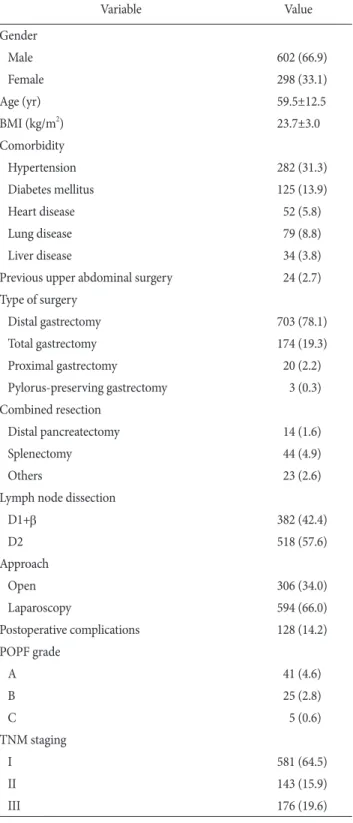
Table 1. Patient characteristics (n=900)
Variable Value
Gender
Male 602 (66.9)
Female 298 (33.1)
Age (yr) 59.5±12.5
BMI (kg/m2) 23.7±3.0
Comorbidity
Hypertension 282 (31.3)
Diabetes mellitus 125 (13.9)
Heart disease 52 (5.8)
Lung disease 79 (8.8)
Liver disease 34 (3.8)
Previous upper abdominal surgery 24 (2.7) Type of surgery
Distal gastrectomy 703 (78.1)
Total gastrectomy 174 (19.3)
Proximal gastrectomy 20 (2.2)
Pylorus-preserving gastrectomy 3 (0.3) Combined resection
Distal pancreatectomy 14 (1.6)
Splenectomy 44 (4.9)
Others 23 (2.6)
Lymph node dissection
D1+β 382 (42.4)
D2 518 (57.6)
Approach
Open 306 (34.0)
Laparoscopy 594 (66.0)
Postoperative complications 128 (14.2)
POPF grade
A 41 (4.6)
B 25 (2.8)
C 5 (0.6)
TNM staging
I 581 (64.5)
II 143 (15.9)
III 176 (19.6)
Values are presented as number (%) or mean±standard deviation.
BMI = body mass index; POPF = postoperative pancreatic fistula.
P-value of <0.05 (2-sided) was considered statistically significant.
Statistical analyses were performed using SPSS version 16.0 (SPSS Inc., Chicago, IL, USA).
Results
1. Patient demographics
Patient characteristics were listed in Table 1. The ratio of male to female was 2 : 1 and mean age of the patients was 59.5 (22 to 92) years. Four hundred and seven (45.2%) patients had comor- bidities such as hypertension, diabetes mellitus, heart disease, lung disease, and liver disease. Distal gastrectomies were most frequently performed (78.1%) and total gastrectomies were the second (19.3%).
There were 81 (9.1%) patients who underwent combined resections such as distal pancreatectomy, splenectomy, colon resection, liver resection, etc. Laparoscopic approach was applied to 66.0% of the patients. Overall morbidity rate was 14.2% and there was no mor- tality. The POPF which is defined as grade B or C occurred in 30 (3.3%) patients.
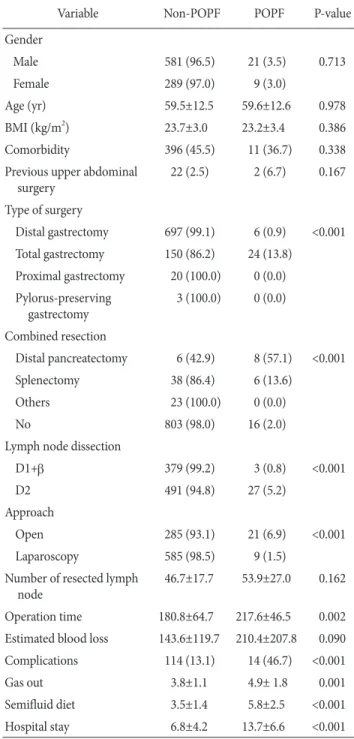
2. Correlation between patient clinicopathological characteristics and postoperative pancreatic fistula The patients were divided into two groups with and without POPF. Table 2 shows the characteristics of two groups. There were no significant differences between two groups in terms of age, sex, body mass index (BMI), comorbidity and history of previous upper abdominal operation. Regarding operative data, two groups differed in the types of surgery, combined resection, scope of lymph node dissection, and surgical approach. Compared to patients without POPF, the patients with the complication of POPF showed higher rates of total gastrectomy, distal pancreatectomy, splenectomy, D2 lymphadenectomy, or open approach. The POPF rates of triglyc- erides, distal pancreatectomy, splenectomy only, D2 lymphadenec- tomy, and open gastrectomy were 13.8%, 57.1%, 13.6%, 4.7%, and 6.9%, respectively. POPF group also had longer operation time.
As to postoperative courses, POPF group had higher morbidity rate, delayed first flatus and diet start, and longer hospital stay. Five grade C patients needed percutaneous drainages and the hospital stays were lengthened, but they could discharge after full recovery.
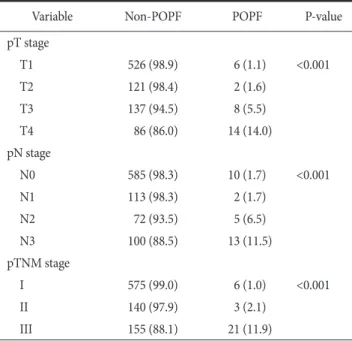
POPF occurred more frequently in advanced stage gastric can- cer patients than in early stage patients (Table 3). POPF rates in early gastric cancer and advanced gastric cancer were 1.1% (6 out of 532 patients) and 6.5% (24 out of 368 patients), respectively.
3. Risk factors for postoperative pancreatic fistula after curative surgery in gastric cancer
Multivariate analysis was performed by using significant factors which were correlated with POPF such as type of surgery, com- bined resection, scope of lymph node dissection, type of surgical
Table 2. Correlation between POPF and patient clinical charac- teristics
Variable Non-POPF POPF P-value
Gender
Male 581 (96.5) 21 (3.5) 0.713
Female 289 (97.0) 9 (3.0)
Age (yr) 59.5±12.5 59.6±12.6 0.978
BMI (kg/m2) 23.7±3.0 23.2±3.4 0.386
Comorbidity 396 (45.5) 11 (36.7) 0.338
Previous upper abdominal surgery
22 (2.5) 2 (6.7) 0.167
Type of surgery
Distal gastrectomy 697 (99.1) 6 (0.9) <0.001 Total gastrectomy 150 (86.2) 24 (13.8)
Proximal gastrectomy 20 (100.0) 0 (0.0) Pylorus-preserving
gastrectomy
3 (100.0) 0 (0.0)
Combined resection
Distal pancreatectomy 6 (42.9) 8 (57.1) <0.001
Splenectomy 38 (86.4) 6 (13.6)
Others 23 (100.0) 0 (0.0)
No 803 (98.0) 16 (2.0)
Lymph node dissection
D1+β 379 (99.2) 3 (0.8) <0.001
D2 491 (94.8) 27 (5.2)
Approach
Open 285 (93.1) 21 (6.9) <0.001
Laparoscopy 585 (98.5) 9 (1.5)
Number of resected lymph node
46.7±17.7 53.9±27.0 0.162
Operation time 180.8±64.7 217.6±46.5 0.002 Estimated blood loss 143.6±119.7 210.4±207.8 0.090 Complications 114 (13.1) 14 (46.7) <0.001
Gas out 3.8±1.1 4.9± 1.8 0.001
Semifluid diet 3.5±1.4 5.8±2.5 <0.001
Hospital stay 6.8±4.2 13.7±6.6 <0.001
Values are presented as number (%) or mean±standard deviation.
BMI = body mass index; POPF = postoperative pancreatic fistula.
approach, operation time, pT stage, and pN stage. Type of surgery (total gastrectomy), combined resection (distal pancreatectomy), and type of surgical approach (open surgery) were the independent risk factors for POPF after curative surgery in gastric cancer (Table 4).
4. Postoperative pancreatic fistula after open versus laparoscopic surgery with stage or procedure matched
When stage or procedure is matched, there were tendencies that laparoscopic gastrectomy had lower POPF rate than open gastrec- tomy in stage I, II, III, distal or proximal gastrectomy, and total gastrectomy with combined resection (Table 5). In patients with total gastectomy, POPF incidence was lower in laparoscopic group than in open gastrectomy group (P=0.002).
Discussion
Morbidity and mortality rates after gastric cancer surgery were Table 3. Correlation between POPF and patient pathologic
characteristics
Variable Non-POPF POPF P-value
pT stage
T1 526 (98.9) 6 (1.1) <0.001
T2 121 (98.4) 2 (1.6)
T3 137 (94.5) 8 (5.5)
T4 86 (86.0) 14 (14.0)
pN stage
N0 585 (98.3) 10 (1.7) <0.001
N1 113 (98.3) 2 (1.7)
N2 72 (93.5) 5 (6.5)
N3 100 (88.5) 13 (11.5)
pTNM stage
I 575 (99.0) 6 (1.0) <0.001
II 140 (97.9) 3 (2.1)
III 155 (88.1) 21 (11.9)
Values are presented as number (%). POPF = postoperative pancreatic fistula.
Table 4. Multivariate analysis of risk factors for POPF in gastric cancers
Variable Odds ratio 95% CI P-value
Type of surgery
Total gastrectomy vs. distal gastrectomy
9.751 3.348~28.397 <0.001
Combined resection
Distal pancreatectomy vs. no combined resection
7.637 1.668~34.961 0.009
Splenectomy vs. no combined resection
0.709 0.205~2.450 0.586
Approach
Open vs. laparoscopy 2.934 1.100~7.826 0.032
Operation time 1.004 0.998~1.010 0.215
pT stage
T2 vs. T1 1.002 0.176~5.689 0.998
T3 vs. T1 1.539 0.372~6.357 0.552
T4 vs. T1 2.072 0.429~10.019 0.365
pN stage
N1 vs. N0 0.264 0.037~1.899 0.186
N2 vs. N0 0.730 0.166~3.203 0.676
N3 vs. N0 1.574 0.406~6.099 0.512
POPF = postoperative pancreatic fistula; CI = confidence interval.
Table 5. POPF after open versus laparoscopic surgery with stage or procedure matched
Variable Non-POPF POPF P-value
Stage I
Open 131 (97.8) 3 (2.2) 0.115
Laparoscopy 444 (99.3) 3 (0.7)
Stage II
Open 63 (95.5) 3 (4.5) 0.059
Laparoscopy 77 (100.0) 0 (0.0)
Stage III
Open 91 (85.8) 15 (14.2) 0.264
Laparoscopy 64 (91.4) 6 (8.6)
Distal or proximal gastrectomy
Open 232 (98.3) 4 (1.7) 0.730
Laparoscopy 488 (99.6) 2 (0.4)
Total gastrectomy
Open 28 (77.8) 8 (22.2) 0.002
Laparoscopy 76 (96.2) 3 (3.8)
Total gastrectomy with combined resection
Open 25 (73.5) 9 (26.5) 0.338
Laparoscopy 21 (84.0) 4 (16.0)
Values are presented as number (%). POPF = postoperative pancreatic fistula.
reported as around 20% and 1%, respectively.7,14,15 Laparoscopic gastrectomy is considered to have less morbidity rate than open surgery.14 The majority of complications can be resolved with con- servative management. However, some major complications need active interventions including reoperation. Pancreatic fistula is one of the significant complications which may affect clinical courses and lead to mortality. Many previous studies investigated the causes of POPF in total gastrectomy or laparoscopic gastrectomy.8-10,16-20 However, this study aimed to identify the overall incidence and risk factors of POPF after various curative surgeries for gastric cancer patients.
The incidence of POPF has been reported as 1.7% to 22.1%.8-10,16,17 It depended on the type of surgery and stage. In open total gastrectomy, POPF rates ranged 13.0% to 22.1%.9,16,19 In early gastric cancer patients who underwent laparoscopic gastrec- tomy, incidence of POPF was 1.7% to 7%.8,17 Our study, consistent with previous reports, showed that overall POPF rate was 3.3% (30 out of 900 patients), 1.1% in early gastric cancer patients, 1.51% in laparoscopic gastrectomy, 6.86% in open gastrectomy, and 13.8% in total gastrectomy.
A few studies have reported risk factors of POPF. Nobuoka et al.16 analyzed the causes of POPF on 740 gastric cancer patients who underwent total gastrectomy and reported that BMI and total gastrectomy with pancreatosplectomy are the influencing factors.
Katai et al.20 showed that pancreas-related abscess was more likely to occur in older, obese patients undergoing node dissection along the distal splenic artery. Tanaka et al.18 identified visceral fat area and splenectomy were significant predictors of pancreatic fistula after total gastrectomy in gastric cancer. Jiang et al.8 examined 798 early gastric cancer patients who received laparoscopic surgery, and suggested male and high BMI are the causing factors of POPF.
The present study showed that total gastrectomy, distal pancreatec- tomy and open gastrectomy were the independent risk factors for POPF, but neither male gender nor BMI. The possible mechanism of POPF can be conjectured. Total gastrectomy with radical supra- pancreatic lymph node dissection can cause pancreatic injury and subsequent pancreatic fistula. So, POPF rates were reported higher in total gastrectomy than in distal gastrectomy. Combined resection such as distal pancreatectomy or splenectomy can be a risk factor for POPF in total gastrectomy as previously reported.16,18
Contrast to total gastrectomy, laparoscopic distal gastrectomy for early gastric cancer had different risk factors because combined resection or lymph node dissection around distal splenic artery and splenic hilum is not necessary.8 In laparoscopic gastrectomy for
early gastric cancer, excessive retraction of pancreas by an assistant or inappropriate use of ultrasonic coagulating shears might injure pancreas. Obama et al.10 reported that the rate of POPF was higher in laparoscopic gastrectomy than in open gastrectomy for early gastric cancer (7% vs. 2%). However, our study showed that POPF occurred less frequently in laparoscopic gastrectomy than open gastrectomy (1.51% in laparoscopic gastrectomy vs. 6.86% in open gastrectomy, P<0.001). Advanced gastric cancers were included in our study, which is different from the previous study.10 Higher rate of POPF in open gastrectomy may result from that open gastrectomy was performed more frequently in advanced gastric cancers which needed combined resection. However, because multivariate analysis showed that laparoscopic or open gastrectomy was the independent influencing factor for POPF, this result sug- gests that laparoscopic gastrectomy might be a good procedure to reduce POPF in gastric cancer. To clarify POPF rate is lower in laparoscopic gastrectomy than open gastrectomy, stage or proce- dure matched analysis was done. Although statistical significance was not seen in stage I, II, III, distal or proximal gastrectomy, and total gastrectomy with combined resection due to small number of POPF cases, laparoscopic gastrectomy had a consistent tendency of lower POPF rates than open gastrectomy. The reason why laparo- scopic gastrectomy can reduce POPF rate is possibly that surgeon can perform fine lymph node dissection around splenic artery and pancreas because of wide and magnified operative field under laparoscopic view. By contrast to laparoscopic surgery, one should perform lymph node dissection at deep seated area such as distal splenic artery and splenic hilum through small window in open surgery and might do blunt dissection and injure pancreas capsule or parenchyma.
In summary, POPF is one of the major complications that can occur after radical gastrectomy. In spite of that, the actual incidence and risk factors of POPF in gastrectomy for gastric cancer is not well known. This study aimed to identify the overall incidence and risk factors of POPF after various curative surgeries for gastric cancer patients in high volume center. Laparoscopic gastrectomy had an advantage over open gastrectomy in terms of lower POPF rate. Total gastrectomy and combined resection such as distal pan- createctomy should be performed carefully to minimize POPF in gastric cancer surgery.
References
1. Guggenheim DE, Shah MA. Gastric cancer epidemiology and
risk factors. J Surg Oncol 2013;107:230-236.
2. Japanese Gastric Cancer Association. Japanese gastric cancer treatment guidelines 2010 (ver. 3). Gastric Cancer 2011;14:113- 123.
3. Songun I, Putter H, Kranenbarg EM, Sasako M, van de Velde CJ. Surgical treatment of gastric cancer: 15-year follow-up re- sults of the randomised nationwide Dutch D1D2 trial. Lancet Oncol 2010;11:439-449.
4. Strong VE, Song KY, Park CH, Jacks LM, Gonen M, Shah M, et al. Comparison of gastric cancer survival following R0 resec- tion in the United States and Korea using an internationally validated nomogram. Ann Surg 2010;251:640-646.
5. Lim do H, Kim HS, Park YS, Lee J, Park SH, Lim HY, et al.
Metastatic lymph node in gastric cancer; is it a real distant me- tastasis? BMC Cancer 2010;10:25.
6. Park do J, Han SU, Hyung WJ, Kim MC, Kim W, Ryu SY, et al.
Long-term outcomes after laparoscopy-assisted gastrectomy for advanced gastric cancer: a large-scale multicenter retro- spective study. Surg Endosc 2012;26:1548-1553.
7. Park DJ, Lee HJ, Kim HH, Yang HK, Lee KU, Choe KJ. Pre- dictors of operative morbidity and mortality in gastric cancer surgery. Br J Surg 2005;92:1099-1102.
8. Jiang X, Hiki N, Nunobe S, Kumagai K, Nohara K, Sano T, et al. Postoperative pancreatic fistula and the risk factors of laparoscopy-assisted distal gastrectomy for early gastric cancer.
Ann Surg Oncol 2012;19:115-121.
9. Miki Y, Tokunaga M, Bando E, Tanizawa Y, Kawamura T, Ter- ashima M. Evaluation of postoperative pancreatic fistula after total gastrectomy with D2 lymphadenectomy by ISGPF clas- sification. J Gastrointest Surg 2011;15:1969-1976.
10. Obama K, Okabe H, Hosogi H, Tanaka E, Itami A, Sakai Y.
Feasibility of laparoscopic gastrectomy with radical lymph node dissection for gastric cancer: from a viewpoint of pancre- as-related complications. Surgery 2011;149:15-21.
11. Lee SI, Choi YS, Park DJ, Kim HH, Yang HK, Kim MC. Com- parative study of laparoscopy-assisted distal gastrectomy and
open distal gastrectomy. J Am Coll Surg 2006;202:874-880.
12. Lee JH, Park do J, Kim HH, Lee HJ, Yang HK. Comparison of complications after laparoscopy-assisted distal gastrectomy and open distal gastrectomy for gastric cancer using the Clavien- Dindo classification. Surg Endosc 2012;26:1287-1295.
13. Bassi C, Dervenis C, Butturini G, Fingerhut A, Yeo C, Izbicki J, et al. Postoperative pancreatic fistula: an international study group (ISGPF) definition. Surgery 2005;138:8-13.
14. Kim HH, Hyung WJ, Cho GS, Kim MC, Han SU, Kim W, et al. Morbidity and mortality of laparoscopic gastrectomy versus open gastrectomy for gastric cancer: an interim report--a phase III multicenter, prospective, randomized Trial (KLASS Trial).
Ann Surg 2010;251:417-420.
15. Lee MS, Lee JH, Park do J, Lee HJ, Kim HH, Yang HK. Com- parison of short- and long-term outcomes of laparoscopic- assisted total gastrectomy and open total gastrectomy in gastric cancer patients. Surg Endosc 2013;27:2598-2605.
16. Nobuoka D, Gotohda N, Konishi M, Nakagohri T, Takahashi S, Kinoshita T. Prevention of postoperative pancreatic fistula after total gastrectomy. World J Surg 2008;32:2261-2266.
17. Katai H, Sasako M, Fukuda H, Nakamura K, Hiki N, Saka M, et al. Safety and feasibility of laparoscopy-assisted distal gastrectomy with suprapancreatic nodal dissection for clinical stage I gastric cancer: a multicenter phase II trial (JCOG 0703).
Gastric Cancer 2010;13:238-244.
18. Tanaka K, Miyashiro I, Yano M, Kishi K, Motoori M, Seki Y, et al. Accumulation of excess visceral fat is a risk factor for pancreatic fistula formation after total gastrectomy. Ann Surg Oncol 2009;16:1520-1525.
19. Sano T, Sasako M, Katai H, Maruyama K. Amylase concen- tration of drainage fluid after total gastrectomy. Br J Surg 1997;84:1310-1312.
20. Katai H, Yoshimura K, Fukagawa T, Sano T, Sasako M. Risk factors for pancreas-related abscess after total gastrectomy.
Gastric Cancer 2005;8:137-141.