Joumd LJzheKoreun ChewzicuiSociety 2000, \’U/.44, No. 4
Prkrkxl in the Republic d’ KorGJ
CJ AI
?4=Pil~Fi! WPMi Ql+sa%=%
%13
4WS1-~tolsNN+ii*@”
“$Ff:fi .
~~’ . $f@m’%+-t)] _E!#jl A}!+Q]5$J].3+j~+-~=fL&
+ XJ +@] q= 0]+q 3+ qq+
-’&..qqm +qq-qqq- =W-+
(2000. 3. 13 ++)
Plant Tissue-Based Amperometric Sensor for Determination of Phenols in lMethykne Chloride
Hyo-Shik Kwon*,In-Keun Park, Kil-,Joong Yoont, and Moo-Lyong See++
hrstitale
of
Science Education, Co[[e,qeoj’Education, Chunghuk National University, Chcongju 361-763, Koreu‘Department qf Chemistry, (Xmgju Univvrsiv, Chemt<g”u360-764, Kore(z - ‘13epatrrnentof Chenrist<Y,i;yermgsmg Natiorrul. Chirrju660-701, KOIW
(Recei\,ecl March 13, XX)O)
The plant tissues with cle.ctrochernical transducers ]ras received considerable attention in recent years. ~: The resulting tissue bioelectrodes possess several advantages over their enzyrn~tic counterparts, including improved stability, higher biocataly?ic activity and lower cost. Early tissue electrodes have thus been successlhlly employed in numerous aqueous mediti. But the ability of enzymes to operate in nonaque{;us media]’4offers a great ~tcntial for new and novel applications of b;OCd~TiC sensors.
Operating an enzytne electrode in an organic solvent enables a simpler and faster enzyme immobilization pro- cedure m be used. Because the enzyme is insoluble in the organic phase. it remains in a din aqueous tilm retained on a hydrophilic support. Enzyme loadings can be ach- ieved with advanced enzyme immobilizrion than the covdcnt iremobilization techniques required for aqueous systems.’ Such unique possibilities ‘andadvantages have been reviewed recently.” These oppmunities have already been documented in connection with en/.yme electrwies incorporating tymsinase,’ ~horsemdish peroxidase9”’0and cholesterol oxidase.’ ]
This paper demonstrates {hat tissue bioeleetredcs can he effectively used for enzymatic resays in methylene chloride. Whi IC organic phase enzymatic ws~ys have performed in chiefly chloroform solvent.’2”’4this study
represents an example of using medrylene chloride solvent,
EXPERIMENTAL
A 10-mL electrochemical cell (Model VC-2 Bioana- lytical System. W. Lafayette, IN) was joined to thework- ing electrode, reference clectrede(Ag/AgCl, Model RIZ- 1, Bioanalytical Systems). and platinum wire auxili~
e~ectmde fhrough holes in i[s Teflon cover. A magnetic stirrer provided convective stirring transport (300 rpm) during amperometric measurements. The three electrodes were connected (o an voltammetric anaiyzer(EG&G PAR Model 264A. Princeton, NJ) and the output of which was displayed on a Houston Omniscribe strip-chart recorder, The tissue-gmphite electrodes were prepared in the following processes. The surfaces of the 6-mm diameter fydphite disk (U50-2. Ultra Carbon Co.) were polished on a silicon carbide paper of 150 grit for 10s. Such pre- treatment formed the roughness desired for subsequem adhesion of the tissue layer The dectrode was rhen mod- ified with the biocomponent by placing it (face down) in an intact portion of the tissue and moving it in a clock- wise motion for 2 min. A mild pressure was maintained during this polishing-like proecdure. The excess tissue was removed from the surrounding with J soft paper,
–376-
The resulting bloelectrodes were allowed to dry for 15 tin prior to use.
The enzyme electrode was prepared by placing 10 L of 3 phosphate buffer solution of pH 7.4 containing 0.5 mg tymsinase over the. inverted graphite cfisk and allowing to dry for 15 min.
Phenol, p-cresol, 2,4dichlorophenol and methylene chloride (Aldrich) were used without further purification.
Stock solutions of the phenolic substrates (0.1 M in meth- ylene dtkn-ide) were prepared daily. Experiments were performed in ametbylene chloride solution containing 0.1 M tetraethyhmunonium p-toluenesulfonate (TEATS, Aldrichj. All used methylene chloride had been previ- OUSIy saturated with a phosphate buffer (50 mM, pH 7.4) as was suggested by Turner and co-workers.~” T}~osi- nase (EC 1.14.18.1, 2400 U mg”’) was purchased from Sigma. The plants used throughout this smdy were pur- chased from a local supermarket and stored untif use at 5.
Amperometrk detection was performed at the -0.25 V.
RESULTS AND DISCUSSION
The rich activity of tyrosinme in the banana and mushroom tissues WM employed for the organic-phase enzymatic assays.’s
Typicaf amperometric responses for several substrates (in a methylene chloride solution), as obtained with unmodified (a) and tissue-mochfkd (b) electrodes were
l--
r’
b,_f’
I ~
I/ I
J_JJJ--@-—
la
I
L J
TIME
Fig. 1.Current-time recording obtained at (a) the umnoditkd and (b) banana rissuc-moditied graphite electrodes on incru.s- ing the phenol substrate concentration. Successive increments of1x1()-3M phenol. operating potential, +.25 V. NkXhylene cbforide solution containing 0.10 M TEATS. Stirred 303 rpm
2000, Vo/.44, No. 4
.7 i .6 i
1
2
0 “”
-.1 1 1 I
0246810~2
Concentration(mM)
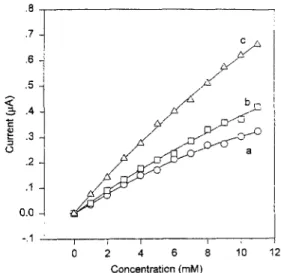
llg. 2.Dependence of the current response of the banana tis- sue modified electrodes on the concentration of (a) phenol.
(b) p-cresol and (c) ‘2,4-dinitrophenol.Other cxmditions were same as in Fig. 1.
showed in Fig. 1. Notice the absence of response at the unmodified surface. In contrast, the tissue electrodes respond very rapidly to the change in the substrate con- centration. producing steady-state currents within a few seconds. The veq’ fast response is atrnbuted to the inti- mate contact between the biocatalytic and graphite sens- ing sites and to the negligible diffusion barriers of the relative thinnest tissue layer. Fig. 2 and 3 show the dependence of the amperomerric response of the bamnna and mushroom electrodes on the concen~ation of phe- nolic compounds in methylene chloride. The bioelec- trodes readily respxtd to all the compounds. Only smafl differences in the sensitivity are observed (with the exception of the larger response for 2,4-dichlorophenol).
The slightly different trends in the sensitivity (Fig. 2 vs.
Fig. 3] are attributed to differences in the substrate spec- ificity of the bamma and mushroom tyrosinases. Note also that the substrate specificity may be altered upon exposure to the nonaqueous environment.~ For the three phenolic compounds, especially, 2,4-dichlorophenol, the linearity showed to 4 and 5 tnM (at the mushroom and banana surfaces, respectively; correlation coeftlcients for the linear portions, 0.9%-1.000). The response for 2,4- dichlorophenol was linear up to 7 rnkl (correlation coef- ficient, 1.000). Adetection knit of’6.5x 1()-5M pcMo- rophenol was estimated from the signal-to-noise
378
1.0- .9- .8-1
.7 J
1.0 .9 .81
.2<
x’
.~
jY , ~
0.0 u ,
-? 1 I 1
C12468
I
10 -iZ
Cocentrstion (mM)
Fi,q. 3. Dependence of the current response of [he mush- room rkwe modified electrodes on [he concentration of (a) phenol, (b) p-crcso] and (u) 2,4-dinitrophcnoL Other condi - dorts were same asin Fix. 1.
characteristics (S/N=3) of response to 5X1(~4 M p-chlo- rophenol in methylene chloride at the banana electrode (not shown,).
Fifteen repetitive measurements of’ 1 tnhl p-2,4-dichlo- mphenol, with a fresh solvent aliquot each time over a J2 h pericd, were pertortned to estimate the reproducibility and stability of the mushroom electrode. A stable respmse with no specific trend was observed during this pro- Jon.ged operation, with a mean peak current of 110 nA, a range of 101-119 nA, and a relative standard deviation (R. S.D.) of 5.3%. The electrode design permits easy and fast replacement of the tissue layer. Alternatively. because of its exrremely low cost, it could be used as a disposable device. Methylene chloride-phase assays performed with tyrosinase (irrrmobiIized isolated enzyme of 1,200 unit) and banana modified electrodes (a vs. b) were compared at Fig. 4. The banana tissue electrode yielded an extend- ed linear range and a slightly more increased sensitivity indicating a very high enzyme activity compared to the tyrosimwe electrode. In addition, the banana surface offers a t’aster response and more favorable signal-to-back- ground characteristics. Also shovm in Fig. 4 is the cor- responding calibration plot at the tissue electrode in the presence ofa higher IO.10 M) e~ectrolyte content (a). The resulting large increase in the sensitivity iUustrates the necessity of suficient electrolyte to minimize ~lential
.3
,2
IL- f ‘
,1 “>
0.0
-.1 / ! 1 1 I I t 1 1 I I 1
I
01234567691011 12
Concentration (mM)
Fig. 4. Calibrationpkxs for 2,4-dichlorophenol in methylene chtonde at (a) tyrosinase and (b, c) hanam tissue electrodes, using (a, b) O.O1OMand (c) O.10M TEATS, other condL lions were same as in Fig. 1.
losses in organic solvent-phase assays.
In conclusion, we have been demonstrated that tissue bioelectrodes can be effectively used for biocatdytic assays in methylene chloride. Although the concept is presented here in terms of phenolic substrates in a meth- ylene chloride media, it could be extended to other sub strates and solvent utilizing different cellular materials.
We are grateful for the financial support from Re,gionaf Center for Health and Life Science of Chung- buk Nationaf Universi~ and Cbtmgmoo Chemical Co.
Ltd.
REFERENCES
1. tlm-gpipa~ W.; Alexander. P. W.; Southwell-Kecly, P.
Anal. Chim. Actu 1995,309, 35.
“2.Yoon, K. J.; Kin], K. J.; Kwmr, H. S. J. Koream. C1-wrn.
S(X. 1999,43, 3, 271.
3. Klibancw, A. M. Chemmch 1986, 16, 354.
4. Dordick, J. S. Enzyme Microbial. Technol. 1989, 11, I94.
5. Cfis, A. E. G.; Davis, G.; Francis, G. D.; Hill, H. A.
0.: Aston, W. J.; higgins, L J.; Plotkin, E, V.; Scott, L, D. L.; Turner, A. i? F itna[. Chern. 1992, 56, 667.
6. Saini, S.; Hall, G. F.; Downs, M. E. A.; Turner, A. P. F.
And Chim. .4ctu 1991.249.1.
Jowmd of’r heKorea)tChemical %ceierv
7.Hall, G. F.; Best, I). J.; Turner, A. P. F.Anal. Chim.
AcffI1988, 2/3, 113.
8. Wang, J.; WU, L. H.; Angnes, L. Anal.Chem. 1991,63, 2993.
9. Wang, J.; Freiha, B.; Naser, N.: Gonzalez-Romero, E.;
W-ollenberger, U.; Ozsoz, M.: Evans, O.Anal. Chim.
,4cfa 1991, 254, !31.
10. Schubert, F.; Saini, S.; Turner, A. P. F.Anal. Chim. Acm 1992, 245, 133.
11. Wang, J.J..4rn. Chem. SOC.1998, 120, 1048.
12. Hall. G. F.: Best, D. J.; Turner, A. P. F.Enzyme Micmb.
Tecfmol. 1988.10.543
13.Hall, G. F.; Best, D. J.: Turner, A. 1? F. .4nd. Chim.
Acts 1988, 10, 543.
14.Wang, J.Elecwoanaly.~i.f 1992, 3, 255.
15.Wang, J.; Naser, h’.;Kwon, H. S.; Cho, M. Y.And. Chim.
Acts 1992, 264, 7,
2000.Vol.44. No. 4