hmal of the Korean ChemicalSocidy 2000, Vol.#, No. 5
Prinkd in tieRepublicof KOIWI
WM#i
“S#5t
“3wi!l!*
a%wtitaw-=wq’
w+
(2000. 4.26 ~+)
Analysis of Volatile Organic Compounds Emitted from Chemical Parts and Monitor Set of PC/Monitor
Jong-Woo Choe, Kyn-Won Back, and Chang-Stwp N*
Depa*nt of Chemirfry Keim,yung University Daegu 704-701 Kotea (Received April 26, 2000)
St % PCYMONtOrXW ?2 i% %W?-%%~+Ei
‘? %~% ~~ ’$ i?+ ~~vo~e
CRI@Ccompounds, VGCSW %+4 A]7Lbl] 4% II?%%!%% ~~d%q. ‘~ %7}A -&~71(residual gas malyzer, RGA~ GC-MSS “]%~~ monitoc~]~ %!~~~~$E? ‘$?i?~~ VOC& ‘&d&; ~}%@-~, ‘~x~
=8 WKS * tiluene, cylclohexanone, benzofuran 9 xylerd] ~~~ GC-M= ‘J~~ HI*}9 E}.+&474+, il+%]~~ wedge rubber% 60 OfM]~j 80’= ‘F~& q“ xylen~ ~d%(%)d] 2.5~] 7}%
57}%~z]T+3, L$+x} ~~ VGW+ I&&] $=~ %$T% %% ~~) $$+ ?j@L 97~~~4. RGA
~ GC-M~ ~~-) ~q ‘~~~~ @~ -L ~=] ~?.d~~, ~i%%%j~w cabiue@ xylene
~H} 6029.3~~m3(l.3 ppm~ ~ jzx]~ +++ X3Z, monitor II++414
‘LEN tduew Nene %’
benzofura#] &E@ 7J7# 10.25 ug/m3, 690 @m3, 180 ~7~A)4 l!d%- g~d” ~ ?,k %
+4 ~W %s =%1= +kW.
ABSTRACT. Wlatile organic compxmds(VOCs) emitted from KYMonitor set and chemical parts com- prising of PC/Monitor set were analyzed and emission trends of VGCs on temperature were investigated. Qual- itative analyses of VOCs ‘fromPC/Monitor set and chemical parts were csmied out by residual gas aualyzer(RGA) and GC-MS system and quantitative analysis was achieved for toluene, cyclohexnnone, ben- zofnmn, and xylene of VOCs based on qualitative analysis. As a result of these analyses, when the Wedge Rub- ber of rubber product was heated from W ‘C to 80 “C, the emission rate(%) of xylene was increased about 2.5 times. But it was evaluated that the left of chemical parts wem not affected by temperature except Wedge Rub- ber. ‘Iheresults of qualitative analyses between RGA and GC-MS were a little diffemt respectively. Whb quantitative analysis, concenhation of xylene emitted from cabinet was. measured to be maximum as 6029.3 pg/m~(l.3ppm). ‘f’heconcentrations of toluene, xylene, and beuzofuran derived tiom PC/Monitor set were 10.25 &gfm,690 @m~, and 180 ~g/m3, and these coneentmtions were relatively high levels which can bring on the risk to hmnan health.
–415–
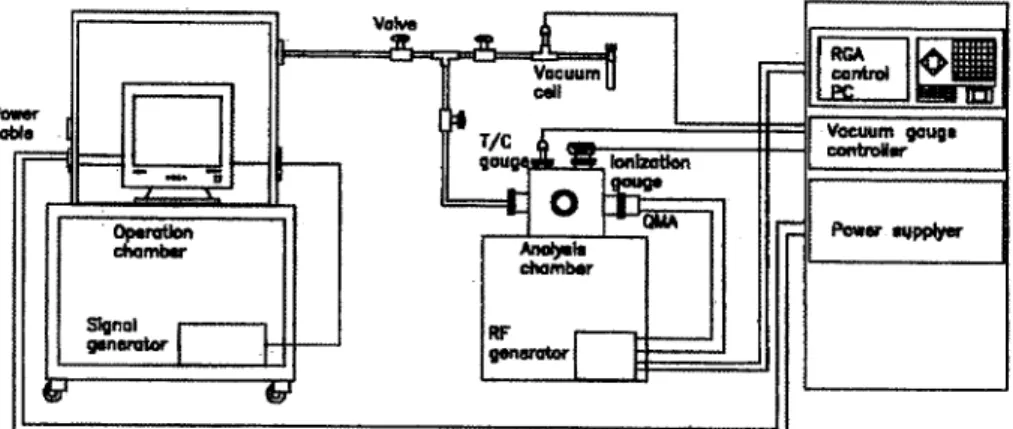
Fig. 1. Schematic diagmm of the gas analysis system equipped withRGAnnd sample chamber,
::- (a) g“- Clz-
; ,0- ●
~ 8-
g .-
4. y= 1-243* fo-6x
2.
0
0.0 2.0.+8 ,.O,,* ~.o.+~ &o.+~ f.rJ*.~ ,.~,,, ,4*+7
Atwa
D.O S-O*.7 1.00+0 +.6;*C *..J;+* ~.1 Area
i24MO;YoL44,No.5
,....-.. -
r: 91mm
w Viwlal
,.,--- M Mm
:]...pw it
Ewlei,,,,, ..,..,.,.,,... ...=.-. ..!45 [thlk fjf..,,,,,,,.,,...,,.,..,... ..,,,,,,,.,,,,,,,,,,.,.: .,,,,,,,,,,.,,,,,.,,,. ,,,.,..,.,,,,,.,....
..J~ ~y$’
Fig. 3.Emission tmxis of VOCS emitted from PCJmonitor set at (a) 20 ‘C and (b) 40 “C.
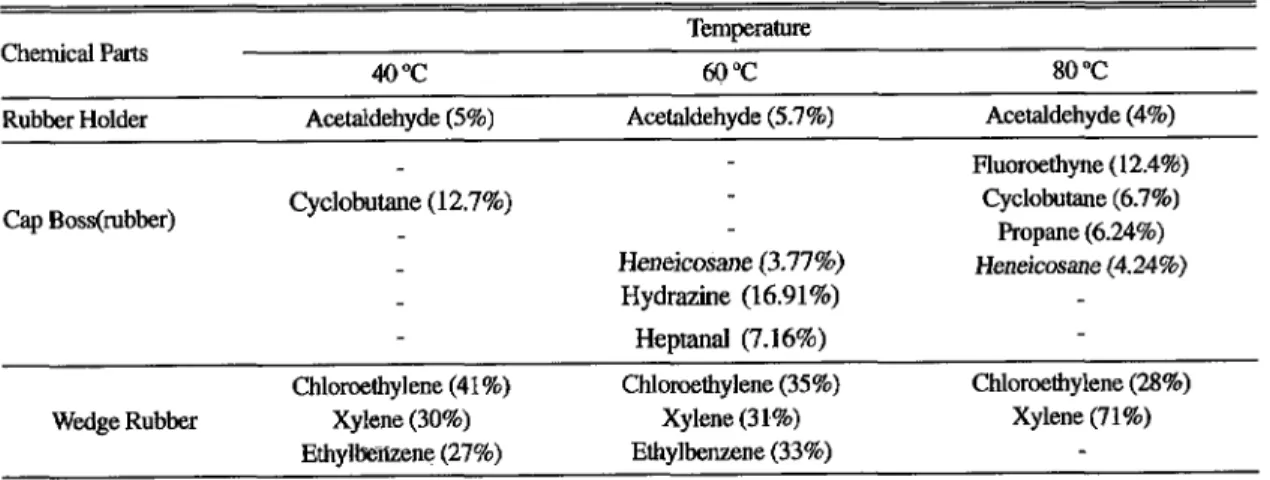
Table1. TheresulLsof qualitative analysis for chemical pm byRGAon temperature Temperature Chemical Par&s
40
“c 60 “c
80 “CRubber Holder Acetaldehyde (5%) Acetaldehyde (5.7%) Acetaldehyde (4%)
Fhroroethyne ( 12.493)
Cap Boss(rubber) Cyclobutane (12.7%) Cyclobutane (6.7%)
Propane (6.24%) Heneicosarre(3.77%) Heneicosarre (4.24%)
Hydrazine (16.91%) Heptanal (7.16%)
CMomethylene (41%) Chlomethylene (35%) Chloroetbylene (28%)
Wedge Rubber Xylene (30%) Xylene (31%) Xylene (71%)
Ethylbertzene (27%) Ethylbenzene (33%)
Jo14rnalof theKorvan Chemical Society
419
Fig. 4. W
55
4 4CKW4
m
Xyhne m
2WO0
Zcnll lm Ioem
Koo
Time os
2 W 4.W 6.00 8.W ?O.LW42.03 14.CQ16.M lWQ 2W.L1322(M 24.00 2&P2 28.00 ?hM 3203340036.00 3.03 Atmmdmce
T Ablmlame
6 +
[c)
55
m
4wb3
4Llxil %2dC acid
Zmtxl
Cycwlsptasiloxane
3WXI “-?4
25(Kc Xylene
20wo
5WI IWM
KMJ31 Cy2Mieiloxane
Trne 0
2.MI 4.03 6 (M e.LM iO.rM 12.LM 14.CO le.C@ 18.C+3~ 00 22.0024.00 zWO 28.LM30C0 2202 24w s.02 2400
chromatognum of VOCS emitted from chemical parts aud monitor @ (a) Cap Boss, (b) Wedge Rubkr, (c) Monitor set
?floo,w. 44, No. 5
420 %MWTI’EIB”WM!
Tuble 2. The concentmtions of VOCS emitted from chemical ptis(Cable, Cap Boss, Wedge Rubber, Cabinet and Monitor) Concenbation(Kg!m3)
Compound Threshold MAK
Cable Cap Boss Wedge Rubber Cabinet Monitor Limit (ppm)] (ppm)z
Tohrene t 10.25-2.5 ppb IO-15 lLXI
Xylene 5.6-12 ppb 2100-0.44 ppm t 6029.3-1.3 ppm 690-0.15 ppm 1 100
Benzofnran 180-0.3 ppb -
Cyclohexanone - T 119.5-0.03 ppm t 0.88 50
Note ‘:3j%~%9+7tl~+$7R, I:QIAW AWX=3 ~%+ %!4+%%=. 2%94414 7M=I+”4%FW14 %%a=+%%=.
(Maxima/ AllowableConcentratiooa)
% Chloroethylene, Xylene ~ Ethylbenzene
‘:-1 Zwl%wl , ‘1 % Chlcsuethylene+
1. Becker, J.; Wensing, M. TUVProduct Librafy, CJ’A:
Germany, l% p 1.
2. ‘Ilromas,K. W.; PelIizzari,E. D.; Claytom C. A.; Peritt, R L.; II= R N.; Gocdric~ R W.;NelsoL W. C; Wal- lace,LA. 1 Expm.Anal &vi. -@i 1993,3(l), 49.
3. Sisovic, A.; Fugas, M.; Sega. K.J. Expos. Ad. Envi.
E@. 1!)%, 6(4), p 439.
4.Miller, A. B. TheInternatimol Synposiwn an Cof&k_w Interaction and Cancer Ptwention; Dept. ofhventive Medicine Nice, Fran% 1996;p 17.
5. Yu, R.; Weisel, C. I?J. Expos. And Envi. Epi. 1996, 6(3), 261.
6,J-fodgson,A. T.; Garbesi, K.; Sextro, R. G.; Daisey, J.
M.J. Air Wrote Mmqe. Asfoc. 1992,277.
7. Weisel,C. P.; Nicholas, N, J.; Lioy, P. J.J. Eqms. And Envi. Epi. 1992, 2(l), 79.
8. Goldish, T.Indoor Air Polhtion Controk Lewis pub- lishe~ Chel~ MI, U.S.A. (991; pp 307-334.
9. Goldis~ T.Indoor Air Pollution Controk Lewis pub- lisher: Chelsea, Ml, U.S.A. 1991; pp 1-73.
10.’Wellace,L. A.; Pelhzzari, E. D.; Hartwell,T. D.; Davis, Y; Michael, L. C,; Whitmore, R. W.Envi Resear, 1989, 5(?, 37.
11.Raymer, J. H;, Pelkz.ari, E. D:, Thomas, K. W;, Cm
~, StephenD. J.*OS. find. i?hi. J&i 191. ~(4),439 12.Ri, C. S.; Choe, J. W.; Back, K. W. J. Koreon Chem
Sot.2ooo(ii press).
ZIOO,VOL44,No.5