Journal of the Korean Chemical Society 2017, Vol. 61, No. 3
Printed in the Republic of Korea https://doi.org/10.5012/jkcs.2017.61.3.125
-125-
Notes
Facile Synthesis of 2-Aryl or β,γ–Unsaturated Esters via 1,2-Migration from Aryl or α,β-Unsaturated Ketones Using Thallium(III) p-Tosylate
Jae In Lee
Department of Chemistry, College of Natural Science, Duksung Women’s University, Seoul 01369, Korea.
E-mail: [email protected]
(Received March 28, 2017; Accepted April 10, 2017)
Key words: Thallium(III) p-tosylate, 2-Aryl esters, 1,2-Aryl migration, Ketalization
The 2-arylpropanoic acids have drawn interest because they exhibit nonsteroidal anti-inflammatory activities.1 2- Arylpropanoates as precursors of them have generally been synthesized by Friedel-Crafts alkylation of aromatic com- pounds with alkyl 2-(mesyloxy)propanoates using aluminum chloride2 and mono-methylation of methyl arylacetates with dimethyl carbonate in the presence of potassium car- bonate at 220oC.3 Methylation of methyl arylacetates with methyl iodide proceeded under mild conditions using bases such as sodium hydride4 and tetrabutylammonium fluoride,5 but the success of methylation depended on the nature of substituents in the aryl group. Cross-coupling of 2-bro- mopropanoates and transmetalated aryl Grignard reagents with zinc chloride also afforded 2-arylpropanoates in mod- erate yields.6
The synthesis of 2-aryl esters was improved by involving 1,2-migration from aryl ketones. The reaction of propiophe- nones with 2 equiv of iodine in trimethyl orthoformate afforded corresponding iodo ketal intermediates that underwent 1,2-aryl migration to give methyl 2-arylpropanoates after 24 h at room temperature.7 Treatment of acetophenones with iodine in the presence of silver nitrate also afforded methyl 2-arylacetates in methanol containing trimethyl orthoformate.8 Furthermore, oxidative 1,2-aryl migration of aryl alkyl ketones was accomplished using (diacetoxy- iodo)benzene 9 or iodic acid10 in trimethyl orthoformate or methanol containing trimethyl orthoformate, respectively, to give the corresponding methyl arylacetates. However, reac- tion of acetophenones with 1H-1-hydroxy-5-methyl-1,2,3- benziodoxathiole 3,3-dioxide (HMBI) afforded methyl phenylacetates together with 2-methoxyacetophenones side products in cases of acetophenones bearing electron-with- drawing groups.11
The reaction of acetophenones and lead(IV) acetate with boron trifluoride etherate or perchloric acid in methanol or trimethyl orthoformate, respectively, yielded methyl 2-
arylacetates.12 This method was further expanded for the synthesis of β,γ–unsaturated esters and cyclopropyl acetates from α,β–unsaturated ketones and cyclopropyl methyl ketones, respectively.13 Alkyl 2-arylpropanoates were prepared by treating of 1-halogenoethyl aryl ketones with thallium(III) trinitrate and 2 equiv of perchloric acid in trimethyl ortho- formate.14 1-Aryl-2-halo-1-alkanones were also converted to 1-aryl-1,1-dimethoxy-2-propanols by sodium methoxide, treated with sulfuryl chloride or sulfonyl chloride, and fol- lowed by 1,2-aryl migration to give 2-arylalkanoic esters in three steps.15
Although several methods have been reported for syn- thesizing 2-aryl esters, some require multiple steps, trimethyl orthoformate solvent, and vigorous or long reaction con- ditions. The present paper reports that 2-aryl esters can be efficiently synthesized via 1,2-aryl migration from aryl ketones using thallium(III) p-tosylate in high yields. Pre- viously, thallium(III) p-tosylate was used to convert fla- vanones to isoflavones and tetrahydroquinolones to quinolones by 2,3-aryl rearrangement.16 However, it has not been uti- lized for direct conversion of aryl ketones to 2-aryl esters.
To determine optimum conditions for conversion of aryl ketones to 2-aryl esters, the effects of solvents were exam- ined. An initial reaction of 4’-methoxypropiophenone and perchloric acid using thallium(III) p-tosylate in ethanol afforded ethyl 2-(4-methoxyphenyl)propanoate in only 10% yield after 24 h at room temperature. However, the corresponding reaction in ethanol/triethyl orthoformate (4/1) was completed in 1 h between 0oC and room tem- perature to give ethyl 2-(4-methoxyphenyl)propanoate in 94% yield. The presence of triethyl orthoformate induced rapid ketalization of enol intermediate and facilitated 1,2- migration of the 4-methoxyphenyl group. The relative effec- tiveness of several metal salts was also examined for con- version of 2’,4’-dimethoxypropiophenone to ethyl 2-(2,4- dimethoxyphenyl)propanoate. Reaction of 2’,4’-dimethoxy-
Journal of the Korean Chemical Society
126 Jae In Lee
propiophenone and perchloric acid in ethanol/triethyl orthoformate (4/1) using Tl(OCOCF3)3, Tl(NO3)3·3H2O, Pb(OAc)4, and PhI(OAc)2 at room temperature yielded ethyl 2-(2,4-dimethoxyphenyl)propanoate in 70%, 67%, 58%, and 27% yield after 5 h, 10 h, 24 h, and 12 h, respec- tively. However, the corresponding reaction using thal- lium(III) p-tosylate was completed after 1.5 h between 0oC and room temperature to give ethyl 2-(2,4-dimethoxyphe- nyl)propanoate in 82% yield.
Thus, conversion of aryl ketones (1) to 2-aryl esters (4) was carried out by the addition of thallium(III) p-tosylate to pretreated 1 with perchloric acid in alcohols/trialkyl orthoformates. The plausible mechanism is represented in Scheme 1. 1 was enolized by perchloric acid to give enol intermediates (2), which were ketalized by alcohols and trialkyl orthoformates to give tetrahedral intermediates (3) together with the addition of thallium(II) p-tosylate. These intermediates then underwent facile 1,2-rearrangement of the aryl group by electron participation of the hydroxyl group. This was followed by elimination of Tl(OTs)2 to produce 4. After reaction completion, alcohols and trialkyl orthoformates were evaporated off, and the residue was dissolved in methylene chloride. The resulting white precipi- tate was filtered off, and the extracted residue was purified by vacuum distillation to give 4.
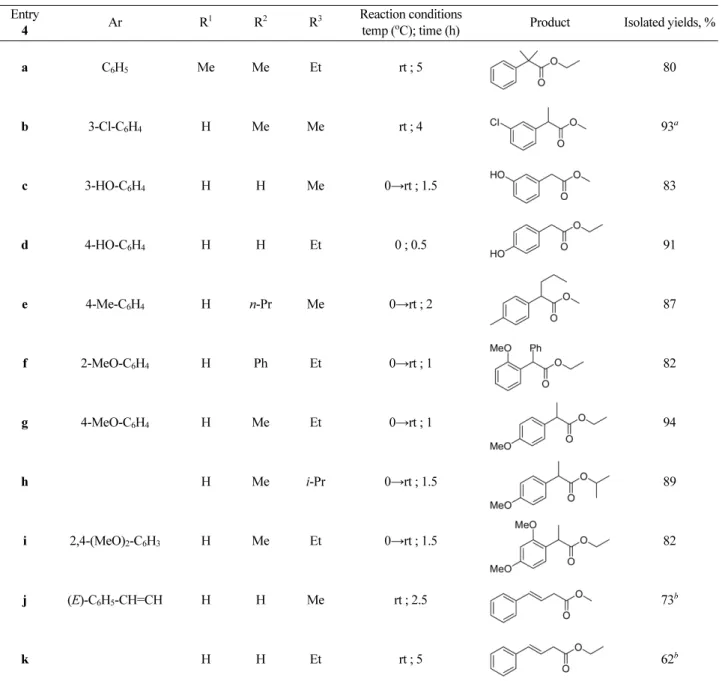
As shown in Table 1, various 2-aryl or β,γ–unsaturated esters were efficiently synthesized by this method in high yields (62-94%). The rapidity of 1,2-aryl migration in 3 was affected by the type of substituents on the phenyl ring.
When substituents were electron-donating groups such as methyl (4e) and methoxy (4f-4i), the reaction was com- pleted within 2 h between 0oC and room temperature.
Furthermore, the presence of a hydroxyl group (4c, 4d) did not affect the facile conversion of 1 to 4 regardless of sub- stitution position under the present reaction conditions.
However, the reaction of 3’-chloropropiophenone with an electron-withdrawing group on the phenyl ring proceeded sluggishly in methanol/trimethyl orthoformate (4/1). Thus, the reaction was carried out in trimethyl orthoformate to give methyl 2-(3-chlorophenyl)propanoate (4b) in 93%
yield after 4h at room temperature. With (3E)-4-phenyl-3-
buten-2-one, conversion to the corresponding β,γ–unsat- urated esters was less effective in the presence of per- chloric acid. The reaction was carried out by treating (3E)- 4-phenyl-3-buten-2-one with 2 equiv of boron trifluoride etherate and 10 equiv of alcohols in THF to give methyl (3E)-4-phenyl-3-butenoate (4j) and ethyl (3E)-4-phenyl- 3-butenoate (4k) in 73% and 62% yield, respectively, at room temperature.
EXPERIMENTAL
Preparation of ethyl 2-(4-methoxyphenyl)propanoate (4g)
To a solution of 4’-methoxypropiophenone (328 mg, 2.0 mmol) in ethanol/triethyl orthoformate (2 mL/8 mL) was added 70% perchloric acid (173 μL, 2.0 mmol), followed by addition of thallium(III) p-tosylate (1.44 g, 2.0 mmol) at 0oC. The reaction mixture was stirred for 1.5 h between 0oC and room temperature. The solvents were evaporated off under reduced pressure, and the residue was dissolved in methylene chloride (20 mL). The white precipitate was filtered off, and the resulting yellow solution was poured into saturated NaHCO3 solution (30 mL) and extracted with meth- ylene chloride (3 × 20 mL). The combined organic layers were dried over anhydrous MgSO4, filtered, and concen- trated in vacuo. The residue was purified by vacuum dis- tillation using a Kugelrohr apparatus to give 4g (391 mg, 94%) as a colorless liquid. 1HNMR (300 MHz, CDCl3) δ 7.23 (d, J = 8.7 Hz, 2H), 6.86 (d, J = 8.7 Hz, 2H), 4.12 (q, J = 7.1 Hz, 2H), 3.79 (s, 3H), 3.65 (q, J = 7.2 Hz, 1H), 1.47 (d, J = 7.2 Hz, 3H), 1.20 (t, J = 7.1 Hz, 3H); 13C NMR (75 MHz, CDCl3) δ 174.7, 158.7, 132.9, 128.4, 114.0, 60.6, 55.2, 44.7, 18.6, 14.1; FT-IR (film) 1726 (C=O) cm−1; Ms m/z (%) 208 (M+, 44), 135 (100), 105 (27).
Ethyl 2-methyl-2-phenylpropanoate (4a): 1H NMR (300 MHz, CDCl3) δ 7.29−7.36 (m, 5H), 4.12 (q, J = 7.1 Hz, 2H), 1.57 (s, 6H), 1.18 (t, J = 7.1 Hz, 3H); 13C NMR (75 MHz, CDCl3) δ 176.8, 144.8, 128.4, 126.9, 125.6, 60.8, 46.5, 26.3, 14.1; FT-IR (film) 1717 (C=O) cm-1; Ms m/z (%) 192 (M+, 12), 119 (100), 91 (41).
Methyl 2-(3-chlorophenyl)propanoate (4b): 1H NMR
Scheme 1.
Facile Synthesis of 2-Aryl or β,γ–Unsaturated Esters via 1,2-Migration from Aryl or α,β-Unsaturated Ketones Using Thallium(III) p-Tosylate127
2017, Vol. 61, No. 3
(300 MHz, CDCl3) δ 7.26−7.30 (m, 1H), 7.20−7.26 (m, 2H), 7.15−7.20 (m, 1H), 3.71 (q, J = 7.2 Hz, 1H), 3.67 (s, 3H), 1.49 (d, J = 7.2 Hz, 3H); 13C NMR (75 MHz, CDCl3) δ 174.4, 142.4, 134.4, 129.9, 127.8, 127.4, 125.7, 52.2, 45.1, 18.4; FT-IR (film) 1735 (C=O) cm−1; Ms m/z (%) 200 (M++2, 15), 198 (M+, 46), 141 (57), 139 (100), 103 (93), 77 (42).
Methyl 3-hydroxyphenylacetate (4c):1H NMR (300 MHz, CDCl3) δ 7.08−7.19 (m, 1H), 6.68−6.82 (m, 3H), 6.13 (br s, 1H), 3.70 (s, 3H), 3.57 (s, 2H); 13C NMR (75
MHz, CDCl3) δ 172.7, 156.0, 135.3, 129.8, 121.5, 116.3, 114.4, 52.3, 41.1; FT-IR (film) 3420 (OH), 1723 (C=O) cm-1; Ms m/z (%) 166 (M+, 75), 107 (100), 77 (35).
Ethyl 4-hydroxyphenylacetate (4d): 1H NMR (300 MHz, CDCl3) δ 7.10 (d, J = 8.6 Hz, 2H), 6.72 (d, J = 8.6 Hz, 2H), 6.09 (br s, 1H), 4.16 (q, J = 7.1 Hz, 2H), 3.54 (s, 2H), 1.26 (t, J = 7.1 Hz, 3H); 13C NMR (75 MHz, CDCl3) δ 172.6, 155.0, 130.4, 125.9, 115.5, 61.0, 40.5, 14.1; FT- IR (film) 3397 (OH), 1713 (C=O) cm−1; Ms m/z (%) 180 (M+, 51), 107 (100), 77 (27).
Table 1. Synthesis of 2-aryl or β,γ–unsaturated esters (4) from 1 Entry
4 Ar R1 R2 R3 Reaction conditions
temp (oC); time (h) Product Isolated yields, %
a C6H5 Me Me Et rt ; 5 80
b 3-Cl-C6H4 H Me Me rt ; 4 93a
c 3-HO-C6H4 H H Me 0→rt ; 1.5 83
d 4-HO-C6H4 H H Et 0 ; 0.5 91
e 4-Me-C6H4 H n-Pr Me 0→rt ; 2 87
f 2-MeO-C6H4 H Ph Et 0→rt ; 1 82
g 4-MeO-C6H4 H Me Et 0→rt ; 1 94
h H Me i-Pr 0→rt ; 1.5 89
i 2,4-(MeO)2-C6H3 H Me Et 0→rt ; 1.5 82
j (E)-C6H5-CH=CH H H Me rt ; 2.5 73b
k H H Et rt ; 5 62b
aThe reaction was carried out in trimethyl orthoformate. bThe reaction was carried out using 2 equiv of BF3· Et2O and 10equiv of CH3OH in THF.
Journal of the Korean Chemical Society
128 Jae In Lee
Methyl 2-(4-methylphenyl)pentanoate (4e): 1H NMR (300 MHz, CDCl3) δ 7.19 (d, J = 8.0 Hz, 2H), 7.11 (d, J = 8.0 Hz, 2H), 3.64 (s, 3H), 3.52 (t, J = 7.7 Hz, 1H), 2.32 (s, 3H), 1.97−2.10 (m, 1H), 1.67−1.79 (m, 1H), 1.19−1.32 (m, 2H), 0.90 (t, J = 7.2 Hz, 3H); 13C NMR (75 MHz, CDCl3) δ 174.8, 136.8, 136.3, 129.3, 127.8, 51.9, 50.9, 35.6, 21.0, 20.7, 13.8; FT-IR (film) 1732 (C=O) cm−1; Ms m/z (%) 206 (M+, 34), 164 (33), 147 (56), 105 (100).
Ethyl 2-(2-methoxyphenyl)-2-phenylacetate (4f): 1H NMR (300 MHz, CDCl3) δ 7.20−7.34 (m, 6H), 7.02 (dd, J
= 7.8, 1.6 Hz, 1H), 6.84−6.90 (m, 2H), 5.28 (s, 1H), 4.18 (q, J = 7.1 Hz, 2H), 3.83 (s, 3H), 1.23 (t, J = 7.1 Hz, 3H);
13C NMR (75 MHz, CDCl3) δ 172.9, 156.9, 137.9, 129.1, 128.5 (overlapped), 128.4, 127.9, 127.1, 120.5, 110.4, 60.9, 55.5, 51.0, 14.2; FT-IR (film) 1731 (C=O) cm−1; Ms m/z (%) 270 (M+, 15), 197 (63), 91 (100).
Isopropyl 2-(4-methoxyphenyl)propanoate (4h): 1H NMR (300 MHz, CDCl3) δ 7.22 (d, J = 8.7 Hz, 2H), 6.85 (d, J = 8.7 Hz, 2H), 4.98 (septet, J = 6.3 Hz, 1H), 3.79 (s, 3H), 3.62 (q, J = 7.2 Hz, 1H), 1.45 (d, J = 7.2 Hz, 3H), 1.21 (d, J = 6.3 Hz, 3H), 1.13 (d, J = 6.3 Hz, 3H); 13C NMR (75 MHz, CDCl3) δ 174.3, 158.6, 133.0, 128.4, 113.9, 67.8, 55.2, 44.9, 21.7, 21.5, 18.5; FT-IR (film) 1724 (C=O) cm−1; Ms m/z (%) 222 (M+, 43), 135 (100), 105 (28).
Ethyl 2-(2,4-dimethoxyphenyl)propanoate (4i): 1H NMR (300 MHz, CDCl3) δ 7.12 (d, J = 8.7 Hz, 1H), 6.47 (d, J = 2.4 Hz, 1H), 6.45 (br s, 1H), 4.12 (q, J = 7.1 Hz, 2H), 3.94 (q, J = 7.2 Hz, 1H), 3.79 (s, overlapped, 6H), 1.42 (d, J = 7.2 Hz, 3H), 1.20 (t, J = 7.1 Hz, 3H); 13C NMR (75 MHz, CDCl3) δ 175.2, 159.8, 157.7, 128.2, 122.3, 104.4, 98.8, 60.3, 55.4, 55.3, 38.7, 17.5, 14.2; FT-IR (film) 1725 (C=O) cm−1; Ms m/z (%) 238 (M+, 48), 165 (100), 150 (17), 105 (22).
Methyl (3E)-4-phenyl-3-butenoate (4j): 1H NMR (300 MHz, CDCl3) δ 7.21−7.39 (m, 5H), 6.49 (d, J = 16.3 Hz, 1H), 6.30 (dt, J = 15.9, 7.0 Hz, 1H), 3.71 (s, 3H), 3.26 (d, J
= 7.0 Hz, 2H); 13C NMR (75 MHz, CDCl3) δ 172.1, 136.8, 133.5, 128.6, 127.6, 126.3, 121.7, 52.0, 38.2; FT-IR (film) 1735 (C=O), 1639 (C=C) cm−1; Ms m/z (%) 176 (M+, 34), 117 (100), 91 (21).
Ethyl (3E)-4-phenyl-3-butenoate (4k): 1H NMR (300 MHz, CDCl3) δ 7.20−7.39 (m, 5H), 6.49 (d, J = 15.8 Hz, 1H), 6.30 (dt, J = 15.9, 7.0 Hz, 1H), 4.17 (q, J = 7.1 Hz, 2H), 3.24 (dd, J = 7.0, 1.3 Hz, 2H), 1.28 (t, J = 7.1 Hz, 3H); 13C NMR (75 MHz, CDCl3) δ 171.5, 137.0, 133.4, 128.5, 127.5, 126.3, 121.9, 60.7, 38.4, 14.2; FT-IR (film) 1730 (C=O), 1641 (C=C) cm−1; Ms m/z (%) 190 (M+, 58), 117 (100), 115 (85), 91 (41).
Acknowledgments. This research was performed during the sabbatical year of Duksung Women’s University (2016).
REFERENCES
1. (a) Li, C.; Grillo, M. P.; Benet, L. Z. J. Pharm. Exp. Therap.
2003, 305, 250. (b) Guzman, J. D.; Evangelopoulos, D.;
Gupta, A.; Birchall, K.; Mwaigwisya, S.; Saxty, B.; McHugh, T. D.; Gibbons, S.; Malkinson, J.; Bhakta, S. BMJ Open 2013, 3, e002672. doi:10.1136. (c) Dhall, H.; Sikka, P.;
Kumar, A.; Mishra, A. K. Orient. J. Chem. 2016, 32, 1831.
2. Piccolo, O.; Azzena, U.; Melloni, G.; Delogu, G.; Valoti, E. J. Org. Chem. 1991, 56, 183.
3. Selva, M.; Marques, C. A.; Tundo, P. J. Chem. Soc. Per- kin Trans. 1 1994, 1323.
4. Takashima-Hirano, M.; Shukuri, M.; Takashima, T.; Goto, M.; Wada, Y.; Watanabe, Y.; Onoe, H.; Doi, H.; Suzuki, M. Chem. Eur. J. 2010, 16, 4250.
5. (a) Kato, K.; Kikuchi, T.; Nengaki, N.; Arai, T.; Zhang, M.-R. Tetrahedron Lett. 2010, 51, 5908. (b) Kikuchi, T.;
Okada, M.; Nengaki, N.; Furutsuka, K.; Wakizaka, H.;
Okamura, T.; Zhang, M.-R.; Kato, K. Bioorg. Med. Chem.
2011, 19, 3265.
6. Harrington, P. J.; Lodewijk, E. Org. Pro. Res. Develop.
1997, 1, 72.
7. (a) Yamauchi, T.; Hattori, K.; Nakao, K.; Tamaki, K. J.
Org. Chem. 1988, 53, 4858. (b) Srikrishna, A.; Lakshmi, B.
V.; Ravikumar, P. C. Tetrahedron Lett. 2006, 47, 1277. (c) McQuade, D. T.; Bogdan, A.; Poe, S. L. US Patent 2011, 0054208 A1.
8. Oppolzer, W.; Rosset, S.; Brabander, J. D. Tetrahedron Lett. 1997, 38, 1539.
9. (a) Tamura, Y.; Yakura, T.; Shirouchi, Y.; Haruta, J. Chem.
Pharm. Bull. 1985, 33, 1097. (b) Sheng, S.-R.; Zhong, M.-H.;
Liu, X.-L.; Luo, Q.-Y.; Chen, H.-Z. J. Chem. Res. 2004, 392.
10. Huddar, S. N.; Deshmukh, S. S.; Akamanchi, K. G. Arkivoc 2011, 67.
11. Justik, M. W. Tetrahedron Lett. 2007, 48, 3003.
12. (a) Myrboh, B.; Ila, H.; Junjappa, H. Synthesis 1981, 126.
(b) Yamauchi, T.; Nakao, K.; Fujii, K. J. Chem. Soc. Perkin Trans. 1 1987, 1433.
13. (a) Mathew, F.; Myrboh, B. Tetrahedron Lett. 1990, 31, 3757. (b) Nongkhlaw, R. L.; Nongrum, R.; Nongkynrih, I.; Vattakunnel, F. M.; Myrboh, B. Indian J. Chem. 2005, 44B, 1054.
14. Yamauchi, T.; Nakao, K.; Fujii, K. J. Chem. Soc. Perkin Trans 1 1987, 1255.
15. (a) Tsuchihashi, G.; Mitamura, S.; Kitajima, K.; Kobayashi, K. Tetrahedron Lett. 1982, 23, 5427. (b) Yamauchi, T.; Hat- tori, K.; Nakao, K.; Tamaki, K. Bull. Chem. Soc. Jpn. 1987, 60, 4015.
16. (a) Singh, O. V.; Kapil, R. S. Synth. Comm. 1993, 23, 277.
(b) Singh, O. V.; Muthukrishnan, M.; Sunderavadivelu, M. Indian J. Chem. 2005, 44B, 2575.