Journal of the Korean Chemical Society 2011, Vol. 55, No. 1
Printed in the Republic of Korea DOI 10.5012/jkcs.2011.55.1.046
-46-
티몰블루와 함께 이온쌍으로서 약제 샘플에서 시메티딘의 추출-분광광도 측정
B. Zargar, N. Pourreza*, and M. Shahrouz
Department of Chemistry, College of Science, Shahid Chamran University, Ahvaz, Iran (접수 2010. 5. 7; 수정 2010. 7. 26; 게재확정 2010. 8. 31)
Extraction-Spectrophotometric Determination of Cimetidine in Pharmaceutical Samples as an Ion Pair with Bromothymol Blue
B. Zargar, N. Pourreza*, and M. Shahrouz
Department of Chemistry, College of Science, Shahid Chamran University, Ahvaz, Iran. *E-mail: [email protected] (Received May 7, 2010; Revised July 26, 2010; Accepted August 31, 2010)
요 약. 감도가 높고 선택적인 추출-분광광도법은 미량의 시메티딘의 측정을 위해 개발되어 왔다. 이 방법은 클로로포름 안에 브로모티몰 블루(BTB)와 함께 이온 쌍으로 시메티딘의 추출에 기초했다. 그리고 417 nm에서 흡광도를 측정하고 있 다. pH, BTB의 농도, 클로로포름의 부피, 섞는 시간과 같은 다른 변수들의 효과를 연구하였다. 또한, 추출에서 간섭이온 의 효과도 연구하였다. 보정곡선은 0.9997의 상관계수와 함께 0.25~8 ug/mL의 범위에서 선형이다. 3Sb에 기초한 검출한계 는 0.14 ug/mL이고 시메티딘의 0.1과 4.0 ug/mL의 10번 측정에 대한 상대표준편차는 3.2와 1.49%이었다. 제안된 방법은 좋 은 회수와 함께 약제 샘플에서 시메티딘의 측정에 적용되었다.
주제어: 추출-분광광도법, 시메티딘, 브로모티몰 블루
ABSTRACT. A highly sensitive and selective extraction-spectrophotometric method has been developed for determination of trace amounts of cimetidine. This method is based on the extraction of cimetidine as an ion pair with bromothymol blue (BTB) into chloroform and measuring its absorbance at 417 nm. The effect of different variables such as pH, concentration of BTB, volume of chloroform and shaking time was investigated. The effect of interfering ions on the extraction was also studied. The calibration curve was linear in the range of 0.25-8 µg mL-1 with correlation coefficient of 0.9997. The detection limit based on 3Sb was 0.14 µg mL-1 and relative standard deviation for 10 replicated measurements of 1.0 and 4.0 µg mL-1 of cime- tidine was 3.2 and 1.49%, respectively. The proposed method was applied to the determination of cimetidine in phar- maceutical samples with good recoveries.
Keywords: Extraction-spectrophotometric, Cimetidine, Bromothymol blue
INTRODUCTION
Cimetidine (CMT) is a compound largely used in med- icine for its protective action on stomach walls in ulcer diseases, due to its histamine H2 receptor blocking effect.1 Cimetidine has also been identified as a substrate for P- glycoprotein (P-GP), an MDR-encoded membrane trans- porter that is expressed in normal tissues including kidney proximal tubules.2,3 Cimetidine is excreted predominantly unchanged by the kidneys and undergoes extensive tubu- lar secretion with renal clearance values approximately four-fold greater than creatinine clearance.4 There are sev- eral approaches regarding the determination of cimetidine in pharmaceutical preparations. These include spectropho- tometric,2 ion-selective electrode,1 solid phase extraction,5 high performance liquid chromatography (HPLC)6 and
LC-tandem mass spectrometry.7 However some of the quantitative pharmaceutical determination methods such as HPLC suffer from large solvent consumption.8
Solvent extraction is one of the versatile analytical tech- niques, in that it has an extremely wide range of application and invokes most of the physical and chemical principles used generally in analytical chemistry.9,10 Extraction methods using ions associated with a large ionic dye or counter ions, forming an ion-association complex with large molar absorptivities are still limited.11,12 More inves- tigation in this field could lead to sensitive methods for trace pharmaceutical determinations.
This paper describes a simple and sensitive method for the quantitative extraction of cimetidine as an ion pair with bromothymol blue (BTB) into chloroform and mea- suring its absorbance at 417 nm.
2011, Vol. 55, No. 1
티몰블루와 함께 이온쌍으로서 약제 샘플에서 시메티딘의 추출-분광광도 측정 47
EXPERIMENTAL
Instrumentation
A Cintra 101 (GBC Scientific Equipment, Australia) UV- Visible spectrophotometer was used for recording absorp- tion spectra and absorbance measurements were made by a JASCO (Japan) model 7850 UV-Vis using 1 cm glass cells. A digital pH-Meter model 632, Metrohm (Herisau, Switzerland) with a combined glass electrode was used for pH adjustments.
Reagents
Analytical reagent-grade chemicals were used. A 1000 mg mL-1 stock solution of cimetidine was prepared by dis- solving 0.1 g of cimetidine (Sigma) in water and diluting to 100 µL in a volumetric flask. The working solutions were prepared by appropriate dilution of the stock solu- tion. A 0.02% (w/v) solution of bromothymol blue was prepared by dissolving 0.2 g of the dyestuff (Merck) in water and diluting to the mark in a 1000 mL volumetric flask.
An acetate buffer solution (pH 5.5) was made by adding a solution NaOH (0.2 mol L-1) to 100 mL of 0.2 mol L-1 of acetic acid and adjusting the pH to 5.5 using a pH meter.
Recommended Procedure
An aliquot of sample solution containing of cimetidine (so that its final concentration would be in the range of 0.25-8 µg mL-1) was placed in a 50 mL volumetric flask.
5.0 mL of 3×10⁻³ mol L-1 of bromothymol blue and 3.0 mL of acetate buffer solution (pH 5.5) were added and the solu- tion was diluted to the mark with distilled water. The solu- tion was transferred into a 100 mL separatory funnel and 5 mL of chloroform was added. The mixture was shaken vigorously for 20 S and the phases were allowed to separate for 10 min. The organic phase was separated and its absor- bance was measured at 417 nm against a reagent blank.
Preparation of samples
The cimetidine tablet samples (Chemi Daruo Co, Iran) were dissolved in few mL of water, and diluted to 200 mL in a volumetric flask. Ampoule samples were dissolved in water and diluted to 200 mL in a volumetric flask.
RESULTS AND DISCUSSION
It was found that cimetidine forms an ion-pair with bro- mothymol blue as a counter ion in aqueous solution, which could be extracted into organic solvent and determined by
spectrophotometric method. The extraction process was performed by some common organic solvents such as dichloromethane, chloroform, hexane and dichloroethane. It was found that the ion-pair is more readily extractable in chloroform than other solvents used and the colored com- plex could not be extracted into the other organic phase as completely as chloroform. The absorption spectra of the extracted ion pair showed that maximum absorbance occurs at 417 nm. Thus this wavelength was selected for absorbance measurements.
Effect of pH
The effect of pH of the aqueous solution on the extrac- tion process of cimetidinebromothymol blue ion-pair was studied. The pH was adjusted by the addition of 0.1 mol L-1 of HCl or NaOH. Based on the obtained results shown in Fig. 1 the absorbance was almost constant at pH values of 5.5-6.0. Therefore pH 5.5 was chosen as optimum pH value and 3 mL of acetate buffer was added to adjust the pH of the solution at this value.
Effect of bromothymol blue concentration
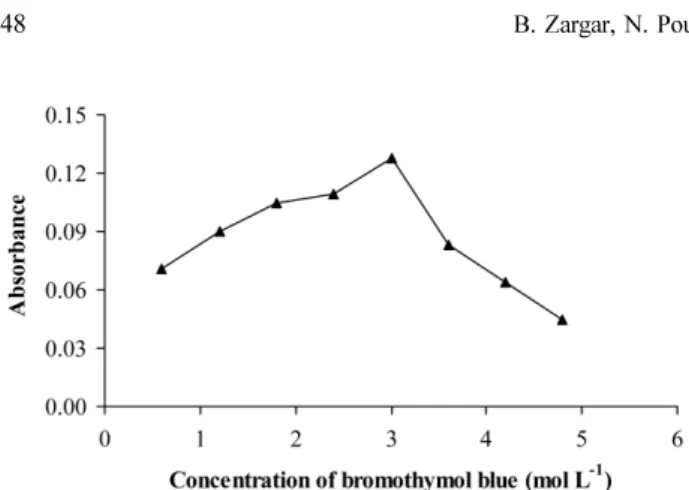
The influence of bromothymol blue concentration on the extraction of cimetidine-bromothymol blue ion-pair was investigated. The results presented in Fig. 2 indicate that the absorbance of the organic phase increases with increasing bromothymol blue concentration up to 3×10⁻⁵ mol L-1 and decreases above that. At higher concentration of bromothymol blue, the blank absorbance value increases and as a result the absorbance of the sample decreases.
Therefore concentration of 3×10⁻⁵ mol L-1 of bromothy- mol blue in the final solution was chosen as the optimum concentration.
Effect of solvent volume
Quantitative extraction of cimetidinebromothymol blue Fig. 1. Effect of pH on the extraction of 2 µg mL-1 cimetidine as bromothymol blue ion-pair.
48 B. Zargar, N. Pourreza, and M. Shahrouz
Journal of the Korean Chemical Society
ion-pair was completed by 5 mL of chloroform in a single stage extraction process. Smaller volume was not suffi- cient enough for the complete extraction in a single stage and absorbance reading for higher volumes was decreased because of dilution. Therefore 5 mL of chloroform was selected for extraction of cimetidinebromothymol blue ion-pair.
Effect of shaking and standing time
The effect of shaking time on the extraction of cime- tidinebromothymol blue ion-pair was studied. A shaking time of 20 S was found to be sufficient for the extraction of ion-pair. A 10 min standing time was also required for the phase separation to be completed before absorbance read- ing.
Analytical characteristics
A linear calibration curve was obtained in the range of 0.25-8 µg mL-1 under optimum conditions. The equation of the line was A=0.0607C-0.0014 with a correlation coefficient of 0.9997 (A is absorbance against a blank and C is cimetidine concentration in µg mL-1). The detection limit based on 3Sb13 was 0.14 µg mL-1 and relative stan- dard deviation for 10 replicated measurements of 1.0 and 4.0 µg mL-1 of cimetidine was 3.20 and 1.49%, respec- tively.
The effect of interfering species
The effect of various species on the extraction of cime- tidine was investigated. 100 mL solutions containing 4 µg mL-1 of cimetidine and each interferent at different weight ratios were subjected to general procedure. A given spe- cies was considered to interfere if it caused more than ± 5% variation in the absorbance signal. The results are pre- sented in Table 1. As can be seen various co expedients
such as dextrose, lactose, fructose and boric acid are tol- erable at high concentrations and cimetidine can be determined quantitatively in the presence of these com- pounds.
APPLICATION
In order to check the applicability of the proposed method it was applied to determination of cimetidine in pharmaceutical samples. An aliquot of the prepared sam- ple solutions was treated under the general procedure. The results are shown in Table 2. As can be observed cime- tidine can be determined with good accuracy in pharma- ceutical samples.
CONCLUSION
The proposed procedure is an easy and inexpensive methodology for separation and determination of trace amounts cimetidine. The method compares favorably in terms of detection limit with some of the previously reported methods for the determination of cimetidine.1-4 The use of an inexpensive instrument such as spectro- photometer is its main advantage over the sophisticated and expensive instruments such as HPLC6 and LC-tan- dem mass spectrometry.7 The method is highly selective and various co expedients such as dextrose, lactose, fruc- tose and boric acid are tolerable at high concentrations and Fig. 2. Effect of bromothymol blue concentration on the
extraction of 2 µg mL-1 cimetidine as bromothymol blue ion-pair.
Table 1. Effect of interfering species on the determination of 4 µg mL-1 of cimetidine
Interfering ions Tolerance limit (µg mL-1) Dextrose, lactose, froctose 2000
Br-, I- , Cl- 500
Boric acid 300
Na+, K+, CO32-, F- 200
aMg2+, aCa2+, bFe3+ 100
Cu2+, Co2+, 4
aafter removal by EDTA. bafter removal by F-
Table 2. Determination of cimetidine in pharmaceutical samples Samples Reference
value (mg)
Founda (mg)
Relative error (%) Tablet 1 200 198.0±2.9 1.00 Tablet 2 200 198.4±7.8 0.80 Tablet 3 200 205.0±7.8 2.50 Injection ampoule 1 200 202.5±5.4 1.25 Injection ampoule 2 200 207.5±7.8 3.75
ax± ts / nat 95% confidence (n=5)
2011, Vol. 55, No. 1
티몰블루와 함께 이온쌍으로서 약제 샘플에서 시메티딘의 추출-분광광도 측정 49
cimetidine can be determined quantitatively in the pres- ence of these compounds. The method was validated for the quantitative determination of cimetidine in some phar- maceutical preparations. The validation data presented in Table 2 demonstrates good precision and accuracy, which proves the reliability of the proposed method.
Acknowledgement. The authors gratefully acknowledge the financial support of this work by Shahid Chamran University Research Council (grant 1389).
REFERENCES
1. Shamsipur, M.; Jalali, F.; Haghgoo, S. J. Pharmaceut.
Biomed. Anal., 2002, 27, 867.
2. Garcia, M. S.; Albero, M. I.; Sanchez-Pedren, C. J.
Pharmaceut.Biomed. Anal., 2003, 32, 1003.
3. Iqbal, T.; Karyekar, C. S.; Kinjo, M.; Ngan, G. C.; Dowl- ing, T. C. J. Chromatogr B, 2004, 799, 337.
4. Ashiru, D. A. I.; Patel, R.; Basit, A. W. J. Chromatogr.
B, 2007, 860, 235.
5. Zendelovska, D.; Stafilov, T. J. Pharmaceut. Biomed. Anal., 2003, 33,165.
6. Hempenius, J.; Wieling, J.; rakenhoffa, J.P.G.; Marisb, F.
A.; Jonkmana, J. H. G. J. Chromatogr. B, 1998, 714, 361.
7. Sun,Y.; Tiana,Y.; Zhang, Z.; Chen, Y. J. Chromatogr. B, 2009, 877, 3953.
8. Mandrioli, R.; Pucci, V.; Visini, D.; Varani, G.; Raggi, M.
A. J. Pharmaceut. Biomed. Anal., 2002, 29, 1127.
9. De, A. K.; Khopkar, S. M.; Chalmers, R. A. Solvent Extraction of Metals, Van Nostrand Reinhold Series in Analytical Chemistry, New York, 1970.
10. Lee, J. H.; Bae, J. H.; Kang, J. G.; Kim, Y. D. J. Korean.
Chem. Soc. 2003, 47, 559.
11. Imasaka, T.; Tsukamoto, A.; Ishibashi, N. Anal. Chem., 1989, 61, 2285.
12. Parham, H.; Fazeli, A. Anal. Sci., 2000, 16, 575.
13. Ingle, J. D.; Crouch, S. R. Spectrochemical Analysis, Pren- tice-Hall, Inc., USA, 1988, pp. 172-173.