2008, Vol. 52, No. 1
Printed in the Republic of Korea
- -
34% 과산화 수소와 함께 알코올의 산화에서 수분-관용적인 촉매로서의 간단한 헤테로 다중산
Reza Tayebee*
Department of Chemistry, Sabzevar University, Sabzevar, Iran, 397 (2006. 12. 4 접수)
Simple Heteropoly Acids as Water-Tolerant Catalysts in the Oxidation of Alcohols with 34% Hydrogen Peroxide, A Mechanistic Approach
Reza Tayebee*
Department of Chemistry, Sabzevar University, Sabzevar, Iran, 397 (Received December 4, 2006)
요 약. 간단한 Keggin형의 텅스텐과 몰리브덴의 헤테로 다중산인, H3PW12O40과 H3PMo12O40는 표준식수에서 34% 과산화 수소와 함께 알코올의 산화를 위한 수분-관용적인 촉매로 사용되어졌다. 우리의 실험결과에 따르면 H3PW12O40는 좋은 수율로 표준식수에서 치환을 위한 간단하고, 효과적이고, 값싼 촉매로 사용되어질 수 있다. 반응 과
정 중 25-80oC에서 다른 용매 효과와 촉매의 농도변화와 기질 또한 연구하였다.
주제어: 산화, 헤테로 다중산, 촉매작용, 과산화 수소
ABSTRACT. Simple Keggin type tungsten and molybdenum heteropoly acids, H3PW12O40 and H3PMo12O40, were used as water-tolerant catalysts for the oxidation of alcohols with 34% hydrogen peroxide in normal drinking water. According to our findings, H3PW12O40 may be used as a simple, effective, and cheap catalyst for this type of transformation in nor- mal drinking water with excellent yields. Effects of different solvents at 25-80oC and changing concentration of catalyst and substrate on the reaction progress were also studied.
Keywords: Oxidation, Heteropoly acid, Catalysis, Hydrogen Peroxide
INTRODUCTION
Development of effective, safe, and environmen- tally benign protocols to carry out selective oxida- tion of alcohols mediated by Lewis acids in water, as the most fundamentally functional transforma- tion in practical and academic organic synthesis, has been a challenge for many years.1-7 A variety of stoichiometric and catalytic routes have been explored to accomplish such a conversion.8-16
However, much of these methods involve the use of expensive reagents, harsh reaction conditions, and leading to the generation of a large amount of
toxic waste.17,18 Because of these facts, there is still a need to develop new environmentally benign routes that meet industrial demands for this trans- formation.
Because of the unique properties of polyoxomet- alates, they are promising acid, redox and bifunctional catalysts. The catalytic reactions can be performed in homogeneous as well as in heterogenous systems.
Polyoxometalates are environment-friendly and economically feasible solid acids due to several advantages such as high catalytic activities, ease of handling, cleaner reaction conditions, non-toxicity and experimental simplicity.19 These compounds
effectively catalyze oxidation of a variety of organic compounds such as olefins, thioethers, and alco- hols with several terminal oxidants such as alkyl hydroperoxide, molecular oxygen, iodosyl benzene, as well as hydrogen peroxide.20-23
Now, in continuation to our previous findings,24 we summarized here our recent developments on different reaction parameters affect oxidation of alco- hols with aqueous hydrogen peroxide catalyzed by water-tolerant catalysts, H3PW12O40 and H3PMo12O40, in normal drinking water. Role of solvent system, effect of catalyst/substrate mole ratio, and tempera- ture on the reaction progress are presented.
RESULTS AND DISCUSSION
General
Polyoxometalates are coordination compounds containing d0metal-oxygen clusters whose chemi- cal properties can be controlled by transition metal substitution and the counter cation used. One important class of polyoxometalates is heteropoly anions, which are more studied and are useful as catalysts. The two main structures of heteropolyox- ometalates are Keggin and Wells-Dawson types (Fig. 1).29
The Keggin structure is roughly spherical and gives a general formula of XM12, where X is the heteroatom and M is the addenda d0metal atom.
Each corner of the heteroatom tetrahedron is associ- ated with an M3O13 unit. Three MO6 of octahedron unit form a triplet M3O13 by sharing octahedral
edges, and four such triplets share the octahedral vertexes and arrange tetrahedrally around the het- eroatom, that is, the three-fold shared oxygen atoms in the triplet M3O13 are coordinated to a heteroa- tom, resulting in a Td symmetric polyoxometalate.
Another structure is the Wells-Dawson type struc- ture that is ellipsoidal, of formula X2M18. This struc- ture consists of two heteroatoms stacked one atop the other, and each end is composed of an M3O13 cap, with two six-metal belts circling the molecule.
For catalysis, Keggin-type heteropoly acids with the general formula of H8-xXxMVI12O40 (where X=SiIV, GeIV, PV, AsV and M=MoVI, WV) are of great impor- tance. The considerable number of studies per- formed during the past years allowed to formulate the selection principles of effective catalysts in the series of Keggin-structure. Their significantly higher Brønsted acidity, compared with the acidity of tradi- tional mineral acid catalysts, is of great importance for catalysis. Using heteropoly acid-based catalysts, it is frequently possible to obtain higher selectivity and successfully solve ecological problems.
Oxidation of cyclohexanol with H2O2 - H3PW12O40 catalytic system in different solvents at 25-80oC It is well known that the nature of solvent plays a very important role in the catalytic reactions car- ried out in liquid phase.30,31 To study the influence of the nature of solvent, the oxidation of cyclohex- anol with H2O2-H3PW12O40 catalytic system was car- ried out in different solvents. Cyclohexanol as model substrate and H3PW12O40 as catalyst were con- ducted in normal water, tbutanol, and chloroform, as solvents, at 25-80oC (Table 1). The results showed that the catalytic performance was strongly affected by the type of solvent. The highest reaction activity was achieved in the system of using water as a sol- vent. The results showed that efficiency and yield of the reactions in tbutanol and chloroform, as organic solvents, were much less than those observed in water. Normal water (electrical conductivity, 550; total dissolved solids, 350; and pH, 8.3) led to complete conversion of cyclohexanol to cyclohex- anone with 100% selectivity at 65oC after 2.5 h;
whereas, chloroform and tbutanol produced <5% of Fig. 1. The structure of Keggin (a) and Wells–Dawson (b)
heteropoly anion [XM12O40]n-. Red corners, black, and pink (blue) balls represent oxygen atoms, metal ions, and heteroatoms in the structures, respectively.
cyclohexanone at the same reaction conditions.
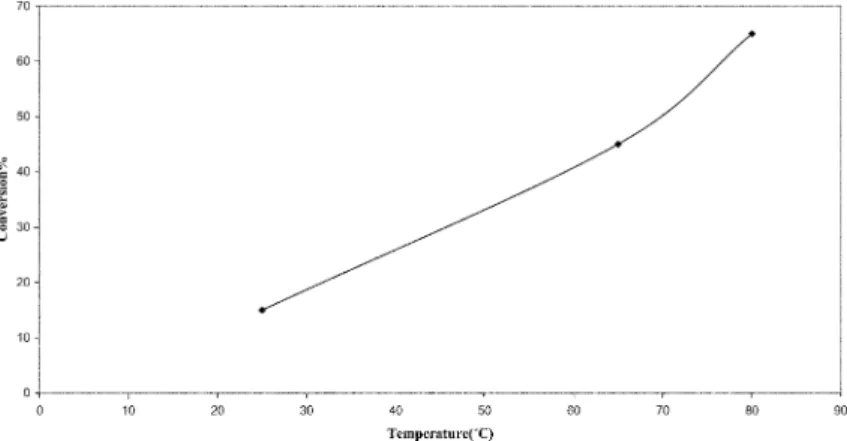
Table 1 also describes effect of temperature ele- vation on the oxidation of cyclohexanol. The con- version found to increase substantially with increasing temperature, which suggested that the reaction was intrinsically kinetically controlled. At ambient tem- perature (25oC), the reaction hardly happened;
while, the conversion increased with increasing temperature. A sharp increase in the yield occurred by elevation of temperature and 65% of cyclohex- anone obtained with H2O2 - H3PW12O40 catalytic sys- tem in water at 80oC after 1h. Whereas, only 15%
of the product observed at ambient temperature at the same time (Fig. 2).
Oxidation of cyclohexanol with H2O2 over some Keggin-type heteropoly acids
Based on the effect of solvent, we selected nor-
mal water as the solvent for the oxidation of cyclo- hexanol. Effect of the type and concentration of heteropoly acid on the oxidation of cyclohexanol in normal water is studied. Table 2 shows that H3PW12O40 acted distinctly more efficient than H3PMo12O40 and H4SiW12O40 in the oxidation of cyclohexanol with H2O2 in normal water. It’s considerable, no conver- sion of cyclohexanol was observed in the absence of catalyst.
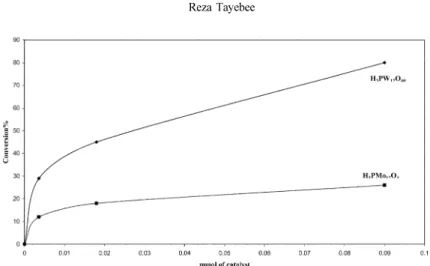
An increase in the catalyst concentration (with respect to cyclohexanol) resulted in an increase in the conversion. 5-fold increase in concentration of H3PW12O40, from 0.0036 to 0.018 mmol, enhanced the conversion from 29 to 45% in water, as solvent, after 1 h. Moreover, increase in concentration of H3PMo12O40 from 0.018 to 0.09 mmol, caused an increase in the conversion from 18 to 26% at the same time. Fig. 3 shows the effect of catalyst con- centration on the oxidation of cyclohexanol with H2O2 in water.
Table 1. Oxidation of cyclohexanol to cyclohexanone with H2O2-H3PW12O40 catalytic oxidation system in different sol- vents at 25-80oC.a
Temperature (oC)
Yield (%) after 1 h
Normal water tButanol Chloroform
25 15 2 3
65 45 <3 <5
80 65 11 16
aTo a solution of H3PW12O40 (0.018 mmol) and 34% H2O2 (5 mmol) in the appropriate solvent (5 ml) was added cyclo- hexanol (0.94 mmol). The reaction mixture was stirred by a magnetic stirrer for the required time. Progress of the reac- tions was followed by the aliquots withdrawn directly and periodically from the reaction mixture, analyzed by gas chromatography.
Fig. 2. Effect of temperature on the conv.% of cyclohexanol with H2O2-H3PW12O40 catalytic system after 1 h.
Table 2. Effect of the type and concentration of heteropoly acid on the yield% of cyclohexanol oxidation in water.a
Catalyst (mmol)
Yield (%) after 1h
H3PW12O40 H3PMo12O40 H4Si W12O40 0 0 0 0
0.0036 29 12 3
0.018 45 18 <5 0.09 80 26 12
aTo a solution of catalyst (0-0.09 mmol) and 34% H2O2 (5 mmol) in normal water (5 ml) was added cyclohexanol (0.94 mmol). The reactions were carried out as described below Table 1.
Oxidation of some alcohols into their correspond- ing oxygenated products with H2O2 - H3PW12O40- H2O catalytic oxidation system
Treatment of an appropriate alcohol with hydro- gen peroxide by the mediation of H3PW12O40 in water afforded the corresponding carbonyl compound after the indicated time in Table 3. Cyclohexanol, as a secondary alcohol, showed the best results under different mole ratios of sub./cat. It led to complete conversion with sub./cat. mole ratio of 52 after 2.5 h. While, benzyl alcohol showed less reactivity toward oxidation and produced 78% benzaldehyde under the same reaction conditions. n-Butanol, as a linear primary aliphatic alcohol, resulted in the least reactivity and obtained 30% of conversion toward the corresponding aldehyde after 2.5h.
Effect of changing concentration of alcohols was also introduced in Table 3. As is expected, conver- sion decreased by enhancing alcohol concentration.
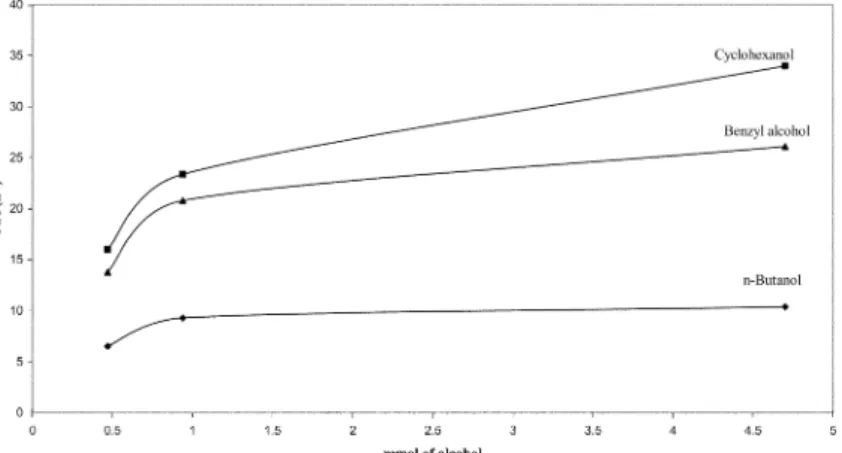
For example, cyclohexanol produced 62, 45, and 13% of conversions with sub./cat. mole ratios of 26, 52, and 260, respectively. However, as is shown in Table 3 and Fig. 4, turnover frequency,42 TOF, increases with enhancing concentration of alcohol.
This may partly be due to lower deactivation of cat- alyst during the reaction and higher number of effective collisions between substrate and the catalyt- ically active oxidizing species. Finally, in all cases no over oxidation products, carboxylic acids, were observed even after extended reaction times.
Catalytically active oxidizing species in H2O2 - H3PM12O40-H2O oxidation system
The groups of Venturello32, 33 and Ishii34-36 indepen- dently developed highly effective and mechanistically closely related polyoxometalates-based catalyst sys- tems for oxygenation of some organic compounds by hydrogen peroxide. Heteropoly acids with the Keggin structure are degraded in the presence of excess H2O2 to form peroxo species {PO4[MO(O2)2]4}3- and [M2O3(O2)4(H2O)2]2- (M=W, Mo), which are the true catalytically active intermediate in the oxygen- ation of organic compounds by hydrogen peroxide catalyzed by H3PW12O40 and H3PMo12O40. It is rec- ommended that these two peroxo species are responsible for the oxidation of alcohols with H2O2- H3PM12O40-H2O (M=W and Mo) catalytic oxida- Fig. 3. Effect of catalyst concentration on the conv.% of cyclohexanol with H2O2 in water after after 1 h.
Table 3. Effect of the type and concentration of some alcohols on the efficiency of H2O2-H3PW12O40-H2O catalytic oxidation system.a
Alcohol (mmol)
Yield% (TOF)b after 1h
n-Butanol Cyclohexanol Benzyl alcohol 0.47 25(6.5) 62(16) 53(13.8) 0.94 18(9.3) 45(23.4) 40(20.8)
4.7 4(10.4) 13(34) 10(26.1)
aTo a solution of H3PW12O40 (0.018 mmol) and 34% H2O2 (5 mmol) in normal water (5 ml) was added the corresponding alcohol (0.47-4.7 mmol). The reactions were carried out as described below Table 1. bTurnover frequency, TOF, was calculated by the expression ([product]/[catalyst])×time (h–1).42
tion system. Scheme 1 represents the general for- mulation of the catalytic system in the oxidation of alcohols.
The reasons why H3PW12O40 showed a higher activity than H3PMo12O40 during the catalysis pro- cess may be explained considering previous find- ings in similar oxidation protocols.37-41 Both H3PW12O40 and H3PMo12O40 are degraded to form the peroxo complexes {PO4[MO(O2)2]4}3- and [M2O3(O2)4(H2O)2]2- (M=W, Mo) in the presence of excess H2O2. The reason may partly be due to the structure and coor- dination environment of these active species. Ding et al.41 believe that the observed different efficacy for H3PW12O40 and H3PMo12O40 in the epoxidation reactions may be related to the different M-O bond order and the different state of electrons filling
orbitals of the central metal ion. The electron con- figuration of atomic tungsten (W) and molybdenum (Mo) are [Xe]4f145d46s2 and [Kr] 4d55s1, respec- tively. For the {PO4[WO(O2)2]4}3-, 5d and 6s orbit- als are vacant, while {PO4[MoO(O2)2]4}3- has more vacant orbitals, i.e. 4f, 4d, and 5s. It is suggested that the substrate and the active species form an intermediate or transitional state during the cata- lytic process, and the electrons of substrate enter the vacant orbitals of the metal ions. For {PO4 [MoO(O2)2]4}3-, there is vacant 4f, 4d, 5s orbitals;
whereas, {PO4[WO(O2)2]4}3- only having two kinds of vacant orbitals. As a consequence, the intermedi- ate formed by the mediation of {PO4[MoO(O2)2]4}3- is comparatively more stable than the one formed by {PO4[WO(O2)2]4}3-. Furthermore, the O-O bonds of tungsten complex are longer than that of molyb- denum complex; it seems to be essential for the fac- ile transfer of the active oxygen.41
EXPERIMENTAL
Materials and Instrumentation
Solvents, reagents, and other chemicals used in this study were of the highest grade available and were purchased commercially. The reagents were stored at 5oC and purified just before use. Silica gel 60 (70-230 mesh, purchased from E-Merck A.G., Darmstadt, Germany) used for column chromatog- raphy. Purity of the substances and progress of the reactions were monitored by Gas Chromatography.
Fig. 4. Effect of alcohol concentration on the TOF in H2O2-H3PW12O40-H2O catalytic oxidation system.
Scheme 1. General scheme for the catalytic oxidation of alcohols with H3PM12O40.
GLC analyses were performed on a Shimadzu GC- 17A instrument equipped with a flame ionization detector using CPB 5-20 (25 m × 0.25 mm, 0.1 to 5.0 µm film thickness) and fused silica WCOT 25 m
× 0.32 mm capillary columns with 5.0 µm film thickness. The heteropoly acids H3PW12O40, H3PMo12O40, and H4SiW12O40 were prepared and characterized according to literature procedures or were pur- chased commercially.25-28
General procedure for oxidation of alcohols to carbonyl compounds in normal drinking water To a solution of catalyst (0.018 mmol) and 34%
H2O2 (5 mmol) in normal water (5 ml) as solvent, was added alcohol (0.94 mmol) and the reaction mixture was allowed to stir at 65oC for the required time. Progress of the reaction was followed by the aliquots withdrawn directly from the reaction mix- ture, analyzed by gas chromatography using n-decane as internal standard. After completion of the reac- tion, products were extracted with 20 ml CHCl3. The extract was dried over anhydrous sodium sul- fate and then was filtered. The filtrate was concen- trated under reduced pressure. Finally, the concentrated filtrate was treated with 2,4-dinitrophenylhydrazine in 6% HCl to give 2,4-dinitrophenylhydrazone of the corresponding carbonyl compound.
Reusability of H3PW12O40
At the end of the reaction, H3PW12O40 recovered by slow drying the aqueous phase of the reaction mixture at 50oC under intense light for 2 h and then at 130oC for 3 h. The regenerated solid acid cata- lyst was washed with dichloromethane, dried at 130oC for 1 h, and re-used in another reaction. The reusability of the catalyst was studied by using the separated catalyst in another reaction. Therefore, two experiments were done, one with the fresh cat- alyst and another with the recycled H3PW12O40. It is concluded that there is no considerable deactiva- tion of the catalyst and it is recyclable. The recycled catalyst could be reused for several times without considerable loss of activity. IR spectroscopy of the catalyst confirmed that the Keggin structure was almost retained at least after four repeated runs.
CONCLUSION
To conform to green chemistry, it is important to realize reaction systems in water instead of organic solvents, to use safe reagents, to decrease hazard- ous inorganic and organic wastes, and to use a min- imal amounts of reusable catalysts.43 Present report established a unique green protocol to achieve some of these goals by using the simplest heteropoly acid catalysts, which offer substantial economic and environmental benefits.
Acknowledgments. The financial support from the research council of Sabzevar University is greatly appreciated.
REFERENCES
1. Dirk, S. M.; Mickelson, E. T.; Henderson, J. C.; Tour, J. M. Org. Lett. 2000, 2, 3405.
2. Suresh, S.; Joseph, R.; Jayachandran, B.; Pol, A. V.;
Vinod, M. P. Tetrahedron 1995, 51, 11305.
3. Webb, K. S.; Seneviratne, V. Tetrahedron Lett. 1995, 36, 2377.
4. Firouzabadi, H.; Jafari, A. A. J. Iran. Chem.Soc, 2005, 2, 85.
5. Li, C.-J. Chem. Rev. 2005, 105, 3095.
6. Ikeda, T.; Tsutumi, O. Science 1995, 268, 1873.
7. Hill, C. L.; Prosser-McCartha, G. M. Coordn. Chem.
Rev, 1995, 143, 407.
8. Zhan, B.Z.; White, M.A.; Sham, T. K.; Pincock, J. A.;
Doucet, R. J.; Rao, K. V. R.; Robertson, K. N.; Cam- eron, T. S. J. Am. Chem. Soc. 2003, 125, 2195.
9. Moorthy, J.N.; Singhal, N.; Venkatakrishnan, P. Tetra- hedron Lett. 2004, 45, 5419.
10. Wolfson, A.; Wuyts, S.; De Vos, D. E.; Vankelecom, I.
F. J.; Jacobs, P. A. Tetrahedron Lett. 2002, 43, 8107.
11. Loua, J.-D.; Xu, Z.-N. Tetrahedron Lett. 2002, 43, 8843.
12. Xu, L.; Trudell, M. L. Tetrahedron Lett. 2003, 44, 2553.
13. Lou, J. D.; Wang, M.; Zhu, L.-Y.; Fang, Z.-G. Catal.
Commun. 2003, 4, 647.
14. Reddy, S. R.; Das, S.; Punniyamurthy, T. Tetrahedron Lett. 2004, 45, 3561.
15. Zhan, B.Z.; White, M. A.; Sham, T. K.; Pincock, J. A.;
Doucet, R. J.; Rao, K. V. R.; Robertson, K. N.; Cam- eron, T. S. J. Am. Chem. Soc. 2003, 125, 2195.
16. Zhang, S.; Xu, L.; Trudell, M. L. Synthesis 2005, 11, 1757.
17. Sato, K.; Aoki, M.; Takagi, J.; Noyori, R. J. Am. Chem.
Soc. 1997, 119, 12386.
18. Neumann, R.; Gara, M. J. Am. Chem. Soc. 1995, 117, 5066.
19. Kozhevnikov, I. V. Chem. Rev. 1998, 98, 171.
20. Ishii, Y.; Ogava, M. In Hydrogen Peroxide Oxidation Catalyzed by Heteropoly Acids Combined with Cetylpyridinium Chloride; MY: Tokyo, 1990, vol.3, p.
121-145.
21. Kozhevnikov, I. V. Russ. Chem. Rev. 1987, 56, 811.
22. Dickman, M. H.; Pope, M. T. Chem. Rev. 1994, 94, 569.
23. Isobe, K.; Yagasaki, A. Act. Chem. Res. 1993, 26, 524.
24. Tayebee, R.; Alizadeh, M. H. Monatshe Chemie 2007, 138, 763.
25. Okun, N. M.; Anderson, T. M.; Hill, C. L. J. Am. Chem.
Soc. 2003, 125, 3194.
26. ten Brink, G. J.; Arends, I. W. C. E.; Sheldon, R. A. Sci- ence 2000, 258, 1636.
27. ten Brink, G. J.; Arends, I. W. C. E.; Sheldon, R. A.
Adv. Synth. Catal., 2002, 344, 355.
28. Brevard, C.; Schimpf, R.; Tourne, G.; Tourne, C. M. J.
Am. Chem. Soc. 1983, 105, 7059.
29. Bonardet, J. L.; Carr, K.; Fraissard, J.; Mc Garvey, G.
B.; Mc Monagle, J. B.; Seay, M.; Moffat, J. B. In Microporous metal-oxygen cluster compounds (het- eropolyoxometalates); in: Moser, W. R. (Ed.), Advanced Catalysts and Nanostructured Materials, Modern Syn- thetic Methods, Academic Press, New York, 1996, p.
395.
30. Hulea, V.; Dumitriu, E.; Patcas, F.; Ropot, R.; Graffin, P.; Moreau, P. Appl. Catal. A 1998, 170, 169.
31. Clerici, M. G.; Bellussi, G.; Romano, U. J. Catal. 1991, 129, 159.
32. Venturello, C.; D’Aloisio, R.; Bart, J. C. J.; Ricci, M. J.
Mol. Catal. 1985, 32, 107.
33. Venturello, C.; D’Aloisio, R. J. Org. Chem. 1988, 53, 1553.
34. Ishii, Y.; Yamawaki, K.; Ura, T.; Yamada, H.; Yoshida, T.; Ogawa, M. J. Org. Chem.1988, 53, 3587.
35. Matoba, Y.; Inoue, H.; Akagi, J.; Okabayashi, T.; Ishii, Y.; Ogawa, M. Synth. Commun. 1984, 14, 865.
36. Ishii, Y.; Ogawa, M. In Reviews on Heteroatom Chem- istry; Ohno, A.; Furukawa, N. (Eds.), vol. 3, MYU, Tokyo, 1990, p. 121.
37. Venturello, C.; D’Aloisio, R. J. Org. Chem. 1988, 53, 1553.
38. Salle, L.; Piquemal, J. Y.; Thouvenot, R.; Minot, C.;
Bregeault, J. M. J. Mol. Catal. A 1997, 117, 375.
39. Campbell, N. J.; Dengel, A. C.; Edwards, C. J.; Grif- fith, W. P. J. Chem. Soc., Dalton Trans. 1989, 1203.
40. Salle, L.; Aubry, C.; Thouvenot, R.; Robert, F.; Doremieux- Morin, C.; Chottard, G.; Ledon, H.; Jeanin, Y.; Bregeault, J. M. Inorg. Chem. 1994, 33, 871.
41. Ding, Y.; Gao, Q.; Li, G.; Zhang, H.; Wang, J.; Yan, L.;
Suo, J. J. Mol. Catal. A 2004, 218, 161.
42. Turnover number, TON, is used as the number of moles of substrate that a mole of catalyst can convert before becoming inactivated. The term turnover fre- quency, TOF, is used to refer to the turnover per unit time.
43. Anastase, P. T.; Warner, J. C. Green Chemistry: Theory and Practice; Oxford University Press, Oxford, 1998.