BACKGROUND
Cancer, having a shattering impact on the life of can- cer patients, also has an immense impact on the spouses.
Many studies (Baider, Koch, Esacson & De-Nour 1998;
Hannur, Gresi-Davis, Harding & Hatfield 1991; Ell, Nishimoto, Mantell & Hamovitch 1998) have reported that spouses considered their partners’ cancer as a signif- icant stressor, and reported a number of adverse effects
on their marital relationship and daily functioning in the family. And since spouses are also the most important supporters for the people with cancer in their everyday lives, it is essential for health professionals to understand the couples as a whole if they are to provide appropriate family-oriented care. Thus, some researchers (Baider et al. 1998; Silver-Aylaian & Cohen 2001) investigated couples as their unit of research, not individuals.
However, because of the different impact between vari- ous types of cancer on psychosocial domain, along with
Experience of Gastric Cancer Survivors and their Spouses in Korea: Secondary Analysis
Myungsun Yi, DNS, RN1, David Kahn, PhD, RN2
1. Associate Professor, College of Nursing Seoul National University 2. Associate Professor, The University of Texas at Austin School of Nursing
Corresponding author: Myungsun Yi, DNS, RN, Associate Professor, College of Nursing Seoul National University, 28 Yongon-dong, Chongno-gu, Seoul 110-799, Korea.
Tel: 82-2-740-8829 Email: [email protected]
This study was supported by Seoul National University Research Fund.
Received March 16, 2004 ; Accepted June 24, 2004January 31, 2000
Purpose. The purpose of this study was to explore the experiences of gastric cancer couples in Korea and to gen- erate a substantive theory integrating the experiences of gastric cancer survivors and their spouses as a whole. The specific aims of this study were to explore major problems gastric cancer couples faced and how they resolved these problems, focusing on inter-relational dynamics within the couples and on similarities and differences between the couples.
Methods. This was a secondary analysis study using grounded theory techniques. The study used the data of 11 married couples which was collected from in-depth interviews from two primary studies. The unit of analy- sis was dyads of gastric cancer survivors and their spouses.
Results. The basic social psychological process that emerged from the analysis was “taking charge of their health.” Major categories involved in this process were identified as 1) adjusting to new diets, 2) reinforcing physical strength, 3) seeking information, 4) strengthening Ki, 5) lowering life-expectations, and 6) going their separate ways. These six categories represent major strategies in overcoming critical problems that occurred in day-to-day experiences. In terms of the process, the first five categories characterize the earlier stage of the process of “taking charge of their health,” while “going their separate ways” indicates the later stage and also the beginning of their separate ways: “pursuing spiritual life” for the survivors, and “prepar- ing for the future” for the spouses.
Conclusions. The results of this study will help design family care for the people with gastric cancer by providing in-depth understanding and insight on the lives of gastric cancer couples.
Key Words: Cancer Nursing, Family Nursing, Grounded Theory, Psychosocial Nursing
the prognosis or significance of the disease intensity, oth- er researchers chose to focus on the couples with specific types of cancer, for example, the couples with breast cancer (Holmberg, Scott, Alexy & Fife 2001; Hoskins 1995a, 1995b; Northhouse 1989; Walker 1997) and those with colon cancer (Northouse, Mood, Templin, Mellon & George 2000). Although headway has been made into these types of cancer, there are still many im- portant types of cancer left that have not be yet re- searched. Gastric cancer, or stomach cancer, is one of these, severely lacking empirical research in understand- ing the experiences of gastric cancer couples (O’Connor 1999; Sawyers & Eaton 1992).
Gastric cancer has the highest prevalence rates among all types of cancer in East Asian societies such as Japan and Korea (National Cancer Center 2003). It is one of the leading causes of cancer death as well. For example, in 2001, death from gastric cancer accounted for 19.4%
of all cancer deaths in Korea (National Cancer Center 2003). Yet its survival rates have increased due to im- proved medical technologies and increased screening ex- aminations. Currently, five-year survival rates of gastric cancer in Korea are reported to be 43.9%, which is much higher than that of lung cancer (11.4%) or liver cancer (10.5%) (National Cancer Center 2003). This in- crease in survival rates and correspondent life span of gastric cancer patients translates into a higher demand for professional care and attention not only in the areas of basic health but also more importantly in the issues of quality-of-life. Gastric cancer is one of the leading caus- es of cancer death in Western societies also. For exam- ple, Hicks (2001) reported that in the UK, gastric cancer is the sixth most common cancer and is responsible for over 9,000 deaths annually, with its five-year survival rates of 34%. In spite of these high rates, few had given attention to gastric cancer.
The purpose of this study was to explore the experi- ences of gastric cancer couples using qualitative sec- ondary analysis. Because culture plays such an impor- tant role in thoughts and feelings about health and ill- ness (Leininger & McFarland 2002), culturally homoge- neous Korean couples were selected to be the focus of the study. The specific aims of this study were to explore major problems that the gastric cancer couples faced and how they resolved these problems, focusing on inter-re- lational dynamics within couples and on similarities and differences between the couples. Ultimately, it was to generate a substantive theory integrating the experiences
of gastric cancer survivors and their spouses as a whole.
METHODS
This research was a grounded theory study using sec- ondary analysis. The data used for this study were de- rived from the primary studies on gastric cancer sur- vivors and on their families to develop a substantive the- ory respectively.
Qualitative Secondary Analysis
Qualitative secondary analysis is a method of using an existing qualitative data set to find answers to research questions that differ from those asked in the primary re- search. It has many advantages. It is convenient, as the researcher does not have to go through the time-con- suming process of data gathering. It maximally uses the existing data, which is assumed to be information-rich, by answering subsequent research questions (Hinds, Vogel & Clarke-Steffen 1997; Steeves, Kahn & Cohen 1996; Szabo & Strang 1997; Thorne 1994). Furthermore, the most important advantage of qualitative secondary analysis exists in its usefulness in producing more ab- stract and generalizable concepts that may not be specifi- cally addressed in the primary analysis (Hinds et al.
1997; Steeves et al. 1996; Szabo & Strang 1997; Thorne 1994).
The aim of this study was to explore the phenomena which were not thoroughly examined in the primary studies. The context of this study was broader than the primary studies as it combined data from two samples;
gastric cancer survivors and their spouses. Thus couples of survivors and their spouses were used as the unit of analysis rather than the individual.
However, qualitative secondary analysis has many dis- advantages as well. The most common potential hazards are threefold: the lack of fit between the data set and the research questions; the lack of control in generating the data set; and the inability to strictly follow the guidelines of the chosen data analysis method (Hinds et al. 1997;
Szabo & Strang 1997;Thorne 1994, 1998). To minimize or solve these problems and establish scientific rigor for this study, these issues were considered and discussed in detail in the subsequent sections of this chapter.
Setting and Participants
Korean society is known to have a collectivistic culture rather than an individualistic one (Hofstede 1980).
“We” or “family” has priority over “I,” and relational harmony is more important than individual indepen- dence in their lives. Confucianism, which has been a ma- jor religion for more than 500 years in Korea, is one of the factors that have influenced this phenomenon.
Confucianism emphasizes relations, and people are very duty-conscious about this (Encyclopedia Britannica 2003). Taoism, which teaches conformity to the Tao by unassertive action and simplicity, has also permeated in- to the lives of Koreans (Encyclopedia Britannica 2003;
Shin, 2001). Buddhism is also an important religion in Korea. It emphasizes mental and moral self-purification in order to be liberated from suffering which is inherent in life (Encyclopedia Britannica 2003). These three reli- gions have played a central role in the spiritual, cultural, and social life of Koreans for more than 1,000 years, though Christianity, which was introduced to Korea less than 200 years ago, has become one of the major reli- gions in Korea.
The data of 11 Korean married couples from the pri- mary data sets were selected for this study. The first au- thor of this study had collected the primary data sets us- ing grounded theory during the years of 1995 to 1998.
The data were mainly gathered from individual in-depth interviews with some family interviews, using open-end- ed questions in all interviews although questions got more focused as the analysis progressed. All interviews were tape recorded and transcribed.
This study obtained approval from the Institutional Review Board, submitting the research proposal and in- dicating it as a secondary analysis study. An ethical issue related to secondary analysis is the consent of the partic- ipants (Hinds et al. 1997; Thorne 1998), because often consent for secondary study is not obtained at the time of primary study. For this study, the primary author had obtained consent in previous studies, indicating possibili- ty of secondary analysis on the consent form.
Among the 11 gastric cancer survivors, nine were males and two were females. It reflects the incidence rate of gastric cancer in Korea, in which the males’ inci- dence is twice as high as that of the females’ (National Cancer Center 2003). The average age of the survivors was 45, ranging from 34 to 63. Educational backgrounds were diverse, but most of them were graduates of high school or higher. At the time of the interviews only three had jobs. In terms of religion, four were Protestants, four were Buddhists, and the rest stated no religious preferences. The average period after the diag-
nosis was three years, ranging from four months to eight years. Except for two people, all had been diagnosed with advanced gastric cancer. All but one had gastrecto- my; four had subtotal gastrectomy, five had total gastrec- tomy, and one had open-closed operation. Six of them had chemotherapy after the surgery.
The average age of the 11 spouses was 42. Their edu- cational backgrounds were similar to those of the sur- vivors. All nine female spouses were housewives and the two male spouses were employed.
Data Analysis
Grounded theory techniques (Glaser 1978; Strauss &
Corbin 1998) were used in the data analysis to develop an explanatory model of the experiences of gastric can- cer couples. The unit of analysis was dyads of gastric cancer survivors and their spouses. Constant compara- tive analysis was used within the data sets. In the process of open coding, the codes were generated by examining the data set word by word and line by line. The codes were compared to each other to develop categories, properties and dimensions. In axial coding, the devel- oped categories from the open coding were connected, utilizing a coding scheme that involves conditions, con- texts, action/interaction strategies, and consequences. In selective coding, a theoretical model was constructed from the categories, identifying a basic social psycholog- ical process that represents a central phenomenon around which all the other categories were anchored. In addition, theoretical memos and diagrams were continu- ously used to generate a substantive theory on the expe- riences of the gastric cancer couples.
Rigor of the Study
As with the primary research, a secondary analysis study must carefully attend to issues of methodologic rigor so that its outcomes can contribute to the develop- ment of new knowledge. It must establish criteria such as credibility, fittingness, auditability, and confirmability, as Guba and Lincoln (1981) and Sandelowski (1986) indi- cated.
In this study credibility and fittingness were estab- lished by several features. First, there were close links between the research question and the data set, as the research question of this study encompassed those of the primary studies. Second, the qualitative primary data was amenable to a secondary analysis, because it con- tained thick descriptive data providing pertinent details
and appropriate depth. Third, the level of control was raised in generating the data set by following the con- stant comparative analysis, though this was possible only within the primary data set. Employing theoretical sam- pling and saturation was possible especially because the primary data were rich enough to test the emerging the- ories. Additionally, getting feedback from cancer re- search colleagues through discussion helped validate the results. Full availability of the primary data, such as orig- inal tapes, transcripts, demographic data, and memos, added to the credibility of this secondary analysis.
Moreover, Korean language was used during the process of analysis to insure accuracy as the primary data were in Korean. The final results of the study were then trans- lated into English in the writing process. To minimize the differences between the original Korean text and the translated English version, the primary author, who is bilingual, brought out the meanings underlying the words rather than translating it literally (Werner &
Campbell 1970).
To establish auditability for this study, the audit trail was maintained through systematic and detailed record- ing, including a personal journal used to document per- sonal biases, thoughts, and feelings that might influence the study. Analytic memos were used to record the de- velopment of the theory.
Confirmability was enhanced in this study by linking quotes to the explanation of the properties and dimen- sions found within the data. In this way, it was confirmed
that the findings had emerged from the data itself. Also, the researchers periodically immersed in and distanced themselves from the data to keep a fresh approach and establish confirmability.
FINDINGS
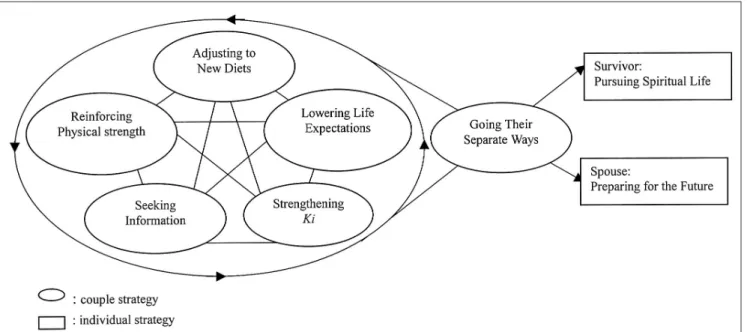
After analyzing the data of the 11 Korean gastric can- cer couples, “taking charge of their health” emerged as the basic social psychological process (BSPP). Major cat- egories involved in this process were identified as 1) ad- justing to new diets, 2) reinforcing physical strength, 3) seeking information, 4) strengthening Ki, 5) lowering life-expectations, and 6) going their separate ways. These six categories capture the essential aspects of “taking charge of their health” and each category represents ma- jor strategies in overcoming critical problems that oc- curred in day-to-day experiences.
Figure 1 is a framework that integrated these cate- gories to the BSPP of “taking charge of their health.” In terms of the process, the big circle with arrows indicates the on-going process, and the straight arrows show the separate paths the couples took in the end. Small ovals indicate categories the couples were involved together, whereas rectangles indicate categories they were in- volved separately. All six categories were closely related with each other, and short lines indicate this interrelated nature. “Adjusting to new diets,” “reinforcing physical strength,” and “seeking information” were major coping
Figure 1.Experience of Gastric Cancer Survivors and Their Spouses: Taking Charge of Their Health
strategies in dealing with the physical problems.
“Strengthening Ki” and “lowering life expectations”
were major strategies in seeking psychosocial and spiri- tual well-being. “Going their separate ways” indicates the later stage of the process of “taking charge of their health” and also the beginning of their separate ways:
“pursuing spiritual life” for the survivors, and “prepar- ing for the future” for the spouses.
Basic Social Psychological Process: Taking Charge of Their Health
The gastric cancer couples considered diagnosis of gas- tric cancer as receiving “a death sentence.” One survivor said, “If you were diagnosed as cancer, you would lose your mind. You would go mad and think, ‘Oh my god!
I’m going to die!’” Although relieved after treatments were finished, this was short-lived and soon they began to fear of getting worse or recurrence of the cancer. At the same time, they came to realize that they could not rely on the health professionals for their health any more because they had received all the treatment they could get. One survivor said, “After taking my last anti- cancer drugs, I felt like I was abandoned in a desert. I hadn’t had the faintest idea how to live on my own.”
In order to go on with their lives after the treatments and realizing that they had been careless about their health before the cancer diagnosis, the couples soon re- solved they would take their health into their own hands. The BSPP of “taking charge of their health” indi- cates the resolutions the survivors and their spouses made after medical treatments were finished. The
“health” in “taking charge of their health” means that of the survivors, and it includes physical, psychosocial, and spiritual domains of health. But the active role in
“taking charge” was mainly played by the spouses, by becoming a vanguard for their survivors when the sur- vivors themselves could not go forward. The process was like a duet in harmony between the survivors and the spouses, although disharmony and conflicts occurred at times. In the end, however, the couples departed from their duet and returned to their separate lives (see Figure 1).
Adjusting to New Diets
All survivors had to be extremely cautious about what to eat, when to eat, and how to eat it, whether they had had surgery or not. If they were to eat as usual, they would experience gastrointestinal (GI) problems, or
Dumping syndromes, which include abdominal pain, sudden sweating, paleness, dizziness, lethargy, and so on.
Though they were given information regarding diets, they found it extremely hard to follow the regimens.
They had difficulty chewing foods for an abnormally long time (about 40 50 times) and adjusting to the ap- propriate amount of meals. Though they were told to have a balanced diet, most of them strictly avoided meat because they thought it would aggravate relapse.
However, they followed the advice in avoiding hot, spicy, or salty foods, even though most Korean foods are so.
Other foods they avoided were fast foods, frozen meals, and fried food.
Despite their cautious eating, all survivors experienced Dumping syndromes. Some experienced it as often as every other week in the early stage and most of them had been taken to the emergency room at least once be- cause of this. Thus they got frustrated and became afraid to eat. For some of them, eating itself became the most difficult task to overcome. These GI problems further made the couples frightened, because they regarded them as indicators of recurrence of cancer or aggravation of physical health status. One spouse said, “The thought of recurrence of cancer always hovers in the back of my mind. If he says that he feels something inside his belly, all of a sudden my heart stops.”
While the survivors experienced difficulty in eating and GI problems, the spouses felt difficulty in preparing food and feeding. When the survivors were male, the fe- male spouses devoted their entire energy into cooking, providing the best freshest food to the survivors at every meal. Most of them thought that doing their best was a way to save the survivors. One spouse said, “Cure comes from devotion. There is a saying, ‘Sincerity moves heaven.’” At the same time, they felt that if something happened to the survivor, it would be their fault.
However, husbands of female survivors did not take this kind of responsibility but arranged for a person to pre- pare meals for some time.
This devotion to cooking had made the female spouses physically drained because most survivors expected to eat newly cooked food at every meal. One spouse said,
“I am living in the kitchen, 24 hours a day. . . Even now [eight months after surgery] he doesn’t eat for lunch what was prepared for breakfast. . . He seems to think I am made of steel!”
It took from several months to several years for the
couples to adjust to the new diets. The survivors were then able to eat the right kinds and right amount of food at the right speed, and experienced less GI problems, while the spouses were able to prepare the meals with- out being drained of physical energy.
Reinforcing Physical Strength
Besides the effects of cancer and its treatments, eating small amounts of meals and poor digestion made all sur- vivors feel lack of physical strength. All experienced loss of weight from 5 to 40 kilograms when finished with treatments. Thus weight gain turned out to be a key indi- cator of recovery and measuring body weight became a daily ritual.
All survivors who avoided meat tried to reinforce physical strength by eating protein-rich folk medicine, such as eels, earthworms, and etc. Boosting the immune system was another way to reinforce physical strength, as it would prevent recurrence. The couples tried various herbal medicines such as plant juice, arrowroots, gin- seng, red ginseng, and mushrooms as well as food that was known to have anti-cancer effects such as bean paste soup and brown rice. All had tried plant juice remedies at least once.
When preparing folk medicine the spouses became a curer rather than a carer for the survivors, thinking that their partners’ lives relied totally on them. “To save my wife, I got her every [folk] medicine people said were good, even those that cost a lot of money. Because I wanted to do everything I could for her.” Besides, using folk medicine was a way of showing their efforts to the survivors and also a way of relieving their anxiety and fear of possible recurrence. Sometimes it became a way to avoid guilt or reproach from the survivors or other family members if the survivors got worse. “I said to my husband, You can’t say that I did not try hard enough.’’
The strategies of “reinforcing physical strength” and
“adjusting to new diets” were often contradictory for the couples. The survivors tended to focus on “adjusting to new diets” because they wanted to avoid GI symp- toms. But the spouses focused more on “reinforcing physical strength” to get the survivors well, urging them to “eat up as if they were taking medicine, even if it’s hard.” In severe cases, encouraging the survivors to eat became threatening, and it made the survivors suffer. On the other hand, if the survivors did not eat up as expect- ed, the spouses got very disappointed and blamed them for lacking the will to live. However, as time went by, the
spouses began to realize that pushing the survivors too hard was not good at all for their physical strength, espe- cially when the survivors experienced Dumping syn- drome, and they came to compromise with the sur- vivors’ picky eating.
Seeking Information
All gastric cancer couples sought information, wanting to see their situation more realistically, and thus cope with their problems more efficiently. The thing the cou- ples wanted to know the most about was the causes of their cancer (in their own terms). This was because they thought by knowing the reason they could correct them and prevent the cancer from recurring. The most com- mon reason they found was unhealthy lifestyles, such as drinking, smoking, and having an irregular diet. Some couples thought the survivors’ perfectionist personalities or neglecting their religious duties were the reason.
In rectifying the causes, conflicts occurred between the couples, especially when the spouses felt that the sur- vivors were not putting in enough effort. It made the spouses disappointed and frustrated, and in the end some even reproached the survivors for getting the can- cer. “When I got upset, I would say to my husband, ‘You got cancer because you didn’t listen to me! You deserve it!’” In the cases in which they could not find any causes, they also went through emotional distress because there were no faults to correct.
All couples also sought information regarding the progress of the illness. They wanted to know about prog- nosis, recurrence, and the ways to manage physical symptoms. This kind of information was mainly ob- tained from health professionals, but most couples were not satisfied with this information, partly because it was too abstract for them to understand, and also because they did not want to believe some of the information, such as the prognosis that they received.
This dissatisfaction made them actively seek details and information involving folk medicine that promised cure. Most of them solicited information from friends and family members and other cancer survivors, who showed their concern by giving this kind of information.
Others sought it from books or other kinds of mass me- dia. However, in the end, they felt confused and frustrat- ed because most brought side effects or complications.
Thus, they came up with their own remedies or gave up the idea entirely.
Strengthening Ki
“Strengthening Ki” refers to revitalizing the strength of the survivors. Ki is a holistic concept referring to a vi- tal energy or essence of life (Chang 2001). It is regarded as the integrated essence of physical, psychological, and spiritual strength needed in human life. Koreans say
“His/her Ki is broken or dead” when they are discour- aged or depressed, and “His/her Ki is free and alive”
when they are energized.
The Ki of the survivors was almost dead not only when they were diagnosed as cancer but even after all treatments had finished. One survivor expressed this feeling as “a bird with a broken wing crawling on the ground.” Some of them thought their families would de- preciate them because they were going to die. This dis- couragement and personal devaluation led them to won- der about their meaning in life. One survivor said, “I wondered, ‘How meaningful is my presence? How much attachment should I have to my life?’”
In this situation, the support from the spouse was ab- solute. The spouses tried to help the survivors strengthen their Ki. First, they gave the survivors all the love and hope they could give besides doing their best in prepar- ing food and folk medicines. Second, they set aside their needs and desires, including their sexual needs. Third, they encouraged them to live not for themselves but for their family members, especially for their children and parents. The spouses encouraged them to live to see the important stages of the children’s life such as graduation and marriage. They also encouraged them to outlive their parents who were still alive, since in Korea, it is an important virtue as a son or daughter. “We” or “Fami- ly” has priority over “I” in Korea and relational harmo- ny is more important than individual independence in their lives. Thus, asking them to strengthen Ki in support of their family rather than for themselves was more per- suasive.
With the awareness of the importance of their exis- tence in a relational context, the survivors began to think that they must not die by virtue of their family, and were then able to bear the sufferings. “When my wife and I talked about our future, I began to have a will to live, and I thought ‘I must live on. I should overcome it at any cost.’” They also strengthened their Ki by learn- ing about other gastric cancer survivors living a normal life, and by comparing themselves with others who were worse off (so-called downward comparison).
However, the spouses thought that strengthening Ki
too much was risky because they could loosen up and become self-indulgent, returning to their previous un- healthy life styles. Thus they had to be cautious while doing this.
Lowering Life Expectations
The most frequent emotional distress the gastric can- cer survivors experienced were frustration and anger.
These mainly came from the fact of their lowered physi- cal strength and their reluctance to discard the previous expectations of life they had envisioned before. Those diagnosed with advanced gastric cancer could not go back to work and became unemployed, which aggravat- ed their financial problems. In addition, unemployment restricted their life and it was very hard especially for male survivors to accept, as they had to stay home for 24 hours a day with their spouses. This situation height- ened their frustration and anger, eliciting an explosive over-reaction for even a trivial offense. Thus, tolerating each other became another immense task to overcome.
The gastric cancer survivors expressed their frustration and anger to their spouses and most spouses tried to ac- cept them rather than talking back or firing up at them.
The spouses thought that they just had to absorb their complaints like a sponge. One male spouse said, “When my wife complains, I just laugh and say ‘I saved your life, and all I get for it is complaints.’” They acted like this because they thought oppressing the survivors’
anger could result in stress, which could cause recur- rence of cancer. Also, they thought it would weaken their Ki. Another major reason was that they felt pitiful toward the survivors and also thankful towards them for just being alive.
However, this strategy soon came to a limit, and in the end, the spouses could not take it anymore. The relation- ships between the couples became unstable, even for those who had no marital problems before. They be- came overly sensitive and annoyed at each other.
Accepting his frustration and anger was so hard. For every thing I said, he got irritated and emotional for no reason . . . So it got me to the point where I said things I didn’t really mean. Though I try to understand him, I am a human being too, you know.
Only a few couples did not experience this conflict, be- cause these spouses knew how to talk back appropriate- ly, and thus manage the anger or emotional distress that the survivors expressed.
As time passed by, however, the survivors slowly be-
gan to realize that they should lower their expectations if they wanted to control their frustration and anger. They did this by changing their priority in life. They put their health as their first priority over wealth or social posi- tion, which had been the major goal of their previous life. In this situation, regardless of their religious prefer- ences, many turned to an implicit and culturally embed- ded Taoism, believing they could become more strong and healthy by cutting themselves off from the modern- ized world and living in secluded mountains, like the Taoist sages of old. This was fueled by the belief that their disease had resulted from the polluted air of the congested cities, the artificial instant food they eat, and the stressful life that accompanies modern-day life.
Taoism, teaching the solidarity of nature and human be- ings, and passing down a tradition thousands of years old of self-cultivation and renewal through being with nature, was indeed a way of life many survivors sought to. But few even came close to actually living the life they wished, for in reality they were still very dependent on health care professionals. Instead, most opted for cul- tivating themselves within their daily lives and focused their energies on renewal of body and soul in the com- fort of their homes. Besides Taoism, religions that teach deserting passion or desires, such as Buddhism and Christianity, helped them change their value system to accept their modest life. However, support from their spouses was necessary in doing this.
He was very sensitive toward money. [Husband says by her side, ‘Of course, breadwinners should be sensi- tive.] So I told him to be free of it, not to worry about it any more, that a person who almost went to heaven’s door does not have to think about it. I said that life itself is the only thing he should think about.
In addition, they diverted their attention through writ- ing, taking a walk, or taking care of grandchildren to control their frustration and anger. But these activities occurred in the later stages as their physical and psy- chosocial conditions got better.
Going Their Separate Ways
All categories mentioned above took place through continuous interaction between the survivors and their spouses. However, as time passed by, the couples fol- lowed different paths; the survivors pursued spiritual life, and the spouses began to prepare for the future to come.
Survivors: Pursuing Spiritual Life. All survivors in this study pursued spirituality to search for peace of mind.
They actively sought it after a couple of years, except for those who were extremely religious and found peace of mind during the diagnosis. Two different kinds were identified in pursuing their spiritual life: a religious one, and a nonreligious one. Religious survivors experienced inner peace of mind by participating in religious activi- ties such as praying. One Buddhist recounted, “I am on- ly an empty shell. I leave everything to the Higher One.”
Others without religion pursued their spirituality by cul- tivating themselves, controlling their body as well as their thoughts. Cultivating themselves involved clearing their mind, emptying all impurities such as anger, greed, or desire, which could lead to loss of spirituality. When they were able to control their body and thoughts, they felt they could overcome anything.
By pursing spiritual life, most survivors, whether they were religious or not, felt renewed by apprehending their real self. Some recognized that they were their own lord, throughout heaven and earth. Others came to think of their current life as a bonus. With this realization they began to enjoy their life again. They gained satisfaction by being more religious, by feeling closer to their ances- tors, or by helping others suffering from cancer.
Spouses: Preparing for the Future. On the other hand, the spouses had to prepare for the future to come. The spouses of the survivors with a better prognosis felt that the worst was over. They were then able to think about their children and their own personal life. However, those whose partners had a poor diagnosis felt com- pelled to prepare for the worst, that is, relapse of the cancer or death of their partners. Although they felt somewhat relieved at this time because they had tried everything they could do to save their partner’s life, they were afraid of their partner’s death and subsequent life without a partner. It was particularly hard for relatively young female spouses. They lived day by day, anxiously waiting for the inevitable to come. For others, life be- came monotonous and lonely. A male spouse whose wife had been sick for five years stated as below:
I am never completely relaxed at all. I suffer. . . I try to allay my loneliness. When I go to social gatherings, I drink till dawn and have a good time to forget the pain, though the thought of my wife never leaves my mind. I just live on, trying to soothe myself. I nod off after a drink, wake up to see it’s already morning, and go to work. I come home in the evening and eat dinner, watch TV, look at my wife from time to time, go to work again.
That’s my life. That’s the way I live.
DISCUSSION
This study provides unique insights into the psychoso- cial adjustment of Korean gastric cancer couples, reveal- ing major common problems, conflicts between the spouses, and resolving strategies. The basic social psy- chological process of “taking charge of their health” in- dicates the desperate struggle of the couples trying to re- gain their health. This study illustrated how the Korean culture and value system influence their experiences.
For example, “strengthening Ki” reflects a Korean’s view of the essence of life, which integrates physical, psychological, and spiritual strength.
Nevertheless, many results of this study are also con- sistent with the results of cancer studies in Western soci- eties. In terms of the process of adjustment, this study showed that gastric cancer survivors adjusted positively with support from their spouses, although physical and psychosocial distresses were noticeable in the earlier process. These results confirm the results of other studies (Cassileth, Lusk, Brown & Cross 1986; Andersen, Anderson & deProsse 1989), indicating that cancer sur- vivors do well in terms of general psychological out- come. This study also showed the physical and psycho- logical burden the spouses had, which is consistent with the findings of other Western cancer couples (Morse &
Fife 1998; Northouse et al. 2000).
Several categories identified in this study are also com- parable with results of previous studies. For example, seeking and using folk medicine in this study is consis- tent with the report of Montbriand (1995), which used alternative therapies as major control behaviors among cancer patients in Canada. The category of “lowering life expectations” is comparable with the “theory of self-dis- crepancies” (Higgins 1987). Higgins proposed examining the relationship between expectations regarding the self and the adjustment to illness, such as cancer. His theory was based upon the gap between the two dimensions of self: the ideal self and the actual self, concepts initially suggested by Rosenberg (1986). The ideal self, contain- ing the aspirations and potential of one’s being, is com- pared to the real self, the current conceptions one has about one’s self. Reconciliation of the two is viewed as necessary in the process of psychological adjustment (Higgins 1987; Higgins, Bond, Klein & Strauman 1986) because a discrepancy between the two might lead to psychological distress. One study (Heidrich, Forsthoff &
Ward 1994) demonstrated the importance of self-dis- crepancy in adjustment of adults with cancer. This study supports this theory of self-discrepancies; however, it further illustrated the roles of religion and value sys- tems, and especially the spouses’ support in this process.
“Pursuing spiritual life” was a vital component of ad- justment among gastric cancer survivors in this study. It confirms the results of previous studies (Coward 1990, 1991; Germino, Fife & Funk 1995) in U.S.A. which used spirituality or “self-transcendence” as an essential com- ponent.
The results of this study will help health professionals provide holistic care for Korean gastric cancer couples, by incorporating factors such as religion, cultural values, and other lifestyle factors into comprehensive health- care programs. The results of this study might also be used in helping others, such as Korean-American gastric cancer couples, who still share common value and belief systems with Koreans.
Beyond these limited applications, the findings suggest numerous potential implications for clinical practice in general. First, health professionals need to include spous- es in care programs. The evidence from this study and others (Morse & Fife 1998; Northouse et al. 2000) pro- vide more than enough data to assert that adjusting to cancer is a primarily family affair. Second, health profes- sionals need to adopt a holistic approach in the care of survivors with cancer, including not only physical and psychosocial domains of health, but also spiritual do- main. Health professionals need to focus on spirituality to promote health and thus improve quality of life of the survivors, as others (Baldacchino & Draper 2001;
Hawks, Hull, Thalman & Richins 1995) have recom- mended. Third, health professionals need to assess both physical and emotional burdens that spouses of gastric cancer survivors have. They need to support the spouses in managing concurrent stress as they carry out their caregiving role (Northouse et al. 2000; Petrie Logan &
DeGrasse 2001). Fourth, health professionals might need to take gender into consideration in helping cou- ples, since the gender of the patient gives way to differ- ent roles of cancer patients and their spouses in in psy- chological and social adjustment, as Petrie et al. (2001) suggested.
The results of this study have potential for future re- search. As this study confirms many existing variables, such as alternative therapy, theory of self-discrepancies, and spirituality, it could be a foundation to conduct
more constructed studies, such as quantitative research.
As culture influences thoughts and feelings about no- tions such as well-being, health, healing, and cancer, fur- ther research is needed to compare and differentiate ex- periences of gastric cancer couples in other cultures.
References
Andersen B., Anderson B. & deProsse C. (1989) Controlled prospective longitudinal study of women with cancer: II.
Psychological outcomes. Journal of Consulting and Clinical Psychology 57, 692-697.
Baider L., Koch U., Esacson R. & De-Nour A. K. (1998) Prospective study of cancer patients and their spouses: The weakness of marital strength. Psychooncology 7(1), 49-56.
Baldacchino D. & Draper P. (2001) Spiritual coping strategies: A re- view of the nursing research literature. Journal of Advanced Nursing 34(6), 833-841.
Cassileth B., Lusk E., Brown L. & Cross P. (1986) Psychosocial sta- tus of cancer patients and next-of-kin: Normative data from the Profile of Mood States. Journal of Psychosocial Oncology 3, 99-105.
Chang S. O. (2001) Meaning of Ki related to touch in caring.
Holistic Nursing Practice 16(1), 73-84.
Coward D. D. (1990) The lived experience of self-transcendence in women with advanced breast cancer. Nursing Science Quarterly 3, 162-169.
Coward D. D. (1991) Self-transcendence and emotional well-being in women with advanced breast cancer. Oncology Nursing Forum 18, 857-863.
Ell K. M., Nishimoto R., Nantell J. & Hamovitch M. (1988) Longitudinal analysis of psychological adaptation among fami- ly members of patient with cancer. Journal of Psychosomatic Research 32, 429-438.
Encyclopedia Britannica. (2003). DVD-ROM.
Germino B. B., Fire B. L. & Funk S. G. (1995) Cancer and the part- ner relationship: What is its meaning? Seminars in Oncology Nursing 11(1), 43-50.
Glaser B. (1978) Theoretical sensitivity. Mill Valley: CA: Sociology Press.
Guba, E. G., & Lincoln, Y. S. (1981) Effective evaluation. San Francisco, CA: Jossey-Bass.
Hannur J. W., Gresi-Davis J. G., Harding K. & Hatfield A. K.
(1991) Effects of individual and marital variables on coping with cancer. Journal of Psychosocial Oncology 9, 1-20.
Hawks S. R., Hull M. L., Thalman R. L. & Richins P. M. (1995) Review of spiritual health: Definition, role, and intervention strategies in health promotion. American Journal of Health Promotion, 99(5), 371-378.
Heidrich S. M., Forsthoff C. A. & Ward S. E. (1994) Psychological adjustment in adults with cancer: The self as mediator. Health Psychology 13(5), 346-353.
Hicks S. J. (2001) Gastric cancer: diagnosis, risk factors, treatment and life issues British Journal of Nursing 10(8), 529-536.
Higgins E. T. (1987) Self-discrepancy: A theory relating self and af- fect. Psychological Review 94, 1143-1150.
Higgins E. T., Bond R. N., Klein R. & Strauman T. (1986) Self-dis- crepancies and emotional vulnerability: How magnitude, acces-
sibility, and type of discrepancy influence affect. Journal of Personality and Social Psychology 51, 5-15.
Hinds P. S., Vogel R. J. & Clarke-Steffen L. (1997) The possibilities and Pitfalls of doing a secondary analysis of a qualitative data set. Qualitative Health Research 7(3), 408-424.
Hofstede G. (1980) Culture’s consequences: International differ- ences in work-related values. Beverly Hills, CA: Sage.
Holmberg S. K., Scott L., Alexy W. & Fife B. L. (2001) Relationship issues of women with breast cancer. Cancer Nursing 24(1), 53- 60.
Hoskins C. N. (1995a) Patterns of adjustment among women with breast cancer and their partners. Psychological Reports 77, 1107-1108.
Hoskins C. N. (1995b) Adjustment to breast cancer in couples.
Psychological Reports 77(2), 435-454.
Leininger M. & McFarland M. (2002) Transcultural nursing:
Concepts, theories, research and practices (3rded.). New York:
McGraw-Hill
Montbriand M. L. (1995) Alternative therapies as control behav- iours used by cancer patients. Journal of Advanced Nursing 22(4), 646-654.
Morse S. R. & Fife B. (1998) Coping with a partner’s cancer:
Adjustment at four stages of the illness trajectory. Oncology Nursing Forum 25(4), 751-760.
National Cancer Center. (2003) Cancer registration statistics.
http://www.ncc.re.kr Goyang-si, Korea. (Accessed on April 23, 2003)
Northouse L. (1989) A longitudinal study of the adjustment of pa- tients and husbands to breast cancer. Oncology Nursing Forum 16, 511-516.
Northouse L. L., Mood D., Templin T., Mellon S. & George T.
(2000) Couples’ patterns of adjustment to colon cancer. Social Science & Medicine 50(2), 271-84.
O’Connor K. G. (1999) Gastric cancer. Seminars in Oncology Nursing 15(1), 26-5.
Petrie W., Logan J. & DeGrasse C. (2001) Research review of the supportive care needs of spouse of women with breast cancer.
Oncology Nursing Forum 28(10), 1601-1607.
Rosenberg M. (1986) Conceiving the self. Malabar, FL: Krieger.
Sandelowski M. (1986) The problem of rigor in qualitative research.
Advances in Nursing Science 8, 27-37.
Sawyers J. E. & Eaton L. (1992) Gastric cancer in the Korean- American: cultural implications. Oncology Nursing Forum 19(4), 619-23.
Shin K. R. (2001) Developing perspectives on Korean nursing theo- ry: The influences of Taoism. Nursing Science Quarterly 14(4), 346-53.
Silver-Aylaian M. & Cohen L. H. (2001) Role of major lifetime stressors in patients’ and spouses’ reaction to cancer. Journal of Traumatic Stress 14(2), 405-412.
Steeves R. H., Kahn D. L. & Cohen M. Z. (1996) Asking substan- tive theory questions of naturalistically derived data. Western Journal of Nursing Research 18(2), 418-431.
Strauss A. & Corbin J. (1998) Basics of qualitative research:
Techniques and procedures for developing grounded theory.
Newbury Park, California: Sage Publications.
Szabo V. & Strang V. R. (1997) Secondary analysis of qualitative data. Advances in Nursing Science 20(2), 66-74.
Thorne S. (1994) Secondary analysis in qualitative research: Issues and implications. In J. Morse (Ed.), Critical issues in qualitative research methods (pp. 263-279). Thousand Oaks, CA: Sage.
Thorne S. (1998) Ethical and representational issues in qualitative secondary analysis. Qualitative Health Research 8(4), 547- 555.
Walker B. L. (1997) Adjustment of husbands and wives to breast cancer. Cancer Practice 5(20), 92-98.
Werner O. & Campbell D. T. (1970) Translating, working through interpretation and the problems of decentering. In R. Narill &
R. Cohen (Eds.), A Handbook of method in cultural anthropol- ogy (pp. 398-420). NY: The Natural History Press.