This work was supported by grant from the Ministry of Trade, Industry and Energy, Republic of Korea(10076389)
*Corresponding Author : Sang-Hun Jang(Gimcheon Univ.) email: [email protected]
Received September 30, 2019 Revised October 29, 2019 Accepted December 6, 2019 Published December 31, 2019
Effects of the moment arm length of backpacks on balance and
walking while carrying a backpack
Tae-Sung In, Sang-Hun Jang*
Dept. of Physical Therapy Gimcheon University
백팩 착용시 모멘트 팔의 길이가 균형과 보행에 미치는 영향
인태성, 장상훈*
김천대학교 물리치료학과
Abstract The present study investigated the effects of the moment arm length on balance and walking when carrying a backpack. In total, 30 normal adults without orthopedic and neurological injuries were assessed. For each subject, balance and gait were measured under three conditions: 1) the no backpack condition, 2) the general backpack condition, and 3) the decreased length of moment arm backpack condition.
There were significant differences in the center of the pressure area and velocity between the three conditions, whereas there was no significant difference in the center of the pressure area and velocity according to the moment arm length. There were significant differences in double limb support time and walking velocity under the three conditions, and there was a significant difference only in double limb support time according to the moment arm length. The results of the present study showed that a change in the length of the moment arm can be helpful for walking when carrying a backpack.
요 약 백팩은 한쪽 어깨에 매는 가방에 비해 척추에 대칭적으로 무게분산이 가능하지만, 무게중심이 뒤쪽으로 이동하게 하여, 체간이 전방굴곡되는 자세 변형을 야기한다. 본 연구는 모멘트팔의 길이차이에 따른 가방 착용 시 균형과 보행에 미치는 영향에 대해 확인하였다. 정형외과적 손상 및 신경학적 손상이 없는 정상 성인 30명을 대상으로 하였다. 대상자 는 1) 백팩 미 착용, 2) 일반적인 백팩, 3) 모멘트 길이를 감소시킨 백팩의 3가지 조건에서 각각 균형 및 보행을 측정하였 다. 자세동요면적과 속도에서 백팩 미착용과, 일반적인 백팩, 특수 백팩의 3가지 조건에 따른 유의한 차이가 있었으나, 백팩의 모멘트팔의 길이에 따른 유의한 차이는 없었다. 양하지 지지기와 보행속도는 백팩 미착용과, 일반적인 백팩, 특수 백팩의 3가지 조건에서 유의한 차이가 있었으며, 양하지 지지기에서만 백팩의 모멘트팔의 길이에 따른 유의한 차이가 있었다. 본 연구의 결과를 통해 백팩 착용시 모멘트팔의 길이 변화가 보행에 도움이 될 수 있었다.
Keywords : Backpack, Moment Arm, Balance, Double Limb Support Time, Walking Velocity
1. Introduction
When carrying a bag, the human body is subjected to stress due to bag weight, causing
changes in balance and posture[1-2]. As the center of gravity (COG) when standing or walking, instability increases[3]. Several studies have reported on backpack-related medical
injuries[4-6].
The following can induce an abnormal posture and affect the musculoskeletal system, causing pain and spinal disorders such as kyphosis or scoliosis: weight (heavy) and type of the bag being carried, and incorrect manner of carrying the bag (position of bag does not distribute weight appropriately)[2,7].
Backpacks are stable because their weight can be distributed symmetrically to the spine, compared to a bag carried on one shoulder[8].
However, considering the fact that the weight of the backpack is placed on the back of the human body, the COG moves backwards beyond the base of support[9]. In response to such a change in the COG position, backpack load increases the trunk forward flexion compared to the unloaded normal gait decreasing the incidence of lumbar lordosis and kyphosis[3,10-13]. In addition, it was reported that instability during walking and static balance impairment increased, thereby increasing the double support phase and reducing walking velocity and stride length[3,14,15].
In a study comparing the difference between using of a front pack and a backpack according to the carrying method, the use of a front pack caused less change in the COG and a decreased slope of the trunk[16] but was associated with an increased incidence of thoracic kyphosis[17].
Mosaad and Abdel-aziem[18] revealed that the influence of a double-sided bag on postural sway and head posture improved postural stability and head posture, compared to traditional backpacks.
However, in that study, gait analysis was not performed, and side effects that might occur in the case of unbalanced weights on both sides in the double-sided bag were not investigated.
Jensen et al.[19] evaluated the effects of backpacks including an ergonomically designed curved strap backpack on gait parameters according to the backpack carriage and type, and reported that when carrying a backpack, stability decreased, causing an increase in double
limb support and a decrease in walking velocity, whereas there was no difference according to the backpack type.
When carrying a backpack, a torque that moves the COG backward is generated and changes in the moment arm length affect this torque. Although there have been various studies on backpacks, backpack designs, and carrying methods, studies on the length of moment arm of backpacks are limited in number.
We specially designed a backpack to decrease the length of moment arm. Therefore, the present study aimed to investigate the effects of the length of moment arm of backpacks on postural sway and walking by using the designed backpack.
2. Method
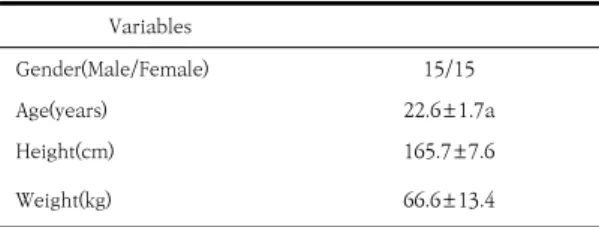
2.1 SubjectsThe subjects of the present study were 30 adults (15 males and 15 females) aged 19 years or older.
The subjects were excluded from the present study if they had severe communication disorders due to cognitive impairment or aphasia; if they had any congenital malformation or disease in the spine, pelvis or feet; if they had any orthopedic or neurological disease in the spine and legs; if they had severely limited joint range of motion; if they took drugs that could interfere with their walking and balance ability; or if they were judged as inappropriate by the researchers to participate in the present study.
The present study was conducted after receiving approval from the IRB at Gimcheon University, Korea (GU-201709-HRa-06-02). The experiment was fully explained to all the subjects, and they agreed to participate in the present study(Table 1).
Variables
Gender(Male/Female) 15/15
Age(years) 22.6±1.7a
Height(cm) 165.7±7.6
Weight(kg) 66.6±13.4
Values are expressed as mean±standard deviation.
Table 1. General characteristics of the subjects (N=30)
2.2 Protocol
In order to investigate the effects of moment arm length of backpacks on spatiotemporal variables in balance and walking when carrying a backpack, a backpack designed to decrease the distance between the spinal joint axis and the COG of the backpack, namely, the moment arm of the backpack, was used in the present study.
This special backpack had additional straps attached to the bottom of general backpacks to minimize the separation distance between the backpack and human body.
For the measurement of postural sway, Force Plate (PDM Multi function Force Measuring Plate;
Zebris, Germany, 2015) was used to measure balance in the subjects under 1) no backpack condition (NBc), 2) general backpack condition (GBc), and 3) decreased moment arm backpack condition (DMBc). Sway area (95% confidence ellipse area), sway path (COP path length), and sway velocity (COP average velocity) were measured. Measurements were taken thrice in each condition, and the mean value was used for analysis. In order to reduce the fatigue of the subjects, a one-minute break was allowed between the measurements.
In addition, for the measurement of spatiotemporal variables associated with walking, GAIT rite (12 ft, CIR System Inc, USA, 2010) was used to measure the walking ability in subjects.
Walking velocity, cadence, step length, single support time and double support time were measured.
2.3 Statistical analysis
Data for the present study were analyzed using the SPSS ver. 18.0 for Windows statistics software (IBM, NY, USA). One-way repeated ANOVA was used to determine the differences in sway path, sway velocity, sway area, and spatiotemporal walking parameters for both feet under all three conditions. Post-hoc analysis was performed using the least significant difference (LSD). The statistical significance level was set at p<.05
3. Results
3.1 Comparison of static balance to backpack carriage and type
The results of comparing the difference in postural sway according to the presence or absence of backpack carriage and backpack type showed that there was no statistically significant difference in postural sway path between the three conditions, and that sway velocity and area were significantly increased under the two conditions of backpack carriage compared to no backpack carriage (p<.05), but there was no difference according to backpack type(Table 2).
Parameter NBC GBC DMBC F P
COP distance
(mm)
64.89
±19.74 74.88
±26.89 73.04
±19.03 2.728 0.074 COP area
(mm2) 110.11
±40.56 177.49
±112.43* 174.54
±102.94* 5.854 0.005 COP
speed (mm/s)
±2.086.81 7.99
±2.76* 7.72
±2.19* 4.102 0.022 Values are expressed as mean±standard deviation
NBC: no backpack condition, GBC: general backpack condition, DMBC: decreased moment arm length backpack condition, COP:
center of pressure
*indicates a significant differences compared with NBC
# indicates a significance difference compared with GBC
† indicates a significance difference compared with DMBC Table 2. Differences in static balance according to
backpack carriage and type (N=30)
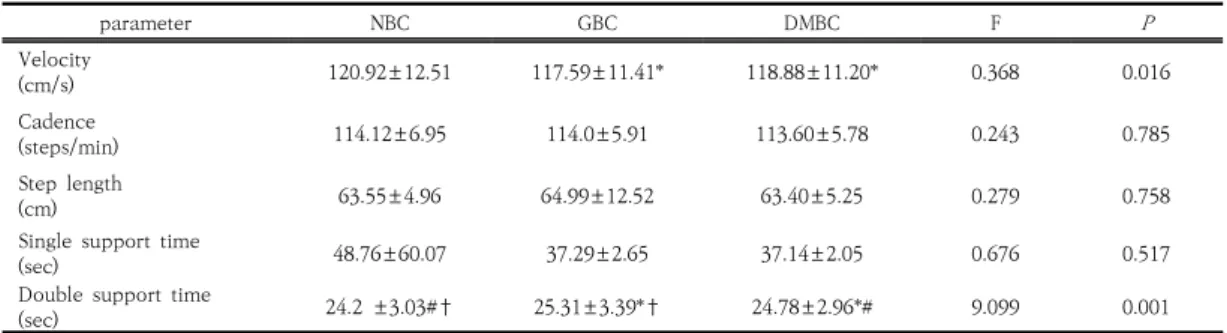
parameter NBC GBC DMBC F P Velocity
(cm/s) 120.92±12.51 117.59±11.41* 118.88±11.20* 0.368 0.016
Cadence
(steps/min) 114.12±6.95 114.0±5.91 113.60±5.78 0.243 0.785
Step length
(cm) 63.55±4.96 64.99±12.52 63.40±5.25 0.279 0.758
Single support time
(sec) 48.76±60.07 37.29±2.65 37.14±2.05 0.676 0.517
Double support time
(sec) 24.2 ±3.03#† 25.31±3.39*† 24.78±2.96*# 9.099 0.001
Values are expressed as mean±standard deviation
NBC: no backpack condition, GBC: general backpack condition, DMBC: decreased moment arm length backpack condition
*indicates a significant differences compared with NBC
# indicates a significance difference compared with GBC
† indicates a significance difference compared with DMBC
Table 3. Differences in walking parameters according to backpack carriage and type (N=30)
3.2 Comparison of walking parameters to backpack carriage and type
The results of comparing the difference in walking variables according to the presence or absence of the backpack carriage and backpack type showed that there was no statistically significant difference in cadence, step length, and single support time under the three conditions. The double support time significantly increased, whereas the velocity significantly decreased when carrying a backpack compared to when not carrying a backpack (p<.05). In terms of backpack type, double limb support time was shown to significantly decrease under the DMBC compared to the GBC (p<.05)(Table 3).
4. Discussion
Many studies have been conducted on oxygen consumption, gait analysis, and EMG analysis according to backpack weight and type.
Mastalerz et al.[21] reported that when the weight of the backpack was of 10% of the subject’s body weight, there were disturbances in plantar force distribution, causing a lowered stability during the standing posture with a backpack. The present study also analyzed the changes in balance and walking under three
conditions: when carrying a general backpack weighing less than 10% of the subject’s body weight, when carrying a backpack with a decreased length of the moment arm, and when not carrying a backpack.
The results of the present study indicated that there was a significant difference in sway velocity and sway area according to the presence or absence of the backpack, whereas there was no significant difference according to the backpack type. The results of a study comparing static balance according to the position of a bag found that static balance was improved when carrying a front pack[17]. A study comparing the static balance between a straight strap backpack carriage and a curved strap backpack carriage revealed that there was no difference in static balance according to backpack type[20]. Hong &
Li[22] reported that, compared to carrying a bag on one shoulder, a backpack carried on both shoulders increased the toe angle change of the foot and postural sway as hip rotations increased, and stated that this is because the motion of the contralateral body and pelvis significantly increased to compensate for the tilting of the COG to one side. Meanwhile, the results of the present study showed that there was a difference in the lengths of the moment arms between the two types of backpacks used.
However, because the backpack position and carrying methods in the two conditions of backpack carriage was identical, it may not be sufficient to cause a change in static balance.
According to the results of a study by Singh &
Koh[3], there was higher forward trunk inclination in dynamic conditions compared to static conditions when carrying a backpack. In addition, Vacheronetal.[23] indicated that backpack weigh t can be effectively distributed when it is less than 15% of the subject’s body weight.
In a study measuring postural sway with respect to backpack weight, postural sway was observed when normal adolescents carried a backpack loaded with 15% of body weight while adolescents with scoliosis carried a backpack loaded with 10% of the subject’s body weight[24].
In this study, the backpack weight was set at 10% of the subject’s body weight, and postural sways were thus measured within a range where the weight of the backpack could be effectively distributed; this may be the reason for no statistically significant changes in postural sways.
The results of the present study showed that during walking, there was a significant difference in the double limb support and walking velocity according to backpack carriage, and double support limb time significantly improved when carrying the special backpack designed to decrease the length of the moment arm compared to general backpacks. In addition, walking velocity was found to increase when carrying the special backpack compared to general backpacks, but it was not statistically significant. The study by Knapik[9] stated that walking with a bag on both shoulders had the smallest body energy cost and made it easier to move the body weight during walking. Also, it has been reported that an efficient balance pattern and posture control were required to achieve the best walking strategies,[25,26] and it has been proven that the walking ability is highly
correlated with the sense of balance. As the COG position of the human body changes due to bag weight, the human body brings the line of gravity to the center of the basal plane to maintain equilibrium, and, in turn, brings the line of gravity further forward for moving forward. At this time, an adaptive mechanism such as an abnormal rearrangement of human body segments appears to maintain balance and save walking-related energy consumption[27]. Jensen et al.[20] conducted a gait analysis on wearing a backpack and the type of backpacks using the ergonomically designed curved strap backpack and reported that when carrying a backpack, stability decreased and the double limb support increased, causing a decrease in walking velocity.
However, no difference was found according to backpack type.
We decided to use a decreased moment arm backpack, which is thought to improve the double limb support time by reducing the backward torque and, thus, improving stability during walking. The double limb support time is used as a variable to measure the dynamic postural instability that can predict falls[28]
Connolly et al.[16] reported that the double limb support time increased when the backpack load was 15% of body weight, but there was no significant difference in walking velocity.
The present study conducted an analysis on balance and walking when carrying a special backpack designed to decrease the length of the moment arm. The results indicated that there was no significant difference in static balance when carrying the special backpack compared to a traditional backpack, but double limb support time was improved.
However, because the number of subjects in this study was small, it is difficult to generalize the results. Additionally, we used backpacks of the same weight to analyze and compare balance and walking according to the presence or absence of a backpack carriage and backpack
type. Furthermore, we did not analyze postural changes such as trunk flexion or neck flexion.
Future studies are needed to investigate the effects of backpack carriage and backpack type on balance, walking, and postural changes under various conditions of backpack weight and length of moment arm.
5. Conclusion
Based on the results of this study, changing moment arm length might improve balance and gait. When carrying a backpack, a torque that moves the COG backward is generated and changes in the moment arm length affect this torque. Our results support the notion of changing moment arm length in the balance and gait.
References
[1] JH. Oh, SN. Choi, "Effects of the length of schoolbag string on gait posture", Journal of Sport and Leisure Studies. Vol.30, pp.619-629, 2007.
[2] T. Matsuo, M. Hashimoto, M. Koyanagi, K. Hashizume,
"Asymmetric load-carrying in young and elderly women; Relationship with lower coordination", Gait Posture. Vol.28, No.3, pp.517-520, 2008.
[3] T. Singh, M. Koh, "Effects of backpack load position on spatiotemporal parameters and trunk forward lean", Gait Posture. Vol.29, No.1, pp.49-53, 2009.
[4] K. Grimmer, M. Williams, "Gender-age environmental associated of adolescent low back pain", App Ergon. Vol.31, No.4, pp.343-360, 2000.
[5] T. Puckree, SP. Silal, J. Lin, "School bag carriage and pain in school children", Disability and Rehabilitation. Vol.26, No.1, pp.54-59, 2004.
[6] J. Whittfield, SJ. Legg, DI. Hedderley, "Schoolbag weight and musculoskeletal symptoms in New Zealand secondary schools ", Applied Ergonomics. Vol.36, No.2, pp.193-198, 2005.
[7] T. H. Kim, S. M. Kim, M. J. Kim, “ Comparison of the Left and Right Muscle Activities of the Upper and Lower Extremities during Gait While Carrying a Messenger Bag and Wearing High Heels”, J korean Acad Ther, Vol.11, No.1, pp.47-55, 2019.
[8] J. Knapik, E. Harman, K. Reynolds, "Load carriage using packs: a review of physiological, biomechanical and medical aspects", Applied Ergonomics. Vol.27, No.3, pp.207-216, 1996.
[9] TC. Lanes, EF. Gauron, KF. Spratt, TJ. Wernimont, EM.
Found, JN. Weinstein, "Long-term follow-up of patients with chronic back pain treated in a multidisciplinary rehabilitation program", Spine. Vol.20, No.7, pp.801-806, 1995.
[10] C. S. Lim, E. S. Shin, S. H. Lee, “Kinetics Analysis of Health Risk Factors on Bag-carrying of School Age Children”, The Korean Journal of Sport. Vol.17 No.2, pp. 707-717, 2019.
[11] C. H. Oh, E. S. Shin, J. H. Bae, S. Y. Hong, “The Effect of Bag Weight on Musculoskeletal Health Risk Factors in Walking Youth”, Korean Journal of Sports Science. Vol.28 No.4, pp. 1093-1100, 2019.
[12] S. Negrini, A. Negrini, "Postural effects of symmetrical and asymmetrical loads on the spines of schoolchildren", Scoliosis. Vol.2, No.8, pp.1-8, 2007.
[13] HW. Mackie, SJ. Legg, "Postural and subjective responses to realistic schoolbag carriage".
Ergonomics. Vol.51, No.2, pp.217-231, 2008.
[14] M. Pau, M. Pau, "Postural sway modifications induced by backpack carriage in primary school children: a case study in Italy", Ergonomics. Vol.53, No.7, pp.872-881, 2010.
[15] Y. Hong, GP. Brueggenmann, "Changes in gait patterns in 10-year-old boys with increasing loads when walking on a treadmill", Gait Posture. Vol.11, No.3, pp.254-259, 2000.
[16] BH. Connolly, B. Cook, S. Hunter, M. Laughter, A.
Mills, N. Nordtvedt, A. Bush, "Effects of backpack carriage on gait parameters in children ", Pediatric Physical Therapy. Vol.20, No.4, pp.347-355, 2008.
[17] P. Fiolkowski, M. Horodyski, M. Bishop, M. Williams, L.
Stylianou, "Changes in gait kinematics and posture with the use of a front pack ", Ergonomics. Vol.49, No.9, pp.885-894, 2006.
[18] CXG. Wang, DHK. Chow, MH. Pope, "biomechanical effect of LOAuD carriage on spine curvature and repositioning ability in adolescents", Anaheim, CA:
ACTA Press. pp.161-166, 2007.
[19] DM. Mosaad, AA. Abdel-aziem, "Postural balance and neck angle changes in school children while carrying a traditional backpack versus a double-sided bag", Biomedical Human Kinetics. Vol.10, No.1, pp.59-66, 2018.
DOI: https://doi.org/10.1515/bhk-2018-0010 [20] DB. Jensen, P. Denney, JV. Slack, M. Bohne, "Effects Of
Different Backpacks On Selected Gait Parameters In College Students", Journal of Undergraduate Kinesiology Research. Vol.9, No.2, pp.41-46, 2014.
[21] A. Mastalerz, T. Niźnikowski, M. Buszta, P. Różański, P.
Wiśniowski, J. Sadowski, "Effect of two backpack designs on cop displacement and plantar force distribution in children during upright stance", Polish Jounal of Sport and Tourism. Vol.23, No.3, pp.123-126, 2016.
DOI: https://doi.org/10.1515/pjst-2016-0015 [22] Y. Hong, JX. Li, "Influence of load and carrying
methods on gait phase and ground reactions in children's stair walking", Gait Posture. Vol.1, No.22, pp.63-68, 2005.
DOI: https://doi.org/10.1016/j.gaitpost.2004.07.001 [23] JJ. Vacheron, G. Poumartat, R. Chandezon, G.
Vanneuville, "Changes of contour of the spine caused by load carrying", Surgical and Radiologic Anatomy. Vol.21, No.2, pp.109-113, 1999.
[24] S. Sahli, H. Rebai, S. Ghroubi, A. Yahia, M. Guermazi, MH. Elleuch, "The effects of backpack load and carrying method on the balance of adolescent idiopathic scoliosis subjects ", Spine Jounal. Vol.13, No.12, pp.1835-1842, 2013.
DOI: https://doi.org/10.1016/j.spinee.2013.06.023 [25] M. de Haart, AC. Geurts, SC. Huidekoper, L. Fasotti, J.
van Limbeek, "Recovery of standing balance in post-acute stroke patient: A rehabilitation cohort study", Physical Medicine Rehabilitation. Vol.85, No.6, pp.886-895, 2004.
DOI: https://doi.org/10.1016/j.apmr.2003.05.012 [26] T. Muehlbauer, C. Besemer, A. Wehrle, A. Gollhofer, U.
Granacher, "Relationship between strength, power and balance performance in seniors", Gerontology. Vol.58, No.6, pp.504-512, 2012.
DOI: https://doi.org/10.1159/000341614
[27] A. Crowe, MM. Samson, "3-D analysis of gait: The effects upon symmetry of carrying a load in one hand", Human Movement Science. Vol.16 No.2-3, pp.357-365, 1997.
[28] B. McGraw, BA. McClenaghan, HG. Williams, J.
Dickerson, DS. Ward DS, "Gait and postural stability in obese and nonobese prepubertal boys", Physical Medicine Rehabilitation. Vol.81, No.4, pp.484-489, 2000.
Tae-Sung In [Regular member]
• Feb. 2009 : Sahmyook Univ.
graduate school Department of Physical Therapy, MS
• Aug. 2012 : Sahmyook Univ.
graduate school Department of Physical Therapy, PhD
• Sep. 2016 ∼ current : Gimcheon Univ. Dept. of Physical Therapy, Professor
<Research Interests>
Biomechanics, Physical Therapy
Sang-Hun Jang [Regular member]
• Aug. 2009 : Daegu Univ., MS
• Aug. 2012 : Daegu Univ., Ph.D.
• Mar. 2013 ∼ current : Gimcheon Univ., Dept. of Physical therapy, Professor
<Research Interests>
physical therapy, kinesiology, therapeutic exercise