소아에서 비타민 D와 천식의 연관성
유민정,1 김우경2,3
1인제대학교 상계백병원 소아청소년과, 2인제대학교 서울백병원 소아청소년과, 3인제대학교 의과대학 알레르기 호흡기 연구소
Vitamin D serum levels and risk of asthma in children
Min Jung You,1 Woo Kyung Kim2,3
1Department of Pediatrics, Inje University Sanggyae Paik Hospital, Seoul; 2Department of Pediatrics, Inje University Seoul Paik Hospital, Seoul; 3Allergy and Respiratory Research Laboratory, Inje University College of Medicine, Seoul, Korea
Purpose: The role of vitamin D in traditional atopic disorders (i.e., asthma, allergic rhinitis, and atopic dermatitis) is still uncertain. We have analyzed the association between serum 25-hydroxyvitamin D3 (25(OH)-D3) levels and asthma in children.
Methods: A total of 133 children were enrolled between April 2008 and December of 2008. Children were divided into 3 groups: the asthma group (n= 80), bronchiolitis group (n= 50), and normal group (n= 35). Serum samples were collected and checked for 25(OH)-D3 levels. From the blood samples, we measured eosinophil counts, total IgE, specific IgE (Dermatophagoides pteronyssinus, Dermatophagoides farinae, milk, egg, cat, dog, cockroach) (Uni-CAP FEIA system).
Results: The mean age of the patients was 4.6 years. The mean 25(OH)-D3 levels of the asthma, bronchiolitis, and normal groups were 17.2± 8.9, 22.5± 9.3, and 27.8± 10.2 ng/mL, respectively (P< 0.01). There was no association between allergens and vitamin D levels. Mean 25(OH)-D3 levels were lower at acute state of asthma than at stable state.
Conclusion: The mean level of 25(OH)-D3 was associated with asthma and acute state of asthma. Further experimental and clinical studies are needed to establish a definite link between vitamin D levels and asthma. (Allergy Asthma Respir Dis 2016;4:44-48)
Keywords: Vitamin D, Asthma, Bronchiolitis
서 론
천식은 기도의 만성 염증성 질환으로 기도의 과민성에 의해 반 복적인 천명, 호흡곤란, 기침이 발생하며 기류폐쇄와 연관된 질환 이다.1 이러한 천식은 소아에서 상당한 이환율을 보이고 지난 몇 십 년 동안 많은 국가에서 천식의 발병이 증가하였다.2,3 발병 원인은 정확히 알려지지 않았으나 여러 유전적 요인과 환경적 요인의 복잡 한 상호작용에 의한 것으로 여겨지며, 최근 천식의 발병에 있어 영 양학적 측면에 대한 관심이 증가하고 있다. 이는 도심과 개발도상 국에서 천식의 발병률 증가의 요인이 식단과 영양학적 측면의 변화 가 중요한 역할을 한다고 생각하기 때문이다.4,5 이 중 하나의 가설 로 비타민 D와 천식과의 관련성에 대해 제기되었는데, 전 세계적으 로 비타민 D 결핍이 증가하고 있고6,7 최근 여러 연구들은 비타민 D 부족이 천식의 유병률을 증가시키고8-11 소아에서 천식의 중증도를
증가시키는 것으로 보고하고 있다.7,12,13 이번 연구에서는 소아에서 천식과 비천식군 간의 혈중 비타민 D 농도 측정을 통해 비타민 D 와 천식의 상관관계에 대해 알아보고 천식의 급성기에 따른 차이 를 알아보고자 하였다.
대상 및 방법
1. 연구 대상
2008년 4월 1일부터 12월 31일까지 인제대학교 서울백병원 소아 청소년과에 입원 또는 외래를 통해 내원한 2세에서 6세까지의 환 아들을 대상으로 의무기록을 후향적으로 분석하였다.
천명을 주소로 방문한 130명과 정상군 35명을 대상으로 하였다.
천명이 있는 환아 130명 중 천식이 80명이었으며 급성 세기관지염 이 50명이었다. 천식 환아군은 호흡기 바이러스 감염 여부와는 관 Allergy Asthma Respir Dis 4(1):44-48, January 2016 http://dx.doi.org/10.4168/aard.2016.4.1.44 ORIGINAL ARTICLE
Correspondence to: Woo Kyung Kim http://orcid.org/0000-0001-8730-010X
Department of Pediatrics, Inje University Seoul Paik Hospital, Inje University College of Medicine, 9 Mareunnae-ro, Jung-gu, Seoul 04551, Korea
Tel: +82-2-2270-0157, Fax: +82-2-2270-0264, E-mail: [email protected]
• This work was supported by 2008 Inje University Academic Research costs.
Received: June 19, 2015 Revised: September 22, 2015 Accepted: September 25, 2015
© 2016 The Korean Academy of Pediatric Allergy and Respiratory Disease The Korean Academy of Asthma, Allergy and Clinical Immunology This is an Open Access article distributed under the terms of the Creative Commons Attribution Non-Commercial License
련 없이 24개월 내에 3회 이상의 천명이 있었던 군이며 급성 세기관 지염 환아군은 호흡기 바이러스 감염과 24개월 내에 3회 미만의 천 명이 있었던 군으로 정의하여 분류하였다. 이 분류는 본원의 과거 의무기록을 기초로 하여 분류하였다. 신환은 이번 연구에서 제외 되었다. 정상군은 유치원에서 시행하는 검진에서 기도 감염의 증거 가 없으며 알레르기의 개인력과 가족력이 없는 군이었다. 그리고 대 상 환아들 중에서 혈중 비타민 D 농도에 영향을 줄 수 있는 비타민 D, 칼슘제, 항경련제, 글루코코르티코이드를 섭취하고 있는 경우는 제외하였다. 천식군 중에서 비타민 D를 검사한 시기에 기침, 호흡 곤란, 천명 등 증상이 악화된 시기와 검사 전 2개월 동안 경구 스테 로이드 사용이 없었고, 증상 악화로 병의원을 방문한 일이 없었던 시기로 급성기와 안정기로 나누었다.14 본 연구는 인제대학교 서울 백병원 임상시험윤리위원회의 승인 후에 진행하였다.
2. 연구 방법
1) 혈청 총 IgE, 알레르겐-특이 IgE, 호산구 수 측정
UniCAP system (ThermoFisher Scientific Inc., Uppsala, Swe- den)을 이용하여 항원 특이 IgE 집먼지 진드기 2종, 음식류(우유, 계란), 개, 고양이, 바퀴 등을 검사(항원 특이 IgE는 0.35 kUA/L 이 상일 경우 양성으로 정의) 결과, 총 IgE 검사 결과를 분석하였으며, 혈청 총 호산구 수는 말초혈액을 통해 검사한 것을 분석하였다.
2) 비타민 D
대상자들에게 혈액검사를 통하여 혈중 25-hydroxyvitamin D3
를 측정하였으며, electrochemiluminescence immunoassay (CO- BAS 6000 Roche, Manheim Germany)를 이용하였다. 25-hy- droxyvitamin D3의 적절한 농도에 대한 일치된 가이드라인은 없으 나 대부분의 전문가들이 20 ng/mL 미만을 부족한 군, 20–29.9 ng/
mL를 불충분한 군, 30 ng/mL 이상은 충분한 군으로 분류하고 있
고 본 연구에서도 이 기준을 사용하였다.15
3. 통계 분석
세 군 간에 차이 분석으로 one way analysis of variance와 Krus- kal-Wallis test를 사용하였다. 그리고 환아들에게 25-hydroxyvita- min D3와 알레르기 지표들(총 IgE, 총 호산구)과의 상관관계를 알 아보기 위해서는 Pearson 상관분석을 하였다. 모든 통계 분석은 MedCalc ver. 9.2 (MedCalc Software, Ostend, Belgium)를 이용하 였고, P 값이 0.05 미만일 때 통계적으로 유의한 것으로 판단하였다.
결 과
1. 대상 환아들의 임상적 특징
정상군의 평균 나이는 4.51±2.63세이며 천식 환아군의 평균 나 이는 5.45±1.56세이고, 세기관지염 환아군의 평균 나이는 2.91±
1.89세였다. 남아 87명(53.0%)으로 평균 나이와 남녀 비율은 환아 군과 통계적으로 유의한 차이는 없었다. 천식 환아군에서만 부모 중에 한쪽이 가족력이 있는 경우가 65% (n=52)를 차지하였다. 천 식만 있는 경우가 67.5%였고, 아토피 피부염이 동반된 경우가 3.7%, 알레르기비염은 28.8%였다(Table 1).
2. 알레르기 지표들
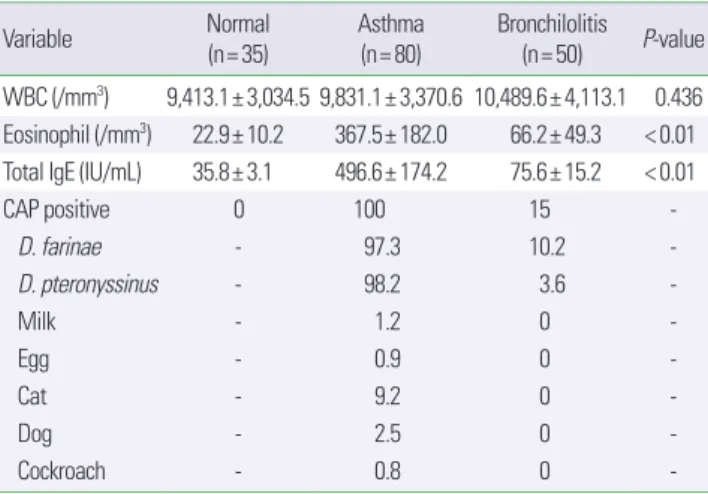
알레르기 지표들 중 천식군에서 총 IgE는 496.6±174.2 IU/mL 로 다른 두 군에 비해서 높게 측정되었다(P<0.01) (Table 2). 총 호 산구 수는 천식군 36.7.5±182.0/mm3, 정상군 22.9±10.2/mm3, 세 기관지염 66.2±49.3/mm3으로 의미 있는 차이를 보였다(P<0.01).
또한 항원 감작에서도 천식군에서 감작률이 높았다(Table 2). 알레 르기 지표들과 비타민 D의 상관관계가 없었다(data not shown).
Table 1. Characteristics of study participants
Characteristic Normal (n= 35) Asthma (n= 80) Bronchilolitis (n= 50)
Age (yr) 4.51± 2.63 5.45± 1.56 2.91± 1.89
Sex
Boy:girl 19:16 41:39 27:23
Family history
Both (–) 35 23 46
Both (+) 0 5 0
Either (+) 0 52 4
Combined allergy disease
Only asthma - 54 (67.5) -
With AD - 3 (3.7) -
With AR - 23 (28.8) -
Values are presented as mean± standard deviation or number (%).
AD, atopic dermatitis; AR, allergic rhinitis.
Table 2. Serum level of groups characteristics
Variable Normal
(n= 35)
Asthma (n= 80)
Bronchilolitis (n= 50) P-value WBC (/mm3) 9,413.1± 3,034.5 9,831.1± 3,370.6 10,489.6± 4,113.1 0.436 Eosinophil (/mm3) 22.9± 10.2 367.5± 182.0 66.2± 49.3 < 0.01 Total IgE (IU/mL) 35.8± 3.1 496.6± 174.2 75.6± 15.2 < 0.01
CAP positive 0 100 15 -
D. farinae - 97.3 10.2 -
D. pteronyssinus - 98.2 3.6 -
Milk - 1.2 0 -
Egg - 0.9 0 -
Cat - 9.2 0 -
Dog - 2.5 0 -
Cockroach - 0.8 0 -
Values are presented as mean± standard deviation or percentage.
WBC, white blood cell; D. farinae, Dermatophagoides farina; D. pteronyssinus, Der- matophagoides pteronyssinus.
3. 비타민 D 농도
비타민 D 농도는 천식군에서 17.2±8.9 ng/mL, 정상군에서 27.8
±10.2 ng/mL였고, 세기관지염군에서 22.5±9.3 ng/mL로 각각 측 정되었다. 천식군이 다른 두 군에 비해 낮게 측정되었다. 천식군, 정 상군, 세기관지염군 간에 통계적 차이가 있었다(P<0.01) (Table 3).
비타민 D 농도는 부족한 군, 불충분한 군, 충분한 군으로 나누어 보 면,15 천식에서 부족한 군과 불충분한 군이 정상군과 세기관염군에 비해서 많았다(Table 3).
4. 천식 환자 상태에 따른 비타민 D 농도 차이
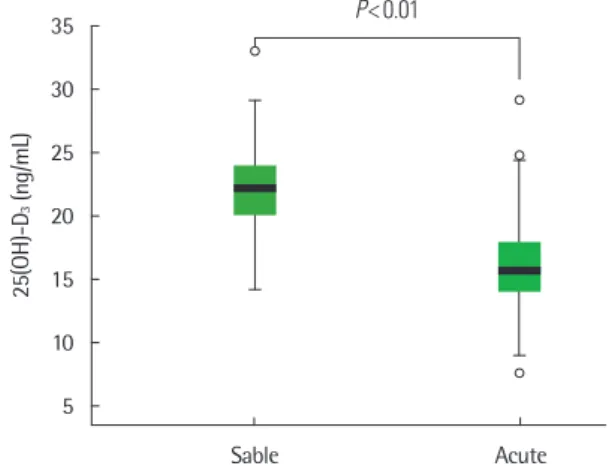
천식군에 환자를 급성기와 안정기로 나누어 보면, 비타민 D의 농 도는 급성기 때 23.6±6.8 ng/mL이고 안정기 때는 15.3±5.4 ng/mL 로 안정기 때 낮게 측정되었다(P<0.01) (Fig. 1).
고 찰
본 연구에서는 2–6세 소아에서 천식군, 급성세기관지군, 정상군 의 혈중 비타민 D 농도 측정을 통해 비타민 D와 천식의 상관관계 에 대해 알아보고자 하였으며 연구 결과 천식군이 비타민 D 농도 가 가장 낮았으며 이어 세기관지염군이 낮았고 정상군이 가장 높게 측정되었다. 특히 천식군에서는 급성기 환아가 안정기 환아에 비해 비타민 D 농도가 낮은 것을 확인 할 수 있었다. 총 IgE, 호산구 수는 천식군이 다른 두 군에 비해 높게 측정되었고 천식군에서 항원 감 작률도 더 높은 것으로 나타났다. 이러한 결과는 사우디아라비아 의 4–18세 70명의 소아를 대상으로 한 연구에서 천식군이 비천식 군에 비해 의미 있게 혈중 비타민 D 농도가 낮았으며 천식의 중증 도가 높을수록 비타민 D 농도가 더 낮은 것으로 보고한 것과16 코 스타리카의 6–14세의 천식 환아 616명을 대상으로 시행한 한 연구 에서 혈중 비타민 D 농도가 감소할수록 혈청 총 IgE 농도, 호산구 수, 병원 입원 빈도, 항염증 약물 사용 빈도, 기관지과민성이 증가하 는 것으로 보고된 연구 결과와7 일치한다. 또한 비타민 D의 보충이 기관지과민성 및 이후 천식의 발생을 예방할 수 있다는 보고도 있 으며17 임신 중 비타민 D를 섭취할 경우 소아기 천명 발생이 감소한 다는 보고도 있어18,19 비타민 D의 부족이 소아에서 천식과 관련 있 으며 특히 천식 상태의 악화와도 연관이 있음을 보여준다. 비록 이
러한 대부분의 연구들이 비타민 D의 예방적 효과를 이야기하고 있 지만 위의 연구들과 상반되는 내용으로 핀란드에서는 출생 후 1년 동안 약 200 IU/day 비타민 D를 섭취한 경우 이들이 성인이 되었을 때 비타민 D를 섭취하지 않은 그룹보다 의미 있게 천식 발현을 높 인다는 보고가 있다.20 그러나 엄마의 비타민 D 섭취 여부에 대한 부분이 누락되어 있고, 신생아 시기에 비타민 D 농도 측정이 이루 어지지 않았으며, 소아기에 천식 발현에 대한 평가가 이루어지지 않 아 연구에 제한점이 있다. 영국 소아를 대상으로 한 또 다른 연구로 임신 후반기 산모의 높은 혈중 비타민 D 농도가 9세 때 출생아의 천식 빈도를 증가시킨다는 보고가 있으나21 70%의 출생아가 추적 관찰 동안 소실되었다는 점에서 제한점이 있다. 이러한 연구 결과 의 차이는 각 연구의 연구 설계, sample 크기, 비타민 D 분석 방법 의 차이에 의한다고 추론되며, 실제 많은 연구가 비타민 D 부족과 천식의 발생 및 악화와의 관련성에 대해 이야기하고 있고20,22-25 몇 몇 가설들이 비타민 D와 천식 사이의 관련성에 대해 제안되어 왔 다. 이는 비타민 D가 천식 발생 및 증상을 악화시킬 수 있는 호흡기 감염의 발생 빈도를 줄이고26-28 폐 형성 및 발달을 촉진시키며29-31 스테로이드 반응성을 증가32-34시키는 것으로 생각한다. 이러한 연 구 결과들을 종합하여 볼 때 비타민 D의 부족이 천식의 발생 및 악 화와 관련이 있는 것으로 생각되며 비타민 D의 보충이 천식 및 알 레르기 질환 예방, 조절할 것으로 기대해 볼 수 있다. 실제 비타민 D 가 부족한 천식군에서 스테로이드 사용이 증가한다는 연구와34 비 타민 D의 보충으로 천식을 비롯한 호흡기 질환을 예방 또는 호전시 킬 수 있다는 연구들이 있다.35,36 하지만 아직 비타민 D의 보충 기준 및 시기에 대한 기준이나 용법, 용량에 대한 명확한 근거가 부족하 여 이에 대한 추가적인 연구가 필요할 것으로 생각한다.
본 연구에서는 천식군에서 비천식군에 비해 비타민 D 농도가 낮았으며 특히 급성기 천식군에서 안정기 천식군보다 비타민 D 농 도가 더 낮음을 확인할 수 있었다. 천식 환아에서 급성 발작은 바이 Table 3. 25-hydroxyvitamin D3 (25(OH)-D3) levels in the study subjects
Normal
(n= 35) Asthma
(n= 80) Bronchilolitis (n= 50) P-value 25(OH)-D3 (ng/mL) 27.8± 10.2 17.2± 8.9 22.5± 9.3 < 0.01
Sufficient (≥ 30) 34 5 43 -
Insufficient (20–29.9) 1 63 6 -
Deficient (< 20) 0 12 1 -
Values are presented as mean± standard deviation.
35
30
25
20
15
10
5 25(OH)-D3 (ng/mL)
Sable Acute
P< 0.01
Fig. 1. The box plot of serum vitamin D levels in asthma states. 25(OH)-D3, 25-hydroxyvitamin D3.
러스 감염으로 인해 유발되는 경우가 많으며37,38 비타민 D의 농도 가 낮을수록 바이러스 감염의 발생 빈도가 증가한다는 여러 연구
결과들은39,40 급성기 천식군에서 비타민 D 농도가 낮은 것을 설명
할 수 있으나 본 연구에서는 바이러스 검사가 진행되지 않아 그 결 과를 제시하지 못하였다.
천식과 비천식군 간의 비타민 D에 대한 연구는 많이 이루어졌지 만 아직 많은 연구들에서 천식군에서의 급성기와 안정기 간의 비 타민 D 농도에 대한 연구가 진행되지 않아 본 연구의 결과가 의미 있을 것으로 생각한다. 그러나 연구에 참여한 소아가 천식의 진단 이 어려운 어린 연령이 있으며, 실제 참여한 대상자의 수가 적었고, 천식군에서 급성기 악화를 유발할 수 있는 호흡기 감염 등의 여러 변수들에 대한 추가적인 조사가 이루어지지 않았다는 점과 후향적 연구로 모든 환자들이 동일 조건에서 연구가 진행되지 못했다는 점 에서 제한점이 있다고 할 수 있겠다. 이러한 제한점을 보완하기 위 해 좀 더 많은 환자를 대상으로 전향적 연구를 통해 비타민 D 농도 가 어느 시점에 얼마나 감소해야 천식을 발생시키거나 악화시킬 수 있는지에 대한 추가적 연구가 필요할 것으로 생각한다.
REFERENCES
1. Bateman ED, Hurd SS, Barnes PJ, Bousquet J, Drazen JM, FitzGerald M, et al. Global strategy for asthma management and prevention: GINA ex- ecutive summary. Eur Respir J 2008;31:143-78.
2. Haby MM, Peat JK, Marks GB, Woolcock AJ, Leeder SR. Asthma in pre- school children: prevalence and risk factors. Thorax 2001;56:589-95.
3. Robertson CF, Heycock E, Bishop J, Nolan T, Olinsky A, Phelan PD. Prev- alence of asthma in Melbourne schoolchildren: changes over 26 years.
BMJ 1991;302:1116-8.
4. Lange NE, Litonjua A, Hawrylowicz CM, Weiss S. Vitamin D, the im- mune system and asthma. Expert Rev Clin Immunol 2009;5:693-702.
5. Harik-Khan RI, Muller DC, Wise RA. Serum vitamin levels and the risk of asthma in children. Am J Epidemiol 2004;159:351-7.
6. Weiss ST, Litonjua AA. Maternal diet vs lack of exposure to sunlight as the cause of the epidemic of asthma, allergies and other autoimmune diseases. Thorax 2007;62:746-8.
7. Brehm JM, Celedon JC, Soto-Quiros ME, Avila L, Hunninghake GM, Forno E, et al. Serum vitamin D levels and markers of severity of child- hood asthma in Costa Rica. Am J Respir Crit Care Med 2009;179:765-71.
8. Al-Riyami BM, Al-Rawas OA, Al-Riyami AA, Jasim LG, Mohammed AJ.
A relatively high prevalence and severity of asthma, allergic rhinitis and atopic eczema in schoolchildren in the Sultanate of Oman. Respirology 2003;8:69-76.
9. Bajpai A, Bardia A, Mantan M, Hari P, Bagga A. Non-azotemic refractory rickets in Indian children. Indian Pediatr 2005;42:23-30.
10. Bener A, Kamal AA. Growth patterns of Qatari school children and ado- lescents aged 6-18 years. J Health Popul Nutr 2005;23:250-8.
11. Bener A, Al-Ali M, Hoffmann GF. High prevalence of vitamin D deficien- cy in young children in a highly sunny humid country: a global health problem. Minerva Pediatr 2009;61:15-22.
12. Bener A, Ehlayel MS, Tulic MK, Hamid Q. Vitamin D deficiency as a strong predictor of asthma in children. Int Arch Allergy Immunol 2012;
157:168-75.
13. Gupta A, Sjoukes A, Richards D, Banya W, Hawrylowicz C, Bush A, et al.
Relationship between serum vitamin D, disease severity, and airway re- modeling in children with asthma. Am J Respir Crit Care Med 2011;184:
1342-9.
14. Kim CK, Kim BE, Yu JH, Yoo Y, Koh YY, Kita H. Increases in IFN-γ dur- ing the chronic asymtomatic phase in patients with asthma. J Asthma Allergy Clini Immunol 2004;24:377-84.
15. Gupta A, Bush A, Hawrylowicz C, Saglani S. Vitamin D and asthma in children. Paediatr Respir Rev 2012;13:236-43.
16. Aldubi HM, Alissa EM, Kamfar HZ, Gaber O, Marzouki ZM. Bronchial asthma and hypovitaminosis D in Saudi children. Asia Pac Allergy 2015;
5:103-13.
17. Hollams EM, Hart PH, Holt BJ, Serralha M, Parsons F, de Klerk NH, et al. Vitamin D and atopy and asthma phenotypes in children: a longitudi- nal cohort study. Eur Respir J 2011;38:1320-7.
18. Devereux G, Litonjua AA, Turner SW, Craig LC, McNeill G, Martindale S, et al. Maternal vitamin D intake during pregnancy and early childhood wheezing. Am J Clin Nutr 2007;85:853-9.
19. Erkkola M, Kaila M, Nwaru BI, Kronberg-Kippila C, Ahonen S, Neva- lainen J, et al. Maternal vitamin D intake during pregnancy is inversely associated with asthma and allergic rhinitis in 5-year-old children. Clin Exp Allergy 2009;39:875-82.
20. Hyppönen E, Sovio U, Wjst M, Patel S, Pekkanen J, Hartikainen AL, et al.
Infant vitamin d supplementation and allergic conditions in adulthood:
northern Finland birth cohort 1966. Ann N Y Acad Sci 2004;1037:84-95.
21. Gale CR, Robinson SM, Harvey NC, Javaid MK, Jiang B, Martyn CN, et al. Maternal vitamin D status during pregnancy and child outcomes. Eur J Clin Nutr 2008;62:68-77.
22. Weiss ST, Litonjua AA. Childhood asthma is a fat-soluble vitamin defi- ciency disease. Clin Exp Allergy 2008;38:385-7.
23. Litonjua AA. Childhood asthma may be a consequence of vitamin D de- ficiency. Curr Opin Allergy Clin Immunol 2009;9:202-7.
24. Freishtat RJ, Iqbal SF, Pillai DK, Klein CJ, Ryan LM, Benton AS, et al. High prevalence of vitamin D deficiency among inner-city African American youth with asthma in Washington, DC. J Pediatr 2010;156:948-52.
25. Camargo CA Jr, Clark S, Kaplan MS, Lieberman P, Wood RA. Regional differences in EpiPen prescriptions in the United States: the potential role of vitamin D. J Allergy Clin Immunol 2007;120:131-6.
26. Jackson DJ, Johnston SL. The role of viruses in acute exacerbations of asthma. J Allergy Clin Immunol 2010;125:1178-87.
27. Jartti T, Ruuskanen O, Mansbach JM, Vuorinen T, Camargo CA Jr. Low serum 25-hydroxyvitamin D levels are associated with increased risk of viral coinfections in wheezing children. J Allergy Clin Immunol 2010;
126:1074-6, 1076.e1-4.
28. Urashima M, Segawa T, Okazaki M, Kurihara M, Wada Y, Ida H. Ran- domized trial of vitamin D supplementation to prevent seasonal influen- za A in schoolchildren. Am J Clin Nutr 2010;91:1255-60.
29. Rehan VK, Torday JS, Peleg S, Gennaro L, Vouros P, Padbury J, et al.
1Alpha,25-dihydroxy-3-epi-vitamin D3, a natural metabolite of 1alpha,25- dihydroxy vitamin D3: production and biological activity studies in pul- monary alveolar type II cells. Mol Genet Metab 2002;76:46-56.
30. Phokela SS, Peleg S, Moya FR, Alcorn JL. Regulation of human pulmo- nary surfactant protein gene expression by 1alpha,25-dihydroxyvitamin D3. Am J Physiol Lung Cell Mol Physiol 2005;289:L617-26.
31. Black PN, Scragg R. Relationship between serum 25-hydroxyvitamin d and pulmonary function in the third national health and nutrition ex- amination survey. Chest 2005;128:3792-8.
32. Xystrakis E, Kusumakar S, Boswell S, Peek E, Urry Z, Richards DF, et al.
Reversing the defective induction of IL-10-secreting regulatory T cells in
glucocorticoid-resistant asthma patients. J Clin Invest 2006;116:146-55.
33. Sutherland ER, Goleva E, Jackson LP, Stevens AD, Leung DY. Vitamin D levels, lung function, and steroid response in adult asthma. Am J Respir Crit Care Med 2010;181:699-704.
34. Searing DA, Zhang Y, Murphy JR, Hauk PJ, Goleva E, Leung DY. De- creased serum vitamin D levels in children with asthma are associated with increased corticosteroid use. J Allergy Clin Immunol 2010;125:995-1000.
35. Camargo CA Jr, Ingham T, Wickens K, Thadhani R, Silvers KM, Epton MJ, et al. Cord-blood 25-hydroxyvitamin D levels and risk of respiratory infection, wheezing, and asthma. Pediatrics 2011;127:e180-7.
36. García de Tena J, El Hachem Debek A, Hernandez Gutierrez C, Izquierdo Alonso JL. The role of vitamin D in chronic obstructive pulmonary dis- ease, asthma and other respiratory diseases. Arch Bronconeumol 2014;
50:179-84.
37. Johnston SL, Pattemore PK, Sanderson G, Smith S, Lampe F, Josephs L, et al. Community study of role of viral infections in exacerbations of asthma in 9-11 year old children. BMJ 1995;310:1225-9.
38. Nicholson KG, Kent J, Ireland DC. Respiratory viruses and exacerbations of asthma in adults. BMJ 1993;307:982-6.
39. Ginde AA, Mansbach JM, Camargo CA Jr. Association between serum 25-hydroxyvitamin D level and upper respiratory tract infection in the Third National Health and Nutrition Examination Survey. Arch Intern Med 2009;169:384-90.
40. Laaksi I, Ruohola JP, Tuohimaa P, Auvinen A, Haataja R, Pihlajamäki H, et al. An association of serum vitamin D concentrations < 40 nmol/L with acute respiratory tract infection in young Finnish men. Am J Clin Nutr 2007;86:714-7.