Self-rated Subjective Health Status Is Strongly Associated with Sociodemographic Factors, Lifestyle, Nutrient Intakes, and Biochemical Indices, but Not Smoking Status: KNHANES 2007- 2012
Despite advertised health warnings regarding the deadly hazards of smoking, many people have not heeded recommendations to quit smoking. We examined factors that affect self- rated subjective health status (SRH) scores among lifestyle, nutrient intake and biochemical parameters, and the association of SRH scores and smoking status in a large Korean adult population. Adjusted odd ratios for SRH were calculated for smoking status, selected biochemical data, and food and nutrient intake obtained using the 24-hr recall method after covariate adjustment in the 2007-2012 Korean National Health and Nutrition Examination Survey (27,534 men and women aged ≥ 20 yr). Age, sex, income, education, drinking, exercise and stress levels were associated with SRH scores, regardless of smoking status (P < 0.001). Interestingly, people in any smoking status groups considered the well-known indicators for metabolic diseases (HDL cholesterol, glucose, aspartate aminotransferase, and alanine aminotransferase in the circulation), and the intake of fiber, total vitamins A, and vitamin C as indicators of SRH. Especially in current smokers, higher intake of nutritious food groups such as grains (OR = 1.227), vegetables (OR = 1.944), and milk (OR = 2.26) significantly increased the adjusted odds ratio of SRH.
However, smoking status was not associated with SRH scores. In conclusion, SRH is affected by the indices related to health but not smoking status in Korean adults. The development of a new indicator of the direct adverse effects of smoking at regular health check-ups might be required to modulate the SRH in smokers and a nutritional education should not include the possible attenuation of adverse effects of smoking by good nutrition.
Keywords: Self-rated Subjective Health Status; Smoking; Vitamin C; HDL; Serum Glucose Sunmin Park,1* Jaeouk Ahn,2*
and Byung-Kook Lee3,4
1Department of Food and Nutrition, Hoseo University, Asan; 2Department of Medical IT Engineering, Soonchunhyang University, Asan;
3Department of Preventive Medicine,
Soonchunhyang University, Asan; 4Chungju Medical Center, Chungju, Korea
* Sunmin Park and Jaeouk Ahn contributed equally to this work.
Received: 16 March 2015 Accepted: 14 May 2015 Address for Correspondence:
Byung-Kook Lee, MD
Department of Preventive Medicine, Soonchunhyang University, 22 Soonchunhyang-ro, Asan 336-745, Korea
Tel: +82.10-5437-0531, Fax: +82.41-548-0670 E-mail: [email protected]
Funding: This work was supported by the Soonchunhyang University Research Fund.
http://dx.doi.org/10.3346/jkms.2015.30.9.1279 • J Korean Med Sci 2015; 30: 1279-1287
INTRODUCTION
Smoking remains one of the most preventable causes of mor- bidity and mortality worldwide (1). Smoking has been docu- mented to induce various harmful diseases including lung can- cer, leukemia, coronary heart disease and peptic ulcer disease over the past 50 yr, and successful smoking cessation results in immediate health improvements (2-4). Educational efforts have focused on increasing public knowledge about the delete- rious effect of smoking on health, and various cessation meth- ods have been applied to smokers (5, 6). However, public edu- cational efforts have not succeed to decrease smoking rates in Korea including Asian countries and still the smoking rates (adult males: 48.3% in 2010) rank at the top among Organization for Economic Cooperation and Development (OECD) countries (7). Quit rates among smokers are low, even in smokers who in-
tend to quit (8-10). However, some smokers have no intention of quitting, as smoking helps relieve mental stress (11, 12). In addition, many smokers fear weight gain, even though recent studies reported that the benefits of quitting smoking far exceed- ed the risks associated with the amount of weight gained (13).
For these reasons, it is difficult to convince smokers to quit smo- king, as behavior modification is preceded by changes of inten- tion (13, 14). Furthermore, knowledge about adverse effects of smoking does not help smokers quit smoking (14). Thus, it is important to understand which factors affect the changes of in- tention, as having the intention to quit smoking plays an impor- tant role in a successful smoking cessation program.
The self-rated subjective health status (SRH) assessment is a comprehensive measure of the general health status according to the individual’s perception. The SRH reflects both mental and physical health (15) and also incorporates elements of health- Endocrinology, Nutrition & Metabolism
related behaviors and social well-being (16, 17). The SRH may be involved in modulating the intention to quit smoking, as smoking is the most important risk factor for chronic disease.
SRH is obtained typically by asking the individuals to describe their health status on a Likert scale (18). Persons who report SRH as poor have increased mortality from cardiovascular dis- ease, cancer and other diseases (19, 20), and the SRH has been shown to have high reliability, validity and predictive power for various illnesses and conditions in large scale surveys (21). The SRH is a useful predictor of various health outcomes, including mortality (20, 21). The SRH is affected by a variety of lifestyle, diet and biochemical factors, with smoking as one of the major factors (22, 23). Smokers with low SRH might be motivated to quit smoking by education about the adverse effects of smok- ing on health. However, some smokers who have favorable SRH scores will not give the motivation to quit smoking by the edu- cation. Therefore, smokers with high SRH scores may not re- spond to smoking cessation interventions that explain the ad- verse effects of smoking.
To our knowledge, no study has examined the association of SRH and smokers in a large population-based sample, espe- cially using a Korean population. Thus, in the present study, the factors that affected SRH scores were examined among lifestyle, dietary intake and biochemical parameters and the association of SRH and smoking status was determined in a large Korean population study with a stratified multistage probability sam- pling design. This study described the factors that modulated SRH and those that increased SRH scores in smokers. This study provided basic information about smokers with high SRH scores, which will be useful for planning future smoking cessation pro- grams and nutrition education.
MATERIALS AND METHODS Design and data collection
This study was based on data obtained from the Korea National Health and Nutrition Examination Survey (KNHANES) IV (2007- 2009) and the KNHANES V (2010-2012) surveys. KNHANES surveys are conducted annually using a rolling sampling design that involves a complex, stratified, multistage probability-clus- ter survey of a large representative sample of the non-institu- tionalized civilian population in South Korea. The survey is per- formed by the Korean Centers for Disease Control and Preven- tion and Korean Ministry of Health and Welfare.
The present cross-sectional analysis was restricted to adult participants ≥ 20 yr of age who completed the health examina- tion survey and the nutrition survey (n = 27,534). Detailed in- formation on the design of the survey has been reported previ- ously (24, 25). Briefly, the information on age, residence area, income, occupation, stress, education, exercise, SRH, smoking history and alcohol intake was collected during the health in-
terview. Obesity was categorized into three groups: lean (BMI
< 18.5), normal (18.5 ≤ BMI < 25), and obese (BMI ≥ 25). In- come level was categorized into four quartile groups (1st Q-4th Q). Education level was categorized into three groups: below high school, high school, and college or higher. Smoking status was divided into three categories: current smoker, past smoker and never-smoker. Smoking status was defined based on self- reported cigarette use: never-smokers had smoked fewer than 100 cigarettes in their lifetime, and participants who smoked 100 or more cigarettes were classified as past or current smok- ers, based on current smoking habits. Alcohol consumption was assessed by asking the participants about their drinking behavior during the month prior to the interview. The respons- es were converted into the amount of pure alcohol (in grams) consumed per day. Alcohol consumption status was catego- rized into four groups according to average daily alcohol con- sumption: nondrinkers, and light (1-15 g), moderate (16-30 g), and heavy (> 30 g) drinkers. Regular exercise was defined as ex- ercising on a regular basis for ≥ 30 min at a time at least five times per week in moderate exercise activities, or for ≥ 20 min at a time at least three times per week in vigorous exercise ac- tivities. Regular walk was specified as walking for ≥ 30 min at a time at least five times per week. The stress level to be recog- nized was checked with none, mild, moderate and heavy dur- ing the routine daily life.
Self-rated subjective health status
The original SRH questionnaire included five-level categorical variables: 1 = very good, 2 = good, 3 = fair, 4 = poor and 5 = very poor. For this study, we categorized this variable into three lev- els: 1 = very good or good, 2 = fair, and 3 = poor or very poor.
Laboratory test
Blood samples were obtained in the morning following an over- night fast. The serum concentrations of glucose, low-density li- poprotein cholesterol (LDL), high-density lipoprotein choles- terol (HDL), triglycerides (TG), aspartate transaminase (AST), and alanine transaminase (ALT) were measured using a Hita- chi automatic analyzer 7600 (Tokyo, Japan). Low-density lipo- protein cholesterol (LDL) was calculated using the Friedewald equation [LDL = total cholesterol-HDL (TG/5)] if the TG con- centration was not above 400 mg/dL. If the TG concentration was above 400 mg/dL, LDL was measured directly using a Hita- chi automatic analyzer 7600.
Dietary assessment method and food grouping
Dietary intake information was collected by administering a validated semi-quantitative food-frequency questionnaire to each participant. This questionnaire requested information re- garding the participant’s consumption of 63 food items until 2011 KNHANES. Food frequency data were used from 2007-2011 KN-
HANES. The participant’s food intake frequency was quantified using nine categories: ‘‘never or seldom,’’ ‘‘once a month,’’ ‘‘two to three times a month,’’ ‘‘one to two times a week,’’ ‘‘three to four times a week,’’ ‘‘five to six times a week,’’ ‘‘once a day,’’ ‘‘twice a day,’’ and ‘‘three times or more every day.’’ Sixty-three food items were further categorized into 10 subgroups: grain 1 (rice, breads and noodles), grain 2 (cereals, rice cakes and potatoes), legume, meat, fish, vegetable, fruit, milk, sugar, and other.
Assessment of nutrient intake
Dietary intake was collected using the 24-hr recall method. Dai- ly intake of energy and nutrients such as protein, carbohydrates, fat, fiber, total vitamin A, vitamin C, Na, Ca, and K was calculat- ed using the Can-Pro 2.0 nutrient intake assessment software developed by the Korean Nutrition Society. Daily energy, car- bohydrate, protein and fat intake were calculated as the per- centage of the Korean Dietary Reference Intake (DRI) accord- ing to sex and age (Committee of Dietary Reference Intake in Korean Nutrition Society, 2010) (26).
Statistical analysis
Statistical analyses were performed using the SAS software (ver- sion 9.4; SAS Institute, Cary, NC, USA) and SUDAAN (Release 11.0; Research Triangle Institute, Research Triangle Park, NC, USA), a software package that incorporates sample weights and adjusts analyses for the complex sample design of the survey.
Survey sample weights were used in all analyses to produce es- timates that were representative of the non-institutionalized ci- vilian Korean population.
Descriptive statistics of participants according to smoking status were obtained by determining frequency distributions of categorical variables of demographic, lifestyle and stress level, and their statistical significances were analyzed using chi-squared tests.
Adjusted odds ratios (ORs) and 95% confidence interval (CI) values for SRH according to smoking status were calculated for demographic, life style variables, and stress level using ordinal logistic regression analysis after covariate adjustment. Covari- ates were sex, age, residence area, income, occupation, educa- tion level, drinking status and physical activities.
Next, to evaluate the possible association of selected labora- tory tests and nutrient intake with SRH, adjusted ORs for SRH were calculated for selected biochemical data and nutrient in- take obtained using the 24-hr recall method after covariate ad- justment. Furthermore, adjusted means and 95% CI of biochem- ical data, and food and nutrient intakes according to smoking status were calculated using analysis of covariance (ANCOVA) with the Proc Regress function. The covariates used for adjusted means were gender, age, residence area, income, occupation, drinking status, education, stress level, obesity and physical ac- tivity.
Finally, adjusted ORs for SRH were calculated for selected food intake groups after covariate adjustment. Food intake groups were categorized into three levels: deficient, adequate and ex- cess intake.
Ethnic statement
The study protocol was approved by the institutional review board of the Korean Centers for Disease Control and Preven- tion (approval nos. 2008-04EXP-01-C, 2009-01CON-03-2C, and 2010-02CON-21-C). Informed consent was exempted by the board.
RESULTS
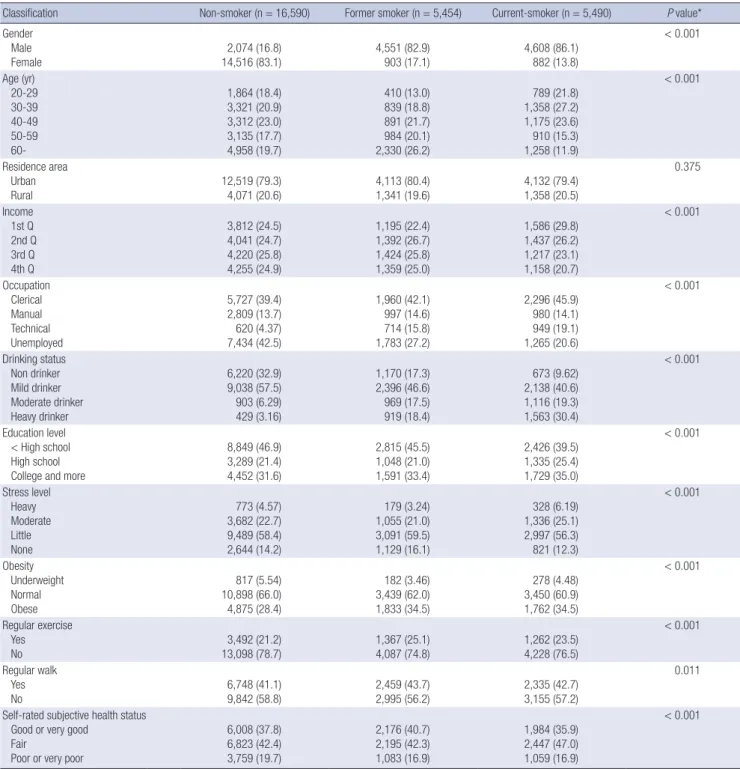
Significant differences in the frequency distribution were found among most classification variables: Current smokers were as- sociated with lower income and who partake of less exercise, clerical work, more drinking, higher stress levels, and obesity (Table 1). In the subjects with over 60 yr, a greater number of past smokers had better SRH scores than current smokers. How- ever, there were fewer current smokers with poor or very poor SRH scores than non-smokers.
All classification variables were significant predictors of SRH after covariate adjustment, indicating that males with younger age, living in urban areas, higher income, employed in clerical and manual settings, higher education, normal weight, regular physical activity, and low stress levels had higher rates of good or very good SRH scores (Table 2). Surprisingly, no apparent differences in ORs were found in the classification variables ac- cording to smoking status. The adjusted OR for SRH was about six fold higher in the no-stress group than the heavy stress group, regardless of smoking status, indicating that stress levels were highly associated with SRH.
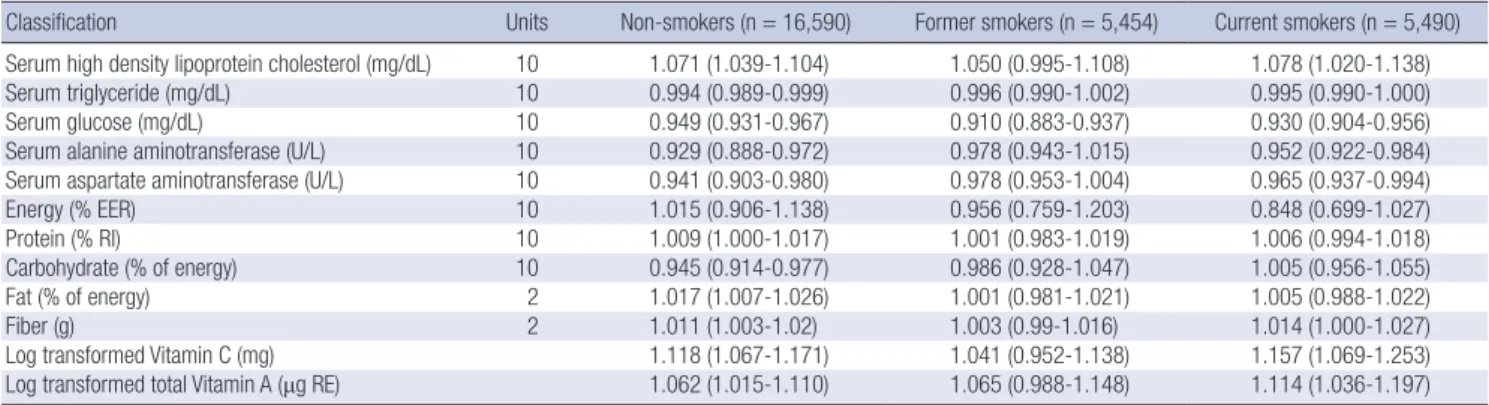
Adjusted ORs and their 95% CI of SRH were calculated after adjusting for covariates according to smoking status (Table 3).
In the non-smoker group, with the exception of total energy in- take as a recommended percent, all biochemical and nutrient variables were significant predictors for SRH after covariates adjustment. In the past smoker group, only serum glucose lev- els were significant predictors. On the other hand, in the cur- rent smoker group, serum glucose, HDL, AST and ALT levels, fiber intake, and log transformed vitamin C and total vitamin A were significant predictors of SRH.
Of 11 food intake groups, 5 groups (grain 1, vegetable, fruit, milk, and sugar) were significant predictors of SRH according to their food intake level among the three smoking status groups.
The non-smoker group had significant ORs regarding adequate intake or adequate/excess intake of vegetables, fruit and sugar (Table 4). The past smoker group had significant ORs in all in- take groups, with the exception of grain 1. On the other hand, the current smoker group had significant ORs in the grain 1, ve-
getable, fruit and milk intake groups (Table 4).
As expected, the mean values of selected biochemical tests differed significantly between the good/very good group and the poor/very poor group. In the non-smoking group, all vari- ables, with the exception of LDL and TG, were significantly dif- ferent according to SRH (Table 5). In addition, all nutrient in- take variables, with the exception of carbohydrate percent in- take, had significantly higher values in the good/very good group
compared to the poor/very poor group among non-smokers (Table 5). However, in the past-smoker group, the means of only three items (Ca, K, and total vitamin A intake) were significantly different according to SRH (Supplementary 1). In the current smoker group, the means of serum HDL, AST, and ALT levels, daily total energy intake, protein intake as recommended per- cent, fiber, K, vitamin C and total vitamin A in were significantly different (Table 6).
Table 1. Distribution of smoking status by classification variables in adult population (n = 27,534) according to 2007-2012 Korea National Health and Nutrition Examination Survey
Classification Non-smoker (n = 16,590) Former smoker (n = 5,454) Current-smoker (n = 5,490) P value*
Gender Male Female
2,074 (16.8) 14,516 (83.1)
4,551 (82.9) 903 (17.1)
4,608 (86.1) 882 (13.8)
< 0.001
Age (yr) 20-29 30-39 40-49 50-59 60-
1,864 (18.4) 3,321 (20.9) 3,312 (23.0) 3,135 (17.7) 4,958 (19.7)
410 (13.0) 839 (18.8) 891 (21.7) 984 (20.1) 2,330 (26.2)
789 (21.8) 1,358 (27.2) 1,175 (23.6) 910 (15.3) 1,258 (11.9)
< 0.001
Residence area Urban
Rural 12,519 (79.3)
4,071 (20.6) 4,113 (80.4)
1,341 (19.6) 4,132 (79.4)
1,358 (20.5)
0.375
Income 1st Q 2nd Q 3rd Q 4th Q
3,812 (24.5) 4,041 (24.7) 4,220 (25.8) 4,255 (24.9)
1,195 (22.4) 1,392 (26.7) 1,424 (25.8) 1,359 (25.0)
1,586 (29.8) 1,437 (26.2) 1,217 (23.1) 1,158 (20.7)
< 0.001
Occupation Clerical Manual Technical Unemployed
5,727 (39.4) 2,809 (13.7) 620 (4.37) 7,434 (42.5)
1,960 (42.1) 997 (14.6) 714 (15.8) 1,783 (27.2)
2,296 (45.9) 980 (14.1) 949 (19.1) 1,265 (20.6)
< 0.001
Drinking status Non drinker Mild drinker Moderate drinker Heavy drinker
6,220 (32.9) 9,038 (57.5) 903 (6.29) 429 (3.16)
1,170 (17.3) 2,396 (46.6) 969 (17.5) 919 (18.4)
673 (9.62) 2,138 (40.6) 1,116 (19.3) 1,563 (30.4)
< 0.001
Education level
< High school High school College and more
8,849 (46.9) 3,289 (21.4) 4,452 (31.6)
2,815 (45.5) 1,048 (21.0) 1,591 (33.4)
2,426 (39.5) 1,335 (25.4) 1,729 (35.0)
< 0.001
Stress level Heavy Moderate Little None
773 (4.57) 3,682 (22.7) 9,489 (58.4) 2,644 (14.2)
179 (3.24) 1,055 (21.0) 3,091 (59.5) 1,129 (16.1)
328 (6.19) 1,336 (25.1) 2,997 (56.3) 821 (12.3)
< 0.001
Obesity Underweight Normal Obese
817 (5.54) 10,898 (66.0) 4,875 (28.4)
182 (3.46) 3,439 (62.0) 1,833 (34.5)
278 (4.48) 3,450 (60.9) 1,762 (34.5)
< 0.001
Regular exercise Yes
No 3,492 (21.2)
13,098 (78.7) 1,367 (25.1)
4,087 (74.8) 1,262 (23.5)
4,228 (76.5)
< 0.001
Regular walk Yes
No 6,748 (41.1)
9,842 (58.8) 2,459 (43.7)
2,995 (56.2) 2,335 (42.7)
3,155 (57.2)
0.011
Self-rated subjective health status Good or very good
Fair
Poor or very poor
6,008 (37.8) 6,823 (42.4) 3,759 (19.7)
2,176 (40.7) 2,195 (42.3) 1,083 (16.9)
1,984 (35.9) 2,447 (47.0) 1,059 (16.9)
< 0.001
*P value by Satterwaite chi-square test.
Table 2. Adjusted odds ratio of self-rated subjective health status by demographic and lifestyle variables according to smoking status in the 2007-2012 Korea National Health and Nutrition Examination Survey*
Classification Non-smoker (n = 16,590) Former smoker (n = 5,454) Current-smoker (n = 5,490)
Gender Male
Female 1.484 (1.305-1.687)
Ref (1.0) 1.24 (1.011-1.522)
Ref (1.0) 1.422 (1.171-1.726)
Ref (1.0) Age (yr)
20-29 30-39 40-49 50-59 60-
Ref (1.0) 0.824 (0.719-0.944) 0.801 (0.697-0.920) 0.630 (0.539-0.736) 0.394 (0.334-0.465)
Ref (1.0) 0.802 (0.609-1.056) 0.831 (0.625-1.105) 0.684 (0.515-0.910) 0.596 (0.445-0.797)
Ref (1.0) 0.857 (0.707-1.039) 0.798 (0.648-0.981) 0.650 (0.513-0.823) 0.506 (0.389-0.657) Residence area
Urban
Rural 1.123 (1.018-1.238)
Ref (1.0) 1.203 (1.021-1.416)
Ref (1.0) 1.022 (0.878-1.191)
Ref (1.0) Income
1st Q 2nd Q 3rd Q 4th Q
Ref (1.0) 1.167 (1.053-1.292) 1.273 (1.148-1.412) 1.403 (1.259-1.563)
Ref (1.0) 1.127 (0.942-1.350) 1.158 (0.968-1.386) 1.544 (1.262-1.890)
Ref (1.0) 1.253 (1.065-1.475) 1.327 (1.113-1.583) 1.452 (1.218-1.731) Occupation
Clerical Manual Technical Unemployed
1.209 (1.111-1.315) 1.160 (1.034-1.302) 0.979 (0.805-1.190)
Ref (1.0)
1.593 (1.333-1.904) 1.470 (1.179-1.832) 1.879 (1.494-2.362)
Ref (1.0)
1.250 (1.036-1.508) 1.316 (1.030-1.683) 1.299 (1.037-1.626)
Ref (1.0) Education level
< High school High school College and more
Ref (1.0) 1.232 (1.110-1.367) 1.432 (1.279-1.604)
Ref (1.0) 1.328 (1.116-1.579) 1.719 (1.426-2.073)
Ref (1.0) 1.288 (1.099-1.510) 1.315 (1.101-1.570) Drinking status
Non drinker Mild drinker Moderate drinker Heavy drinker
Ref (1.0) 1.179 (1.092-1.273) 1.303 (1.095-1.550) 1.260 (0.996-1.595)
Ref (1.0) 1.330 (1.108-1.598) 1.433 (1.168-1.758) 1.351 (1.093-1.670)
Ref (1.0) 1.306 (1.050-1.624) 1.318 (1.043-1.666) 1.193 (0.948-1.500) Obesity
Lean Normal Obese
Ref (1.0) 1.34 (1.136-1.581) 1.138 (0.950-1.363)
Ref (1.0) 1.589 (1.074-2.351) 1.461 (0.969-2.203)
Ref (1.0) 1.379 (1.000-1.901) 1.098 (0.789-1.530) Regular exercise
Yes
No 1.185 (1.076-1.304)
Ref (1.0) 1.24 (1.064-1.445)
Ref (1.0) 1.377 (1.181-1.605)
Ref (1.0) Regular walk
YesNo 1.234 (1.137-1.340)
Ref (1.0) 1.239 (1.091-1.408)
Ref (1.0) 1.24 (1.091-1.409)
Ref (1.0) Stress level
Heavy Moderate Little None
Ref (1.0) 1.619 (1.330-1.973) 3.451 (2.853-4.174) 5.908 (4.786-7.293)
Ref (1.0) 2.500 (1.645-3.799) 3.912 (2.594-5.898) 6.427 (4.213-9.806)
Ref (1.0) 1.750 (1.312-2.333) 3.372 (2.593-4.385) 5.908 (4.331-8.059)
*Adjusted for gender, age, residence area, income, occupation, smoking and drinking status, education, stress level, obesity, and physical activities.
Table 3. Adjusted odds ratio of self-rated subjective health status by selected biochemical data and nutrient intakes in adult subjects according to 2007-2012 Korea National Health and Nutrition Examination Survey*
Classification Units Non-smokers (n = 16,590) Former smokers (n = 5,454) Current smokers (n = 5,490)
Serum high density lipoprotein cholesterol (mg/dL) 10 1.071 (1.039-1.104) 1.050 (0.995-1.108) 1.078 (1.020-1.138)
Serum triglyceride (mg/dL) 10 0.994 (0.989-0.999) 0.996 (0.990-1.002) 0.995 (0.990-1.000)
Serum glucose (mg/dL) 10 0.949 (0.931-0.967) 0.910 (0.883-0.937) 0.930 (0.904-0.956)
Serum alanine aminotransferase (U/L) 10 0.929 (0.888-0.972) 0.978 (0.943-1.015) 0.952 (0.922-0.984)
Serum aspartate aminotransferase (U/L) 10 0.941 (0.903-0.980) 0.978 (0.953-1.004) 0.965 (0.937-0.994)
Energy (% EER) 10 1.015 (0.906-1.138) 0.956 (0.759-1.203) 0.848 (0.699-1.027)
Protein (% RI) 10 1.009 (1.000-1.017) 1.001 (0.983-1.019) 1.006 (0.994-1.018)
Carbohydrate (% of energy) 10 0.945 (0.914-0.977) 0.986 (0.928-1.047) 1.005 (0.956-1.055)
Fat (% of energy) 2 1.017 (1.007-1.026) 1.001 (0.981-1.021) 1.005 (0.988-1.022)
Fiber (g) 2 1.011 (1.003-1.02) 1.003 (0.99-1.016) 1.014 (1.000-1.027)
Log transformed Vitamin C (mg) 1.118 (1.067-1.171) 1.041 (0.952-1.138) 1.157 (1.069-1.253)
Log transformed total Vitamin A (μg RE) 1.062 (1.015-1.110) 1.065 (0.988-1.148) 1.114 (1.036-1.197)
*Adjusted for gender, age, residence area, income, occupation, smoking and drinking status, education, stress level, obesity, and physical activities. EER, energy requirement estimation; RI, recommended intake; RE, retinol equivalent.
DISCUSSION
Public health warnings about the adverse effects of smoking have been advocated intensively, but these warnings have been ineffective (6, 12). Such failure may be related to the fact that smokers in Korea have good SRH scores and consider smoking as a compensatory mechanism of relieving stress to maintain good health. Subjects with poor/very poor SRH tend to smoke less than those with very good/good SRH. We investigated the
factors that influence current smokers to consider themselves to have good and fair health, and examined which components contributed to their high SRH scores. Our results showed that the proportion of poor SRH scores in current smokers was simi- lar to those in past smokers but lower than those in non-smok- ers, indicating that current smokers might not believe that smok- ing endangered their health despite public health warnings. In- terestingly, regardless of smoking status, people considered well- known indicators of metabolic diseases (serum HDL, glucose, Table 4. Adjusted odds ratio of self-rated subjective health status by selected food groups in adult subjects according to 2007-2012 Korea National Health and Nutrition Exami- nation Survey*
Food intake groups Self-rated subjective health status
Non-smokers (n = 16,590) Former smokers (n = 5,454) Current smokers (n = 5,490) Grain 1
Deficient Adequate Excess
Ref (1.0) 1.065 (0.949-1.195) 1.082 (0.992-1.180)
Ref (1.0) 1.173 (0.990-1.389) 1.115 (0.969-1.284)
Ref (1.0) 1.110 (0.950-1.296) 1.227 (1.052-1.431) Vegetable
Deficient Adequate Excess
Ref (1.0) 1.125 (1.037-1.22) 1.205 (0.974-1.491)
Ref (1.0) 1.159 (1.011-1.328) 1.205 (0.832-1.745)
Ref (1.0) 1.266 (1.112-1.443) 1.944 (1.418-2.665) Fruits
Deficient Adequate Excess
Ref (1.0) 1.153 (1.067-1.246) 1.294 (0.968-1.729)
Ref (1.0) 1.212 (1.056-1.392)
1.06 (0.572-1.965)
Ref (1.0) 1.297 (1.129-1.491) 1.419 (0.714-2.820) Milk
Deficient Adequate Excess
Ref (1.0) 1.057 (0.978-1.142) 0.843 (0.558-1.274)
Ref (1.0) 1.178 (1.020-1.360) 1.882 (0.739-4.793)
Ref (1.0) 1.138 (0.993-1.303)
2.26 (1.155-4.424) Sugar
Deficient Adequate Excess
Ref (1.0) 1.206 (1.112-1.309) 1.305 (1.173-1.452)
Ref (1.0) 1.169 (1.012-1.350) 1.270 (1.068-1.510)
Ref (1.0) 0.993 (0.855-1.153) 1.115 (0.956-1.302)
*Adjusted for gender, age, residence area, income, occupation, smoking and drinking status, education, stress level, obesity, and physical activities.
Table 5. Means and 95% confidence intervals of selected biochemical data, blood pressure and selected 24-hr individual food intake by self-rated subjective health status in a non-smoking population after covariate adjustment*
Variables
Self-rated subjective health status Good or very good
(n = 6,008) Fair
(n = 6,823) Poor or very poor
(n = 3,759) P value†
Biochemical tests
Serum high density lipoprotein (mg/dL) Serum low density lipoprotein (mg/dL) Serum triglyceride (mg/dL) Serum aspartate transaminase (U/L) Serum alanine transaminase (U/L)
53.97 (53.51-54.42) 109.7 (108.7-110.7) 108.1 (105.6-110.6) 19.88 (19.59-20.17) 17.71 (17.19-18.23)
53.12 (52.68-53.56) 112.1 (111.1-113.1) 112.0 (108.9-115.1) 20.59 (20.30-20.88) 19.18 (18.74-19.62)
52.48 (51.88-53.07) 110.8 (109.3-112.3) 114.5 (110.9-118.1) 20.96 (20.47-21.45) 19.78 (18.88-20.68)
0.003 0.08 0.119
< 0.001
< 0.001 24 hr food intake
Energy (% EER) Protein (% RI)
Carbohydrate (% of energy) Fat (% of energy) Fiber (g) Na (mg) Ca (mg) K (mg) Vitamin C (mg) Total vitamin A (ug RE)
87.98 (86.77-89.18) 137.2 (134.8-139.7) 67.66 (67.26-68.06) 17.82 (17.54-18.10) 7.293 (7.109-7.477) 4,539.5 (4,440.2-4,638.8)
476.4 (465.9-487.0) 2,914.1 (2,864.1-2,964.0)
81.36 (79.09-83.69) 1,001.2 (970.58-1,032.7)
87.61 (86.52-88.71) 135.3 (133.2-137.4) 67.94 (67.58-68.31) 17.74 (17.47-18.01) 7.080 (6.901-7.260) 4,400.1 (4,312.4-4,487.8)
476.7 (466.2-487.1) 2,849.3 (2,800.0-2,898.6)
78.82 (76.63-81.08) 1,024.4 (992.27-1,057.5)
86.28 (84.57-87.98) 131.5 (128.5-134.4) 68.86 (68.35-69.36) 16.95 (16.57-17.32) 6.802 (6.565-7.038) 4,297.0 (4,169.5-4,424.6)
458.3 (442.4-474.2) 2,765.5 (2,697.1-2,833.8)
72.58 (69.76-75.53) 907.23 (863.67-952.98)
0.399 0.008 0.048 0.022 0.002 0.021 0.045 0.005 0.002 0.032
*Adjusted for gender, age, residence area, income, occupation, smoking and drinking status, education, obesity, and physical activities; †P value for Satterwaite chi-square test.
EER, energy requirement estimation; RI, recommended intake; RE, retinol equivalent.
Table 6. Means and 95% confidence intervals of selected biochemical data, blood pressure and selected 24-hr individual food intake by self-rated subjective health status in a smoking population after covariate adjustment*
Variables
Self-rated subjective health status Good or very good
(n = 1,984) Fair
(n = 2,447) Poor or very poor
(n = 1,059) P value†
Biochemical tests
Serum high density lipoprotein (mg/dL) Serum low density lipoprotein (mg/dL) Serum triglyceride (mg/dL) Serum aspartate transaminase (U/L) Serum alanine transaminase (U/L)
50.23 (49.56-50.90) 107.1 (105.2-108.9) 152.3 (145.7-158.9) 23.34 (22.69-24.00) 25.18 (23.90-26.46)
48.91 (48.30-49.51) 107.1 (105.3-109.0) 161.8 (155.9-167.8) 24.71 (23.92-25.50) 27.19 (26.15-28.22)
48.63 (47.69-49.58) 107.5 (104.8-110.3) 162.3 (153.6-170.9) 24.77 (23.63-25.90) 27.38 (25.67-29.08)
0.002 0.967 0.067 0.025 0.033 24 hr food intake
Energy (% EER) Protein (% RI)
Carbohydrate (% of energy) Fat (% of energy) Fiber (g) Na (mg) Ca (mg) K (mg) Vitamin C (mg) Total vitamin A (µg RE)
100.8 (98.19-103.5) 164.2 (158.7-169.7) 60.61 (59.78-61.43) 18.87 (18.39-19.35) 7.965 (7.667-8.262) 6,064.2 (5,849.1-6,279.3)
562.5 (541.4-583.5) 3,434.9 (3,337.4-3,532.4)
82.73 (78.83-86.81) 1,152.6 (1,094.0-1,214.3)
98.30 (96.15-100.4) 159.7 (154.9-164.5) 60.80 (60.13-61.47) 19.02 (18.62-19.42) 7.614 (7.339-7.889) 5,901.3 (5,727.2-6,075.3)
531.8 (514.8-548.7) 3,282.0 (3,196.7-3,367.3)
76.20 (73.20-79.33) 1,096.0 (1,047.3-1,147.1)
95.18 (91.83-98.54) 150.5 (143.9-157.0) 62.03 (60.95-63.12) 18.05 (17.34-18.76) 7.208 (6.788-7.629) 5,699.0 (5,392.0-6,006.1)
524.0 (484.4-563.6) 3,150.0 (3,009.2-3,290.9)
72.71 (68.15-77.58) 1,013.4 (939.26-1,093.3)
0.032 0.012 0.107 0.058 0.017 0.151 0.095 0.003 0.003 0.025
*Adjusted for gender, age, residence area, income, occupation, smoking and drinking status, education, obesity, and physical activities; †P value for Satterwaite chi-square test.
EER, energy requirement estimation; RI, recommended intake; RE, retinol equivalent.
AST and ALT levels, and intake of food groups of milk, vegeta- bles, grain and total vitamins A and C) as indicators of SRH. Thus, the development of a new indicator that showed the direct ad- verse effects of smoking might be useful to promote discussion at regular health check-ups.
Previous studies have demonstrated that SRH is affected by several factors, such as gender, education, drinking status, in- come, exercise, walking and stress levels. These results were mostly consistent with findings reported previously, although previous studies lacked sub-categorization according to smok- ing status (27, 28). However, the influence of gender in SRH is inconsistent among the previous studies (17, 29-31). The pres- ent study demonstrated that females had lower SRH scores than males. Some studies reported results consistent with ours (29), while others did not (17, 30, 31). Camelo et al. (30) reported that females had lower SRH scores than males, especially when smo- king females were compared with smoking males. The effect of smoking on SRH in various age groups has been also contro- versial (28, 32). The present study showed that the number of non-smokers and former smokers with poor SRH was higher than that in smokers, indicating that smoking was not one of the main modulators for determining SRH. The adjusted OR for SRH was highest in participants in their 20s, which decreased significantly in smokers. However, no significant decline was detected until participants reached their 30s and 40s in smok- ers and former smokers, respectively. Jia et al. (32) reported that smoking did not alter the SRH in Chinese subjects with differ- ent ages. No significant associations between smoking status change and SRH were found over time, with the exception of females in their 20s. Quitting smoking was associated with more positive SRH in older age group over time in an Australian lon-
gitudinal study (28). These results suggested that the SRH might play an important role in smoking cessation only in the elderly.
Accordingly, public health warnings for smoking cessation should be designed differently to target each age category and their SRH relationship to smoking.
SRH in the Korean adult population is affected by biochemi- cal parameters, possibly because people are informed of their biochemical results every 1-2 yr at medical checkups. The pres- ent study indicated that the adjusted ORs of SRH were higher in serum HDL and lower in serum glucose, ALT, and AST regard- less of smoking status in Korean adults. In the Oslo Health Study, increasing HDL levels were associated with increasing ORs for good SRH; a 1 mM/L increase in HDL elevated the OR for re- porting good health by 2.06-2.50 (P < 0.001), when adjusting for gender, age group, time since food intake and use of cholester- ol-lowering drugs (33). Their SRH result for HDL was consider- ably higher than that in the present study. We showed that the adjusted OR for good SRH was elevated about 1.07-fold at a 0.26 mM/L increase in HDL regardless of smoking status. Thus, HDL might be a good candidate indicator of SRH. Other biochemical factors have not been investigated as indicators of SRH. How- ever, the present study suggested that not only serum HDL lev- els but also serum concentrations of glucose, ALT, and AST can be predictors of SRH. Therefore, the biochemical factors, direct- ly and immediately related to smoking status, need to be devel- oped for recognizing smoking as detrimental for their health status.
The SRH is influenced by being underweight or obese (23, 34).
In the present study the adjusted OR was higher in the normal weight than underweight groups regardless of smoking status.
Thus, people with a normal BMI had better SRH than did the
other BMI groups. As body weight is influenced by energy and nutrient intake, the daily intake may alter SRH. However, few studies have been performed in healthy adults (35). We showed that higher intakes of protein and fat and lower intake of carbo- hydrates elevated the SRH in non-smokers. Former and current smokers showed a similar relationship as non-smokers, but the differences did not reach significance. Higher intake of fiber, to- tal vitamin A and vitamin C also increased the adjusted OR of SRH in non-smokers and current smokers, but showed no dif- ference among smokers. Consistent with our results, Södergren et al. (35) reported that fruit and vegetable intake was positively associated with self-rated health in Australian older adults. These results suggested that since people considered fruits and vege- tables containing total vitamin A and vitamin C as healthy foods, their consumption increased SRH.
To our knowledge, this is the first study to determine the as- sociation of SRH with lifestyle, biochemical and nutrient intake parameters according to smoking status in a large representa- tive sample of the Korean population. This study had limitations.
First, the results cannot be taken to indicate causality since this was a cross-sectional study. Second, the results may be skewed by under-reporting of negative behaviors and over-reporting of positive behaviors, as all behavior measures were self-reported (36). Third, food intake could be under-reported knowingly or accidentally, despite being determined by trained dieticians.
In conclusions, smoking status did not influence the SRH in a Korean adult population and SRH was affected by serum HDL, glucose, AST and ALT levels, and intake of fiber and total vita- mins A and vitamin C. These results indicate that people think good nutrition and good values of biochemical markers can compensate for adverse effects of smoking. Thus, smoking ces- sation program needs the reasons beyond emphasizing the ad- verse effects for health. These findings have significant implica- tions for designing tobacco smoking prevention programs for the public. The development of a new direct biochemical pa- rameter would facilitate alteration of the values according to smoking status and sensitivity to SRH. Nutritional education should not empathize that good nutrition attenuates the harm- ful effect of smoking.
DISCLOSURE
All the authors declare that there are no conflicts of interest.
AUTHOR CONTRIBUTION
Study design: Ahn J, Park S. Data collection and statistical anal- ysis: Lee BK. Writing manuscript: Ahn J, Park S. Final acceptance of manuscript: all authors.
ORCID
Sunmin Park http://orcid.org/0000-0002-6092-8340 Jaeouk Ahn http://orcid.org/0000-0002-8870-1527 Byung-Kook Lee http://orcid.org/0000-0001-9162-3390 REFERENCES
1. Centers for Disease Control and Prevention (US), National Center for Chronic Disease Prevention and Health Promotion (US), Office on Smo- king and Health (US). Publications and Reports of the Surgeon General.
Atlanta (GA): Centers for Disease Control and Prevention (US), 2010.
2. Centers for Disease Control and Prevention (CDC). Quitting smoking among adults--United States, 2001-2010. MMWR Morb Mortal Wkly Rep 2011; 60: 1513-9.
3. Park S, Jee SH, Shin HR, Park EH, Shin A, Jung KW, Hwang SS, Cha ES, Yun YH, Park SK, et al. Attributable fraction of tobacco smoking on can- cer using population-based nationwide cancer incidence and mortality data in Korea. BMC Cancer 2014; 14: 406.
4. Shin DW, Cho B, Kim SY, Jung JH, Park JH. Management of cancer sur- vivors in clinical and public health perspectives: current status and fu- ture challenges in Korea. J Korean Med Sci 2013; 28: 651-7.
5. Office of the Surgeon General (US), Office on Smoking and Health (US).
The health consequences of smoking: a report of the Surgeon General.
Atlanta (GA): Centers for Disease Control and Prevention (US), 2004.
6. Heydari G, Masjedi M, Ahmady AE, Leischow SJ, Lando HA, Shadmehr MB, Fadaizadeh L. A comparative study on tobacco cessation methods:
a quantitative systematic review. Int J Prev Med 2014; 5: 673-8.
7. Ministry of Health and Welfare (KR), Korea Health Promotion Founda- tion (KR). Health Plan 2020 annual report: the 3rd National Health Pro- motion Strategy 2011-2020. Seoul: Ministry of Health and Welfare, 2013.
8. Smit ES, de Vries H, Hoving C. Determinants of practice nurses’ inten- tion to implement a new smoking cessation intervention: the importance of attitude and innovation characteristics. J Adv Nurs 2013; 69: 2665-74.
9. Paek YJ, Lee S, Kim YH, Lee KS, Yim HW, Kim MS, Kim CH, Jeung O.
Effect on smoking quit rate of telling smokers their health risk appraisal in terms of health age: a randomized control trial. Asian Pac J Cancer Prev 2014; 15: 4963-8.
10. Katanoda K, Jiang Y, Park S, Lim MK, Qiao YL, Inoue M. Tobacco con- trol challenges in East Asia: proposals for change in the world’s largest epidemic region. Tob Control 2014; 23: 359-68.
11. Lindström M. Psychosocial work conditions, social capital, and daily smoking: a population based study. Tob Control 2004; 13: 289-95.
12. Kim H, Oh JK, Lim MK, Jeong BY, Yun EH, Park EY. The national “smok- ing cessation clinics” program in the republic of Korea: socioeconomic status and age matter. Asian Pac J Cancer Prev 2013; 14: 6919-24.
13. Bush T, Levine MD, Beebe LA, Cerutti B, Deprey M, McAfee T, Boeck- man L, Zbikowski S. Addressing weight gain in smoking cessation treat- ment: a randomized controlled trial. Am J Health Promot 2012; 27: 94- 102.
14. Webb TL, Sniehotta FF, Michie S. Using theories of behaviour change to inform interventions for addictive behaviours. Addiction 2010; 105: 1879- 92.
15. Herman KM, Hopman WM, Sabiston CM. Physical activity, screen time
and self-rated health and mental health in Canadian adolescents. Prev Med 2015; 73: 112-6.
16. Ryu SY, Park J, Choi SW, Han MA. Associations between socio-demogra- phic characteristics and healthy lifestyles in Korean Adults: the result of the 2010 Community Health Survey. J Prev Med Public Health 2014; 47:
113-23.
17. Schütte S, Chastang JF, Parent-Thirion A, Vermeylen G, Niedhammer I.
Social differences in self-reported health among men and women in 31 countries in Europe. Scand J Public Health 2013; 41: 51-7.
18. Giltay EJ, Vollaard AM, Kromhout D. Self-rated health and physician- rated health as independent predictors of mortality in elderly men. Age Ageing 2012; 41: 165-71.
19. Kaplan GA, Camacho T. Perceived health and mortality: a nine-year fol- low-up of the human population laboratory cohort. Am J Epidemiol 1983; 117: 292-304.
20. Strawbridge WJ, Wallhagen MI. Self-rated health and mortality over three decades results from a time-dependent covariate analysis. Res Ag- ing 1999; 21: 402-16.
21. Miilunpalo S, Vuori I, Oja P, Pasanen M, Urponen H. Self-rated health status as a health measure: the predictive value of self-reported health status on the use of physician services and on mortality in the working- age population. J Clin Epidemiol 1997; 50: 517-28.
22. McClave AK, Dube SR, Strine TW, Mokdad AH. Associations between health-related quality of life and smoking status among a large sample of U.S. adults. Prev Med 2009; 48: 173-9.
23. Yamada C, Moriyama K, Takahashi E. Self-rated health as a comprehen- sive indicator of lifestyle-related health status. Environ Health Prev Med 2012; 17: 457-62.
24. Kim Y, Lee BK. Iron deficiency increases blood manganese level in the Korean general population according to KNHANES 2008. Neurotoxicol- ogy 2011; 32: 247-54.
25. Park S, Lee BK. Body fat percentage and hemoglobin levels are related to blood lead, cadmium, and mercury concentrations in a Korean Adult Population (KNHANES 2008-2010). Biol Trace Elem Res 2013; 151: 315-
23.
26. The Korean Nutrition Society. Dietary reference intake for Koreans. Seoul:
The Korean Nutrition Society, 2010.
27. Hämmig O, Gutzwiller F, Kawachi I. The contribution of lifestyle and work factors to social inequalities in self-rated health among the employed population in Switzerland. Soc Sci Med 2014; 121: 74-84.
28. Sargent-Cox K, Cherbuin N, Morris L, Butterworth P, Anstey KJ. The ef- fect of health behavior change on self-rated health across the adult life course: a longitudinal cohort study. Prev Med 2014; 58: 75-80.
29. Shin HY, Shin MH, Rhee JA. Gender differences in the association be- tween self-rated health and hypertension in a Korean adult population.
BMC Public Health 2012; 12: 135.
30. Camelo Ldo V, Giatti L, Barreto SM. Subjective social status, self-rated health and tobacco smoking: Brazilian Longitudinal Study of Adult Health (ELSA-Brasil). J Health Psychol 2014; 19: 1388-99.
31. Rohlfsen LS, Jacobs Kronenfeld J. Gender differences in trajectories of self-rated health in middle and old age: an examination of differential exposure and differential vulnerability. J Aging Health 2014; 26: 637-62.
32. Jia Y, Gao J, Dai J, Zheng P, Wu X, Li G, Fu H. Difference of the associations between self-rated health and demographic characteristics, lifestyle, and psychosocial work environment between two types of Chinese worksite.
BMC Public Health 2014; 14: 851.
33. Tomten SE, Høstmark AT. Self-rated health showed a consistent associa- tion with serum HDL-cholesterol in the cross-sectional Oslo Health Study.
Int J Med Sci 2007; 4: 278-87.
34. Månsson NO, Merlo J. The relation between self-rated health, socioeco- nomic status, body mass index and disability pension among middle- aged men. Eur J Epidemiol 2001; 17: 65-9.
35. Södergren M, McNaughton SA, Salmon J, Ball K, Crawford DA. Associa- tions between fruit and vegetable intake, leisure-time physical activity, sitting time and self-rated health among older adults: cross-sectional data from the WELL study. BMC Public Health 2012; 12: 551.
36. van de Mortel TF. Faking it: social desirability response bias in self-report research Aust J Adv Nurs 2008; 25: 40-8.
Supplement Table 1. Means and 95% confidence intervals of selected biochemical data, blood pressure and selected 24-hr individual food intake by self-rated subjective health status in a former-smoking population after covariate adjustment*
Variables
Self-rated subjective health status
P value† Good or very good
(n = 2,176) Fair
(n = 2,195) Poor or very poor
(n = 1,083) Biochemical tests
Serum high density lipoprotein (mg/dL) Serum low density lipoprotein (mg/dL) Serum triglyceride (mg/dL) Serum aspartate transaminase (U/L) Serum alanine transaminase (U/L)
50.23 (49.56-50.90) 107.1 (105.2-108.9) 152.3 (145.7-158.9) 23.34 (22.69-24.00) 25.18 (23.90-26.46)
48.91 (48.30-49.51) 107.1 (105.3-109.0) 161.8 (155.9-167.8) 24.71 (23.92-25.50) 27.19 (26.15-28.22)
48.63 (47.69-49.58) 107.5 (104.8-110.3) 162.3 (153.6-170.9) 24.77 (23.63-25.90) 27.38 (25.67-29.08)
0.071 0.409 0.587 0.079 0.095 24 hr food intake
Energy (% EER) Protein (% RI)
Carbohydrate (% of energy) Fat (% of energy) Fiber (g) Na (mg) Ca (mg) K (mg) Vitamin C (mg) Total vitamin A (µg RE)
100.8 (98.19-103.5) 164.2 (158.7-169.7) 60.61 (59.78-61.43) 18.87 (18.39-19.35) 7.965 (7.667-8.262) 6,064.2 (5,849.1-6,279.3)
562.5 (541.4-583.5) 3,434.9 (3,337.4-3,532.4)
82.73 (78.83-86.81) 1,152.6 (1,094.0-1,214.3)
98.30 (96.15-100.4) 159.7 (154.9-164.5) 60.80 (60.13-61.47) 19.02 (18.62-19.42) 7.614 (7.339-7.889) 5,901.3 (5,727.2-6,075.3)
531.8 (514.8-548.7) 3,282.0 (3,196.7-3,367.3)
76.20 (73.20-79.33) 1,096.0 (1,047.3-1,147.1)
95.18 (91.83-98.54) 150.5 (143.9-157.0) 62.03 (60.95-63.12) 18.05 (17.34-18.76) 7.208 (6.788-7.629) 5,699.0 (5,392.0-6,006.1)
524.0 (484.4-563.6) 3,150.0 (3,009.2-3,290.9)
72.71 (68.15-77.58) 1,013.4 (939.26-1,093.3)
0.061 0.108 0.199 0.503 0.059 0.166 0.002 0.005 0.101 0.011
*Adjusted for gender, age, residence area, income, occupation, smoking and drinking status, education, obesity, and physical activities; †P value for Satterwaite chi-square test.
EER, energy requirement estimation; RI, recommended intake; RE, retinol equivalent.