Vol. 18, No. 11 pp. 778-784, 2017
참굴 , Crassostrea gigas의 패각운동을 이용한 유독와편모조 Alexandrium 속의 모니터링 연구
김윤정1, 윤양호2*
1전남대학교 대학원 해양환경학과, 2전남대학교 해양기술학부
A Studies on the Bio-monitoring using Shell Valve Movements (SVMs) of Pacific Oyster Crassostrea gigas for Toxic Dinoflagellates,
Genus Alexandrium
Yoon Jeong Kim
1, Yang Ho Yoon
2*1Dept. of Enviromental Oceanography of Graduate school, Chonnam National University
2Faculty of Marine Technology, Chonnam National University
요 약 참굴(Crassostrea gigas)의 패각운동을 이용하여 Alexandrium 속의 조기 출현모니터링 가능성을 고찰하였다. 지구규모 에서 패류독화를 발생시키는 A. fundyense와 잠재적 유독종으로 알려진 A. affine를 이용하여 홀 소자센서(Hall element sensor) 를 사용하여 참굴의 패각운동(SVMs)을 측정하였다. 참굴은 Isocrysis galbana를 먹이생물로 하여 안정화 시킨 다음 3일간 절식 시킨 후 실험에 제공하였다. 결과 참굴은 A. fundyense에 대해 세포밀도 20 cells/mL에서 SVMs 횟수가 10.5 ± 1.2 times/hr로 증가하여 민감하게 반응하였고, 세포밀도 500 cells/mL에서 재차 14.1 ± 5.7 times/h, 5,000 cells/mL에서 27.9 ± 11.1 times/hr로 SVMs가 급격한 증가를 보였다. 그러나 A. affine에 대해서는 세포밀도가 300 cells/mL까지 6.7 ± 3.9 times/hr 로 기준 SVMs와 유사하였고, 세포밀도 1,000 cells/mL 이상에서 15.3 ± 10.8 times/hr로 급격히 증가하였다. 즉 A. fundyense는 20 cells/mL에서부터 참굴의 SVMs가 민감하게 반응하였지만, A. affine는 높은 1,000 cells/mL의 세포밀도에서 SVMs가 반응 하였다. 이러한 결과에서 유독와편모조에 대한 참굴의 SVMs는 종에 따른 차이가 있어, A. fundyense의 초기발생 예보에는 유용하게 활용 가능하지만, A. affine에 응용하는 것은 어렵다는 결론을 얻었다.
Abstract We investigatedthe possibility of a bio-monitoring system for predicting toxic dinoflagellates (Genus Alexandrium) by the measuring shell valve movements(SVMs) of Pacific oyster, Crassostrea gigas (Mollusca: Bivalvia) using the Hall element sensor. We then described the SVMs of Pacific oyster exposed to the toxic algae under laboratory conditions. Pacific oyster used for experiment were fed Isochrysis galbana until they stabilized and kept under hunger conditions for three days to prevent the influence of food before the experiment. Pacific oyster were exposed to the toxic dinoflagellate, A. fundyense, and the potentially toxic dinoflagellate, A. affine. When Pacific oyster were exposed to A.
fundyense, SVMs increased over 10 times/hr at low cell densities of 20 cells/mL. SVMs increased again at 14.1 ± 5.7 times/hr at 500 cells/mL, and 27.9 ± 11.1 times/hr at the high cell density of 5,000 cells/mL. However, in the presence of A. affine, SVMs increased at 6.7 ± 3.9 times/hr until 300 cells/mL, while they increased greatly to 15.3 ± 10.8 times/hr at 1,000 cells/mL. The SVMs of Pacific oyster indicated differences depending on species for toxic dinoflagellates.
Therefore, the SVMs of Pacific oyster could be useful for A. fundyense, but would bedifficult to apply for A. affine.
Keywords : Bio-monitoring, Genus Alexandrium, Hall element sensor, Pacific oyster, Shell valve movements(SVMs), Toxic dinoflagellates
이 논문은 해양수산부(해양과학기술진흥원) 지원 2015년도 미래해양산업기술개발사업인 “이매패류 바이오센서를 활용한 연안환 경 모니터링 시스템 개발” (과제번호 20150129) 지원으로 수행되었음.
*Corresponding Author : Yang Ho Yoon (Chonnam National Univ.) Tel: +82-61-659-7142 email: [email protected]
Received August 31, 2017 Revised (1st September 27, 2017, 2nd October 13, 2017) Accepted November 3, 2017 Published November 30, 2017
1. 서론
지구규모의 연안/내만해역에 발생하는 유독와편모조 에 의한 적조발생 및 패류독화는 수권생태계를 넘어 인 류의 공중보건을 위협할 뿐만 아니라 막대한 수산피해에 따른 사회문제로 확산되면서[1], 원인생물의 거동 및 조 기발생 탐지 등은 범지구적인 관심사가 되고 있다[2]. 현 재 유독와편모조의 출현 및 대량발생의 예보는 해역의 물리·화학적 환경인자 측정과 지속적인 원인생물의 거동 을 모니터링하거나 인공위성 및 항공촬영에 기반을 둔 해양관측에 의존하는 바가 크지만, 최근 이들 원인생물 에 민감한 반응을 보이는 검지소자로 활용한 바이오모니 터링을 이용한 연구가 진행되고 있다[3,4]. 즉 생물은 내 부의 생리요인 및 외적 환경요인 변화에 민감한 반응을 보이기에[5,6], 지속적인 생물의 행동관찰로서 다양한 인자의 변화를 감지할 수 있다[4].
이러한 해양생물을 이용한 모니터링은 민감도가 높 고, 정확한 생물반응을 관찰할 수 있는 장점으로 기존의 화학·물리학적 모니터링 방법에 비해 높은 효율성을 나 타낸다[7]. 이매패인 참굴은 한국 양식생산량의 14%로, 전복 다음으로 높은 생산을 보이는 패류로서 국내 전체 패류생산량의 25%를 차지한다(통계청, http://kostat.go.kr).
참굴과 같은 이매패류는 이동성이 거의 없는 저서생물로 환경변화에 수동적으로 반응하기에 해역에서 환경지표 생물로 많이 이용 된다[8,9]. 특히 이매패류는 내적 생리 변화 및 외적 환경변화에 패각의 개폐활동인 패각운동 (SVMs:shell valve movements)으로 반응한다[10,11].
이러한 이매패류의 SVMs는 처음 패류의 건강도를 판단 하는 지표로 이용되었다[12]. 그러나 SVMs가 생물의 체 내 및 외부 환경변화에 대한 방어반응으로 인지되면서 [13], 환경변화를 탐지하는 바이오모니터링 수단으로 활 발하게 사용되었다[3,14,15,16]. 즉 이매패류의 SVMs는 호흡, 배설, 심박수, 먹이활동, 생물학적 리듬 등의 내부 적 요인과 급격한 외부의 환경자극, 그리고 포식자로부 터의 회피 등에 의해 변화를 받는다[17,18]. 특히 유독, 유해플랑크톤 등 먹이생물의 종에 따른 SVMs 변화 [14,19]를 이용하여 유해적조의 조기탐지에 유용하게 활 용할 수 있다는 것이 보고된다[3].
따라서 이 연구에서도 참굴을 대상 이매패류로 하여 많은 마비성 패류독화 원인종을 포함하는 유독와편모조 인 Alexandrium 속의 두 종을 대상으로 세포밀도 변화 에 따른 참굴의 SVMs의 변화를 고찰하여, 이들 유독플
랑크톤이 패류양식장 조기출현 모니터링 여부를 평가하 였다.
2. 재료 및 방법
참굴은 통영과 여수 돌산도 굴 양식장에서 월동한 2 년생 각굴을 대상으로 하였다. 실험에 제공한 참굴의 각 장, 각고 및 각폭은 각각 93.0 ± 6.4mm, 27.7 ± 7.1mm, 및 53.8 ± 8.7mm의 범위였고, 참굴의 습중량은 71.7 ± 24.6g으로 크기에는 변화가 없었지만, 무게에서 산지에 따라 개체 사이에 다소 차이를 보였다. 유독플랑크톤은 마비성 패독을 생산하는 Alexandrium fundyense 및 잠 재적 유독종으로 알려지는 A. affine를 대상으로 하였다.
A. fundyense는 주로 온대해역에서 저수온기에 발견되 며, 우리나라 남해안에서 일반적으로 출현하는 종이며, A. affine 또한 18 ~ 25℃의 수온대인 온대해역에서 봄 과 여름에 주로 출현한다[20,21]. 이들 유독 플랑크톤은 수온 20℃, 염분 30.0 psu, 광조건 100 μmol/㎡/sec, 명 암주기(L:D) 12h:12h의 조건에서 배양하였다. 배양은 f/2 배지를 사용하여[22] 대수성장기까지 증식시킨 다음 실험에 제공하였다.
SVMs 측정은 참굴의 왼쪽 패각에 홀 소자센서 (Allegro MicroSystems, A1369EUA-24-T), 오른쪽 패 각에 자석을 산호접착제로 부착하여 홀 센서와 자석사이의 거리에 따른 전압차이를 이용하는 측정장치(Oceantech Co., OT-SVML -001)를 사용하였다. 홀 센서는 약 2g으 로 15 ~ 1,000 mV의 전압을 0.5 ~ 2.0초 간격으로 연 속측정이 가능하였다. 참굴은 실험수조에서 하루에 2번 국립수산과학원 굴양식 매뉴얼에서 참굴 유생의 먹이로 권장하는 침편모조류 Isocrysis galbana를 먹이생물[23]
로 공급하여 안정화 시켰다. 실험은 시작 전 3일간 절식 상태로 순치시킨 다음 유독와편모조의 세포밀도가 각각 0, 20, 50, 70, 100, 300, 500, 700, 1,000, 5,000 cells/mL가 되도록 단계별로 조절하여 각 실험구간에서 1시간씩 폭로시키면서 연속적으로 SVMs를 측정하였다.
SVMs는 24시간 명조건 및 수온 16.3 ± 0.35℃의 조건 에서 측정하였다. 수온을 20℃ 이하로 한 것은 참굴이 20℃ 이상 수온에서는 산란하여 체력이 급격하게 감소 하기 때문에 이러한 현상을 방지하기 위한 조치였다 [24]. 또 외부자극에 대한 스트레스 및 굴 개체 사이의 간섭을 최소화하기 위해 독립된 공간을 제공할 수 있도
Fig. 1. Schematic diagram for the SVMs(shell valve movements) measurement.
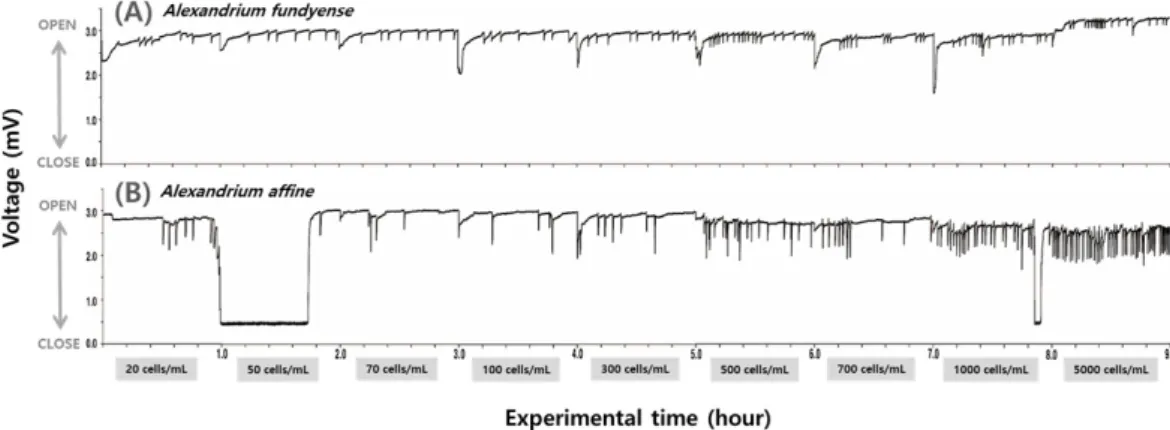
Fig. 3. The Fluctuations of SVMs of Pacific oyster on the variations of cell density for toxic dinoflagellates, Alexandrium fundyense (A) and A. affine (B).
Fig. 2. Standard pattern of SVMs on the Pacific oyster.
록, 특수수조에서 8개체의 실험 참굴의 SVMs를 동시에 연속 측정하였다(Fig. 1). 실험 참굴에 대한 생산지별 개 체사이에 차이는 있었지만 모든 실험은 동일 개체에 대 해 유해생물의 세포밀도를 변화시켜 SVMs를 측정하였 기에 개채간의 차이에 따른 오차는 그다지 문제가 되지 않을 것으로 판단되었다. 그리고 모든 측정된 SVMs는 데이터 로거를 통해 직접 노트북에 저장되게 고안되어, 저장된 자료를 분석하였다.
3. 결과
1.1 참굴의 기준 SVMs
참굴 생체 내부 및 외부 환경자극에 대한 최적조건에 서의 SVMs 측정 및 결과를 객관화 시킨다는 것은 매우 어렵다. 때문에 이 연구에서 각 실험구의 결과 비교를 하 기 위한 기준 SVMs의 파형과 횟수는 실험에 제공한 참 굴을 3일 동안 절식한 후 먹이생물이 없는 여과해수에서
1 시간 연속 측정한 SVMs 결과를 사용하였다(Fig. 2).
참굴의 기준 SVMs은 개체에 따라 차이는 있지만 약 5
~ 10 times/hr 범위에서 7 times/hr 전후의 SVMs 횟수를 보였고(Fig. 2A), SVMs 패턴은 패각이 닫히는 것(폐각) 은 매우 빠르게 진행되는 것에 반해, 패각이 열리는 것 (개각)은 천천히 진행되어, 개각 이후 일정시간 개각상태 를 유지하였다(Fig. 2B). 또한 참굴은 천천히 개각 할 때 배설하는 것이 관찰되었다.
1.2 유독와편모조 Alexandrium 속에 대한 SVMs 변화
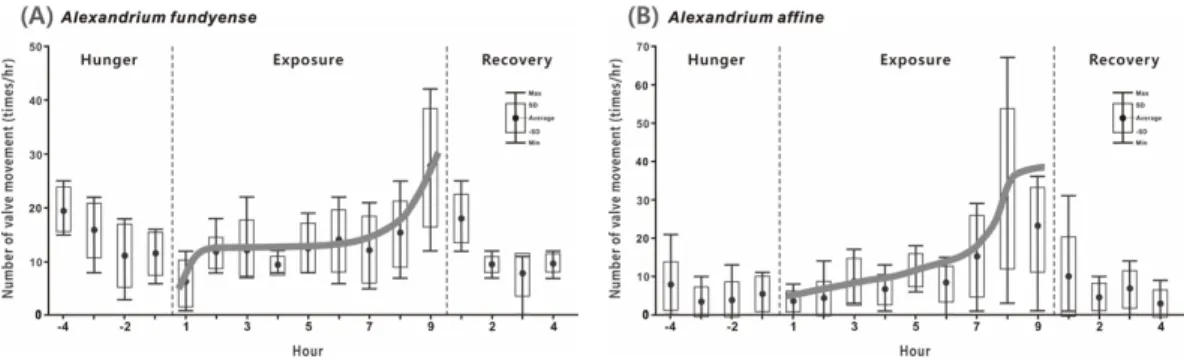
마비성 패류독화의 대표적 원인종인 A. fundyense에 노출되었을 때, 참굴의 SVMs 패턴은 세포밀도가 20 cells/mL에서 SVMs 횟수가 10회를 초과하여, 20 ~ 300 cells/mL의 범위에서 10.5 ± 1.2 times/hr의 SVMs 횟수 를 보였고, 500 cells/mL에서 재차 14.1 ± 5.7 times/hr 로 급격하게 증가하였다. 더욱이 5,000 cells/mL의 세포 밀도에서는 27.9 ± 11.1 times/hr를 나타내었다(Fig. 3A
& 4A). 그러나 잠재적 유독 플랑크톤인 A. affine에 대 해서는 50 cells/mL의 세포밀도에서 일시적으로 폐각하
Fig. 4. The fluctuations of SVMs times of Pacific oyster on the variations of cell density for toxic dinoflagellate, Alexandrium fundyense (A) and A. affine (B).
는 현상이 관찰되기도 하였지만, 세포밀도가 300 cells/mL까지는 6.7 ± 3.9 times/hr로 기준 SVMs와 유사 하였지만, 500 cells/mL에서 11.7 ± 4.6 times/hr, 1,000 cells/mL에서 15.3 ± 10.8 times/hr으로 급격하게 증가하 였다(Fig. 3B & 4B).
4. 고찰
이매패류의 SVMs을 이용한 바이오모니터링 방법은 담수권에서 독성물질을 감지하기 위해 시작되었으나 [25], 지금은 담수는 물론 해양환경에 이루는 수권 전체 에서 다양한 환경 인자를 검지하는 방법으로 독일[26], 프랑스[27] 등의 유럽과, 일본[3], 한국[16], 대만[28] 등 북서태평양 연안의 패류양식장 등에서 광범위하게 활용 되고 있다. 즉 프랑스는 굴 양식장의 패류독화 원인종의 출현을 감시하기 위해서[27], 일본은 진주조개양식장의 대량폐사를 발생시키는 유해적조 원인종인 Heterocapsa circularisquama의 조기출현 탐지[3]에 이용되고 있다.
그리고 독일이나 대만 등은 수권의 유해물질 탐지를 위 한 방법[26,28,29]으로 사용되고 있으며, 국내에서도 이 상 수온이나 염분의 변화[7,16] 및 해저 빈산소 및 황화 수소의 발생[15]과 같은 환경 인자의 변화를 탐지하는 방법으로 사용되고 있다. 그러나 국내에서는 아직까지 유해적조 및 패류독화 원인종의 조기출현을 탐지하기 위 한 모니터링 방법으로 사용된 적은 없다.
SVMs의 측정 대상 이매패류도 패각이 매끄럽고, 센 서 부착이 쉬운 담치류[11-13,25]를 시작으로 진주조개 [3], 바지락[14], 가리비[30], 재첩[28] 등 매우 다양하지 만, 동ㆍ서양을 막론하고 식용가치가 높은 굴[7,19]을 대
상으로 최근 많은 연구가 진행되고 있다.
먹이생물로 제공한 와편모조 Alexandrium 속은 현재 41종이 보고되지만[31], 많은 종에서 마비성 패류독을 생산하여, 지구규모에서 굴이나 담치류 등 이매패류를 독화시켜 수산생물생산에 막대한 경제적 손실을 발생시 키는 것은 물론 인류의 공중위생에도 커다란 위협으로 작용한다[1]. Alexandrium 속에서 특히 A. fundyense는 지구규모의 발생과 생산되는 독성분 및 패류독의 분포 등이 잘 파악되어 있다[20,32]. 이 연구에서도 A. fundyense 에 대한 참굴의 SVMs는 낮은 세포밀도에서부터 민감하 게 반응하였다. 이러한 반응은 유해적조생물인 H.
circularisquama에 대한 진주조개의 반응에서도 유사한 결과를 보였다[3]. 이와같은 유독와편모조에 대한 이매 패류의 반응은 유독플랑크톤에 대한 내부 방어행동으로 내부적 요인에 의한 결과이다[18,19]. 그러나 유독플랑 크톤에 대한 이매패류의 행동은 독성분에 민감하게 반응 하지 않은 진주담치와 같은 비저항성 패류에서는 여과율 이나 SVMs 변화가 거의 발생하지 않기에, 유독플랑크 톤을 먹이생물로서 다량 섭취하여 빠른 속도로 체내에 독소를 축척하는 것이 알려진다[33]. 그러나 가리비와 같이 독성에 민감한 저항성 패류는 유독플랑크톤 출현이 감지되면 먹이섭취 행위인 여과율을 감소시켜, 체내에 독소가 축적되지 않게 하는 행동을 하는 것이 알려진다 [34]. 유독플랑크톤 독성에 대한 참굴의 감수성이 담치 류와 가리비의 중간정도로 독성분에 의해 폐사되지 않지 만 SVMs 등 생리활성에 크게 영향을 받아[19], 여과율 이나 생물발육 속도가 감소하는 것이 알려진다[35-38].
유독플랑크톤에 대한 이매패류의 SVMs가 종에 따라 다른 특성을 보이는 것과 마찬가지로 Alexandrium 속에 대해서도 종에 따라 참굴의 SVMs가 다른 특이성, 즉 유
독플랑크톤 종 특이성을 보인다. 그리고 A. fundyense에 대한 참굴의 SVMs는 낮은 세포밀도에서 특이성이 관찰 되지만, A. affine에 대해서는 500 cells/mL 이상의 매우 높은 세포밀도에서 특이성이 관찰되었다. 이러한 결과는 바이오모니터링을 대상으로 하는 생물종은 물론 유독플 랑크톤 종에 따른 특이성을 표현하는 것으로, 이매패류 의 SVMs를 이용한 바이오모니터링 응용에는 사전에 현 장에서 대상으로 하고자 하는 환경인자는 물론 유해생물 의 종을 대상으로 한 SVMs의 패턴 확보가 필요한 것이 된다. 즉 각 바이오모니터링 대상종에 대한 환경인자 또 는 유해플랑크톤의 SVMs의 결과물(dictionary)를 정리 하여, 상황에 적합한 대상생물을 선택하여야 한다는 것 을 시사한다. 또한 바이오모니터링에 의한 유해물질이나 유해플랑크톤의 출현 탐지는 낮은 농도의 물질유입이나 유해플랑크톤의 군 성장 이전 단계의 낮은 세포밀도에서 반응하여야만 모니터링의 유효성이 확보될 수 있다. 때 문에 낮은 세포밀도에서 반응을 보이는 마비성 패류독화 원인종인 A. fundyense와는 달리 높은 세포밀도에서 반 응을 보이는 잠재적 유독종인 A. affine와 같은 종에 대 해서는 참굴을 이용한 유해생물 조기탐지 모니터링이 적 합하지 않기에 모니터링이 가능한 유사 패류종 탐색이 필요할 것으로 판단되었다. 최근 진주조개 양식으로 유 명한 일본 이세만에서 유해적조발생으로 진주조개가 대 량 폐사되는 것을 방지하기 위해, 유해적조 H.
circularisquama의 조기출현 탐색을 위한 진주조개의 SVMs 측정기기를 현장에 설치하여 적조발생에 대한 피 해경감에 크게 기여하는 것으로 전해진다[3, T. Honjo, personal community].
References
[1] Y. H. Yoon, Red Tides–The uprising from the sea-, Gipmundang, Seoul, pp. 1-531, 2010.
[2] V. M. Bricelj, S. E. Shumway, “Paralytic shellfish toxins in bivalve mollusks: occurrence, transfer kinetics, and biotrans- formation,” Reviews in Fisheries Science, vol.
6, no. 4, pp. 315-383. 1998.
DOI: http://dx.doi.org/10.1080/10641269891314294 [3] K. Nagai, T. Honjo, J. Go, H. Yamashita, S. J. Oh, “Detecting
the shellfish killer Heterocapsa circularisquama (Dinophyceae) by measuring bivalve valve activity with a hall element sensor”, Aquaculture, vol. 255, no. 1-4, pp. 395-401. 2006
DOI: https://doi.org/10.1016/j.aquaculture.2005.12.018
[4] M. J. Bae, J. S. Kim, Y. S. Park, Y. S., 2012, “Evaluation of changes in effluent quality from industrial complexes on the Korean nationwide scale using a self-organizing map”, International Journal of Environmental Research and Public Health, vol. 9, no. 4, pp. 1182-1200. 2012.
DOI: http://doi.org/10.3390/ijerph9041182
[5] A. Gerhardt, “Aquatic behavioral ecotoxicology -prospects and limitations”, Human and Ecological Risk Assessment:
An International Journal, vol. 13, no. 3, pp. 481-491. 2007.
DOI: http://dx.doi.org/10.1080/10807030701340839 [6] N. B. Davies, J.R. Krebs, S. A. West, An introduction
to behavioural ecology (4rd eds). Wiley Blackwell Scientific, London, pp. 1-520, 2012.
[7] S. J. Oh, J. H. Lee, S. Y. Kim, S. Y., 2013,
“Bio-monitoring system using shell valve movements of Pacific oyster (Crassostrea gigas) - I. detecting abnormal shell valve movements under low salinity using a hall element sensor”, Journal of the Korean Society for Marine Environment and Energy, vol. 16, no.
2. pp. 138-142, 2013.
DOI: http://dx.doi.org/10.7846/JKOSMEE.2013.16.2.138 [8] M. S. Jeng, W. L. Jeng, T.C. Hung, C. Y. Yeh, R. J.
Tseng, P. J. Meng, B. C. Han, “Mussel watch: a review of Cu and other metals in various marine organisms in Taiwan, 1991∼98”, Environmental Pollution, vol. 110, no. 2, pp. 207-215, 2000.
DOI: http://dx.doi.org/10.1016/S0269-7491(99)00304-8 [9] J. Moroishi, I. J. Kang, K. Nagafuchi, T. Honjo, Y.
Shimasaki and Y. Oshima, “Biological monitoring to detect both water pollution and water quality recovery based on valve movements of freshwater bivalves (Corbicula japonica)”, Journal- Faculty of Agriculture Kyushu University, vol. 54, no. 2, pp. 413-420, 2009.
[10] A. R. Manley, J. Davenport, “Behavioural responses of some marine bivalves to heightened seawater copper concentrations”, Bulletin of Environmental Contamination and Toxicology, vol. 22, no. pp. 6739-744, 1979.
DOI: http://dx.doi.org/10.1007/BF02027017
[11] K. J. M. Kramer, H. A. Jenner, D. D. Zwart, “The valve movement response of mussels: a tool in biological monitoring”, Hydrobiologia, vol. 188, no. 1, pp.
433-443, 1989.
DOI: https://doi.org/10.1007/BF00027811
[12] T. Fujii, S. Toda, “Open and close shell-movement of the mussel, Mytilus edulis L. under natural conditions”, Bulletin of National Research Institute of Aquaculture, vol. 20, pp. 33-40, 1991.
[13] S. Rajagopal, G.V.D. Velde, H. A. Jenner, “Shell valve movement response of dark false mussel, Mytilopsis leucophaeta, to chlorination”, Water Research, vol. 31, no. 12, pp. 3187-3190, 1997.
DOI: https://doi.org/10.1016/S0043-1354(97)00163-2 [14] L. Basti, K. Nagai, Y. Shimasaki, Y. Oshima, T. Honjo
and S. Segawa, “Effects of the toxic dinoflagellate Heterocapsa circularisquama on the valve movement behavior of the Manila clam Ruditapes philippinarum”, Aquaculture, vol. 291, no. 1-2, pp. 41-47, 2009.
DOI: https://doi.org/10.1016/j.aquaculture.2009.02.029 [15] J. Y. Jeon, S. Y. Moon, S. J. Oh, “Bio-monitoring
system using shell valve movements of Pacific oyster (Crassostrea gigas) (detecting abnormal shell valve
movements under hypoxia water using hall element sensor)”, Journal of Marine Life Science, vol. 1, no. 1, pp. 25-30, 2016.
[16] S. Y. Moon, D. H. Kim, Y. H. Yoon, S. J. Oh, “A study on bio-monitoring systems using shell valve movements of Pacific oysters (Crassostrea gigas) in response to abnormal high water temperature”, Korean Society of Marine Environment & Safety, vol. 23, no. 1, pp. 91-97, 2017.
[17] K. P. Rao, “Tidal rhythmicity of rate of water propulsion in Mytilus, and its modifiability by transplantation”, Biological Bulletin, vol. 106, no. 3, pp. 283-293, 1954.
[18] R. W. Langton, “Digestive rhythms in the mussel Mytilus edulis”, Marine Biology, vol. 41, no. 1, pp. 53-58, 1977.
[19] T. Damien, H. Hansy, S. Philippe, C. Pierre, M.
Jean-Charles, M., 2009, “Behavioral responses of Crassostrea gigas exposed to the harmful algae Alexandrium minutum”, Aquaculture, vol. 298, no. 3-4, pp. 338-345, 2009.
DOI: https://doi.org/10.1016/j.aquaculture.2009.10.030 [20] Anderson, T. J. Alpermann, A. D. Cembella, Y. Collos,
E. Masseret and M. Montresor, M., 2012, “The globally distributed genus Alexandrium: Multifaceted roles in marine ecosystems and impacts on human health”, Harmful Algae, vol. 14, pp. 10-35, 2012.
DOI: http://dx.doi.org/10.1016/j.hal.2011.10.012 [21] H. H. Shin, Z. Li, E. S. Kim, J. W. Park, W. A. Lim,
“Which species, Alexandrium catenella (Group I) or A.
pacificum (Group IV), is really responsible for past paralytic shellfish poisoning outbreaks in Jinhae-Masan Bay, Korea?”, Harmful Algae, vol. 68, 31-39, 2017.
DOI: https://doi.org/10.1016/j.hal.2017.07.006
[22] R. R. L. Guillard, Culture of phytoplankton for feeding marine invertebrates. In, W.L. Smith and M.H. Chanley (Eds.), “Culture of Marine Invertebrate Animals”.
Plenum Press, New York, pp. 26-60, 1975.
[23] MIFAFF(Ministry for Food, Agriculture, Forestry and Fisheries)ㆍNFRDI(National Fisheries Research and Development Institute), Standard Manual of Pacific Oyster Hanging Culture (11-1541370-000323-01), pp.
1-205, 2012
[24] C. W. Kim, E. O. Kim, H. D. Jeong, C. G. Jung, M.W.
Park and S.G. Son, S.G., 2009, “Variation of Body Composition and Survival Rate According to Spawning of Pacific Oyster, (Crassostrea gigas) in Gamak Bay ”, Korean Journal of Fisheries and Aquatic Sciences, vol.
42, no. 5, pp. 481-486, 2009.
DOI: http://dx.doi.org/10.5657/kfas.2009.42.5.481 [25] J. Borcherding, “Another early warning system for the
detection of toxic discharges in the aquatic environment based on valve movements of the freshwater mussel Dreissena polymorpha”, Limnologie Aktuell, vol. 4, pp.
127-146, 1992.
[26] J. Borcherding, “Ten years of practical experience with the Dreissena-Monitor, a biological early warning system for continuous water quality monitoring, Hydrobiologia, vol. 556, no. 1, pp. 417-426, 2006.
DOI: http://dx.doi.org/10.1007/s10750-005-1203-4 [27] D. Tran, H. Haberkorn, P. Soudant, P. Ciret, J.C.
Massabuau, “Behavioral responses of Crassostrea gigas exposed to the harmful algae Alexandrium minutum”,
Aquaculture, vol. 298, no. 3-4, pp. 338-345, 2010.
DOI: https://doi.org/10.1016/j.aquaculture.2009.10.030 [28] C. M. Liao, S. F. Jau, C. M. Lin, L. J. Jou, C. W. Liu,
V. H. C. Liao, F. J. Chang, “Valve movement response of the freshwater clam Corbicula fluminea following exposure to waterborne arsenic”, Ecotoxicology, vol. 18, no. 5, pp. 567-576. 2009.
DOI: http://dx.doi.org/10.1007/s10646-009-0314-5 [29] L. J. Jou, S.C. Lin, B. C. Chen, W.Y. Chen, C.M. Liao,
2013, “Synthesis and measurement of valve activities by an improved online clam-based behavioral monitoring system”, Computers and Electronics in Agriculture, vol.
90, pp. 106-118, 2013.
DOI: https://doi.org/10.1016/j.compag.2012.09.008 [30] L. Coquereau, A. Jolivet, H. Hégaret and L. Chauvaud,
“Short-term behavioural responses of the Great scallop Pecten maximus exposed to the toxic alga Alexandrium minutum measured by accelerometry and passive acoustics”, PloS one, vol. 11, no. 8, e0160935, 2016.
DOI: http://dx.doi.org/10.1371/journal.pone.0160935 [31] Y. H. Yoon, H. H. Shin, Dinoflagellate Cysts. Chonnam
Nat`l Univ. Press, Gwangju, pp. 1-306, 2014.
[32] L. M. Granttan, S. Holobaugh, J. G. Morris Jr, “Harmful algal blooms and public health”, Harmful Algae, vol. 57, part B, pp. 2-8, 2016.
DOI: https://doi.org/10.1016/j.hal.2016.05.003
[33] V. M. Bricelj, L. Connell, K. Konoki, S. P. MacQuarrie, T. Scheuer, W. A. Catterall, V. L. Trainer, V. L., 2005,
“Sodium channel mutation leading to saxitoxin resistance in clams increases risk of PSP”, Nature, vol.
434, pp. 763-767, 2005.
DOI: http://dx.doi.org/10.1038/nature03415
[34] L. F. Gainey, S. E. Shumway, “A compendium of the responses of bivalve mollusks to toxic dinoflagellates”, Journal of Shellfish Research, vol. 7, pp. 623-628, 1988.
[35] M. Bardouil, M. Bohec, M. Cormerais, S. Bougrier, P.
Lassus, “Experimental study of the effect of a toxic microalgal diet on feeding of the oyster Crassostrea gigas Thunberg”, Journal of Shellfish Research, vol. 12, no. 2, pp. 417-422, 1993.
[36] M. Laabir, P. Gentien, “Survival of toxic dinoflagellates after gut passage in the Pacific oyster Crassostrea gigas”, Journal of Shellfish Research, vol. 18, no. 1, pp.217-222, 1999.
[37] S. Bougrier, P. Lassus, M. Bardouil, P. Masselin, P.
Truquet, “Paralytic shellfish poison accumulation yield and feeding time activity in the Pacific oyster (Crassostrea gigas) and king scallop (Pecten maximus)”, Aquatic Living Resources, vol. 16, no. 4, pp.347-352, 2003.
DOI: https://doi.org/10.1016/S0990-7440(03)00080-9 [38] P. Lassus, R. Baron, P. Garen, P. Truquet, P. Masselin,
M. Bardouil, D. Leguay and Z. Amzil, “Paralytic shellfish poison outbreaks in the Penzé estuary:
environmental factors affecting toxin uptake in the oyster Crassostrea gigas”, Aquatic Living Resources, vol. 17, no. 2, pp. 207-214, 2004.
DOI: https://doi.org/10.1051/alr:2004012
김 윤 정(Yoon Jeong Kim) [준회원]
•2017년 8월 : 전남대학교 대학원 환경해양학과(이학석사)
•2017년 11월 ~ 현재 : 한국수산자 원관리공단 남해지사
<관심분야>
연안해양생태 및 해양환경관리, 바다목장 및 바다숲 조성과 관리
윤 양 호(Yang Ho Yoon) [정회원]
•1984년 3월 : Nagasaki대학 대학 원 수산학연구과(수산학석사)
•1989년 3월 : Hiroshima대학 대학 원 생물권과학연구과(학술박사)
•1990년 3월 ~ 2006년 2월 : 여수 대학교 교수
•2006년 3월 ~ 현재 : 전남대학교 교수
<관심분야>
식물플랑크톤 생리ㆍ생태, 연안환경생태, 미세조류의 산업이 용, 해역이용 및 관리, 그리고 환경보전