비가열, 재래식 및 통전가열한 오디주스의 품질 평가
양지원1․한대석1․이창호1․박성진2․김영언1,†
1한국식품연구원, 2한림성심대학교 관광외식조리과
Evaluation on the Quality of Fresh, Conventionally Heated and Ohmically Heated Mulberry Fruit Juice
Ji-Won Yang1, Dae-Seok Han1, Chang-Ho Lee1, Sung-Jin Park2 and Young-Eon Kim1,†
1Division of Metabolism and Functionality Research, Korea Food Research Institute, Seongnam 463-746, Korea
2Dept. of Tourism Food Service Cuisine, Hallym Polytechnic University, Chuncheon 200-711, Korea
Abstracts
The aim of this study was to establish the superiority of ohmic heating over conventional heating for the sterilization of mulberry juice. Heat treatment of fresh juice significantly reduced the concentration of soluble solids, lowered the pH, and lowered the reducing sugar content (p<0.01). Color measurements showed decreases in the L and a values and increases in the b, H and C values after heat treatment, although the total color differences were smaller after ohmic heating than after conventional heating of fresh juice. The antioxidant capacities, such as reducing power, FRAP, and DPPH, decreased in the order of fresh juice, ohmically heated juice and conventionally heated juice. Furthermore, the anthocyanin, flovonoid, and total antioxidant capacities of the juices significantly decreased in the same order. Sensory evaluations showed no difference between fresh and ohmically heated mulberry fruit juice excluding off-flavor, whereas conventionally heated juice received significantly lower evaluations. The microbial counts were zero in the juice after either heat treatment. Thus, ohmic heat treatment can be effectively used to sterilize fresh mulberry juice to obtain good shelf life with minimal physicochemical, color, antioxidant and sensory deterioration.
Key words: Mulberry fruits, juice, ohmic heating, sterilization
†Corresponding author : Young-Eon Kim, Tel : +82-31-780-9073, Fax : +82-31-701-9876, E-mail : [email protected]
Introduction
To achieve efficient production of high-quality fruit juice, it is necessary to inactivate the juice by applying high-tem- perature heating for a very short duration to avoid microbial spoilage. The major drawbacks of conventional heating are its low energy efficiency and long drying times. For these rea- sons, Halleux et al (2005) examined ohmic heating, where the electrical resistance of the food itself generates heat as current is passed through it, and found that it provided 82.97% energy saving while reducing the heating time by 90.95% as com- pared to conventional heating. Ohmic heating avoids excessive thermal damage to labile substances and thus preserves the nutritional value of the food, flavor compounds and pigments (Palaniappan & Sastry 1991). It also achieves faster inactiva- tion of lipoxygenase, polyphenol oxidase (Vikram et al 2005,
Nolsoe & Undeland 2009, Sagar & Kumar 2010, Ghnimi et al 2008, Zareifard et al 2003, Castro et al 2004) and microbial and pectin esterase (Leizerson & Shimoni 2005a).
In addition, many reactions affecting the color of foods can take place during thermal processing (Barreiro et al 1997, Suh et al 2003), such as degradation of carotenoids (lycopene, xan- thophylls, etc.), anthocyanins, and chlorophylls and browning reactions (Barreiro et al 1997, Lozano & Ibarz 1997, Ibarz et al 1999). Thus, color can be used as a quality indicator to evaluate the extent of deterioration due to thermal processing (Avila & Silva 1999) and it is also an important attribute itself, because color is usually the first property the consumer observes (Saenz et al 1993). Therefore, in addition to changes in the total amount of phenolic compounds, color changes have an important role in explaining the changes occurring in food structures. Of particular concern regarding damage due to heat treatment are deep-colored fruits and vegetables rich in phenols including flavonoids, anthocyanins, and carotenoids, which have significant antioxidant capacities and thus play a poten-
tially important role in human health by reducing the risk of cancer, cardiovascular disease, and other pathologies (Bravo 1998, Konczak & Zhang 2004, Sass-Kiss et al 2005, Cieslik et al 2006).
One such fruit is the mulberry (Morus alba L.), a kind of deep-colored berry and a traditional Korean edible fruit that can be eaten fresh. Traditionally mulberry fruit has also been used in Korean folk medicines to effectively treat fever, strengthen joints, protect the liver from damage, lower blood pressure, and facilitate discharge of urine. Among berries, mulberries are particularly rich in phenolic compounds and anthocyanins (Ercisli & Orhan 2007, Bae & Suh 2007, Tsai et al 2005). Thus, in recent years, mulberries have been widely converted to juice for use in the production of wine, fruit juice, jam and canned food (Lee & Choi 2011).
In the present study, the physicochemical properties, color, antioxidant activity, total amount of phenolic compounds, and shelf life of mulberry fruit (Morus alba) juices were inves- tigated in order to examine and compare the qualities of ohmically heated and conventionally heated juices after the same heating temperatures and times. This research will be valuable for both industrial applications and academic research in which the ohmic heating technique is used for thermal processing of beverages, concentrated juice and puree products.
Materials and Methods
1. Preparation and Processing of Mulberry Fruit Juice Mulberry fruit of full maturity was provided by the Ye- cheon Red Pepper Powder Farm Corporation. The berries were selected for uniformity of weight (approx. 3 g) and color (purple red), and fruit with apparent injuries were removed.
For the experiments, 250 g of the stored frozen mulberry fruit and 2,250 mL of water were mixed and homogenized for 5 min. The mixture was then centrifuged at 7,500 rpm and 4℃ for 30 min. The supernatant was filtered through a filter paper (Whatman No. 41, Florida, USA). As a food additive, 1%
calcium lactate was added to the raw juices. A 2,000 mL sam- ple of fresh mulberry fruit juice was immediately transferred to the cell, and then the sterilization procedure was carried out.
2. Heating Methodology
Samples in a polycarbonate container were inserted into a
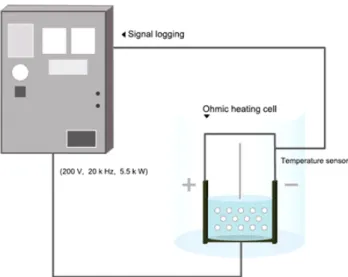
water bath (C-SKW1, Chang Shin Science Co., Seoul, Korea) heated to 75℃ and held at this temperature for 20 min. Elec- tronic temperature sensors were inserted in the center point of the glass container. The temperature differences among different locations were within approximately 1℃ during the heating. A schematic diagram of this ohmic heating circuit is presented in Fig. 1. The mulberry fruit juice was sterilized by ohmic heating in a parallelepipedic cell (14.5×6.6×8 cm) with two planar electrodes (14.5×8 cm) connected to an ac generator (50 Hz; voltage and intensity up to 200 V and 7.5 A; EPI- MODEL 24, Frontier Engineering Co., Osaka, Japan). The juice was then directly placed in the parallelepipedic cell between the electrodes. A Teflon-coated electronic temperature sensor with a compression fitting was used to measure the temperature in different sections of the sample in the test cell.
The selected range of temperature was 50 to 120±2℃, and the heating time was varied from 0 to 300 min using a tempe- rature control system. The sample was ohmically heated from 20℃ to 75℃, and the temperature was kept constant at 75±
1℃ for 20 min by adjusting the power on and off during the ohmic heating. The temperature of each sample was assumed to be uniform in the cell, since the maximum difference among the temperatures measured at different locations was approxi- mately within 1℃. The experiments were replicated three times.
3. Determination of Total Soluble Solid Content, Titratable Acidity, pH, and Reducing Sugar Content
The total soluble solid (TSS) content, expressed as °Bx, was measured with a portable refractometer (PR-201α, Atago Co.,
Fig. 1. Schematic diagram of the ohmic heating system.
Ltd., Tokyo, Japan) and corrected for a temperature of 20℃ (Section 22.024, AOAC, 1984). The titratable acidity(TA) was determined with 0.1 M NaOH up to pH 8.3, and the results are expressed as percentage of citric acid as determined by standard procedures (AOAC, 1984). The pH values for the sample juice were measured with a digital pH meter (Model 320, Thermo Orion, Massachusetts, USA). The 3,5-dinitrosali- cylic acid (DNS) method (Miller 1959) was employed as a standard protocol to determine the amount of reducing sugar.
All analyses were carried out in triplicate.
4. Determination of Color
Color (CIE L, a, b) measurements of the juice samples were carried out using a spectrophotometer (Color-Eye 3100, Koll- morgen Instruments Corp., New York, USA). These L, a and b CIE color values are also used to calculate the hue angle (tan-1(b/a)), chroma {(a2+b2)1/2} and total color differences {(L2+a2+b2)1/2} before and after pasteurization (Lee & Coates 1999).
5. Determination of the Antioxidant Compound Contents The analysis was carried out in triplicate using the pH differential method (Giusti & Wrolstad 2001) with two buffer systems: 0.025 M potassium chloride (KCl) buffer at pH 1.0 and 0.4 M sodium acetate (NaC2H3O2) buffer at pH 4.5. For each analysis, 200 µL of the anthocyanin sample was mixed separately with 1.8 mL of potassium chloride and sodiumacetate buffer and the absorbances at 520 nm and 700 nm were deter- mined. The difference in absorbance of the samples at different pH was determined as follows:
Abs = (A510 nm—A700 nm) at pH 1.0—(A510 nm—A700 nm) at pH 4.5
The monomeric anthocyanin pigment concentration (mg/L) in the original sample was determined using the following for- mula: monomeric anthocyanins pigment (mg/L) = (A×MW×
DF×1000)/(ε×1), where A is the absorbance difference between the two pH ranges, ε is the cyanidin-3-glucoside molar absor- bance (26,900), MW is the molecular weight of anthocyanin (449.2), and DF is the dilution factor.
The total phenolic content was determined by using Folin- Ciocalteu’s reagent (Lim et al 2007). For these experiments, 0.3 mL of sample was placed in each test tube, followed by
1.5 mL of Folin-Ciocalteu’s reagent (1:10 dilution with dis- tilled water) and 1.2 mL of sodium carbonate (7.5% w/v). The tubes were vortexed, covered with parafilm, and allowed to stand for 30 min at room temperature. The absorption at 765 nm was measured. The total phenolic contents were expressed in gallic acid equivalents (mg per 100 g fresh fruit). The total flavonoid contents were estimated according to the method previously described (Liu et al 2008). A 250 µL aliquot of extract was mixed with 1.25 mL of distilled water and 75 µL of 5% NaNO2. After 6 min, 150 µL of 10% AlCl3 was added.
Finally, 500 µL of 1 M NaOH was added and the total volume was increased to 2.5 mL with distilled water. The absorbance was measured at 510 nm. The results were expressed in cate- chin equivalents (mg per 100 g fresh fruit).
6. Determination of the Antioxidant Activity
The DPPH free radical-scavenging activity of the juices was measured using the method described by Gorinstein et al (2004). A 0.1 mM solution of DPPH in methanol was pre- pared. An 0.2 mL aliquot of sample was added to 2.8 mL of this solution and kept in the dark for 30 min. The ability of the sample to scavenge the DPPH radical was calculated with the following equation:
% inhibition = {(A0—A1)/A0}×100
where A0 is the absorbance of the control and A1 is the absorbance in the presence of the sample. The reducing power of the extracts was determined as described previously (Oyaizu 1986). A 1 mL aliquot of extract (10% v/v) was mixed with 2.5 mL of phosphate buffer (0.2 M, pH 6.6) and 2.5 mL of potassium ferricyanide (1%). The mixture was incubated at 50℃ for 20 min, then mixed with 2.5 mL of 10% trichloroacetic acid by vortexing. The mixture was centrifuged at 1,000 g for 10 min, and then 2.5 mL aliquot of the supernatant was mixed with an equal amount of milli Q water and 0.5 mL of 0.1%
FeCl3. The absorbance was measured at 700 nm using a spec- trophotometer. All assays were performed in triplicate. L- Ascorbic acid(0∼0.1 mg/mL) was used as reference standard, and the results are expressed in L-ascorbic acid equivalents (mg per 100 g fresh fruit). The FRAP assay (Benzie & Strain 1996) is based on the ability of phenolic compounds to reduce Fe3+ to Fe2+. To prepare the FRAP reagent, 0.1 M acetate buffer (pH 3.6), 10 mM TPTZ, and 20 mM ferric chloride
Table 1. Physicochemical properties of fresh, conventionally heated and ohmically heated mulberry juice
Processing process Total soluble solid
(°Bx) pH Titratable acidity
(g citric acid 100 mL—1)
Reducing sugar (g glucose 100 mL—1)
Fresh juice 2.71±0.02c 5.38±0.01b 0.43±0.04a 6.42±0.00c
Conventionally heated juice 2.81±0.01a 5.47±0.01a 0.36±0.01b 9.13±0.01a
Ohmically heated juice 2.76±0.01b 5.41±0.01a 0.37±0.00ab 7.20±0.00b
Values are means±standard deviations(S.D.) of triplicate analysis from 3 different productions.
Values in the same column with different superscripts differ significantly(p<0.01).
(10:01:01, v/v/v) were mixed. Then, 20 µL of the previously diluted extract was added to 150 µL of the reagent. The absorbance was measured at 593 nm using a microplate spec- trophotometer (170-6930, Benchmark Plus, USA). The analysis was performed in triplicate using an aqueous trolox solution as standard, and the results are expressed in L-ascorbic acid equivalents (mg per 100 g fresh fruit).
7. Microbiological Analysis
Aerobic bacteria, coliform bacteria and yeast and mold count were measured with Petrifilm Count Plates (3MTM Pet- rifilmTM Aerobic Count Plate, 25℃, 5 day; 3MTM Petrifilm TM Yeast & Mold Count Plate, 25℃, 5 day; 3MTM Petri- filmTM and Coliform Count Plate, 37℃, 48 hr) according to the AOAC(1984) official methods 990.12, 991.14 and 997.02.
8. Sensory Evaluation
To evaluate sensory acceptability of the microfiltered and pasteurized juice, an effective test using a nine-point hedonic scale was carried out according to the procedure outlined by Meilgaard et al (1999). On this scale, nine is equivalent to
“like extremely,” five is equivalent to “neither like nor dislike,”
and one “dislike extremely.” The acceptance test was perfor- med by twenty untrained panelists, all sugar cane juice con- sumers. The test was performed in individual rooms, where the juice was served in 50 mL disposable cups under white light at a temperature of 15±1℃, always 2 hr after a meal.
The samples were served individually.
9. Statistical Analysis
All experiments were carried out in triplicate and data were expressed as mean±standard deviation (S.D.) using SPSS version 11.5.0 (SPSS Inst.,). One-way analysis of variance (ANOVA) and Duncan’s multiple-range test were used to determine the
significance of the difference among samples with a signifi- cance level of 0.01.
Results and Discussion
The temperature changes in the mulberry fruit juice during sterilization using conventional and ohmic heating are shown in Fig. 2. To reach 75℃, the conventional heating process takes 2,995 sec and the ohmic heating takes 205 sec, ohmic heating is about five times faster. The total soluble solid (TSS) con- tent, titratable acidity (TA), pH of fresh, conventionally heated and ohmically heated mulberry juice are listed in Table 1.
First, the TSS of fresh, ohmically heated, and conventionally heated mulberry fruit juice are 2.71, 2.76, and 2.81. TSS was the highest for conventionally heated juice and significantly lower for the fresh juice, which showed the lowest value.
These results are similar to those obtained in a study of ohmic heating and conventional heating of pomegranate juice (Yildiz et al 2009). However, the TSS was not significantly different after sterilization of apple juice using an ultra- high-pressure treatment (Suárez-Jacoboa et al 2011). The pH value of fresh, ohmically heated, and conventionally heated mulberry fruit
Fig. 2. Heating curve of mulberry fruit juice.
Table 2. Changes in color values of fresh, conventionally heated and ohmically heated mulberry juice
Processing process
Color
Hue angle(°) Chroma Total color differences
L a b
Fresh juice 47.90±0.10a 19.45±0.04a 21.92±0.01c 0.96±0.00c 26.72±0.01c -
Conventionally heated juice 29.60±0.03c 15.28±0.02c 33.59±0.04a 1.05±0.00a 38.82±0.05a 22.10 Ohmically heated Juice 33.80±0.03b 15.82±0.02b 26.34±0.60b 1.03±0.01b 30.72±0.50b 15.22 Values are means±standard deviations(S.D.) of triplicate analysis from 3 different productions.
Values in the same column with different superscripts differ significantly(p<0.01).
juice are 5.38, 5.41, and 5.47. As for pH, increases in pH are directly related to decreases in TA. The pH value of the fresh juice was significantly lower than those of the heated juices, because increases in temperature lead to the evaporation of organic acids. However, ohmic heating and conventional hea- ting did not produce significantly different pH changes. Finally, the TA of fresh, ohmically heated, and conventionally heated mulberry fruit juice are 0.43, 0.37, and 0.36. The TA of fresh juice was significantly higher than that of the conventionally heated juice. These TA results are also similar those obtained in the aforementioned study of ohmic heating and conven- tional heating of pomegranate juice (Yildiz et al 2009).
For the most part, these results are consistent with previous reports. It has been found that fresh apple juice has a lower pH value than pasteurized juice (Charles-Rodríguez et al 2007) and that microwave treatment decreases the pH of blackberry juice and increases its TA (Ghazaleh et al 2011). It was deter- mined that the pH and TA of apple juice subjected to ultrahigh- pressure sterilization are not significantly different from those of fresh juice (Suárez-Jacoboa et al 2011), and the pH and TA of grape juice did not vary significantly for different sterilization methods (Garde-Cerdán et al 2007).
The higher sterilization times involved in conventional hea- ting increased the reducing sugar content significantly. The reducing sugar content of fresh, ohmically heated and conven- tionally heated mulberry fruit juice are 6.42, 7.20 and 9.13.
This is consistent with several previous reports. For example, mulberry fruit extract (Suh et al 2003) and grape juice (Bozkurt et al 1999) treated at high temperatures had significantly higher reducing sugar contents. The high-temperature sterilization of apple juice (Lee et al 2012) produced higher reducing sugar contents. However, the reducing sugar content of grape juice was not significantly different for different sterilization me- thods (Garde-Cerdán et al 2007).
The color values of raw, conventionally heated and ohmically heated mulberry fruit juice are listed in Table 2. The color changes occurring in processed fruit juices are complex and cannot be explained by a single processing factor. Such changes can be caused by various combinations of enzymatic and nonen- zymatic reactions occurring in this temperature range that turn the juice brown when the juice takes up oxygen. Color dete- rioration in fresh and processed fruits is usually related to enzymatic browning reactions (Giner et al 2001, Van Loey et al 2002), although nonenzymatic Maillard-type reactions can also cause color changes (Moyer & Aitken 1980).
In this study, the lightness L of mulberry juices decreased significantly with increasing sterilization time. As expected, ohmic heating of mulberry fruit juice also browns the juice.
The L values of fresh, ohmically heated, and conventionally heated mulberry fruit juice are 47.90, 33.80 and 29.60, respec- tively. Because a decrease in the L value is directly indicative of browning (Petriella et al 1985, Sapers et al 1989), these observations indicate that the browning reactions are initiated by the thermal treatment and are more severe for conventional heating than for ohmic heating. These color changes can pro- bably be attributed to partial precipitation of unstable particles suspended in the juice, as described by Genovese et al (1997).
The a and b values indicate the redness and yellowness, respectively. The a values of fresh, ohmically heated and con- ventionally heated mulberry fruit juice are 19.45, 15.82 and 15.28. The b values of fresh, ohmically heated and conven- tionally heated mulberry fruit juice are 21.92, 26.34 and 33.59.
After sterilization treatment, the b values shifted significantly in the positive direction, especially for conventional heating.
In contrast, the a values shifted significantly in the negative direction after sterilization treatment, again especially for conventional heating. Thus, the juice became more yellow and less red after longer sterilization times.
Table 3. Changes in the antioxidant compound contents of fresh, conventionally heated and ohmically heated mulberry juice
Processing process Monomeric anthocyanin contents (mg cyanidin-3 glucoside equivalents /g)
Total flavonids contents (mg catechin equivalents /g)
Total phenolic contents (mg gallic acid /g)
Fresh juice 28.72±0.30a 46.36±0.43a 67.13±0.10a
Conventionally heated juice 19.69±0.51c 39.12±0.74c 61.11±0.70c
Ohmically heated juice 24.61±0.51b 42.90±0.28b 63.29±0.41b
Values are means±standard deviations(S.D.) of triplicate analysis from 3 different productions.
Values in the same column with different superscripts differ significantly(p<0.01).
In recent years, the hue angle has been used to characterize the color changes in some foods. The mean hue angle for fresh juice is 0.96, while those for the heat-treated juices were higher, probably because of changes in the pigment profile.
Lower hue angle ratios indicate that there exist phenolic com- pounds that strongly influence the juice color and that less browning has occurred. The hue angle ratios of the ohmically heated samples were found to be lower than those of the conventionally heated samples, since less browning occurred during the heat treatment (p<0.01).
Finally, the chroma value C, which represents the color intensity, was lower for fresh juice than for sterilized juice, and increased for longer sterilization times. The final C was higher for conventionally heated juice than for ohmically heated juice, which is consistent with the color trends noted above.
In summary, fresh juice clearly had the highest lightness and redness values, and because it required a shorter treatment time, ohmic heating yielded a significantly higher lightness value than conventional heating. The yellowness values showed the opposite trend. The hue angle was the lowest for fresh juice, higher for ohmically heated juice, and, highest for con- ventionally heated juice, as was the chroma value C. These results are consistent with those for blackcurrant syrups, grape juice, blood orange juice, purple carrots, oranges, pomegranate juice and apple juice (Skrede G 1985, Rhim et al 1989, Arena et al 2001, Uyan et al 2004, Leizerson & Shimoni 2005a, Maskan M 2006, Charles-Rodríguez et al 2007), which all had the highest lightness values when fresh. However, the lightness of red grapefruit showed the opposite trend (Lee &
Coates 1999). Leizerson & Shimoni (2005a) reported that ohmic heating reduces the lightness of orange juice as the treatment time goes on. Similar observations of decreases in redness values during heating were reported by other resear- chers for red grapefruit juice (Lee & Coates 2003, Lee &
Coates 1999), pomegranate juice (Alper et al 2005, Maskan M 2006), blackcurrant syrups (Skrede G 1985), grape juice (Rhim et al 1989), blood orange juice (Arena et al 2001), and purple carrots (Uyan et al 2004). However, the redness of apple juice showed the opposite trend (Charles-Rodríguez et al 2007), whereas its yellowness (Charles-Rodríguez et al 2007) showed a similar tendency to that observed in this study. Red grapefruit juice (Lee & Coates 2003, Lee & Coates 1999), pomegranate juice (Alper et al 2005, Maskan M 2006), black- currant syrups (Skrede G 1985), grape juice (Rhim et al 1989), blood orange juice (Arena et al 2001) and purple carrots (Uyan et al 2004), on the other hand, showed the opposite behavior of the yellowness value. Pea puree (Icier et al 2006), orange juice (Lee & Coates, 2003) and pomegranate juice (Yildiz et al 2009) had hue angle results similar to those observed in this study. Furthermore, similar increases in chro- ma due to the application of heat have been observed for the manufacture of tomato juice (Davis & Gould, 1955) and orange juice (Lee & Coates, 2003).
Beyond the color characteristics, the antioxidant capacities of raw, conventionally heated, and ohmically heated mulberry fruit juice measured using different antioxidant assays are listed in Tables 3, 4. In particular, the DPPH, reducing power, and ferric reducing antioxidant power were measured to evaluate the antioxidant activity, and the monomeric antho- cyanin content, flavonoid contents and phenolic compound contents were measured to evaluate the antioxidant compound contents. The monomeric anthocyanin contents of fresh, ohmi- cally heated, and conventionally heated mulberry fruit juice are 28.72, 24.61 and 19.69. The flavonoid contents of fresh, ohmically heated and conventionally heated mulberry fruit juice are 46.36, 42.90 and 39.12. The phenolic compound contents of fresh, ohmically heated and conventionally heated mulberry fruit juice are 67.13, 63.29 and 61.11. The antioxidant com- pound contents of the fresh juice was significantly higher than
Table 4. Changes in the antioxidant activity of fresh, conventionally heated and ohmically heated mulberry juice
Processing process Reducing power (mg ascorbic acid equivalents /g)
FRAP
(mg ascorbic acid equivalnet /g)
DPPH radical scavenging activity (%)
Fresh juice 94.80±0.47a 553.03±3.87a 77.97±0.42a
Conventionally heated juice 72.39±0.91c 450.90±1.54c 66.68±1.57c
Ohmically heated juice 86.20±0.86b 528.77±1.44b 71.89±0.77b
Values are means±standard deviations(S.D.) of triplicate analysis from 3 different productions.
Values in the same column with different superscripts differ significantly(p<0.01).
Table 5. Changes in the sensory evaluation of fresh, conventionally heated and ohmically heated mulberry juice
Processing process Color Off-odor Flavor Taste Overall acceptance
Fresh juice 4.93±0.88ab 5.93±1.16a 5.60±1.30a 5.80±1.27ab 5.20±0.94ab
Conventionally heated juice 3.93±1.22b 4.67±0.82b 4.93±1.49a 4.13±0.92b 4.20±1.32b
Ohmically heated juice 5.07±1.03a 3.73±1.16b 5.73±1.34a 6.53±1.06a 6.47±0.90a
Values are means±standard deviations(S.D.) of triplicate analysis from 3 different productions.
Values in the same column with different superscripts differ significantly(p<0.01).
those of the heated juices. The fresh mulberry juice sample had a significantly higher antioxidant capacity than the steri- lized samples in all antioxidant assays. However, as compared to conventional heating, ohmic heating sterilization led to significantly increased antioxidant activity because of the re- duced heating time. These results are consistent with the previously reported results that polyphenolic compounds are susceptible to heat damage and thus are lost during various processing operations (Skrede et al 2000, Rajauria et al 2010), whereas anthocyanins are stable during thermal processing (Kirca et al 2007, Wang & Xu 2007, Scalzo et al 2008).
Furthermore, dehydration processes often deteriorate the color quality in foods, which reflects a loss of anthocyanins and other phytochemicals specific to fruits and vegetables (Krifi et al 2000, Kwok et al 2004).
Regarding the phenolic compounds, these secondary meta- bolites in plants are known to play an important role in the color and flavor of fruit juices. Phenols are also used as indicators of the physiological state of fruit products and of potential damage (Blanco et al 2001). In contrast to the deterioration of phenolic compounds during heat treatment observed in this study, the results obtained by Yildiz et al (2009) suggested that the total phenolic compound content of fresh juice was lower than that of the heat-treated juice and that conventional and ohmic heat treatments did not produce significant differences in phenol content. Mercali et al (2014)
observed that the monomeric anthocyanin content in acerola pulp was higher after ohmic heating than after conventional heating. The phenol content of fresh apple juice was also observed to be higher than those of sterilized juices (Aguilar- Rosas et al 2007), because it did not undergo filtering. Thus, ohmic heating is comparable to other sterilization methods in terms of retained phenol content.
As for the sensory characteristics of the differently treated juices, Table 5 shows the results of sample quality tests con- ducted on the color, odor, flavor, taste and overall acceptance of the mulberry juice. It was observed that the different processes applied to the mulberry fruit juice had a statistically significant influence on its sensory acceptability in terms of all the different attributes evaluated, although some differences between fresh and heat-treated juices were not significant excluding off-flavor. The taste, color and overall acceptance of the mulberry fruit juice sterilized by ohmic heating were significantly better than those of the juice sterilized by con- ventional heating. Furthermore, although the odor and flavor of the fresh mulberry fruit juice were found to be better than those of the juices subjected to heat treatments, the differences between conventionally heated and ohmically heated juices were not significant. The conventionally heated mulberry fruit juice received the lowest grades, and it was the least preferred in terms of color (3.93), flavor (4.93), taste (4.13) and overall impression (4.20), probably because of its darker coloring
caused by enzymatic activity (polyphenoloxidase and peroxi- dase), among other factors that can affect the taste. According to Souto et al (2004), enzymes can participate in a large number of oxidative and biodegradation reactions involving, for example, changes in color, chlorophyll degradation, and the oxidation of phenols, and many of these factors can also be associated with the taste, color, texture, and nutritional qualities of food. The ohmically heated juice received higher grades for color flavor, taste and overall acceptance, with an overall impression between “like very much” and “like extre- mely.”
These results are again consistent with previous investiga- tions of ohmic heating. For example, fresh and ohmically heated orange juices were found exhibit similar flavor com- pound concentrations. Leizerson & Shimoni (2005b) performed a triangle sensory test to compare fresh, pasteurized and ohmically heated orange juices and found that the panelists could distinguish between fresh and conventionally pasteu- rized samples but not distinguish between fresh and ohmically heated samples. Tumpanuvatr & Jittanit (2012) indicated that the color and flavor of ohmically heated orange juice and pineapple juice were not significantly different from those of conventionally heated specimens. Thus, ohmic heating of mulberry juice produces similar results to those obtained for other fruit juices.
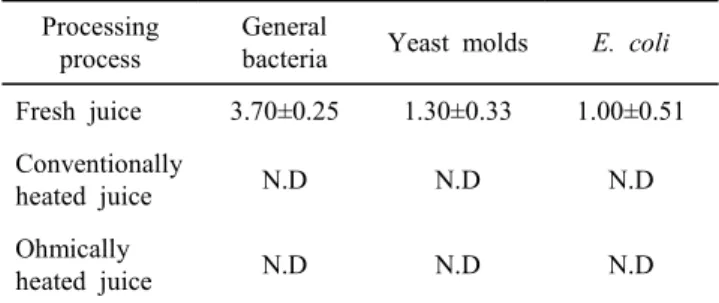
As a final test, we compared the abilities of ohmic and conventional heating to inactivate the microorganisms in fresh mulberry juice to avoid microbial spoilage (Table 6). In this study, we attributed the inactivation of microorganisms to heat only. Both ohmic and conventional thermal treatments reduced the microbial counts to zero, possibly because there was very little bacterial contamination in the untreated product (Trouvé et al 1991). The microbiological viability of fresh and heat- treated juice in terms of the general bacteria counts, mold and yeast counts, and E. coli counts are shown in Table 6. The fresh juice had a general bacteria count of 3.70±0.25, a yeast and mold count of 1.30 ± 0.33, and an E. coli count of 1.00
± 0.51 log CFU/g. These results are similar to the findings of Palaniapcpan et al (1992). Similarly, Rezzadori et al (2013) reported that heat-processed juices contained no detectable total plate appearances, yeast and molds, or E. coli. Further- more, Leizerson & Shimoni (2005a) reported another similar result: ohmic and conventional heating sterilization of orange juice resulted in no detectable microorganisms. Rivas et al
Table 6. Changes in microbial counts of fresh, conven- tionally heated and ohmically heated mulberry juice
Processing process
General
bacteria Yeast molds E. coli Fresh juice 3.70±0.25 1.30±0.33 1.00±0.51 Conventionally
heated juice N.D N.D N.D
Ohmically
heated juice N.D N.D N.D
CFU : colony-forming units.
N.D. : no detect.
Values are means±standard deviations(S.D.) of triplicate analysis from 3 different productions.
(2006) reported that pulsed electric field (PEF) and heat pasteurization treatment of carrot juice and oranges reduced the total plate count, mold count and yeast count.
In the present study, conventionally and ohmically heated mulberry fruit juices were compared to fresh juice to evaluate the impact of this technology on their quality characteristics.
The physicochemical properties, TSS, pH, TA, and reducing power of the fresh juice were significantly different after the different heat treatments. The physicochemical properties were changed less by ohmic heating than by conventional heating.
The L and a color values were decreased, and the b, H and C color values were increased by the heat treatments. The total color differences was lower for ohmic heating than for conventional heating, including, in particular, the change in H.
This may be because the shorter heating time used for ohmic heating was not sufficient to inactivate the enzymes in mul- berry fruit juice. The antioxidant capacity and antioxidant contents were the highest for fresh juice, lower after ohmic heating and even lower after conventional heating. Thus, the more rapid the process, the better the antioxidant capacity was preserved. Finally, sensory evaluation analysis showed no difference between fresh and ohmically heated mulberry fruit juice, while conventionally heated juice scored significantly lower. The general bacteria and yeast, mold and E. coli counts were all zero after both heat treatments.
While sterilization is important for ensuring the stability of fruit juice during transportation and storage, it may cause irreversible loss of nutritional quality and antioxidant activity and, in consequence, may affect the health-related properties of the juice. In conclusion, ohmic heating is a suitable tech-
nology for preserving bioactive nutrients in fruit juices that produces safe and fresh-seeming juice. Further studies are being conducted to explore the effect of this treatment on the long-term stability and shelf life of such products.
Summary
Ohmic heating is an alternative fast-heating method that is especially useful for the sterilization of liquid foods. The aim of this study was to compare the physicochemical, antioxi- dant, microbiological, and sensory characteristics of unheated, conventionally heated, and ohmically heated mulberry fruit juice to confirm the suitability of ohmic heating for practical applications. Heat treatment of fresh juice significantly reduced the concentration of soluble solids, lowered the pH, and low- ered the reducing sugar content (p<0.01), and because of its long heating time, conventionally treated juice showed a signi- ficantly larger reduction in the amount of soluble solids and in the reducing sugar content (p<0.01). Color measurements showed decreases in the L and a values and increases in the b, H and C values after heat treatment, although the total color differences were smaller after ohmic heating than after conventional heating of fresh juice. Furthermore, the antioxi- dant capacities decreased from fresh, to ohmically heated, to conventionally heated mulberry fruit juices, as shown by reducing power, FRAP and DPPH assays and the anthocyanin, flavonoid and phenolic antioxidant contents of the juices also decreased significantly in the same order. Sensory evaluations showed no difference between fresh and ohmically heated mulberry fruit juice, whereas conventionally heated juice sco- red significantly worse. No microbial counts were detected in the juice after either heat treatment. Thus, ohmic heat treatment can be effectively used to sterilize fresh mulberry juice to obtain good shelf life safety with minimal physicochemical, color, antioxidant, and sensory deterioration.
Acknowledgements
This research was supported by the High Value-added Food Technology Development Program (311025-3), Ministry of Agriculture, Food and Rural Affairs.
References
Aguilar-Rosas SF, Ballinas-Casarrubias ML, Nevarez-Moorillon
GV, Martin-Belloso O, Ortega-Rivas E (2007) Thermal and pulsed electric fields pasteurization of apple juice: Effects on physicochemical properties and flavour compounds. J Food Eng 83: 41-46.
Alper A, Bahceci KS, Acar J (2005) Influence of processing and pasteurization on colour values and total phenolic com- pounds of pomegranate juice. J Food Process Pres 29:
357-368.
AOAC (1984) Official Methods of Analysis. 14th ed. Associ- ation of Official Analytical Chemists, Washington DC. p 32.
Arena E, Fallico B, Maccarone E (2001) Evaluation of anti- oxidant capacity of blood orange juices as influenced by constituents, concentration process and storage. Food Chem 74: 423-427.
Avila IMLB, Silva CLM (1999) Modelling kinetics of thermal degradation of colour in peach puree. J Food Eng 39:
161-166.
Bae SH, Suh HJ (2007) Antioxidant activities of five different mulberry cultivars in Korea. LWT-Food Sci Technol 40:
955-962.
Barreiro JA, Milano M, Sandoval AJ (1997) Kinetics of colour change of double concentrated tomato paste during thermal treatment. J Food Eng 33: 359-371.
Benzie IFF, Strain JJ (1996) The ferric reducing ability of plasma as a measure of “antioxidant power”: The FRAP assay. Anal Biochem 239: 70-76.
Blanco GD, Fraga PM, Mangas AJ (2001) Capillary liquid chromatographic determination of neutral phenolic com- pounds in apple juice. Anal Chim Acta 426: 111-117.
Bozkurt H, Göğüş F, Eren S (1999) Nonenzymic browning reactions in boiled grape juice and its models during sto- rage. Food Chem 64: 89-93.
Bravo L (1998) Polyphenols: Chemistry, dietary sources, meta- bolism, and nutritional significance. Nutr Rev 5611: 317- 333.
Castro A, Teixeira JA, Salengke S, Sastry SK, Vicente AA (2004) Ohmic heating of strawberry products: electrical conductivity measurements and ascorbic acid degradation kinetics. Innov Food Sci Emerg Technol 5: 27-36.
Charles-Rodrı´guez AV, Neva´rez-Moorillo´n GV, Zhang QH, Ortega-Rivas E (2007) Comparison of thermal processing and pulsed electric fields treatment in pasteurization of apple. Food Bioprod Process 85(C2): 93-97.
Cieslik E, Greda A, Adamus W (2006) Contents of polyphe-
nols in fruit and vegetables. Food Chem 94: 135-42.
Davis RB, Gould WA (1955) The effect of processing methods on the color of tomato juice. Food Technol 9: 540-547.
Ercisli S, Orhan E (2007) Chemical composition of white (Morus alba), red(Morus rubra) and black(Morus nigra) mulberry fruits. Food Chem 103: 1380-1384.
Garde-Cerdán T, Arias-Gil M, Marsellés-Fontanet AR, Ancín- Azpilicueta C, Martín-Belloso O (2007) Effects of thermal and non-thermal processing treatments on fatty acids and free amino acids of grape juice. Food Control 18: 473- 479.
Genovese DB, Elustondo MP, Lozano JE (1997) Color and cloud stabilization in cloudy apple juice by steam heating during crushing. J Food Sci 62: 1171-1175.
Ghazaleh H, Mahboubeh F, Zahra E (2011) Effects of heating method and conditions on the quality attributes of black mulberry(Morus nigra) juice concentrate. Int J Food Sci Technol 46: 956-962.
Ghnimi S, Flach-Malaspina N, Dresh M, Delaplace G, Main- gonnat JF (2008) Design and performance evaluation of an ohmic heating unit for thermal processing of highly viscous liquids. Chem Eng Res Des 86: 627-632.
Giner J, Gimeno V, Barbosa-Ca’novas GV, Martı´n O (2001) Effects of pulsed electric field processing on apple and pear polyphenoloxidases. Food Sci Technol Int 7: 339-345.
Giusti MM, Wrolstad RE (2001) Current Protocols in Food Analytical Chemistry: UNIT F1.2 Characterization and Mea- surement of Anthocyanins by UV-visible Spectroscopy. John Wiley and Sons, New York. pp 1-13.
Gorinstein S, Haruenkit R, Park YS, Jung ST, Zachwieja Z, Jastrzebski Z, Katrich E, Trakhtenberg S, Belloso OM (2004) Bioactive compounds and antioxidant potential in fresh and dried Jaffa® sweeties, a new kind of citrus fruit.
J Sci Food Agric 84: 1459-1463.
Halleux DD, Piette G, Buteau ML, Dostie M (2005) Ohmic cooking of processed meats: energy evaluation and food safety considerations. Biosyst Eng 47: 341-347.
Ibarz A, Pagan J, Garza S (1999) Kinetic models for colour changes in pear puree during heating at relatively high temperatures. J Food Eng 39: 415-422.
Icier F, Yildiz H, Baysal T (2006) Peroxidase inactivation and colour changes during ohmic blanching of pea puree. J Food Eng 74: 424-429.
Kirca A, Ozkan M, Cemeroglu B (2007) Effects of tempera-
ture, solid content and pH on the stability of black carrot anthocyanins. Food Chem 101: 212-218.
Konczak I, Zhang W (2004) Anthocyanins - more than nature’s colours. J Biomed Biotechnol 5: 239-240.
Krifi B, Chouteau F, Boudrant J, Metchel M (2000) Degra- dation of anthocyanins from blood orange juices. Int J Food Sci Technol 35: 275-283.
Kwok BHL, Hu C, Durance T, Kitts DD (2004) Dehydration techniques affect phytochemical contents and free radical scavenging activities of saskatoon berries(Amelanchier alni- folia Nutt.). J Food Sci 69: 122-126.
Lee HS, Coates GA (2003) Effect of thermal pasteurization on Valencia orange juice color and pigments. LWT-Food Sci Technol 36: 153-156.
Lee HS, Coates GA (1999) Thermal pasteurization effects on color of red grapefruit juices. J Food Sci 64: 663-666.
Lee SJ, Jang HL, Shin SR, Yoon KY (2012) Quality charac- teristics of apple juice according to the sterilization methods.
Korean J Food Preserv 19: 178-184.
Lee YJ, Choi SW (2011) Preparation of high quality mulberry- processed products. Natur Sci Res collecti dissert 9: 1-9.
Leizerson S, Shimoni E (2005a) Effect of ultrahigh-tempe- rature continuous ohmic heating treatment on fresh orange juice. J Agric and Food Chem 53: 3519-3524.
Leizerson S, Shimoni E (2005b) Stability and sensory shelf life of orange juice pasteurized by continuous ohmic hea- ting. J Agric and Food Chem 53: 4012-4018.
Lim YY, Lim TT, Tee JJ (2007) Antioxidant properties of several tropical fruits: A comparative study. Food Chem 103: 1003-1008.
Lozano JE, Ibarz A (1997) Colour changes in concentrated fruit pulp during heating at high temperatures. J Food Eng 31: 365-373.
Maskan M (2006) Production of pomegranate(Punica granatum L.) juice concentrates by various heating methods: colour degradation and kinetics. J Food Eng 72: 218-224.
Meilgaard M, Civille GV, Carr BT (1999) Sensory Evaluation Techniques. 3th ed. CRC Press, Florida. p 320.
Mercali GD, Schwartz S, Marczak LDF, Tessaro IC, Sastry S (2014) Ascorbic acid degradation and color changes in acerola pulp during ohmic heating: Effect of electric field frequency. J Food Eng 123: 1-7.
Miller GL (1959) Use of dinitrosalicylic acid reagent for determination of reducing sugar. Analytical Chemistry 31:
426-428.
Moyer JC, Aitken HC (1980) Apple juice. In: 7. Fruit and Vegetable Juice Processing Technology. Ed, PE Nelson, DK Tressler. AVI Publishing, Westport, CT. pp 212-267.
Nolsoe H, Undeland I (2009) The acid and alkaline solubili- sation process for the isolation of muscle proteins: state of the art. Food Bioprocess Tech 2: 1-27.
Oyaizu M (1986) Studies on products of browning reactions- antioxidative activities of products of browning reaction prepared from glucosamine. Jpn J Nutr 44: 307-315.
Palaniappan S, Sastry SK (1991) Electrical conductivity of selected juices: influences of temperature, solids content, applied voltage, and particle size. J Food Process Eng 14:
247-260.
Palaniappan S, Sastry SK, Richter ER (1992) Effects of elec- troconductive heat treatment and electrical pretreatment on thermal death kinetics of selected microorganisms. Bio- technol Bioeng 39: 225-232.
Petriella C, Resnik SL, Lozano R, Chirife J (1985) Kinetics of deteriorative reactions in model food systems of high water activity: Color changes due to nonenzymatic brow- ning. J Food Sci 50: 622-626.
Rajauria G, Jaiswal AK, Ghannam NA, Gupta S (2010) Effect of hydrothermal processing on colour, antioxidant and free radical scavenging capacities of edible Irish brown sea- weeds. Int J Food Sci Technol 45: 2485-2493.
Rezzadori K, Petrus RR, Benedetti S, Carminatti CA, Petrus JCC (2013) Effects of tangential microfiltration and pas- teurisation on the rheological, microbiological, physico-che- mical and sensory characteristics of sugar cane juice. Int J Food Sci Technol 48: 1-9.
Rhim JW, Nunes RV, Jones VA, Swartzel KR (1989) Kinetics of colour change of grape juice generated using linearly increasing temperature. J Food Sci 54: 776-777.
Rivas A, Rodrigo D, Martı´nez AG, Barbosa-Ca´novas V, Ro- drigo M (2006) Effect of PEF and heat pasteurization on the physical–chemical characteristics of blended orange and carrot juice. LWT-Food Sci Technol 39: 1163-1170.
Saenz C, Sepulveda E, Araya E, Calvo C (1993) Color changes in concentrated juices of prickly pear(Opuntia ficusindica) during storage at different temperatures. LWT-Food Sci Technol 26: 417-421.
Sagar VR, Kumar PS (2010) Recent advances in drying and dehydration of fruits and vegetables: a review. J Food Sci
Technol 47: 15-26.
Sapers GM, Hicks KB, Phillips JG, Garzarella L, Pondish DL, Matulaitis RM, McCormack TJ, Sondey SM, Seib PA, El-Atawy YS (1989) Control of enzymatic browning in apple with ascorbic acid derivatives, polyphenol oxidase inhibitors, and complexing agents. J Food Sci 54: 997- 1002.
Sass-Kiss A, Kiss J, Milotay P, Kerek MM, Toth-Markus M (2005) Differences in anthocyanin and carotenoid content of fruits and vegetables. Food Res Int 38: 1023-1029.
Scalzo R, Genna A, Branca F, Chedin M, Chassaigne H (2008) Anthocyanin composition of cauliflower(Brassica oleracea L. var. botrytis) and cabbage(B. oleracea L. var. capitata) and its stability in relation to thermal treatments. Food Chem 107: 136-144.
Skrede G (1985) Colour quality of blackcurrant syrups during storage evaluated by Hunter L, a, b values. J Food Sci 50:
514-517.
Skrede G, Wrolstad RE, Durst RW (2000) Changes in antho- cyanins and polyphenolics during juice processing of high- bush blueberries(Vaccinium corymbosum L.). J Food Sci 65: 357-364.
Souto RF, Durigan JF, Souza BSS, Donadon J, Menegucci JLP (2004) Conservação pós-colheita de abacaxi 'Pérola' colhido no estádio de maturação "pintado" associando-se refrigeração e atmosfera modificada. Revista Brasileira de Fruticultura 26. p 110.
Suárez-Jacobo A, Rüfer CE, Gervilla R, Guamis B, Roig- Sagués AX, Saldo J (2011) Influence of ultra-high pressure homogenisation on antioxidant capacity, polyphenol and vitamin content of clear apple juice. Food Chem 127:
447-454.
Suh HJ, Noh DO, Kang CS, Kim JM, Lee SW (2003) Ther- mal kinetics of color degradation of mulberry fruit extract.
Nahrung 47: 132-135.
Trouvé E, Maubois JL, Piof MMN, Fauquant J, Rouault A, Tabard J, Brinkman G (1991) Retention de different esespe`ces microbienneslors de l’e´puration du lait par microfiltration en flux tangentiel. Lait 71: 1-13.
Tsai PJ, Delva L, Yu TY, Huang YT, Dufossé L (2005) Effect of sucrose on the anthocyanin and antioxidant capa- city of mulberry extract during high temperature heating.
Food Res Int 38: 1059-1065.
Tumpanuvatr T, Jittanit W (2012) The temperature prediction
of some botanical beverages, concentrated juices and purees of orange and pineapple during ohmic heating. J Food Eng 113: 226-233.
Uyan SE, Baysal T, Yurdagel U, El SN (2004) Effects of drying on antioxidant activity of purple carrots. Nahrung 48: 57-60.
Van Loey A, Verachtert B, Hendrickx M (2002) Effects of high electric field pulses on enzymes. Trends Food Sci Technol 12: 94-102.
Vikram VB, Ramesh MN, Prapulla SG (2005) Thermal degra- dation kinetics of nutrients in orange juice heated by elec- tromagnetic and conventional methods. J Food Eng 69:
31-40.
Wang WD, Xu SHY (2007) Degradation kinetics of anthocy-
anins in blackberry juice and concentrate. J Food Eng 82:
271-275.
Yildiz H, Bozkurt H, Icier F (2009) Ohmic and conventional heating of pomegranate juice: effects on rheology, color, and total phenolics. Food Sci Technol Int 15: 503-512.
Zareifard MR, Ramaswamy HS, Trigui M, Marcotte M (2003) Ohmic heating behaviour and electrical conductivity of two- phase food systems. Innov Food Sci Emerg Technologies 4: 45-55.
접 수:
최종수정:
채 택:
2013년 12월 6일 2014년 1월 25일 2014년 2월 20일