237 https://doi.org/10.21289/KSIC.2016.19.4.237
꼬마사과를 활용하여 다양한 발효 제조방법과 설탕량이 발효에 미치는 영향
꼬마사과를 활용하여 다양한 발효 제조방법과 설탕량이 발효에 미치는 영향
The Study of Thinned Young Apples Fermentation by Manipulating Preparation Treatment and Sugar Content
정성원*,데스티아니 수페노*, 판두 산디 프라타마*, 최원식**
Sung Won Chung*,Destiani Supeno*,Pandu Sandi Pratama*,Won Sik Choi**
<Abstract>
This paper investigates the possibility to increase the economic value of the thinned young apple trough fermentation process. It is studies the optimal fermentation condition of thinned young apple by manipulating preparation treatment and sugar content. To do this following steps are done. Firstly, different preparation treatment for thinned young apple such as whole apple, cutting apple, and blending apple were done. The different sugar content such as 24°Brix, 15°Brix and 4°Brix was added.
Secondly, the sugar contents and pH level were measured during fermentation process.
Finally, statistical analysis was used to examine the relation between the preparation treatment, sugar content and pH level during the fermentation process. The experimental result shows that the different preparation treatment influences to the fermentation process. The blending apple treatment gave lower pH level compared to other kind treatments. The sugar content of thinned young apple was decrease during the fermentation process. The statistical analysis shows that the manipulation preparation treatment and sugar content affect the final pH level and whole fermentation process. Experimental result shows that the thinned young apple fermentation could be proposed as new alternative product in the market. The best fermentation process was obtained from blending thinned young apple treatment with 24°Brix.
Keywords : Acidity, Fermentation, Thinned young apple, Alcohol, Apple cider
* 정회원, 부산대학교 *Professor, Dept. of Bio-Industrial 바이오산업기계공학과 교수 Machinery Eng.,Pusan Natl. Univ 경상남도 밀양시 삼랑진읍 삼랑진로 1268-50 Miryang 50463 REPUBLIC OF KOREA
우편번호 50463 E-mail : [email protected], Tel: +82-55-350-5422
** 교신저자, 부산대학교 바이오산업기계공학과, **Corresponding Author, Dept. of Bio-Industrial 경상남도 밀양시 삼랑진읍 삼랑진로 1268-50 Machinery Eng.,Pusan Natl. Univ 우편번호 50463 Miryang 50463 REPUBLIC OF KOREA
E-mail: [email protected] Tel:+82-55-350-5425
1. Introduction
Based on recent study by the Rural Development Administration, apples are Korean's favorite fruit because it has many benefits for human body. Apple cider contents antioxidant to reduce the risk of certain types of cancer (Lobo et al, 2009).
The polyphenols content in the apple also can reduce the atherosclerosis and hepatic steatosis (Xu et al, 2015). The daily apple consumption reduced the risk of chronic diseases such as cardiovascular disease (Koutsos et al, 2015). Apple cider vinegar had affirmative effects on blood lipid levels, liver functions and body weight increase (Budak et al, 2011).
According to the Korean Statistical Information Service (KOSIS), South Korea produced 582,845 ton in 2015. The largest production area is in Mungyeong city, Gyeongsangbuk province. To obtain the high quality apple, some of young apples should be removed during the fruit thinning in early summer period. Fruit thinning is necessary to improve the fruit size and quality, allows sunlight and air to penetrate the branches and improving homogeneity of ripening, reduce branches breaking risk caused by fruit over load, and also reduces the spread of pests and diseases. Since those thinned young apples are non-edible, the farmer in Mungyeong city could not sell it to the market. Every year thousand tons of unripen young apples from fruit thinning process are
usually discarded in apple groves. Since the content of total polyphenols in unripe apples is approximately ten times that in ripe apples, it is a kind of agricultural and food resource (Sun et al 2013). The solution to increase the value of left over thinned young apples is needed. Young apple fermentation is one of the solutions to solve this problem.
There are several research related to the apple fermentation. Previous research was studied the apple juice acetic acid fermentation optimal condition (Kang et al, 2011). Two stage fermentation methods were proposed to produce high acetic acid apple vinegar (Sung et al, 2014). This research only analyzed the quality of ripen apple fruit fermentation by varying the initial alcohol content. An apple vinegar production from substandard and surplus fruit was proposed using Acetobacter aceti (Grewal et al, 1988).
However, this paper was not considered the optimal condition of fermentation. To solve this problem this paper proposed a study on optimal fermentation condition of thinned young apple by manipulating preparation treatment and sugar content.
2. Material and methods
2.1. Samples Preparation
Thinned young apples were obtained from Mungyeong apple orchad, Korea on July 2016. In this experiment the Malus domestica
“Fuji” variety was used. The thinned young apple has light green color and diameter
239 꼬마사과를 활용하여 다양한 발효 제조방법과 설탕량이 발효에 미치는 영향
Table 1 Pretreatment and initial brix
around 2.5 to 3.5 cm. The apple fruit has maturity within 30 to 45 days after full bloom. A mature Fuji apple normally has 16.8±1.2 °Brix and pH 3.88±0.06 (Sapers, 2006), in this paper since the apple is not fully ripening the sugar level is only 4°Brix and pH 3.91. In the preparation step, each apple was washed and the apple stalk was separated from the clean fruits. To investigate the effect of pre-treatment condition to f e r m e n t a t i o n p r o c e s s , t h r e e k i n d o f pre-treatment condition were prepared. In the first treatment (A1) the whole thinned young apple was fermented with sugar addition to make the total sugar content 24°Brix. In the second treatment (A2), the thinned young apple was cut into 4 pieces vertically and then sugar was added to make the total sugar content 24°Brix. In the Third treatment (A3), the thinned young apple was crushed using a blender and fermented with sugar addition to make the total sugar content 24°Brix. To investigate the effect of initial sugar content in fermentation process, the sugar was added to apple crushed by a blender, resulting three sugar initial °Brix 4%
(B1), 15% (B2) and 24% (B3). The samples pre-treatment and initial brix are shown in Table 1.
2.2. Fermentation
In the fermentation process, 500g of thinned young apple from each treatment was mixed with 500ml of water and 1g of Effective Microbial (EM). EM is known to contain more than 80 kinds of anaerobic or aerobic microbes including lactic acid bacteria (Moon et al 2001). The sample was put inside a normal mouth jars with 1 litter volume. Jars are kept inside the incubator for 180 hours (7.5 days). This fermentation was conducted at 30°C with good temperature control.
2.3. Determination of sugar content
During the fermentation process, the sugar content should be measured in order to get an idea how quickly the sugar is disappearing and how much sugar remains.The rapidity of sugar consumption is related with the fermentation rate. The amount of sugar dissolved in water is related to the
ability of the sample to bend (or refract) the light. A refractometer is an instrument that measures the angle of refraction through a sample of liquid and commonly used to assess the amount of sugar. In this research, sugar content test was carried out using pocket refractometer ATAGO series JP/PAL-1, Tokyo, Japan. It can measure °Brix form 0.0 to 53.0 % with resolution 0.1% and accuracy
±0.2%. The samples were checked every 12 hours in a day until 180 hours.
2.4 Determination of pH level
During apple fermentation process, in addition to generating alcohol and carbon dioxide, small amounts of a various organic acids also have been produced. The amount of acid in the solution is related with the fermentation rate. In this experiment, the pH level was checked by using digital pH-meter ISTEK series pH-250L. It can measure pH form -2.000 to 19.999 with resolution 0.001 and accuracy ±0.002. The samples were checked every 12 hours in a day until 180 hours together with sugar content measurement.
3. Result and discussion
3.1. The behavior of sugar content and pH value related to pre-treatment variation
The first step in understanding the effect of pre-treatment in fermentation
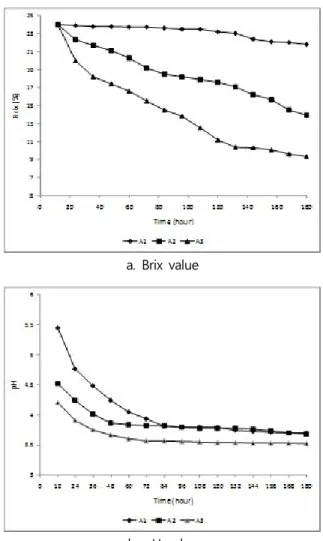
characteristics is through understanding the characteristics of sugar content and pH value during fermentation process. Figure 1.a displays a brix fermentation curve for the thinned young apple fermentation with different pre-treatment at initial 24 °Brix.
Sugar consumption initiates almost immediately at the beginning of fermentation.
The highest rate of sugar utilization occurs after the microbe population has reached maximal density and ethanol concentrations are low. From t=0h until t=48h shows the steepest part of the sugar consumption curve.
This condition coincides with the fastest rate of fermentation. The pre-treatment condition influences this state. On the whole apple (A1) fermentation, the fermentation rate is lower compared to other treatments since the microbe could not penetrate inside the apple and consume the outer skin of the apple. On the cutting treatment (A2) fermentation, the fermentation rate is higher than (A1) treatment but lower than (A3) since the microbe can enter the apple flesh but only stay on the surface of the flesh. On the blending treatment (A3) fermentation, the microbe can access the entire fruit therefore the fermentation rate is highest compare to the other fermentation process. That high rate is sustained until the fermentation is well below 17 °Brix. Given that the fermentation started at roughly 24 °Brix, this indicates the strain has sustained ethanol tolerance until the external ethanol has reached inhabitant level. As ethanol accumulates
241 꼬마사과를 활용하여 다양한 발효 제조방법과 설탕량이 발효에 미치는 영향
further, the fermentation progressively slows.
The second phase is conducted by strains of greater ethanol tolerance, with the fermentation rate is showing a decline. The fermentation was complete at day 7. The final brix of (A1) is 22.1°Brix, (A2) is 13.9
°Brix and (A3) is 9.3 °Brix.
Figure 1.b shows the pH value curve for thinned young apple fermentation with different pretreatment conditions. During apple fermentation process, in addition to generating alcohol and carbon dioxide, small amounts of a various organic acids also have been produced. As fermentation progresses the solution becomes richer in organic acids, and this increase becomes evident as a lowering of the pH. The longer fermentation is allowed to continue, the richer in organic acids the medium becomes. This formation of acids is reflected in a time-dependent decrease of pH and an increase in titratable acidity in the fermenting medium. Figure 1.b shows that at initial condition even though the brix level for all samples is similar, the pretreatment condition has significant impact to the initial pH. In treatment A1 since the apple hasn’t been cut or blend, the dominant content on the sample liquid is sugar. Therefore the pH is higher than the other treatment. In Treatment (A2) some of juices escape from the fruit flesh and mixed with the solution. Therefore the pH value is lower than the treatment (A1). In treatment (A3) the juices from the apple mixed perfectly with the solution. Therefore the
pH value is lowest compare to the other treatment. From t=0h until t=48h shows the steepest part of the pH curve. The pretreatment condition influences the final pH value. On the whole apple (A1) fermentation the final pH is 3.75. On the cutting treatment (A2) the final pH is lower than treatment (A1) which is 3.62.
The lowest pH obtained from the blending treatment (A3) which is 3.52.
a. Brix value
b. pH value
Figure 1.Effect of preparation treatment manipulation on pH and sugar content (°Brix)
3.2. The behavior of sugar content and pH value related to initial brix variation
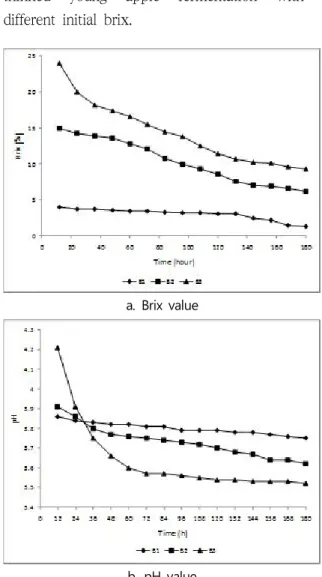
To understand the effect of initial brix in fermentation characteristics also can be obtained thorough understanding the characteristics of sugar content and pH value during fermentation process. Figure 2.a displays a brix fermentation curve for the thinned young apple fermentation with different initial brix.
a. Brix value
b. pH value
Figure 2. Effect of initial brix manipulation on pH and sugar content (°Brix)
In the Figure 2.a from t=0h until t=48h shows that the sample with the higher initial brix have higher fermentation rate because the microbe has more food to consume. The final value of the brix is influenced by the initial brix. The final brix of (B1) is 1.3°Brix, (B2) is 7.1 °Brix and (B3) is 13.9
°Brix.
Figure 2.b shows the pH value curve for thinned young apple fermentation with different initial brix conditions. Figure 2.b shows that at the time t=0 until t=48h the acidity increment rate is high. This condition related to the highest rate fermentation process. This figure also shows that the higher initial sugar level related to higher acidity increment rate. The final pH of (B1) is 3.75, (B2) is 3.65 and the lowest final pH is obtained from (B3) 3.52.
4. Conclusion
This paper studies about the optimal fermentation condition of thinned young apple by manipulating preparation treatment and sugar content. To investigate the effect of pretreatment condition to fermentation process, three kind of pretreatment condition such as whole apple (A1), cutting apple (A2) and blending apple (A3) was prepared. The pretreatment affected the fermentation rate and final brix and pH. The final brix of (A1) is 22.1°Brix, (A2) is 13.9 °Brix and (A3) is 9.3 °Brix. The final fermentation pH of (A1)
243 꼬마사과를 활용하여 다양한 발효 제조방법과 설탕량이 발효에 미치는 영향
is 3.75, (A2) is 3.62, and the lowest final pH is obtained from (A3) which is 3.52. To investigate the effect of initial sugar content in fermentation process, the sugar was added to apple crushed by a blender, resulting three sugar initial brix 4% (B1), 15% (B2) and 24% (B3). The initial sugar level influences the final brix and pH. The final brix of B1 is 1.3°Brix, B2 is 7.1 °Brix and B3 is 13.9
°Brix. The final pH of (B1) is 3.75, (B2) is 3.65 and the lowest final pH is obtained from (B3) 3.52.
Acknowledgments
This work was supported by 2-Year Research Grant of Pusan National University.
Reference
[1] Lobo A. P., Y. D. Garcia, J. M.
Sanchez, R. R. Madreraand B. S. Valles.
2009. Phenolic and antioxidant composition of cider. Journal of Food Composition and Analysis 22: 644–648.
[2] Xu Z. R., J. Y. Li, X. Y. Dong, Z. J.
Tan, W. Z. Wu, Q. M. Xie and Y. M.
Yang. 2015. Apple polyphenols decrease atherosclerosis and hepatic steatosis in
apoE´/´ mice through the
ROS/MAPK/NF-κB pathway. Nutrients 7: 7085-7105.
[3] Koutsos A., K. M. Tuohy and J. A.
Lovegrove. 2015. Apples and cardiovascular health - is the gut microbiota a core consideration?
Nutrients 7: 3959-3998.
[4] Budak N. H., D. K. Doguc, C. M. Savas, A. C. Seydim, T. K. Tas, M. I. Ciris and Z. B. Guzel-Seydim. 2011. Effects of apple cider vinegars produced with different techniques on blood lipids in high cholesterol fed rats. Journal of Agricultural and Food Chemistry 59:
6638–6644.
[5] Kang B. H., E. J. Shin, S. H. Lee, D. S.
Lee, S. S. Hur, K. S. Shin, S. H. Kim, S.
M. Son and J. M. Lee. 2011.
Optimization of the acetic acid fermentation condition of apple juice.
Korean Journal of Food Preservation 18(6): 980-98.
[6] Sung N. Y., S. M. Woo, J. H. Kwon, S.
H. Yeo and Y. J. Jeong. 2014. Quality characteristics of high acidity apple
vinegar manufactured using two stage fermentation. Journal of the Korean Society of Food Science and Nutrition 43(6): 877-883.
[7] Grewal H. S., H. K. Tewari and K. L.
Kalra. 1988. Vinegar production from substandard fruits. Biological Wastes 26:
9-14.
[8] Sapers G. M., J. R. Gorny, A. E. Yousef.
2006. Microbiology of fruits and vegetables. Taylor and Francis Group, [9] Sun L. J, Y. R. Guo, C. C. Fu, J. J. Li
and Z. Li. 2013. Simultaneous separation and purification of total polyphenols, chlorogenic acid and phlorizin from thinned young apples.
Food Chemistry 136:1022-1029.
[10] Moon Y.H, K.B. Lee, Y.J. Kim, and Y.M. Koo. 2011. Current status of EM (Effective Microorganisms) utilization.
Korean Society for Biotechnology and Bioengineering Journal 26: 365-373.
(접수:2016.10.05.,수정:2016.10.17, 개제확정:2016.11.11)