환경모니터링을 위한 집비둘기 알 껍데기의 중금속 축적특성 연구
이장호·이종천·박종혁·이유진·심규영·김명진·신영규 국립환경과학원 자연환경연구과
The Characteristics of Heavy Metal Accumulations
in Feral Pigeon (Columba livia) Eggshells for Environmental Monitoring
Jangho Lee·Jongchun Lee·Jong-Hyouk Park·Eugene Lee·
Kyuyoung Shim·Myungjin Kim·Youngkyu Shin
Natural Environment Research Division, National Institute of Environmental Research
요 약 : 본 연구에서는 알 껍데기 시료의 중금속 축적특성을 파악하기 위해 알의 중금속 축적을 연구한 자 료들을 정리하여 알 껍데기와 내용물의 축적특성을 비교·검토한 후 집비둘기 알 껍데기의 중금속 모니터 링 시료로서의 가능성을 고찰하였다. 먼저 집비둘기(Columba livia)를 포함한 19종의 조류 알을 대상으 로 카드뮴(Cd) 등 8종의 중금속 축적농도를 검토한 결과, 알 껍데기 중금속 농도의 변동계수(표준편차/평 균)는 알 내용물에 비해 대체적으로 높은 값을 나타냈다. 이는 알 내용물 속 배(embryo)가 중금속 독성에 노출되지 않도록 하는 생리적 항상성 통제기작의 발달과 관련이 있는 것으로 판단된다. 이에 비해 알 껍 데기는 서식환경 등에 따라 중금속 축적 변동이 알 내용물보다 크게 나타났는데, 이는 서식환경에 따른 중 금속 축적 변동을 알 내용물보다는 더 적절히 반영할 가능성이 있다고 해석될 수 있다. 집비둘기 알 껍데 기가 체내 장기 조직 등의 유해 중금속(납, 카드뮴) 축적농도 패턴을 반영하는 지를 검토한 결과, 도심지 역 한강공원이 체내 장기 조직 등에서 농촌지역인 함평공원보다 높은 납과 카드뮴 축적농도를 보였고, 이 러한 차이는 알 껍데기에서도 두드러지게 나타났지만, 알 내용물에서는 지점 간에 차이가 없었다. 이러한 결과는 알 내용물 속 배(embryo)의 안전한 발달을 위해 중금속 축적을 통제하는 항상성 기작이 알 내용물 에 더 강화되어 나타나는 특성과 관련이 있는 것으로 판단된다. 이상의 결과로 볼 때, 알 껍데기가 서식환 경에 따른 중금속 축적 변동을 알 내용물보다는 더 적절히 반영할 가능성이 크다고 판단된다.
주요어 : 집비둘기, 중금속 축적, 알 껍데기 Research Paper
First Author: Jangho Lee, Natural Environment Research Division, National Institute of Environmental Research, E-mail: [email protected] Corresponding Author: Jongchun Lee, Natural Environment Research Division, National Institute of Environmental Research, Korea
Tel: +82-32-560-7594, E-mail: [email protected]
Co-Authors: Jong-Hyouk Park, Natural Environment Research Division, National Institute of Environmental Research, E-mail: [email protected] Eugene Lee, Natural Environment Research Division, National Institute of Environmental Research, E-mail: [email protected] Kyuyoung Shim, Natural Environment Research Division, National Institute of Environmental Research, E-mail: [email protected] Myungjin Kim, Natural Environment Research Division, National Institute of Environmental Research, E-mail: [email protected] Youngkyu Shin, Natural Environment Research Division, National Institute of Environmental Research, E-mail: [email protected] Received : 12 October, 2015. Revised: 11 November, 2015. Accepted: 19 November, 2015.
I. 서 론
집비둘기는 도시나 농촌과 같이 인간이 거주하는 곳의 환경 중 오염물질 축적 정도와 영향을 모니터링 할 수 있는 대표적인 지표종 중 하나이다(Johnston and Janiga, 1995). 집비둘기 몸에 축적된 오염물질 농도는 장기를 적출하여 측정할 수도 있지만, 죽이지 않고 알이나 깃털 등의 시료를 이용하여 간접적으로 오염물질 축적 패턴을 파악하는 방법(non-invasive monitoring method)도 널리 쓰이고 있다(Nagel et al., 2001; Paulus et al., 2010). 특히 알은 알 내용 물의 지질(lipids) 성분으로 인해 친유성(親油性, lipophilic property)을 띠는 유기 오염물질(PCBs, DDE 등)에 대한 축적이 잘 이루어지는 것으로 알려 져 있다(Paulus et al., 2010; Klein et al., 2012).
하지만 납(Pb), 카드뮴(Cd) 같은 특정 중금속의 경 우, 난소(ovary)에 형성된 방해기작으로 인해 알 내 용물에 저농도로 축적되는 것으로 알려져 있다 (Paulus et al., 2010).
환경부 국립환경과학원 국가환경시료은행에서는 환경 오염물질 모니터링을 위해 집비둘기 알을 주기 적으로 채취하여 알 내용물을 초저온으로 저장해 오
고 있다. 하지만 앞서 밝힌 바와 같이 알 내용물의 경 우, 중금속이 저농도로 축적되는 특성이 있기 때문에 중금속 모니터링 시료로서 적합하지 않을 수 있다.
이에 본 연구에서는 대안시료로서 알 껍데기 시료를 중심으로 알 내용물과의 비교를 통해 중금속 축적 특 성 모니터링 시료로서의 가능성을 고찰하였다. 본 연 구의 구성은 다음과 같다. 첫째, 알의 중금속 축적 특 성에 대해 여러 조류종을 대상으로 수행된 기존 선행 연구 결과를 정리하고 검토하였고, 둘째, 집비둘기 알의 중금속 축적 특성은 어떠한지 검토하였다. 셋 째, 이러한 결과를 바탕으로 알 껍데기의 중금속 모 니터링 시료로서의 가능성을 고찰하였다.
II. 연구방법
집비둘기 알 껍데기와 내용물의 중금속 축적특성 을 동시에 분석한 국내 연구는 적고(Nam et al., 2003), 국외 자료 또한 많지 않기 때문에 집비둘기 외의 조류종 중 알 껍데기와 내용물을 동시에 분석한 자료들을 함께 수집하여 정리하였다. 먼저 조류 알의 중금속 축적 특성을 파악하기 위한 선행연구 검토는 집비둘기를 포함한 19종의 조류 알을 대상으로 카드 Abstract : The heavy metal accumulations of avian eggshells were studied in order to test a feral pigeon (Columba livia)’s eggshell as an indicator for the environmental monitoring of pollutants. The reviews on the eggs of the different 19 avian species showed that it is the eggshell rather than the egg content that can better reflect the heavy metals in the environment; in most cases the CVs (coefficients of variations) of the heavy metal concentrations in the eggshells were higher than those in the egg contents. This can indicate that the heavy metal accumulations are homeostatically controlled in the egg contents, but the accumulations in the eggshells are varied according to the environmental conditions. To test the reviews, the feral pigeon eggs from the two different sites, one representing urban and the other rural environment, were analyzed for lead (Pb) and cadmium (Cd). The result showed that the eggshells of the urban pigeons (Hangang) had the higher metal concentrations than those of the rural pigeons (Hampyeong). The same difference can also be found in the internal organs (liver, bone) and blood. However, the analyses of the egg contents between the two sites did not reveal the differences. In other words, the result suggests that the feral pigeons, like the other avian species, are able to control the heavy metals into the egg contents homeostatically. Therefore, it is more useful to use the feral pigeon eggshell rather than the egg content in case of monitoring heavy metals in different habitats.
Keywords : Feral Pigeon, Heavy Metal Accumulation, Eggshell
Table 1. The list of reviewed papers English nameScientific nameAcronym¶LocationSurvey yearEgg shell or content†Central tendencyHeavy metalsReference Feral pigeonColumba liviaFp(a)Ansan, Korea2000~ 2001Sw, Cdm§Cd, PbNam et al. 2003 Feral pigeonColumba liviaFp(s)Seoul, KoreaSw, CdmCd, PbNam et al. 2003 Feral pigeonColumba liviaFp(k)Kajang, Malaysia2010S, CmAs, Mn, Cu, Zn, FeAbduljaleel et al. 2011 Feral pigeonColumba liviaFp(bg)Baghdad, Iraq2011SmMn, Pb, ZnAl-Obaidi et al. 2012 Feral pigeonColumba liviaFp(b)Basle, Switzerland1997CmMn, Cu, Pb, Ni, Zn, FeNagel et al. 2001 Feral pigeonColumba liviaFp(r)Riverside, USA1999Cg★Mn, PbHui 2002 Feral pigeonColumba liviaFp(l1)Los Angeles, USA1998CgMn, PbHui 2002 Feral pigeonColumba liviaFp(l2)Los Angeles, USA1999CgMn, PbHui 2002 Feral pigeonColumba liviaFp(sf)San Francisco1999CgMn, PbHui 2002 Feral pigeonColumba liviaFp(g)Gianitsa, Greece2008CdmCd, As, Mn, Cu, Ni, ZnNisianakis et al. 2009 Collared doveStreptopelia decaoctoCdoBaghdad, Iraq2011SmMn, Pb, ZnAl-Obaidi et al. 2012 Black-tailed gullLarus crassirostrisBgHongdo (south-east sea), Korea2008S, CmCd, Mn, Cu, Pb, ZnKim & Oh 2014 Audouin’s gullLarus audouiniiAgEBRO Delta, Spain1992S, CmMn, Cu, ZnMorera et al. 1997 Guinea fowlNumida meleagrisGfKajang, Malaysia2010S, CmAs, Mn, Cu, Zn, FeAbduljaleel et al. 2011 MallardAnas platyrhynchosMNew Jersy, USA2007CdmCd, As, PbTsipoura et al. 2011 Canada gooseBranta canadensisCgNew Jersy, USA2007CdmCd, As, PbTsipoura et al. 2011 Short-tailed albatrossPhoebastria albatrusSaTorishima Island, Japan2002S, CmPb, ZnIkemoto et al. 2005 Black-footed albatrossPhoebastria nigripesBaTorishima Island, Japan2002S, CmPb, ZnIkemoto et al. 2005 ChickenGallus gallusCKajang, Malaysia2010S, CmAs, Mn, Cu, Zn, FeAbduljaleel et al. 2011 QuailCoturnix coturnix japonicaQKajang, Malaysia2010S, CmAs, Mn, Cu, Zn, FeAbduljaleel et al. 2011 Blue TitParus caeruleusBtHoboken, Belgium1998S, CmCd, As, Cu, Pb, ZnDauwe et al. 1999 Great TitParus majorGt(u)University of Antwerp, Belgium1998S, CmCd, As, Cu, Pb, ZnDauwe et al. 1999 Great TitParus majorGt(h)Hoboken, Belgium1998S, CmCd, As, Cu, Pb, ZnDauwe et al. 1999 Marsh wrenCistothorus palustrisMwNew Jersy, USA2007CdmCd, As, PbTsipoura et al. 2011 Red-winged blackbirdAgelaius phoeniceusRbNew Jersy, USA2007CdmCd, As, PbTsipoura et al. 2011 Willow flycatcherEmpidonax traillii extimusWfArizona, USA2000S, CmAs, Mn, Cu, Pb, Ni, ZnMora 2003 White-eared bulbulPycnonotus leucotisWbBaghdad, Iraq2011SmMn, Pb, ZnAl-Obaidi et al. 2012 House sparrowPasser domesticusHsBaghdad, Iraq2011SmMn, Pb, ZnAl-Obaidi et al. 2012 Yellow-breasted chatIcteria virensYcArizona, USA2000S, CmAs, Mn, Cu, Pb, Ni, ZnMora 2003 ¶: The acronym of the bird english name; †: S (egg shell), C (egg content); w: Wet weight values were used; d: Wet weight values multiplied by 3 were used as dry weight values; §: Arithmetic mean; ★: Geometric mean.
뮴(Cd) 등 8종의 중금속 축적농도를 검토하였다 (Table 1). 대부분의 논문에서 알 껍데기와 내용물의 중금속 농도 표시를 dry weight로 나타냈으나 wet weight로 나타낸 논문자료의 경우, 알 내용물은 wet weight 값을 3배하여 dry weight로 변환하였고 (Burger, 2002), 알 껍데기의 경우, 수분함량이 거 의 없는 것으로 간주하여 wet weight로 측정된 값을 그대로 표시하였다(Table 1).
국가환경시료은행에서 직접 채취한 집비둘기 알에 대한 분석결과는 연구보고서(Lee et al., 2013)와 Lee et al.(2014)의 논문을 근거로 정리 및 검토하였 다. 연구지역은 도시지역인 서울 한강공원과 농촌지 역인 함평군 함평공원을 대상으로 하였다. 채집한 알 은 썩은 알을 제외한 후 한강공원 10개와 함평공원 14개를 선택하여 세척 및 중금속 분석(Lee et al.
2014)을 실시하고 카드뮴(Cd) 등 8종에 대한 결과를 정리하여 검토하였다.
통계분석은 SPSS 18.0 소프트웨어를 사용하였다.
평균비교는 Mann-Whitney test를 사용하였고, 상 관분석은 Spearman rank correlation coefficients 를 산출하였다. 평균(_
X )이 서로 다른 집단 간의 산 포도(표준편차, s)를 비교하기 위해 변동계수값 (Coefficient of variation)을 s/_
X로 산출하였다. 유 의성은 NS(non-significant), *(p < 0.05), **(p <
0.01)로 표시하였다.
III. 결과 및 고찰
1. 조류 알의 중금속 축적농도
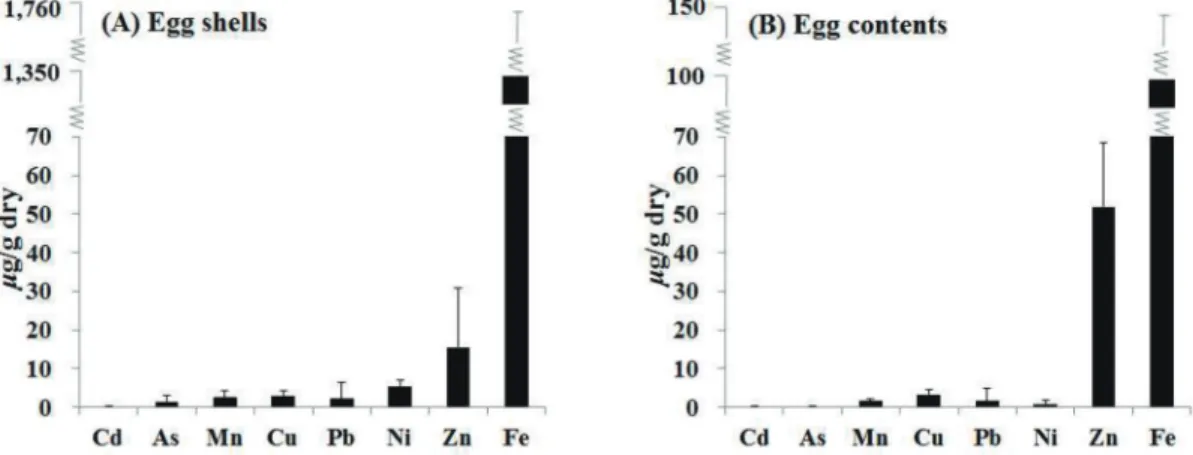
Figure 1은 기존 연구자료를 검토하여 여러 조류 종을 대상으로 한 알 껍데기와 내용물의 중금속 축적 농도의 평균값을 나타낸 것이다. 괭이갈매기(Larus crassirostris) 등 4종의 조류 알 껍데기 평균 카드뮴 (Cd) 농도는 0.177±0.169 μg/g dry를 보였고, 알 내용물(조류 8종)은 0.138±0.240 μg/g dry로 나타 났다. 이는 나머지 중금속 7종에 비해 가장 낮은 축 적농도 값이다(Appendix 1, 2). 다음으로 비소(As) 가 알 껍데기(조류 8종) 1.497±1.540 μg/g dry, 알 내용물(조류 12종) 0.185±0.194 μg/g dry로 두 번 째로 낮은 평균 농도를 보였다. 그리고 망간(Mn), 구 리(Cu), 납(Pb), 니켈(Ni)은 알 껍데기와 내용물 모 두 6 μg/g dry 미만으로 아연(Zn)이나 철(Fe)에 비 해 낮은 농도를 보였다. 아연은 조류 알 껍데기(조류 16종)가 평균 16±15 μg/g dry, 알 내용물(조류 12 종)은 52±17 μg/g dry로 알 내용물이 껍데기에 비 해 3배 정도 높게 축적되는 것으로 나타났다(Mann- Whitney test, p<0.01). 이에 비해 철은 알 껍데기 (조류 4종)는 평균 1,349±410 μg/g dry, 알 내용물 (조류 4종)은 평균 101±50 μg/g dry로 알 껍데기가 10배 이상 높은 축적농도를 보였다(Mann-Whitney test, p<0.05).
Figure 1. The comparison of average heavy metal concentrations between egg shells and contents
※Egg shells: Cd (n=6), As (n=9), Mn (n=12), Cu (n=11), Pb (n=14), Ni (n=2), Zn (n=17), Fe (n=4); Egg contents: Cd (n=11), As (n=14), Mn (n=14), Cu (n=13), Pb (n=19), Ni (n=4), Zn (n=15), Fe (n=5); Averages and SD (standard deviation) are showed in Appendix 1, 2.
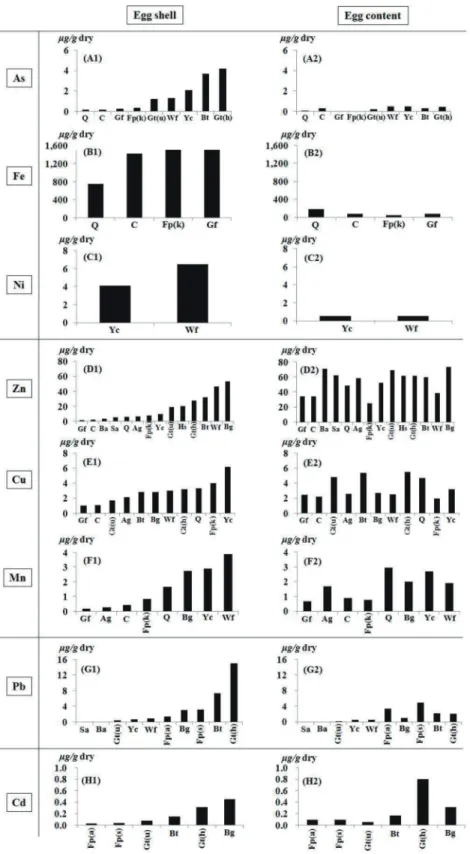
Figure 2. The comparison of variation patterns relating to heavy metal concentrations between avian egg shells and contents
※Each acronym is explained in table 1.
무기질(mineral)은 생물의 생화학적 과정에 필요 한 양에 따라 다량 무기질(예: 칼슘(Ca), 인(P), 마그 네슘(Mg) 등)과 미량 무기질(철(Fe), 아연(Zn), 구리 (Cu), 망간(Mn) 등), 매우 적은 양인 초미량 무기질 (비소(As), 니켈(Ni) 등)로 구분될 수 있다(Al- Obaidi et al. 2012). 이들 항목들은 필수 영양성분 에 해당하지만, 카드뮴(Cd)과 납(Pb)은 초미량 무기 질로서 비필수 성분에 해당하고, 적은 양으로도 생체 내 신진대사에 악영향을 줄 수 있기 때문에 늘 관심 의 대상이 되어 왔다(Scheuhammer, 1987).
Figure 1에 나타난 알 껍데기와 내용물의 중금속 축적패턴을 좀 더 자세히 비교하기 위하여 알 껍데기 와 내용물의 중금속을 동시에 분석한 연구만을 간추 려 Figure 2와 같이 알 껍데기 속 중금속 농도 증가 순에 따라 자료를 배치할 경우, 알 내용물 속 농도는 어떻게 변하는 지를 검토하였다. 알 껍데기와 내용물 의 중금속 분석결과가 동시에 분석·기술된 15개 자 료를 검토하여 중금속별로 자료를 정리하였다 (Figure 2; Table 1; Appendix 1, 2). 변동패턴은 크 게 4가지로 구분되었다.
첫 번째는 알 껍데기의 중금속 농도 증가와 상관 없이 알 내용물에서는 대체로 낮은 농도를 보이는 패 턴으로 비소(As), 철(Fe), 니켈(Ni)이 해당하였다 (Figure 2(A1~C2)). 알 껍데기와 내용물간 상관관 계를 살펴보면, 비소(r=0.6), 철(r=-0.4) 모두 통계 적으로 유의한 상관을 보이지 않았다(Table 2). 이는
조류종이나 서식환경에 관계없이 비소, 철, 니켈은 알 껍데기에 비해 알 내용물에 상대적으로 적은 양 이 일정하게 축적되는 경향을 보인다고 판단할 수 있다. 두 번째 패턴은 알 껍데기의 중금속 농도 증가 와 상관없이 알 내용물에서는 불규칙한 변동패턴을 보이는 경우로서 아연(Zn), 구리(Cu), 망간(Mn)이 해당하는 것으로 판단하였다(Figure 2(D1~F2)).
이들 중금속 농도에 대한 알 껍데기와 내용물의 상관관계 또한 통계적으로 유의하게 나타나지 않았 다(Table 2). 이는 조류종이나 서식환경에 따라 알 내용물이나 껍데기 모두에 이들 중금속 축적이 큰 변동으로 이루어질 가능성이 있는 것으로 판단할 수 있다. 다만 아연의 경우, 조사된 14종의 조류 중 딱 새 일종인 Willow flycatcher(Empidonax traillii extimus)한 종만 제외하고 나머지 13종의 조류에 서는 알 내용물의 아연 농도가 일관되게 높게 나타 났다.
세 번째 패턴은 비필수 유해 중금속인 납(Pb)의 경 우인데(Figure 2(G1, G2)), 집비둘기(Fp(a)와 Fp(s)) 를 제외하고 나머지 8종의 조류 알 껍데기가 내용물 보다 1.2~7.5배 높은 납 농도를 보였다. 그리고 알 껍데기와 내용물의 농도 상관계수(r)는 0.9로서 통 계적으로 유의한 수준의 높은 양(+)의 상관을 보였 다. 즉, 알 껍데기와 내용물 속 납 농도가 함께 증감 하는 경향을 두드러지게 보였다고 판단할 수 있다.
마지막으로 비필수 유해 중금속인 카드뮴(Cd)의 경 우(Figure 2(H1, H2)), 알 껍데기와 내용물 모두 낮 은 농도에서 비슷한 수준을 보였고(알 껍데기: 0.030
~0.450 μg/g dry, 알 내용물: 0.050~0.800 μg/g dry), 알 껍데기와 내용물 간의 상관관계는 통계적으 로 유의하지는 않았지만, 계수값(r)은 0.8로서 높게 나타나 알 껍데기와 내용물 속 카드뮴 농도가 함께 증감하는 경향을 다소 보인다고 판단된다. Kim and Oh(2014)는 괭이갈매기(Larus crassirostris) 알 껍 데기와 내용물 간 납 또는 카드뮴 농도의 상관을 비 교했는데, 통계적으로 유의한 양(+)의 상관을 보였 고, 알 껍데기가 오염물질 축적 모니터링의 적합한 시료가 될 수 있다고 판단했는데, 특히 조류의 번식 을 방해하지 않고 빈 알 껍데기만을 채취하여 모니 Table 2. The correlation coefficients of heavy metal
concentrations between egg shells and contents
Heavy metal r¶ p† n‡
As 0.6 NS 7
Fe -0.4 NS 4
Zn 0.4 NS 14
Cu 0.2 NS 11
Mn 0.7 NS 8
Pb 0.9 ** 10
Cd 0.8 NS 6
¶: Spearman rank correlation coefficient
†: NS (non-significant), **(p < 0.01)
‡: Number of samples
※Ni was not calculated due to small sample size (n=2).
터링할 수 있는 장점이 크다고 강조하였다. Swaileh and Sansur(2006)도 집참새인 House sparrow (Passer domesticus)의 알 껍데기와 내용물 간 납 농도가 통계적으로 유의한 양(+)의 상관을 나타냈고, 알 껍데기의 모니터링 시료로서의 가능성을 기술하 였다.
Figure 2에 나타낸 알 껍데기와 알 내용물의 중금 속 축적 패턴을 축적농도의 변동성 측면에서 살펴보 기 위해 Table 3과 같이 각 중금속별로 알 껍데기와 내용물에 대해 변동계수값(CV)을 구하였다. CV값은 평균(_
X )이 서로 다른 집단 간의 산포도(표준편차, s) 를 비교하기 위한 통계값이다. 납(Pb)과 카드뮴(Cd) 을 제외한 나머지 5개 중금속(As, Fe, Zn, Cu, Mn) 의 알 내용물 속 농도의 CV값은 1미만으로 낮거나 알 껍데기에 비해 상대적으로 낮았으며, 납은 알 껍데기 의 CV값(1.5)에 비해 상대적으로 낮은 1.1을 보였고, 카드뮴은 알 껍데기(1.0)와 비슷한 1.1의 값을 보였 다. 이와 같이 알 내용물의 CV값이 알 껍데기에 비해 전반적으로 낮게 나타나는 것은 알 내용물이 이들 중 금속의 흡수에 있어 알 껍데기보다는 상대적으로 변 동이 적은 일정 정도의 양만 축적되도록 하는 특성과 관련이 있는 것으로 판단된다. 이러한 특성은 조류의 알이 중금속과 같은 물질의 축적에 있어 일정 정도의 양만이 알 내용물에 축적되도록 하는 항상성 통제기 작(homeostatical control mechanism)이 잘 발달 되어 있는 것과 관련이 있는 것으로 판단된다(Dauwe et al., 1999).
2. 집비둘기 알의 중금속 축적농도
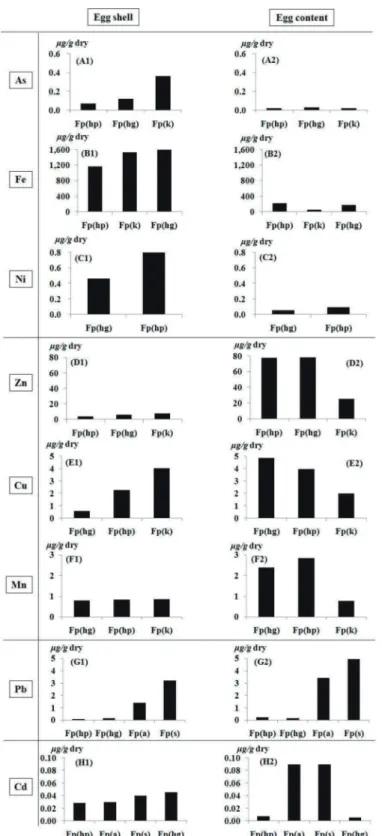
Figure 3은 집비둘기 알 껍데기와 내용물을 동시 에 분석한 연구자료만을 간추려 알 껍데기와 내용물 간의 농도 수준을 비교한 그래프이다. 집비둘기 알 껍데기와 내용물의 중금속 분석결과가 함께 기술된 3개 자료와 국가환경시료은행에서 연구한 2개 자료 를 합쳐 5개 자료를 검토하였다. 자료수가 적어 농도 증감에 대한 상관분석은 따로 실시하지 않았다. 비소 (As), 철(Fe), 니켈(Ni)의 경우(Figure 3(A1~C2)), Figure 2의 일반 조류종과 마찬가지로 알 껍데기의 중금속 농도 증가와 관계없이 알 내용물에서는 대체 로 낮은 농도를 보이는 패턴인 것으로 판단되었다.
아연(Zn)의 경우(Figure 3(D1, D2)), 알 내용물의 농 도가 알 껍데기에 비해 상대적으로 높은 수준을 모두 나타냈는데, 이는 Figure 2의 일반 조류종의 결과와 유사하다. 이렇게 알 내용물 속 아연 농도가 높은 것 은 알 내용물의 배발생 단계에서 유전자 발현과 세포 분화의 생화학적 과정에 관여하는 필수 물질로서 아 연이 역할을 하는 것과 관련이 있다(Falchuk, 1998;
Miles, 2000; Falchuk and Montorzi, 2001).
비필수 유해 중금속인 납(Pb)의 경우(Figure 3 (G1, G2)), Nam et al.(2003)이 안산(Fp(a))과 서울 (Fp(s)) 지점에서 조사한 집비둘기는 알 껍데기가 내 용물보다 낮은 농도를 보였다(Fp(a): 알 껍데기 (1.410 μg/g dry), 내용물(3.390 μg/g dry); Fp(s):
알 껍데기(3.190 μg/g dry), 내용물(4.920 μg/g dry); Appendix 1, 2). 마찬가지로 국가환경시료은 Table 3. The comparison of coefficient of variations in heavy metal concentrations between egg shells and contents
Heavy metal n# Egg shell Egg content
s¶ _
X† CV‡ s _
X CV
As 7 1.5 1.5 1.0 0.2 0.3 0.7
Fe 4 410 1,349 0.3 58 100 0.6
Zn 14 16.9 17.2 1.0 15.3 53.7 0.3
Cu 11 1.5 2.8 0.5 1.4 3.5 0.4
Mn 8 1.4 1.6 0.9 0.9 1.7 0.5
Pb 10 4.7 3.2 1.5 1.7 1.5 1.1
Cd 6 0.2 0.2 1.0 0.3 0.3 1.1
#: Number of samples; ¶: Sample standard deviation; †: Sample average; ‡: Coefficient of variation
※Ni was not calculated due to small sample size (n=2).
Figure 3. The comparison of variation patterns relating to heavy metal concentrations between feral pigeon’s egg shells and contents
※Fp(a) and Fp(s) (Nam et al. 2003), Fp(k) (Abduljaleel et al. 2011), Fp(hp) and Fp(hg) (Lee et al. 2013; 2014)
행에서 함평공원(Fp(hp))과 한강공원(Fp(hg))에서 조사한 집비둘기도 알 껍데기가 내용물보다 낮은 농 도를 보였다(Fp(hp): 알 껍데기(0.082 μg/g dry), 내용물(0.216 μg/g dry); Fp(hg): 알 껍데기(0.131 μg/g dry), 내용물(0.149 μg/g dry)). 이는 Figure 2의 기타 조류종들의 알 껍데기가 알 내용물보다 1.2~7.5배 높은 Pb 농도를 보인 것과는 다른 결과이 다. 이러한 상반된 결과가 집비둘기만의 특성인지는 향후에 추가 연구가 필요하다.
비필수 유해 중금속인 카드뮴(Cd)의 경우(Figure 3(H1, H2)), 함평공원(Fp(hp))과 한강공원(Fp(hg)) 의 집비둘기는 알 껍데기(Fp(hp): 0.029 μg/g dry;
Fp(hg): 0.045 μg/g dry)가 알 내 용 물 (Fp(hp):
0.007 μg/g dry; Fp(hg): 0.005 μg/g dry)보다 4~9 배 높은 농도를 보인 반면, Nam et al.(2003)이 안 산(Fp(a))과 서울(Fp(s))에서 조사한 집비둘기는 알 내용물(Fp(a): 0.090 μg/g dry; Fp(s): 0.090 μg/g dry)이 알 껍데기(Fp(a): 0.030 μg/g dry; Fp(s):
0.040 μg/g dry) 보다 2~3배 높은 농도를 보였다.
유해 중금속인 납이나 카드뮴의 환경모니터링용 집비둘기 알 껍데기의 시료로서의 가능성을 판단하
기 위한 조건으로 두 가지를 검토해 볼 수 있다. 첫째 는 생화학적 차단 기작에 의해 유해 중금속 축적이 덜 이루어지는 알 내용물(Paulus et al. 2010; Klein et al. 2012)에 비해 알 껍데기가 상대적으로 더 많은 축적이 이루어지는 지와 둘째는 실제로 환경 중의 유 해 중금속이 집비둘기 체내로 흡수되어 장기조직 등 에 축적되는 패턴을 알 껍데기가 간접적으로 유의미 하게 반영하는가이다.
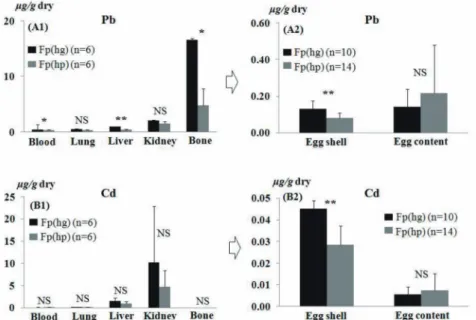
첫 번째 조건의 경우, 위에서 살펴본 바와 같이 집 비둘기 알 껍데기의 납이나 카드뮴 축적농도가 서식 환경(지역, 시기 등)에 따라 알 내용물과 비교해서 큰 차이가 나지 않을 수 있다고 판단된다. 두 번째 조건 인 집비둘기 체내 장기조직 등에 흡수, 축적된 농도 패턴을 알 껍데기와 내용물이 어떻게 반영하는 지 검 토하기 위해 Figure 4와 같이 자료를 정리하여 검토 하였다. Figure 4(A1, A2)는 2013년 국가환경시료 은행에서 실시한 한강공원과 함평공원 비교 연구 (Lee et al. 2013: Lee et al. 2014)에서 집비둘기 생 체 내 장기조직 등의 납(Pb) 축적 농도가 지점 간에 통계적으로 차이가 있는지를 비교(A1)하고, 알에서 도 지점 간 차이 여부를 비교한 그래프(A2)이다. 이
Figure 4. The concentrations of the lead (Pb) and cadmium (Cd) in feral pigeon’s internal organs and eggs between environmentally different sites
※Fp(hg): Hangang Park, Fp(hp): Hampyeong Park, Mann-Whitney test (Lee et al. 2013; 2014).
연구에서 뼈(bone), 간(liver), 혈액(blood)에서 통계 적으로 유의하게 한강공원(Fp(hg))이 함평공원 (Fp(hp))에 비해 높은 납 농도를 보였다(Figure 4(A1)). 이러한 패턴은 알 껍데기에서도 나타났는데, 한강공원(Fp(hg))이 함평공원(Fp(hp))에 비해 통계 적으로 유의하게 높게 나타났다. 하지만 알 내용물 의 납 농도는 지점 간에 통계적으로 유의한 차이가 없었다.
Nam et al.(2003)은 2000년~2001년에 서울과 안산 지점의 집비둘기 중금속 농축 특성을 연구했는 데, 뼈에서 뚜렷한 농축 차이를 보였고, 이러한 경향 은 알 껍데기와 내용물 모두에서 통계적으로 유의하 게 나타났다고 보고한 바 있다. 일반적으로 납은 생 물체로 흡수되면 뼈에 가장 높은 농도로 축적되는 것 으로 알려져 있는데, 이는 뼈의 구성물질인 칼슘(Ca) 과 경쟁하면서 뼈 조직 내에 결합되는 성질과 관련이 있기 때문이다(Rabinowitz, 1991; Wiemann et al., 1999; Lee et al., 2014). 조류의 뼈에 축적된 납은 알을 포함한 다양한 체외 배출경로(분변, 우지선(羽 脂腺, uropygial gland), 염류선(塩類腺, salt gland), 깃털 등)을 통해 일정 부분 빠져나가는 것으로 알려 져 있다(Burger and Gochfeld, 1985; Burger, 1993;
Dauwe et al., 1999; Dauwe et al., 2002; Mora, 2003; Brait and Antoniosi Filho, 2011).
Lee et al.(2014)이 납의 배출경로로서 집비둘기 깃털과 알을 분석한 자료에 따르면, 한강공원 (Fp(hg))과 함평공원(Fp(hp))의 집비둘기 깃털은 각 각 2.070 μg/g dry, 0.692 μg/g dry의 납 축적농도 를 보였다. 이 수치는 알 껍데기(Fp(hg): 0.131 μg/g dry, Fp(hp): 0.082)와 내용물(Fp(hg): 0.149 μg/g dry, Fp(hp): 0.216 μg/g dry)에 비해 한강공원 (Fp(hg))은 약 13~15배 높은 농도이고, 함평공원 (Fp(hp))은 약 3~8배 높은 농도이다. 따라서 납의 배출경로로서 집비둘기 알이 차지하는 비중은 크지 않다고 판단할 수 있다. 이는 알 속의 배(embryo)가 유해 중금속의 독성에 노출되지 않도록 생리적으로 통제하는 시스템(homeostatical control mechanism) 이 작동하고 있는 것과 관련되어 있다고 판단된다 (Dauwe et al., 1999; Nisianakis et al., 2009). 다
만, 알 껍데기도 대부분 칼슘(Ca)으로 구성되어 있기 때문에 신진대사 과정에서 칼슘과 비슷한 분자생물 학적 거동(결합, 운반, 저장 등)을 보이는 납의 축적 거동이 어떤 형태로든 알 껍데기의 납 축적에 관여할 가능성이 크고(Scheuhammer, 1987; Dauwe et al., 1999; Ruuskanen et al., 2014), 알 껍데기 속 칼슘 등의 물질들이 알 내용물 속 배발생의 신진대사 과정 에서 이용되는 것으로 알려져 있기 때문에 알 껍데기 에 축적된 납도 알의 배발생에 영향을 줄 가능성이 큰 것으로 판단된다(Feinblatt, 1982; Mora, 2003).
Figure 4(B1, B2)는 2013년 한강공원과 함평공원 집비둘기의 카드뮴(Cd) 축적농도를 비교한 그래프이 다. 장기조직 등에서 두 지점 간에 카드뮴 농도는 통 계적으로 유의한 차이를 보이지 않았다(B1). 다만, 카드뮴이 가장 많이 축적되는 것으로 알려진 신장과 간의 경우(Kim et al., 2003; Kim et al., 2006; Shin et al., 2008), 통계적으로 유의성은 없었지만 한강 공원(Fp(hg) liver: 1.450 μg/g dry, kidney: 8.773 μg/g dry)이 함평공원(Fp(hp) liver: 0.881 μg/g dry, kidney: 4.463 μg/g dry)에 비해 높게 나타났 다. 이러한 패턴은 알 껍데기에서 더욱 뚜렷하게 나 타나 한강공원(Fp(hg): 0.045 μg/g dry)이 함평공 원(Fp(hp): 0.029 μg/g dry)에 비해 통계적으로 유 의하게 높게 나타났다. 하지만 알 내용물 속 평균 농 도값은 반대로 함평공원(Fp(hp): 0.007 μg/g dry) 이 한강공원(Fp(hg): 0.005 μg/g dry)에 비해 다소 높게 나타났다. Nam et al.(2003)의 연구에서는 간 과 신장에서 카드뮴 농도가 통계적으로 유의하게 지 점 간 차이(서울지점 농도 > 안산지점 농도)를 보였 지만, 이러한 경향은 알에서는 통계적인 유의성은 없 는 것으로 나타났다. 다만, 알 껍데기(서울지점 농도
> 안산지점 농도)가 알 내용물(서울지점 농도 = 안산 지점 농도)보다는 지역 간 차이를 다소 반영하는 경 향을 보였다. Dauwe et al.(1999)이 오염지역과 비 오염지역 간 박새(Parus major) 알의 카드뮴 축적정 도를 비교한 연구에 따르면 알 내용물에 비해 알 껍 데기가 오염지역의 카드뮴 농도 수준을 더 적절히 반 영한다고 밝힌 바 있다.
이와 같이 납과 카드뮴의 집비둘기 체내 축적경향
을 알 껍데기가 알 내용물보다는 상대적으로 잘 반영 하는 특성은 알 내용물 속 배(embryo)의 안전한 발 달을 위해 중금속 축적을 통제하는 항상성 기작이 알 내용물에 더 강화되어 나타나는 특성과 관련이 있는 것으로 판단된다.
V. 결 론
본 연구에서는 환경모니터링을 위한 집비둘기 알 의 중금속 축적 특성을 검토하기 위해 집비둘기를 포 함한 여러 조류종의 알을 대상으로 알 껍데기와 내용 물을 구분하여 비교·검토한 후 집비둘기 알 껍데기의 중금속 모니터링 시료로서의 가능성을 고찰하였다.
일반적으로 알 내용물은 배(embryo)가 중금속 독 성에 노출되지 않도록 하는 생리적인 항상성 통제기 작(homeostatical control mechanism)이 발달되어 있기 때문에 알 껍데기보다는 상대적으로 농도의 변 동이 적은 일정 정도의 양만 축적되도록 하는 특성이 강한 것으로 판단된다. 이에 비해 알 껍데기는 중금 속 축적의 변동성이 알 내용물보다는 상대적으로 크 다고 볼 수 있으며, 이는 서식환경에 따른 중금속 축 적 변동을 알 내용물보다는 더 적절히 반영할 가능성 이 있다는 의미로도 해석될 수 있다.
유해 중금속 축적 농도 측면에서 보면, 본 연구에 서는 집비둘기의 알 껍데기와 내용물의 축적 농도가 비슷하게 나타났다. 이는 안전한 배발생을 보장하기 위해 유해 중금속의 축적이 알 껍데기와 내용물 모두 에 저농도로 이루어지는 특성과 관련이 있는 것으로 판단된다. 비록 알에 저농도로 유해 중금속이 축적되 지만, 생체 조직(간, 신장, 뼈 등) 내 축적농도의 지 역 간 차이는 알 껍데기가 알 내용물보다는 간접적으 로 더 적절히 반영하는 것으로 나타났다.
중금속 모니터링을 위한 알 껍데기 시료의 활용은 집비둘기의 번식을 방해하지 않고 빈 알 껍데기만을 채취하여 모니터링할 수 있는 장점이 크다고 볼 수 있다. 따라서 향후에 중금속 오염정도에 따른 집비둘 기 알 껍데기의 축적특성에 대한 추가적인 연구를 통 해 집비둘기 알 껍데기의 모니터링 시료로서의 활용 성을 강화하는 것이 중요하다고 판단된다.
사 사
본 연구는 국립환경과학원에서 2013년 ‘환경오염 지표종인 집비둘기 시료의 부위별 중금속 농축특성 연구’(NIER-RP2013-340)의 일환으로 수행되었습 니다.
인용문헌
김상진, 이종남, 이두표. 2006. 한국에 도래하는 아 비류의 카드뮴과 납 축적 레벨, J. Eco.
Field Biol., 29(6), 539-543.
김정수, 이두표, 구태회. 2003. 서울지역에 서식하 는 집비둘기 Columba livia의 깃털을 이용 한 중금속오염 모니터링, 한국생태학회지, 26(3), 91-96.
남동하, 이두표, 구태회. 2003. 도심 지역과 공단 지역에 서식하는 비둘기의 알, 새끼, 성조의 납 과 카 드 뮴 농 도 비 교 , Korean J.
Environ. Biol., 21(2), 142-148.
이장호, 이종천, 이상희, 이유진, 한아름, 오길종.
2013. 환경오염 지표종인 집비둘기 시료의 부위별 중금속 농축특성 연구, 국립환경과 학원 보고서.
이장호, 이종천, 이상희 김명진, 이유진, 한아름, 심 규영. 2014. 환경모니터링을 위한 집비둘기 깃털의 중금속 축적특성 연구, 환경영향평 가, 23(6), 492-504.
신주렬, 김정수, 구태회. 2008. 우리나라 야생조류 의 납과 카드뮴 농도, Korean J. Environ.
Biol., 26(1), 8-14.
Abduljaleel SA, Shuhaimi-Othman M, Babji A.
2011. Variation in trace elements levels among chicken, quail, guinea fowl and pigeon eggshell and egg content, Research Journal of Environmental Toxicology, 5(5), 301-308.
Al-Obaidi FA, Mehdi BI, Al-Shdeedi SM. 2012.
Identification of inorganic elements in egg
shell of some wild birds in Baghdad, Advances in Applied Science Research, 3(3), 1454-1458.
Brait CHH, Antoniosi Filho NR. 2011. Use of feathers of feral pigeons as a technique for metal quantification and environmental monitoring, Environmental Monitoring Assessment, 179, 457-467.
Burger J. 1993. Metals in avian feathers:
bioindicators of environmental pollution, Rev. Environ. Toxicol., 5, 203-311.
Burger J. 2002. Food chain differences affect heavy metal in bird eggs in Barnegat Bay, New Jersey, Environmental Research Section A, 90, 33-39.
Burger J, Gochfeld M. 1985. Comparison of nine heavy metals in salt gland and liver of Great Scaup (Aythya marila), Black Duck (Anas rubripes), and Mallard (A. platyrhynchos), Compar. Biochem. Physiol., 81C, 287-292.
Dauwe T, Bervoets L, Blust R, Pinxten R, Eens M. 1999. Are eggshell and egg contents of great and blue tits suitable as indicators of heavy metal pollution?, Belg. J. Zool., 129(2), 439-447.
Dauwe T, Lieven B, Ellen J. 2002. Great and blue tit feathers as biomonitors for heavy metal pollution, Ecological Indicators, 1, 227-234.
Falchuk KH. 1998. The molecular basis for the role of zinc in developmental biology, Molecular and Cellular Biochemistry, 188, 41-48.
Falchuk KH, Montorzi M. 2001. Zinc physiology and biochemistry in oocytes and embryos, BioMetals, 14, 385-395.
Feinblatt JD. 1982. The comparative physiology of calcium regulation in sbumammalian vertebrates, Advances in Comparative
Physiology and Biochemistry, 8, 74-97.
Hui CA. 2002. Concentration of chromium, manganese, and lead in air and in avian eggs, Environmental Pollution, 120, 201- 206.
Ikemoto T, Kunito T, Tanabe S, Tsurumi M, Sato F, Oka N. 2005. Non-destructive monitoring of trace element levels in short-tailed albatrosses (Phoebastria albatrus) and black-footed albatrosses (Phoebastria nigripes) from Torishima Island, Japan using eggs and blood, Marine Pollution Bulletin, 51, 889-895.
Johnston RF, Janiga M. 1995. Feral Pigeons, Oxford University Press, Inc.
Kim J, Oh J-M. 2014. Trace element concentrations in eggshells and egg contents of black-tailed gull (Larus crassirostris) from Korea, Ecotoxicology, 23, 1147-1152.
Klein R, Bartel-Steinbach M, Koschorreck J, Paulus M, Tarricone K, Teubner D, Wagner G, Weinmann T, Veith M. 2012.
Standardization of egg collection from aquatic birds for biomonitoring - a critical review, Environ, Sci. & Tech., 1-40.
Miles RD. 2000. Trace minerals and avian embryo development, Ciencia Animal Brasileira, 2(1), 1-10.
Mora MA. 2003. Heavy metals and metalloids in egg contents and eggshell of passerine birds from Arizona, Environmental Pollution, 125, 393-400.
Morera M, Sanpera C, Crespo S, Jover L, Ruiz X.
1997. Inter- and intraclutch variability in heavy metals and selenium levels in audouin’s gull eggs from the Ebro Delta, Spain, Arch. Environ. Contam. Toxicol., 33, 71-75.
Nagel P, Smrekar G, Haag-Wackernagel D. 2001.
Use of feral pigeon eggs for urban biomonitoring, Fresenius Environmental Bulletin, 10(1), 18-25.
Paulus M, Bartel M, Klein R, Quack M, Tarricone K, Teubner D, Wagner G.
2010. Guideline for sampling and sample treatment, Feral pigeon (Columba livia f.
domestica), Umweltprobenbank des Bundes.
Nisianakis P, Giannenas I, Gavriil A, Kontopidis G, Kyriazakis I. 2009. Variation in trace element contents among chicken, turkey, duck, goose, and pigeon eggs analyzed by Inductively Coupled Plasma Mass Spectrometry (ICP-MS), Biol. Trace Elem.
Res., 128, 62-71.
Rabinowitz MB. 1991. Toxicokinetics of bone lead, Environmental Health Perspectives, 91, 33-37.
Ruuskanen S, Laaksonen T, Morales J, Moreno J, Mateo R, Belskii E, Bushuev A, Jarvinen A, Kerimov A, Krams I, Morosinotto C, Mand R, Orell M, Qvarnstrom A, Slater F, Tilgar V, Visser ME, Winkel W, Zang H, Eeva T. 2014. Large-scale geographical variation in eggshell metal and calcium content in a passerine bird (Ficedula hypoleuca), Environ Sci Pollut Res., 21, 3304-3317.
Scheuhammer AM. 1987. The chronic toxicity of aluminium, cadmium, mercury, and lead in birds: a review, Environmental Pollution, 46, 263-295.
Swaileh KM, Sansur R. 2006. Monitoring urban heavy metal pollution using the house sparrow (Passer domesticus), J. Environ.
Monit., 8, 209-213.
Tsipoura N, Burger J, Newhouse M, Jeitner C, Gochfeld M, Mizrahi D. 2011. Lead, mercury, cadmium, chromium, and arsenic
levels in eggs, feathers, and tissues of canada geese of the New Jersey Meadowlands, Environmental Research, 111, 775-784.
Wiemann M, Schirrmacher K, Busselberg D.
1999. Interference of lead with the calcium release activated calcium flux of osteoblast-like cells, Calcified Tissue International, 65, 479-485.
References
Abduljaleel SA, Shuhaimi-Othman M, Babji A.
2011. Variation in trace elements levels among chicken, quail, guinea fowl and pigeon eggshell and egg content, Research Journal of Environmental Toxicology, 5(5), 301-308.
Al-Obaidi FA, Mehdi BI, Al-Shdeedi SM. 2012.
Identification of inorganic elements in egg shell of some wild birds in Baghdad, Advances in Applied Science Research, 3(3), 1454-1458.
Brait CHH, Antoniosi Filho NR. 2011. Use of feathers of feral pigeons as a technique for metal quantification and environmental monitoring, Environmental Monitoring Assessment, 179, 457-467.
Burger J. 1993. Metals in avian feathers:
bioindicators of environmental pollution, Rev. Environ. Toxicol., 5, 203-311.
Burger J. 2002. Food chain differences affect heavy metal in bird eggs in Barnegat Bay, New Jersey, Environmental Research Section A, 90, 33-39.
Burger J, Gochfeld M. 1985. Comparison of nine heavy metals in salt gland and liver of Great Scaup (Aythya marila), Black Duck (Anas rubripes), and Mallard (A. platyrhynchos),
Compar. Biochem. Physiol., 81C, 287-292.
Dauwe T, Bervoets L, Blust R, Pinxten R, Eens M. 1999. Are eggshell and egg contents of great and blue tits suitable as indicators of heavy metal pollution?, Belg. J. Zool., 129(2), 439-447.
Dauwe T, Lieven B, Ellen J. 2002. Great and blue tit feathers as biomonitors for heavy metal pollution, Ecological Indicators, 1, 227-234.
Falchuk KH. 1998. The molecular basis for the role of zinc in developmental biology, Molecular and Cellular Biochemistry, 188, 41-48.
Falchuk KH, Montorzi M. 2001. Zinc physiology and biochemistry in oocytes and embryos, BioMetals, 14, 385-395.
Feinblatt JD. 1982. The comparative physiology of calcium regulation in sbumammalian vertebrates, Advances in Comparative Physiology and Biochemistry, 8, 74-97.
Hui CA. 2002. Concentration of chromium, manganese, and lead in air and in avian eggs, Environmental Pollution, 120, 201-206.
Ikemoto T, Kunito T, Tanabe S, Tsurumi M, Sato F, Oka N. 2005. Non-destructive monitoring of trace element levels in short-tailed albatrosses (Phoebastria albatrus) and black-footed albatrosses (Phoebastria nigripes) from Torishima Island, Japan using eggs and blood, Marine Pollution Bulletin, 51, 889-895.
Johnston RF, Janiga M. 1995. Feral Pigeons, Oxford University Press, Inc.
Kim JS, Lee DP, Koo TH. 2003. Monitoring of heavy metal contaminations using feathers of feral pigeons Columba livia in Seoul, Korean J. Ecol., 26(3), 91-96.
Kim SJ, Lee JN, Lee DP. 2006. Cadmium and
lead levels of loons wintering in Korea, J.
Ecol. Field Biol., 29(6), 539-543.
Kim J, Oh J-M. 2014. Trace element concentrations in eggshells and egg contents of black-tailed gull (Larus crassirostris) from Korea, Ecotoxicology, 23, 1147-1152.
Klein R, Bartel-Steinbach M, Koschorreck J, Paulus M, Tarricone K, Teubner D, Wagner G, Weinmann T, Veith M. 2012.
Standardization of egg collection from aquatic birds for biomonitoring - a critical review, Environ, Sci. & Tech., 1-40.
Lee J, Lee J, Lee SH, Lee E, Han A, Oh G.
2013. The characteristics of heavy metal accumulations in feral pigeon (Columba livia) as an environmental pollution indicator, NIER Report.
Lee J, Lee J, Lee SH, Kim M, Lee E, Han A, Shim K. 2014. The characteristics of heavy metal accumulations in feral pigeon (Columba livia) feathers for environmental monitoring, J. Environ. Impact Assess., 23(6), 492-504.
Miles RD. 2000. Trace minerals and avian embryo development, Ciencia Animal Brasileira, 2(1), 1-10.
Mora MA. 2003. Heavy metals and metalloids in egg contents and eggshell of passerine birds from Arizona, Environmental Pollution, 125, 393-400.
Morera M, Sanpera C, Crespo S, Jover L, Ruiz X.
1997. Inter- and intraclutch variability in heavy metals and selenium levels in audouin’s gull eggs from the Ebro Delta, Spain, Arch. Environ. Contam. Toxicol., 33, 71-75.
Nagel P, Smrekar G, Haag-Wackernagel D. 2001.
Use of feral pigeon eggs for urban biomonitoring, Fresenius Environmental
Bulletin, 10(1), 18-25.
Nam DH, Lee DP, Koo TH. 2003. Comparison of lead and cadmium accumulations in feral pigeons (Columba livia) with different developmental stages from urban and industrial complex areas, Korean J.
Environ. Biol., 21(2), 142-148.
Nisianakis P, Giannenas I, Gavriil A, Kontopidis G, Kyriazakis I. 2009. Variation in trace element contents among chicken, turkey, duck, goose, and pigeon eggs analyzed by Inductively Coupled Plasma Mass Spectrometry (ICP-MS), Biol. Trace Elem.
Res., 128, 62-71.
Paulus M, Bartel M, Klein R, Quack M, Tarricone K, Teubner D, Wagner G.
2010. Guideline for sampling and sample treatment, Feral pigeon (Columba livia f.
domestica), Umweltprobenbank des Bundes.
Rabinowitz MB. 1991. Toxicokinetics of bone lead, Environmental Health Perspectives, 91, 33-37.
Ruuskanen S, Laaksonen T, Morales J, Moreno J, Mateo R, Belskii E, Bushuev A, Jarvinen A, Kerimov A, Krams I, Morosinotto C, Mand R, Orell M, Qvarnstrom A, Slater F, Tilgar V, Visser ME, Winkel W, Zang
H, Eeva T. 2014. Large-scale geographical variation in eggshell metal and calcium content in a passerine bird (Ficedula hypoleuca), Environ Sci Pollut Res., 21, 3304-3317.
Scheuhammer AM. 1987. The chronic toxicity of aluminium, cadmium, mercury, and lead in birds: a review, Environmental Pollution, 46, 263-295.
Shin JR, Kim JS, Koo TH. 2008. Lead and cadmium concentrations in Korean wild birds, Korean J. Environ. Biol., 26(1), 8-14.
Swaileh KM, Sansur R. 2006. Monitoring urban heavy metal pollution using the house sparrow (Passer domesticus), J. Environ.
Monit., 8, 209-213.
Tsipoura N, Burger J, Newhouse M, Jeitner C, Gochfeld M, Mizrahi D. 2011. Lead, mercury, cadmium, chromium, and arsenic levels in eggs, feathers, and tissues of canada geese of the New Jersey Meadowlands, Environmental Research, 111, 775-784.
Wiemann M, Schirrmacher K, Busselberg D.
1999. Interference of lead with the calcium release activated calcium flux of osteoblast-like cells, Calcified Tissue International, 65, 479-485.
Appendix1. Theheavymetalconcentrations(µg/gdry) ofavianeggshells English nameScientific nameSurvey yearLocationCdAsMnCuPbNiZnFeReference Feral pigeonColumba livia2001Ansan, Korea0.030---1.410---Nam et al. 2003w Feral pigeonColumba livia2001Seoul, Korea0.040---3.190---Nam et al. 2003w Feral pigeonColumba livia2010Kajang, Malaysia-0.3600.8604.000--81,536Abduljaleel et al. 2011 Feral pigeonColumba livia2011Baghdad, Iraq--4.750-0.400-10-Al-Obaidi et al. 2012 Collared doveStreptopelia decaocto2011Baghdad, Iraq--4.720-0.420-10-Al-Obaidi et al. 2012 Black-tailed gullLarus crassirostris2008Hongdo (south-east sea), Korea0.450-2.7602.8003.100-54-Kim & Oh 2014 Audouin's gullLarus audouinii1992EBRO Delta, Spain--0.2902.140--7-Morera et al. 1997 Guinea fowlNumida meleagris2010Kajang, Malaysia-0.2600.2001.010--21,683Abduljaleel et al. 2011 Short-tailed albatrossPhoebastria albatrus2002Torishima Island, Japan----0.011-6-Ikemoto et al. 2005 Black-footed albatrossPhoebastria nigripes2002Torishima Island, Japan----0.039-3-Ikemoto et al. 2005 ChickenGallus gallus2010Kajang, Malaysia-0.1900.4301.060--21,422Abduljaleel et al. 2011 QuailCoturnix coturnix japonica2010Kajang, Malaysia-0.1621.6703.340--6755Abduljaleel et al. 2011 Blue TitParus caeruleus1998Hoboken, Belgium0.1503.700-2.8007.400-32-Dauwe et al. 1999 Great TitParus major1998University of Antwerp, Belgium0.0801.200-1.7200.370-19-Dauwe et al. 1999 Great TitParus major1998Hoboken, Belgium0.3104.200-3.20015.000-28-Dauwe et al. 1999 Willow flycatcherEmpidonax traillii extimus2000Arizona, USA-1.3003.9003.0000.9006.50046-Mora 2003 White-eared bulbulPycnonotus leucotis2011Baghdad, Iraq--4.270-0.440-11-Al-Obaidi et al. 2012 House sparrowPasser domesticus2011Baghdad, Iraq--4.230-0.410-11-Al-Obaidi et al. 2012 Yellow-breasted chatIcteria virens2000Arizona, USA-2.1002.9006.2000.6004.10010-Mora 2003 Minimum0.0800.1620.2001.0100.0114.1002755 Maximum0.4504.2004.7506.20015.0006.500541,683 Standard deviation0.1691.5401.8111.4604.1371.69715410 Average0.1771.4972.5822.8432.4065.300161,349 No. of samples691211142174 w: Wet weight values were used.
Appendix2. Theheavymetalconcentrations(μg/gdry) ofavianeggcontents English nameScientific nameSurvey yearLocationCdAsMnCuPbNiZnFeReference Feral pigeonColumba livia2001Ansan, Korea0.090---3.390---Nam et al. 2003d Feral pigeonColumba livia2001Seoul, Korea0.090---4.920---Nam et al. 2003d Feral pigeonColumba livia2010Kajang, Malaysia-0.0200.7701.980--2551Abduljaleel et al. 2011 Feral pigeonColumba livia1997Basle, Switzerland--2.5003.00014.5002.50064104Nagel et al. 2001 Feral pigeonColumba livia1999Riverside, USA--1.390-0.160---Hui 2002 Feral pigeonColumba livia1998Los Angeles, USA--1.240-0.220---Hui 2002 Feral pigeonColumba livia1999Los Angeles, USA--1.090-0.200---Hui 2002 Feral pigeonColumba livia1999San Francisco--1.140-0.600---Hui 2002 Feral pigeonColumba livia2008Gianitsa, Greece0.0020.0211.1421.286-0.04224-Nisianakis et al. 2009d¶ Black-tailed gullLarus crassirostris2008Hongdo (south-east sea), Korea0.310-1.9902.6700.920-73-Kim & Oh 2014 Audouin's gullLarus audouinii1992EBRO Delta, Spain--1.6902.580--58-Morera et al. 1997 Guinea fowlNumida meleagris2010Kajang, Malaysia-0.0300.6802.438--3486Abduljaleel et al. 2011 MallardAnas platyrhynchos2007New Jersy, USA0.0010.049--0.186---Tsipoura et al. 2011d Canada gooseBranta canadensis2007New Jersy, USA0.0010.016--0.483---Tsipoura et al. 2011d Short-tailed albatrossPhoebastria albatrus2002Torishima Island, Japan----<0.001-63-Ikemoto et al. 2005† Black-footed albatrossPhoebastria nigripes2002Torishima Island, Japan----0.010-71-Ikemoto et al. 2005 ChickenGallus gallus2010Kajang, Malaysia-0.3000.8802.220--3479Abduljaleel et al. 2011 QuailCoturnix coturnix japonica2010Kajang, Malaysia-0.1002.9604.670--48184Abduljaleel et al. 2011 Blue TitParus caeruleus1998Hoboken, Belgium0.1700.330-5.4002.200-60-Dauwe et al. 1999 Great TitParus major1998University of Antwerp, Belgium0.0500.220-4.8000.130-69-Dauwe et al. 1999 Great TitParus major1998Hoboken, Belgium0.8000.450-5.5002.000-62-Dauwe et al. 1999 Marsh wrenCistothorus palustris2007New Jersy, USA0.0010.030--0.104---Tsipoura et al. 2011d Red-winged blackbirdAgelaius phoeniceus2007New Jersy, USA0.0010.018--0.116---Tsipoura et al. 2011d Willow flycatcherEmpidonax traillii extimus2000Arizona, USA-<0.5001.9002.500<0.500<0.50039-Mora 2003‡ Yellow-breasted chatIcteria virens2000Arizona, USA-<0.5002.7003.200<0.500<0.50052-Mora 2003‡ Minimum0.0010.0160.6801.2860.0010.0422451 Maximum0.8000.5002.9605.500 14.5002.50073184 Standard deviation0.2400.1940.7351.3763.3821.0981750 Average0.1380.1851.5773.2501.6390.88652101 d: Wet weight values multiplied by 3 were used as dry weight values; ¶; The heavy metal concentrations of the egg contents were calculated by the equation, ((2.78 × ppm of albumen) + (1 × ppm of yolk))/(2.78+1) †: The value of <0.001 was regarded as 0.001; ‡: The value of <0.500 was regarded as 0.500.