Print ISSN: 2288-4637 / Online ISSN 2288-4645 doi:10.13106/jafeb.2021.vol8.no4.0441
The Effect of Halal Awareness on Purchase Intention of Halal Food: A Case Study in Indonesia
Nico Alexander VIZANO
1, Khamaludin KHAMALUDIN
2, Mochammad FAHLEVI
3Received: November 30, 2020 Revised: February 20, 2021 Accepted: March 02, 2021
Abstract
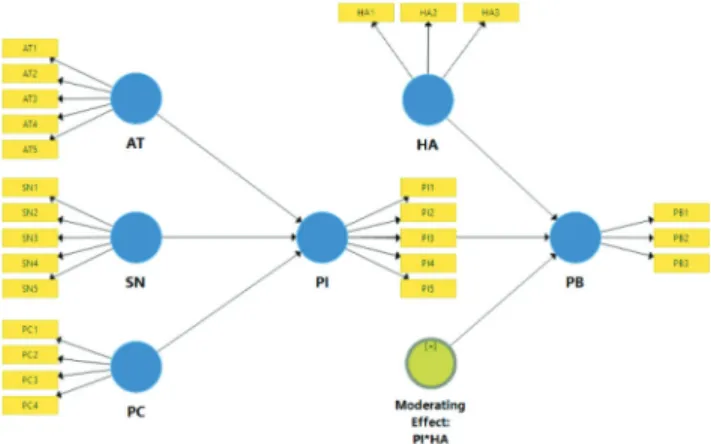
This study seeks to examine the effect of attitude, subjective norm, and perceived behavioral control on the purchase behavior of students enrolled in a private higher education establishment in Tangerang, Indonesia. This is a quantitative study and it employs samples by simple random sampling of 410 university students. The returned and valid questionnaire results totaled 261 samples. Data processing used the SEM method with SmartPLS 3.0 software. The findings of this study reveal that attitude, subjective norm, and perceived behavioral control have a significant effect on purchase intention. Meanwhile, purchase intention has a significant effect on working students’ purchase behavior, and halal awareness had a moderating effect of purchase intention on purchase behavior. Purchasing interest has a positive effect on purchasing behavior, and this study proves that halal awareness is able to moderate the effect of purchase intention on purchasing behavior toward halal food products. The higher the awareness of halal products, the greater the relationship between buying interest and buying behavior of halal food. The results of this study also show the importance of paying attention to halal awareness factor in the form of increasing the relationship between buying interest and buying behavior of halal food products.
Keywords: Halal Awareness, Purchase Intention, Subjective Norms, Halal Food, Planned Behavior Theory JEL Classification Code: M31, I23, L25, L66
it and the process of making it. According to PT Sofyan Hospitality International’s data, in 2016, the level of Muslim consumption at the global level was US$1.8 trillion, while in Indonesia reached US$225.7 billion. In the last five years, the growth of industries that carry the concept of halal in Indonesia has reached 40%, which consist of clothing, food, hotels, cosmetics, and financial sharia (Mix 2017).
According to the Institute for the Study of Food, Drugs and Cosmetics of the Indonesian Ulema Council (LPPOM MUI), the only institution authorized to provide halal certificates until 2014, 8,636 companies out of a total of 26,979 companies, supplying 53,383 products out of a total of 231 851 products in circulation, have been certified halal (Ministry of Religion 2015). According to the Central Statistics Agency (BPS), the population of Indonesian Muslims reaching 207 million or 87.18% of Indonesia’s population (BPS 2010). So, with such a large share of the population, of course, the need for halal products in the market is very large. Based on a survey conducted by the research team of the Indonesian Ulama Council (MUI), it was revealed that the level of awareness of the Indonesian people toward halal products increased very significantly. If, in 2009, the level of public awareness of halal products was
1
First Author and Corresponding Author. Lecturer, Universitas Mercubuana, Indonesia [Postal Address: Jl. Meruya Selatan Kembangan, Jakarta Barat, 11650, Indonesia]
Email: [email protected]
2
Lecturer, Universitas Islam Syekh Yusuf, Indonesia.
Email: [email protected]
3
Lecturer, Management Department, BINUS Online Learning, Bina Nusantara University, Indonesia.
Email: [email protected]
© Copyright: The Author(s)
This is an Open Access article distributed under the terms of the Creative Commons Attribution Non-Commercial License (https://creativecommons.org/licenses/by-nc/4.0/) which permits unrestricted non-commercial use, distribution, and reproduction in any medium, provided the original work is properly cited.