임목폐기물을 활용한 비탈면 녹화용 식생기반재 배합비율*
박연재1)․전기성2)․조동길3)․심윤진3)․도종남2)․박미영4)․이재영5)
1)서울시립대학교 일반대학원 환경공학과․2)한국도로공사 도로교통연구원․3)넥서스환경디자인연구원(주)
4)대한콘설턴트․5)서울시립대학교 환경공학과
The Mixing Ratio of Wood Waste on Slope Revegetation base Materials
Park, Yeon-Jae
1)․Jeon, Gi-Seong
2)․Cho, Dong-Gil
3)․Shim, Yun-Jin
3)․Do, Jong-Nam
2)Park, Mi-Young
4)and Lee, Jai-Young
5)5)5)1)Department of Environmental Engineering, Graduate School, University of Seoul,
2)Korea Expressway Corporation Research Institute,
3)NEXUS Environmental Design Centre,
4)DAE HAN CONSULTANTS CO., LTD,
5)Department of Environmental Engineering, University of Seoul.
ABSTRACT
This study introduced wood waste into revegetation base materials for recovery of highway cut slope.
The object of this study is to derive the mixing ratio of wood waste, kaoline and silica by conducting a test installation, monitoring, analysis and evaluation. The following items were investigated and analyzed each experimental zone to deduce the mixing ratio of wood waste, kaoline and silica on slope revegetation base materials: the physical and chemical properties of the vegetation base materials, soil-hardness, soil-humidity, collapse and eroded spots, established number of trees, existing species of grass and tree species, vegetation coverage ratio, pest status, and invasion of disturbance species. The revegetation method was evaluated in each experiment zone which had different mixing ratios. As a result, experiment zone C scored 47 points out of 60 as the best revegetation method. However, this
* 본 연구는 한국도로공사 도로교통연구원 과제 “깎기비탈면 표층유실 복구를 위한 녹화공법 시험시공 모니터링”
의 지원에 의해 수행되었습니다.
First author:Park, Yeon-Jae, Department of Environmental Engineering, Graduate School, University of Seoul,
Tel:+82-44-201-7270, E-mail:[email protected]Corresponding author:Jeon, Gi-Seong, Korea Expressway Corporation Research Institute,
Tel:+82-31-371-3373, E-mail:[email protected]Received:13 June, 2016. Revised:22 August, 2016. Accepted:22 August, 2016.
- 45 -
result has been derived from just one construction and short-term monitoring. In order to derive the suitable and dependable mixing ratio, conducting an objective revegetation method evaluation and long-term experimenting and monitoring is required.
Key Words:Ecological restoration, Highway cut slope, Recycling, Soil-media hydroseeding measures.
I. 서 론
인류 역사를 돌아보면 인간은 끊임없이 주변 의 산림을 제거하고 이를 개간해왔다. 하지만 18세기 산업혁명이 이후 인류는 과학문명의 이 기를 동원해 과거 어느 때보다 빠른 속도와 큰 규모로 산림을 훼손하고 이를 개간해왔다(Zala- siewicz et al., 2011). 우리나라의 경우 국토 면 적의 60% 이상이 산지지형으로 이루어져 전 국 토에 걸쳐 도로공사 및 각종 건설공사로 인하여 매년 산림훼손이 이루어졌고, 이에 따른 비탈면 발생이 증가되고 있는 실정이다(Cho et al., 2015b). 이러한 훼손 비탈면은 식생의 생육기반 이 불량하여 자연복원력만으로 녹화되기까지 오랜 시간이 소요된다. 특히 각종 건설공사로 인해 발생되는 비탈면은 경사가 매우 급하고, 양분 및 수분 공급이 어려운 열악한 조건으로 식물 생육에 매우 불리한 조건을 가지고 있다 (Pritchett and Fischer, 1987).
일반적으로 건설공사를 통해 발생되는 비탈 면은 식생의 천이를 위한 기반으로 우수나 외기 조건으로부터 안정화하기 위해 다양한 녹화공 법이 적용되고 있다. 이러한 녹화공법은 대부분 폐자원인 하수오니와 각종 슬러지를 활용하고 있는 상황이나 많은 공법들이 악취와 미생물의 활성화로 인해 도심지 공사 등에서는 어려움을 겪고 있는 실정이며, 바람이나 태풍, 강우 등에 의해 비산되거나 침식되어 제 역할을 못하는 경 우가 많은 것이 사실이다(Park et al., 2015).
한편, 환경부에서는「자원의 절약과 재활용 촉진에 관한 법률」에 의거, 건설공사 현장의 폐 기물에 대한 재활용을 적극 권장하고, 매년 발
생하는 임목폐기물을 재활용함으로써 건설공사 예산절감 및 국토환경 개선에 적용하도록 하고 있다. 이러한 관련 법률 제정에도 불구하고 국 내에서는 임목폐기물의 약 10% 이상을 현장에 서 사용하도록 권고하고 있을 뿐, 관련 법규나 기준이 마련되지 않아, 현장 반출, 소각, 매립 등 활용 기술에 한계를 나타내고 있다. 건설현장에 서 발생하는 5톤 이상의 임목폐기물은 사업장 일반폐기물로 분류되고 있으며 2009년 기준으 로 발생량은 1,030톤/일으로, 이 중 약 80%가 재활용되고 있으나 실제 국내 건설현장에서 발 생되는 임목폐기물은 재활용에 대한 관련 기준 및 지침이 미비하여 건설현장의 재활용률은 저 조한 실정이다(MOE and KEITI, 2014).
건설공사 중에 발생되는 식물발생제(잎, 가
지, 목질부, 뿌리)를 파쇄하여 재활용하는 것은
자연본래의 순화시스템으로 되돌리는 것이므로
가장 바람직한 자원재활용이라고 할 수 있다
(Chiaki and Oouchi, 2001). 2000년대에 들어오
면서 녹화용 임목폐기물 분쇄재를 이용한 공법
에 대하여, 환경친화적 사방공법의 정립에 관한
연구(KFS, 2002), 생육보조재 취부공법에 의한
비탈면 녹화 식생배합의 적정성 연구(Kim et
al., 2005), 얇은 식생기반 취부공법에 의한 비탈
면 녹화 식생배합 및 적용시험 연구(Kim et al.,
2006), 폐유목분쇄재 녹화공법의 식물 발아능
평가(Kim et al., 2007), 비탈면 녹화에서 임목폐
기물의 활용에 관한 연구(Kim et al., 2008), 임
목폐기물의 현장 재활용을 위한 퇴비화기술
(Heo et al., 2009), 임목폐기물 파쇄칩을 활용한
녹화기술의 비탈면 적용성에 관한 연구(Koh et
al., 2010a) 등 다양한 연구가 이루어졌다. 현재
까지 임목폐기물에 대한 식재기반재로서의 활 용성은 여러 측면에서 검증되고 있으나 비탈면 녹화공법으로서 적용방법 부문에 대해서는 아 직 미진한 상황이다.
임목폐기물은 녹화토양의 근간이 될 수 있으 며, 장차 부식되면 식물이 활용하는 영양소의 공급원이 될 수 있다. 그러나 이러한 임목폐기 물만으로는 토양의 결속력이 부족하여 녹화토 양으로 사용이 용이하지 않는 실정이다(Futami et al., 1999). 따라서 본 연구에서는 이러한 임목 폐기물의 단점을 보완하고자 고령토와 규석을 활용하고자 한다. 고령토는 메타카올린과 포졸 란의 성분을 가지고 있어 입자들 사이의 공극을 충족시켜 치밀한 조직을 갖게 해주며(Kim et al., 2014), 규사는 무수규산인 이산화규소(SiO
2) 성분을 가진 석영알갱이로 된 모래로 둥근 모양 의 입자를 가지고 있어 암반의 틈이나 공간을 확장시켜서 투수성(Permeability)을 증가시킨다 (Chun, 2007). 고령토의 결합력과 규사의 투수 성은 임목폐기물의 식생기반으로써의 효과를 높일 수 있다고 판단된다.
따라서 본 연구에서는 비탈면의 식생기반재 로 임목폐기물과 고령토, 규사의 재료 배합비율 을 달리하면서 시험시공 및 모니터링을 실시한 후 효과 분석 및 평가를 실시하였다. 이를 통해 식물의 생육조건을 향상시킬 수 있는 임목폐기 물, 고령토, 규사의 적정한 배합비율을 도출하 여 향후 비탈면의 생태적인 녹화를 위한 기초 자료를 제공하는 데 목적을 두고 있다.
II. 연구의 범위 및 방법
1. 시험시공 대상지
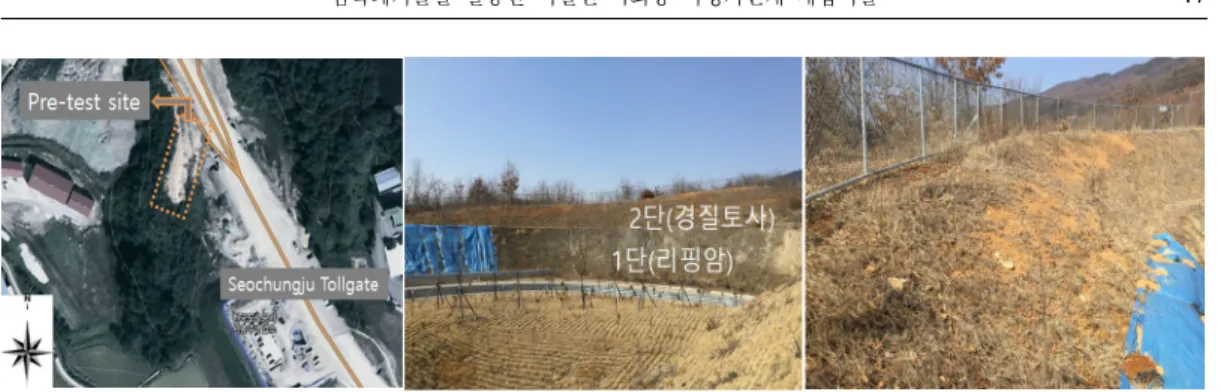
시험시공 대상지 위치는 충북 충주시 신니면 모남리 일대 서충주 톨게이트 회차로 옆 비탈면 으로 길이 150m, 높이 10m로 총 면적은 약 1,100㎡이다. 비탈면 방위는 동사면으로 윗단은 경질토사로 경사 약 60°, 아랫단은 리핑암으로 약 60°의 경사를 이루고 있다(Figure 1).
2. 공시재료
본 연구에 이용된 종자배합은 ‘도로비탈면 녹 화공사의 설계 및 시공 지침(MLTMA, 2009)’의 기타 적용지역의 두꺼운 식생기반재뿜어붙이기 (두께 5㎝ 이상) 종자배합량 조견표 중 초본․
관목 혼합형 종자배합을 기준으로 적용하였다 (Table 1).
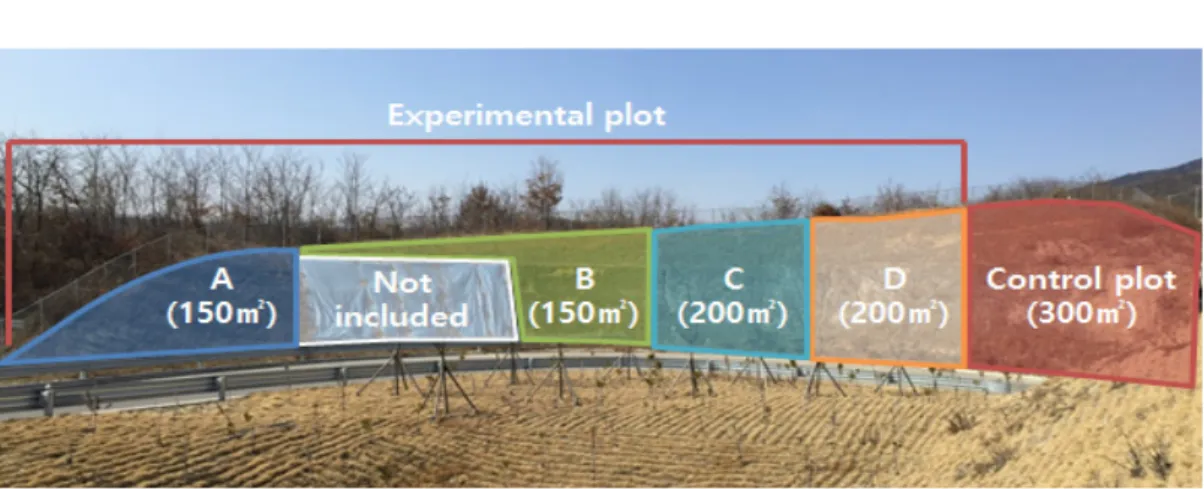
식생기반재의 재료 배합에 사용된 임목폐기물 은 경기도 안성의 벌목을 진행하는 임목을 10mm 이하로 파쇄 후 이물질 선별 및 제거 과정을 거쳐 조달되었다. 고령토는 경주 성주에서, 규사는 강 릉 주문진에서 재료가 조달되었다. 고령토, 규사, 임목, 제지 슬러지, 오니 등 재료를 적정 배합한 후 법면녹화 스크린 선별기를 통해 최종적으로 이물질 제거 과정을 실시하였다(Table 2). 시험시 공은 2015년 4월에 재료배합 비율(부피비를 기 준)을 달리한 4가지 실험구(A, B, C, D)와 유리슬 러지를 이용한 녹생토를 대조구로 설정하여 Figure 2와 같이 대상지에 실시하였다.
Figure 1. Current state of experimental plot.
3. 시험시공 모니터링 항목 및 방법
시험시공 모니터링 조사 항목은 MLTMA (2009)를 기본으로 Kwon(2013), Koh et al.
(2010b), Jang et al.(2012) 등 선행연구 내용을
검토하여 조사 항목을 도출하였다. 도출된 조사 항목의 신뢰도 향상을 위해 전문가들의 자문회 의를 통해 의견을 수렴하여 최종적으로 조사항 목을 선정하였다.
Division Native trees (30%) Native grass (60%) Exotic grass (10%)
Plant name
Rhus javanica L.
1.8Lotus corniculatus var.
japonica Regel
6.0Festuca arundinacea
Schreb. 4.0
Lespedeza cyrtobotrya
8.0Dianthus chinensis L.
5.7Lolium perenne L.
3.2Indigofera
pseudo-tinctoria
6.5Astragalus sinicus L.
6.2 - -- -
Centaurea cyanus L.
7.8 - -- -
Silene armeria L.
5.4 - -- -
Coreopsis tinctoria Nutt. 2.8
- -- -
Cosmos bipinnatus Cav.
2.6 - -Total
3 Species 16.3 7 Species 36.5 2 Species 7.212 Species (60)
Table 1. Mixing ratio of applied seeds. (Unit: g/㎡)
Figure 2. Experimental plot mimetic diagram.
Table 2. Mixing ratio of vegetation base materials. (Unit: %)
Division Kaoline +
silica Wood waste Paper mill
sludge Slime
*Clay+
granite soil +sand
Auxiliary
material Polymer
A
10 30 10 10 35 3 2B
20 20 10 10 35 3 2C
30 10 10 10 35 3 2D
40 0 10 10 35 3 2Control zone
glass sludge 20%, sea mineral 10%, loess 20%, cement 10%, phospho-gypsum 5%, vegetable and its by-product materials 35%
*Structure: clay(40%) + silt(40%) + sand(20%)
식생기반재에 대한 물리적 특성분석 항목으 로 유효수분, 공극률, 투수성 등 3개 항목, 화학 적 특성분석 항목으로 산도, 유기물, 전질소, 유 효인산, CEC, 치환성양이온(칼륨, 칼슘, 마그네 슘), EC, 염분 등 10개 항목을 선정하고 Table 3과 같은 분석 방법을 적용하였다.
식생기반재 모니터링 항목은 토양경도, 토양 습도, 탈락 및 붕괴 정도 등 3개 항목, 식생 모니 터링은 목본성립본수, 초본․목본 출현종수, 피 복률, 병충해 유무, 생태계교란생물 및 위해종 등 5개 항목을 선정하였다. 식생기반재 모니터 링 및 식생 모니터링 방법은 MLTMA(2009)에 서 제시하는 조사방법을 참고하였다.
4. 시험시공 모니터링 시기
MLTMA(2009)의 녹화공법 평가 일정에 따라 식생모니터링은 1차 모니터링(2015년 5월), 2차 모니터링(2015년 8월), 3차 모니터링(2015년 10 월) 등 총 3회에 걸쳐 실시하였다. 토양경도, 토 양습도, 탈락 및 붕괴지점 등 식생기반재에 대 한 모니터링은 모니터링 결과의 신뢰도를 높이 기 위해 총 5회(2015년 5월, 2015년 6월, 2015년 8월, 2015년 9월, 2015년 10월)에 걸쳐 조사를 실시하였다.
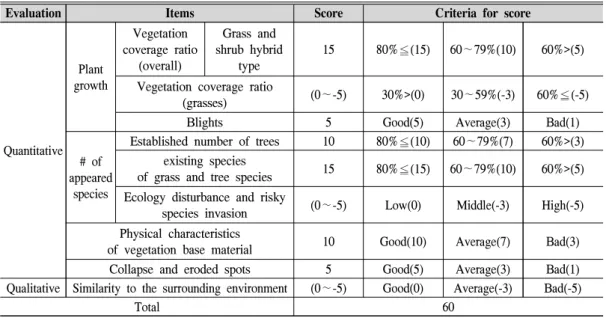
5. 녹화공법 평가기준
MLTMA(2009)의 녹화공법 평가표 중 본 연구
에서 적용가능한 품질 관련 항목을 중심으로 평 가기준을 제시하였다. 경제성 및 품질 관련 일부 항목(식생생육량, 녹화 지속성 및 식생침입 가능 성)을 제외한 품질기준에 한해 60점 만점으로 평 가하였으며, 기존 평가방법을 고려하여 녹화 공 법이 선정 가능한 점수 75점
1)을 비율로 환산하 여 45점 이상인 녹화공법에 대하여 우수 녹화공 법으로 평가하였다(Table 4).
임목폐기물과 고령토의 배합 비율에 따른 식 생기반재와 물리적·화학적 분석 항목(유효수분, 공극률, 투수성, 산도, 유기물, 전질소, 유효인산, CEC, 치환성양이온(칼륨, 칼슘, 마그네슘), EC, 염분) 및 모니터링 항목(토양경도, 토양습도, 목 본성립본수, 출현종수) 간의 상관관계를 확인하 기 위하여 SPSS 프로그램(SPSS 17.0, IBM SPSS Inc., Chicago, IL, USA)을 이용하여 상관 분석 및 회귀분석을 수행하였다.
Ⅲ. 결과 및 고찰
1. 식생기반재 물리적 특성 분석 1) 식생기반재 유효수분
식생기반재의 유효수분은 수분특성식을 이용
1) MLTMA(2009)에 따르면 녹화평가점수가 100점 만 점 중 75점 이상인 녹화공법을 선정하도록 되어 있다.
Physical character-
istics
Available soil water Porosity Permeability
Pressure equilibrium method Dry gravimetric method Constant water method
Chemical character-
istics
Acidity (pH)
Organic material
(%)
Total Nitrogen
(%)
Available phosphate (㎎/㎏)
CEC (cmol/㎏)
Exchangeable cation(cmol/㎏) EC (dS/m)
Salinity Potassium Calcium Magnesium (%)
pH- meter
Dry oxidation
method Dry oxidation
method
Lancaster 1N- Ammonium
acetate leaching
method
Atomic Absorption Spectroscopy method
EC- meter
Morhr’s method
Table 3. Analysis method of physical and chemical characteristics of the vegetation base materials.
해 포장용수량, 위조점을 계산하여 유효수분함 량을 도출하였으며, 포장용수량은 33kPa, 위조 점은 1,500kPa을 기준으로 하였다.
실험구에서 유효수분함량은 A에서 가장 높 게, D에서 가장 낮은 것으로 분석되었으며, 임 목폐기물의 비율이 증가함에 따라 포장용수량 이 증가하여 그로 인해 유효수분함량 또한 높게 나타났다. 임목폐기물이 배합되지 않고 고령토+
규사의 비율이 가장 높은 실험구 D에서는 위조 점이 다른 실험구에 비해 높은 값을 나타내었다 (Table 5).
2) 식생기반재 공극률 및 투수성
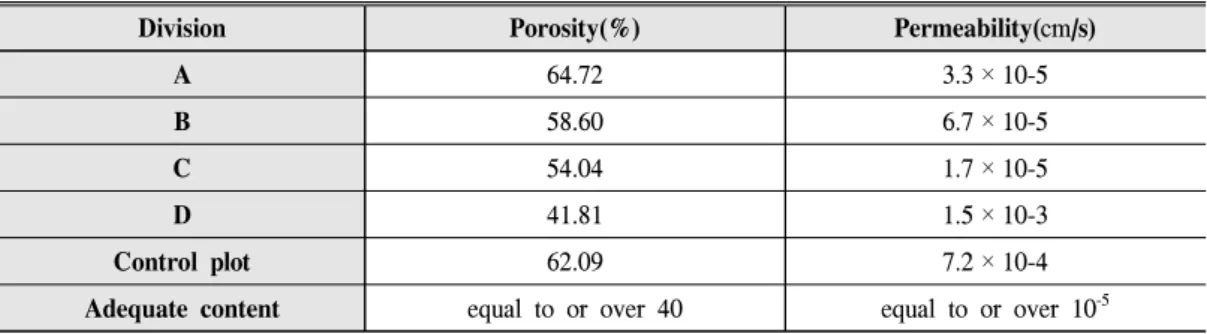
공극률은 임목폐기물의 비율이 높을수록 높은 값을 나타내며, 실험구 A에서 가장 높고 실험구 D에서 가장 낮은 것으로 분석되었다(Table 6). 투 수성은 실험구 내에서는 D에서 가장 높고 C에서 가장 낮아 공극률과 달리 일정한 경향을 나타내 지 않았다. 일반적으로 공극률과 투수성은 관련 이 있다고 볼 수 있지만 공극률이 공극의 크기를 반영하지 않기 때문에 공극률이 높더라도 미세 공극이 주로 발달한 경우에는 투수성을 향상시 키지 못하고, 반대로 공극률이 낮더라도 대공극
Division
Moisture characteristic equation (x=Water potential, y=Volumetric
water content)
Field capacity(%) Wilting point(%) Available soil water(%)
A
y = -14.28ln(x)+103.59 50.59 7.83 42.76B
y = -11.65ln(x)+86.928 43.13 9.34 33.79C
y = -11.111ln(x)+81.331 40.20 6.57 33.63D
y = -6.642ln(x)+57.161 33.53 11.59 21.94Control plot
y = -3.356ln(x)+36.733 25.00 4.46 20.54Adequate content*
Available water: equal to or over 4.0*Source: KILA(2013)
Table 5. Results of available water analysis of the vegetation base materials.
Evaluation Items Score Criteria for score
Quantitative Plant growth
Vegetation coverage ratio
(overall)
Grass and shrub hybrid
type
15 80%≦(15) 60∼79%(10) 60%>(5)
Vegetation coverage ratio
(grasses) (0∼-5) 30%>(0) 30∼59%(-3) 60%≦(-5)
Blights 5 Good(5) Average(3) Bad(1)
# of appeared
species
Established number of trees 10 80%≦(10) 60∼79%(7) 60%>(3) existing species
of grass and tree species 15 80%≦(15) 60∼79%(10) 60%>(5) Ecology disturbance and risky
species invasion (0∼-5) Low(0) Middle(-3) High(-5) Physical characteristics
of vegetation base material 10 Good(10) Average(7) Bad(3) Collapse and eroded spots 5 Good(5) Average(3) Bad(1) Qualitative Similarity to the surrounding environment (0∼-5) Good(0) Average(-3) Bad(-5)
Total 60
Table 4. Evaluation criteria of slope revegetation measure.
이 주로 발달한 경우에는 투수성이 크게 증가하 는 것으로 판단된다(Cho et al., 2015a).
3) 식생기반재와 물리적 특성의 상관관계 식생기반재의 고령토 및 임목폐기물의 배합
비율과 물리적 특성인 유효수분, 공극률, 투수성 간의 상관관계를 확인하기 위하여 대조구 결과 의 포함 유무에 따라 각각 회귀분석을 수행하였 다(Figure 3). 대조구의 결과 값을 제외한 회귀분 석의 결과는 고령토의 배합비율이 증가할수록 Table 6. Results of porosity, permeability analysis of the vegetation base materials.
Division Porosity(%) Permeability(cm/s)
A
64.72 3.3 × 10⁻⁵B
58.60 6.7 × 10⁻⁵C
54.04 1.7 × 10⁻⁵D
41.81 1.5 × 10⁻³Control plot
62.09 7.2 × 10⁻⁴Adequate content
equal to or over 40 equal to or over 10-5Figure 3. Relationships between physical characteristics(available soil water, porosity and permeability)
and mixing ratio(kaoline+silica and wood waste) of the vegetation base materials(Including control plot, n=5; Except control plot, n=4; *p< 0.05).*Red and Blue dash line indicate ‘Including control plot’ and ‘Except control plot’, respectively.
유효수분, 공극률은 감소하는 경향을 나타내었 으며 투수성은 증가되는 경향을 나타내나 공극 률과의 관계를 제외하고는 통계적 유의성을 나 타내지 못하였다(p<0.05). 임목폐기물의 경우 배 합비율이 증가할수록 유효수분, 공극률은 증대
되고 투수성은 감소한 결과를 나타내었으며 이 중 공극률과의 관계에서만 통계적으로 유의하였 다 (p<0.05). 대조구를 포함한 회귀분석 수행 결 과, 통계적으로 유의한 결과는 고령토와 공극률 (p<0.05) 및 임목폐기물과 유효수분(p<0.05)의
Division Acidity
(pH)
Organic material
(%)
Total Nitrogen
(%)
Available phosphate (mg/kg)
CEC (cmol/kg)
Includingcontrol plot
kaoline+silica
mixing ratio(%) 0.730 -0.856 -0.856 -0.830 -0.944*
wood waste
mixing ratio(%) -0.076 -0.279 -0.291 -0.113 -0.089
Except control plot
kaoline+silica
mixing ratio(%) 0.548 -0.986* -0.979* -0.619 -0.886
wood waste
mixing ratio(%) -0.548 0.986* 0.979* 0.619 0.886
Division Exchangeable cation(cmol/kg) EC
(dS/m)
Salinity Potassium Calcium Magnesium (%)
Including control
plot
kaoline+silica
mixing ratio(%) -0.799 -0.831 -0.827 -0.597 -0.214
wood waste
mixing ratio(%) -0.762 -0.334 -0.241 -0.623 0.839
Except control plot
kaoline+silica
mixing ratio(%) -0.990** -0.941 -0.622 0.738 -0.800
wood waste
mixing ratio(%) 0.990** 0.941 0.622 -0.738 0.800
*p<0.05; **p<0.001
Table 8. Correlation coefficients between chemical characteristics and mixing ratio(kaoline+silica and wood waste)
of the vegetation base materials(n=5).Division Acidity (pH)
Organic material
(%)
Total Nitrogen
(%)
Available phosphate (㎎/㎏)
CEC (cmol/㎏)
Exchangeable cation(cmol/㎏) EC (dS/m)
Salinity Potassium Calcium Magnesium (%)
A
7.5 3.22 0.211 382 9.08 0.72 6.78 1.27 2.19 0.014B
7.8 2.07 0.174 427 8.68 0.64 5.98 0.64 2.17 0.017C
7.8 1.64 0.160 401 8.44 0.47 5.90 0.62 2.43 0.011D
7.7 0.74 0.110 312 6.20 0.32 4.45 0.79 2.34 0.008Control
plot
7.5 9.39 0.481 515 11.12 0.59 14.53 2.09 3.55 0.009Adequate
content*
6.0~8.0 3.0≦ 0.06≦ 100≦ 6.0≦ 0.6≦ 2.5≦ 0.6≦ < 1.0 < 0.5*Souce: MLTMA(2009) and KILA(2013)
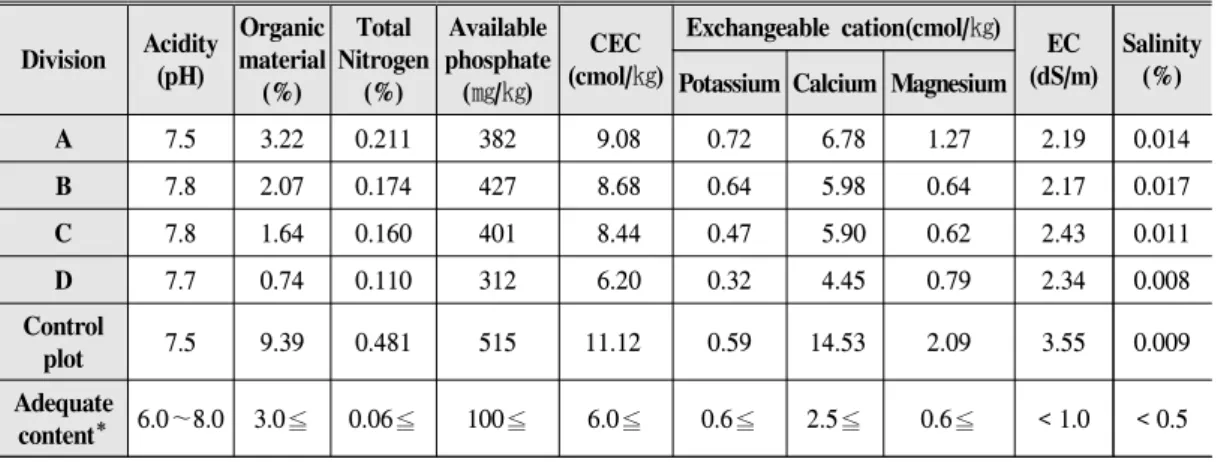
Table 7. Results of the Chemical characteristics of the vegetation base materials.
관계에서 확인되었다. 이러한 결과를 토대로 유 효수분은 고령토보다는 임목폐기물의 배합비율 이 증가할수록 증대되는 것으로 판단되며 공극 률은 고령토의 배합비율이 증대될수록 감소하는 것으로 사료된다. 투수성의 경우 고령토와 임목 폐기물의 비율에 상반되는 양상을 나타내나 유 의미한 결과를 보이지는 않았다.
2. 식생기반재 화학적 특성 분석
식생기반재 화학적 특성 분석결과, 모든 실험 구에서 EC를 제외한 항목 모두 적정함량 기준 에 적합한 것으로 분석되었다. 대체로 유기물함 량과 전질소, 유효인산, CEC, 치환성양이온은 임목폐기물의 비율이 높을수록 높은 값을 나타 냈다(Table 7).
식생기반재와 화학적 특성 간의 상관관계를 분석하였으며 대조구를 포함한 분석결과는 (Table 8) 고령토 배합비율과 CEC 간의 유의한 음의 상관관계(p<0.05)를 보였으며 그 외 식생 기반재 처리 비율과 토양의 화학적 성분의 유의 한 상관관계는 확인되지 않았다. 그러나 대조구 를 제외한 식생기반재와 화학적 특성의 상관관 계 분석결과 고령토 배합율과 유기물 함량, 총 질소, 칼륨(K) 간에 통계적으로 유의한 상관관 계를 확인하였으며 임목폐기물의 배합비율은 고령토 배합비율의 상관관계 분석결과와 반대 의 결과를 나타내었다. 이러한 분석결과를 통해 고령토의 배합비율이 증가할수록 유기물 함량,
총질소, 칼륨은 감소하며 반대로 임목폐기물의 배합비율이 증가할수록 유기물함량, 총질소, 칼 륨은 증대되는 것으로 확인되어 화학적 특성의 증대는 고령토의 배합비율보다는 임목폐기물의 배합비율에 의한 것으로 판단된다.
3. 식생기반재 모니터링 결과 1) 토양경도 변화
식생기반재 토양경도 변화는 Figure 4와 같 다. 임목폐기물 비율에 따라 변화를 살펴보았지 만 비율에 따른 변화양상은 나타나지 않았다.
토양경도는 대조구를 제외하고 평균 18.22∼
19.36mm로 나타나 토양경도 적정기준(MLTMA, 2009)에 따라 식물의 근계생장에 적당한 값으로 측정되었다.
2) 토양습도 변화
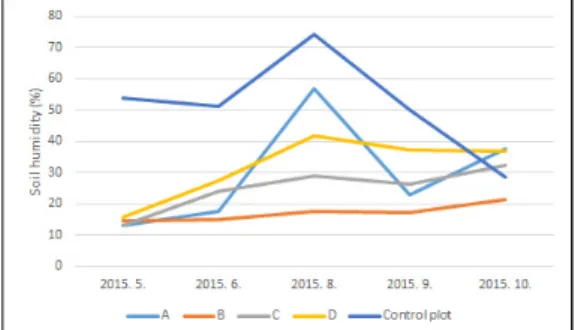
식생기반재 토양습도 변화는 Figure 5와 같다.
토양습도는 토양경도와 마찬가지로 임목폐기물 비율에 따른 변화양상을 살펴보았지만 비율에 따른 특이사항은 나타나지 않았다. 토양습도의 조사 결과는 대조구를 제외하고 평균 17.14∼
31.72%로 나타났다.
3) 탈락 및 붕괴
식생기반재의 안정성을 평가하기 위해 탈락 및 붕괴지점을 파악하였다. 모니터링 기간 동안 모든 실험구 및 대조구에서 탈락과 붕괴가 발생
Figure 4. Changes in soil hardness for the vegetation
base materials.Figure 5. Changes in soil humidity for the vegetation
base materials.한 지점은 관찰되지 않았다. 토양경도 조사결과 평균값이 18mm 이상으로 안정적으로 비탈면을 유지하고 있는 것으로 판단되나, 향후 탈락 및 붕괴지점이 발생할 수 있으므로 지속적인 모니 터링이 필요하다고 판단된다.
4. 식생 모니터링 결과 1) 목본성립본수
목본성립본수에 대한 판정 방법은 1m×1m 방 형구를 설치하고 목본의 성립본수를 10회 조사 하여 본수/㎡로 평균하여 각 실험구별 목본성립 본수를 비율로 나타냈다. 모니터링 결과 실험구 B에서 가장 높은 비율을 나타냈으며 대조구에 서 가장 낮은 비율을 보였다(Table 9).
2) 초본․목본 출현종 수
초본 및 목본류의 출현종수에 대한 판정 방법 은 각 위치별 사용종과 출현종을 조사하여 목표 대비 출현비율을 통해 비교하였다. 대조구를 포 함한 실험구 C, D에서 출현 비율이 58.3%로 나 타나고 실험구 A(50.0%), 실험구 B(41.7%) 순 으로 출현 비율이 나타났다(Table 10). 목본으로 는 붉나무, 초본으로는 자운영, 외래 초종으로 는 페레니얼라이그라스가 출현하지 않아 향후 지속적인 모니터링을 통해 추가 연구가 필요하 다고 판단된다.
3) 피복률
실험구별 식생피복률은 Table 11과 같다. 전 체피복률은 대상지에 설치되어 있는 방형구 (1m×1m)를 이용하여 3회 측정 후 산술평균하 여 전체피복도로 환산하거나 현장에서 육안으 Table 9. Evaluation of established number of trees with experiment zones. (Unit: # of trees/㎡)
Division Experiment zone
A B C D Control plot
Recovery target Grass and shrub hybrid model (3 tree)
Established number of trees 1.67 2.97 2.86 1.06 0.37
Ratio(%) 56 99 95 35 12
Table 10. existing species of grass and tree species at monitored slopes. (●: appeared, ○: non-appeared)
Division Plant name A B C D Control plot
Trees
Rhus javanica L.
○ ○ ○ ○ ○Lespedeza cyrtobotrya
● ● ● ● ●Indigofera pseudo-tinctoria
○ ● ● ● ●Sub-Total 1 2 2 2 2
Native grass
Lotus corniculatus var. japonica Regel
● ● ● ● ●Dianthus chinensis L.
○ ○ ● ● ○Astragalus sinicus L.
○ ○ ○ ○ ○Centaurea cyanus L.
● ● ● ● ●Silene armeria L.
○ ○ ○ ○ ●Coreopsis tinctoria Nutt.
● ○ ○ ○ ○Cosmos bipinnatus Cav.
● ○ ● ● ●Sub-Total 4 2 4 4 4
Exotic grass
Festuca arundinacea Schreb.
● ● ● ● ●Lolium perenne L.
○ ○ ○ ○ ○Sub-Total 1 1 1 1 1
Total 6 5 7 7 7
Ratio(%) 50.0% 41.7% 58.3% 58.3% 58.3%
로 실측 또는 사진촬영 후 실내에서 피복률을 계산하였다.
2015년 5월 조사결과는 시험시공 초기 조사 결과로 전반적으로 피복률이 낮은 것으로 조사 되었으나, 실험구 C의 경우 상대적으로 피복률 이 높게 조사되었다. 전반적인 식물출현 특성은 시공 초기인 관계로 이입종은 거의 조사되지 않 았고, 출현하더라도 1~2개체 정도로 나타났다.
또한 덩굴성식물의 이입도 조사되지 않았으며, 초기 피복률을 높인 종으로 초본은 외래종인 톨 훼스큐 및 수레국화, 목본 은 참싸리로 조사되 었다.
2015년 8월과 10월 조사결과는 조사 초기에 비해 우점종의 변화가 상대적으로 심했으며 우 점종의 경우 파종식물이 우점하는 지점과 이입 종이 우점하는 지점이 유사한 비율로 나타났다.
우점종의 경우 계절적인 영향으로 인해 낭아초, 참싸리, 코스모스 등의 파종식물이 높은 비율로 나타났으며 도로 및 산림과 인접해 있는 환경을 고려했을 때 참쭉, 바랭이 등 이입종 또한 나타 난 것으로 판단된다.
4) 병충해 유무
시험시공 후 수시로 파종 식물의 병충해 발생 유무를 동정하였다. 조사결과 모든 조사구에서 병충해가 발생하지 않았다.
5) 생태계교란 및 위해종
시험시공지역에 환경부에서 지정한 생태계교 란생물(돼지풀, 단풍잎돼지풀, 가시박 등)과 환 삼덩굴, 칡 등과 같은 하부식생을 파괴하는 위 해 수종에 대해 시험시공지 침입여부를 확인하
고 교란정도를 측정하였다. 생태계교란생물은 전 실험구 내에서 발견되지 않았으나 C, D, 대 조구에서 위해종으로 환삼덩굴, 칡 등이 조사되 었다.
6) 식생기반재와 식생의 상관관계
식생기반재 배합비율과 식생 모니터링 결과 로 확인된 목본성립수 및 식물 출현종수 간의 상관관계를 분석하기 위해 대조구 결과의 포함 유무에 따라 각각 회귀분석을 수행하였다(Fig.
6). 대조구를 포함한 식생기반재와 식생의 상관 관계 결과는 선형관계보다는 비선형인 2차 다 항식의 관계를 나타내고 있으나 통계적으로 유 의하지는 않았다. 반면 대조구를 제외한 분석에 서는 목본성립수가 고령토 및 임목폐기물의 배 합비율과 유의한 상관관계를 확인하였으며 (p<
0.05) 대조구를 포함한 관계와 동일한 2차 다항 식의 관계를 나타내었다. 그러나 식물 출현종수 와는 유의한 상관관계가 확인되지 않았다. 이러 한 상관분석 및 회귀분석 결과로 식생기반재로 서 식생의 활착에 가장 적절한 배합비율은 고령 토 20~30%, 임목폐기물 10~20%가 적절한 것으 로 판단되며 추후 장기간의 모니터링을 통해 식 생기반재 비율의 장기적인 타당성 및 효과에 대 한 검토가 필요할 것으로 사료된다.
5. 녹화공법 평가
실험구별 녹화공법에 대한 평가는 <Table 12>과 같다. 임목폐기물 비율에 따른 평가결과 C 실험구가 47점으로 가장 높게 나타났으며, 다 음으로 B, A, D 및 대조구 순으로 나타났다.
이 중 45점 이상의 평가점수를 만족하는 배합 Table 11. Results of the overall coverage ratio of experiment zone. (Unit: %)
Division A B C D Control plot
May 2015
42 13 70 30 8Aug 2015
100 100 100 100 100Oct 2015
100 88 97 100 90Table 12. Evaluation results of slope revegetation measures.
Evaluation Items Score A B C D Control
plot
Quantitative Plant growth
Vegetation coverage ratio
(overall)
Grass and shrub hybrid
type
15 15 10 15 10 10
Vegetation coverage ratio
(grasses) (0∼-5) 0 0 0 -3 0
Blights 5 5 5 5 5 5
# of appeared
species
Established number of trees 10 3 10 10 3 3
existing species
of grass and tree species 15 5 5 5 5 5
Ecology disturbance and risky
species invasion (0∼-5) 0 0 -3 -3 -3
Physical characteristics
of vegetation base material 10 10 10 10 10 7
Collapse and eroded spots 5 5 5 5 5 5
Qualitative Similarity to the surrounding environment (0∼-5) 0 0 0 0 0
Total 60 43 45 47 32 32
Ranking - 3 2 1 4 4
Figure 6. Relationships between established number of trees, total plant species and mixing ratio(kaoline+silica
and wood waste) of the vegetation base materials(n=5).*Red and Blue dash line indicate ‘Including control plot’ and ‘Except control plot’, respectively.
비율은 실험구 C와 B로 나타났으며, 대조구를 포함한 다른 배합비율에 대해서는 해당 점수에 만족하지 못하는 평가결과가 나타났다.
따라서 실험구 C와 B의 식생기반재 배합비율 인 임목폐기물 10~20%, 고령토+규사 20~30%, 제지슬러지 10%, 오니 10%, 점토+마사토+모래 35%, 보조재료 3%, 고분자재 2%의 배합비율에 서 식생기반재로써의 가능성을 확인하였다.
IV. 결 론