*Corresponding author: Sun-Ju Kim
Phone: +82-42‐821‐6738; Fax: +82‐42‐821‐7142;
E-mail: [email protected]
Korean J Environ Agric. 2018;37(3):197-206. Korean Online ISSN: 2233-4173
Published online 2018 September 30. https://doi.org/10.5338/KJEA.2018.37.3.25 Print ISSN: 1225-3537
간척지 토양에서 양액의 전기전도도가 비트 및 순무의 생장에 미치는 영향
조지영1, 성호영1, 천진혁1, 박종석2, 박상언3, 박영준4, 김선주1*
1충남대학교 농업생명과학대학 생물환경화학과, 2충남대학교 농업생명과학대학 원예학과, 3충남대학교 농업생명과학대학 식물자원학과,
4한국농어촌공사 농어촌연구원
Effects of Electro-conductivity on Growth of Beet and Turnip in the Reclaimed Land Soil
Ji-Young Jo1, Ho-Young Sung1, Jin-Hyuk Chun1, Jong-Seok Park2, Sang-Un Park3, Young-Jun Park4 and Sun-Ju Kim1* (1Department of Bio-Environmental Chemistry, College of Agriculture and Life Sciences, Chungnam National University, Daejeon 34134, Korea, 2Department of Horticulture, College of Agriculture and Life Sciences, Chungnam National University, Daejeon 34134, Korea, 3Department of Crop Science, College of Agriculture and Life Sciences, Chungnam National University, Daejeon 34134, Korea, 4Agricultural Infrastructure, Rural Community & Infrastructure Research Group, Rural Research Institute, Korea Rural Community Corporation, Ansan 15634, Korea)
Received: 6 July 2018/ Revised: 15 September 2018/ Accepted: 19 September 2018 Copyright ⓒ 2018 The Korean Society of Environmental Agriculture
This is an Open-Access article distributed under the terms of the Creative Commons Attribution Non-Commercial License (http://creativecommons.org/licenses/by-nc/3.0) which permits unrestricted non-commercial use, distribution, and reproduction in any medium, provided the original work is properly cited.
ORCID Ji-Young Jo
http://orcid.org/0000-0002-2329-5345 Sun-Ju Kim
http://orcid.org/0000-0003-4872-9637
197
Abstract
BACKGROUND: The present study aimed to examine the crops capable of growing and adapting to the external environment and various stresses of reclaimed agriculture land for the development of high value-added agricultural utilization technology based on reclaimed land through standardization and empirical study of cultivation environment for cultivating crops.
METHODS AND RESULTS: Two crops namely turnips and beets were selected for the salt tolerance test of soil environmental conditions on reclaimed land. Turnip and beet seedlings were planted on the soil collected at the 'Seokmun' reclaimed land. There are five treatments such as non-treatment, 1.0, 2.0 (control), 4.0 and 8.0 dS․m-1 of EC.
The contents of betacyanin in beet roots was highest in control and decreased with increasing salt concentration.
The GSL contents in the turnip roots waswere highest at EC
2.0 and decreased with increasing salt concentration, whereas those in turnip leaves waswere high both in the non-treated control and atthe EC 1.0-treatment. But, tThere was, however, no statistical differences among the treatments.
CONCLUSION: The degree of salt tolerance of crops was examined, and the limit EC iswas expected to be 3.0~4.0 dS․ m-1 as reported to date. If the soil improvement is performed and irrigation systems are used in the actual reclaimed land, the EC of supplied irrigation will be low, and desalination effecttreatment by the lower EC of the supplied irrigation on the soil will lead to more favorable soil condition of the rhizosphere and cultivation environment offor the crops than those in the port experiment. Therefore, monitoring the salinity, water content and ground water level will enable prediction of the rhizosphere environment, and setting up irrigation management and supplying irrigation will lead to crop cultivation results that are close to normal.
Key words: Betacyanins, Electrical conductivity (EC), Glucosinolates, Reclaimed Land, Salt stress
Research Article Open Access
Fig. 1. Chemical structure of betacyanins of Beta vulgaris L. (a), betanin; (b), isobetanin (Florian and Reinhold, 2004).
Fig. 2. Enzymatic desulfation of glucosinolates. (a), glucosinolate; (b), desulfated natural glucosinolate (Kim and Ishii, 2006).
서 론
우리나라는 국토 면적에 비해 상대적으로 경작지가 부족 하기에 이를 해결하기 위하여 간척지를 조성해왔다(Go, 2014).
간척지는 강이나 바다, 호수였던 둑을 쌓고 물을 빼내는 과정 을 통해, 새롭게 탄생한 땅을 의미한다. 간척지는 지하수위가 지면 부위에 있고, 지표면의 수분이 증발됨에 따라 염이 모세 관 현상으로 상승하게 되어 토양의 염 농도가 높아져 작물 재 배에 어려움이 많다(Kim et al., 2011). 토양 중에 Na+과 Cl- 가 많이 존재하면 식물은 염 스트레스를 받는다. 염 스트레스 는 이온의 독성, 수분포텐셜의 저하, 이온의 흡수 및 수송의 억제에 의한 영양불균형을 일으킨다(Munns and Termaat, 1986). 토양에 염류가 심하게 집적되면 특정 이온에 의한 독 성 또는 토양의 수분포텐셜 감소에 따른 수분흡수장애가 나 타나 물질 생산이 크게 저하된다(Lutts et al., 1995;
Volkmar et al., 1998; Lee et al., 2008). 염 스트레스는 수 분 스트레스와 밀접하게 연관되어 있다. 염은 토양의 삼투압 을 낮추어 식물 뿌리의 수분 흡수를 방해하고(Parida and Das, 2005), 과도한 Na+, Cl-이 식물체 내로 흡수되면 세포 의 Na+, Cl- 이온뿐만 아니라 K+, Ca2+ 이온 등의 항상성을 방해하여 세포 내 이온불균형을 유발한다(Hasegawa et al., 2000; Rodriguez et al., 2005).
비트(Beta vularis L.)는 유럽 남부 및 지중해 연안이 원 산지로 쌍떡잎식물강 명아주과(Chenopodiceae)의 두해살이 풀이다. 비트는 칼로리가 낮고 각종 미네랄과 비타민이 풍부 하여 다양하게 건강상의 유익함을 줄 수 있는 식물이다(Yi et al., 2017). 작물의 내염성(saline tolerant)은 식물이 생육하는 배지에서 과도한 염의 영향을 견딜 수 있는 식물의 능력이다.
내염성은 식물의 생육 조건 등 여러 가지 요인, 제한 요소, 조 건 등 때문에 정확한 값으로 정의될 수 없다. 작물의 내염 정 도는 sensitive (S), moderately sensitive (MS), moderately tolerant (MT), tolerant (T)로 구분하고 그 이상에서는 재배 가 불가능한 것으로 간주한다. 비트는 MT 등급(내염성 중)이 다(Ahn et al., 2003). 수용성 천연색소인 베타레인(betalains) 을 함유하고 있다. 베타레인은 자주색 색소인 베타시아닌 (betacyanins)과 노란색 색소인 베타크산틴(betaxanthins) 으로 구성되어 있다(Slawomir, 2005). 다시 베타시아닌은 베 타닌(betanin)과 이소베타닌(isobetanin)으로 나누어진다 (Florian and Reinhold, 2004)(Fig. 1). 주요물질인 베타닌 은 항암효과뿐만 아니라 항산화 작용이 높다(Chung and Byun, 2009). 또한 베타닌 색소를 함유한 비트 묘목은 비색 소 묘목보다 식물 병원균 Phythium debaryum에 저항성이 큰 항균성 작용을 하며 비독성 물질로 화장품, 제약, 식품 산 업에 천연색소 첨가물로 이용된다(Gabrela et al., 2004).
순무(Brassica rapa L.)는 양귀비목 배추과(Brassicaceae, 십자화과)의 두해살이풀이다. 중앙아시아와 유럽 남부지방이 원산지이다. 현재 우리나라에서는 강화도 지역의 ‘강화 순무’, 이천의 ‘이천 게걸무’ 등 지방에 따라 다양한 순무가 재배되 고 있으며, 주로 잎과 뿌리 모두 김치의 원료로 활용되고 있
다. 순무는 배추 종(Brassica rapa)의 뿌리가 비대한 것으로 팽이모양이고 육질이 연하고 즙이 많고, 순한 맛을 지니나 매 운맛을 나타낸다(Bang et al., 2009; Jeong et al., 2013;
Lee, 2006). 배추과 식물은 생리활성 물질인 글루코시놀레이 트(glucosinolates, GSLs)를 다량 함유하고 있다(Ko et al., 2017). 순무는 MS 등급(내염성 중약)으로 분류되고, 작물의 내염성(saline tolerant)은 작물의 생장과 생산물의 감소 등 에 악영향을 주지 않으며 염 스트레스에 견딜 수 있는 작물체 의 저항력을 의미한다.
GSLs는 배추과 식물들의 2차 대사산물로 양배추(B.
oleracea var. capitata), 무(Raphanus sativus), 케일 등에 많이 들어 있다(Cartea et al., 2008)(Fig. 2). 질소와 황을 함 유하고 있는 배당체이며 곁사슬 R기에 따라 분류가 되며 (Fahay et al., 2001; Park et al., 2017; Kim et al., 2011), 약 200종 이상 알려져 있다(Clarke, 2010; Kim et al., 2015).
GSLs류 물질들은 그 기본구조에 β-D-glucopyranose를 갖 고 있으며, 7종류 아미노산(alanine, methione, waline, leucine, isoleucine, phenylalanine, tryptophan)으로부터 생합성된다(Fahey et al., 2001; Halkier and Gershenzon, 2006; Jeong et al., 2015). 식물의 조직이 벌레나 바람 등에 의하여 물리적으로 손상될 때, GSLs는 식물체 내에 있는 myrosinase의 가수분해에 의하여 isothiocyanate, thiocyanate 및 nitrile 등을 생성한다. GSLs는 동물실험 연구에서 피부암 을 유발하는 종양을 억제시켜 준다는 결과가 보고되었으며, 최근 이와 같은 여러 가지 약리적, 생리적 활성을 나타내는 것으로 보고되어 많은 관심과 연구가 집중되고 있다(Van Etten et al., 1969; Halkier and Gershenzon, 2006). 그 중에서 GSL 분해 산물인 isothiocyanates는 종양을 저해하 는 성질을 가지고 있으며 간암, 위암 등에 효과가 있을 뿐만
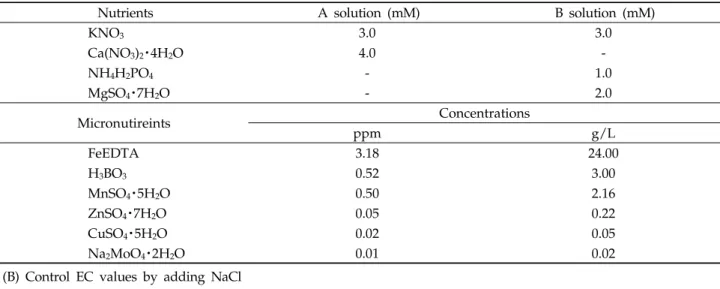
(A) Japanese Enshi A and B nutrient solutions
Nutrients A solution (mM) B solution (mM)
KNO3 3.0 3.0
Ca(NO3)2・4H2O 4.0 -
NH4H2PO4 - 1.0
MgSO4・7H2O - 2.0
Micronutireints Concentrations
ppm g/L
FeEDTA 3.18 24.00
H3BO3 0.52 3.00
MnSO4・5H2O 0.50 2.16
ZnSO4・7H2O 0.05 0.22
CuSO4・5H2O 0.02 0.05
Na2MoO4・2H2O 0.01 0.02
(B) Control EC values by adding NaCl
Treatment JapaneseEnshinutrientsolution in de-ionized water (ml/L)a) NaCl treatment (g/L)
Non-treatment (EC 0.3) 0.00b) 0.00b)
EC 1.0 5.00 dilutedfromthecontrolc)
Control (EC 2.0) 10.00 0.00
EC 4.0 10.00 1.75
EC 8.0 10.00 3.45
a)The stock solutions are made up at 100 times.
b)Only used tap-water.
c)diluted 2 times from the control (EC 2.0) with de-ionized water.
Table 1. Nutrient compositions of (A) Japanese Enshi nutrient solutions and (B) EC values
아니라 생체방어반응에도 관여를 한다(Zhang and Talalay, 1994; Talalay and Zhang, 1996; Halkier and Gershenzon, 2006; Lee et al., 2014).
본 실험에서는 간척지 밭작물 재배 작부체계 매뉴얼 개발 을 위하여 간척지 토양에서 재배 가능한 작물 선별을 목표료 원예작물 중 내염성에 대하여 MT 등급인 비트와 MS 등급인 순무를 양액 재배하여 NaCl 처리 농도(EC 값 기준)에 따른 2차 대사산물인 베타시아닌과 GSL 함량에 미치는 영향을 조 사하였다. 이러한 염농도 수준에 따른 작물의 수량 반응 및 내염성 자료는 간척지 밭에 정식 또는 파종 될 수 있는 작물 을 선발하는데 기초 자료로 활용될 가치가 있다. 그리고 향후 간척지에 도입될 가능성이 있는 경제작물을 위한 염농도 및 수분 관리 기술 개발 연구에 활용이 가능하다.
재료 및 방법 시약
개미산(formic acid, HCOOH)은 Samchun Chemicals (Gyeonggi-do, Korea)에서 구입하였다. Acetonitrile (CH3CN), methanol (MeOH, CH3OH)은 J.T. Baker Chemical Co.
(Phillipsburg, NJ, USA) 것을 사용하였다. Sodium acetate (NaC2H3O2․3H2O)와 ethanol (EtOH)은 Samchun Pure
Chemical Co., Ltd. (Pyeongtaek, Korea)에서 구입하였다.
컬럼 충진물인 DEAE-Sephadex A-25는 GE Healthcare Bio-Sciences AB (Uppsala, Sweden)것을 사용하였고, aryl sulfatase (type H-1, EC 3.1.6.1)와 글루코시놀레이트 표준 품인 sinigrin (2-propenyl GSL)은 Sigma-Aldrich Chemical Co.에서 구입하였다. 베타시아닌의 표준품인 베타닌(betanin) 은 Aldrich Chemistry Co. Inc. (Milwaukee, WI, USA) 을, Sep-pak Plus C18 Cartridges는 Waters (Milford, Delaware, USA) 것을 사용하였다.
토양 채취 및 분석
석문 간척지(충청남도 당진시 송산면 가곡리 송산2공구 7 단지) 토양을 채취하여 포트실험(간척지 토양 2.34 kg)을 하 였다. 간척지 토양을 채취할 때 토양 수분(37.8%), 토양 온도 (28.3℃), 토양 전기전도도(EC, 3.8~4.3 dS․m-1)를 측정하였다.
비트 및 순무 재배
시중에서 구입한 비트[‘제일비트’, 제일종묘재단]와 순무 [‘강화순무’, 아시아종묘㈜]를 2017년 9월 2일(0 DAS, days after sowing) 충남대학교 농업생명과학대학 부속 유리온실 에서 육묘 트레이(plug tray, 105홀)에 파종하였다. 파종을 하고 육묘 트레이르 신문지로 덮고 물을 주어 발아의 적정 습
도를 유지시켰다. 비트는 55개, 순무는 50개를 파종 하였고, 각각 100, 98%의 발아율을 나타내었다. 파종 후 7일(7 DAS) 에 비트와 순무는 중형포트(13×13×15 cm3, 간척지 토양 2.34 kg)에 이식하였다. 각 포트는 양액을 처리할 때마다 그 위치를 순환시켜 재배환경을 균일하게 하였다. 이식 후 뿌리 활착 및 실험에 맞는 적정 생육단계까지 생육을 하였다. 평균 온도 23°C, 광량 180~205 μmol․m-2․s-1, 광주기 주/야 11/13 h, 습도 9~12%인 환경에서 재배를 하였다.
일본원예처방액에 의한 전기전도도 (EC) 값 조절 무처리구는 수돗물, 대조구는 EC 2.0, 실험구는 EC 1.0, EC 4.0, EC 8.0으로 구분하여 실시하였다. 무처리구는 수돗 물(EC 0.3), 양액 EC 값은 일본원예처방액(Kimiharu et al., 2010)을 기본으로 해서[대조구(EC 2.0)] NaCl를 첨가하여 EC 4.0, EC 8.0으로 조절하고, EC 1.0은 희석하였다(Table 1).
한 실험구당 비트, 순무 시료는 4반복으로 하고, 일본원예처 방액은 1주 2회씩, 총 4주간 처리하였다. 수확한 작물은 실험 구별 생육상태(엽장, 엽폭, 생체중 등)를 측정하고, 동결건조 후 막자와 막자사발로 분말화 하였다.
베타시아닌 추출 및 분석
분말시료(100 mg)를 칭량하여 2.0 mL-eppendorf tube 에 넣고 2.0 mL 초순수를 넣고 5분 동안 진동혼합(vortex) 한 후 초음파 분산기(sonicator)로 15분간 약하게 초음파 처 리(sonication)를 하였다. 그 다음 원심분리(15,000 rpm, 4℃, 15 min) 한 후, Sep-pak Plus C18 Cartridges을 통과 시 켜 추출물을 정제시켰다. Sep-pak Plus C18 Cartridges는 미 리 2.0 mL 100% 메탄올(MeOH)로 활성화 시킨 후 2.0 mL 초순수로 씻었다. 상층액을 넣은 다음 5% 에탄올(EtOH)로 붉은 색이 다 빠져나올 때까지(8~10 mL) 넣어 주어 시료를 용출시켰다. 용출된 시료는 0.45 µm hydrophilic PTFE syringe filter (직경 13 mm)로 여과한 후, 감압농축기로 EtOH이 완전히 제거될 때까지 농축시켰다. 농축 시료를 1.0 mL EtOH와 1.0 mL 증류수를 넣어 녹인 다음 HPLC용 갈 색 vial병에 담아 HPLC로 분석하였다.
베타시아닌 분석은 Synergi 4 µ POLAR-RP 80A 컬럼 (250×4.6 mm, 4 µm Phenomenex)을 장착한 1200 series HPLC (Agilent Technologies, CA, USA)를 사용하였다.
분석 조건은 검출 파장(detection wavelength) 538 nm, 유량 (flow rate) 1.0 mL/min, 컬럼 온도(column temperature) 35°C로 설정하여 분석하였다. 시료는 자동 주입기(automatic injector)를 사용하여 20.0 μL 주입하였다. 이동상 용매는 solvent A[water: formic acid, (99: 1, v/v)]와 solvent B (acetonitrile, CH3CN)를 사용하였다. 용매 구배는 solvent B를 기준으로 실시하였고 총 25분의 분석 시간이 소요되었 다. Solvent B는 처음에 0%로 시작하여 15분까지 20%로 증 가시킨 후 20분까지 40%로 증가시켰다. 20.1분에 0%로 급격 히 감소시킨 후 25분까지 0%를 유지시켰다. 분석된 각 성분 은 외부표준물질인 Betanin의 머무름 시간(retention time,
RT)이 동일하여 동정하였고, HPLC 피크 면적(area)을 기준으 로 각 베타시아닌 성분의 피크 면적을 비교하여 정량하였다.
GSL 추출 및 HPLC 분석
GSL 추출 및 HPLC 분석은 여러 논문을 참고하여 시행 하였다(Jeong et al., 2015; Kim et al., 2011; Lee et al., 2014; Kim et al., 2015; Park et al., 2017). 동결 건조된 분 말 시료 100 mg을 칭량하여 2.0 mL-Eppendorf tube에 넣 고, 70%(v/v) boiling MeOH 1.5 mL를 넣어 진동혼합 (vortex)하였다. 진동혼합 후 항온수조(75℃)에서 5분간 조 (crude) GSLs를 추출하였다. 이후 2.0 mL-Eppendorf tube를 원심분리(12¸000 rpm, 4°C, 10 min)하였고, 분리된 상층액은 시험관(test tube)에 수거하였다. 위 과정을 동일하 게 2회 더 반복하여, 총 3회 실시하였고 각 상층액을 수거하 여 합하였다. Mini-column (1¸000 µL pipet tip) 충진용 DEAE Sephadex A-25는 초순수에 녹여서 분액여두에 넣은 다음 초순수가 거의 빠져나간 다음에 sodium acetate (0.5 M)를 넣어 H+ 형태로 활성화하여 사용하였다. Mini-column 은 아래 부분을 탈지면으로 막은 다음 활성화된 DEAE Sephadex A-25를 5 cm가량 채운 뒤 GSL 조 추출물(crude extract)을 pasteur pipet으로 로딩하였다. 추출물이 빠져나 가면 초순수 2 mL를 pasteur pipet으로 로딩하였다. 초순수가 다 빠져나가면 mini-column 아래 끝 부분을 paraffin film으 로 새어나가지 않게 막고, mini-column에 aryl sulfatase solution 75 µL을 넣은 뒤 위 끝 부분을 paraffin film으로 막았다. 봉합된 mini-column은 16~18시간 동안 상온에 정 치 한 후, 2.0 mL-Eppendorf tube에 초순수 0.5 mL로 3회 반복하여 용출하였다. 용출시킨 시료는 0.45 µm hydrophilic PTFE syringe filter (직경 13 mm)로 여과한 후, HPLC용 갈색 vial병에 담아 HPLC로 분석하였다.
GSL 분석은 Inertsil ODS-3 column(150×3.0 mm I.D., particle size 3 μm), 가드 컬럼은 Inertsil ODS-2 Cartridge Guard column E(10×2.0 mm I.D., particle size 5 μm) (GL Science, Tokyo, Japan)을 사용하였고 HPLC(Agilent Technologies, CA, USA)를 이용하여 분석 하였다. 분석 조건은 검출 파장(detection wavelength) 227 nm, 유량(flow rate) 0.4 mL/min, 컬럼 온도(column temperature) 40°C로 설정하여 분석하였다. 시료는 자동 주 입기(automatic injector)를 사용하여 10.0 μL 주입하였다.
이동상 용매는 solvent A(초순수)와 solvent B(acetonitrile, CH3CN)를 사용하였다. 용매 구배는 solvent B를 기준으로 실시하였고 총 27분의 분석 시간이 소요되었다. Solvent B는 처음 2분까지는 0%로 유지시키고 7분에 0에서 10%로 증가 시키고, 16분에는 10에서 31%로 증가시켰다. 19분에는 31%
를 유지시키고 21분까지 31에서 0%로 감소, 27분에는 0%를 유지시켰다. 각 GSL 성분은 본 연구진의 실험실 내부 HPLC 및 LC-MS 분석자료와 기 발표한 문헌의 자료(Chun et al., 2016)를 참고하여 동정하였고, 외부표준물질인 Sinigrin의 HPLC 피크 면적(area)을 기준으로 각 GSL 성분의 피크 면
Plant Treatment
Leaf Root Fresh weight (g) dry weight (g) water content (%)
length (cm) width
(cm) number length (cm) width
(cm) leaf root leaf root leaf roof
Beet Non-treatment (EC 0.3) 24.5±2.3a 7.7±0.3a 8.3±0.4a 4.9±1.6a 3.3±0.2a 39.6±8.9a 19.7±1.3a 4.03±0.93a 3.45±0.1a 89.8±0.38a 82.4±1.25a EC 1.0 25.6±0.8a 8.3±0.6a 6.8±0.8bc 5.4±1.0a 3.3±0.2a 38.9±5.4a 23.8±4.8a 3.26±0.30a 3.77±0.9a 91.5±1.09a 84.2±1.32a Control (EC 2.0) 26.2±2.1a 8.2±1.1a 8.0±0.7ab 5.1±0.5a 3.1±0.5a 37.4±10.7a 19±6.4a 3.3±0.90a 3.07±0.9a 91.1±0.46a 83.4±2.07a EC 4.0 23.4±1.1a 7.4±0.5a 7.3±0.4abc 3.5±0.3a 2.6±0.5a 27.9±4.3a 11.9±4.3a 2.65±0.55a 2.15±0.7a 90.5±1.36a 81.7±1.10a EC 8.0 22.5±1.6a 7.1±0.6a 6.3±0.4c 4.4±1.0a 2.4±0.3a 25.8±5.2a 13.7±7.6a 2.67±0.29a 2.58±1.3a 89.5±1.02a 80.8±0.78a Turnip Non-treatment (EC 0.3) 29.4±1.9ab 9.7±0.9a 6.3±0.8a 8.0±0.4a 2.5±0.3a 41.4±13.0a 16.2±3.5a 3.19±1.42a 2.44±0.46a 92.5±1.0ab 84.8±0.7a
EC 1.0 32.0±3.1a 10.7±1.6a 6.0±0.0a 8.7±0.3a 2.7±0.4a 48.6±14.5a 20.1±7.3a 3.25±1.11a 2.73±0.97a 93.4±0.3a 86.3±1.1a Control (EC 2.0) 33.3±1.3a 11.6±1.6a 6.8±0.8a 8.8±1.1a 2.0±0.6a 55.2±2.3a 14.3±4.5a 4.05±0.22a 2.56±0.75a 92.7±0.5ab 84.9±1.8a EC 4.0 27.8±2.2ab 10.2±0.6a 6.0±0.0a 8.3±0.9a 2.8±0.5a 42.4±7.9a 16.9±2.9a 3.15±0.64a 2.51±0.54a 92.5±0.8ab 85.2±1.0a EC 8.0 25.8±2.9b 9.3±1.4a 5.8±0.8a 7.9±0.7a 2.5±0.4a 32.3±5.0a 20.2±6.7a 2.8±0.6a 3.1±1.2a 91.5±0.7b 84.8±1.3a
Table 3. Plant growth of beet and turnip (n=4)
Non-treatment
(EC 0.3) EC 1.0 Control
(EC 2.0) EC 4.0 EC 8.0
Beet
Tumip
Table 2. Leaf response of beet and turnip to different EC values
적을 비교하여 정량하였다.
통계분석
HPLC 분석 결과는 Microsoft Office Excel 2010을 이 용하여 각 성분에 대한 함량의 평균값과 반복의 표준편차를 구하였다. 통계처리 프로그램은 Windows용 IBM SPSS 22 Statistics을 사용하였다. 유의수준은 0.05 이하로 설정하였고, Tukey 검정을 시행하여 유의성을 검증하였다.
결과 및 고찰 비트 및 순무 생장
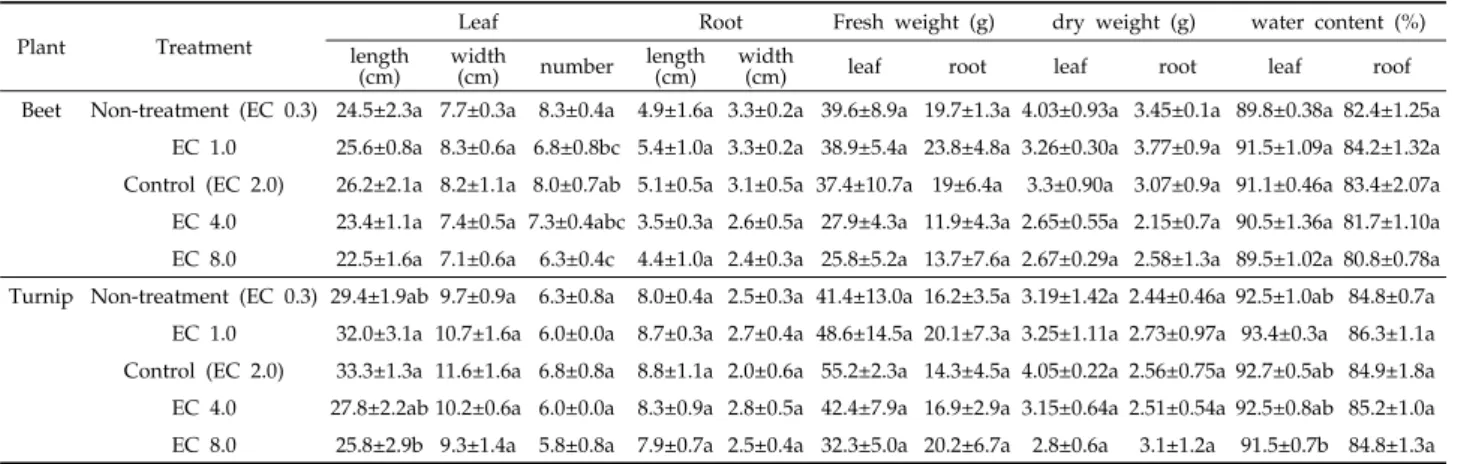
EC 값 차이에 따른 염 스트레스를 입은 비트와 순무의 잎 상태를 보면 EC 값이 높을수록 잎이 말려 오므라지거나 일부 분 황백화현상이 일어났다(Table 2). 비트(Beta vulgaris L.) 잎의 길이는 EC 2.0 대조구(26.2)에서 가장 길었으며 EC 8.0 실험구(22.5 cm)에서 가장 짧았다(Table 3). 뿌리의 길이는 EC 1.0 실험구(5.4)에서 가장 길었고 EC 4.0 실험구(3.5 cm) 에서 가장 짧았다. 잎의 생체중은 무처리구(39.6)에서 높았고, 뿌리의 생체중은 EC 1.0 실험구(23.8 g)에서 가장 높았다. 잎 의 수분함량은 EC 1.0 실험구(91.5)에서, 뿌리의 수분함량은 EC 1.0 실험구(84.2%)에서 가장 높았다.
순무(Brassica rapa L.) 잎의 길이는 EC 2.0 대조구 (33.3)에서 가장 길었으며 EC 8.0 실험구(25.8 cm)에서 가장 짧았다(Table 3). 뿌리의 길이는 EC 2.0 대조구(8.8)에서 가
장 길었고 EC 8.0 실험구(7.9 cm)에서 가장 짧았다. 잎의 생 체중은 EC 2.0 대조구(55.2)에서 가장 높았고, 뿌리의 생체중 은 EC 8.0 실험구(20.2 g)에서 가장 높았다. 잎의 수분함량은 EC 1.0 실험구(93.4)에서, 뿌리의 수분함량은 EC 1.0 실험구 (86.3%)에서 가장 높았다. 수확 후 일본원예처방액에 의한 EC 값 조절에 따른 변화를 살펴보았다. 비트와 순무의 생장 은 EC 2.0 대조구에서 가장 높았다. 브로콜리 새순을 수확 후 NaCl 농도처리가 낮을수록 브로콜리의 생장이 증가하였 다(Aghajanzadeh et al., 2017). 자연 상태에서 식물은 저 온, 건조, 염 스트레스와 같은 다양한 형태의 환경 스트레스 에 노출된다(Alonso-Blanco et al., 2009; Hwang et al., 2017; Choi et al., 2013). 염 스트레스는 직접적으로는 식물 의 생장 및 발달, 수확량 감소 등을 유발하고, 간접적으로는 염 스트레스에 의한 수분 부족 현상을 유도하므로 염 스트레 스는 수분 스트레스 영향을 받을 수도 있다(Sobhanian et al., 2011; Lee et al., 2014; Hong et al., 2015). 케일은 수 분 스트레스 기간이 증가할수록 수분 함량이 감소하였고 (Jeong et al., 2015), 케일의 생체중도 감소하는 경향을 보였 다(Lee et al., 2017). 저온처리하여 생장한 케일은 온실에서 재배한 케일보다 생육이 더 낮은 경향을 보였다(Hwang et al., 2017). 수분함량은 EC 값이 높을수록 대체적으로 감소한 것으 로 보아 수분 스트레스가 영향을 끼쳤을 것으로 사료된다.
비트 내 베타시아닌 함량
비트 내 베타시아닌을 HPLC로 분석한 결과, 2종류의 베 타시아닌(betanin, isobetanin)를 분리하였다(Table 4, Fig. 3).
실험구[무처리구, EC 1.0, 대조구(EC 2.0), EC 4.0, EC 8.0]
에서 총 베타시아닌 함량은 EC 2.0 대조구(327.46)와 비교하 였을 때, 무처리구(425.29)에서는 약 1.29배 높았고, EC 1.0 실험구(368.41)에서는 대조구보다 1.12배 높았다(Table 5).
EC 4.0 실험구(262.55)와 EC 8.0 실험구(216.57 mg/g dry wt.)에서는 대조구에 비해 약 1.51배 낮았다. 각 베타시아닌 성분별 함량 범위는 betanin (161.16~292.59), isobetanin (54.09~75.82 mg/g dry wt.)으로 나타났다. Betanin 함량 은 무처리구(324.08)에서 최고값을 나타났고, EC 8.0 실험구 (161.16 mg/g dry wt.)에서 최저값을 나타내었다. Isobetanin
No.a) RTb) Trivial names Chemical formula m/z [M+H]+ 1 10.902 Betanin C24H27N2O13 551 (389,505) 2 11.876 Isobetanin C24H27N2O13 551 (389,505) a) No., the elution order of HPLC analysis. b) RT, retentiontime
(min).
Fig. 3. HPLC chromatograms of betacyanins separated from beet root. (a), betacyanin standards; (b), control (EC 2.0). Peak numbers refer to the betacyanins: 1, betanin; 2, isobetanin (see Table 4).
Table 4. Betacyanins identified in beet
No.a) RTb) Trivial names Molecularweight
(m/z)c) Responsefactord)
1 10.76 Progoitrin 309 1.09
2 11.56 Sinigrin 279 1.00
3 12.15 Glucoalyssin 371 1.07
4 12.40 Gluconapoleiferin 323 1.00
5 15.49 Glucobrassicanapin 307 1.15
6 16.38 Glucobrassicin 368 0.29
7 17.05 4-Methoxyglucobrassicin 398 0.25
8 17.40 Gluconasturtiin 343 0.95
9 18.63 Neoglucobrassicin 398 0.20
a)No., the elution order of HPLC analysis.
b)RT, retentiontime (min).
c)As a desulfo-glucosinolate.
d)The international organization for standardization (ISO 9167-1, 1992).
Table 6. Glucosinolates identified in turnip root and leaf
No.a) Trivial names Non-treatment (EC 0.3) EC 1.0 Control (EC 2.0) EC 4.0 EC 8.0 1 Betanin 324.08±103.84a 292.59±53.02ab 254.14±36.01ab 208.45±31.32ab 161.16±33.08b
2 Isobetanin 101.21±48.35a 75.82±12.77a 73.31±8.21a 54.09±9.31a 55.42±13.40a
Total 425.29±148.29a 368.41±62.86ab 327.46±34.36ab 262.55±39.60ab 216.57±42.93b
a)Peak numbers refer to the betacyanins listed in Table 4.
Table 5. Betacyain contents (mg/g dry wt.) in beet root treated with different EC values (n=4) 함량은 무처리구(101.21)에서 최고값, EC 4.0 실험구(54.09
mg/g dry wt)에서 최저값을 나타내었다. 무처리구와 EC 8.0 실험구를 제외한 EC 1.0, 2.0 4.0 처리구에서는 통계적 유의차가 없었다. 식물은 염, 건조 스트레스 등과 같은 비생 물적 스트레스 환경(abioic stress environment)에 적응하 여 왔지만, 이러한 스트레스 환경에 노출 되었을 때 자신을 보호하기 위한 방어기작을 작동시켜서 다양한 식물화학물질 을 축적시킨다(Alonso-Blanco et al., 2009; Davies, 1995;
Hwang et al., 2017). 베타시아닌 함량은 건조 스트레스와 염 스트레스 영향을 받을 때 증가하고(Bothe, 1976; Hayakawa and Agarie, 2010; Jain and Gould, 2015; Jain et al., 2015;
Nakashima et al., 2011; Wang et al., 2007; Jain and Gould, 2015), 공심연자초를 수확 후 NaCl 농도 처리를 높 게 할수록 줄기에 있는 2차 대사산물인 베타시아닌의 합성이 증가하였지만, 잎에서는 상관관계가 없었다 (Ribeiro et al.,
2014). Cl-은 높은 농도에서 베타시아닌 합성을 저해하기 때 문에, Amaranthus 묘목은 NaCl 농도 처리를 높게 할수록 베타시아닌 합성이 감소하였다(Elliott, 1979). 본 연구에서는 EC 값이 높을수록 베타시아닌 함량은 감소하였다.
순무 내 GSL 함량
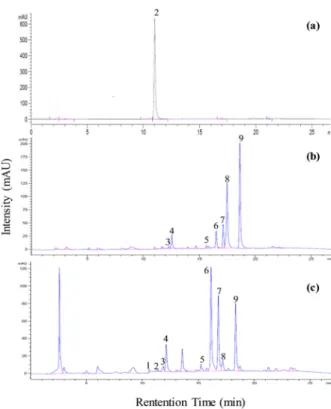
순무 내 GSLs를 HPLC로 분석한 결과, 뿌리 내에서는 총 8종류의 GSLs (progoitrin, glucoalyssin, gluconapoleiferin, glucobrassicanapin, glucobrassicin, 4-methoxyglucobrassicin, glucona sturtiin, neoglucobrassicin)를 분리하였고, 잎 내 에서는 뿌리에서 분리한 8종류에 sinigrin을 더해서 총 9종 류의 GSLs를 분리하였다(Table 6, Fig. 4). 순무 뿌리에서, 총 GSL 함량은 EC 2.0 대조구(19.53)와 비교하였을 때, 무 처리구(18.28)에서는 약 1.06배, EC 1.0 실험구(15.09)는 1.29 배 낮았다. EC 4.0 실험구(18.33)와 EC 8.0 실험구(13.03 μ mol/g dry wt.)도 대조구보다 GSL 함량이 낮았다. 그렇지만, 각 실험구 간의 통계적 유의차는 없었다(Table 7). 각 GSL 성분별 함량 범위는 progoitrin (0.49~3.16), glucoalyssin (0.21~0.33), gluconapoleiferin (0.44~1.49), gluco-brassicanapin (1.46~3.98), glucobrassicin (0.32~1.04), 4-methoxyglucobrassicin (0.33~0.60), gluconasturtiin (7.63~10.96), neoglucobrassicin (0.94~1.78 μmol/g dry wt.)으로 나타났다. 순무 잎에서, 총 GSL 함량은 EC 2.0 대조구(5.01)과 비교하였을 때, 무처 리구(6.36)에서는 약 1.26배, EC 1.0 실험구(6.41)는 약 1.27 배 높았다(Table 7). EC 4.0 실험구(4.91)와 EC 8.0 실험구 (3.65 μmol/g dry wt.)에서는 대조구보다 낮았다. 특히 EC 8.0 실험구(3.65 μmol/g dry wt.)에서는 약 1.37배 가장 낮 았지만 뿌리와 마찬가지로 잎의 EC 값에 따른 GSL 함량은
Fig. 4. HPLC chromatograms of glucosinolates separated from turnip root and leaf. (a), external sinigrin standard;
(b), root control (EC 8.0); (c), leaf control (EC 1.0). Peak numbers refer to the GSLs listed in Table 6.
No.a) Trivial names
root leaf
Non-treatment
(EC 0.3) EC 1.0 Control
(EC 2.0) EC 4.0 EC 8.0 Non-treatment
(EC 0.3) EC 1.0 Control
(EC 2.0) EC 4.0 EC 8.0 1 Progoitrin 3.16±2.19a 0.76±0.23a 0.68±0.68a 1.10±0.83a 0.49±0.24a 0.68±0.60a 0.61±0.13a 0.60±0.13a 0.24±0.02a 0.20±0.06a
2 Sinigrin NDa) ND ND ND ND 0.49±0.42a 0.38±0.44a 0.21±0.07a 0.25±0.03a 0.21±0.22a
3 Glucoalyssin 0.33±0.13a 0.28±0.22a 0.27±0.28a 0.21±0.04a 0.24±0.17a 2.17±1.21a 1.86±0.61a 2.01±0.34a 1.38±0.17a 0.98±0.35a 4 Gluconapoleiferin 1.49±1.00a 0.44±0.18a 0.57±0.26a 0.87±0.34a 0.71±0.20a 0.40±0.39a 0.14±0.10a 0.13±0.09a 0.18±0.13a 0.19±0.16a 5 Glucobrassicanapin 1.65±0.39a 2.83±2.39a 3.98±1.68a 1.46±1.04a 2.37±1.60a 0.26±0.16ab 0.20±0.10ab 0.13±0.06b 0.83±0.15a 0.64±0.53ab 6 Glucobrassicin 0.64±0.13ab 0.73±0.27ab 0.94±0.24a 1.04±0.29a 0.32±0.09b 0.46±0.19a 1.00±0.69a 0.57±0.20a 0.26±0.09a 0.23±0.08a 7 4-Methoxyglucobrassicin 0.45±0.07a 0.42±0.15a 0.60±0.14a 0.43±0.19a 0.33±0.07a 0.24±0.09ab 0.41±0.19a 0.27±0.10ab 0.19±0.07ab 0.10±0.01b 8 Gluconasturtiin 9.19±1.28a 8.60±4.26a 10.96±1.32a 11.46±4.10a 7.63±2.46a 0.47±0.09a 0.47±0.05a 0.43±0.02a 0.72±0.35a 0.37±0.08a 9 Neoglucobrassicin 1.36±0.44a 1.02±0.54a 1.53±0.40a 1.78±1.41a 0.94±0.39a 1.19±0.33a 1.33±1.47a 0.66±0.18a 0.86±0.48a 0.73±0.59a Total 18.28±2.45a 15.09±7.09a 19.53±3.24a 18.33±5.08a 13.03±3.50a 6.36±2.74a 6.41±2.14a 5.01±0.41a 4.91±0.49a 3.65±1.08a
a)Peak numbers refer to the GSLs listed in Table 6. b)ND, not detected.
Table 7. Glucosinolate contents (μmol/g dry wt.) in root and leaf of turnip treated with different EC values (n=4) 통계적 유의차가 없었다. 각 GSL 성분별 함량 범위는 progoitrin
(0.20~0.68), sinigrin (0.21~0.49), glucoalyssin (0.98 ~2.17), gluconapoleiferin (0.13~0.40), gluco-brassicanapin (0.13~0.83), glucobrassicin (0.23~1.00), 4-methoxyglucobrassicin (0.10~0.41), gluconasturtiin (0.37~0.72), neoglucobrassicin (0.66~1.33 μ mol/g dry wt.)으로 나타났다. 순무의 뿌리와 잎을 비교 분 석해 본 결과, EC 2.0 대조구에서 재배한 순무가 가치가 높 을 것으로 판단된다. 식물은 스트레스가 많은 환경조건(염, 수 분, 온도, 광 스트레스 등)에 노출되었을 때 자신을 보호하기 위한 방어 기작의 하나로써 항산화 물질을 포함한 다양한 이 차대사산물을 생합성하여 식물체내에 축적하게 된다(Dixon and Paiva, 1995; Davies, 1995; Hwang et al., 2017). 염
스트레스는 수분포텐셜의 저하 등을 유발하므로 수분 스트레 스 영향을 받을 수도 있다(Munns and Termaat, 1986;
Sobhanian et al., 2011; Lee et al., 2014; Hong et al., 2015). 브로콜리 새싹채소에서 NaCl 농도에 따라 GSL 함량 은 무처리구(NaCl 0 mmol/L)부터 60 mmol/L 까지는 감 소하다가 80, 100 mmol/L에서는 높게 나타났고, 3일차에서 5, 7일차로 갈 수로 그 함량은 낮아졌는데, 이는 NaCl이 식 물이 생장함에 따라 염에 내성이 생기기 때문이라고 고찰하 였다(Guo et al., 2013). 케일이 수분 스트레스를 더 심하게 받을수록 급격히 많은 양의 GSLs를 축적하였다(Brown et al., 2002; Jeong et al., 2015). 본 연구에서 EC 깂에 따른 GSL 함량은 통계적 차이가 없었지만, 순무 잎의 총 GSL 함 량은 EC 값이 높을수록 감소하였다. 이 결과는 Na+과 Cl-가 많아 염 스트레스를 받아 수분포텐셜의 저하, 이온의 흡수 및 수송의 억제에 의한 영양불균형을 일으켜 수분흡수장애가 나 타나 물질 생산이 크게 저하된 것으로 사료된다. 이러한 연구 결과의 불일치는 환경의 다양성과 식물 발달 단계 및 식물 기 관의 다양성에서 기인한다고 생각된다. 석문 지구의 간척지 토양을 이용한 재배 실험에서 작물의 내염 정도를 살펴보았 으나, 한계 EC로는 지금까지 보고된 3.0~4.0 dS․m-1 수준으 로 예상 된다. 실제 간척지에서 토양 개량 및 관수시스템을 이용하면, 공급되는 급액의 EC가 낮고, 토양의 제염처리를 하여 근권의 토양조건과 작물의 재배환경은 포트 실험 조건 보다는 양호해 질 것으로 사료된다. 따라서 토양의 염도, 함 수량, 지하수위 값을 모니터링 하게 되면 근권의 환경이 예측 되고 이에 따른 급액관리를 설정하여 공급하면 정상에 가까 운 작물재배 결과가 예상된다.
Note
The authors declare no conflict of interest.
Acknowledgement
This work was supported by Korea Institute of Planning and Evaluation for Technology in Food, Agriculture, Forestry and Fisheries (IPET) through
Agri-Bio industry Technology Development Program funded by Ministry of Agriculture, Food and Rural Affairs (MAFRA) (317005-04-2).
References
Ahn, Y., Lee, S. H., Ji, K. J., Hong, B. D., Noh, H. M., Ryu, S. H., Lee, S. M., Yoon, S. I., Choi, Y. D., & Noh, Y. D. (2003). Studies on changes of soil characteristics and utilization after tidal land reclamation. Korea Agricultural and Rural Infrastructure Corporation Rural Research Institute, 1-332.
Alonso-Blanco, C., Aars, M. G., Bentsink, L., Keurentjes, J. J. B., Reymond, M., Vreugdenhil, D., & Koornneef, M. (2009). What has natural variation taught us about plant development, physiology, and adaptation?. Plant Cell, 21(7), 1877-1896.
Bang, M. H., Lee, D. Y., Han, M. W., Chung, H. G., Jeong, T. S., Choi, M. S., Lee, K. T., & Baek, N. I.
(2009). Isolation and identification of secondary metabolites from the roots of Brassica rapa. Journal of Plant Biotechnology, 36(1), 64-67.
Bothe, H. (1976). Salzresistenz bei pflanzen. Biologie in unserer Zeit, 6(1), 3-10.
Brown, A. F., Yousef, G. G., Jeffery, E. H., Wallig, M. A., Kushad, M. M., & Juvik, J. A. (2002). Glucosinolate profiles in broccoli: Variation in levels and implications in breeding for caner chemoprotection. Journal of the American Society for Horticultural Science, 127(5), 807-813.
Cartea, M. E., Velasco, P., Obregon, S., Padilla, G., &
de-Haro A. (2008). Seasonal variation in glucosinolate content in Brassica oleracea crops grown in northwestern Spain. Phytochemistry, 69(2), 403-410.
Choi, S. C., Kim, J. G., & Choo, Y. S. (2013). Effects of salt stress on inorganic ions and glycine betaine contents in leaves of Beta vulgaris var. cicla L. Korean Journal of Ecology and Environment, 46(3), 388-394.
Chun, J. H., Kim, N. H., Seo, M. S., Jin, M., Park, S. U., Arasu, M. V., Kim, S. J., & Al-Dhabi, N. A. (2016).
Molecular characterization of glucosinolates and carotenoid biosynthetic genes in Chinese cabbage (Brassica rapa L. ssp. pekinensis). Saudi Journal of Biological Sciences, 25, 71-82. 25, 71-82.
Chung, S. H., & Byun, Y. H. (2009). Convenient methods for the extraction and discrimination of water-soluble plant pigments. Journal of The Korea Contents Association, 9(3), 353-360.
Clarke, D. B. (2010). Glucosinolates, structures and
analysis in food. Analytical Methods, 2(4), 310-325.
Davies, K. J. (1995). Oxidative stress: the paradox of aerobic life. Biochemical Society Symposium, 61(1), 1-31.
Dixon, R. A., & Paiva, N. L. (1995). Stress-induced phenylpropanoid metabolism. The Plant Cell, 7(7), 1085-1097.
Elliott, D. C. (1979). Ionic regulation for cytokinin- dependent betacyanin synthesis in Amaranthus seedlings. Plant Physiology, 63(2), 264-268.
Fahey, J. W., Zalcmann, A. T., & Talalay, P. (2001). The chemical diversity and distribution of glucosinolates and isothiocyanates among plants. Phytochemistry, 56, 5–51.
Florian, C. S., & Reinhold, C. (2004). Functional properties of anthocyanins and betalains in plants, food, and in human nutrition. Food Science & Technology, 15(1), 19-38.
Gabrela, S. J., Patricia, R. B., Helena, P., & Mario, R. S.
(2004). Betacyanin synthesis in red beet (Beta vulgaris) leaves induced by wounding and bacterial infiltration is preceded by an oxidative burst. Physiological and Molecular Plant Pathology, 64(3), 125-133.
Go, E. B., Kim, K. M., Lee, K. J., & Chae, J. C. (2014).
Rhizomicrobes isolated from reclaimed land enhance growth and salt tolerance in plant. The Plant Resources Society of Korea, 4, 191-191.
Guo, R. F., Yuan, G. F., & Wang, Q. M. (2013). Effect of NaCl treatments on glucosinolate metabolism in broccoli sprouts. Journal of Zhejiang University: Science B, 14(2), 124-131.
Halkier, B. A., & Gershenzon, J. (2006). Biology and biochemistry of glucosinolates. Annual Review of Plant Biology, 57, 303-333.
Hasegawa, P. M., Bressa, R. A., Zhu, J. K., & Bohnert, H.
J. (2000). Plant cellular and molecular responses to high salinity. Annual Review of Plant Physiology &
Plant molecular Biology, 51, 463-499.
Hayakawa, K., & Agarie, S. (2010). Physiological roles of betacyanin in a halophyte, Suaeda japonica Makino.
Plant Production Science, 13(4), 351-359.
Hong, S. H., Kim, J. S., Park, J. W., & Lee, E. Y. (2015).
A study on the effect of the Rhizobacterium, Bacillus sp. SH1RP8 and potassium family polymers on the crop growth under saline. Korean Society for Biotechnology and Bioengineering Journal, 30(3), 97-102.
Hwang, S. J., Chun, J. H, & Kim, S. J. (2017). Effect of cold stress on carotenoids in kale leaves (Brassica oleracea). Korean Journal of Environmental Agriculture,
36(2), 106-112.
Jain, G., & Gould, K. S. (2015). Are betalain pigments the functional homologues of anthocyanins in plants?.
Environmental and Experimental Botany, 119, 48-53.
Jain, G., & Gould, K. S. (2015). Functional significance of betalain biosynthesis in leaves of Disphyma australe under salinity stress. Environmental and Expeirmental Botany, 109, 131-140.
Jain, G., Schwinn, K. E., & Gould, K. S. (2015). Betalain induction by l-DOPA application confers photoprotection to saline-exposed leaves of Disphyma australe. New Phytologist, 207(4), 1075 -1083.
Jeong, N. R., Chun, J. H., Park, E. J., Lim, Y. H., & Kim, S. J. (2015). Variations of glucosinolates in kale leaves (Brassica oleracea var. acephala) treated with drought- stress in autumn and spring seasons. Korean Journal of Agricultural Science, 42(3), 167-175.
Jeong, R. H., Wu, Q., Cho, J. G., Lee, D. Y., Shrestha, S., Lee, M. H., Lee, K. T., Choi, M. S., Jeong, T. S., Ahn, E. M., Chung, H. G., Rho, Y. D., & Baek, N. I. (2013).
Isolation and identification of flavonoids from the roots of Brassica rapa ssp. Journal of Applied Biological Chemistry, 56(1), 23-27.
Kim, C. R., Lim, Y. S., Lee, S. W., & Kim, S. J. (2011).
Identification and quantification of glucosinolates in rocket salad (Eruca sativa). Korean Journal of Agricultural Science, 38(2), 285-294.
Kim, D. W., Yun, S. K., Park, H. H., Hwang, J. J., Han, O. K., Park, T. I., Jung, G. H., Lee, J. E., Kim, S. L., &
Chung, Y. H. (2011). Physiological and proteomic responses of barley seedlings to salt stress. The Korean Society of international Agriculture, 23(5), 537-545.
Kim, S. J., & Ishii, G. (2006). Glucosinolate profiles in the seeds, leaves and roots of rocket salad (Eruca sativa Mill.) and anti-oxidative activities of intact plant powder and purified 4-methoxyglucobrassicin. Soil Science and Plant Nutrition, 52(3), 394-400.
Kim, Y. J., Chun, J. H., & Kim, S. J. (2015). Influence of the lime on inorganic ion and glucosinolate contents in Chinese cabbage. Korean Journal of Agricultural Science, 42(4), 405-421.
Ko, H. C., Sung, J. S., Hur, O. S., Baek, H. J., Jeon, Y. A., Luitel, B. P., Ryu, K. Y., Kim, J. B., & Rhee, J. H.
(2017). Comparison of glucosinolate contents in leaves and roots of radish (Raphanus spp.). Korean Journal of Plant Resources, 30(6), 579-589.
Lee, G. H., Yu, J. G., Park, J. H., & Park, Y. D. (2014).
Construction of a network model to reveal genes related to salt tolerance in Chinese cabbage. Korean
Journal of Horticultural Science and Technology, 32(5), 684-693.
Lee, G. R., Kim, Y. J., Chun, J. H., Lee, M. K., Ryu, D. K., Park, S. H..Y., Chung, S. O., Park, S. U., Lim, Y. P., &
Kim, S. J. (2014). Variation of glucosinolate contents of
‘Sinhongssam’ grown under various light sources, periods, and light intensities. Korean Journal of Agricultural Science, 41(2), 125-133.
Lee, H. J., Chun, J. H., & Kim, S. J. (2017). Effects of water stress on carotenoid and proline contents in kale (Brassica oleracea var. acephala) leaves. Korean Journal of Environmental Agriculture, 36(2), 97-105.
Lee, J. Y., Jang, B. C., Lee, S. Y., Park, J. H., Choi, G. H., Kim, S. C., & Kim, T. W. (2008). Growth response and changes of nitrate and sucrose content in tomato under salt stress condition. Korean Society of Soil Sciences and Fertilizer, 41(3), 164-169.
Lee, S. D. (2006). The study of the status quo into the production, utilization and efficacy of turnip. Journal of Health Science & Medical Technology, 32(1), 47-60.
Lutts, S., Kinet, J. M., & Bouharmont, J. (1995). Changes in plant response to NaCl during development of rice (Oryza sativa L.) varieties differing in salinity resistance. Journal of Experimental Botany, 46(293), 1843-1852.
Munns, R., & Termaat, A. (1986). Whole-plant responses to salinity. Australian Journal of Physiology, 3, 143- 160.
Nakashima, T., Araki, T., & Ueno, O. (2011). Photoprotective function of betacyanin in leaves of Amaranthus cruentus L. under water stress. Photosynthetica, 49(4), 497–506.
Parida, A. K., & Das, A. B. (2005). Salt tolerance and salinity effects on plants: a review. Ecotoxicology and Environmental Safety, 60(3), 324-349.
Park, Y. J., Chun, J. H., Woo, H. Y., Akiko, M. N., &
Kim, S. J. (2017). Effects of different sulfur ion concentration in nutrient solution and light source on glucosinolate contents in kale sprouts (Brassica oleracea var. acephala). Korean Journal of Agricultural Science, 44(2), 261-271.
Ribeiro, M. V., Deuner, S., Benitez, L. C., Einhardt, A.
M., Peters, J. A., & Braga, E. J. B. (2014). Betacyanin and antioxidant system in tolerance to salt stress in Alternanthera philoxeroides. Agrociencia, 48(2), 199-210.
Rodrguez, M., Canales, E., & Borras-Hidalzo, O. (2005).
Molecular aspects of abiotic stress in plants.
Biotecnologia Aplicada, 22, 1-10.
Slawomir, W. (2005). Formation of decarboxylated
betacyanins in heated purified betacyanin fractions from red beet root (Beta vulgaris L.) monitored by LC-MS/MS. Journal of Agricultural and Food Chemistry, 53(9), 3483-3487.
Sobhanian, H., Aghaei, K., & Komatsu, S. (2011). Changes in the plant proteome resulting from salt stress:
Toward the creation of salt-tolerant crops?. Journal of Proteomics, 74(8), 1323-1337.
Talalay, P., & Zhang, Y. (1996). Chemoprotection against cancer by isothiocyanates and glucosinolates. Biochemical Society Transactions, 24(3), 806-810.
van Etten, C. H., Daxenbichler, M. E., & Wolff, I. A.
(1969). Natural glucosinolates (thioglucosides) in foods and feeds. Journal of Agricultural and Food Chemistry, 17(3), 483-491.
Volkmar, K. M., Hu, Y., & Steppuhn, H. (1998).
Physiological responses of plants to salinity: A review.
Canadian Journal of Plant Science, 78, 19-27.
Wang, C. Q., Xu, C., Wei, J. G., Wang, H. B., & Wang, S.
H. (2008). Enhanced tonoplast H+-ATPase activity and superoxide dismutase activity in the halophyte Suaeda salsa containing high level of betacyanin. Journal of Plant Growth Regulation, 27(1), 58–67.
Yi, M. R., Hee, K. C., & Bu, H. J. (2017). Antioxidant and anti-inflammatory activity of extracts from red beet (Beta vulagaris) root. Korean Journal of Food Preservation, 24(3), 413-420.
Zhang, Y., & Talalay, P. (1994). Anticarcinogenic activities of organic isothiocyanates: chemistry and mechanisms.
Cancer Research, 54(7), 1976-1981.