DOI 10.3339/jkspn.2008.12.2.202
1)
INTRODUCTION
Technical breakthroughs in dialysis and re- nal transplantation over the past few decades have enabled the long-term survival of child-
접수 : 2008년 9월 9일, 승인 : 2008년 10월 1일 책임저자 : 하일수, 서울시 종로구 연건동 28번지
서울대학교 의과대학 소아과학교실 Tel : 02)2072-2858 Fax : 02)743-3455 E-mail : [email protected]
ren with end-stage renal disease(ESRD). Ac- cordingly, with the long-term survival of the- se children, the main research focus has been shifting from the prolongation of life to pro- vision of a better quality of life(QOL) with improved emotional and social well-being.
QOL is an essential aspect of human exis- tence. It refers to an overall evaluation of life, both a subjective and objective index of hap-
Development of a Quality of Life Scale For Children on Chronic Peritoneal Dialysis
Min-Sup Shin, Ph.D. † , Soo-Churl Cho, M.D. † Jae-Yeon Jang, R.N. ‡ , Hae-Il Cheong, M.D. ‡
Yong Choi, M.D. ‡ and Il-Soo Ha, M.D. ‡, *
Department of Child Psychiatry
†, Department of Pediatrics
‡Seoul National University Childrens Hospital, Seoul, South Korea
= Abstract =
Purpose : The aim of this study was to develop a quality of life scale for children on chro- nic peritoneal dialysis(QOL-CPD).
Methods : Thirty children on chronic PD at Seoul National University Children's Hospital participated. A healthy control group included 47 elementary school children. Other patients groups are 32 children from the department of pediatric orthopedics and 28 children from the department of child psychiatry. The age range of all children was 7 to 16 years. Preliminary items of the QOL-CPD were developed and administered along with the Korean version of the Children's Depression Inventory(CDI) to all children.
Results : The final QOL-CPD was constructed by excluding those items with a factor load- ing of less than .20, and the principal axis factor analysis was performed again. The QOL- CPD demonstrated a good internal consistency with a value of .87. The dialysis and child- psychiatric groups showed significantly lower QOL scores compared to the healthy control group. In addition, the dialysis and child-psychiatric groups showed greater difficulties on physical and academic functions. For the CDI, the PD group showed a mild level of depression.
Conclusion : The results of this study demonstrate the clinical utility of a newly developed self-report QOL scale specific for children on chronic PD. (J Korean Soc Pediatr Nephrol 2008;12:202-212)
Key Words : Children with end-stage renal disease, PD, Quality of life, Depression, Hope-
lessness, Negative self-concept
piness and the perception of the way one is living life. Ferrans and Power[1] provided a specific definition of QOL as "well-being, sa- tisfaction with life, personal feeling about hap- piness or unhappiness". Padilla and Grant[2]
defined QOL of patients as "what makes life worth living, which includes physical, emotio- nal well-being, concern about body image, so- cial interest, and response to treatment". Fur- thermore, according to Noh et al.[3], QOL is a subjective perception of well-being by each individual in physical, mental, and socio-eco- nomic domains, which consists of the emotio- nal state, self-esteem, physical functioning, and relationships with family and neighbors.
While the definition of QOL may vary from one scholar to another, it generally includes the physical, psychological, emotional, social well-being and treatment satisfaction domains.
[4]
However, most of the studies conducted thus far have focused on the physical aspects of the quality of life, such as physical func- tioning and symptoms in patients with chronic renal failure. The psychological and adjust- ment problems, associated with this group of patients, have been relatively neglected.
In addition, most studies have been limited to adult patients; there are only a few reports that address the QOL in children with ESRD [5, 6]. In fact, empirical studies on the varia- bles that affect the QOL of the children with chronic renal failure are limited, as are the scales for assessing the QOL. Previous stu- dies on children with renal failure showed that psychosocial adjustment and treatment adhe- rence were negatively influenced by depres- sion, anxiety, a sense of hopelessness, as well
as poor self-perception and perception by their parents, low family economic status, and the absence of social support[5, 6]. Measurement scales such as 'the Child Health and Illness Profile Adolescent Edition'(CHIP-AE)[7], 'the Children's Health Questionnaire'(CHQ)[8] and 'the Pediatric Quality of Life Inventory' (PedsQL)[9] that have been used to assess the QOL of children with chronic kidney disease, were not developed specifically for children on chronic peritoneal dialysis(PD). Hence, in the present study we have developed a self-report questionnaire to assess the QOL of children, especially those on chronic PD.
Since the QOL is a subjective concept, the perception of children can be different from those of their parents. In addition, parents may base their ratings on comparisons with other children or with their own experiences, which may be susceptible to their emotional state and expectations of their children. Therefore, it is more appropriate to have the children directly assess and report their own QOL.
Therefore, we developed a self-report QOL questionnaire for children with ESRD on PD.
MATERIAL AND METHORDS
Sample and Procedure
Thirty children with ESRD on PD who
were attending the pediatric dialysis clinic,
Seoul National University Children's Hospital
participated in this study. They were 18 boys
and 12 girls with a mean age of 12.6±3.7
years. We included only the children on PD
because the dialysis modality may have affec-
ted the QOL, and PD is the primary modality
used in this age group. The mean duration of PD was 42.7±30.4 months. 8 children on PD (27%) had significantly shorter height and lower weight compared to their age norms.
The mean height of the children in this group was two standard deviations(SD) below the age norm and their weight was one SD below the age norm. Since growth failure and psy- chosocial difficulties are common and signifi- cant problems of children on chronic dialysis, 32 children with Osteogenesis Imperfecta from the department of pediatric orthopedics and 28 children from the department of child psychia- try also participated in this study as the other clinical group(mean age=12.8±4.5, 11.47±2.7, respectively). The psychiatric group consisted of children who were diagnosed with attention deficit hyperactivity disorder(ADHD) with learning problems. For the healthy control group, 47 children were recruited from an ele- mentary school in Seoul(mean age=11.7±1.6).
Since the children were required to read and complete the self-report scales reliably, child- ren in the age range from 7 to 16 years, with- out reading problems, were included for both the clinical and control groups. There was no significant difference in the mean age among the groups. Informed consent was obtained from all parents of the children before conduc- ting this study. Any human data included in this manuscript was obtained in a compliance with the regulations of Seoul National Univer- sity Hospital and have therefore been per- formed in accordance with the ethical stan- dards reported in the 1964 Declaration of Hel- sinki. The demographic and laboratory data of the children with ESRD are presented in Ta- ble 1.
Construction of the Quality of Life Scale for Children on Chronic PD (QOL-CPD)
First, the content domains of QOL-CPD were determined according to the generally accepted definition of quality of life. The con- tent domains thereby included a "Physical Function Domain," an "Emotional Function Domain," an "Academic Function Domain,"
and a "Social Function Domain." Next, we delveloped the preliminary items for the QOL- CPD that was thought to reflect accurately those domains after a thorough discussion among the investigators. Since the self-report scale for children should be simple and not too lengthy, the preliminary QOL-CPD consisted of 56 items using the 3-point Likert scale.
Measures and Statistical Analysis The preliminary QOL-CPD and the Korean version of the Children's Depression Scale (CDI)[10, 11] were individually administered to all children. Next, the item-total correlation was obtained for each item to exclude those showing less than a .20 item-total correlation;
then principal axis factor analysis was carried out with the remaining items. The final QOL-
Table 1. Characteristics of Children on Chronic PD
Variables Mean(S.D) Range
Age(year) Hemoglobin(g/dL) Serum albumin(g/dL) Residual renal Kt/V Total Kt/V
Residual renal CCr (L/week·1.73 m
2) Total CCr
(L/week·1.73 m
2)
12.6(3.7) 10.6(1.7) 3.99( .41)
.28( .47) 2.22(.77) 10.8(17.9)
52.8(15.0)
7-16 5.3-12.9 3.30-4.70 0.00-1.88 1.30-5.35 0.0-66.9
32.3-89.9
CPD was constructed after a process of ex- cluding those items with the factor loading of less than .20 and then conducting the principal axis factor analysis again. In order to confirm the validity of the newly developed "QOL- CPD", its correlation with the CDI was calcu- lated, and the differences in the mean scores of the QOL-CPD among the children on PD, child-psychiatric and healthy control groups were examined by analysis of variance (ANOVA) for its discriminant validity. The reliability of the QOL-CPD was examined by obtaining the internal consistency coefficient and a 2-week test-retest reliability coefficient.
All data analyses were performed with SPSS WIN 12.0.
RESULTS
The QOL-CPD and Its Reliability After obtaining the item-total correlation coefficients of the data from the clinical and healthy groups and excluding 16 items with an item-total correlation of less than .20, the factor analysis was conducted, and the 40- item "QOL-CPD" was finalized(Appendix).
The score ranges of the physical, emotional, academic and social functions are 0-40, 0-16, 0-18, 0-9, respectively. The QOL-CPD show- ed a good internal consistency with the Chronbach's α of .87. Its test-retest reliability coefficient was .67. As the QOL-CPD includes various items reflecting difficulties in physical, emotional, academic, and social domains, and since the emotional state may vary with time, the reliability of the QOL-CPD developed in this study was considered satisfactory.
Validity of the QOL-CPD
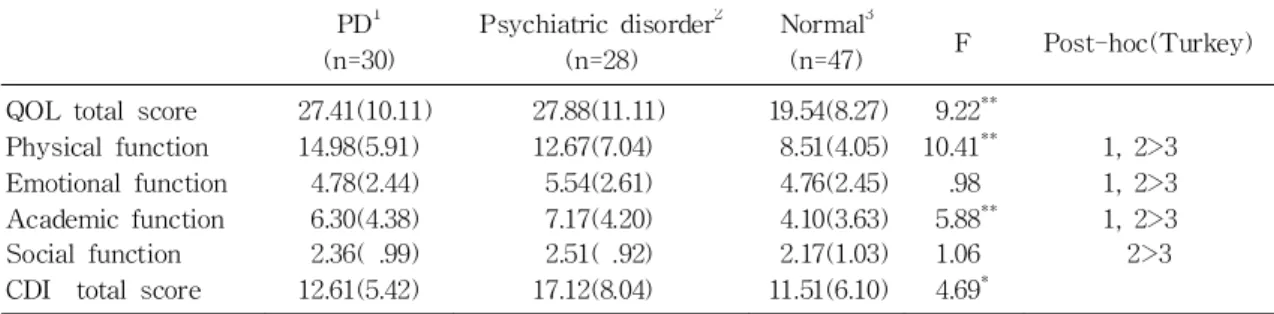
A higher total QOL-CPD score indicates a worse QOL as perceived by the children. The children with Osteogenesis Imperfecta were not included in the analysis because their QOL-CPD mean score was nearly equal to that of the healthy group. The PD and child- psychiatric groups were found to have signi- ficantly lower QOL scores compared to the healthy group (mean QOL total score=27.41, P<.01, mean QOL total score=27.88, P<.01).
Specifically in terms of the sub-domains, the PD and child-psychiatric groups reported more difficulties in the physical and academic function domains(P<.01), while the three groups showed no differences in the emotional and social function domains. Therefore, these results showed that the PD group not only had trouble in physical functioning, but also in learning, similar to the child-psychiatric group. For the CDI, the child-psychiatric group had the highest depression score(17.12) and the PD group had a mild level depression score(12.61)(Table 2).
The results of previous studies[5, 6] have shown that among all symptoms of depres- sion, hopelessness and a negative self-concept yielded more negative influences on the psy- chosocial adjustment of children on dialysis.
Therefore, we totaled the hopelessness and the
negative self-concept items of the CDI sepa-
rately and examined their correlations with
the QOL-CPD scale. As a result of Pearson
product-moment correlation analysis, in the
PD group, the scores of hopelessness and ne-
gative self-concept showed significant corre-
lations with the QOL-CPD total score(r=.47,
P<.01; r=.42, P<.05, respectively). That is, the more hopeless, and the more negative the self-concept, the worse the QOL score. In the child-psychiatric and healthy control groups, the QOL-CPD total score was not significan- tly correlated with either hopelessness or negative self-concept scores(r=.15, r=.29 for the child-psychiatric group; r=.27, r=.28 for the healthy group).
Although the CDI total score was the high- est in the child-psychiatric group, there was no significant correlation between the CDI to- tal score and the QOL score, and there was no significant correlation between the hopeless- ness or negative self-concept score and the QOL score. Considering that the child-psychi- atric group in our study consisted mostly of ADHD children, such a high CDI score ap- pears to be due to their emotional problem- s such as depressive mood rather than a ne-
gative self-concept or hopelessness. On the other hand, the children on PD seem to suffer more from increased hopelessness and a ne- gative self-concept, causing low QOL expe- riences.
The Pearson product-moment correlation coefficients between the QOL-CPD and the CDI scores for all children were calculated and were found to range from .24 to .61, which were all significant(Table 3). These results confirm that the QOL-CPD developed in our study may be a valid and reliable instrument for assessing difficulties in physical, emotio- nal, academic, and social function domains in children on PD.
The QOL-CPD scores were not significan- tly correlated with the duration of PD, and the clinical and laboratory data, including height and weight SDS scores, hemoglobin, albumin, residual renal Kt/V, total Kt/V, residual CCr, Table 2. Means and Standard Deviations of the Scores of the QOL-CPD and CDI for the Three Groups.
PD
1(n=30)
Psychiatric disorder
2(n=28)
Normal
3(n=47) F Post-hoc(Turkey) QOL total score
Physical function Emotional function Academic function Social function CDI total score
27.41(10.11) 14.98(5.91)
4.78(2.44) 6.30(4.38) 2.36( .99) 12.61(5.42)
27.88(11.11) 12.67(7.04)
5.54(2.61) 7.17(4.20) 2.51( .92) 17.12(8.04)
19.54(8.27) 8.51(4.05) 4.76(2.45) 4.10(3.63) 2.17(1.03) 11.51(6.10)
9.22
**10.41
**.98 5.88
**1.06 4.69
*1, 2>3 1, 2>3 1, 2>3 2>3
( ) standard deviation; QOL quality of life; CDI Children s Depression Inventory. In Post-hoc analysis, 1 refers to the PD group, 2 to the psychiatric disorder group, and 3 to the normal group.
*
P<.05,
**P<.01
Table 3. Correlation Coefficients of the QOL-CPD and CDI Scores Physical function Emotional
function Academic Function Social function QOL total score
CDI total score .24
*.61
**.46
**.33
**.50
**QOL-CPD the Quality of Life Scale for Children on Chronic PD; CDI Children s Depression Inventory.
*
P<.05,
**P<.01
and total CCr.
DISCUSSION
As anticipated, the QOL of children on PD was found to be significantly lower than that found in their healthy counterparts. While the difficulties in emotional and social function domains were not significantly higher than those of the child-psychiatric group, the child- ren with ESRD on PD were found to have more difficulties due to physical symptoms and learning problems at a level similar to the child-sychiatric group. Considering that the child-psychiatric group consisted of ADHD children with learning and emotional problems, assistance with the academic problems, in addition to the medical treatment for physical symtoms, appears to be important for impro- ving the QOL of children with ESRD on chro- nic PD.
Children on chronic PD are very likely to experience difficulties with school adjustment due to school absence for hospital visits and the limitations on participating in school acti- vities, as well as their distractibility and dimi- nished attention span due to uremia[12,13]. In Korea, where the educational expectations of the parents for their children are very high and a university diploma is a prerequisite for a better marriage and employment, individu- alized educational programs or tutoring is necessary to assist the psychosocial adjust- ment and prevent the development of pro- blems on later for children on PD.
Children with ESRD often suffer from growth retardation. In the present study, 8 children on PD(27%) showed growth retarda-
tion. The mean weight and height of children on chronic PD were one and two SD below the age norms, which likely resulted in the feeling of inferiority with regard to their body image, thus leading to a negative self- con- cept. Since the QOL of children on chronic PD worsens with increasing feelings of hopeless- ness and a negative self-concept, children on chronic PD need not only assistance for their physical symptoms and learning difficulties, but also support for building a more positive self-image.
Although there are only a few studies on psychiatric disorders among children on chro- nic dialysis, these reports have demonstrated that children with ESRD are at high-risk for psychiatric disorders such as depression, an- xiety and adjustment disorders. According to Fukunishi and Kudo's study[14], 17 of 25 (65.4%) Japanese children with ESRD on ch- ronic PD were found to have psychiatric dis- orders. Sixteen percent of British children with ESRD on home dialysis had psychiatric disorders[15]. Bakr et al.[16] found that ad- justment disorders were the most common (18.4%) among children with ESRD on regular hemodialysis, followed by depression(10.3%) and neurocognitive disorder(7.7%).
The results of our study revealed that the
children on chronic PD not only had trouble in
physical and academic functions similar to the
child-psychiatric group, but also had a mild
level of depression by the CDI score. How-
ever, the level of depression experienced by
the children on PD was not as severe as anti-
cipated. Such a result can be considered as a
positive sign attributed to treatment adherence
and psychosocial adjustment. Since the child-
ren on PD in our study showed good treat- ment adherence, they may have thereby shown only a mild level of depression. How- ever, another interpretation might be possible.
Children on chronic PD may develop a denial defense to cope with the emotional problems that accompany their chronic medical illness.
The QOL-CPD scores were not significantly correlated with the duration of PD, and the clinical and laboratory data, including height SDS, weight SDS, hemoglobin, albumin, and the scales of PD adequacy. These results are consistent with those of Bakr et al.[16], which did not show significant correlations among psychiatric disorders, age, gender, severity of anemia, duration of chronic renal failure, and duration of hemodialysis. They interpreted these findings as suggesting that psychiatric disorders in children on dialysis could be better explained by the difficulties encountered in living with chronic renal failure rather than by such demographic and physical factors.
However, the absence of a significant rela- tionship between psychiatric disorders and physical factors might be due to the small number of patients studied.
The limited number of patients available for study is one of the shortcomings of the pre- sent study. Unlike adults, it is actually diffi- cult to recruit a large number of children on chronic PD in the age range of 7 to 16 years.
Further studies are required to confirm the re- liability and validity of the scale developed in this study using other already existing QOL instruments for children, and to examine its clinical utility in children on chronic PD, with a larger number of children. Omission of indi- vidual interviews to assess the difficulties in
physical, emotional, academic, and social func- tions as well as treatment satisfaction of the children on chronic PD may be another limi- tation of this study.
However, despite such limitations, this stu- dy tried and provided a self-report QOL scale specifically developed for children on chronic PD, and the results demonstrated a relatively high reliability and validity.
한 글 요 약
만성 복막투석 아동용 삶의 질 척도 개발
서울대학교어린이병원 소아정신과†, 소아과‡