125
Turfgrass Quality and Disease Suppression on a Creeping Bentgrass Green by Various Nitrogen Sources
Sang-Kook Lee*
Dept. of Golf, Hoseo University, Asan 336-795, Korea
ABSTRACT. Dollar spot and brown patch disease are the most economically important disease for highly maintained turfgrass area such as golf courses. Previous researches indicated that various natural fertilizers are good nitrogen (N) sources and they may lead to turf disease suppression because disease suppression by natural N sources may be due to microbial activity increased. Increased microbial activities in soil reduce the activity of plant pathogen.
The objective of this study was to evaluate efficacy of various N sources to suppress dollar spot and brown patch on creeping bentgrass. The seven N sources and fungicide combinations were investigated for turf disease suppression.
Emerald™ and ProStar™ were applied for the applications of fungicide combination. No differences were found on turf quality among N source treatments. However, there was significant difference on turf quality between fungicide combination and fungicide combination plus urea. Overall, N source had no significant effects on suppression of dollar spot and brown patch. Although there were a few differences among N source treatments, fungicide treatments were needed for turf disease suppression for highly maintained turfgrass area such as golf courses.
Key words:Brown patch, Creeping bentgrass, Dollar spot, Nitrogen
Introduction
Dollar spot disease caused by Sclerotinia homoeocarpa is the most economically important disease. Air temperatures from 15 to 30oC are most favorable to dollar spot development and spread of dollar spot for the growing season (Smiley et al., 2005). On highly maintained turfgrass area such as golf courses, Sclerotinia homoeocarpa attacks a wide range of turfgrasses including both warm and cool season species. Dollar spot is especially main disease on close-cut creeping bentgrass. Other important summer diseases of bentgrass greens are brown patch (Rhizoctonia solani). Brown patch is first noticed in tall fescue (Festuca arundenacea), but it is the most destructive turf disease for golf course green with dollar spot. More than 70% of fungicides used on golf courses are used for control of dollar spot, brown patch (Rhizoctonia solani Kühn.), and anthracnose (Colletotrichum graminicoloa) (Bonos et al., 2003). This point may lead to the plethora of fungicide application because a superintendent’s success is commonly evaluated by the condition of putting green. However, for the reasons of environmental issue and budget limited, golf course superintendents are searching for the ways to
decrease the amount of fungicide on creeping bentgrass putting green to suppress turf disease without noticeable loss in bentgrass quality.
Previous researches indicated that various natural fertilizers are good nitrogen (N) sources and they may lead to turf disease suppression (David and Dernoeden, 2002).
The mechanism for disease suppression by natural N sources may be due to microbial activity increased.
Increased microbial activity in soil reduce the activity of plant pathogen. Several researches reported significant reduction in dollar spot activity after applications of Milorganite (Cook et al., 1964; Markland et al., 1969). Liu et al. (1995) evaluated various N sources related dollar spot suppression. They found significant higher amount of microbial population on the leaves and thatch layer after applications of Ringer fertilizers, ammonium nitrate, and sulfur-coated urea. They also reported organic fertilizer treatments may be related to dollar spot suppression.
Landschoot and McNitt (1997) evaluated five natural organic fertilizers, urea, and ureaform for their effects on dollar spot suppression in creeping bentgrass. Their results indicated that urea had better results than other natural N sources on dollar spot suppression.
General suppression of pathogen activities is directly related to the total amount of microbial activity in the soil and plant under the condition that pathogen prefer in their life cycle (Cook and Baker, 1983). More new products of N sources have been produced. The objective of this study was to evaluate efficacy of various N sources to suppress
*Corresponding author; Tel: +82-41-540-5879 E-mail : [email protected]
Received : Nov. 22, 2010, Revised : Dec. 1, 2010, Accepted : Dec.
6, 2010
dollar spot and brown patch on creeping bentgrass.
Materials and Methods
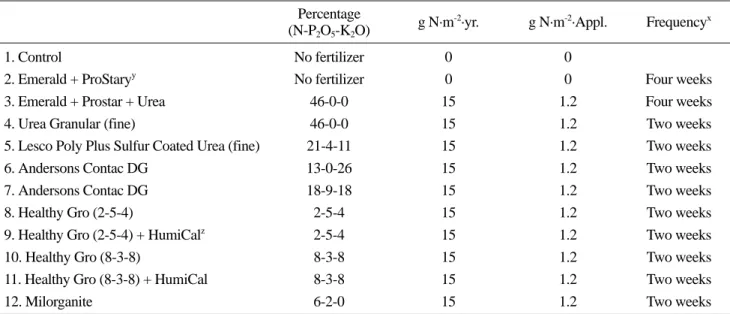
The fertilizer trial was initiated on June 19, 2007 on an L- 93/G-2 creeping bentgrass green. Experimental plot measured 1.2×1.8 m. Various nitrogen sources and fungicide combinations
were investigated for turf disease suppression. Emerald™ and ProStar™ were applied for the applications of fungicide combination. For complete listing of treatments and schedule of treatment refer to Table 1. A backpack sprayer was used to apply liquid treatments and a hand-shaker container was used to apply granular treatments. All granular applications were watered-in (0.6 cm) immediately after granular Table 1. Treatment list.
Percentage
(N-P2O5-K2O) g N·m-2·yr. g N·m-2·Appl. Frequencyx
1. Control No fertilizer 0 0
2. Emerald + ProStaryy No fertilizer 0 0 Four weeks
3. Emerald + Prostar + Urea 46-0-0 15 1.2 Four weeks
4. Urea Granular (fine) 46-0-0 15 1.2 Two weeks
5. Lesco Poly Plus Sulfur Coated Urea (fine) 21-4-11 15 1.2 Two weeks
6. Andersons Contac DG 13-0-26 15 1.2 Two weeks
7. Andersons Contac DG 18-9-18 15 1.2 Two weeks
8. Healthy Gro (2-5-4) 2-5-4 15 1.2 Two weeks
9. Healthy Gro (2-5-4) + HumiCalz 2-5-4 15 1.2 Two weeks
10. Healthy Gro (8-3-8) 8-3-8 15 1.2 Two weeks
11. Healthy Gro (8-3-8) + HumiCal 8-3-8 15 1.2 Two weeks
12. Milorganite 6-2-0 15 1.2 Two weeks
x The frequency of fungicide application is every 28 days and nitrogen application is applied every two weeks.
y The combination of Emerald (0.04 ml/m2) + ProStar (1.43 ml/m2) was selected to provide broad spectrum control of dollar spot, brown patch and fairy ring.
zHumiCal is applied at the label rate of 56 g/m2.
Table 2. Turf quality of creeping bentgrass green treated by different nitrogen sources and a fungicide combination.
Turfgrass qualityx
Jun.20 Jul.10 Jul.23 Aug.14
Control 7.5 6.0 3.3 cy 3.0 c
Fungicide combination 7.0 4.8 4.3 bc 3.3 c
Fungicide combination + Urea 7.3 8.5 9.0 a 7.5 a
Urea Granular (fine) 7.3 6.3 4.3 bc 5.8 b
Surfer Coated Urea (fine) 6.8 7.0 3.8 bc 4.8 b
Andersons Contac DG 13-0-26 7.0 5.8 3.5 bc 5.3 b
Andersons Contac DG 18-9-18 7.3 6.8 3.8 bc 5.3 b
Healthy Gro 2-5-4 7.3 7.3 4.5 b 6.0 b
Healthy Gro 2-5-4 + HumiCal 7.8 7.0 4.3 bc 6.0 b
Healthy Gro 8-3-8 6.8 7.5 4.0 bc 6.0 b
Healthy Gro 8-3-8 + HumiCal 7.5 7.3 3.8 bc 5.5 b
Milorganite 7.3 6.3 3.8 bc 4.8 b
LSD NS NS 1.1 1.4
x Turf quality scale is 0 to 9 with 6=acceptable and 9=best.
y Means with the same letter or denoted (NS) are not significantly different by Fisher’s LSD test (P<0.05).
applications using containers. Creeping bentgrass was mowed at 0.4 cm. Turfgrass quality was visually rated on a scale of 0 to 9 with 0=poor, 6=acceptable and 9=excellent.
Disease was estimated visually whenever present, by percent plot area damaged (dollar spot and brown patch) or number of infection centers (dollar spot). Dollar spot disease was qualified by counting infection centers per plot, as well as estimate percent plot area damaged.
The experimental design was a randomized complete block design with four replications. The data were analyzed using the t-test procedures and mean separation was performed by standard error of difference (SED) method of the Statistical Analysis System (SAS, 1987). PROC MIXED was used for multiple factor analyses of variance.
Results and Discussion
Among treatments of N sources, no differences were found on turf quality. However, there was significant difference on turf quality between fungicide combination and fungicide combination plus urea on July 23 and August 14, 2007 (Table 2). Fungicides plus urea produced excellent turf quality among all treatments. No significant differences were found among treatments of N sources. All N sources provided acceptable visual quality (> 6) until high dollar spot disease pressure began in July. However, no treatments of N sources produced better turf quality than acceptable turf quality of 6. The fungicide treatment alone without N could not maintain acceptable bentgrass quality due to poor color and chlorosis after June 20, 2007. But Fungicides plus
urea produced excellent turf quality among all treatments for the research period.
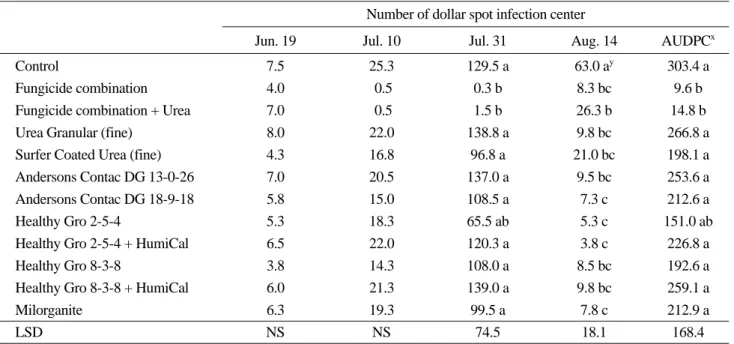
Significant differences were found on dollar spot damage from July 31, 2007 (Table 3, and Figure 1). However, no N effects were found during the study. Only differences between treatments with and without fungicide on dollar spot suppression were found from July 31, 2007. Fungicide treatments produced excellent dollar spot suppression after July 23, 2007 (Figure 1). There were no differences between the fungicide combination with or without urea during the study. The results of this study indicated that dollar spot damage was reduced by fungicides. Fungicides plus urea has excellent turf quality because those plots are consistently disease-free. Fungicides alone didn’t produce acceptable quality, because poor color and density occurred due to low fertility. Thus far, dollar spot was not effectively suppressed by any fertility treatment and could not provide acceptable quality on multiple dates at summer (Table 2). For example, area under the disease progress curve (AUDPC) indicated that N did not provide season long dollar spot suppression (Table 3). Emerald (0.04 ml m-2) was applied to all plots to maintain turfgrass cover on July 31, 2007. This application reduced dollar spot thereafter (Table 3).
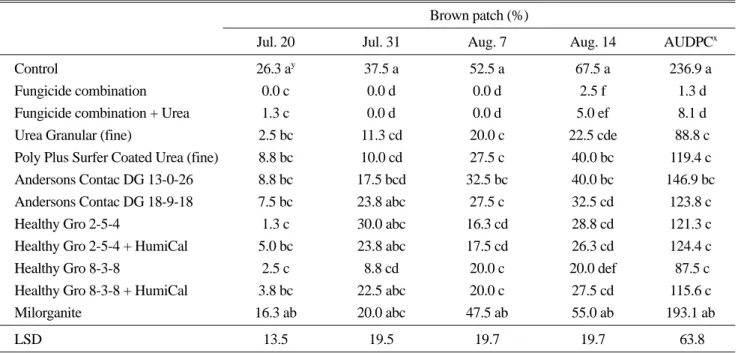
N sources did not influence brown patch development (Table 4 and Figure 2). Although the fungicide treatment without urea suppressed brown patch, acceptable turf quality was lacking due to poor color and chlorosis. The fungicide combination plus urea produced the highest turf quality among the treatments, because it both suppressed brown patch and provided good turf color. Among N source
Table 3. Dollar spot disease progression on creeping bentgrass green treated by different nitrogen sources and fungicides.
Number of dollar spot infection center
Jun. 19 Jul. 10 Jul. 31 Aug. 14 AUDPCx
Control 7.5 25.3 129.5 a 63.0 ay 303.4 a
Fungicide combination 4.0 0.5 0.3 b 8.3 bc 9.6 b
Fungicide combination + Urea 7.0 0.5 1.5 b 26.3 b 14.8 b
Urea Granular (fine) 8.0 22.0 138.8 a 9.8 bc 266.8 a
Surfer Coated Urea (fine) 4.3 16.8 96.8 a 21.0 bc 198.1 a
Andersons Contac DG 13-0-26 7.0 20.5 137.0 a 9.5 bc 253.6 a
Andersons Contac DG 18-9-18 5.8 15.0 108.5 a 7.3 c 212.6 a
Healthy Gro 2-5-4 5.3 18.3 65.5 ab 5.3 c 151.0 ab
Healthy Gro 2-5-4 + HumiCal 6.5 22.0 120.3 a 3.8 c 226.8 a
Healthy Gro 8-3-8 3.8 14.3 108.0 a 8.5 bc 192.6 a
Healthy Gro 8-3-8 + HumiCal 6.0 21.3 139.0 a 9.8 bc 259.1 a
Milorganite 6.3 19.3 99.5 a 7.8 c 212.9 a
LSD NS NS 74.5 18.1 168.4
x Area under the disease progress curve (AUDPC) summarizes 9 rating dates from June 19 to August 14.
y Means with the same letter or denoted (NS) are not significantly different by Fisher’s LSD test (P<0.05).
treatments, urea had better suppression of brown patch than Milorganite after July 31, 2007 (Figure 2).
Overall, N source had no significant effects on suppression of dollar spot and brown patch. Although there were differences among N source treatments, fungicide treatments were needed for turf disease suppression. In previous researches, natural N sources had efficacy on disease on turf disease suppression. However, fungicide applications are required for highly maintained turfgrass
area such as golf courses especially with growing summer season under the condition of warm and humid weather.
Acknowledgement
This research was supported by the academic research fund of Hoseo University in 2010 (2010-0112)
Fig. 1. Dollar spot disease progression on creeping bentgrass green treated by different nitrogen sources and fungicides. Means with the same letter or denoted (NS) are not significantly different by Fisher’s LSD test (P<0.05).
Table 4. Brown patch disease progression on creeping bentgrass green treated by different nitrogen sources and fungicides.
Brown patch (%)
Jul. 20 Jul. 31 Aug. 7 Aug. 14 AUDPCx
Control 26.3 ay 37.5 a 52.5 a 67.5 a 236.9 a
Fungicide combination 0.0 c 0.0 d 0.0 d 2.5 f 1.3 d
Fungicide combination + Urea 1.3 c 0.0 d 0.0 d 5.0 ef 8.1 d
Urea Granular (fine) 2.5 bc 11.3 cd 20.0 c 22.5 cde 88.8 c
Poly Plus Surfer Coated Urea (fine) 8.8 bc 10.0 cd 27.5 c 40.0 bc 119.4 c
Andersons Contac DG 13-0-26 8.8 bc 17.5 bcd 32.5 bc 40.0 bc 146.9 bc
Andersons Contac DG 18-9-18 7.5 bc 23.8 abc 27.5 c 32.5 cd 123.8 c
Healthy Gro 2-5-4 1.3 c 30.0 abc 16.3 cd 28.8 cd 121.3 c
Healthy Gro 2-5-4 + HumiCal 5.0 bc 23.8 abc 17.5 cd 26.3 cd 124.4 c
Healthy Gro 8-3-8 2.5 c 8.8 cd 20.0 c 20.0 def 87.5 c
Healthy Gro 8-3-8 + HumiCal 3.8 bc 22.5 abc 20.0 c 27.5 cd 115.6 c
Milorganite 16.3 ab 20.0 abc 47.5 ab 55.0 ab 193.1 ab
LSD 13.5 19.5 19.7 19.7 63.8
zArea under the disease progress curve (AUDPC) summarizes 6 rating dates from July 20 to August 14.
y Means with the same letter or denoted (NS) are not significantly different by Fisher’s LSD test (P<0.05).
References
1. Bonos, S. A., M. D. Casler, and W. A. Meyer. 2003. Inheritance of dollar spot resistance in creeping bentgrass. Crop Sci.
43:2189-2196.
2. Cook, R. N., R. E. Engel, and S. Bachelder. 1964. A study of the effect of nitrogen carriers on turfgrass disease. Plant Dis.
Rep. 48:254-255.
3. Cook, R. J. and K. F. Baker. 1983. The nature and practice of biological control of plant pathogens. The American Phyto- pathological Society, St. Paul, MN.
4. David, J. G. and P. H. Dernoeden. 2002. Dollar spot severity, tissue nitrogen, and soil microbial activity in bentgrass as influ- enced by nitrogen source. Crop Sci. 42:480-488.
5. Landschoot, P. J. and A. S. McNitt. 1997. Effect of nitrogen
fertilizers on suppression of dollar spot disease of Agrostis stolonifera L. Intl. Turfgrass Soc. Res. J. 8:905-911.
6. Liu, L. X., T. Hsiang, K. Carey, and J. L. Eggens. 1995. Micro- bial populations and suppression of dollar spot disease in creeping bentgrass with inorganic and organic amendments.
Pland Dis. 79:144-147.
7. Markland, F. E., E. C. Roberts, and I. R. Fredrick. 1969. Influ- ence of nitrogen fertilizers on Washington creeping bentgrass.
Agrostis palustris Huds. II. Incidence of dollar spot, Sclerotinia homoeocarpa, infection. Agron. J. 61:701-705.
8. SAS. 1987. SAS/STAT User’s Guide. Version 6. Statistical Analysis System Institute, Inc., Cary, NC.
9. Smiley, R. W., P. H. Dernoeden, and B. B. Clark. 2005. Com- pendium of turfgrass disease. 3rd ed. Am. Phytopathol. Soc., St.
Paul, MN.
질소 시비가 크리핑 벤트그래스의 품질과 병 억제효과에 미치는 영향
이상국*
호서대학교 골프학과
요 약: 달라스팟과 브라운패치는 골프코스관리에서 가장 많이 발생되는 병이기도 하며 코스관리 예산에 있어 경 제적으로 가장 중요한 병들이다. 최근 연구에 의하면 다양한 질소 비료에 의해 잔디에서 발생되는 병이 억제 된 다는 결과가 보고되었다. 본 실험은 여러종류의 질소 비료가 크리핑 벤트그래스에서 발생되는 달라스팟과 브라운 패치 병에 대한 억제 효능에 대해 알아보기 위해서 수행이 되었다. 총 7가지의 질소 비료와 Emerald™ and ProStar™
의 2가지 잔디병 약제가 약제 조합을 위해 실험에 사용이 되었다. 질소의 잔디질에 있어서 종류가 다른 질소 시 비간의 차이는 본 실험의 결과에서 나타나지 않았다. 그러나 잔디병약제 조합과 잔디병약제 조합 그리고 요소비 Fig. 2. Brown patch disease progression on creeping bentgrass green treated by different nitrogen sources and fungicides. Means with the same letter or denoted (NS) are not significantly different by Fisher’s LSD test (P<0.05).
료의 혼합에서는 유의차를 보였다. 달라스팟과 브라운패치 병의 억제 효과에 있어서는 종류가 다른 질소 시비들 간의 차이를 보이지 않았다. 본 실험의 결과에 의하면 질소질 비료의 종류에 따라 달라스팟과 브라운 패치의 억 제 효과는 나타나지 않았다. 실험기간중 다소 유의차가 나타난 기간이 있었지만 집중적인 관리가 요구되는 골프 코스와 같은 잔디지역에서는 병방제를 위해서 약제의 사용이 필요하다고 판단이 되었다.
주요어:달라스팟, 브라운패치, 크리핑 벤트그래스, 질소