• 검색 결과가 없습니다.

Nurses awareness of paramedics and their opinions on a paramedic's proper duties in emergency medical centers

N/A
N/A
Protected

Academic year: 2021

Share "Nurses awareness of paramedics and their opinions on a paramedic's proper duties in emergency medical centers"

Copied!
10
0
0

로드 중.... (전체 텍스트 보기)

전체 글

(1)

JKSCI

Nurses awareness of paramedics and their opinions on a paramedic’s proper duties in emergency medical centers

1)

Yong-Seok KIM*, Hyo-Young KANG*, Jin-Woo KIM**

*Assistant Manager, Emergency Medical Technology, Emergency Medical Center of Myongji Hospital, Goyang, Korea

*Chief, Emergency Medical Technology, Emergency Medical Center of Myongji Hospital, Goyang, Korea

**Professor, Dept. of Emergency Medical Technology, Daejeon Health University, Daejeon, Korea

[Abstract]

This study was designed to ask experienced nurses at local and regional emergency medical centers for their awareness of paramedics and for their opinions on a paramedic’s proper duties in emergency medical centers. The questionnaire consisted of 61 questions in total, including general questions, questions about awareness of paramedics, and questions about the duties of paramedics in emergency medical centers. For data analysis, SPSS 21.0 was applied to conduct frequency and correlation analyses. Regarding the duties of paramedics in emergency medical centers, there were positive answers in 33 questions of the questionnaire. The need for paramedics who work for emergency medical centers and the importance of their duties in emergency medical centers were high in the questionnaire. In addition, there were positive answers to the questions about the need for the professionalism of paramedics and the nees for increasing the number of paramedics in emergency medical centers. There was no difference between the groups.

▸Key words: Paramedics, Scope of practices, Necessity, Professionalism, Partnership

[요 약]

본 연구는 전국 권역·지역응급의료기관 내 경력 간호사들을 대상으로 1급 응급구조사에 대한 인지와 적정 업무에 대한 의견을 알아보고자 하였다 . 설문문항은 총 61문항으로 일반적인 사항, 응급의료센터에서의 1급 응급구조사에 대한 인식, 1급 응급구조사의 업무 관련 문항으로 구성되 었다. SPSS21.0 version을 통해 빈도 분석과, 분산 분석 등의 자료 분석을 실시하였다. 응급의료기 관 내 1급 응급구조사 업무에 대한 긍정적인 의견은 33개의 문항에서 나타났다. 또한 응급의료기 관 내 1급 응급구조사의 필요성과 업무의 중요성 그리고 전문성 및 증원의 필요성에 대해 긍정적 인 의견이 높게 나타났으며, 집단 간 차이는 없었다.

▸주제어: 1급 응급구조사, 업무 범위, 필요성, 전문성, 파트너십

∙First Author: Yong-Seok KIM, Corresponding Author: Hyo-Young KANG

*Yong-Seok KIM ([email protected]), Emergency Medical Technology, Emergency Medical Center of Myongji Hospital

*Hyo-Young KANG ([email protected]), Emergency Medical Technology, Emergency Medical Center of Myongji Hospital

**Jin-Woo KIM ([email protected]), Dept. of Emergency Medical Technology, Daejeon Health University

∙Received: 2020. 01. 28, Revised: 2020. 05. 22, Accepted: 2020. 05. 25.

Copyright ⓒ 2020 The Korea Society of Computer and Information http://www.ksci.re.kr pISSN:1598-849X | eISSN:2383-9945

(2)

I. Introduction

응급의료는 일반적인 의료와 달리 특정 지식과 기술을 요구하는 특수 분야이다[1]. 또한 짧은 시간 내에 고도의 응급의료를 제공하기 위해 응급의료종사자들의 협력이 중 요하다[2]. 최근 응급실 내원 환자의 증가와 중증도가 높아 지고 있으나[3], 응급의료를 담당할 인적자원의 부족으로 응급의료기관 내 의료인력의 업무는 더욱 더 가중되고 있 는 실정이다[4]. 이러한 문제를 일부 해소하기 위해 응급의 료기관 내 1급 응급구조사들은 의사의 직·간접 의료지도를 통해 진료보조, 중증도 분류, 중증환자의 모니터링, 환자 이송, 재난대응팀, 외상팀, 심폐소생술팀의 일원으로서 응 급환자에 대한 정확하고 신속한 치료가 원활히 이루어지 도록 맡은바 역할을 수행하고 있다[5-6]. 의료법에서는 원 칙적으로 무면허 의료행위 등을 금지하고 있으며, 의료법 시행규칙[7]으로 예외를 두고 있다. 그러나 응급의료기관 내 1급 응급구조사의 행위 중 상당수는 이러한 법률적 예 외 규정에 포함되지 않음은 명백하다[8]. 이에 응급의료기 관 내 1급 응급구조사들이 맡고 있는 업무 중 상당수는 법 적인 보호를 받지 못하는 실정이다. 선행 연구에 의하면 응급의료기관 내 1급 응급구조사의 업무가 간호 업무에 대 한 우선순위에 영향을 미치지 않는다 하였고[9]. 의사 수련 과정 중 인턴제도 폐지로 인한 응급의료기관 내 과중되는 업무를 간호사와 응급구조사로 대체 가능성에 대한 연구 들이 진행 되었다[10]. 기존 선행 연구들은 응급의료기관 내 응급구조사의 업무범위에 대한 연구들과 직역간의 갈 등을 주제로 연구 하였으며, 실제 팀을 이루어 근무하고 있는 간호사들이 응급의료기관 내 응급구조사의 적정 업 무로 인정하고 있는 업무에 대한 연구는 미비한 실정이다.

이에 본 연구는 전국 지역응급의료센터 이상 응급의료기 관에 근무하고 있는 간호사를 대상으로 그들이 인지하고 있는 응급의료기관 내 1급 응급구조사들의 이미지와 적정 업무범위에 대하여 알아보고자 하였다.

II. Methods

본 연구 대상자는 전국 권역 및 지역응급의료센터 내에 종사하는 임상경력 4년차 이상의 간호사 중 프리셉터 교육 을 이수 받은 경력직 간호사로 선정하였다. 설문 기간은 2018년 11월 04일부터 11월 24일까지 20일간 전국 36개 권역응급의료센터와 80개 지역응급의료센터에 설문지를

배부하고 우편을 통해 수집하였다. 설문에 응답한 기관은 16개 기관의 147명이 설문에 응답하였다. 전국 지역응급 의료센터 이상 응급의료기관 내 1급 응급구조사를 대상으 로 현재 시행하고 있는 업무범위에 대한 전수조사 결과 [11] 등의 연구를 바탕으로 수정, 보완 하여 사용하였으며 설문 구성은 일반적 특성 10문항, 응급의료기관 내 1급 응 급구조사 인지도 6문항, 업무 45문항[환자평가(4문항), 환 자검사(5문항), 환자처치(36문항)]으로 총 61문항으로 구 성되어 있다. Likert 9점 척도로 매우 중요하다(9점), 전혀 중요하지 않다(1점)로 평가하였다. 평가점수를1~3점은 부 정, 4~6점은 중립, 7~9점은 긍정의 결과로 변경 하여 간호 사의 의견을 확인하고자 하였다. 이에 <표>에 제시된 자료 는 부정, 중립, 긍정으로 제시하였다. SPSS version 21.0 을 활용하여 빈도분석, 분산분석을 실시하였다.

III. Results

3.1 General characteristics of subjects

본 연구대상자의 일반적 특성은 <Table 1>과 같다. 응

답자들의 자격은 응급 전문 간호사 10.2%(15명), 간호사

89.8%(132명)로 전체 147명이 응답하였다. 근무지역은 경

기 23.8%(35명), 강원 18.4%(27명), 광주 15.0%(22명),

서울 13.6%(20명)의 순으로 나타났다. 응답자가 근무하는

응급의료기기관은 권역응급의료센터 64.6%(95명), 지역응

급의료센터 35.4%(52명)로 나타났으며, 1일 근무인원은

20명이상 47.6%(70명), 10명 이상 20명 미만 26.5%(39

명), 10명 미만 25.9%(38명)로 일평균 18.34(±7.95)명이

근무하는 것으로 나타났다. 응답자의 의료기관 종사경력은

5년 이상 10년 미만 41.1%(60명), 5년 미만 30.6%(45명),

10년 이상 28.1%(41명)로 평균 8.1(±5.0)년으로 나타났으

며, 현재 모든 응답자가 1급 응급구조사와 함께 근무하고

있다고 응답 하였다. 응급의료기관 종사경력은 4년 이상 8

년 미만 75명, 4년 미만 36명, 8년 이상 35명으로 평균

6.07(±4.09)년으로 나타났다. 1급 응급구조사와의 근무경

력은 4년 이상 7년 미만 75명, 4년 미만 36명, 7년 이상

35명으로 평균 6.07(±4.09)년으로 나타났다. 응답자의 성

별은 147명 중 여자 89.8%(132명), 남자 10.2%(15명)이었

으며, 연령은 평균 31.4(±5.13)로 나타났다.

(3)

Variables Category Frequency % M/SD

position ECNS

Nurse 15

132 10.2

89.8

A working area

Seoul Daejeon Gwangju Busan Gyeonggi Gangwon Gyeongbuk Gyeongnam Jeonnam

20 9 22 4 35 27 8 13 9

13.6 6.1 15.0 2.7 23.8 18.4 5.4 8.8 6.1 Service

status with - Paramedics

Yes 147 100.0

Gender Male

Female

15 132

10.2 89.8 Age

(years)

〈30 30≤ 〈35

35≤

67 46 34

45.6 31.3 23.1

31.40

±5.13 Type of

Emergency Medical Institution

REMC LEMC

95 52

64.6 35.4

Number of nurse per day (persons)

〈10 10≤ 〈20

20≤

38 39 70

25.9 26.5 47.6

18.34

±7.95

Work experience at medical institution (years)

〈5 5≤ 〈10

10≤

45 60 41 1

30.6 41.1 28.1 0.2

8.10

±5.0

Work experience at emergency

room

〈4 4≤ 〈7

7≤

36 75 35

24.5 51.0 23.8

6.07

±4.09

ECNS: emergency clinical nurse specialist REMC: regional emergency medical center LEMC: local emergency medical center Table 1. General characteristics

3.2 Awareness of paramedics in emergency medical institutions for nurses

간호사들을 대상으로 시행한 응급의료기관 내 1급 응급 구조사 인지도는 <Table 2>와 같다. 응급의료기관 내 1급 응급구조사의 필요성에 대한 문항 중 89.8%(132명)로 필 요하다는 의견이 대부분을 차지했다. 1급 응급구조사의 업 무범위를 알고 있는지에 관한 문항에서 알고 있다 53.1%(78명), 보통이다 44.9%(66명), 전혀 모름 2.0%(3 명)로 1급 응급구조사의 업무 범위를 인지하고 있는 것으 로 나타났다. 1급 응급구조사 역할의 중요성에 대한 문항 중 86.4%(127명)의 응답자가 1급 응급구조사의 역할이 중 요하다고 평가하였다. 1급 응급구조사가 응급의료 종사자 로서 전문가라고 생각하는지에 대한 문항 중 79.6%(117 명)의 응답자가 긍정적 의견을 나타났다. 응급의료 기관

내 1급 응급구조사의 증원 필요성에 대한 문항 중 76.2%(112명)의 응답자가 긍정적 의견을 나타났다.

Variables Category Frequency % M/SD The necessity of

Paramedics

Positive Neutral Negative

132 15 0

89.8 10.2 0

8.01

±1.15 Whether it its

work scope of Paramedics

Positive Neutral Negative

78 66 3

53.1 44.9 2.0

6.46

±1.26 The importance of

the role of Paramedics

Positive Neutral Negative

127 19 1

86.4 12.9 0.7

7.63

±1.23

Expertise of Paramedics

Positive Neutral Negative

117 29 1

79.6 19.7 0.7

7.43

±1.28 The need for the

reinforcement of Paramedics

Positive Neutral Negative

112 28 7

76.2 19.0 4.8

7.27

±1.84 Table 2. Awareness of Paramedics in Emergency Medical Institutions for nurses

3.3 Opinions of nurses in the scope of work of paramedics’ in emergency medical institutions

3.3.1 Opinions of nurses on patient evaluation services of paramedics’ in emergency medical institutions

환자평가 항목에 대한 간호사들의 응답은 <Table 3>과 같다. 활력징후 측정 활동 70.7%(104명), GCS, RTS 등을 이용한 외상환자 평가 활동 72.8%(107명), KTAS 등을 이 용한 중증도 분류 활동 67.3%(99명)로 모든 항목에서 긍 정적인 의견이 중립, 부정적 의견보다 높게 나타났다.

3.3.2 Opinions of nurses on patient examination services of paramedics’ in emergency medical institutions

환자검사 항목에 대한 간호사들의 응답은 <Table 4>와

같다. 심전도 검사 89.1%(131명), 혈당 체크 74.1%(109

명), 정맥혈 채혈(혈액배양검사 포함) 57.8%(85명), 동맥혈

채혈 57.8%(85명)로 모든 항목에서 긍정적 의견이 중립,

부정적 의견보다 높게 나타났다.

(4)

Variables Category Frequency % M/SD Vital signs

measurement

Positive Neutral Negative

104 33 10

89.8 10.2 0

8.01

±1.15 Evaluation of

trauma patients using GCS, RTS

Positive Neutral Negative

107 35 5

53.1 44.9 2.0

6.46

±1.26

Classification of severity using

KTAS

Positive Neutral Negative

99 37 11

67.3 25.2 7.5

6.77

±1.88 GCS: glasgow coma scale

RTS: revised trauma score

KTAS: korean triage and acuity scale

Table 3. Opinions of nurses on patient evaluation services of paramedics’ in emergency medical institutions

Variables Category Frequency % M/SD

12 Lead ECG

Positive Neutral Negative

131 13 3

89.1 8.8 2.0

7.77

±1.41

BST check

Positive Neutral Negative

109 25 13

74.1 17.0 8.8

7.01

±2.07 Venous Blood

collection (Including blood

culture test)

Positive Neutral Negative

85 40 22

57.8 27.2 15.0

6.02

±2.47

Arterial blood Collection

Positive Neutral Negative

85 39 23

57.8 26.5 15.6

6.22

±2.51 ECG: electro cardio graphy

BST: blood sugar test

Table 4. Opinions of nurses on patient examination services of paramedics’ in emergency medical institutions

3.3.3 Opinions of nurses on patient treatment service of paramedic’s in emergency medical institutions

3.3.3.1 Positive opinions of nurses on patient treatment service of paramedics in emergency medical institutions

환자처치 항목 중 간호사들의 긍정적 의견이 높았던 문 항은 <Table 5>와 같다. OPA/NPA를 이용한 기도유지 및 산소공급 59.9%(88명), 산소마스크를 이용한 산소공급 69.4%(102명), BVM을 이용한 호흡 보조 및 인공호흡기 사용 52.4%(77명), 경추/척추 고정 87.1%(128 명), 사지 부목고정 91.8%(135명), 지혈 및 창상 처치 88.4%(130 명), 비위관튜브 삽입 68.7%(101명), 위세척 66.0%(97명), 도뇨관 삽입 70.7%(104명), 관장 68.0%(100명), 온열 및 한랭 환자 처치 80.3%(118명), 봉합 보조 77.6%(114명),

수술준비 및 응급수술 보조 71.4%(105명), 골절 및 탈구 정복 보조 81.0%(119명), 심폐소생술 중 기본심폐소생술 수행 93.9%(138명), 수동제세동 사용 76.9%(113명), ECMO보조 65.3%(96명), 저체온치료 70.7%(104명)로 긍 정적 의견이 중립, 부정적 의견보다 높게 나타났다.

3.3.3.2 Neutral opinions of nurses on patient treatment service of paramedics in emergency medical institutions

환자처치 항목 중 간호사들의 중립적 의견의 문항은

<Table 6>와 같다. 정맥로 확보, 기관내 삽관, 단순봉합, 코/귀/눈 이물 제거, 구강/식도 이물 제거, 골절 및 탈구 정복 문항들은 긍정과 부정이 대립되는 양상이 나타났다.

3.3.3.3 Negative opinions of nurses on patient treatment service of paramedics in emergency medical institutions

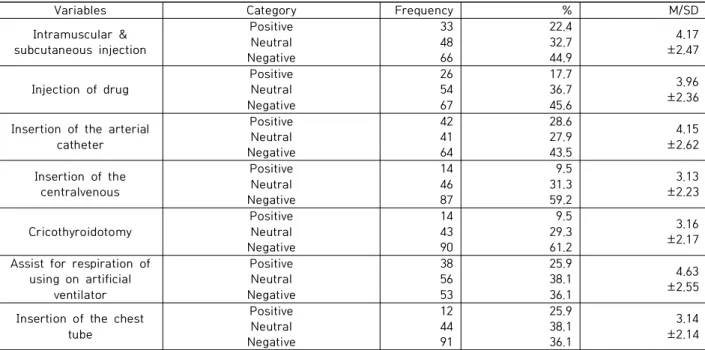
환자처치 항목 중 간호사들의 부정적 의견이 높았던 문 항은 <Table 7>과 같다. 근육/피하주사 44.9%(66명), 약 물투여 45.6%(67명), 동맥관 삽관 43.5%(64명), 중심정맥 관 삽관 59.2%(87명), 윤상갑상막절개술 61.2%(90명), 인 공호흡기를 이용한 호흡 보조 36.1%(53명), 흉관삽관 61.9%(91명)로 부정적 의견이 높은 것으로 나타났다.

3.3.3.4 Analysis of relationships between key variables

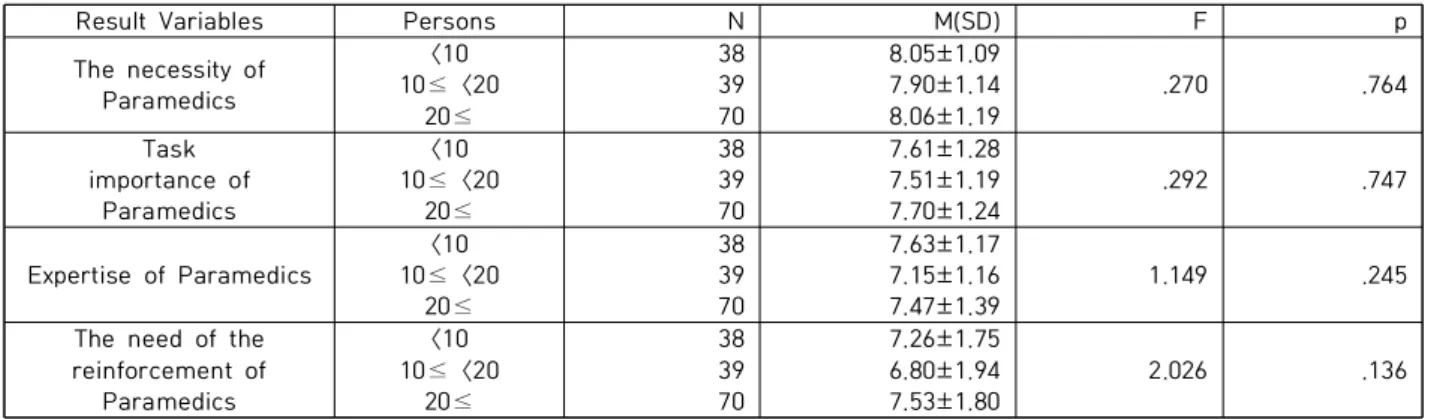
응답자의 경력과 1급 응급구조사와의 협업 경력에 따른 주요 변인들 간의 인식차이를 확인하고자 하였다. 1급 응 급구조사에 대한 응답자의 경력에 따른 집단 간 인식의 차 이를 비교 하였다. 응답자들의 경력에 따라 1급 응급구조 사들의 필요성, 업무의 중요성, 전문성, 증원의 필요성 모 두 통계적으로 유의한 차이가 나타나지 않았다<Table 8>.

1급 응급구조사에 대한 응답자의 협업경력에 따른 집단 간

의 인식 차이를 비교하였다. 응답자들의 협업경력에 따른

1급 응급구조사들의 필요성, 업무의 중요성, 전문성, 증원

의 필요성 모두 통계적으로 유의한 차이가 나타나지 않았

다<Table 9>. 1급 응급구조사에 대한 응답자의 간호사 근

무 인원수에 따른 집단 간의 인식 차이를 비교 하였다. 응

답자의 1일 근무 인원수에 따른 1급 응급구조사의 필요성,

업무중요성, 전문성, 증원필요성 모두 통계적으로 유의한

차이가 나타나지 않았다<Table 10>.

(5)

Variables Category Frequency % M(SD) Airway maintenance and

oxygen supply using OPA/NPA

Positive / Neutral / Negative 88/42/17 59.9/28.6/11.6 6.44(±2.09)

Oxygen supply using oxygen

mask Positive / Neutral / Negative 102/33/12 69.4/22.4/8.2 6.97(±1.98) Using respiratory assist and

respirator with BVM Positive / Neutral / Negative 77/50/20 52.4/34.0/13.6 6.31(±2.32) Immobilization

of the cervical spine Positive / Neutral / Negative 128/19/0 87.1/12.9/0 7.76(±1.19) Immobilization

of the limb Positive / Neutral / Negative 135/12/0 91.8/8.2/0 7.85(±1.08) Hemostasis & wound

management Positive / Neutral / Negative 130/16/1 88.4/10.9/0.7 7.88(±1.21) Insertion

of the nasogastric tube Positive / Neutral / Negative 101/29/17 68.7/19.7/11.6 6.76(±2.20) Gastric lavage Positive / Neutral / Negative 97/31/19 66.0/21.2/12.9 6.67(±2.27) Nelaton Positive / Neutral / Negative 104/28/15 70.7/19.0/10.2 6.87(±2.27) Enema Positive / Neutral / Negative 100/31/16 68.0/21.1/10.9 6.74(±2.32) Treatment of

heat and cold patients Positive / Neutral / Negative 118/26/3 80.3/17.7/2.0 7.42(±1.53) Assist suture Positive / Neutral / Negative 114/30/3 77.6/20.4/2.0 7.47(±1.55) Preparing for surgery and

assisting with emergency

operation Positive / Neutral / Negative 105/28/14 71.4/19.0/9.5 6.93(±2.14) Assist for the reduction of the

fracture and dislocation Positive / Neutral / Negative 119/23/5 81.0/15.6/3.4 7.42(±1.68) Basic life support Positive / Neutral / Negative 138/9/0 93.9/6.1/0 8.36(±1.01)

Using of

the monophasic defibrillator Positive / Neutral / Negative 113/24/10 76.9/16.3/6.8 7.56(±2.00) Assist for

the ECMO Positive / Neutral / Negative 96/29/22 65.3/19.7/15.0 6.67(±2.41) Treatment of

the hypothermia Positive / Neutral / Negative 104/33/10 70.7/22.4/6.8 7.16(±1.96) OPA: oro pharyngeal airway

NPA: naso pharyngeal airway BVM: bag valve mask

ECMO: extracorporeal membrane oxygenation

Table 5. Positive Opinions of nurses on patient treatment services of paramedics in emergency medical institutions

Variables Category Frequency % M(SD)

Secured by vein Positive

Neutral Negative

46 51 50

31.3 34.7 34.0

4.75(±2.59)

Intubation of the trachea

Positive Neutral Negative

46 47 54

31.3 32.0

36.7 4.65(±2.62)

Simple suture Positive

Neutral Negative

50 41 56

34.0 27.9 38.1

4.78(±2.80)

Remove for foreign body of the nose,ear,eye

Positive Neutral Negative

65 49 33

44.2 33.3

22.4 5.74(±2.49) Remove for foreign body of the

oral cavity and esophagus

Positive Neutral Negative

59 51 37

40.1 34.7 25.2

5.42(±2.53)

Reduction of the fracture and dislocation

Positive Neutral Negative

63 47 37

42.9 32.0 25.2

5.56(±2.59)

Table 6. Neutral Opinions of nurses on patient treatment services of paramedics in emergency medical institution

(6)

Variables Category Frequency % M/SD Intramuscular &

subcutaneous injection

Positive Neutral Negative

33 48 66

22.4 32.7 44.9

4.17

±2.47

Injection of drug

Positive Neutral Negative

26 54 67

17.7 36.7 45.6

3.96

±2.36

Insertion of the arterial catheter

Positive Neutral Negative

42 41 64

28.6 27.9 43.5

4.15

±2.62

Insertion of the centralvenous

Positive Neutral Negative

14 46 87

9.5 31.3 59.2

3.13

±2.23

Cricothyroidotomy

Positive Neutral Negative

14 43 90

9.5 29.3 61.2

3.16

±2.17 Assist for respiration of

using on artificial ventilator

Positive Neutral Negative

38 56 53

25.9 38.1 36.1

4.63

±2.55

Insertion of the chest tube

Positive Neutral Negative

12 44 91

25.9 38.1 36.1

3.14

±2.14 Table 7. Negative Opinions of nurses on patient treatment services of paramedics in emergency medical institution

Result Variables Career

(years) N M(SD) F p

The necessity of Paramedics

〈5 5≤ 〈10

10≤

45 60 41

8.33±1.00 7.87±1.21 7.90±1.16

2.478 .088

Task importance of Paramedics

〈5 5≤ 〈10

10≤

45 60 41

7.91±1.14 7.48±1.17

7.53±1.40 1.176 .183

Expertise of Paramedics

〈5 5≤ 〈10

10≤

45 60 41

7.71±1.24 7.35±1.19 7.24±1.45

1.634 .199

The need of the reinforcement of

Paramedics

〈5 5≤ 〈10

10≤

45 60 41

7.73±1.44 7.05±1.92

7.05±2.06 2.180 .117

Table 8. Difference in Necessity, Work Importance, Expertise, and Need for Reinforcement of Paramedics According to Respondent's Clinical Experience

Result Variables Career

(years) N M(SD) F p

The necessity of Paramedics

〈4 4≤ 〈7

7≤

53 55 38

8.33±1.00 7.87±1.21

7.90±1.16 1.675 .191

Task importance of Paramedics

〈4 4≤ 〈7

7≤

53 55 38

7.91±1.14 7.48±1.17 7.53±1.40

.427 .654

Expertise of Paramedics

〈4 4≤ 〈7

7≤

53 55 38

7.71±1.24 7.35±1.19

7.24±1.45 2.063 .131

The need of the reinforcement of

Paramedics

〈4 4≤ 〈7

7≤

53 55 38

7.73±1.44 7.05±1.92 7.05±2.06

2.023 .136

Table 9. Difference in Necessity, Work Importance, Expertise, and Need for Reinforcement of Paramedics

According to Respondent's Work Experience with Paramedics

(7)

Result Variables Persons N M(SD) F p The necessity of

Paramedics

〈10 10≤ 〈20

20≤

38 39 70

8.05±1.09 7.90±1.14 8.06±1.19

.270 .764

Task importance of

Paramedics

〈10 10≤ 〈20

20≤

38 39 70

7.61±1.28 7.51±1.19 7.70±1.24

.292 .747

Expertise of Paramedics

〈10 10≤ 〈20

20≤

38 39 70

7.63±1.17 7.15±1.16

7.47±1.39 1.149 .245

The need of the reinforcement of

Paramedics

〈10 10≤ 〈20

20≤

38 39 70

7.26±1.75 6.80±1.94 7.53±1.80

2.026 .136

Table 10. Difference in Necessity, Work Importance, Expertise, and Need for Reinforcement of Paramedics According to Respondent's number of nurse per day

IV. Discussions

본 연구는 응급의료기관 내 1급 응급구조사 업무범위 개선을 위한 업무 실태조사로 병원응급구조사회 연구 과 제로 실시되었다. 응급의료기관 내 응급조사 인지도 항목 에서 1급 응급구조사의 필요성 8.01(±1.15)/9점, 업무범 위 인지 6.46(±1.26)/9점, 역할의 중요성 7.63(±1.23)/9 점, 전문성 7.43(±1.28)/9점, 증원의 필요성 7.27(±1.84)/9점으로 긍정적 답변이 높게 나타났다. 이 는 한[12]등의 연구결과 응급구조사 업무 인식의 점수는 3.27(±0.34)/5점과 정[13]등의 연구에서 응급구조사의 이미지 분석의 점수 응급구조사 대상 2.74(±0.257)/4점, 간호사 대상 2.75(±0.383)/4점, 배[19]등의 연구의 3.23(±0.67)/5점과 본 연구의 결과가 유사하거나 다소 높은 결과가 나타났다. 본 연구에서 선행연구 결과보다 높은 결과가 나타난 이유는 연구대상자를 경력 간호사를 대상으로 시행하여 1급 응급구조사에 대한 높은 이해가 원인이라 사료된다. 이는 응급의료기관 내 1급 응급구조 사의 활동이 고품질의 응급의료를 효율적으로 제공하면 서 응급의료팀 구성원으로 필요한 인적자원으로 인식하 고 있다고 생각된다. 따라서 응급의료기관에서 1급 응급 구조사의 역할과 수행능력에 대하여 긍정 적인 의견과 응 급의료기관 내에 필요한 직종이라는 결과로 인해 1급 응 급구조사가 응급의료기관에서 응급 의료 팀 구성원으로 도움이 되고 필요로 하는 존재라 사료된다. 응급의료기관 내 1급 응급구조사의 업무 중 환자평가 항목인 활력징후 측정 70.7%(104명), GCS, RTS 등을 이용한 외상환자 평 가 72.8%(107명), KTAS 등을 이용한 중증도 분류 67.3%(99명)와 환자 검사 항목인 심전도 검사

89.1%(131명), 혈당측정 74.1%(109명), 정맥혈 채혈(혈 액배양검사포함) 57.8%(85명), 동맥혈 채혈 57.8%(85명) 으로 모든 항목에서 긍정적 견해가 높았다.

이는 한[15]등의 연구에서 의사가 인식하는 환자 평가 및 검사에서 활력징후 평가를 가장 중요하다고 생각 (55.1%) 하며 활력징후 평가와 심전도 검사를 가장 필요 하다고 생각(68.9%)을 바탕으로 심전도 검사를 가장 허 용할 수 있다고 생각(75.8%)하는 것으로 나타났는데 본 연구에서도 유사한 결과가 나타났다. 이는 1급 응급구조 사들이 응급의료기관 내에서 하고 있는 환자평가와 환자 검사 활동이 직접, 간접 의료지도를 시행하는 주체인 의 사뿐만 아니라 팀원의 일원인 간호사들 또한 1급 응급구 조사의 적합한 업무로 인정하고 있다고 사료된다.

환자 처치 항목의 OPA/NPA를 이용한 기도유지 및 산 소공급에 대해 개입 59.9%(88명), 산소마스크를 이용한 산소공급 69.4%(102명), BVM을 이용한 호흡 보조 52.4%(77명), 목뼈/척추 고정 87.1%(128명), 팔다리 부 목고정 91.8%(135명), 지혈 및 창상 처치 88.4%(130명), 비위관튜브 삽입 68.7%(101명), 위세척 66.0%(97명), 도 뇨관 삽입 70.7%(104명), 관장 68.0%(100명), 온열 및 한랭 환자 처치 80.3%(118명), 봉합 보조 77.6%(114명), 수술준비 및 응급수술 보조 71.4%(105명), 골절 및 탈구 정복 보조 81.0%(119명). 심폐소생술 중 기본심폐소생술 수행 93.9%(138명), 수동제세동 사용 76.9%(113명), ECMO 보조 65.3%(96명), 저체온 치료 70.7%(104명)으 로 긍정적 견해가 높게 나타났다.

정[13]등의 연구에서 간호사가 생각하는 응급구조사의

업무에 대한 인식도는‘외상처치’가 가장 높았고 응급의료

기관내에서 근무하고 있는 의사, 간호사를 대상으로 한

배[19]등의 연구에서도 응급구조사의 업무로 ‘외상처치’

(8)

를 가장 높게 인식하고 있었으며 본 연구의 결과와 유사 하였다. 강[16]등의 연구에서도 외상처치분야의 의료 인 력에서 응급구조사가 1명 증가할 때 마다 응급실 체류 시 간을 9분가량 감소시키는데, 이는 외상처치, 검사실 이 동, 병실 및 수술장 이동 등 외상 환자의 응급실 체류 시 간에 직접적인 영향을 주고 있기 때문이다. 현재 1급 응 급구조사는 응급환자처치에 긍정적 영향을 미치고, 간호 사들의 신뢰를 받고 있다고 생각할 수 있다. 따라서 환자 처치에 있어 의사의 직·간접 의료지도를 통하여 안전하게 수행 하고 있고, 간호사들과 응급환자에 대한 응급처치 팀원으로서 역할을 다하고 있다고 생각한다. 따라서 현재 일부 처치 항목은 1급 응급구조사의 업무 범위에 포함되 어 있지는 않지만, 향후 응급환자에게 미치는 영향과 응 급의료제공의 안정화에 따라 1급 응급구조사의 업무범위 로의 개선될 가능성을 시사하고 있다.

응급의료기관 내 1급 응급구조사의 업무 중 중립적인 답변으로 정맥 로 확보에 대해 긍정 31.3%(46명), 중립 34.7%(51명), 부정 34.0%(50명)으로 간호사들의 의견 차 이가 보였다. 기관 내 삽관에 대해서도 긍정 31.3%(46 명), 중립 32.0%(47명), 부정 36.7%(54명)로 간호사들의 의견 차이가 보였다. 단순 봉합에 대해 긍정 34.0%(50 명), 중립 27.9%(41명), 부정 38.1%(56명)로 간호사들의 의견 차이를 보였다. 이는 현재 1급 응급구조사의 업무범 위라 할지라도 의사, 간호사의 주 업무와 중복된다고 생 각할 수 있다. 결국 응급환자에게 제공하는 응급의료의 질을 높이고자 팀원으로서 직역 간 최적의 역할을 맡는 것이 바람직하다 생각된다. 부정적 의견이 높은 항목들은 근육/피하주사 44.9%(66명), 약물투여 45.6%(67명), 동 맥관삽관 43.5%(64명), 중심 정맥 관 삽관 59.2%(87명), 윤상갑상막절개술 61.2%(90명), 인공호흡기를 이용한 호 흡 보조 36.1%(53명), 흉관삽관 61.9%(91명)로 부정적인 의견이 높게 나타났다. 이는 정[13]등의 연구를 살펴본 결과 ‘약물투여’가 가장 낮은 것으로 나타났으며 한[15]등 의 연구에서도 약물투여에 대한 인식도가 가장 낮았다.

박[17]등의 연구에서 1급 응급구조사의 법적인 업무에 약 물투여가 가능하다 기술되어 있지만 투여 제한으로 인하 여 실효성이 의심되고 있다. 배[14]등의 연구에서는 고도 의 의학 기술과 판단이 요구되는 기도관리(2.82점), 약물 투여(2.43점) 영역에 대해서는 응급구조사의 업무로 인식 하지 않는 경향이 보여 진다.

부정적 의견이 지배적인 항목들의 원인으로는 간호사의 업무 범위와 중복되며, 위험부담이 큰 술기에 대해서는 의 료분쟁사고의 위험성이 높고 책임의 문제와 의료행위에 대

한 합법성 그리고 행위에 대한 기록 책임소재가 명확하지 않기 때문에 1급 응급구조사의 업무로 보기에는 어렵다는 의견이 많았다. 또한 김[9]등의 연구에서 권역응급의료센 터, 전문응급의료센터 지정기준의 인력기준의 수는 명시되 어 있지만 구체적인 업무 범위 또는 능력수준에 대해서는 명시되어 있지 않기에 갈등을 증가시킬 수 있다고 하였다.

이러한 부분에서는 업무조정이 불가피해 보인다. 이 같은 부분은 심층적인 검증을 통해 개선해 나가야할 것이다.

주요 변인간의 관계분석에서 응답자의 경력과 응답자 의 협업경력 1일 근무 인원수에 따른 1급 응급구조사의 필요성, 중요성, 증원필요성 간 상관관계는 통계적으로 유의하지 않다. 이는 응답자의 경력, 1급 응급구조사와의 협업 경력, 응답자의 1일 근무 인원수에 따른 1급 응급구 조사에 대한 인지도에 차이가 없기에 간호사들은 1급 응 급구조사에 대한 필요성, 업무의 중요성, 전문성, 증원의 필요성에 대해 긍정적으로 동의하고 있다고 생각할 수 있 고, 응급의료기관에서 1급 응급구조사가 팀원으로서 인정 받고 있고 그들의 활동도 지지 받고 있다고 생각된다.

Ⅴ. Conclusions

본 연구는 응급의료기관 내 종사하는 간호사들이 인지 하고 있는 응급의료기관 내 1급 응급구조사의 이미지와 적정 업무 범위에 대한 의견을 파악하기 위해 시행하였 다. 응급의료기관 내 1급 응급구조사에 대한 인지도는 응 급구조사의 필요성, 역할의 중요성, 전문성, 증원의 필요 성에서 긍정의 의견이 높게 나타났다. 환자 평가 영역의 활력징후 측정, GCS, RTS 등을 이용한 외상환자 평가, KTAS 중증도 분류, 환자 검사 영역의 심전도 측정, 혈당 측정, 정맥, 동맥 채혈, 환자 처치 영역에서는 비위관 튜 브 삽입, 위세척, 도뇨관 삽입, 관장, 온열 및 한냉 환자 처치, 봉합 보조, 수술 준비 및 응급수술 보조, 골절 및 탈구 정복 보조, 수동 제세동기 사용, ECMO 보조, 저체 온 치료에서 긍정의 의견이 높게 나타났다.

REFERENCES

[1] K. M. Lee, M. S. Hong, A study on relationships of work stress, fatigue, and job satisfaction in emergency room nurses, Chonnam Journal of Nursing Science, Vol. 8(1), No.1, pp. 87-10, August 2003. http://crins530.jnuac.kr/bbs/board.php?bo_table=journal2&

wr_id=89&sca=%EC%A0%9C8%EA%B6%8C+%EC%A0%9C

(9)

1%ED%98%B8

[2] Jung-Mi Park, Sun-Sim Kim, Comparison study of satisfaction levels on Field Practice of EMT college students by 5 Practice Fields, The Journal of the Korean Society of Emergency Medical Technology, Vol.2, No.-, pp.7-25, December 1998.

http://www.kemt.or.kr/bbs/board.php?bo_table=sub_030302&vol

=2&no=1

[3] C. Billie, K. Louise, Impact of job satisfaction components on intent to leave and turnover for hospital-based nurse:A review of the research literature, International Journal of Nursing Studies, Vol. 44, pp. 297-314, February 2007. https://doi.org/10.1016/j.

ijnurstu.2006.02.004

[4] Eun Nam Lee, Bog Ja Kim, Kyung Hee Kang, Sung Sook Kim, Young Soon Kim, Development of an In-service Education Program for Emergency Room Nurses According to Their Career Ladders, Journal of Korean Clinical Nursing research, Vol. 14 No.1, pp.99-111, Aprill 2008. http://www.koreascience.kr/article /JAKO200807662068237.page

[5] Lee OH, The work and job satisfaction of paramedics in the emergency room of university hospitals. Korean J Emerg Med Ser 2011;15(1):47-63, Aprill 2011. http://www.kemt.or.kr/bbs/

board.php?bo_table=sub_030302&vol=15&no=1&th_no=227 [6] Yoou SK, Kwon HR, Park HJ, Shin SD, Choi ES, Uhm TH,

Job analysis of paramedic on the developing a curriculum method, Korean J Emerg Med Ser 2013;17(3):115-137, December 2013. http://www.kemt.or.kr/bbs/board.php?bo_table=

sub_030302&vol=17&no=3&th_no=289

[7] Korea Ministry of Government Legislation. Available at:

http://www.law.go.kr, 2017, Article 27 of the Medical Law (Prohibition of unlicensed medical activities, etc.)

[8] Park CS, Kim YH, The legal Status of Emergency Medical Technician, Korean Association of Law and Politics, 2018;18(4):289-307, December 2018. http://dx.doi.org/10.1792 6/kaolp.2018.18.4.289

[9] Kim BJ, A Study of Job Analysis of the Emergency Room Nurse.

Clinical Nursing Research Vol.12(1):81-95, August 2006.

https://khna.or.kr/home/research/searchArticle.php?bo_table=artic le_search&wr_id=237&sca=&sfl=wr_subject&stx=A+Study+of+

Job&sop=and

[10] Chung SP, You JS, Kim MJ, Yoon YH, Hong DY, Yoon YS, Cho JH, Lee KW, Kang JH, Lee KW, Chun BJ, Ryu JH, Kim SH, Lee JY, Lim H, Kim SJ, Task and Time Analysis of Intern Physicians in the Emergency Department: Multicenter Cross-sectional Study Journal of the Korean Society of Emergency Medicine, Vol.25(3) : 231-237, 2014 https://ir.ymlib.yonsei.ac.kr/handle/22282913/138956

[11] Ahn KO, Shin SD, Song KJ, Park JO, Lee JS, Suh GJ, Delphi study to develop consensus for the quality improvement of prehospital care. J Korean Soc Emerg Med 2007;18(2):95-96,

April 2007 http://www.jksem.org/upload/pdf/18401751.pdf [12] Han SY, Bae KS, Kim UK, Image of Hospital Emergency

Medical Technicians Perceived by Emergency Medical Service Providers (Focusing on tertiary medical institutions in Daejeon and Chungcheongnam do). The Journal of the Korea Contents Association Vol12(4): 373-379, 2012 http://dx.doi.org/10.5392/

JKCA.2012.12.04.373

[13] Jung SW, Kang KH, Awareness and direction of paramedics work and image in hospitals (Focusing on paramedics and nurses in the emergency room). Korean J Emerg Med Ser 2016;20(2):81-97, August 2016. http://dx.doi.org/10.14408/KJE MS.2016.20.2.081

[14] Bae KS, Han SY, Emergency Medical Participants’ Recognition of The Emergency Medical Technician’s Job Awareness, Journal of the Korea Academia-Industrial Cooperation Society 2013;14(6):2908-2914, June 2013. http://dx.doi.org/10.5762/K AIS.2013.14.6.2908

[15] Han SY, Ji HK, Yoon SW, Lee CH, Legislation Feasibility Studies for Expanding the Business Scope of Paramedics:

Focused on High Level Task in Importance, Need and Allowance, Korean J Emerg Med Ser 2015;19(3):117-138, December 2015. http://dx.doi.org/10.14408/KJEMS.2015.19.3.

117

[16] Kang JH, Kang YJ, Song SW, Lee SK, Yang YR, The effect of Change in the Trauma Care System on Length of Stay of Trauma Patient in the Emergency Department, Asia-pacific Journal of Multimedia Services Convergent with Art, Humanities, and Sociology 2017;7(10):683-692, October 2017.

http://dx.doi.org/10.14257/ajmahs.2017.10.27

[17] Park JM, Bang JS, Hong SW, Song YJ, A study on improvement of EMT-paramedic’s pre-hospital paramedic emergency care for cadioplegic patients. Korean Review of Crisis & Emergency Management 2013;9(3): 89-110. https://www.kci.go.kr/kciport al/ci/sereArticleSearch/ciSereArtiView.kci?sereArticleSearchBe an.artiId=ART001759111

[18] Bae HA, Medical Direction and Unlicensed Medical Practice in Prehospital Emergency Medical System. Korean Criminological Review, 2009;79:87-125, September 2009 http://www.kic.re.kr/upload/savedata/crime_resrch//html/04 [19] Bae HA, A study on the Scope of Practice of Nurses in the

Prehospital Emergency Medical Servie System. The Korean Society of Law and Medicine, 2019;20(2):141-170, September 2019 https://lawmed.jams.or.kr/po/volisse/sjPubsArtiPopView.k ci?soceId=INS000000140&artiId=SJ0000000363&sereId=SER 000000001&submCnt=1&indexNo=5

[20] Korea Ministry of Government Legislation. Available at:

http://www.law.go.kr, 2017, The Enforcement Rules of the

Emergency Medical Act [Appendix 14] Scope of work of

emergency assistance

(10)

Authors

Yong-Seok KIM received the B.S., M.S.

degrees in Health Science promotion from Korea National University of Transportation, Korea, in 2016, 2018 respectively. MS.

Kim is currently in the Emergency

Medical Center of Myongji Hospital. He is interested in disaster medicine.

Hyo-Young KANG received the M.S degree in Health Science from Graduate school of Public Health Yonsei Universtiy, Korea in 2017. He has been working at Myongji Hospital, Myongji Medical Foundation.

He is interested in Mass Casualty Incident.

Jin-Woo KIM received the B.S degree in athletic prescription at Konyang University in 2002, MS degree in athletic prescription and athletic therapy at Korea University in 2005 and Ph.D. in anatomy and

neuroscience at Eulji University Medical School in 2014.

He has been working as a professor of Emergency Medical Technology at Daejeon Health University since March 2011.

He is interested in trauma Medicine.

수치

Table  4.  Opinions  of  nurses  on  patient  examination  services  of  paramedics’  in  emergency  medical  institutions
Table 5. Positive Opinions of nurses on patient treatment services of paramedics in emergency medical institutions
Table  8.  Difference  in  Necessity,  Work  Importance,  Expertise,  and  Need  for  Reinforcement  of  Paramedics  According  to  Respondent's  Clinical  Experience
Table  10.  Difference  in  Necessity,  Work  Importance,  Expertise,  and  Need  for  Reinforcement  of  Paramedics  According  to  Respondent's  number  of  nurse  per  day

참조

관련 문서

Therefore, nurses should be responsible for the relations to resolve the needs of care between nurses and patients and through communication with the patients,

Objective: The purpose of this study was to investigate the relationship between the awareness of death and the ethical attitude to Do-Not-Resuscitate (DNR) among some

Objective : This study is to identify factors related to performance of hand washing in daily life for emergency Medical Technology students.. Methods : The study subjects

Purpose: The aim of this study is to identify the relationship between knowledge and awareness of radiation department students and their intent in

The staff of outstanding hospitals (doctors, nurses, administrative personnel) provide proper medical services that meet the

Length scale transport equation of which the exact form can be derived from Navier-Stokes eq.. ~ However, the amount of energy dissipated is controlled by the energy fed

→ For the turbulent jet motion and heat and mass transport, simulation of turbulence is important.. in the mean-flow equations in a way which close these equations by

In a difference according to position, fairness and immediacy show a statistically meaningful difference, and centers have the lowest awareness about the