Received 05 April 2015, Revised 24 April 2015, Accepted 08 May 2015
* Corresponding Author Chan-Yong Jin(E-mail:[email protected], Tel:+82-63-850-6567)
Division of Information and Electronic Commerce(Institute of Convergence and Creativity), Wonkwang University Iksan 570-749, Korea
Open Access
http://dx.doi.org/10.6109/jkiice.2015.19.7.1711 print ISSN: 2234-4772 online ISSN: 2288-4165 한국정보통신학회논문지(J. Korea Inst. Inf. Commun. Eng.) Vol. 19, No. 7 : 1711~1718 Jul. 2015
전자상거래 연구에서 만족, 신뢰 그리고 충성도 간에 관계에 관한 메타분석
남수태
1
· 양기설2
· 진찬용1*
A Meta-analysis of Relationship among Satisfaction, Trust, and Loyalty in E-commerce
Soo-Tai Nam
1· Ki-Seol Yang
2· Chan-Yong Jin
1*1*
Division of Information and EC(Institute of Convergence and Creativity), Wonkwang University, 570-749, Korea
2
Department of Merchandising and Digital Retailing, University of North Texas, Denton, 76203, U. S. A.
요 약
메타분석은 여러 실증연구의 정량적인 결과를 통합과 분석을 통해 전체 결과를 조망할 기회를 제공하는 통계적 통 합 방법이다. 전자상거래 연구에서 만족, 신뢰와 충성도 간의 관계에 관한 연구들을 문헌연구와 메타분석을 실시하였
다 . 최근 전자상거래나 정보통신기술과 지식정보사회의 융합은 정치, 경제 및 다양한 분야에 빠른 영향을 미치고 있
다 . 본 연구는 2002년부터 2013년까지 우리나라 학술지에 게재된 연구 중 만족, 신뢰 및 충성도의 인과관계가 설정된
총 57편의 연구논문을 대상으로 하였다. 메타분석의 결과 만족과 신뢰의 경로가 가장 큰 효과 크기로 나타났으며, 효
과 크기는(r = .591)이었다. 두 번째 효과 크기는 만족과 충성도 경로에서 효과 (r = .554), 다음으로 신뢰와 충성도 경로 에서는(r = .552)로 나타났다. 그런데 신뢰와 만족 경로에서는 가장 낮은 효과 크기(r = .484)로 나타났다.
ABSTRACT
A Meta-analysis refers to a statistical literature synthesis method from the quantitative results of many known empirical studies. Recently, the convergence of knowledge-based society and, information telecommunication technologies has a rapid impact on politics, economics and various fields. A meta-analysis was conducted to identify the relationships among satisfaction, trust, and loyalty in e-commerce studies. A total of 57 research papers published in Korean academic journals during 2002 and 2013 were reviewed and the causal relationships among satisfaction, trust, and loyalty in e-commerce were established. The result of the meta-analysis might be summarized that the highest effect size (r =. 591) was in the path from the satisfaction to the trust. The second biggest effect size (r =. 554) was found in the path between the satisfaction to the loyalty. The third biggest effect size (r =. 552) was found in the path between the trust to the loyalty. By the way, the smallest effect size (r =. 484) was found in the path between the trust to the satisfaction.
키워드 : 메타분석, 전자상거래, 충성도, 만족, 신뢰
Key word : Meta analysis, E-commerce, Loyalty, Satisfaction, Trust
Ⅰ. INTRODUCTION
Recently, advances in multimedia broadcasting communications have introduced a variety of platform technologies that offer related application services. The convergence of knowledge-based society and information telecommunication technologies has a rapid impact on politics, economics and various fields. The development of information technology and information telecommunication technology, drive the rapid expansion of behavioral intention in e-commerce. The rapid growth of e-commerce market is ascribed to the super highway internet and network infrastructure, a seemingly endless increase of internet users. The expansion of online shopping malls provides companies with the opportunity of an expansion of circulation and an improvement of communication with customers. The companies envision cost reductions for the company and a concurrent improvement in customer service.
E-commerce market is predicted to reach USD 1 trillion in 2014. The Internet shopping, as well as competition across industries and, in the industry has intensified. In this competitive e-commerce environment, improving customer loyalty is emphasized as the most important success factor to retain existing customers for the company.
Ⅱ. PREVIOUS RESEARCH
In previous research of the business organization literature, trust focuses on the trust mechanism as an alternative mechanism of hierarchy and pricing mechanism. In the marketing literature, trust has been examined as a variable to maintain the business relationship in a long-term dealing a distribution channel.
Customer loyalty is a variable, commonly categorized as brand loyalty, service loyalty, and store loyalty, etc.
When compared to traditional markets, the customer loyalty in the Internet market acted as competitiveness advantage for the company. Today, market entry of
competitors in the Internet environment is relatively easy, than in the traditional off-line market. In addition, the very low switching cost due to the nature of the Internet makes customers easily to leave for other companies’ websites to look for better deals. The loyalty of customers could be the core value of business in Internet shopping to retain existing customers and ultimately increase sales [1]. The research model is depicted in Fig. 1 proposes the relationships among satisfaction, trust, and loyalty in e-commerce in this study.
그림 1. 연구 모델 Fig. 1 Research model
As it is proposed in the research model, customer satisfaction and customer trust have a reciprocate relationship. Furthermore, customer satisfaction and trust increase customer loyalty, an ongoing relationship in a long-term [2]. The study on “An Analysis of Variables Affecting Customer Loyalty in Internet Banking” [3]
supported that the correlation of the path from the satisfaction to the loyalty showed the effect size (r =. 54).
In addition, the results of the study showed that the correlation of the path from the trust to the loyalty was the effect size (r =. 22), and the correlation of the path from the trust to the satisfaction showed the effect size (r
=. 29). In the study on “The Structural Relationship
among Influential Factors, Satisfaction and Customer
Loyalty on Internet Shopping” [4], the correlation of the
path from the satisfaction to the trust showed the effect
size (r =. 46). It implies that customer trust is continuous and a decisive factor of customer satisfaction, meaning the extent to which product/service/store fulfills the customer's request [1].
Ⅲ. META ANALYSIS
A meta-analysis refers to a statistical literature synthesis method from the quantitative results of many known empirical studies [5]. The meta-analysis can be described as expressed analysis. The methodological approaches and characteristics of meta-analysis are as follow. In terms of quantity, a meta-analysis is to use the summary statistics to integrate the data simply. In addition, the effect size is calculated by using different research methods and results to measure. As it can be compared with the integration, the effect size is converted to a common unit. Thus, a meta-analysis can be derived conclusion commonly. In addition, a small difference between studies can be neglected for generalization even when different effect sizes are used [6]. This study reviewed research papers that examined causal relationships among satisfaction, trust, and loyalty in e-commerce. The research papers were published in Korea academic journals on e-commerce research during 2002 and 2013. The papers included in this study meta-analysis were identified using keywords that are “e-commerce loyalty”, “e-commerce satisfaction” and “e-commerce trust", specifying on RISS, DBpia, KISS in database articles of social science.
A total of 234 research papers were found, consisting of 200 papers from RISS, 23 papers from DBpia and 11 papers from KISS through the search. This study filtered research papers published in Korean academic journals with the study criteria and then targeted a total of 57 papers for this study purpose. Based on the methodology of meta-analysis, was utilized the CMA (comprehensive meta analysis) program developed by Biostat was utilized.
The homogeneity test in the meta-analysis was
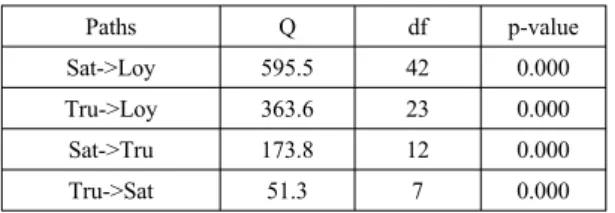
performed on these research subjects to find that the effect sizes of multiple independent studies are values extracted from the individual population. Statistical null hypothesis for the homogeneity test, showed that no difference between the estimates of the effect size of the results of the individual studies. When the null hypothesis is accepted, a meta-analysis can be performed to obtain an estimate of the comprehensive effect size by integrating the estimated effect sizes. For interpretation of homogeneity test, the Q values of the test statistics based on chi-square distribution isused. The Q values are the same with the chi-square distribution. The results of heterogeneity test are shown in Table 1.
표 1. 동질성 검정의 결과
Table. 1 Results of homogeneity test
Paths Q df p-value
Sat->Loy 595.5 42 0.000
Tru->Loy 363.6 23 0.000
Sat->Tru 173.8 12 0.000
Tru->Sat 51.3 7 0.000
Q: Q statistics, df: degree of freedom
Q-values in paths Sat->Loy, Tru->Loy, Sat->Tru and
Tru->Sat is 595.5, 363.6, 173.8, 51.3, if and p = 0.5,
chi-squared critical value were 55.75, 35.17, 21.03,
14.07 respectively. Therefore, the Q values were bigger
than the limit value, the null hypothesis of homogeneity
were rejected. Because it was not extracted from the
same population, it could establish estimation as
consisting of heterogeneous data set. In other words, the
sizes of effects for all paths are regarded as being over
the standard error. In this heterogeneous case, we
calculate the average effect size by using calibrated
inverse variance weighting values with the
random-effects model, not the fixed-effects model [7,
8]. In summarizing the results of previous studies in the
specific field, a matter of publication bias or the file
drawer problem can be occurred when the normalization
of the sample does not include all of the previous
studies in the field, but it only represents part of
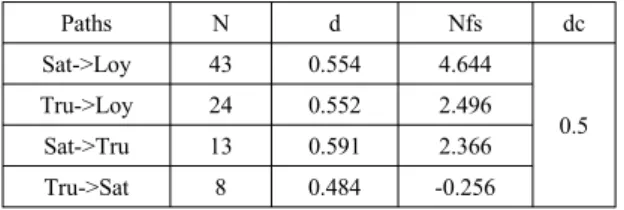
previous studies. This implies that papers published in journals have a high likelihood of positive results as compared to unpublished papers. The result of calculating Fail-safe number is shown in Table 2.
표 2. 안전계수 계산의 결과
Table. 2 Results of calculator for fail-safe number
Paths N d Nfs dc
Sat->Loy 43 0.554 4.644
Tru->Loy 24 0.552 2.496 0.5
Sat->Tru 13 0.591 2.366
Tru->Sat 8 0.484 -0.256
N: number of studies, d: effect size, Nfs: number fail-safe, dc:
determination coefficient
Ⅳ. CONCLUSIONS
This study reanalyzed the research papers with the purpose to classify the results of the previous studies that causal relationships among satisfaction, trust and loyalty in the e-commerce research, published Korean academic journals during 2002 and 2013. A total of 57 research papers were filtered with the study criteria from three databases and examined the causal relationships among satisfaction, trust, and loyalty in e-commerce the proposed research model of this study As shown in the collected data set (see APPENDIX), the values of effect size using the inverse weighted-mean as method approach with the random effect model are provided for the paths from Sat to Loy, from Tru to Loy, from Sat to Tru and from Tru to Sat. First, the result of the meta-suggests that the highest effect size is the path from the satisfaction to the trust (the effect size 0.591).
The effect size for the path from the satisfaction to the loyalty showed similar and slightly higher with the effect size in the research of Kim and Oh [4]. Second, the effect size for the path from the satisfaction to the loyalty showed similar to the effect size in the research of Kang and Lee [3]. Next, the effect size for the path from the trust to the loyalty showed very higher than the
effect size in the research of Kang and Lee [3]. Also, the effect size for the path from the trust to the satisfaction showed much higher than the effect size in the research of Kang and Lee [3]. In summarize, the result of the meta-analysis can be concluded that lower effect size (r
= .484) for the path from the trust to the satisfaction.
The three factors in the proposed research model have a power of explanation about 50% or more. Further, the predictive variables of this study have power of explanation about 50% or more. In conclusion, the result of the study is significant in that we can estimate effect sizes on the basis of path constructs. In addition, we expect that the results of by this study would be touchstones to researchers in similar studies.
ACKNOWLEDGMENTS
This paper was sponsored by Joosan Scholarship Foundation of Wonkwang University in 2013.
REFERENCES
[1] H. N. Moon, N. S. Yoon and J. H. Jeong, "Effect of relational benefits on internet shopping satisfaction and loyalty," The Korea Society of Management Information Systems Spring Conference, 2002.
[2] J. H. Kim and S. H. Kim, "Factors affecting cross-buying intentions in the banking industry," Asia Marketing Journal, vol. 11, no. 3, 2009.
[3] W. G. Kang, and H. B. Lee, "An analysis of variables affecting customer loyalty in Internet banking," Korea Business Review, vol. 27, no. 2, 2012.
[4] S. H. Kim and S. H. Oh, "The effects of internet shopping mall characteristics on satisfaction, Trust, and loyalty,"
Journal of Small and Medium Business, vol. 24, no. 2, 2002.
[5] S. T. Nam, D. G. Kim, H. C. Lee, S. Y. Shin and C. Y. Jin, "A Meta-analysis on the Behavioral Intention for Information Technology in Korea," Journal of the Korea Institute of Information and Communication Engineering, vol. 17, no.
11, 2013.
Satisfaction → Loyalty
No Sample F-z Corr L-L U-L Z-v P-v Q 1 305 0.61 0.55 0.46 0.62 11.00 0 596 2 199 0.57 0.52 0.41 0.61 8.00 0 596 3 333 0.46 0.43 0.34 0.51 8.00 0 596 4 326 0.68 0.59 0.52 0.66 12.00 0 596 5 219 0.58 0.52 0.42 0.61 9.00 0 596 6 200 0.71 0.61 0.51 0.69 10.00 0 596 7 204 0.78 0.65 0.56 0.72 11.00 0 596 8 650 1.02 0.77 0.74 0.80 26.00 0 596 9 141 0.42 0.40 0.25 0.53 5.00 0 596 10 183 0.46 0.43 0.31 0.54 6.00 0 596 11 408 0.56 0.51 0.43 0.58 11.00 0 596 12 411 0.61 0.55 0.47 0.61 12.00 0 596 13 252 0.66 0.58 0.49 0.66 10.00 0 596 14 237 0.72 0.62 0.53 0.69 11.00 0 596 15 356 0.93 0.73 0.68 0.78 17.00 0 596 16 355 0.42 0.39 0.30 0.48 8.00 0 596 17 165 0.78 0.65 0.55 0.73 10.00 0 596 18 245 0.46 0.43 0.32 0.53 7.00 0 596 19 323 0.25 0.25 0.14 0.35 5.00 0 596 20 553 0.60 0.54 0.47 0.59 14.00 0 596 21 662 0.83 0.68 0.64 0.72 21.00 0 596 22 237 0.64 0.57 0.47 0.65 10.00 0 596 23 183 0.48 0.45 0.32 0.56 6.00 0 596 24 184 0.62 0.55 0.44 0.65 8.00 0 596 25 308 0.69 0.60 0.52 0.67 12.00 0 596 26 210 0.80 0.66 0.58 0.73 11.00 0 596 27 199 0.81 0.67 0.59 0.74 11.00 0 596 28 364 0.35 0.34 0.24 0.43 7.00 0 596 29 175 0.91 0.72 0.64 0.78 12.00 0 596 30 338 0.62 0.55 0.47 0.62 11.00 0 596 31 285 0.17 0.17 0.05 0.28 3.00 0 596 32 239 0.84 0.69 0.61 0.75 13.00 0 596 33 365 0.85 0.69 0.64 0.74 16.00 0 596 34 411 0.61 0.55 0.47 0.61 12.00 0 596 35 257 0.66 0.58 0.49 0.65 11.00 0 596 36 216 0.15 0.15 0.02 0.28 2.00 0.02 596 37 185 0.37 0.36 0.22 0.47 5.00 0 596 38 90 0.59 0.53 0.36 0.66 5.00 0 596 39 212 0.28 0.28 0.15 0.40 4.00 0 596 40 202 0.56 0.51 0.40 0.61 8.00 0 596 41 233 0.73 0.62 0.53 0.69 11.00 0 596 42 211 1.32 0.87 0.83 0.90 19.00 0 596 43 313 0.65 0.57 0.49 0.64 11.00 0 596 12,144 Ran(r) 0.55 0.51 0.60 18.00 0 596
Trust → Loyalty
No Sample F-z Corr L-L U-L Z-v P-v Q 44 125 0.65 0.57 0.44 0.68 7.22 0 364
1 305 0.22 0.22 0.11 0.32 3.80 0 364 3 333 0.35 0.34 0.24 0.43 6.43 0 364 45 277 0.65 0.57 0.48 0.64 10.69 0 364 46 174 1.08 0.79 0.73 0.84 14.12 0 364 47 174 1.08 0.79 0.73 0.84 14.12 0 364 6 200 1.38 0.88 0.85 0.91 19.37 0 364 48 218 0.51 0.47 0.36 0.57 7.54 0 364 9 183 0.37 0.35 0.22 0.47 4.96 0 364 49 467 0.88 0.71 0.66 0.75 18.89 0 364 11 408 0.69 0.60 0.53 0.66 13.95 0 364 13 252 0.56 0.51 0.41 0.60 8.88 0 364 15 356 0.71 0.61 0.54 0.67 13.32 0 364 20 553 0.64 0.56 0.50 0.62 14.98 0 364 22 237 0.59 0.53 0.43 0.61 9.01 0 364 25 308 0.64 0.57 0.49 0.64 11.26 0 364 28 364 0.43 0.40 0.31 0.48 8.09 0 364 30 338 0.65 0.57 0.49 0.64 11.85 0 364 33 365 0.56 0.51 0.43 0.58 10.63 0 364 36 216 0.28 0.27 0.14 0.39 4.02 0 364 37 185 0.54 0.49 0.37 0.59 7.25 0 364 38 90 0.38 0.37 0.17 0.53 3.57 0 364 40 202 0.60 0.54 0.43 0.63 8.52 0 364 43 313 0.46 0.43 0.34 0.52 8.10 0 364 6,643 Ran(r) 0.55 0.48 0.62 12.55 0 364
Satisfaction → Trust
No Sample F-z Corr L-L U-L Z-v P-v Q 50 639 1.11 0.81 0.78 0.83 28.06 0 174 51 172 0.49 0.46 0.33 0.57 6.40 0 174 6 200 0.65 0.58 0.47 0.66 9.19 0 174 15 356 0.85 0.69 0.63 0.74 15.93 0 174 16 355 0.52 0.48 0.39 0.55 9.71 0 174 20 553 0.69 0.60 0.54 0.65 16.29 0 174 52 460 0.76 0.64 0.58 0.69 16.21 0 174 30 338 0.59 0.53 0.45 0.60 10.80 0 174 53 290 0.74 0.63 0.56 0.69 12.56 0 174 33 365 0.55 0.50 0.42 0.57 10.45 0 174 54 231 0.37 0.35 0.23 0.46 5.57 0 174 40 202 0.76 0.64 0.55 0.72 10.77 0 174 55 281 0.70 0.60 0.52 0.67 11.61 0 174 4,442 Ran(r) 0.59 0.51 0.66 11.70 0 174
Trust → Satisfaction
No Sample F-z Corr L-L U-L Z-v P-v Q 1 305 0.30 0.29 0.19 0.39 5.25 0 51 56 278 0.61 0.54 0.46 0.62 10.11 0 51 10 183 0.55 0.50 0.38 0.60 7.39 0 51 23 183 0.21 0.21 0.06 0.34 2.80 0.01 51 25 308 0.64 0.57 0.48 0.64 11.18 0 51 29 175 0.76 0.64 0.54 0.72 9.94 0 51 57 208 0.64 0.57 0.47 0.65 9.19 0 51 37 185 0.52 0.48 0.36 0.58 7.00 0 51 1,825 Ran(r) 0.48 0.38 0.57 8.23 0 51
[6] G. V. Glass, "Primary, secondary and meta-analysis of
research," Educational Researcher, vol. 5, no. 10, pp. 3-8, 1976.
[7] S. S. Oh, Meta-analysis: theory and Practice, Konkuk University Publication, 2009.
[8] R. G. Orwin, "A fail-safe N for effect size," Journal of Educational Statistics, vol. 8, no. 2, pp. 157-159, 1983.
APPENDIX
Fish-Z: Fisher's Z, Corr: correlation, L-L: low limit, U-L: upper limit, Z-v:
Z-value, P-v: p-value, Q: Q statistics, Ran(r): random(effect size).
REFERENCES of APPENDIX
1. W. G. Kang and H. B. Lee, "An Analysis of Variables Affecting Customer Loyalty in Internet Banking," Korean Management Review, vol. 27, no. 2, pp. 455-475, 2012.
2. I. S. Ko and S. J. Choi, "Building Customer Loyalty with Trust and Familarity in the Internet-based Shopping-mall,"
Asia Pacific Journal of Information Systems, vol. 15, no. 3, pp. 187-207, 2005.
3. W. Gunadi and K. S. Han, "The Effect of e-CRM on Customer Loyalty in Online Shopping: A Comparison between South Korea and Indonesia," Entrure Journal of Information Technology, vol. 8, no. 2, pp. 195-207, 2009.
4. J. H. Kim S. S. Seo and J. H. Lee, "A Study on the Influence of Customer Satisfaction and Loyalty by the Logistic Service Quality of Internet Shopping Mall," Korea Business Review, vol. 26, no. 1, pp. 443-461, 2011.
5. J. G. Kim, "The Effects of Internet Shopping Mall Attributes on Shopping Value, Consumer Satisfaction and Customer Loyalty," The Journal of Korea Corporation Management, vol. 47, pp. 63-87, 2013.
6. J. H. Kim, "The Impact of Value Congruence between Community and Members on Relationship Quality and Loyalty in the Online Brand Communities," Journal of Channel and Retailing, vol. 14, no. 4, pp. 53-81, 2011.
7. C. K. Kim and C. J. Kim, "A Study on the Effects of System and Information Quality of Internet Shopping Malls on Satisfaction and Loyalty," Journal of Management and Retailing, vol. 16, no. 1, pp. 101-117, 2013.
8. D. K. Na, J. H. Lee, M. Y. Baek and H. Y. Lee, "A Study on the Effect of Web Site Characteristics to Customer Value, Satisfaction, and Loyalty," The Journal of Entertainment Industry Association, vol. 5, no. 1, pp. 97-106,
9. Y. J. Moon and J. H. Lee, "A Study on the Influence of the Satisfaction and e-Loyalty by Functionalities Factors for Community-oriented Design and Contents Value Factors,"
Korea Business Review, vol. 38, pp. 83-101, 2005.
10. Y. J. Moon and J. H. Lee, "A Study on the Effect of Trust of online Community on Community Loyalty," Journal of KECRA, vol. 7, no. 1, pp. 3-22, 2006.
11. Y. J. Moon, "E-loyalty in the B2C context: the effects of website factors via e-satisfaction/trust and the moderating role of switching costs," Korean Journal of Business Administration, vol. 21, no. 2, pp. 587-614, 2008.
12. M. H. Park and Y. H. Jang, "The Relationship between Internet Shopping Mall Site Design Factors, Customer Satisfaction and Loyalty," Journal of Internet Electronic
Commerce Research, vol. 8, no. 2, pp. 283-305, 2008.
13. Y. B. Park and S. K. Park, "A Study on Structural Relationships among Value, Trust, Satisfaction, Commitment and Loyalty of Online Consumers," Journal of Korean Consumption, vol. 8, no. 3, pp. 43-61, 2005.
14. Y. T. Park and Y. E. Moon, "An Empirical Study on the Relationship between Experience and Customer Loyalty in B2C Shopping Mall From An Is Success and Customer Satisfaction," The Journal of Internet Electronic Commerce Research, vol. 10, no. 2, pp. 101-128, 2010.
15. E. J. Park, "Effects of Apparel Product Attributes on Customer Satisfaction, Trust, and Loyalty in Online Stores,"
Journal of the Korean Society of Clothing and Textiles, vol.
32, no. 8, pp. 1299-1308, 2008.
16. J. C. Park, "The Effect of Internet Shopping Mall User's Customer Satisfaction on Trust, Commitment, and Customer Loyalty Behaviors," Asia Pacific Journal of Information Systems, vol. 13, no. 3, pp.131-149, 2003.
17. G. H. Suh, "An Empirical Study of the e-Loyalty Analyzing Model on the DB Marketing: Focused on Store Image in On-Line Shopping Mall," Journal of Korean Consumption Culture, vol. 9, no. 4, pp. 187-211, 2006.
18. H. S. Suh and E. J. Cho, "An Exploratory Study on the e-Brand Relationship Quality, Customer Satisfaction, and e-Loyalty in On-Line Book Store," E-Trade Review, vol. 7, no. 1, pp. 1-37. 2009.
19. S. H. So, I. Ryu and Y. S. Park, "Structural Relationships of Logistics Service Quality, Relationship Orientation, Customer Satisfaction and Customer Loyalty in Electronic Commerce," The Journal of Information Systems, vol. 16, no. 4, pp. 107-129, 2007.
20. J. I. Shin, K. H. Chung and K. S. Kim, "The Relationship among e-Service Value, Relationship Quality, and Customer Loyalty: The Moderating Effect of Shipping Cost," The Journal of Korea Customer Satisfaction Management, vol.
14, no. 3, pp. 21-42, 2012.
21, H. K. Shin, J. H. Hong and K. K. Kim "The Influence of Website Characteristics on Customer Satisfaction, Customer Loyalty, and Repurchase Intention in Internet Shopping Malls," The Journal of Society for e-business Studies, vol.
12, no. 1, pp. 41-71, 2007.
22. J. H. Yang and D. J. Kang, "A Study on the Effects of Service Quality of Online Shopping-Mall on the Customer Reliability, Satisfaction and Loyalty," E-Trade Review, vol.
9, no. 1, pp. 1-23. 2011.
23. S. J. Yoo and H. J. Kim, "A Study on the Affecting Factors
to the Customer Loyalty in Internet Auction," Korea
Business Review, vol. 40, pp. 271-297, 2005.
24. I. Ryu, J. J. Kim and H. O. Rho, "The Effect of Web Site Usability on Customer Satisfaction and Customer Loyalty in Internet Shopping Malls," The Journal of Korean Industrial Economic, vol. 19, no. 4, pp. 1597-1614, 2006.
25. I. Ryu, G. Cho, Y. S. Park and S. H. So, "The Effect of Relationship Orientation Factors on Customer Satisfaction and Customer Loyalty in Internet Shopping Malls," Journal of Information Technology Application and Management, vol. 14, no. 2, pp. 129-149, 2007.
26. N. S. Yoon, Y. Q. Pei, J. H. Park and Y. K. Lee, "A Comparative Study on e-Satisfaction`s Determinants and Consequences in Korean and Chinese Internet Shopping Mall," The Journal of Korea Customer Satisfaction Management, vol. 13, no. 1, pp. 189-209, 2011a.
27. N. S. Yoon, Y. Q. Pei, J. H. Park and Y. K. Lee, "A Comparative Study on e-Satisfaction`s Determinants and Consequences in Korean and Chinese Internet Shopping Mall," The Journal of Korea Customer Satisfaction Management, vol. 13, no. 1, pp. 189-209, 2011b.
28. S. H. Yoon, "Structural Relationship between Customer Loyalty and Complaining Behavior of the Customers on the Chinese Internet Shopping Mall," International Area Studies Review, vol. 13, no. 3, pp.287-322, 2009.
29. K. Y. Lee, "Effects of Online Product Reviews Attributes and Site Familiarity on Consumers' Loyalty in Online Product Searching Site," The Journal of Society for e-business Studies, vol. 15, no. 1, pp. 17-37, 2010.
30. M. H. Lee, "The Effects of Communication on Product, Logistics, and Relationship Quality," The e-Business Studies, Vol. 11, no. 3, pp. 67-89, 2010.
31. O. H. Lee and Y. M. Jin, "A Study on the Beauty Company Web Site Configuration Factors Affect Customer Behaviors," Journal of the Korean Beauty Art Society, vol. 4, no. 2, pp. 5-16, 2010.
32. O. H. Lee, "Effect of Shopping Value, Customer Satisfaction, Switching Barrier on Consumer Royalty of The Website," Journal Korea Clothing Industry, vol. 12, no. 1, pp. 60-67, 2010.
33. J. S. Lee and Y. G. Lee, "A Study on the effects of social network service characteristics on customers` Loyalty,"
Journal of Channel and Retailing, vol. 15, no. 3, pp. 49-65, 2012.
34. G. Y. Jang, B. D. Jung and B. J. Yoon, "A Study on Effects of Service Quality of Internet Shopping Malls on Customer Satisfaction and e-loyalty," The Journal of Internet Electronic Commerce, vol. 9, no. 4, pp. 277-295, 2009.
35. S. T. Jeun and H. J. Lee, "The effect of service quality on the customer satisfaction and the customer loyalty in internet shopping mall." Journal of KECRA, vol, 13, no. 1, pp. 59-85, 2012.
36. O. S. Jeon, "A Study of Website Factors and Trust, Satisfaction on Loyalty of Chines Internet Shopping Users:
The Moderating Effect of Switching Cost," The Journal of Korean Industrial, vol. 25, no. 2, pp. 1489-1512, 2012.
37. K. H. Chung, Y. Q. Zhang and J. I. Shin, "A Study on Factors Affecting Cunsumer's e-Trust, e-Satisfaction, and e-Loyalty in Chinese Internet Shopping Market," The Journal of Internet Electronic Commerce Research, vol. 8, no. 4, pp. 319-340, 2008.
38. L. C. Chung, "An Empirical Study for the Effect of Relational Quality on the Loyalty between Supply Chain Alliance Partnerships," Journal of KECRA, vol. 12, no. 3, pp. 31-52.pp.3-22, 2011.
39. L. S. Jung and S. Y. Lee, "An Empirical Study on the Structural Relationship among Corporate Image, Quality Characteristics, Customer Satisfaction, and Customer Royalty in Internet Shopping" Management & Information Systems Review, vol. 28, no. 4, pp. 175-197, 2009.
40. Y. G. Choi and J. W. Park, "The Effect of Internet Interactivity on Satisfaction, Trust and Loyalty," The Journal of Internet Electronic Commerce Research, vol. 7, no. 1, pp. 87-106, 2007.
41. C. G. Kim, "The Structural Relationship among Influential Factors, Satisfaction and Customer Loyalty on Internet Shopping Mall," The Journal of Regional Development, vol.
11, no. 2, pp. 51-87, 2012.
42. S. H. Ha and S. H. Joo, "Internet banking system quality and its impact on user satisfaction and service loyalty: banking services perspective," The Journal of Internet Electronic Commerce Research, vol. 10, no. 1, pp. 173-195, 2010.
43. J. S. Hyun and H. H. Ha, "A Study of the Causal Relationships of Customer Loyalty and Complaining Behavior in Internet Shopping Mall," Korean Journal of Business Administration, vol. 19, no. 3, pp. 781-807, 2006.
44. K. H. Kang and J. H. Lee, "A Study on the Effect of e-Service Quality on Customer's Trust and e-Loyalty,"
Journal of KECRA, vol. 10, no. 1, pp. 23-42, 2009.
45. M. S. Lee, C. W. Yoo and Y. C. Choe, "The Impact of Product Heterogeneity on Online Consumer Behavior in Korea," The e-Business Studies, vol. 9, no. 5, pp. 159-185, 2008.
46. S. H. Kim, Y. I. Kim and H. K. Yang, A Study on Online
Trust Building Model in Travel Agency Websites Tourism
Sciences Conference, 2008.
47. S. H. Kim, Y. I. Kim and H. K. Yang, "A Study Trust Building Model in Travel Agency Websites - the case of a e-commerce users -," International Journal of Tourism Sciences, vol. 24, no. 1, pp. 119-139, 2009.
48. C. H. Ryoo and C. j. Choi, "Effects of Site Design Satisfaction on Trust, Commitment and Loyalty in Internet Shopping Malls Setting," Journal of Brand Design Association of Korea, vol. 11, no. 1, pp. 19-28, 2013.
49. Y. J. Moon, "A Study on the Performance of Online Community Reputation, Social Presence, Interactivity, Playfulness: Mediating Trust and Flow," The e-Business Studies, vol. 9, no. 1, pp. 75-99, 2008.
50. S. H. Kwon and Y. G. Lee, "The roles of customer′s perceived value, satisfaction, trust and their relationship with loyalty in Internet shopping environment," Management Science & Financial Engineering, vol. 20, no. 1, pp.
149-163, 2003.
51. S. H. Kim and S. H. O, "The Effects of Internet Shopping Mall Characteristics on Satisfaction, Trust, and Loyalty,"
Journal of Small and Medium Business, vol. 24, no. 2, pp.
237-271, 2002.
52. K. M. Lee and S. H. Kim, "The Effects of Logistics Service
Quality on Relationship Quality and Loyalty in internet Shopping Mall," The Journal of Industry Innovation, vol. 28, no. 1, pp. 139-173, 2012.
53. Y. N. Lee and M. W. Lee, "Consumer's Psychological Factors Influencing Satisfaction and Trust in Internet Shopping Mall," The Journal of Korean Industrial Economic, vol. 18, no. 2, pp. 761-779, 2005.
54. Y. H. Joh, "The Effect of Trust and Satisfaction on Purchase Intention in the Electronic Commerce of Agricultural Products," Korean J. Community Living Science, vol. 21, no.
2, pp. 259-270, 2010.
55. H. L. Choi, "Relationships Among Sense of Community in Online Community, Relationship Quality and Customer Loyalty: The Mediating Effects of Satisfaction, Trust and Commitment," Journal of Information Technology Application, vol. 12, no. 1, pp. 69-90, 2005.
56. S. H. Kwon, "The Impact of Customer Satisfaction and Trust of E-Commerce on Repurchase Effect," The Journal of Korean Industrial, vol. 15, no. 1, pp. 53-71, 2002.
57. H. B. Lee, S. C. Lee and H. W. Park, "A Study on the Evaluation of Consumer Satisfaction in the Electronic Commerce," The Korean Journal of Local Government Studies, vol. 9, no. 1, pp. 255-271, 2005.
Soo-Tai Nam, First Author
Lecturer : Wonkwang University Ph. D : Wonkwang University
※ Interesting Fields : MIS, Production Management, EC, Ubiquitous Technology
Ki-Seol Yang, Co-Author
Associate Professor : University of North Texas
※ Interesting Fields : Mobile Shopping, Quality Evaluation of Online Site, Customer Experience of Digital Environment
Chan-Yong Jin, Corresponding Author