Kor. J. Hort. Sci. Technol. 29(3):260-266, 2011
Optimization of Embryogenic Callus Induction and Plant Regeneration in Orchid Coelogyne cristata
Aung Htay Naing and Ki Byung Lim
*Department of Horticultural Science, Kyungpook National University, Daegu 702-701, Korea
Abstract. An efficient protocol was established for high frequency somatic embryogenesis through a callus culture of Coelogyne cristata. The best frequency of callusing was obtained from a PLB segment (3-5 mm) cultured on MS medium supplemented with coconut water (CW) and a combination of both 3 mg・L
-1of 2,4-D and BA. When the calli were sub-cultured on the MS medium without any PGRs, the average number of somatic embryos were higher than those with PGRs treatment. NAA is the most critical factor among PGRs, which dramatically hindered for the formation of a somatic embryo. The efficacy of the addition of coconut powder (CP) for somatic embryogenesis was almost the same in all treatments. However, the number of somatic embryos formed distinctly depended on age of the callus. The somatic embryos converted into healthy plants with well-developed shoots on the same medium. Plantlets showed the best responses of root and shoot growth when transferred to ½ MS medium containing 1.5 g・L
-1of activated charcoal. All plants with above 3.0-cm-high were successfully acclimatized in the greenhouse.
Additional key words: callus formation, plant growth regulators, somatic embryogenesis, tropical orchid
*Corresponding author: [email protected]
※ Received 23 November 2009; Accepted 21 March 2011. The authors acknowledge the financial support from BioGreen 21 Program (code
# 20070301034033), Rural Development Administration, Republic of Korea
Introduction
Coelogyne cristata, which belongs to the family Orchidaceae, has high ornamental value as a cut flower. It produces graceful racemes of white flowers with yellow blotches on the throat, and has a long lasting fragrant scent. In any kind of orna- mental plants, it is inevitably important to have germplasm with wide genetic variations as fundamental resources for crop improvement. To broaden genetic variability, conventional breeding has recognized as one of the most useful strategies.
However, this traditional method has a disadvantage that orchids take at least three to six years from seed germination to flower, and the protracted selection period remains as a major hurdle in the rapid production of new orchid varieties.
Biotechnological approaches are easily amenable for both rapid propagation and genetic crop improvement. They, however, necessitate the mastery of a plant regeneration process by means of somatic embryogenesis, preferably from a unicellular origin to avoid a chimerism. The process has been induced in tissue cultures of orchids either directly from the epidermal cells of explants (Chang and Chang, 1998;
Chen and Chang, 2001; Chen et al., 1999; Chung et al., 2007) or indirectly via an intervening callus stage (Wu et
al., 2004).
In general, the phenomenon of somatic embryogenesis via callus is rather rare as success of callus formation in orchids is limited due to slow growth and a tendency to become necrotic (Begum et al., 1994; Kerbauy, 1984). Even when callus induction was achieved, the frequency of callusing may be low and the callus is difficult to maintain and eventually failed to survive (Begum et al., 1994; Huana et al., 2004; Roy and Banerjee, 2003). Therefore, success of somatic embryogenesis via a callus culture in orchids is a true-sense plant regeneration and improvement of orchids.
This study presents the optimal concentrations of 2,4-D and BA for callus induction and effect of coconut powder on somatic embryogenesis through the culture of a protocom-like body (PLB) - derived callus in Coelogyne cristata.
Materials and Methods
Mature capsules of Coelogyne cristata were collected from
Mingalardon Orchid Farm, Yangon, Myanmar. Each capsule
was washed thoroughly under running tap water and it was
sterilized by immersing in 70% (v/v) ethanol and flamed
for few seconds. It was then dissected longitudinally and
Table 1. Effect of phytohormones on callus induction from PLBs segments of Coelogyne cristata after 4 weeks of culture in dark condition.
PGR (mg・L-1) No of inoculated explants
Fresh weight/explant 2,4-D BA (mg)
Without CW 0
1
2
3
0 1 2 3 1 2 3 1 2 3
30 30 30 30 30 30 30 30 30 30
380 gz 400 g 420 g 450 de 450 de 520 ab 530 ab 500 cd 530 ab 550 ab With CW
0 1
2
3
0 1 2 3 1 2 3 1 2 3
30 30 30 30 30 30 30 30 30 30
410 ef 430 ef 480 cd 490 cd 480 cd 540 ab 540 ab 510 bc 580 ab 600 a
zMeans within the same letter are not significantly different by DMRT (P > 0.05).
seeds were isolated and sown on a H
3P
2(3 g・L
-1Hyponex and 2 g・L
-1peptone) basal medium for in vitro germination.
After 3 months of culture, germinated plants at about 1.0 cm height were transferred to the MS (Murashige and Skoog, 1962) basal medium supplemented with 1.0 mg・L
-1NAA and 2.0 mg・L
-1BA for plant growth. PLBs were obtained from the base of intact seedlings after 2 months of culture.
PLBs (3-5 mm sized segment) were used as a material to conduct further experiments.
Callus Induction
PLBs segments, about 3-5 mm in length, were used as explants. To investigate the growth of callusing they were cultured on the medium containing various combinations of 2,4-dichlorophenoxyacetic acid (2,4-D; 0, 1.0, 2.0, and 3.0 mg・L
-1) and benzyladenine (BA; 0, 1.0,2.0 and 3.0 mgl・L
-1), and with or without coconut water (5% v/v) (MB cell, Seoul, Korea). Each experiment was consisted of 10 explants with three replications. The culture vessels were placed in the dark condition. Growth of callus was recorded after 4 weeks of culture.
Plant Regeneration
To examine the effect of plant growth regulators on somatic embryogenesis and number of embryos formed from callus cultures, 30 days old callus pieces (about 2 mm long) derived from PLBs segments were cultured on MS basal medium with and without (1.0, 1.5, or 2.0 mg・L
-1) kinetin, (1.0, 1.5, or 2.0 mg・L
-1) BA, (1.0, 1.5, and 2.0 mg・L
-1) TDZ, (1.0, 1.5, or 2.0 mg・L
-1) NAA and combinations of 0.5 and 1.0 mg・L
-1NAA and (1.0, 1.5, and 2.0 mg・L
-1) kinetin. Each experiment was consisted of 10 explants with three repli- cations. Data were recorded after 12 weeks of culture.
To investigate the effect of CP (MB Cell, USA) and callus age on somatic embryogenesis and number of embryos formed, about 2 mm long segments of both 30- and 45-day-old calli were inoculated on the medium containing different concent- rations (5.0, 1.0, 15.0, 20.0, 25.0, 30.0 mg・L
-1) CP. Each experiment consisted of 10 explants with three replications and data were recorded after 8 weeks of culture.
Rooting and Shoot Growth
For rooting and shoot growth, the resultant seedlings with 1.0 cm in height were transferred to ½ MS medium con- taining different concentrations of (0.5, 1.0, 1.5, 2.0, and 2.5 g・L
-1) AC and (0.1, 0.2, 0.3, 0.4, and 0.5 mg・L
-1) NAA.
Data were recorded after 6 weeks of culture.
Acclimatization
Plantlets with 3 cm height and more than five roots
obtained from the experiments were transplanted to small plastic pots containing sphagnum moss [Pacific Wide (NZ) Ltd., New Zealand] and bark (Seungjin Bark, Korea) at 2:1 (v/v). All the pots were kept in a greenhouse maintained at room temperature (22-25℃).
For all cultures, medium contained sucrose and agar at 3.0 and 0.8% (w/v). The pH of medium was adjusted to 5.8 before adding agar. Data were analyzed by Duncan’s multiple range test at P = 0.05.
Results and Discussion
Effect of CW and PGRs on Callus Induction from PLB Segment
In general, the formation of callus in orchids is rather difficult due to its slow growth and necrotic tendency. In this study, calli were induced from PLB segments in all treatments including the control after 2 weeks of culture.
On a CW containing media, the callus formation started 10
days after starting the culture and grew very quickly. The
induced callus from the PLB segments were whitish yellow
A B
C D
E F
Fig. 1. In vitro somatic embryogenesis from callus. Whitish yellow and granular typed callus induced from PLB segments (A), embryogenic callus (B), globular shaped embryos (C), germinating embryo (D), cotyledonary-shaped embryos (E), plantlets developed through somatic embryogenesis after 8 weeks of culture (F).
and granular (Fig. 1A). As callus formation occurred from all explants in all treatments, data was recorded based on the fresh weight of the callus mass. The best response of callus induction (600 mg/explant) was obtained on the media containing 3 mg・L
-12,4-D and 3 mg・L
-1BA with CW after 4 weeks of culture (Table 1). The fresh weights of the callus masses were slightly better along with higher concentrations of 2,4-D and BA. Cultures with CW also showed superior callus growth as compared to those that were devoid of CW.
Recently, combinations of 2,4-D and TDZ have been reported for their callus induction properties in ornamental plants including the orchid genera, Vanda coerulea (Lang and Hang, 2006), Cypripedium formosanum (Lee and Lee, 2003), and Paphiopedilum (Lin et al., 2000). However, BA alone or in combination with 2,4-D totally inhibited callus induction in Paphiopedilum (Lin et al., 2000). In the present study, callus formation has been successfully shown from PLB segments cultured on the hormone free medium or
supplemented with concentrations of 2,4-D and BA. However, higher concentrations of 2,4-D and BA seemed to induce higher frequencies of callusing from PLB segments as compared to lower concentrations of 2,4-D and BA; whereas hormone free medium has been proven to form the least amount of callus. Moreover, the addition of CW to the medium showed superior effect in callus growth when compared to cultures with CW. Ishii et al. (1998) mentioned that the presence of CW could effectively induce callus from a PLB segment in Phaelaenopsis. Van Overbeek et al. (1941) also first introduced CW as a new component of the nutrient medium for callus cultures. It is obvious that CW has a stimulatory effect on callus induction from PLB segments in orchids.
It might be that the cytokinins contained in coconut water
are playing a critical role as a growth-promoting component
in callus induction. According to our findings, we have found
that the effects of exogenous hormones and coconut water
are of significant importance in callus induction of C. cristata.
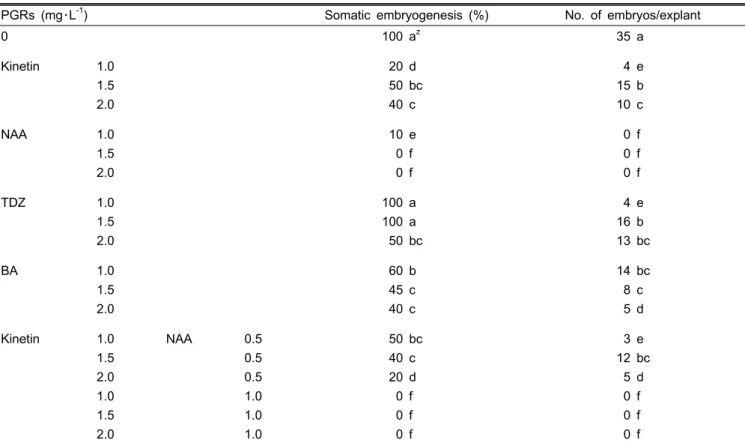
Table 2. Effects of different concentrations of plant growth regulators on somatic embryogenesis from the callus segment after 12 weeks of culture.
PGRs (mg・L-1) Somatic embryogenesis (%) No. of embryos/explant
0 100 az 35 a
Kinetin 1.0
1.5 2.0
20 d 50 bc 40 c
4 e 15 b 10 c
NAA 1.0
1.5 2.0
10 e 0 f 0 f
0 f 0 f 0 f
TDZ 1.0
1.5 2.0
100 a 100 a 50 bc
4 e 16 b 13 bc
BA 1.0
1.5 2.0
60 b 45 c 40 c
14 bc 8 c 5 d
Kinetin 1.0
1.5 2.0 1.0 1.5 2.0
NAA 0.5
0.5 0.5 1.0 1.0 1.0
50 bc 40 c 20 d 0 f 0 f 0 f
3 e 12 bc
5 d 0 f 0 f 0 f
zMeans within the same letter are not significantly different by DMRT (P > 0.05).
Effects of Plant Growth Regulators on the Somatic Embryo- genesis of the Callus
The effects of growth regulators and nutrient factors were intensively studied on somatic embryogenesis in orchids (Chen and Chang, 2004; Kuo et al., 2005; Wu et al., 2004). There- fore, in this study, pieces of calli originated from the culture of PLB segments were cultured on both hormone free and PGR containing media (kinetin, BA, TDZ, NAA and kinetin + NAA), and the capacity of somatic embryogenesis was examined. Calli from the segments in most cases continued to proliferate, gradually turned green, and were followed by the initiation of embryo-like-structures that begun from the callus (Fig. 1B). The initiated embryo-like–structures turned into somatic embryos in most treatments and the embryos were converted into different forms and shapes along during the culture period (Figs. 1C, D, E, and F). Table 2 shows the percentages of somatic embryogenesis and the number of embryos per responding callus. Comparatively, the formation of somatic embryos in a hormone free medium was found earlier, and the percentage of somatic embryogenesis and the number of embryos were distinctly better than those on the media containing PGRs. Besides, the embryos were easily able to be converted into individual plants. Of the PGRs used, however, it was found that while the three cytokinins,
kinetin, TDZ and BA, could induce somatic embryos, TDZ seemed to be the best. Similarly, Kuo et al. (2005) observed that TDZ was superior for somatic embryogenesis to that of kinetin or BA in Phaelaenopsis. NAA alone or in combination with kinetin dramatically inhibited somatic embryogenesis.
This supported that NAA showed an inhibitory effect for
somatic embryogenesis in this species. Chen and Chang
(2006) also mentioned that NAA retarded embryo formation
in Phaelaenopsis. Although TDZ has recently resulted in
promoting the capacity for embryo formation in orchid genera,
Oncidium (Chen and Chung, 2001), Dendrobium (Chung et
al., 2007) and Phaelaenopsis (Kuo et al., 2005), it showed
a decrease in the number of somatic embryos as compared
to that of those grown on a hormone free medium. In addition,
in contrast to the hormone free medium, the presence of
the PGRs distinctly delayed the formation of somatic embryos
as well. Thus, the use of the PGRs in this study showed
negative effects in a percentage of somatic embryogenesis
and the number of somatic embryos. The result does not
agree with the species, Oncidium (Chen and Chang, 2001),
Phalaenopsis amabilis (Chen and Chang, 2006). Phalaenopsis
amabilis and Dendrobium (Chung et al., 2007) in which
explants cultured on hormone free medium did not respond
somatic embryogenesis at all, might be due to the types of
Table 3. Effects of different concentrations of CP and callus ages on somatic embryogenesis of Coelogyne cristata after 8 weeks of culture.
Callus age CP (g・L-1) Proliferation rate (%) Somatic embryogenesis (%) No. of embryo/explant
30-day-old 5
10 15 20 25 30
5.0 dz 7.5 c 7.5 c 10.5 bc 11.2 b 12.5 a
100 a 100 a 100 a 100 a 100 a 100 a
8 e 41 cd 60 bc 71 b 83 ab 91 a
45-day-old 5
10 15 20 25 30
1.3 f 1.5 f 4.0 e 5.5 d 6.0 cd 6.5 cd
0 b 100 a 100 a 100 a 100 a 100 a
0 f 16 d 36 cd 40 cd 48 c 60 bc
zMeans within the same letter are not significantly different by DMRT (P > 0.05).
explants and plant species used.
According to what we presented here, cultures of calli on hormone free media were absolutely appropriate for higher somatic embryogenesis as compared to the effects of the PGRs in the same callus origin.
Effect of CP and Callus Age on Somatic Embryogenesis Although the effects of growth regulators and nutrient factors were intensively studied on somatic embryogenesis in orchids (Chen and Chang, 2004; Kuo et al., 2005; Wu et al., 2004), the effects of CP and callus age were not tested for somatic formation in any orchid. Thus, in this study, different ages of calli (30-day-old and 45-day-old) were cultured on the same basal media containing different concentrations of CP to consider the degrees of somatic embryo formation (Table 3). The percentages of somatic embryogenesis were almost the same in all treatments except for those 45-day-old explants cultured on the media containing 5 g・L
-1CP. When higher concentrations of CP were used, higher proliferation rates of callus mass were obtained. Likewise, higher proli- feration rates of callus mass induced a higher number of somatic embryos. It should be mentioned that the growth of the callus or the number of embryos per explant was different in the same callus origin along with higher concentrations of CP used. It may be that the nutrients contained in CP are effectively playing the role of growth as growth promoting components in callus growth or formation of somatic embryos.
Comparatively, the induced number of somatic embryos of a 30-day-old callus was superior to that of a 45-day-old callus. It is obvious that the number of somatic embryos per explant was greatly influenced by age of the callus (younger
> older callus). This finding is in agreement with those cereal crops (Arockiasamy et al., 2001; Binh et al., 1992; Pola et
al., 2009) as they mentioned the regeneration frequency was found to decrease with an increase in the age of the callus.
According to our findings, higher concentrations of CP and a young age callus affect a positive production of somatic embryos and led to quick plant regeneration. In this study, the best response (91 embryos/explant) was recorded from a 30-day-old callus cultured on the media containing 30 g・L
-1CP. It was found that concentrations of CP above 30 g・L
-1would show a higher number of somatic embryos. The advantages of using CP are that it can easily produce a large number of somatic embryos, convert most embryos to shoots, reduce the time period from the initial stage to shoot pro- duction, and it is much cheaper than other plant growth regulators. Thus, our experiment strongly revealed that CP, which has plant growth nutrients, is the most suitable organic supplement for highly efficient somatic embryo formation and plant regeneration.
Rooting, Shoot Growth and Acclimatization
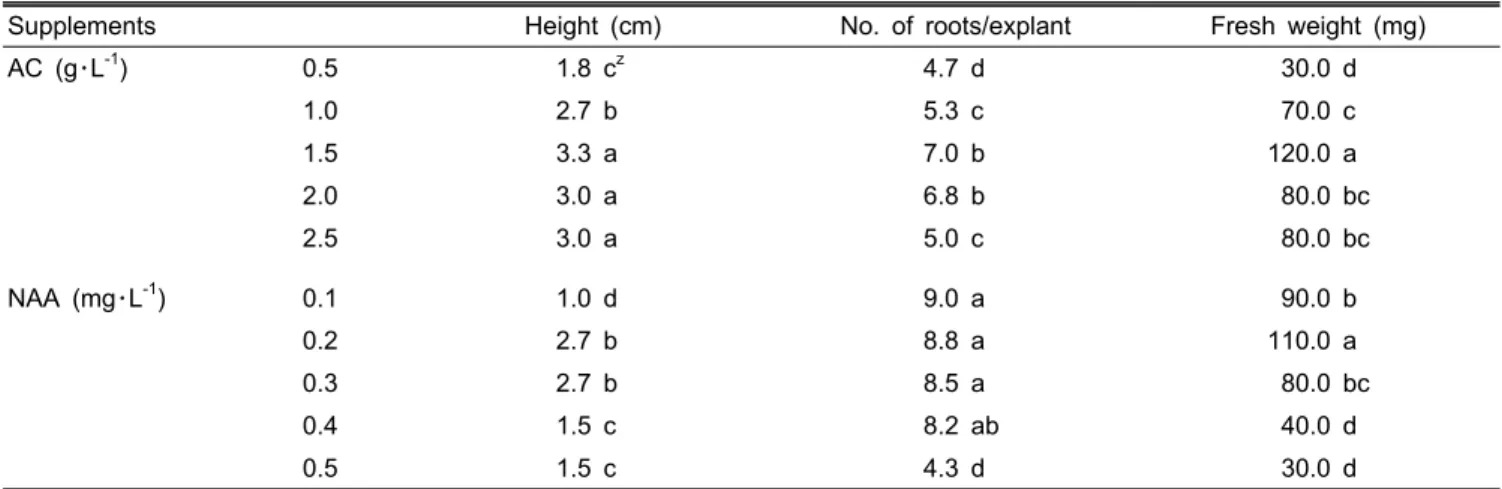
Individual plants from multiple shoot clusters measuring 1.0 cm in height were separated and transferred to ½ MS basal medium containing NAA for rooting and shoot growth.
Concentrations of AC from 0.5 to 1.5 g・L
-1caused a steady increase in the number of roots, plant height and fresh weight.
In particular, explants grown in a medium containing 1.5 g・L
-1of AC formed significantly more roots (7.0 roots) with a greater height (3.3 cm) and maximum fresh weight (120 mg) than those obtained from any other AC concentrations.
A further increase in the AC concentration to the highest level (2.5 g・L
-1) resulted in the suppression of root formation.
The result is in agreement with Dendrobium hybrid (Martin and Madassery, 2006).
In all media containing NAA, responses of shoot growth
Table 4. Effect of activated charcoal (AC) and NAA on rooting and shoot growth of seedlings after 6 weeks of culture.
Supplements Height (cm) No. of roots/explant Fresh weight (mg)
AC (g・L-1) 0.5 1.8 cz 4.7 d 30.0 d
1.0 2.7 b 5.3 c 70.0 c
1.5 3.3 a 7.0 b 120.0 a
2.0 3.0 a 6.8 b 80.0 bc
2.5 3.0 a 5.0 c 80.0 bc
NAA (mg・L-1) 0.1 1.0 d 9.0 a 90.0 b
0.2 2.7 b 8.8 a 110.0 a
0.3 2.7 b 8.5 a 80.0 bc
0.4 1.5 c 8.2 ab 40.0 d
0.5 1.5 c 4.3 d 30.0 d
zMeans within the same letter are not significantly different by DMRT (P > 0.05).
and rooting distinctly appeared earlier than that of those from media containing AC. The best responses were observed on the media containing NAA 0.2 mg・L
-1. Higher concentrations of NAA above the optimum level showed an inhibitory effect for rooting and shoot growth. A similar result was reported in Rhynchostylis retusa (Thomas and Michael, 2007). Com- paratively, the average number of roots from the shoots cultured on the media containing NAA was higher than that of those from media containing AC. However, plant height and fresh weight was distinctly lower (Table 4). Thus, 1.5 g・L
-1AC was noted as the optimum concentration for rooting and shoot growth. According to results based on this experi- ment, the formation of a higher number of roots did not relate to the increasing of plant height and fresh weight.
About 3-cm-sized plantlets which bore more than five roots were transferred from the above experiment to small plastic pots containing moss and bark (2:1 v/v) and accli- matized in the greenhouse. Cultural requirements such as watering, temperature control and fertilization were done as necessary.
In conclusion, somatic embryos were indirectly induced from a PLB derived callus. The application of the callus was quite appropriate for somatic embryogenesis in this species.
The formation of callus was better achieved on the MS medium supplemented with a higher concentration of 2,4-D and BA combination, and CW. Using 30 g・L
-1CP revealed to have a greater potential for somatic embryo formation on the MS medium with 30 day-old callus as compared to any other treatments. Healthy plants developed through somatic embryos rooted and grew well on ½ MS medium containing 1.5 g・L
-1AC and survived when transplanted in the greenhouse. Although this protocol is simple and easy to carry out, it could provide a large number of embryos and plants for mass propagation in a short period of time.
To the best of our knowledge, we are the first to report on the study of somatic embryogenesis in Coelogyne cristata and this ability will open up the prospect of using biotech- nological approaches for the genetic improvement of this species.
Literature cited
Arockiasamy, S., S. Prakash, and S. Ignacimuthu. 2001. High regenerative nature of Paspalum scrobiculatum L., an important millet crop. Curr. Sci. 80:496-498.
Begum, A.A., M. Tamaki, and S. Kako. 1994. Formation of protocorm-like-bodies (PLB) and shoot development through in vitro culture of outer tissue of Cymbidium PLB. J. Japan.
Soc. Hort. Sci. 63:663-673.
Binh, D.Q., L.E. Heszky, G. Gyulai, and A. Csillag. 1992.
Plant regeneration of NaCl pretreated cells from long-term suspension culture of rice (Oryza sativa L.) under high saline conditions. Plant Cell, Tissue Organ Cult. 29:75-82.
Chang, C. and W.C. Chang. 1998. Plant regeneration from callus culture of Cymbidium ensifolium var. misericors. Plant Cell Rep. 17:251-255.
Chen, J.T., C. Chang, and W.C. Chang. 1999. Direct somatic embryogenesis on leaf explants of Oncidium ‘Gower Ramsey’
and subsequent plant regeneration. Plant Cell Rep. 19:143-149.
Chen, J.T. and W.C. Chang. 2001. Effects of auxins and cytokinins on direct somatic embryogenesis on leaf explants of Oncidium
‘Gower Ramsey’. Plant Growth Regulat. 34:229-232.
Chen, J.T. and W.C. Chang. 2004. TIBA affects the induction of direct somatic embryogenesis from leaf explants of Oncidium.
Plant Cell Tiss. Org. Cult. 79:315-320.
Chen, J.T. and W.C. Chang. 2006. Direct somatic embryogenesis and plant regeneration from leaf explants of Phalaenopsis amabilis. Biologia Plantarum 50:169-173.
Chung, H.H., J.T. Cheng, and W.C. Chang. 2007. Plant regeneration through direct somatic embryogenesis from leaf explants of Dendrobium. Biologia Plantarum 51:346-350.
Huana, L.V.T., T. Takamura, and M. Tanaka. 2004. Callus for-
mation and plant regeneration from callus through somatic embryo structures in Cymbidium orchid. Plant Sci. 166:1443-1449.
Ishii, Y., T. Takamura, M. Goi, and M. Tanaka. 1998. Callus induction and somatic embryogenesis of Phalaenopsis. Plant Cell Rep. 17:446-450.
Kerbauy, G.B. 1984. Plant regeneration of Oncidium varicosum (Orchidaceae) by means of root tip culture. Plant Cell Rep.
3:27-29.
Kuo, H.L., J.T. Chen, and W.C. Chang. 2005. Efficient plant regeneration through direct somatic embryogenesis from leaf explants of Phalaenopsis ‘Little Steve’. In Vitro Cell. Dev.
Biol.-Plant. 41:453-456.
Lang, N.T. and N.T. Hang. 2006. Using biotechnological approaches for Vanda orchid improvement. Omonrice 14:140-143.
Lee, Y. and N. Lee. 2003. Plant regeneration from protocorm- derived callus of Cypripedium formosanmun. In Vitro Cell.
Dev. Biol.-Plant. 39:475-479.
Lin, Y.H., C. Chang, and W.C. Chang. 2000. Plant regeneration from callus culture of a Paphiopedilum hybrid. Plant Cell Tiss. Org. Cult. 61:21-25.
Martin, K.P. and J. Madassery. 2006. Rapid in vitro propagation of Dendrobium hybrids through direct shoots formation from foliar inoculums, and protocorm-like bodies. Sci. Hort. 108:95-99.
Pola, S., N.S. Mani, and T. Ramana. 2009. Long-term maintenance of callus cultures from immature embryo of Sorghum bicolor.
World J. Agr. Sci. 5:415-421.
Roy, J. and N. Banerjee. 2003. Induction of callus and plant regeneration from shoot tip explants of Dendrobium fimbriatum Lindl. var. oculatum Hk. f. Sci. Hort. 108:332-336.
Thomas, T.D. and A. Michael. 2007. High-frequency plantlet regeneration and multiple shoot induction from cultured immature seeds of Rhynchostylis retusa Blume., an exquisite orchid. Plant Biotechnol. Rep. 1:243-249.
Van Overbeek, J., M.E. Conklin, and A.F. Blakeslee. 1941.
Factors in coconut milk essential for growth and development of very young Datura embryos. Science 94:350-351.
Wu, J.F., J.T. Chen, and W.C. Chang. 2004. Effects of auxins and cytokinins on embryo formation from root-derived callus of Oncidium ‘Gower Ramsey’. Plant Cell Tiss. Org. Cult.
77:107-109.