740
Copyright © 2014 The Korean Society of Fisheries and Aquatic Science pISSN:0374-8111, eISSN:2287-8815
서 론
장염비브리오
(Vibrio parahaemolyticus)
는저도호염성해양 세균으로이균에오염된어패류를생식하거나불충분하게가 열처리된수산물을섭취하면주로설사,
복통,
구토,
오한및미 열등을동반하는급성위장염증상을유발하는식중독원인세 균이다(Sakazaki et al., 1968; Honda and Iida, 1993; Makino et al., 2003).
해수및어패류등의자연계에서분리한대부분의 장염비브리오는비병원성균주인반면수산물기인식중독사 고의환자가검물에서분리한대부분의장염비브리오는내열성 용혈독(thermostable direct hemolysin, TDH)
또는내열성용혈 독관련용혈독(TDH-related hemolysin, TRH)
의 유전자를보 유하고있다.
그렇기때문에이들독소는장염비브리오의주요 한병원성인자로인식되고있다(Sakazaki et al., 1968; Shirai et al., 1990; Honda and Iida 1993; Makino et al., 2003).
병원성미생물을검출하기의한고전적인방법즉
,
최확수법,
선택배지의사용, DNA-DNA colony hybridization
등미생물학적또는생화학적방법에기초하는검출방법들은분석하는 데시간이오래걸리며많은노동력과다수의시료를분석해야 하는단점들을내포하고있다
(Peeler et al., 1992; Kaysner and DePaola, 2001).
이런단점들을보완한방법에는conventional PCR, real-time PCR
과LAMP assay
등이있으며이들방법들 또한일부보완이필요한점도있지만현재일반적으로사용되 고있는검출방법이다.
다양한시료로부터장염비브리오를신 속정확하게검출하기위한PCR assay, real-time PCR assay
및LAMP assay
에관한보고는다수존재한다(Kim et al., 1999;
Kim et al., 2008; Chen and Ge, 2010; Yu et al., 2010; Hossain et al., 2011; No et al., 2011; Liu et al., 2012; Wang et al., 2013).
염기서열이결정된장염비브리오
RIMD2210633
균주에서β-lactamase (VPA0477)
는 작은 염색체에 존재하는 유전자 로283
개의아미노산으로이루어져있으며분자량은약31.7 kDa
으로 추정하고 있다(Makino et al., 2003).
장염비브리 오β-lactamase (VPA0477)
유전자는 비브리오속의다른 종 에서 보고된class A group β-lactamase
의중요한구조적특β-Lactamase (VPA0477) 유전자를 표적으로 Polymerase chain reaction에 의한 장염비브리오( Vibrio parahaemolyticus)의 검출
박권삼*
군산대학교 식품생명공학과
Application of the β-lactamase (VPA0477) Gene for the Detection of Vibrio parahaemolyticus by Polymerase Chain Reaction
Kwon-Sam Park*
Department of Food Science and Biotechnology, Kunsan National University, Gunsan 573-701, Korea
In this study, the β-lactamase (VPA0477) gene was used as a new target for the PCR-based detection of Vibrio parahaemolyticus . Primers specific for the β-lactamase (VPA0477) gene of V. parahaemolyticus , were designed and incorporated into a PCR-based assay. The assay was able to specifically detect all of the 191 V. parahaemolyticus strains tested, but did not result in amplification of 39 other Vibrio spp. and non- Vibrio spp. strains tested. The detec- tion limit of the assay was 10 CFU of V. parahaemolyticus RIMD2210633 from pure culture broth. The β-lactamase (VPA0477) gene-based assay developed in this study was sensitive and specific, and has great potential for the ac- curate detection and identification of V. parahaemolyticus in seawater or seafood samples.
Key words: Vibrio parahaemolyticus , β-lactamase, Polymerase chain reaction, Detection
This is an Open Access article distributed under the terms of the Creative Commons Attribution Non-Commercial Licens (http://creativecommons.org/licenses/by-nc/3.0/)which permits unrestricted non-commercial use, distribution, and reproduction in any medium, provided the original work is properly cited.
http://dx.doi.org/10.5657/KFAS.2014.0740 Kor J Fish Aquat Sci 47(6) 740-744, December 2014
Received 7 October 2014; Revised 4 November 2014; Accepted 7 November 2014
*Corresponding author: Tel: +82. 63. 469.1822 Fax: +82. 63. 469. 7448
E-mail address: [email protected]
징의아미노산서열이동일한위치에존재할뿐만아니라높 은상동성및분자량도매우유사하다는점에서
class A group β-lactamase
에속한다고보고되어있다(Lee et al., 2011).
최근, β-lactamase (VPA0477)
유전자의존재유무를PCR assay
로확 인한결과전북곰소만의표층해수유래108
개균주및완도해 역표층해수분리67
균주즉실험에제공된모든장염비브리오 에는β-lactamase (VPA0477)
유전자가존재하는것으로보고 하고있으며(Lee et al., 2011; Kim et al., 2014), Pazhani et al.
(2014)
은인도의급성위장염환자로부터분리한178
균주장염 비브리오모든균주에서도β-lactamase (VPA0477)
유전자가 존재한다고보고하고있다.
이러한결과들을종합해보면
β-lactamase (VPA0477)
유전 자는β-lactam
계열의항생제인암피실린을분해하는유전자임 에도불구하고장염비브리오의염색체DNA
에삽입되어현재 는하나의보편적인유전자로존재하고있다는점에서이균의 검출및동정을위한새로운표적유전자로서가능성이시사된 다.
따라서본논문에서는장염비브리오의검출및동정을위한 새로운표적유전자로서β-lactamase (VPA0477)
의가능성및 유효성을검토하였다.
재료 및 방법
균주 및 배양
실험에 사용한 균주는
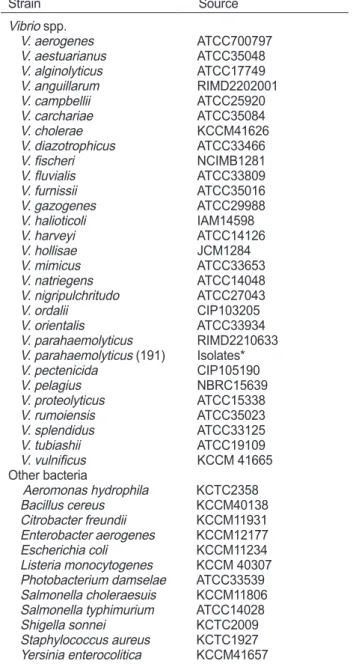
Table 1
에 나타내었다.
비브리오속의 표준균주 및임상분리 장염비브리오는 일본오사카대학 교미생물병연구소에서분양받았으며
,
기타표준균주및환 경분리장염비브리오는실험실에서보관하고있는균주를사 용하였다.
균배양을위한배지에는Luria-Bertani broth (Bec- ton Dickinson, Sparks, USA), brain heart infusion (Becton Dickinson, Sparks, USA), heart infusion (Becton Dickinson, Sparks, USA)
및marine broth (Difco, Detroit, USA)
등을사 용하여실온또는35℃
에서배양하였다.
Oligonucleotide primers 및 PCR assay 조건 VPA0477
유전자증폭을위한primer
는Bioneer (Daejeon,
Korea)
에 의뢰하여 합성하였으며,
염기서열은 다음과 같다[VPA0477-F (5′-CCTCATCGAGAAACAAACAT-3′, 20mer, Tm = 56)
및VPA0477-R (5′-AGTGCTCTAAAATCAGT TGG-3′, 20mer, Tm = 56)].
유전자증폭에는EmeraldAmp GT PCR Master Mix (Takara, Japan)
및GeneAmp PCR sys- tem 9700 (Applied Biosystems, USA)
를사용하였다. PCR as- say
조건은95℃
에서1
회3
분간열변성후95℃ 30
초, 55℃ 30
초, 72℃ 1
분을한단위로하여이를30
회반복하여DNA
를증 폭하였으며,
증폭된DNA
산물은1.5% agarose gel
에서전기 영동후ethidium bromide
로염색하여Vilber Lourmat (Bio- Paint ST4, France)
사의Gel-Doc system
으로관찰하였다.
Table 1. Bacteria strains used in this study
Strain Source
Vibrio spp.
V. aerogenes V. aestuarianus V. alginolyticus V. anguillarum V. campbellii V. carchariae V. cholerae V. diazotrophicus V. fischeri V. fluvialis V. furnissii V. gazogenes V. halioticoli V. harveyi V. hollisae V. mimicus V. natriegens V. nigripulchritudo V. ordalii V. orientalis V. parahaemolyticus V. parahaemolyticus (191) V. pectenicida
V. pelagius V. proteolyticus V. rumoiensis V. splendidus V. tubiashii V. vulnificus Other bacteria
Aeromonas hydrophila Bacillus cereus Citrobacter freundii Enterobacter aerogenes Escherichia coli Listeria monocytogenes Photobacterium damselae Salmonella choleraesuis Salmonella typhimurium Shigella sonnei Staphylococcus aureus Yersinia enterocolitica
ATCC700797 ATCC35048 ATCC17749 RIMD2202001 ATCC25920 ATCC35084 KCCM41626 ATCC33466 NCIMB1281 ATCC33809 ATCC35016 ATCC29988 IAM14598 ATCC14126 JCM1284 ATCC33653 ATCC14048 ATCC27043 CIP103205 ATCC33934 RIMD2210633 Isolates*
CIP105190 NBRC15639 ATCC15338 ATCC35023 ATCC33125 ATCC19109 KCCM 41665 KCTC2358 KCCM40138 KCCM11931 KCCM12177 KCCM11234 KCCM 40307 ATCC33539 KCCM11806 ATCC14028 KCTC2009 KCTC1927 KCCM41657
Sources for the strains are as follows: American Type Culture Collection (ATCC), Rockville, Md.; Collection de Bacteries de l’Institut Pasteur (CIP), Paris, France; IAM Culture Collection (IAM), Institute of Molecular and Cellular Biosciences, The Uni- versity of Tokyo, Tokyo, Japan; Japan Collection of Microorgan- isms (JCM), RIKEN, Saitama, Japan; Korean Culture Center of Microorganisms (KCCM), Seoul, Korea; Korean Collection for Type Cultures (KCTC), Deajeon, Korea; NITE Biological Re- source Center (NBRC), National Institute of Technology and Evaluation, Chiba, Japan; National Collections of Industrial and Marine Bacteria, Ltd. (NCIMB), Aberdeen, United Kingdom; Re- search Institute for Microbial Diseases (RIMD), Osaka University, Osaka, Japan. *V. parahaemolyticus isolates from 16 clinical and 175 environmental samples.
균수 조정
VPA0477
유전자를표적으로하는PCR assay
에의한장염비 브리오의최소검출농도를측정하기위하여3% NaCl
이첨가 된Luria-Bertani (tryptone 1%, yeast-extract 0.5%, NaCl 3%) broth
에서하룻밤배양한장염비브리오RIMD2210633
균주 를원심분리(12,000 rpm, 2 min)
하여집균후여기에1.0 mL
의PBS (phosphate buffered saline, pH 7.2)
를가하여현탁후원 심분리하여집균후PBS
로재차현탁하였다.
균수측정은현 탁액10 µL
를counting chamber (Paul Marienfeld Gmbh&Co, Germany)
에넣고광학현미경(Olympus CX31RBSF, Olym- pus Optical Co., LTD. Tokyo, Japan)
하에서균수를직접계측 하여계산하였으며적절한농도까지10
진법으로희석한균액 을PCR assay
에주형으로사용하였다.
결과 및 고찰
장염비브리오 β-lactamase (VPA0477) 유전자의 특 성
장염비브리오의작은염색체에존재하는
VPA0477
유전자는283
개의아미노산으로구성되어 있는단백질로 분자량은약31.7 kDa
으로추정된다(Makino et al., 2003). VPA0477
유전 자해석을위하여암피실린에내성(minimum inhibitory con- centration, MIC, 2,048 μg/mL)
을갖는환경유래장염비브리오에
VPA0477
유전자결손균주를작성하여검토한결과결손균주는암피실린에대해감수성균주
(MIC, ±1.0 μg/mL)
로표현 형이변화하였는데이결과는VPA0477
유전자는장염비브리 오의암피실린내성에관여하는유전자임을증명하는결과로 판단된다(Lee and Park, 2010).
장염비브리오VPA0477
유전자와비브리오속다른종의
β-lactamase
유전자와의상동성을비 교해보면Vibrio sp. EX25, V. alginolyticus NBRC15630, V.
campbellii ATCC BAA-1116, V. harveyi ATCC BBA-1116,
및Vibrio sp. EJY3
등의균주와78, 78, 75, 75,
및73%
로상동 성은높은편이였으며이들유전자의존재위치는장염비브리 오와마찬가지로작은염색체에존재하였다(
자료미제시).
장염 비브리오의검출및동정을위한표적유전자로서VPA0477
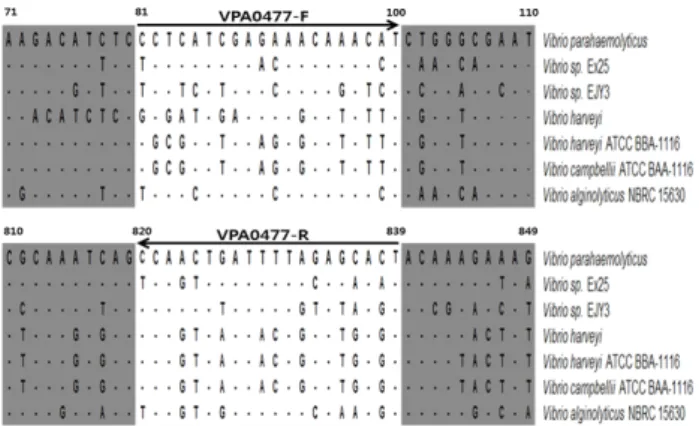
유전자의가능성을검토하기위한프라이머디자인은
ClustalW2,
v2.1 (http://www.clustal.org)
으로각유전자의상동성을검토 한결과상동성이낮은81 bp
에서100 bp
및820 bp
에서839 bp
의염기를프라이머로디자인하였다(Fig. 1).
장염비브리오 β-lactamase (VPA0477) 유전자의 분 포
분리시기및유래가다른
175
주의환경유래장염비브리오및16
주의임상분리장염비브리오합계191
균주의균체를사용 하여β-lactamase (VPA0477)
유전자의존재유무를PCR assay
로검토한결과실험에제공된191
주모든균주에서760 bp
의DNA
증폭산물이확인되었다. Fig. 2
에나타낸결과는일부균주의결과만을나타낸것으로증폭예상크기인
760 bp DNA
증폭산물이외의다른비특이적인증폭산물은확인되지않았 다
.
따라서β-lactamase (VPA0477)
검출용프라이머및PCR assay
조건은양호한것으로판단된다.
비브리오속 및 비비브리오속 중의 β-lactamase (VPA0477) 유전자의 분포
장염비브리오를포함한
28
종의비브리오속및12
종의비비Fig. 1. Nucleotide sequence alignment of the VPA0477 gene of V.
parahaemolyticus, Vibrio sp. EX25, Vibrio sp. EJY3, V. harveyi, V. harveyi ATCC BBA-1116, V. campbellii ATCC BAA-1116, and V. alginolyticus NBRC15630. Nucleotides identical to those of V.
parahaemolyticus are indicated with dots. Primer sets (VPA0477-F and VPA0477-R) are indicated by the arrows.
Fig. 2. Agarose gel electrophoresis of V. parahaemolyticus-specific DNA products amplified in PCR using primer set VPA0477-F and VPA0477-R.
M, 100 bp DNA ladder; lane 1, RIMD2210633; lane 2, RIMD2210050; lane 3, RIMD2212010; lane 4, RIMD2210875;
lane 5, RIMD2210877; lane 6, environmental strain 15; lane 7, environmental strain 33; lane 8, environmental strain 40; lane 9, environmental strain 77; lane 10, environmental strain 113.
1
M 2 3 4 5 6 7 8 9 10
760 bp
브리오속 세균을 대상으로
β-lactamase (VPA0477)
유전자 의 존재유무를 확인하였다.
그 결과 장염비브리오를 제외한27
종의비브리오속 및12
종의비비브리오속세균모두에서β-lactamase (VPA0477)
유전자는증폭되지않았다(Fig. 3).
다 만일부세균에서는β-lactamase (VPA0477)
유전자와는크기가다른
DNA
증폭산물이매우희미하게관찰되는균주도있는데이는
β-lactamase (VPA0477)
유전자와는관계없는비특 이적인증폭산물이며PCR assay
결과를오판할정도는아니라 고판단된다.
장염비브리오의 검출 한계의 검토
PCR assay
에의한장염비브리오의검출한계에관한보고는다수존재한다
.
염색체DNA
를주형으로groEL
유전자를표적 으로한경우, PCR assay
에의한검출한계농도는100 pg
이라 고보고하고있으며(Hossain et al., 2011), H-NS
유전자를표적으로하는
PCR assay
에의한검출한계농도는0.14 pg
이라 고보고하고있으며(No et al., 2011), O-serogroup
을표적으로 한PCR assay
에의한검출최소농도는1.0 ng
이라고보고하고 있다(Chen et al., 2012).
또한균체를주형으로한PCR assay
의검출최소농도는10 colony forming unit (CFU)
였다고보 고되어있다(Wei et al., 2014). V. anguillarum
의경우, rpoS
의 유전자를표적으로하는PCR assay
에서정제한염색체DNA
및균체의검출한계는3 pg
및6 CFU
이였다고보고되어있다(Kim et al., 2008).
β -lactamase (VPA0477)
유전자를표적으로하는PCR assay
에의한장염비브리오균체의검출최소농도를검토하기위하 여 균체농도를반응액에1.0×10³ CFU
에서1.0×10
0CFU
의 농도가 되도록 조정하였다. VPA0477
유전자의 증폭은1.0×10
1CFU
농도에서는확인되지않았지만1.0×10¹ CFU
이상의농도에서는예상증폭단편인760 bp
의DNA
증폭산물 이확인되었다.
그러나1.0×10¹ CFU
농도의반응구에서는다 른농도에비해증폭DNA
밴드는미약하게나타났다(Fig. 4).
결론적으로
PCR assay
를위한반응액중의장염비브리오농도가
10 CFU
이상이면검출은가능하다고판단되는결과이며이는기존의결과와유사한결과이다
(Wei et al., 2014).
결론적으로
β-lactamase (VPA0477)
유전자를표적으로PCR assay
에의한임상및환경분리191
주장염비브리오의검출에 는유효성이검증되었으며,
장염비브리오를제외한27
종의비 브리오속및12
종의비비브리오속의세균에서는유전자증폭 이확인되지 않는특이성이확인되었기때문에해수또는수 산물중의장염비브리오의신속검출및 동정에β-lactamase (VPA0477)
유전자는유용하게이용되리라사료된다.
References
Chen M, Guo D, Wong HC, Zhang X, Liu F, Chen H, Chen M, Liu B, Wang L, Wu F and Feng L. 2012. Development of O- serogroup specific PCR assay for detection and identification Fig. 3. Agarose gel electrophoresis of Vibrio spp. and non-Vibrio
spp. DNA products amplified in PCR using primer set VPA0477-F and VPA0477-R. M, 100 bp DNA ladder; lane 1, V. aerogene; lane 2, V. aestuarianus; lane 3, V. alginolyticus; lane 4, V. anguillarum;
lane 5, V. campbellii; lane 6, V. carchariae; lane 7, V. cholerae;
lane 8, V. diazotrophicus; lane 9, V. fischeri; lane 10, V. fluvialis;
lane 11, V. furnissii; lane 12, V. gazogenes; lane 13, V. halioticoli;
lane 14, V. harveyi; lane 15, V. hollisae; lane 16, V. mimicus; lane 17, V. natriegens; lane 18, V. nigripulchritudo; lane 19, V. ordalii;
lane 20, V. orientalis; lane 21, V. parahaemolyticus; lane 22, V.
pectenicida; lane 23, V. pelagius; lane 24, V. proteolyticus; lane 25, V. rumoiensis; lane 26, V. splendidus; lane 27, V. tubiashii; lane 28, V. vulnificus; lane 29, Aeromonas hydrophila; lane 30, Bacillus cereus; lane 31, Citrobacter freundii; lane 32, Enterobacter aero- genes; lane 33, Escherichia coli; lane 34, Listeria monocytogenes;
lane 35, Photobacterium damselae; lane 36, Salmonella cholerae- suis; lane 37, Salmonella typhimurium; lane 38, Shigella sonnei;
lane 39, Staphylococcus aureus; lane 40, Yersinia enterocolitica.
M 1 2 3 4 5 6 7 8 9 1011 12 13 14 15 16 17181920
M 21 22 23 24 25 26 2728293031 32 33 34 35 36 37383940
760 bp
Fig. 4. Agarose gel electrophoresis of DNA products amplified from V. parahaemolyticus RIMD2210633 in PCR assay using VPA0477 primers. M, 100 bp ladder marker; lane 1, 1.0×10³ CFU;
lane 2, 1.0×10² CFU; lane 3, 1.0×10¹ CFU; lane 4, 1.0×10⁰ CFU.
of Vibrio parahaemolyticus. Int J Food Microbiol 159, 122- 129. http://dx.doi.org/10.1016/j.ijfoodmicro.2012.08.012.
Chen S and Ge B. 2010. Development of a toxR-based loop- mediated isothermal amplification assay for detecting Vibrio
parahaemolyticus. BMC Microbiol 10, 41. http://dx.doi.
org/10.1186/1471-2180-10-41.
Honda T and Iida T. 1993. The pathogenicity of Vibrio parahae-
molyticus and the role of the thermostable direct haemolysin
and related haemolysins. Rev Med Microbiol 4, 106-113.Hossain MT, Kim EY, Kim YR, Kim DG and Kong IS. 2011.
Application of groEL gene for the species-specific de- tection of Vibrio parahaemolyticus by PCR. Lett Appl Microbiol 54, 67-72. http://dx.doi.org/10.1111/j.1472- 765X.2011.03174.x.
Kaysner CA and DePaola Jr A. 2001. Vibrio. In: FP Downes and K Ito, eds., Compendium of Methods for the Microbiologi- cal Examination of Food. American Public Health Associa- tion, Washington, DC. U.S.A., 405-420.
Kim DG, Bae JY, Hong GE, Min MK, Kim JK and Kong IS.
2008. Application of the rpoS gene for the detection of Vib-
rio anguillarum in flounder and prawn by polymerase chain
reaction. J Fish Dis 31, 639-647. http://dx.doi.org/10.1111/j.1365-2761.2008.00943.x.
Kim TO, Eum IS, Jo SM, Kim HD and Park KS. 2014. Anti- microbial-resistance profiles and virulence genes of Vibrio
parahaemolyticus isolated from seawater in the Wando area.
Kor J Fish Aquat Sci 47, 220-226. http://dx.doi.org/10.5657/
KFAS.2014.0220.
Kim YB, Okuda J, Matsumoto C, Takahashi N, Hashimoto S and Nishibuchi M. 1999. Identification of Vibrio parahae-
molyticus strains at the species level by PCR targeted to the toxR gene. J Clin Microbiol 37, 1173-1177.
Lee KW and Park KS. 2010. Antibiotic-resistance profiles and the identification of the ampicillin-resistance gene of Vibrio
parahaemolyticus isolated from seawater. Kor J Fish Aquat
Sci 43, 637-641.Lee NH, Song HJ, Park CS, Kim HD and Park KS. 2011. Ge- netic characterization of β-lactamase (VPA0477) in Vibrio
parahaemolyticus. Kor J Fish Aquat Sci 44, 597-604. http://
dx.doi.org/10.5657/KFAS.2011.0597.
Liu B, He X, Chen W, Yu S, Shi C, Zhou X, Chen J, Wang D and Shi X. 2012. Development of a real PCR assay for rapid detection of Vibrio parahaemolyticus from seafood.
Protein Cell 3, 204-212. http://dx.doi.org/10.1007/s13238- 012-2017-6.
Makino K, Oshima K, Kurokawa K, Yokoyama K, Uda T, Tagomori K, Iijima Y, Najima M, Nakano M, Yamashita A, Kubota Y, Kimura S, Yasunaga T, Honda T, Shinagawa H, Hattori M and Iida T. 2003. Genome sequence of Vibrio
parahaemolyticus: a pathogenic mechanism distinct from
that of V. cholerae. Lancet 361, 743-749.No AR, Okada K, Kogure K and Park KS. 2011. Rapid detec-
tion of Vibrio parahaemolyticus by PCR targeted to the histone-like nucleoid structure (H-NS) gene and its genetic characterization. Lett Appl Microbiol 53, 127-133. http://
dx.doi.org/10.1111/j.1472-765X.2011.03072.x.
Pazhani GP, Bhowmik SK, Ghosh S, Guin S, Dutta S, Rajendran K, Saha DR, Nandy RK, Bhattacharya MK, Mukhopadhyay AK and Ramamurthy T. 2014. Trends in the epidemiology of pandemic and non-pandemic strains of Vibrio parahae-
molyticus isolated from diarrheal patients in Kolkata, India.
PLoS Negl Trop Dis 8, e2815. http://dx.doi.org/10.1371/
journal.pntd.0002815.
Peeler JT, Houghtby GA and Rainosek AP. 1992. The most probable number technique. In: FP Downes and K Ito, eds., Compendium of Methods for the Microbiological Exami- nation of Food. American Public Health Association, Wash- ington, DC. U.S.A., 105-120.
Sakazaki R, Tamura K, Kato T, Obara Y and Yamai S. 1968.
Studies on the enteropathogenic, facultatively halophilic bacterium, Vibrio parahaemolyticus. 3. Enteropathogenici- ty. Jpn J Med Sci Biol 21, 325-331.
Shirai H, Ito H, Hirayama T, Nakamoto Y, Nakabayashi N, Kumagai K, Takeda Y and Nishibuchi M. 1990. Molecular epidemiological evidence for association of thermostable direct hemolysin (TDH) and TDH-related hemolysin of Vib-
rio parahaemolyticus with gastroenteritis. Infect Immun 58,
3568-3573.Wang L, Shi L, Su J, Ye Y and Zhong Q. 2013. Detection of
Vibrio parahaemolyticus in food samples using in situ loop-
mediated isothermal amplification method. Gene 515, 421- 425. http://dx.doi.org/10.1016/j.gene.2012.12.039.Wei S, Zhao H, Xian Y, Hussain MA and Wu X. 2014. Multi- plex PCR assays for the detection of Vibrio alginolyticus,
Vibrio parahaemolyticus, Vibrio vulnificus, and Vibrio chol- erae with an internal amplification control. Diagn Microbiol
Infect Dis 79, 115-118. http://dx.doi.org/10.1016/j.diagmi- crobio.2014.03.012.Yu S, Chen W, Wang D, He X, Zhu X and Shi X. 2010. Species- specific PCR detection of the food-borne pathogen Vibrio
parahaemolyticus using the irgB gene identified by compar-
ative genomic analysis. FEMS Microbiol Lett 307, 65-71.http://dx.doi.org/10.1111/j.1574-6968.2010.01952.x.